
Slice of Life Challenge Day 7
Yesterday our sixth grade gifted students met the author of a book they have been reading for our enrichment Wednesdays. We’ve been using project based learning while meeting monthly focusing on the theme of water. We selected the book Flood on the Rio Teche by Diane Marquart Moore for a number of reasons. One, this historical fiction novel would help the students learn about the history of New Iberia’s discovery and settlement, and Two, water is important to the story. Also, the author lives locally part of the year. We were lucky to catch her before she moves back to Sewanee, TN for the spring and summer.
Our students were interested in how she came to write the book, her inspiration and her research. But I saw the lights go on when she talked about being an author. She didn’t candy-coat it, either. Being an author is hard work. She gave advice that she had gotten from Ernest Gaines when she had the privilege of taking a class with him. He said, “Revise, revise, revise,” and “The first sentence is the most important one of the whole novel.” She talked about how once she figured out that the rain on a palmetto roof would hiss like the snake for which the Teche was named, her book was ready to be written.
Opening sentence for Flood on the Rio Teche: Rain hissed on the palmetto roof, and Antonio felt like hissing back at the downpour.
Diane writes a blog at A Word’s Worth.
The Slice of Life Challenge has been revealing to me as I participate with my students. There is an immediacy about it. They rush to the computer and often compose right there. Then they hit the publish button. I am amazed how fresh and fun some of the writing is. However, the teacher in me wants them to be conscious of their reader and use correct grammar. I want to think about how I can continue the momentum while showing them the value of revision and editing.


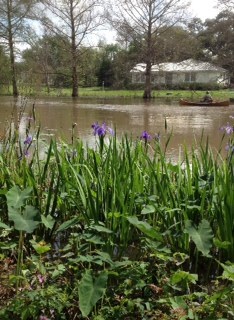
 Reflections on the Teche
I love your thoughts! I tend to write and click publish on these Slices myself… I glance over the thoughts and just let it go..
My kids slice, too – and they’ve become much more adept at thinking about their slices and correcting/adding on with time. They hate re reading their slices and seeing errors – it’s embarrassing, and that’s motivation enough to take more time.
And mine are not hesitant to point out mistakes in their comments. We should put our heads together and write about the change we see in our students’ writing. Mine are bouncing ideas off of each other. They can’t wait to get to the computer to write. A few are even writing at home. I am very pleased.
The most sensible thing would seem to be to let them go at it all month, and then take a couple of their pieces that they want to work on further. Slicing as process that leads to future revision?