Feeds:
Posts
Comments

Archive for the ‘Books’ Category

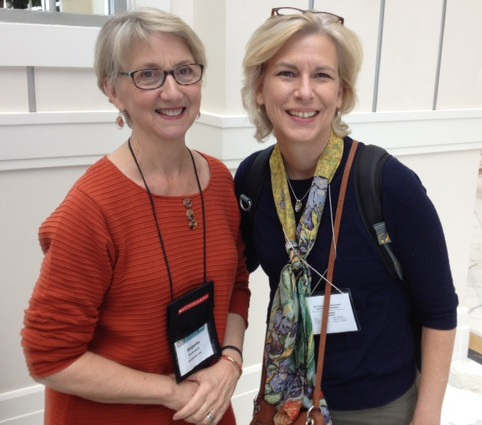
On the left is Augusta Scattergood. We met in person at NCTE '14.

On the left is Augusta Scattergood. We met in person at NCTE ’14.

I met Augusta Scattergood face to face at NCTE in 2014, but I knew of her and her writing back in 2012 when a neighbor and friend of my parents came to a book signing for my book Blessen. He told me about growing up with her in Cleveland, MS. and how she had had a book signing for Glory Be just a few weeks before. I had to get the book and wanted to meet her from that moment on.

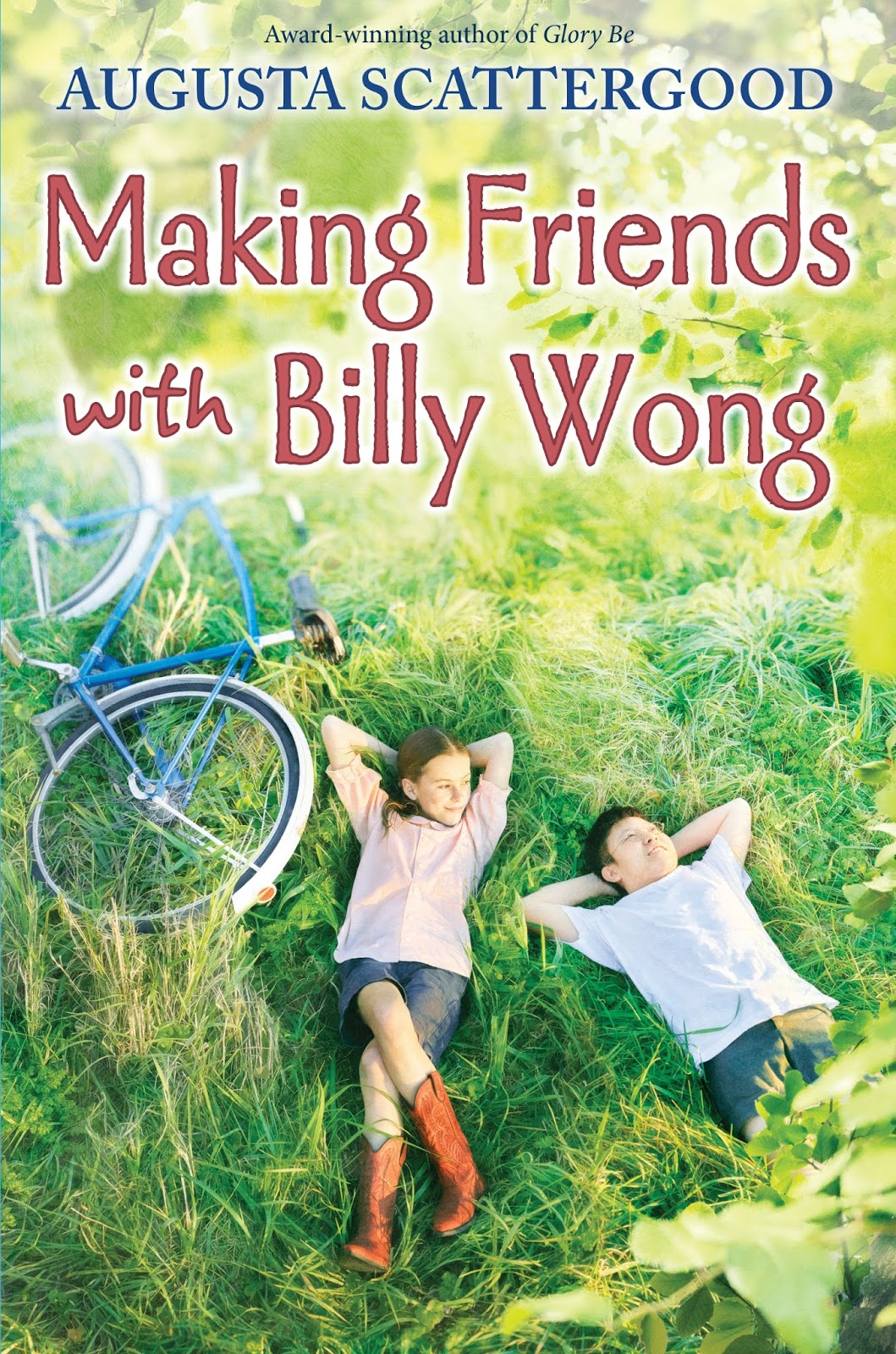
I sent her a message letting her know I would love an ARC of her latest book, Making Friends with Billy Long. Officially, the book will be out in August. You can pre-order a copy here.

My Goodreads and Amazon review:

Making friends sounds like it would be easy, but there is nothing easy for Azalea Morgan. Azalea starts her summer resenting the fact that she must leave her home and friends in Texas to help her grandmother who lives in Paris Junction, Arkansas. When Grandma Clark gathers a group of children to help in her garden, Azalea feels like an outsider. She is cautious of Willis DeLoach, a bully, and doesn’t warm up to Melinda Bowman, a girly girl. Yet Billy Wong is an outsider like her.

As Azalea adjusts to life in Paris Junction, she comes to understand her grandmother and enjoy spending time with Billy. Willis appears grumpy and mean, but Azalea knows his real problem is finding a safe place to live with his younger sister. While Azalea looks forward to going back home to Texas, her life is forever changed by her summer in Paris Junction.

This book will appeal to children ages 8-11 as they, too, navigate complicated relationships and learn how to accept others for who they are.
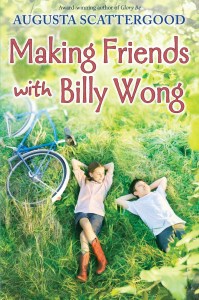
 

new Billy Wong hires Cvr

I am always curious about the decisions authors make in writing their books. I interviewed Augusta Scattergood about the writing of Making Friends with Billy Wong.

I am a collector of good opening lines for books, my favorite being E. B. White’s opening line for Charlotte’s Web, “Where’s Papa going with that ax?”

Your first line for Making Friends with Billy Wong is “All it took to send my summer on the road to ruin was a fancy note and a three-cent stamp.” Can you talk about your process of getting to that line and if you had any other contenders?

What a great question! I also love first lines and yes, there were many contenders. What helped me settle on that final first line was the three-cent stamp mention which hinted at the time period, and the worry Azalea felt about meeting her grandmother and spending time with her.

Until I read something from somebody about not starting with a “Hello, my name is” opening, this was one of my early favorites. (I’m terrible about reading writing advice and thinking I must follow it. I need to work on this.) Though I do still like this one of (many) early drafts, it was possibly too abrupt to announce this tidbit before we actually know much about the story or the characters:

My name is Azalea Ann Morgan, and I’ve already heard all the jokes. Yes, I was named for a pink-flowered bush blooming outside the Kings Daughters’ Hospital room when Mama first laid eyes on me.

Making Friends is written mainly from the point of view of Azalea, (great name, BTW); however, we hear from Billy Wong in small sections of verse. What made you decide to include his voice and why verse?

Originally, I tried to write in THREE points-of-view, and a character named Noble was the third. He was much too strong to take a back seat to anybody. He was taking over the story! I’m saving him for another day. My critique group often comments on how I give characters the ax. Or combine their traits with another’s. I do a lot of wandering around before I figure out my stories.

I started writing Billy’s voice as straight narrative. It was awful, a huge info dump. I gave up. Now I was down to Azalea telling the story, but I despaired of losing Billy. There were certain things, events, impressions that only he could tell us. Plus, such a nice kid!
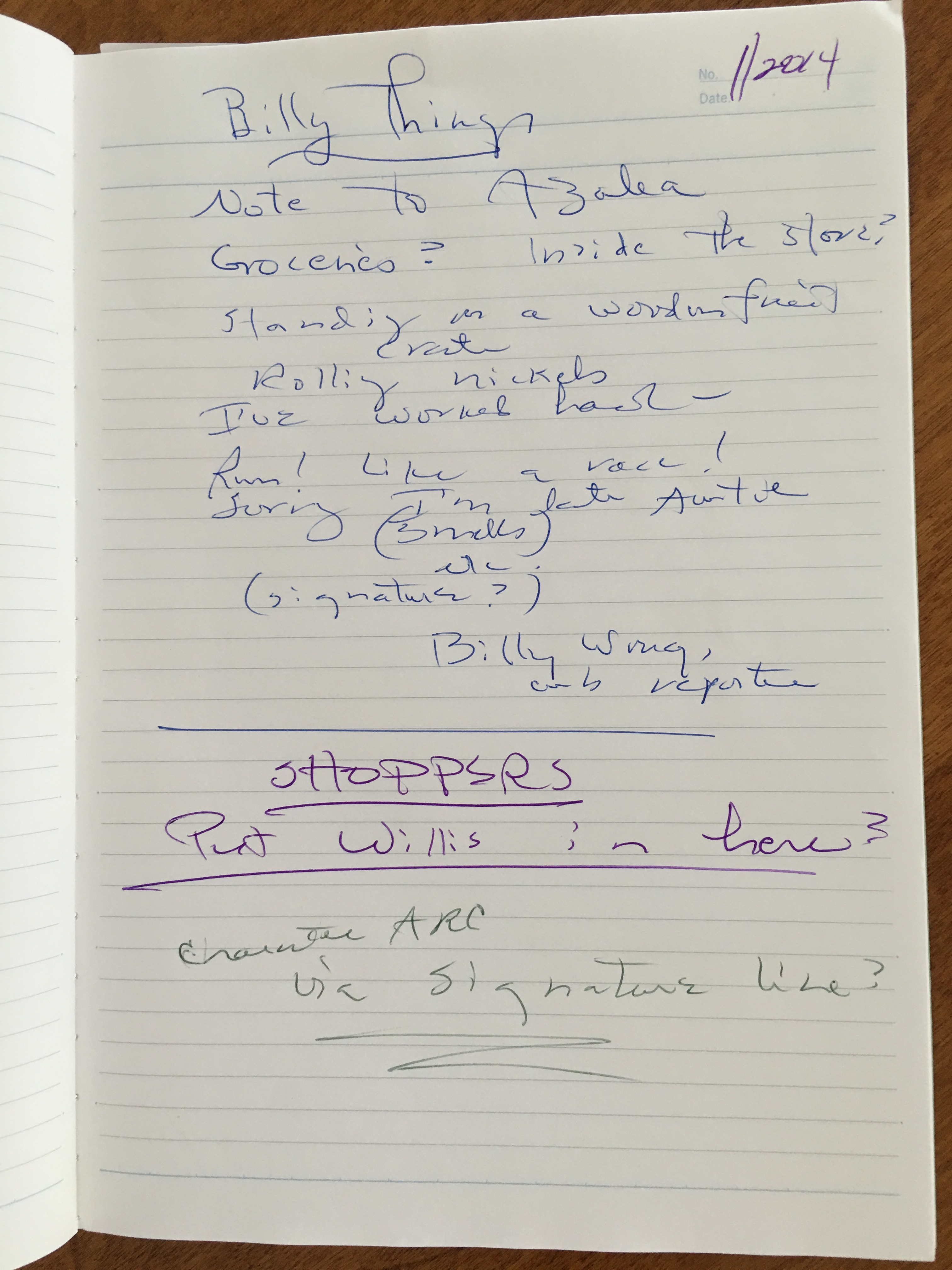
One day, I sat with a notebook doodling Billy Things (I even wrote that at the top of the page). What would Billy Wong be interested in? I doodled lists, newspaper notes, letters, Billy’s dreams, and I filled up a notebook with ideas. A true aha! moment.
I don’t think of them as verse exactly, but they spilled out with a certain poetic quality, and I liked that.
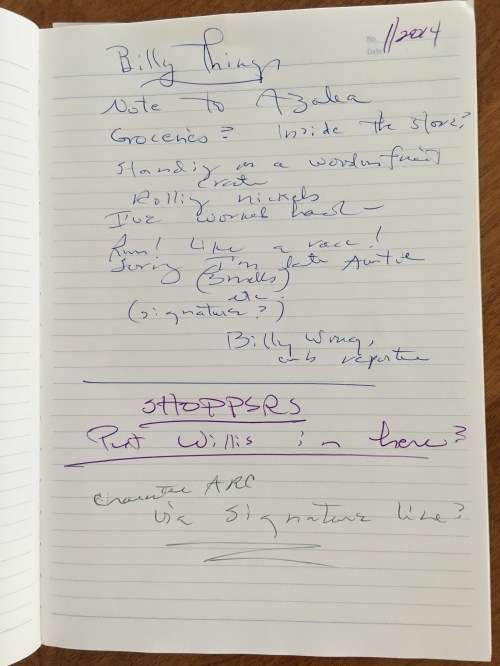
A peek into Augusta's notebook as she thought about Billy.

A peek into Augusta’s notebook as she thought about Billy.

You grew up in the segregated South. Billy Wong lives in Arkansas and Azalea is from Texas. Were you intentional about the setting? How does the setting influence the events in the story?

I love reading books where setting is a crucial part of the story. Right now, I’m reading THE HIRED GIRL, which takes place in Baltimore where I lived for a while. And that city is so wonderfully portrayed.

For me, setting is a huge part of my own writing. I don’t think I could set a book in the frozen north (though I did live in New Jersey for over 25 years, come to think of it), if I tried!
My childhood was bike rides, climbing trees to read a book, playing kick-the-can till it got dark. I can still feel the mosquito bites (and smell the DDT truck, sadly). Those are the details I know, and yes, they seem very southern.

But there were other things we didn’t see, or took for granted. There was a white side of my town and a black side. I learned from research that the Chinese often fit into both worlds. Even if I’m not describing some of these details, they slip subtly into my writing.
Perhaps I don’t write the kinds of books that could take place anywhere. But I think I write about family and friendship and feelings that are universal.

Willis DeLoach is an unlikable character, yet you build in some obvious reasons for his meanness. Willis does not change during the course of the novel. I was hoping he would somehow “see the light” and change his ways. Can you tell us about your impression of Willis and his character arc?

In my mind, Willis has small hints of seeing the light! But he’s a product of the times (1950s) and his environment. He worries that somebody’s going to take his place in his small world, replace him in school sports, usurp his tree hideaway. Unlikeable yes, yet he has a soft spot for his little sister. I think his eyes will open this year in school. Remember, before that time most people had never crossed paths with anybody who was different from them. Cross cultural and interracial friendships were not encouraged, and actually, there was little opportunity for someone like Willis DeLoach to truly know a boy like Billy Wong until the schools allowed Chinese American students to attend. I had to make his story true to the times.

Also, my book only spans a few weeks at the end of a summer. I decided it would be unrealistic to have Willis do a complete about-face and change his ways in that brief moment.

In the author’s note, you write about the research you did for historical context. Were there any surprises for you as you did this research?

As I mention in my note, I started writing after reading a very poignant essay written by a friend, Bobby Joe Moon, who also grew up in Cleveland, Mississippi. Children and even teenagers in the early 1960s in small southern towns could be oblivious to what was happening all around them. Bobby’s essay about the difficulties of growing up Chinese in the Deep South surprised me and made me think about sharing this story with young readers.

Many readers of my author’s note may be surprised to learn how many Chinese immigrants came to the south to open grocery stores. I’d shopped almost every day with my grandmother or my mother at those same stores and I knew they were there. But I was fascinated to discover why this happened. My research and my unrelenting questions posed to Chinese American friends uncovered so many fascinating details. I could not have told this story without asking a lot of questions.

All three of my novels have been historical fiction, requiring reading and digging deep, which I love. Uncovering surprises is really the best part of research, isn’t it?

IMWAYR 2015

Read Full Post »
Discover. Play. Build.

Ruth Ayres invites us the celebrate each week. Click over to her site Discover. Play. Build. to read more celebrations.

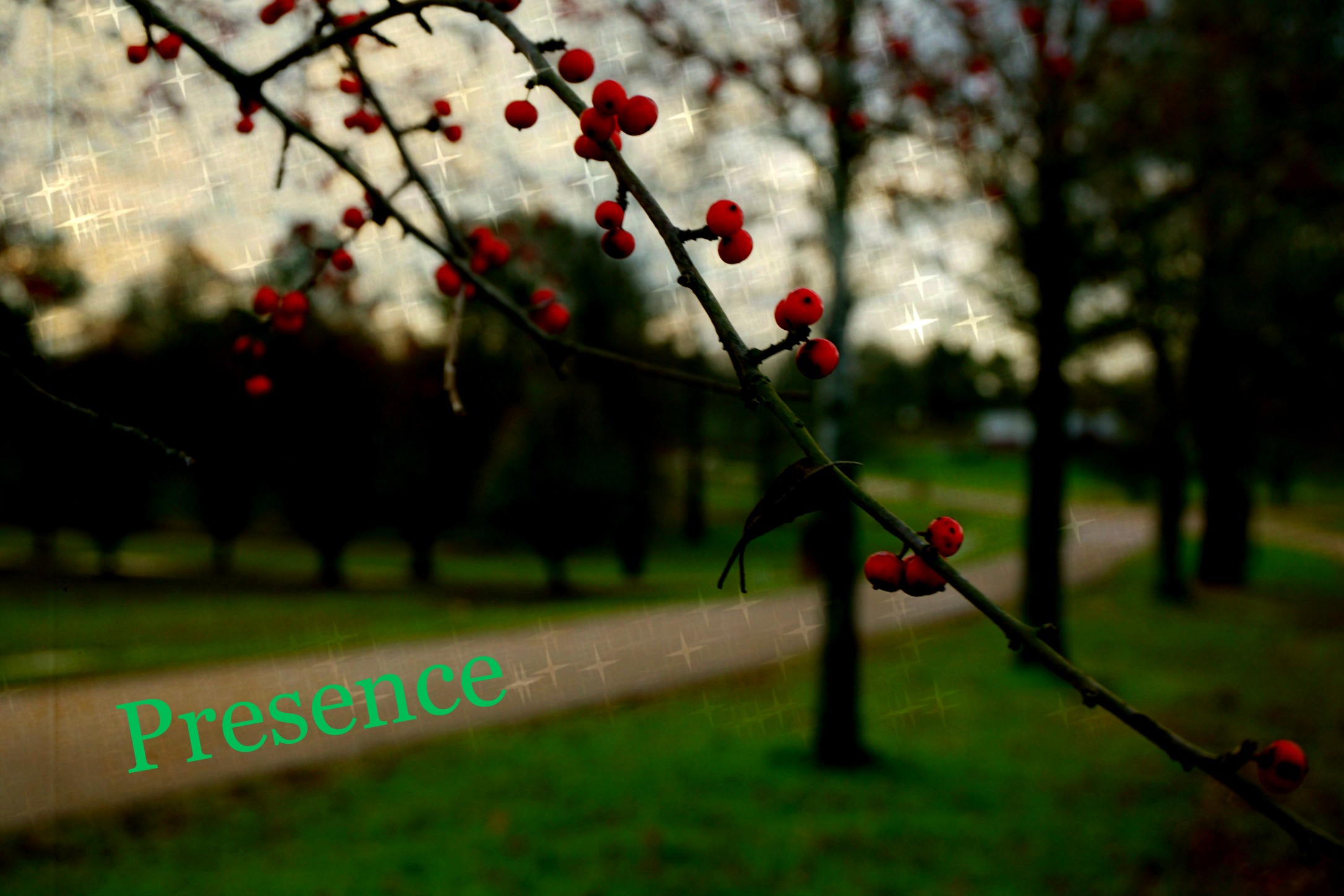
photo by Margaret Gibson Simon enhanced on Picmonkey

photo by Margaret Gibson Simon enhanced on Picmonkey

With the selection of my OLW, Presence, I thought about my classroom(s) and how I could be more present there. At the beginning of the school year, I wanted to make reading aloud an every day occurrence. It is a challenge with my teaching situation because I have students in different grades rotating in and out. With my morning group, I realized that most days we were all there at 10:30 AM, and they leave between 10:50 and 11:00, so Read Aloud became constant on the schedule.

This week we finished Fish in a Treeby Lynda Mullaly Hunt, the middle-grade Global Read Aloud choice. Being so closely involved with a book, so intimate, my voice cracked through the whole last chapter. I think I cried not only because Ally had triumphed, but also because I was looking out at the wide eyes of my students and feeling their love for Ally, too. When we finished, before I knew it, Emily had written a quote and taped it to the wall, “Nothing is Impossible. The very word says, I’m Possible!”

I have had more trouble getting a time to read aloud with my afternoon group, so this week I made it a priority. All work stopped at 2:40 and we read until 3:00. I started Crenshaw by Katherine Applegate. I loved it when Noah said, “Mrs. Simon, can we watch Crenshaw?” Isn’t that what read aloud is all about? Watching a book together.

Today, I celebrate special moments with my students to be truly present.

Read Full Post »
Discover. Play. Build.

Ruth Ayres invites us the celebrate each week. Click over to her site Discover. Play. Build. to read more celebrations.

Cybils-Logo-2015-Web-Lg

I had the privilege of being a round one judge for the CYBILS awards for poetry. Here is our list of finalists.

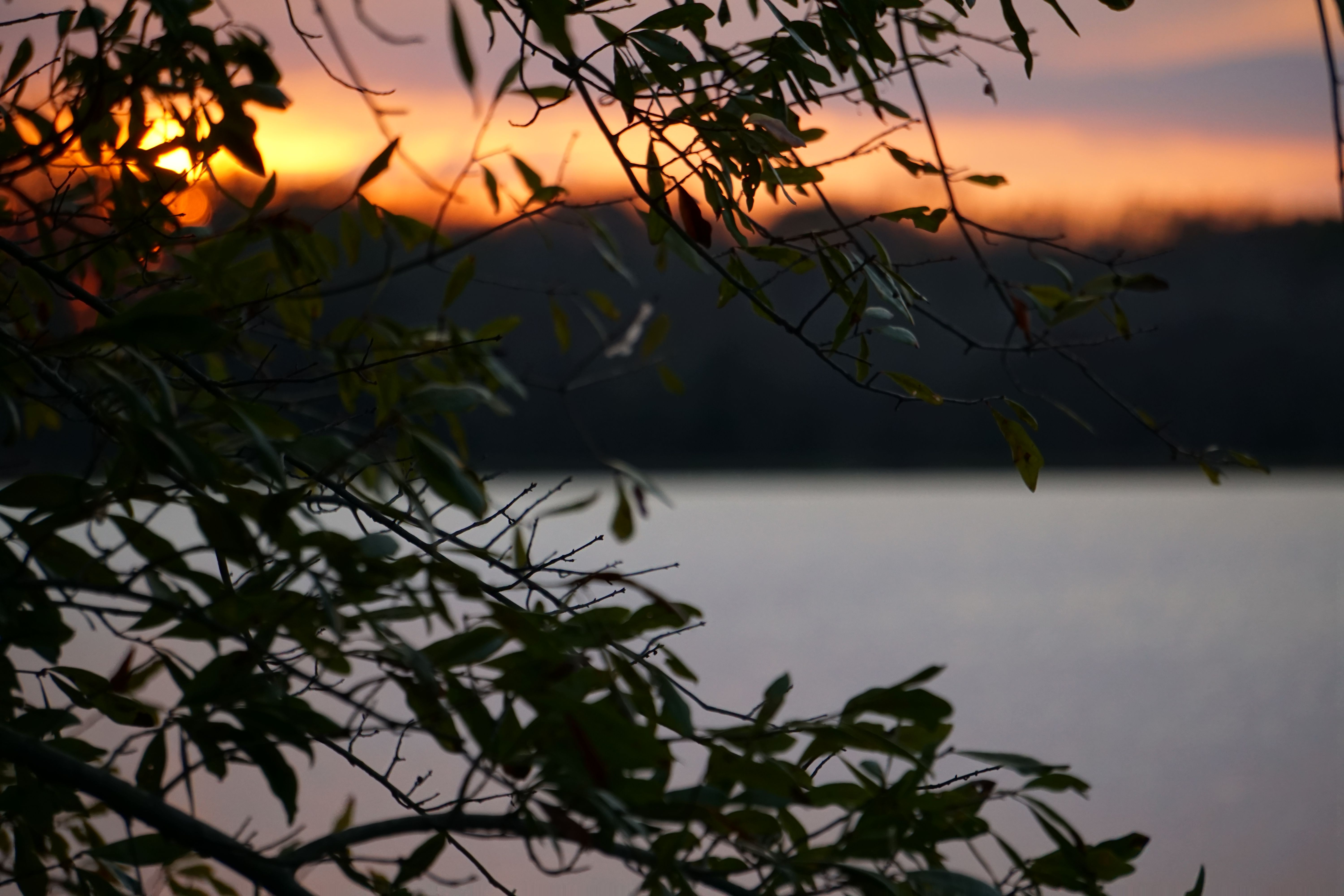
Sunset by Margaret Gibson Simon, all rights reserved.

Sunset by Margaret Gibson Simon, all rights reserved.

For Christmas, I got a new digital camera, Sony a6000. This week while I was at New Castle Lake with my parents in Mississippi, I took this sunset picture. My plan for 2016 is to take more pictures and share them here. Images inspire me in many ways. Some, like this one, speak of quiet and being present with the light.

New Year’s Day with my husband was nothing special and everything special. He built a fire. It was a perfect fire-in-the-fireplace day, wet and cold. I put Pandora on the Roku (a gift from the children) and undecorated. Taking down the decorations can be a chore, but yesterday I actually enjoyed the process–wrapping each ornament in soft tissue paper worn with time and nesting the creche figures back into their boxes.

We cooked a meal together, black-eyed peas, cabbage, sweet potatoes, bread, and baked chicken. Sitting together at the kitchen table felt sacred to me. We rarely take this kind of time just to simply be with each other.

Then we went to see Star Wars! My heart was racing the whole time. As others have said, it is a must-see. Fond memories of the first Star Wars. Masterfully done.

My wish for 2016 for you and for me: An appreciation of the simple joys in life!

Read Full Post »

Join the Two Writing Teachers blog for Tuesdays Slice of Life Challenge.

Join the Two Writing Teachers blog for Tuesdays Slice of Life Challenge.

making memory string
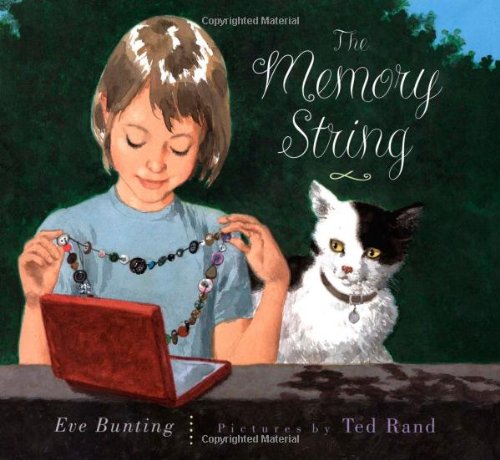
The Memory String

I was in the library looking for another Eve Bunting book and came across this one. I sat right down on the floor and read it. Then I had an idea. I wasn’t sure it would work, but I thought of all the buttons I had collected in a box in my closet. What did I need them all for?

One of my goals for my teaching this year is to bring in more picture books. I am reading one each week. In The Memory String, the character Laura has a string full of buttons. Her mother died three years before, and her stepmother is trying to win Laura’s heart. Laura’s memory string is her way of holding on to the memory of her mother.

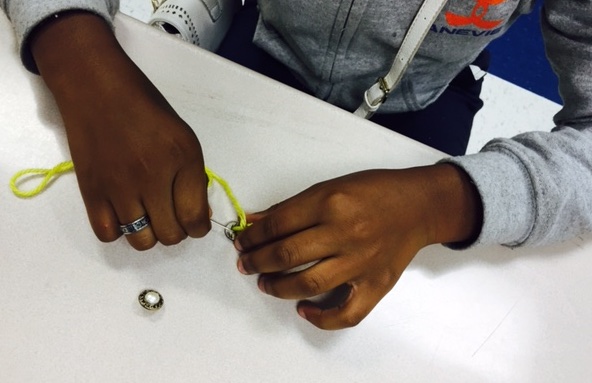
I brought my cigar box of buttons into class and after reading the story, the students each selected 3-5 buttons. I told them they would be writing a memory for each button. We sewed the buttons on a string, and the students began writing. This was a great form to prompt writing.

Here are some student samples:

The fourth button is a blueish greenish color. It reminds me of the first time I swam in the ocean. It was 2011 and I was 7 years old. I was still living in Minnesota, and I had never even gone near the ocean. We were going on a road trip to Florida. The first time I swam in the ocean was in the Atlantic Ocean. It was a pretty beach with water that looked clear and bright. I loved it, but I never got to swim at a beach like that again. (Vannisa)

This is the story of the button that is gold and black. This button reminds me of my brother. This button reminds me of him because when we all brought him home from the hospital, it was cold and he was wearing a jacket that had a button that looked like this button. This button also reminds me of myself because that was the same jacket that I wore when I was brought home from the hospital. That was the story of the button that is gold and black. (Lani)

One button is absolutely clear, and its very small. It reminds me of how I feel when my dad is gone, and when he is usually gone for months. One time, he didn’t come back for half a year. I missed him very much, but when he came back, I was happy to see him.(Tobie)

Any one of these button memories could be a longer personal narrative (or Slice of Life) story. I hear the lament often, “I don’t know what to write about.” A picture book story and a box of buttons can open up a string of memories.

memory string emily

Read Full Post »

Please use this button on your site for DigiLit Sunday posts

Please use this button on your site for DigiLit Sunday posts

A few weeks ago I wrote about a virtual book club I joined led by Julianne Harmatz. We read A Handful of Stars and wrote using Google docs. The model worked well, so subgroups have broken off to read other books. My group is reading Lost in the Sun by Lisa Graff. Resources are popping up for teaching reading that I have not tuned in before. Something about doing what you ask students to do makes the teaching more authentic. If I write a page full of sketch notes about a book and show my students, they see that this is a practice of a reader, not an assignment by a teacher. Julianne started a padlet, and we are still adding to it. This padlet will be a go-to for me this year. I hope others will continue to add to it and build more and more resources for writing about reading. Using Google docs for teaching is new to me. It’s so easy and natural, like writing a note to a friend. In the document, we notice and note things about our reading. Everyone responds differently, and that is the beauty of it. Because I teach individual students in gifted, the accessability of a Google doc will allow them to communicate about reading beyond the walls of our classroom and our school. Using the #WabtR, we can continue the conversation and perhaps match up students book by book. The possibilities are exciting. If you are interesting in joining in on this virtual book club fun, let me know. Link up your digital literacy posts:

Read Full Post »

Join the IMWAYR meme at Teach Mentor Texts.

Join the IMWAYR meme at Teach Mentor Texts.

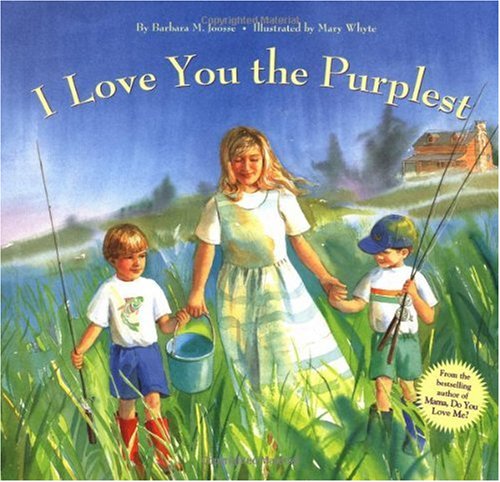
When I think of mentor texts, a wonderful addition to my library is I Love You the Purplest by Barbara M. Joosse with beautiful watercolor illustrations by Mary Whyte. This book tells the story of two brothers going fishing with their mom. Each wants to be loved more than the other. But this is one poetic mother. She loves one the bluest and one the reddest. The metaphorical language is understandable to even my youngest students.

love you purplest

Why, Julian, I love you the bluest!
I love you the color of a dragonfly
at the tip of its wing.
I love you the color of a cave
in its deepest, hidden part
where grizzly bears and bats curl up until night.
The mist of a mountain.
The splash of a waterfall.
The hush of a whisper.

After reading the story, I ask my students to choose a color. Brainstorm words that would go with that color. We share our lists. Then they choose someone they love. (Most choose mothers. You could make it a Mother’s Day activity.) Using their lists, they write a poem about the one they love using the title, “__________, I Love you the _______-est.”

Matthew won second place in a state writing contest in second grade with his poem.

Mom, I Love you the Bluest

Mom, I love you like the color of the sky.
The shimmer of the ocean.
The color of our cat’s eyes.
My old blue jeans.
I love you with the strongest emotion.

https://youtu.be/IYAl64ng09c

I guess when you have a tried and true lesson, and you’ve been blogging for 4 years, something’s bound to come back around. I did a Google search for images and came across my own Poetry Friday post from 2013. You can read more student poems here.

Emily purplest

Use this button created by Leigh Anne Eck to post your Digital Poetry this month.

Use this button created by Leigh Anne Eck to post your Digital Poetry this month.

Read Full Post »
Join the IMWAYR meme.

Join the IMWAYR meme.

Today I am joining the roundup of kidlit books at Teach Mentor Texts. Click on over for more reviews.

Use this button created by Leigh Anne Eck to post your Digital Poetry this month.

Use this button created by Leigh Anne Eck to post your Digital Poetry this month.

I am the guest writer on Laura Shovan’s blog today, Author Amok. I wrote about Ellen Bass’s poem The Orange-and-White High-Heeled Shoes.

handfulofstars

When Cynthia Lord offered an ARC of her latest novel A Handful of Stars on Facebook, I commented and was added to the list. A copy came this week, just in time for Spring Break reading.

I was immediately drawn in to this story when Lily chases her blind dog into a blueberry field. Lucky is stopped by a migrant girl, Salma Santiago, who becomes a new friend to Lily. Salma is artistic and wants to help Lily raise money for an operation for Lucky. She joins Lily in painting mason bee boxes. The two become fast friends.

Lily is a complex character. She lives with her French Canadian grandparents who own a general store. You get the sense that the family is still grieving the death of Lily’s mom even though Lily does not remember her. The dog Lucky is her connection to her mother. Lily is also dealing with the change in a childhood friendship. Salma brings hope to Lily. Salma opens up Lily’s mind about art, migrant workers, and friendship.

Cynthia Lord creates a story that not only touches; it also teaches. I learned a lot about blueberry harvesting in Maine (which is different from blueberries in Louisiana.) Through Pépère, Lily learns life lessons. I’ve been wanting to experiment with black-out poetry and Zentangle. I made a copy of a page in which Pépère speaks to Lily about how Lucky (dogs) can teach us. I highlighted words to create a poem and drew Zentangle designs to black out the words. Zentangle can be meditative. Kind of like doodling.

Lucky
wants to see.
He seems happy to me.
We learn from dogs.
They don’t ask ‘why me?’
They find a new way to be happy.

Setting something free
takes faith.

Handful of Stars Zentangle poem

Read Full Post »
 

SOL #25

Jessie Wilcox Smith, Flickr, 1915 "The New Book"

Jessie Wilcox Smith, Flickr, 1915 “The New Book”

Reader response has been an integral part of my gifted classroom curriculum. Now that the first round of testing is done, I am wondering if there is a way I can continue using reader response while integrating testing style writing.

I hesitate to call this authentic writing because God knows I don’t write about every book I read. “Sometimes I just want to read for the pleasure of it,” one student said exasperated by yet another reader response assignment.

But sometimes it is helpful to write to process thinking, or to make that metacognition happen in the first place. I am doing that very kind of writing right this minute. Writing to discover. Could reader response be a discovery? Could we learn as we write?

In my class this morning, we had a discussion about theme. I was pushing my young writer to think deeper about his reader response. He said he thought the theme was stated in the title, “Walk Two Moons.” I grabbed this statement and held on.

“What is meant by the title?”

“Don’t judge a man until you have walked two moons in his moccasins.”

“Are there examples from the story to prove this theme?”

He continued by recalling scenes from the book. “So, what is the most important thing about your claim that this is the theme?”

“Text evidence!”

I love when we make connections between what we are actually doing when we read with what the testers want us to do. You must support your claim with evidence from the book.

Linda Baie posted yesterday about reader response. Here are some take aways from that post that I want to build into my renewed reader response assignments:

  1. Think about the book as a whole.  What theme arises?
  2. What imprint does this book leave on your life right now?
  3. Talk about the author’s craft.  How did the author tell the story?
  4. Is the main character in your heart?  Why?  Did he/she teach you anything?

It is also important to have book discussions with your students individually.  I talked to Jacob this morning about his reader response.  He wrote that he would like to go to the moon.  I asked, “Can you tell me more about this?”

He said, “I really don’t want to go to the moon.  I am scared of how you would float out into space.”  He eventually wrote about the earth having an atmospheric bubble that helps you breathe.  So much more interesting than the patent answer.  I told him this.  He became proud and confident in his own personal response to reading.  It became about more than the facts in the book.  He became an authentic reader and writer, expressing his own fears and understanding about outer space.

I want reading to be freedom for my students, not a burden.  Freedom to fly into outer-space or to walk two moons.  Freedom to find their own way exploring the world in books.

walk two moons


Read Full Post »

SOL #23

SOL #23

Join the IMWAYR meme.

Join the IMWAYR meme.

Saving Gee's Bend

Irene Latham

Irene Latham

I first met the beautiful and talented Irene Latham through Poetry Friday. Her poetry blog is Live your Poem. Then I met her face to face briefly at NCTE, but that brief moment was enough for her to offer encouraging words that made me love her.

When I went to our school’s book fair a few weeks ago, I saw the book Leaving Gee’s Bend. I didn’t know about this book. I bought it immediately and tweeted to Irene. She didn’t know that it was in Scholastic Book Fairs. How cool is that! This past week was testing, so I had some quiet time to read. I wanted to say, “Where have you been hiding?” How had I not read this book before? I can’t recommend it highly enough.

I love historical fiction, and I am a product of the South, so I related to Ludelphia. Don’t you just love her name? Ludelphia loves to quilt, and while the story arc is centered around this love of stitching and quilt making, the compelling part for me was her wild adventure to travel on foot and through water to get medicine for her mother. I pulled for her all along the way and was happy to find some other white characters who did the same. In the process of trying to save her mama, she triumphantly saves the whole town.

Irene is traveling, so she could not respond to my invitation for an interview for this post. I will use a quote from the Author’s Note. This is what fascinates me as a writer, how an idea forms and changes and becomes the book.

There are many fascinating events in the history of Gee’s bend, but it was the photographs Arthur Rothstein took for the Resettlement Administration in 1937 that most captivated me. Then when I read firsthand accounts of the 1932 raid on Gee’s Bend and later learned of the Red Cross rescue, I knew this was the experience I most wanted to write about. The people who lived through this terrible time possess a strength and faith I admire and want only to honor.

Not only has Irene Latham honored the people of Gee’s Bend, she has made them come alive and live on in us, her readers. I hope this book falls into your hands at a book fair near you.

Read Full Post »

SOL #16

SOL #16

Join the IMWAYR meme.

Join the IMWAYR meme.

fish in a tree - final cover

If you do not have this book in your library for middle grade students, then get it now. I read Lynda Mullaly Hunt’s first book One for the Murphys and now again with Fish in a Tree, she has drawn me in to love her characters.

I read for strong characters, characters I can believe in, characters who speak to me. Ally Nickerson and her quirky friends are a group I want to hang out with. I was sorry to reach the end and have to tell them goodbye. In my mind, they continue on and do great things.

Ally is in 6th grade and struggles with dyslexia; although, she doesn’t know that her problems stem from a real disability. She believes she is just plain stupid. She plays movies in her head and draws in her sketchbook of impossible things. Until Mr. Daniels comes along and notices her. He reaches out to her and helps her to understand dyslexia. She believes in herself. Every teacher should read this book to meet Ally’s empathetic, caring teacher and see the power you have to change a life.

I recently read a touching post by Lynda Mullaly Hunt on The Nerdy Book Club about her own relationship with her brother which informed her creation of Ally’s brother Travis. Not only was this an awesome post, but Lynda responded to each comment. I spoke to her of my own struggle to create real characters with a deep relationship.

Nerdy book club comment

Here is a quote from Chapter 48 that shows how Lynda’s books are about more than the characters and their individual problems. They teach life lessons.

And looking around the room, I remember thinking that my reading differences were like dragging a concrete block around all day, and I felt sorry for myself. Now I realize that everyone has their own blocks to drag around. And they all feel heavy. (p. 245)

Read Full Post »
« Newer Posts - Older Posts »