Use this button created by Leigh Anne Eck to post your Digital Poetry this month.
Every year we gather all the elementary gifted students at our local city park for a day of playing strategic games and combining nature, art, and poetry. This year our 6th grade students led the day. They’ve been working together once a month all year to plan a day of wonder for all our students. They performed a play about the Wonders of New Iberia. Written, designed, and performed by students, the play led the audience on a tour of the wonders of our area.
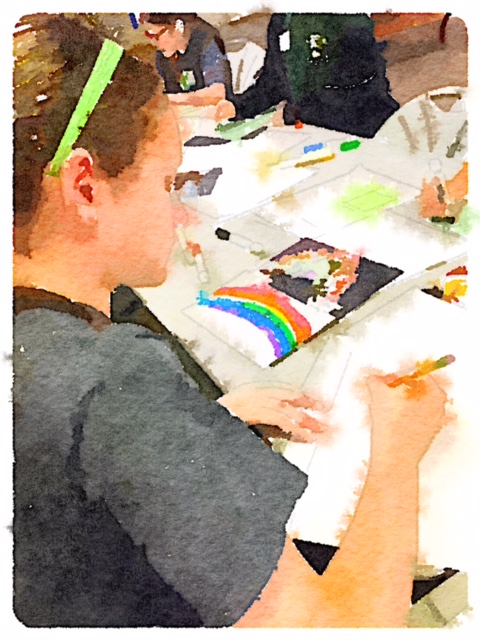
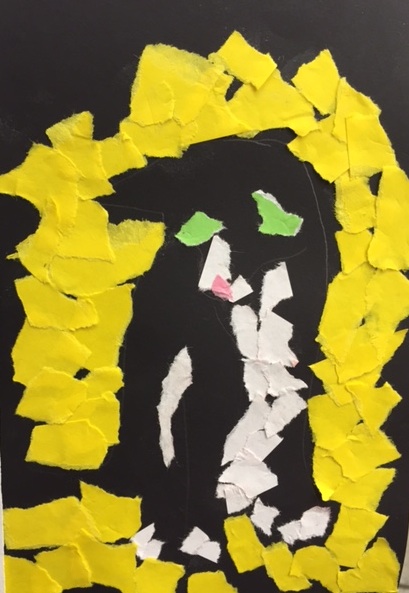
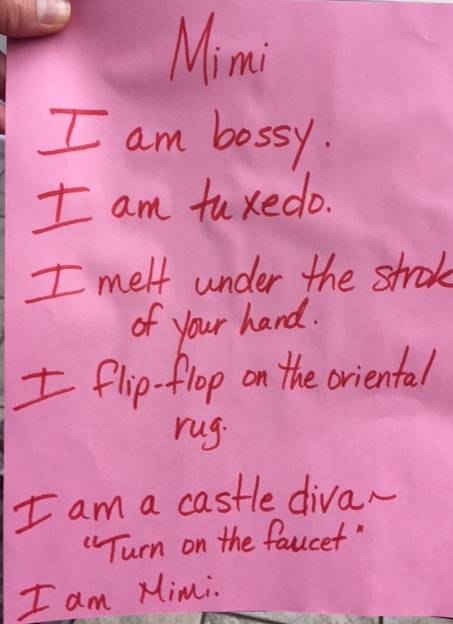
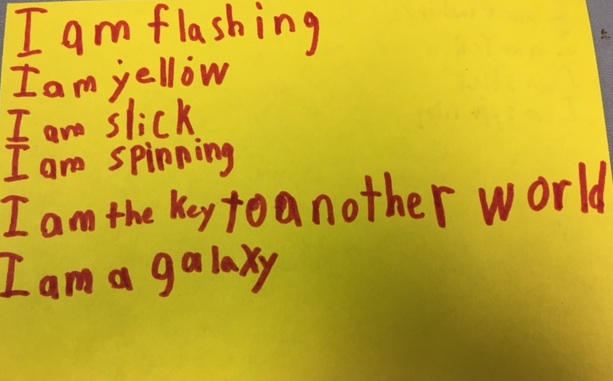
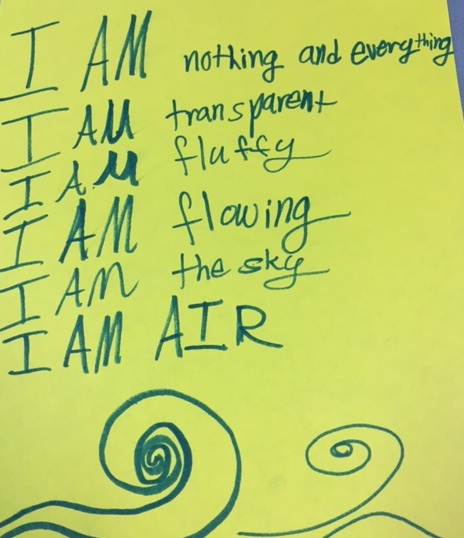
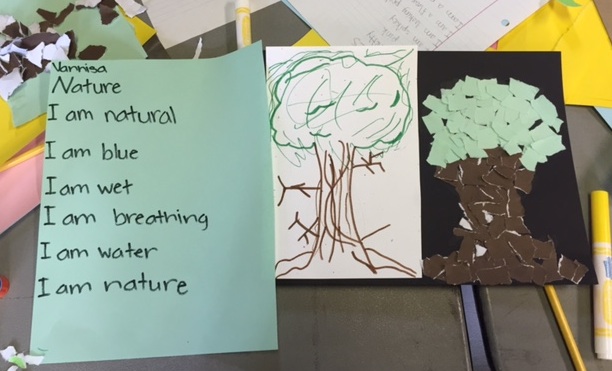
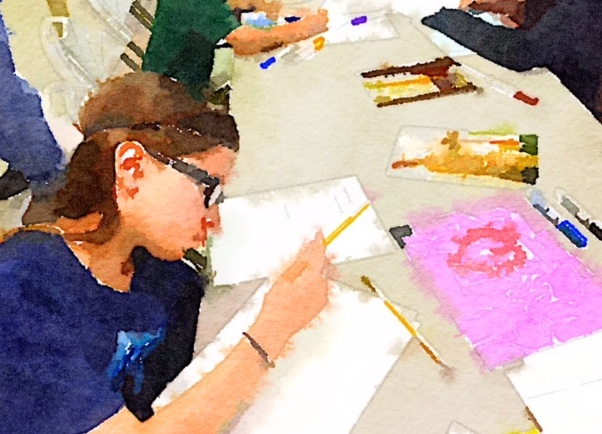
The 6th grade students led an art and poetry activity. Their instructions were to think of something you wonder about and write an I am poem about it. The form was simple. The students wrote and tore paper to create an art piece to accompany the poem. I participated because I wanted to sit next to students and be one of them. I thought about my diva cat, Mimi. One of the students helped me with my torn paper art.
Torn paper Mimi by Margaret Simon
Galaxy by Kaiden
Air by Matthew
Nature by Vannisa
This post is my 600th post. I never would have thought I would get here when I started this amazing journey. Thank you, friends and readers!
Use this button created by Leigh Anne Eck to post your Digital Poetry this month.
Please use this button on your site for DigiLit Sunday posts
Amy Ludwig VanDerwater is doing a unique and fun writing project on her blog, The Poem Farm. My students are huge fans. We have been checking in daily to see the new poem, to sing all the match up songs possible, count syllables, then make a guess. We have recorded our guesses on Soundcloud using my iPhone.
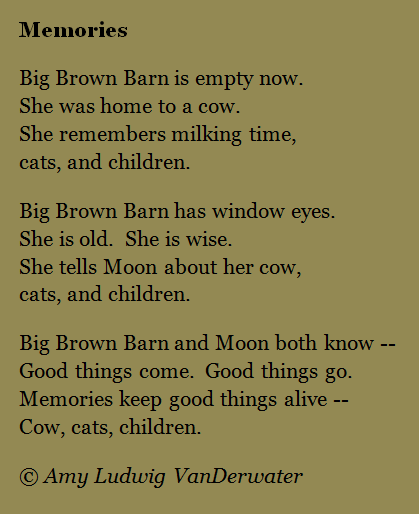
My students have gotten good at this. They are not in the least bit shy about singing. This week was mostly filled with more state testing. So when testing was over, and we finally had uninterrupted time together, they insisted on visiting The Poem Farm. We read Amy’s poem Memories and after quite a few fails, we decided it was the tune of “London Bridge is Falling Down.”
Writing workshop became a frenzy of experimenting with different songs, counting syllables, and writing original poems to the tunes. I was particularly fond of Emily’s because I helped her with it. She was writing about stinky feet. We googled a picture of a labeled shoe to get the proper shoe vocabulary. I talked to her about how she could personify eyelets. Finding rhymes was a challenge, too. (Rhymezone.com helped) I kept trying to describe that reeking of feet as steam. She came up with word vapor. So we made a near rhyme with vapor and garbage collector. It worked. Read the poem first to see if you can guess the tune, then listen to the Soundcloud. Thank you, Amy VanDerwater for inspiring such creativity and fun.
Do your shoes smell bad?
Do your laces stink a tad?
Can the eyelets see the dirt?
If they can, they may avert.
Does the footbed reek and vapor
like the garbage can collector?
Do your shoes smell bad?
Join the roundup with Robyn at Life on the Deckle Edge
Use this button created by Leigh Anne Eck to post your Digital Poetry this month.
I am staying true to my blog title and reflecting today. I discovered a student of mine has been writing acrostic poems. Lani is new to my gifted class, in third grade, and works on math with me. She knew the others were blogging for the month of March, and she wanted to join in. Of course, I let her, and her mother welcomed the challenge by allowing her computer time at home to post. With the crazy number of posts during March, I was not completely keeping up. I thought I was until I saw this post from Lani from March 25th.
Since today is International Poetry Day for me… this is my poem…..
Hour long punishment Expelled from school yesterday Lectures from my mother Practicality flunked sixth grade
My worst day ever Everyone knows that I lied to get their attention
I hope that you liked my poem!!
This form intrigued me. As I said, Lani is a third grader, and none of her lines were true to her, so I assumed that she was writing a novel in verse as a 6th grade character. Here was another post from the same day.
Crazy unpredictable things have happened Once I had a pig for supper Maybe a dog would have tasted better Eww!!!
Inviting you is not a problem Never a problem because I need a witness
All my relatives have not survived Nor my family Dad did not want to come in fearing that he will be finished
Sometimes I do not know how people can lie Even if they are lying to themselves Everyone thinks that I am lying and I am!!!
After reading this, I had to have a discussion with Lani. I was wondering where she was getting her ideas from. She didn’t have an explanation. She just wanted to write poems, and she knew she was good at acrostic. The only time she had written a poem with me was for Chalkabration, an acrostic about March. I gave her loads of praise because it was a great poem.
I talked to Lani about her fictional character. She made some notes in her notebook. I encouraged her to keep it going. Since this conversation, we have had disruptions with spring break and testing, so I hadn’t checked in with Lani. These poems seem to get crazier and crazier. Not everything makes sense, and yet, I think I have a creative writer on my hands. I hope we can make time again to put aside the math book and write poems. I love how she gives me credit for “coaching” her.
Hard-headed Ant=my brother Reading maniac=my sister Dare addict=my dad Especially the hard ones Sardines eater=my cousin Tardy=my friends
Dummy=my other cousin Arnold=my brother’s name Reaction=crazy Extreme dare
Elapsed time:02 seconds Ventriloquist people call me crazy (look at them!) Even my mother! Listen to what she calls it!!!! Ridiculous lying is what my mother calls it
This a poem for MY International Poetry Month. It took me a few days but I finally finished it. (with a little help from Mrs.Simon and some ”coaching”)
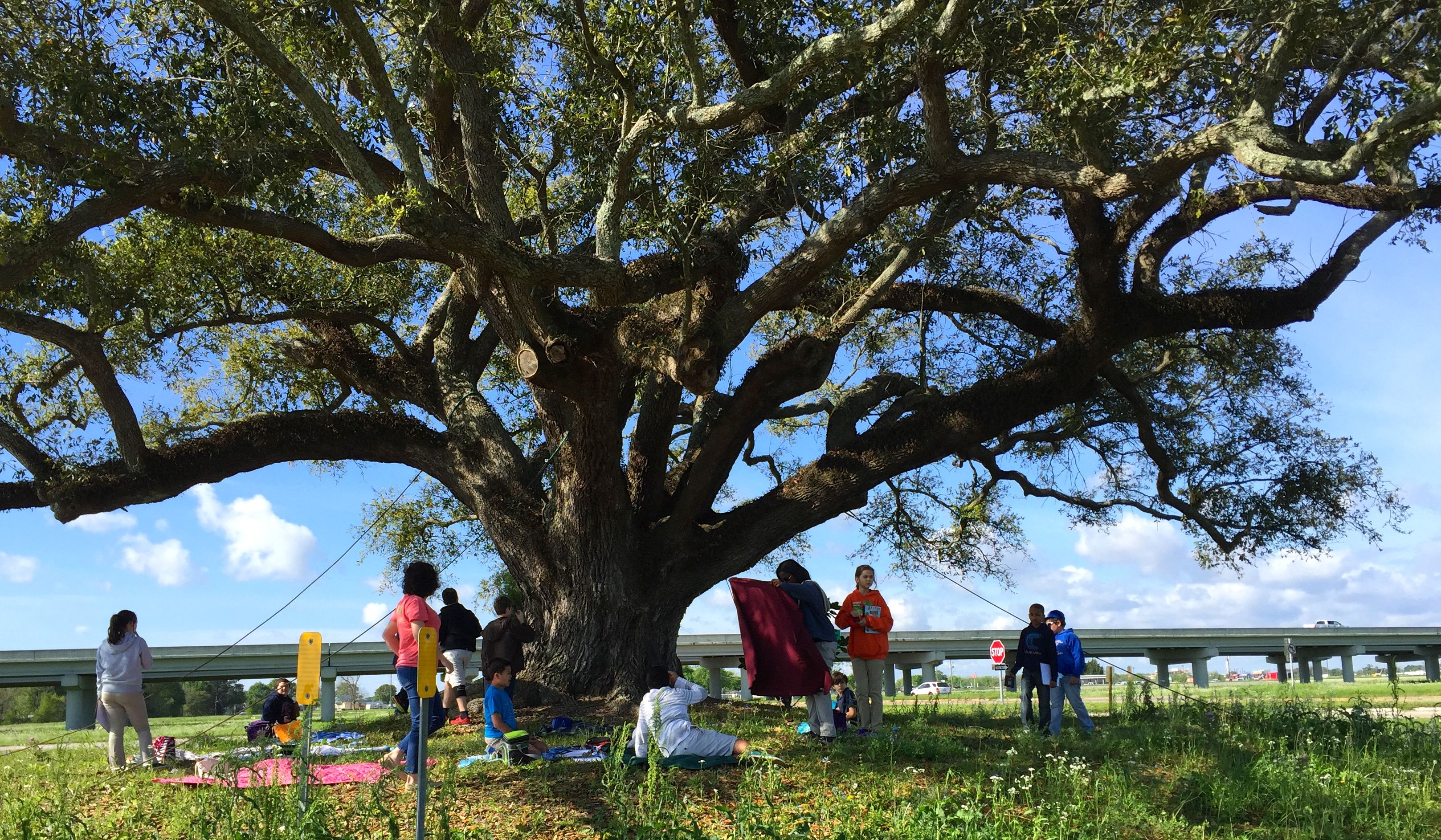
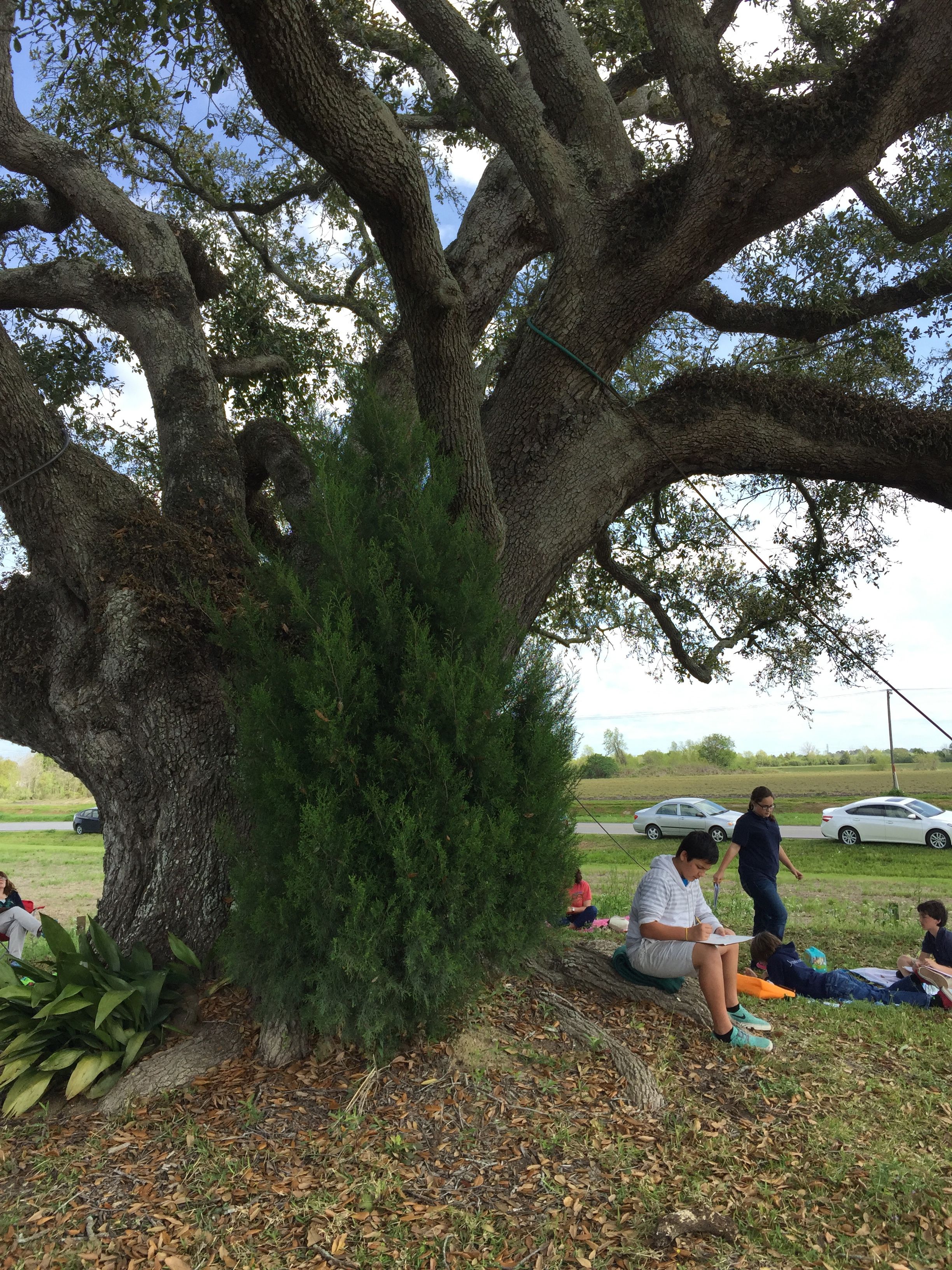
With our 6th grade students in the parish (district), we have been doing an enrichment Wednesday each month that we call WOW for Way Out Wednesday. This year’s theme has been wonder. One of the wonders of our area is this huge old oak tree named Mr. Al. A few years ago, Mr. Al was in the way of a planned service road next to the highway. Protesters were instrumental in getting Mr. Al moved to a safer location. He now overlooks an intersection of the highway, Highway 90 at Weeks Island Road.
This past Wednesday was a gorgeous spring day. We took the 20 students out to Mr. Al for a picnic. They sketched and wrote poetry. I coached the poetry writing with a suggestion that they look outside and write description, then look inside for a memory or inner feelings, then go outside again. Darian came to me with an idea. She was caught up on the directions, though. She told me she saw the whole area as a kingdom and Mr. Al was the king. I loved this creative response and told her, “Yes, this idea is using your imagination that is inside you.” She crafted this poem.
What a wonderful way to honor Mr. Al with writing and drawing. The time was peaceful and productive. A true gift to the students and their teachers.
A tree in the middle of nowhere,
As lonely as can be.
But the tree is not as lonely,
As the eye can see.
Ferns and flowers, moss and thorns,
Give the tree some company.
The hill is a castle,
Its rightful ruler on top.
A king greater than all kings.
King Al is protected by his guards,
The ants and spiky plants.
His loyal citizens obey his commands,
For they are the flowers,
purple, yellow, white and green.
His advisers–the fern, magnolia and evergreen,
Work together in harmony.
Long branches reach out,
As if to be holding up the sky.
Leaves more numerous than stars.
Reader response has been an integral part of my gifted classroom curriculum. Now that the first round of testing is done, I am wondering if there is a way I can continue using reader response while integrating testing style writing.
I hesitate to call this authentic writing because God knows I don’t write about every book I read. “Sometimes I just want to read for the pleasure of it,” one student said exasperated by yet another reader response assignment.
But sometimes it is helpful to write to process thinking, or to make that metacognition happen in the first place. I am doing that very kind of writing right this minute. Writing to discover. Could reader response be a discovery? Could we learn as we write?
In my class this morning, we had a discussion about theme. I was pushing my young writer to think deeper about his reader response. He said he thought the theme was stated in the title, “Walk Two Moons.” I grabbed this statement and held on.
“What is meant by the title?”
“Don’t judge a man until you have walked two moons in his moccasins.”
“Are there examples from the story to prove this theme?”
He continued by recalling scenes from the book. “So, what is the most important thing about your claim that this is the theme?”
“Text evidence!”
I love when we make connections between what we are actually doing when we read with what the testers want us to do. You must support your claim with evidence from the book.
Linda Baie posted yesterday about reader response. Here are some take aways from that post that I want to build into my renewed reader response assignments:
Think about the book as a whole. What theme arises?
What imprint does this book leave on your life right now?
Talk about the author’s craft. How did the author tell the story?
Is the main character in your heart? Why? Did he/she teach you anything?
It is also important to have book discussions with your students individually. I talked to Jacob this morning about his reader response. He wrote that he would like to go to the moon. I asked, “Can you tell me more about this?”
He said, “I really don’t want to go to the moon. I am scared of how you would float out into space.” He eventually wrote about the earth having an atmospheric bubble that helps you breathe. So much more interesting than the patent answer. I told him this. He became proud and confident in his own personal response to reading. It became about more than the facts in the book. He became an authentic reader and writer, expressing his own fears and understanding about outer space.
I want reading to be freedom for my students, not a burden. Freedom to fly into outer-space or to walk two moons. Freedom to find their own way exploring the world in books.
Pay attention to your fantasies, daydreams, and self-talk. What are they reinforcing? What purpose do they serve? Do you believe that some feelings are more “you” than others are? (The Wisdom of the Enneagram, 189)
Self-talk. Is that my enemy? I do this all the time.
We finished phase one of testing, and I read this post from one of my students. The writing part is hard for me because I never learned how to start it or conclude it the way my class did.
I teach gifted pull-out, so she didn’t get the formula for writing.
Am I wrong not to teach the formula?
In the fall of 2014, not six months ago, I received the prestigious Donald Graves Award for the teaching of writing, and yet, I still question my methods. That is the curse of my personality type, self-talk. But I have to question, what is the real issue here?
I realize that the formulas offer comfort and confidence. While my student knew the answer to the prompt, she froze when faced with a blank page. How do you begin?
Even though I know that the best writing for my students is writing they choose, I realize that I need to provide the safety net. The additional practice in formulaic writing.
Today when I came home from school, a new magazine was waiting. The Spring edition of Cultural Vistas, a publication for the Louisiana Endowment of the Arts. My long time mentor Ann Dobie was featured in an interview by my friend and writing group colleague, Dianne Dempsey-Legnon. When I went through the Summer Institute for the National Writing Project of Acadiana in 1995, Ann was the director. This is what she said about her time as director.
It was a magical time… I have seen changes from teacher-centered to student-centered classrooms. Another monumental change is from feeding information to students to allowing them to discover it on their own which is far more dynamic and lasting. –Ann Brewster Dobie, Ph.D.
I will not give up the belief that students need to discover through writing rather than spitting back information within a set format. But I will look for ways to make my beliefs and the new reign of testing co-exist. I owe this to my students who count on me.
Join the roundup with Catherine at Reading to the Core.
This week we talked about form and being innovative and creative with form in Slices of Life and in poetry. We looked at Tara Smith’s call for Classroom Slices in which she shared the poem That was Summer by Marci Ridlon. I had not seen this poem before. I trusted Tara that it would inspire writing.
Have you ever smelled summer?
Sure you have.
Remember that time
when you were tired of running
or doing nothing much
and you were hot
and you flopped right down on the ground?
That was summer. From That was Summer by Marci Ridlon
Today I would like to introduce you to my student, Erin. I wish I could post a picture of her because she is quite adorable. She has long dark hair that accentuates her tan skin (her mother is Filipino.) There is a dimple that appears with every smile, and she smiles a lot. She is small for her age, nine, which only adds to her charm. Erin experimented with two forms this week, the “Remember that time” form and a two voice poem with Spring arguing with Winter.
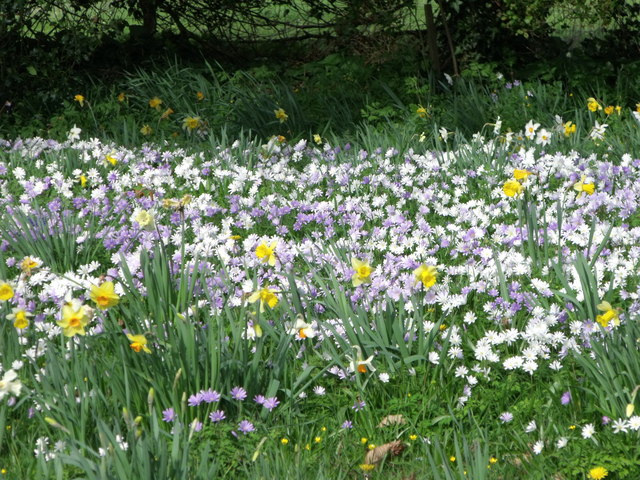
Spring flowers, Lytes Cary, Somerset Copyright nick macneill and licensed for reuse under this Creative Commons Licence.
Can you feel spring? Remember the breeze blowing and you feel you’re flying.
That was Spring.
Remember the time you played catch with your dog,
and he knocked you down in the soft spiky grass?
That was spring.
Remember the wonderful warmth
of the sun on your skin
after the harsh winter.
That was spring.
—Erin
Spring
I’m spring here to kick you out.
No one likes you with your cold heart and all.
While i am loved by millions all around the world.
Winter
Ha you wish.
You bring mosquitoes and bees stinging all about.
I kill and make them pout.
I rule all seasons. While you are a slave.
Spring
Please, you wish.
You give people hatred and make them cry.
While I give them hope and sunshine.
Winter
Oh, really?
You make them happy.
I think that all that sunshine
is going to your head.
Now, be a good girl
and go to bed!
—Erin
Can you hear Erin giggle after that last line? She had a boy in class play the part of Spring. He was a good sport about it. In fact, I think anyone in our class would do anything for Erin. You can click on her name under either poem to leave comments just for her.
Please use this button on your site for DigiLit Sunday posts
I invite teacher bloggers to write about their digital literacy experiences in the classroom and link back to this round up. Please leave your link in the comments. I will update the post during the day.
This week I read an NCTE article in Council Chronicle entitled Students as Makers and Doers by Trisha Collopy. At the end of the article is an “Authenticity Test” for student activities. This test includes two major priorities: 1. Is the activity used outside of school? and 2. Is it a literate habit of experienced adults?
As a reflective teacher, I wonder about the activities and lessons that I setup for my students. In gifted education, we strive to center our work around student interests. When students are interested, they remain engaged and motivated. When you think about authenticity, adults usually engage in activities that interest them. When we are interested, we immerse ourselves in the subject. If you were to look at my email inbox and my Facebook feed, you would know immediately that I am a teacher who loves to read and write.
How do I make activities that advance a students’ learning, engage them in their interests, and practice an authentic task? Blogging. As I sit here at my computer writing about an intense interest of mine, I realize that this is what I pass on to my students. In the Slice of Life Challenge, they are allowed to write about their interests. They are engaged in the process. They are learning by doing. Some of them are even choosing to write outside of school.
Erin is a third grader. She is a voracious reader. She loves all things Rick Riordan. She devours these books within days. But her writing. Well, that has not been quite up to my expectations. For some reason, though, with the SOLC, something has clicked in her. She came to school on Monday with pages of a notebook filled with slices. Her typing is slow, so I helped her type them in. Not any more. On Friday, she went home and typed 3 slices. You can see Erin’s blog here. She writes just like she speaks, with great enthusiasm.
I am probably preaching to the choir here about blogging with students. I love that I have found “real, authentic” articles to back up my convictions.
Don’t forget to leave your link int the comments. Thanks!
My students are doing the classroom Slice of Life Challenge. They are impressing me with their commitment to writing every day. This school year I have required three blog posts a week, so they are used to a rigorous posting schedule. The other day I mentioned how many words a first grader had written (178!), and they set off on a self-made word count competition. But it is not the word count or their writing commitment that is impressing me. It is the voice.
Voice is a very difficult concept to teach. Here is a post-it from Writing Fix, a great resource for teaching writing. As one of the six traits of writing, voice should be taught.
From Writing Fix
I have come to believe that voice is something to be discovered rather than taught. All children come with a voice. Enter any school cafeteria and you can hear them roar. Through blogging every day, my students have become more comfortable expressing themselves, and their voices are coming through each piece of writing. Here are some samples of strong voice:
My mom has one of those smart car things or whatever.The kind where you hit a button and use it like siri. Well in my moms phone my dad is labeled as B T.in case you were wondering it means Boo Thing.So nevertheless when she says call b t it says calling Mrs.Simon mobile.So ya Mrs.Simon if you have any missed calls from her that’s why. Reed
So, today I went to the book fair. I got a calculator,pencils,2 books and a pencil sharpener.
I can’t wait to read my books tonight, and I will get a sticker for our chart for reading books.
But, I know what you are thinking ” wow those sound really boring!” They are actually not boring.The calculator is a chocolate scented calculator. The pencils were drumstick pencils. And, the pencil sharpener is …wait for it…wait for it…A MUSHROOM, and the top is an eraser {TALK ABOUT 2in1.} Emily
After, we walked on Bourbon Street. It was so crazy!!! There was this little boy dancing like Michael Jackson, and he was so good. I gave him $5, because that is all I had on me. After, Bourbon we went back to the hotel. My friend and I were doing flips on the bed. It was extra fun, but I almost broke my ne… nevermind that!! In the morning, we went down stairs to eat breakfast. It was free!! Kielan
Now I need to do a lesson on how so is a conjunction. I never realized how many of my students start their sentences with so. I have time for that because obviously, I do not have to teach voice.
In addition to joining the Slice of Life Challenge at the Two Writing Teachers blog, I have committed to hosting a DigiLit Sunday round up each week. If this is your first time here, consider joining us on Sundays. I love reading about all the new tools available for students and how teachers are using them. Use the button below on your site.
Please use this button on your site for DigiLit Sunday posts
This week was the last of our third nine weeks. How this year is flying! My students do a book talk presentation each quarter, so this was the week to get them done. I love how the room buzzes with computer activity and how talk revolves around books. I added a new requirement this quarter: found poems. These were their instructions:
1. Find a section of 50-100 words. This may be your favorite part or the climax or a part with a good description.
2. Copy words or phrases from the section.
3. Rewrite or type as a poem. Notice line breaks. You may change the order or add words only if necessary to add meaning.
4. Check your poem for tone. Does it reflect the tone of the book?
My students choose the technology they wanted to use for their presentations. Some used Emaze, Powtoon, Animoto, or PowerPoint. Some used the technology to guide their talks. Other used it as a hook or to enhance the presentation.
I want to share some of the found poems, a Powtoon, and an Animoto trailer.
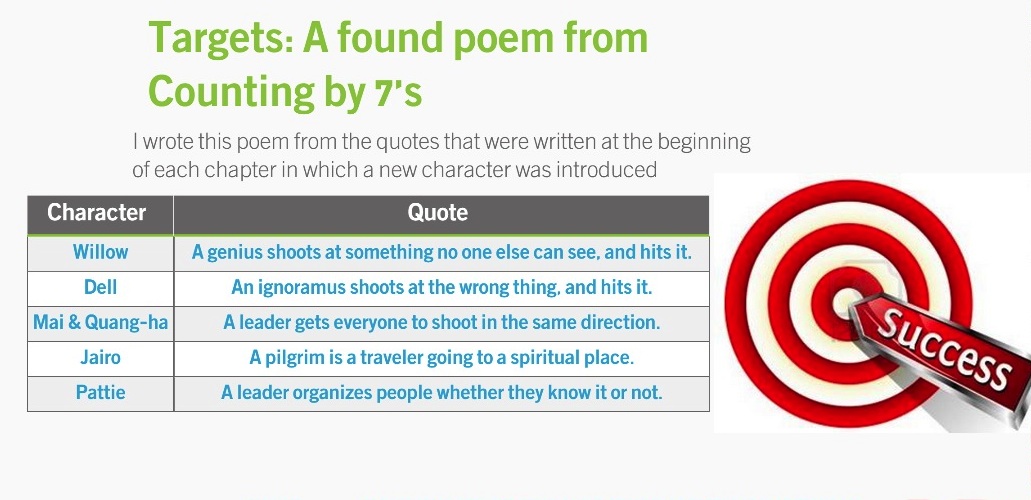
Vannisa used chapter quotes from Counting by 7’s. Each phrase connects to the character in some way.
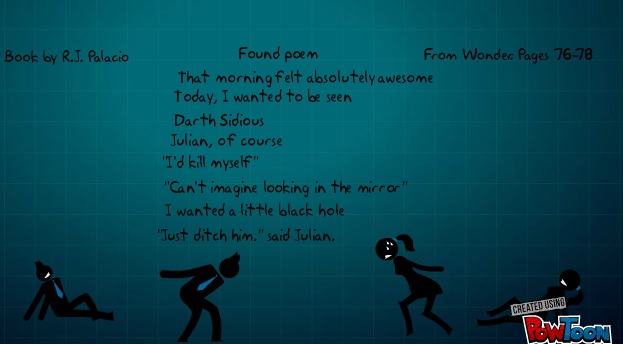
Tobie wrote this poem from the Halloween chapter in Wonder. He could relate to the black hole August wanted to go into.
Matthew’s Animoto book trailer for Escape from Mr. Lemoncello’s Library.
Mission Impossible is a favorite background. Tobie used it to create this Powtoon presentation about Wonder.
Digital Learning Day is on March 13th. My plan is a Crazy Comment Challenge in which my students will try to write as many comments as possible on other SOL posts. Please consider joining us. More about Digital Learning Day can be found here. Use the hashtag #DLDay, #sol15, and #crazycomments in your Tweets.
If you have written a Digital Literacy post, please add your link in the comments. I will add them to this post. I am having some trouble with link up apps lately, so I’m just using the old fashioned way.
Margaret Simon lives on the Bayou Teche in New Iberia, Louisiana. She is a retired elementary gifted teacher who writes poetry and children's books. Welcome to a space of peace, poetry, and personal reflection. Walk in kindness.









 Reflections on the Teche