Last week when my youngest daughter, Martha, set up her office on the back deck, she watched hummingbirds fighting at the feeder. It was one of those rare high pressure/ low humidity days with an actual breeze. She had to silence the wind chimes for her Zoom calls. Today, Martha’s office is back in New Orleans as power has returned.
Currently I am watching the rain bands of Hurricane Nicholas (now a tropical storm) fill up the bayou. The hummers are still coming. That’s a good sign.
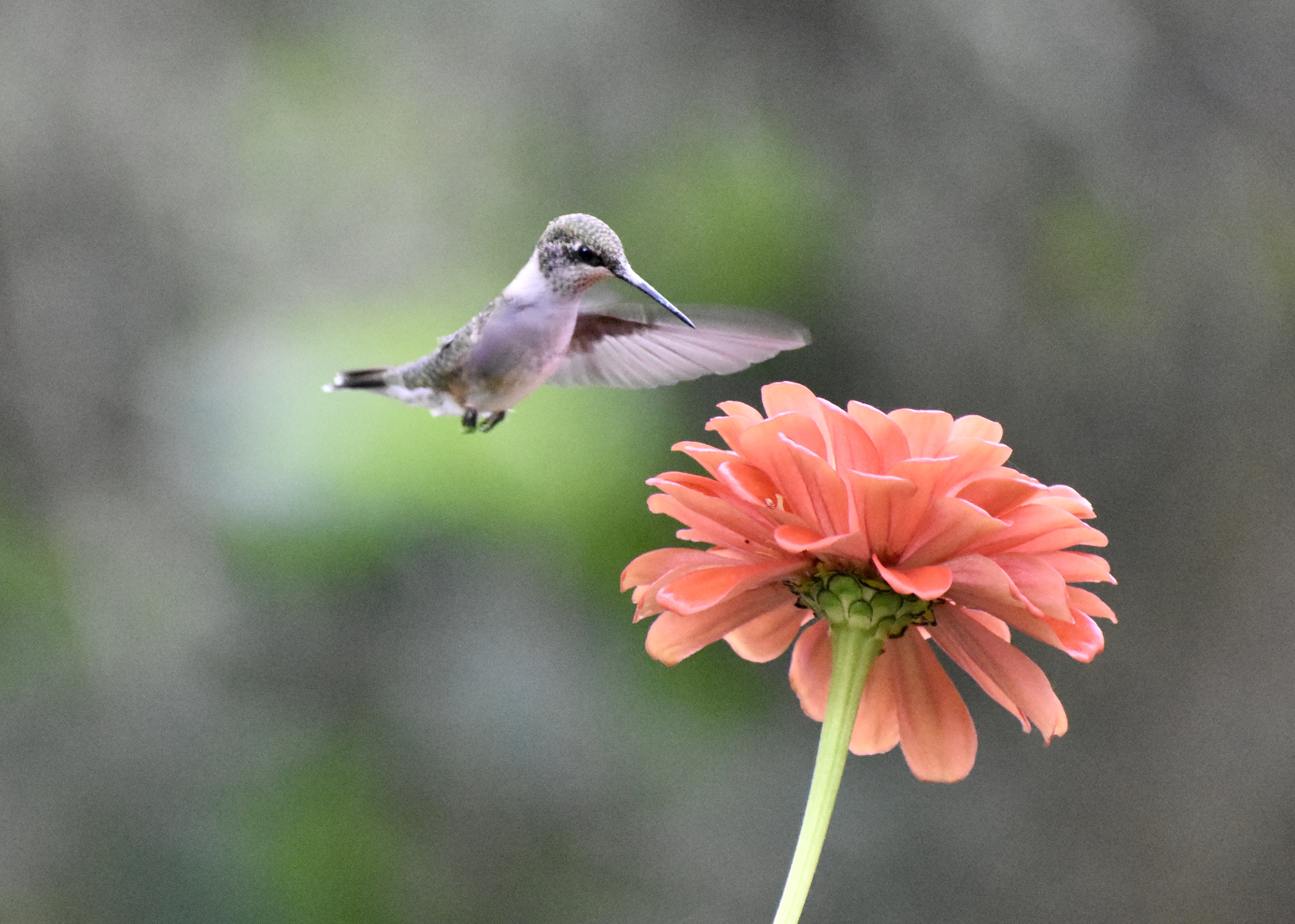
My friend Molly Hogan in Maine has been watching these amazing birds, too, and taking amazing photos of them. She sent me this one.
For my students, since this is a virtual learning day due to the storm, I linked the photo to this Wonderopolis article and used one of the facts in my haiku.
photo by Molly Hogan
Peach-sweet zinnia fanned by wingbeats 200 times per second: Zest!
Haiku draft, Margaret Simon
Please write a small poem in the comments and reply to other writers with encouraging words. Thanks for being here.
My middle daughter’s son, my middle grandchild, turned 2 yesterday. “Mamoo” (his version of Mamére) bought a set of bubbles and wands for his family birthday party. It’s fascinating when a child learns to blow bubbles. Often the blow is too fast for the bubble to form. The bubble set came with a variety of instruments for making bubbles. I hit the Walmart $5 Jackpot with this set. “Tuffy” (the nickname Thomas gave to himself) was able to blow more slowly through the pipe and watch the bubble form. This helped him blow with the wand. Bubble success! Then he was on to something else.
I, however, stayed focused on getting a photo of a bubble. I am posting the best of the bunch. I find the colors magical.
Photo by Margaret Simon
There is a rainbow of magic inside a bubble blown by a boy learning to blow.
Thank you to Two Writing Teachers for creating an amazing community of writers and a safe, welcoming space to write and share.
Another week of writing from The Quickwrite Handbook by Linda Rief. I have two pieces of writing I’d like to share today. The first was a prompt after Cynthia Rylant’s When I Was Young in the Mountains. Linda Rief wrote a mentor text “When I Was Young at the Ocean.” I wrote “When I Was Young at Purple Creek.”
When I was young at Purple Creek, I dangled my toes in the trickle of water and watched minnows dart around them, sending tickles and goose pimples all the way up my skinny white legs.
When I was young at Purple Creek, I buried my Barbies in the sand, played Treasure Island on the wrip-wrap shore, and let go of the leash so Loopy could wander and explore, bark at the squirrels.
When I was young at Purple Creek, my fear of snakes was on high alert. Brother shouted a warning just to see me jump. We gathered treasures in a tin bucket (rocks, broken glass, colored leaves, mimosa seed pods, a baby frog).
My flip-flop feet toughened on summer days when I was young at Purple Creek. The trickle was my ocean. The shoreline my cave. The pine trees my towers. I was queen of Purple Creek.
The next text we read and wrote from was an Excerpt from The Terrible Two by Mac Barnett and Jory John.
That Kind of Teacher
On the first day of school, you can decide what kind of teacher you want to be. You can be the smiley teacher, the one who greets everyone at the door with “How are you today?” You could be the fashionable teacher, the one who turns heads with her new outfit each day. You could be the kind of teacher who knows everything about the new reading curriculum guidelines. The teacher who decorates her classroom in rainbow colors and files everything in matching color-coded binders. You could be the teacher who stands at the board and takes roll, who finishes her report cards on time. Or you could be that teacher who works as hard as her students. The curious teacher. The open-minded teacher. The teacher with a lot of stickers on the chart. When the school year starts, you can choose what kind of teacher you will be, the kind of teacher you will be for the rest of your life.
Margaret Simon
And here’s 6th grader Chloe’s poem response for “I’m the Kind of Kid Who”
I’m the kind of kid who leaves at the end of class, new kids asking why. I say “Guess” to hear what they think.
I’m the kind of kid who always does their work or finishes their homework in class so they have nothing left to do.
I’m the kind of kid whose teacher lets them eat in class as long as she doesn’t see me.
I’m the kind of kid who writes every day. If you don’t know what I mean, I’m doing it right now.
I’m the kind of kid who is ready for the weekend and is actually ready to come back to school.
Chloe
Adelyn, 3rd grade, wrote about her sister and posted it here on FanSchool.
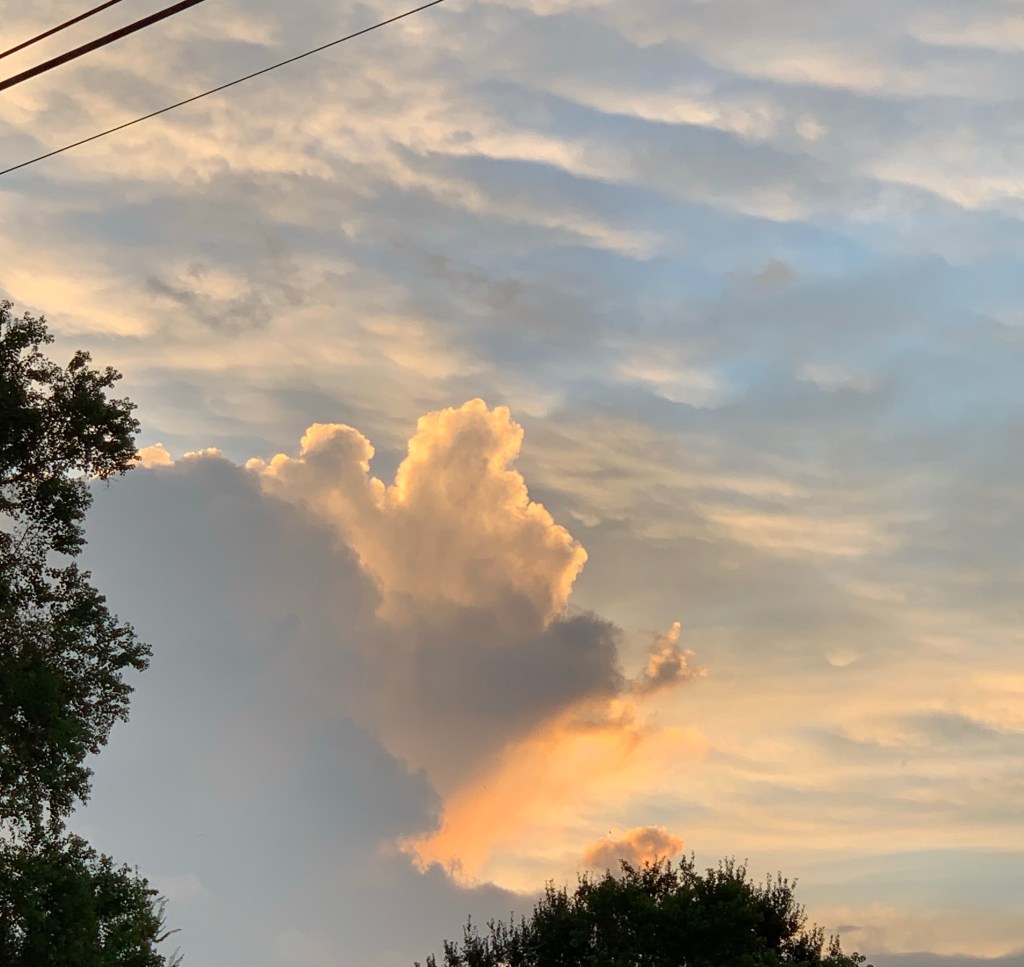
I almost forgot it was Wednesday. Yesterday was the first day of my work week because we had Monday off for Hurricane Ida, which thankfully did not impact us directly. When I walked Tuesday morning, this beautiful cloud led me. I held my phone up high to capture this photo. Clouds always draw my eye, especially ones with the sun within them.
Yesterday there were ten minutes of class left before the bell rang, so I challenged my student in a game of Metaphor Dice. We rolled 3 dice and wrote a poem in one minute (her idea). It was a great way to keep our brains active. I am using a revised version of mine as a small poem today.
Silver lining by Margaret Simon
Metaphor Minute
My birth is like a bright meadow– like stars on the path to a grand castle, like diamonds strung on a silver string, walking in clouds lined with sunbeam.
Margaret Simon, draft
Join me in praising the clouds and the spirit of all things. Leave a small poem in the comments. Support others with encouraging words. Thanks for being here.
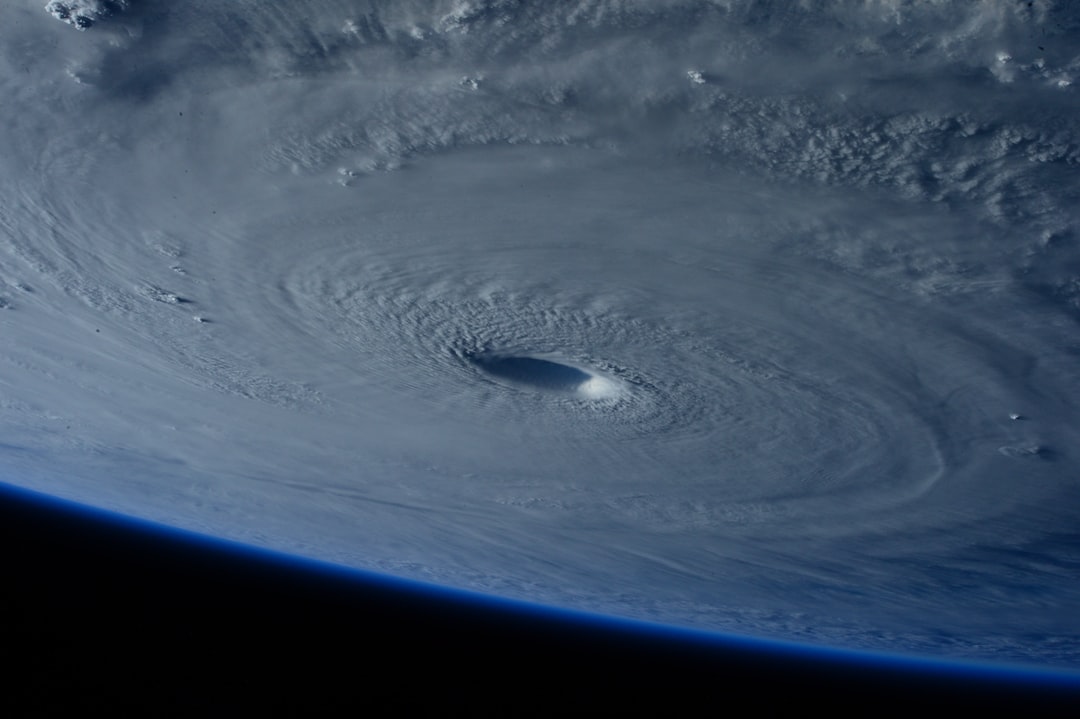
Hot August oceans churn. Tornadoes internally spurn a meteorologist’s concern.
This is what the hurricane knows.
With strength beyond a whale’s tail, swallow waves into booming gale, loosen nature’s grip and WAIL!
Margaret Simon, draft
On Friday, I wrote wisdom poems with my students. I couldn’t focus on much except Hurricane Ida heading our way. They also wrote some wonderful wisdom poems linked below.
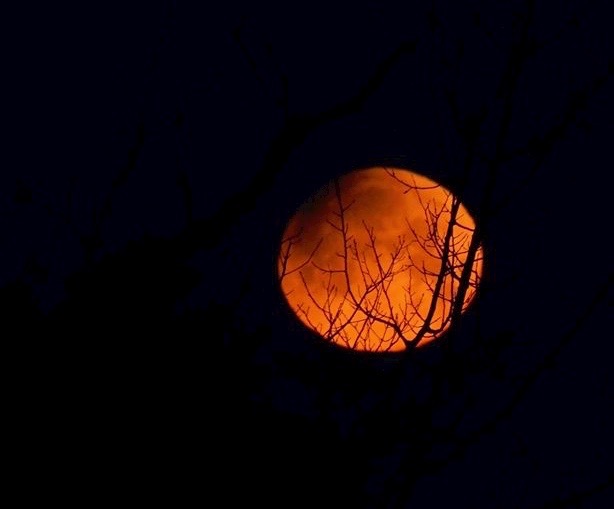
Every morning this week the full “blue” moon has accompanied me on my walk. I’ve taken cell phone photos that I posted on Instagram, but for this post, I reached out to my Inkling writing friend Molly Hogan. She came through with multiple moon photos for me to choose from.
On Ethical ELA’s Open Write this week, Tamara “Tammi” Belko led us in a one sentence poem prompt. You sure can pack a lot into one sentence if you try. I wrote mine by speaking into my phone notes app while walking. Siri often misunderstands me–must be the southern accent– and she thought I said “How are you” instead of “Owl echoes over the bayou.” I decided to leave it in the poem.
In the early morning light of a new day when the moon still hangs high while the owl echoes “how are you”, I am tethered to this old dog walking, wandering, praying.
Margaret Simon, draft
Moon through the trees by Molly Hogan
Please join us by writing a small poem (maybe just one sentence) in the comments. Leave encouraging comments for other writers. Thanks for stopping by.
The world continues to spin out of control. We feel like we can’t hold on. If it’s not the rise of Covid cases, it’s the earthquake and storm in Haiti. If it’s not the political discord, it’s Afghanistan. There is little we can do, literally.
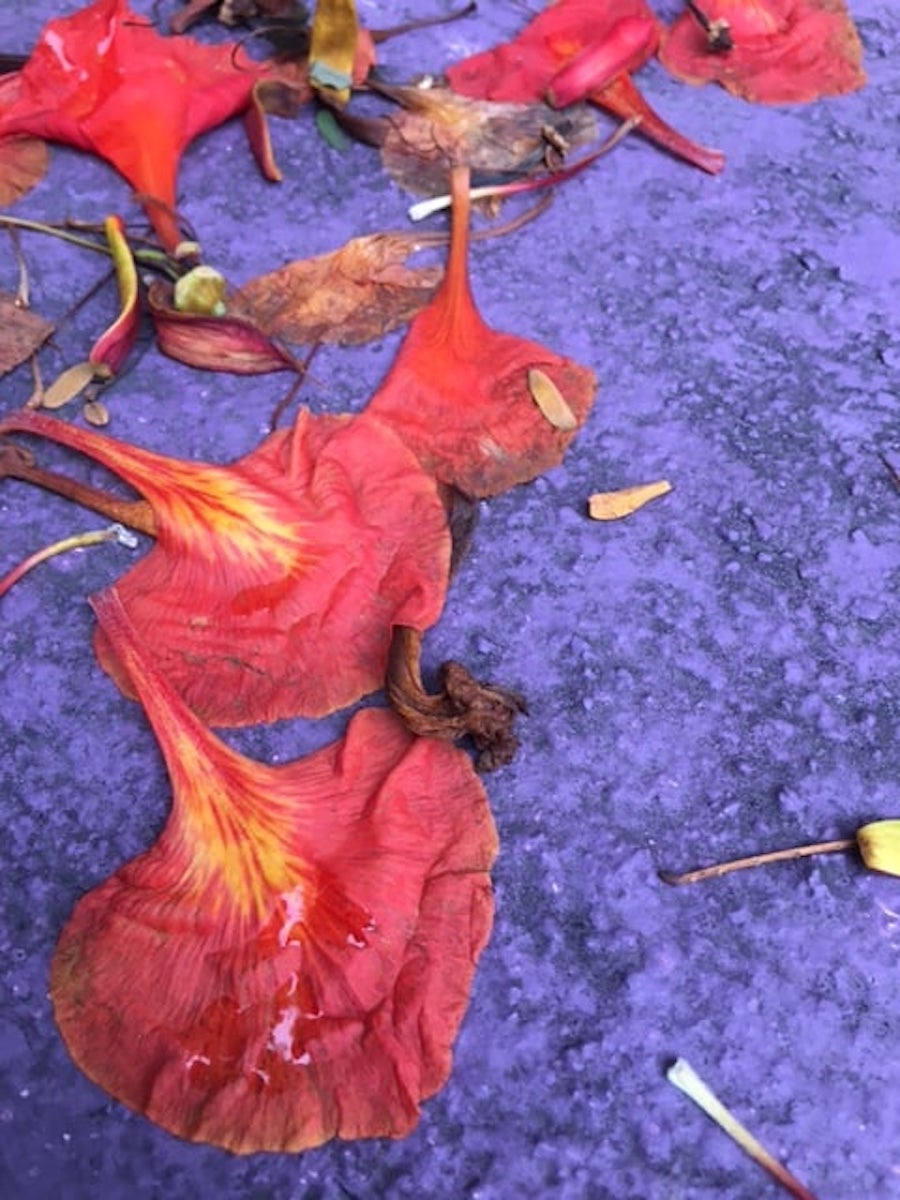
So let’s turn to this image from our friend-teacher-blogger Ruth Hersey’s. Ruth lives and teaches in Haiti. She made it home safely from a summer trip to the states only to be faced with political upheaval and an earthquake. Ruth is thankfully safe. Every day she posts a photo response to a daily prompt. She posted this beauty on Facebook. It’s an image that speaks of the beauty found in the tragedy. The petals are from the flamboyant tree (poinciana).
Ruth is also posting daily updates about Haiti and organizations that are on the ground doing good work. Check her FB page. For another way to donate to vetted organizations on the ground, click here for CNN’s Haiti Earthquake Relief.
Flamboyant tree by Ruth Hersey
Your flames still burn bright petals fall, confetti-tears after the party
Margaret Simon, draft
Write a small poem in the comments. Share encouraging words for other writers. Donate to Haiti, if you are able.
Today is my 60th birthday. I gasp when I see that. Sixty years is a long time! I share my birthday with two sisters I met right here, connecting through blogging, Linda Mitchell and Julieanne Harmatz. Happy Birthday to you, too!
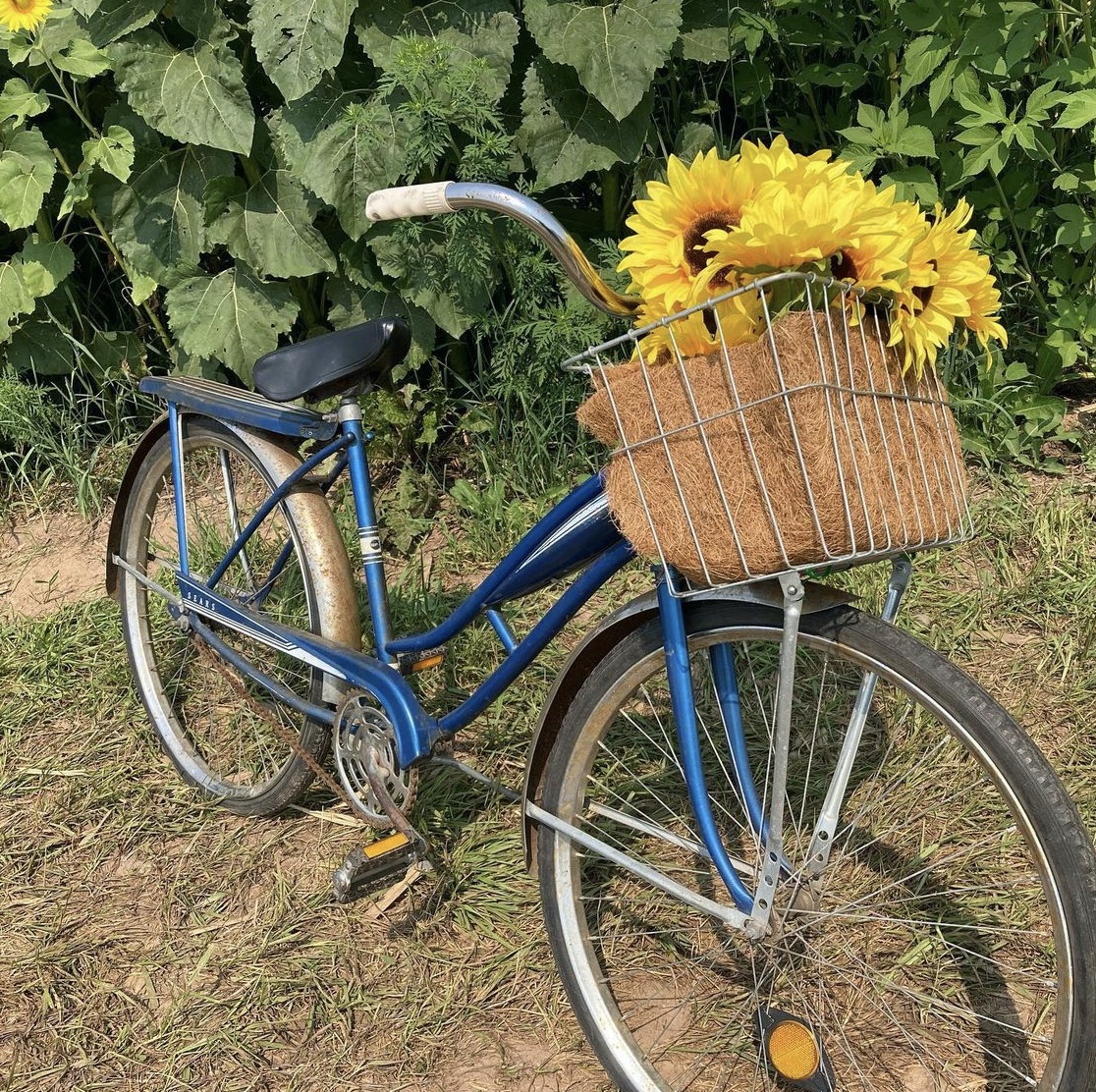
This week’s photo is a fun one. I found it on Instagram, posted by Trina Bartel, another fellow blogger. She tells me it was taken at Bergsbaken Farms in Wisconsin.
(The photo) is from a sunflower farm in a tiny town in Cecil, WI (NE WI). It’s a huge field of sunflowers that you can visit for a suggested donation of 2 dollars each. There are props (like the bike) that you can take photos with. The bike is on the edge of a huge sunflower field. It is at the entrance. This sunflower farm is about 3-4 years old. I believe it was created as a way to generate money for a struggling family farm.
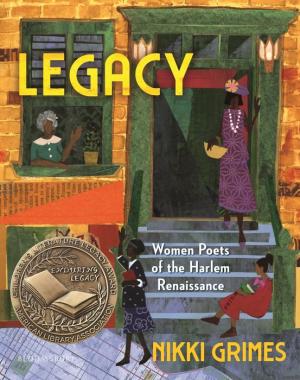
I was the lucky winner of a free copy of Legacy by Nikki Grimes. I would have, should have a copy of this book, but hadn’t bought it yet. I recently subscribed to Chris Barton’s newsletter, and low and behold, was the winner of this book on my first month. You can be lucky, too. Subscribe here. His newsletters are full of stuff, author interviews on “This Book is Dedicated to”, promotional materials, and links to more.
In Legacy, Nikki Grimes uses the golden shovel form to celebrate women poets of the Harlem Renaissance. Each Renaissance poem is accompanied by a golden shovel and an illustration by a Black woman artist. It’s beautifully pulled together into 3 sections: Heritage, Earth Mother, and Taking Notice.
The poems I am featuring today are about poetry, the writing of poems. The fancy term is ars poetica.
Notice the tactile in this poem, kneel, wriggling, and my favorite “water which satisfies, soothes, tickles–what wet word/ pours itself into the vessel that/you call thought?” Nikki Grimes calls us to notice it all and make poetry.
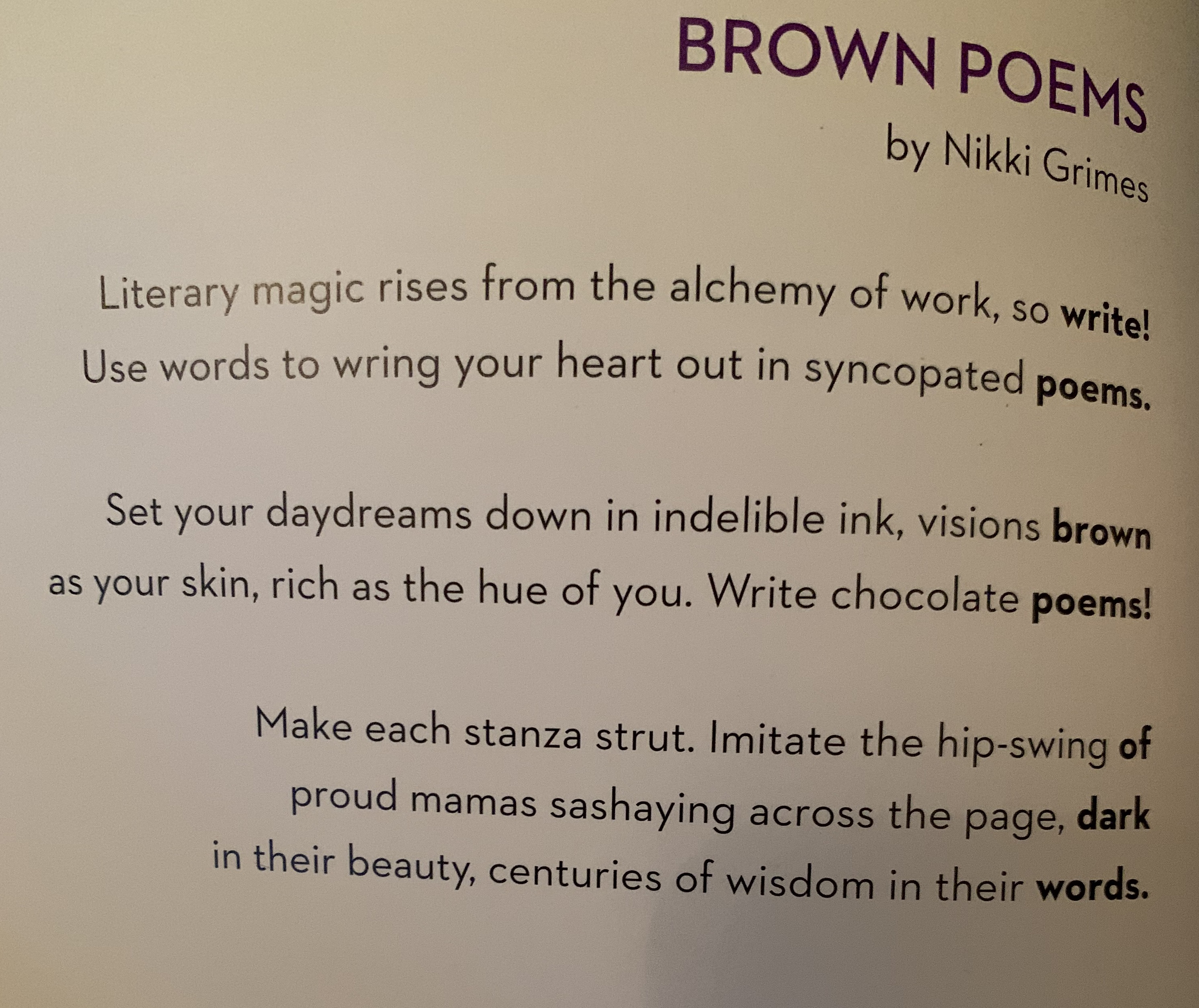
And this one I will print out for my brown girl writers this year.
I love the instruction to “Write chocolate poems!” Can’t you taste it? I’ll bring in Dove chocolates, the kind with a message on the wrapper and hand them this poem. Yes! I’m excited to start a new year of teaching with this book in my hands. Thanks, Chris Barton and Nikki Grimes!
Let’s get real; I took on the Sealy Challenge to get smarter, to read more poetry, to fill the well. The reality is I am challenged. Challenged not because I don’t have enough poetry books. Not because I can’t read a poetry book each day. I am challenged because poetry is not like fiction that carries you through with a narrative. Poetry requires a different kind of reading. You can’t skim poetry. You have to sit with a poem, and read it again and again to let it sink in. This takes time.
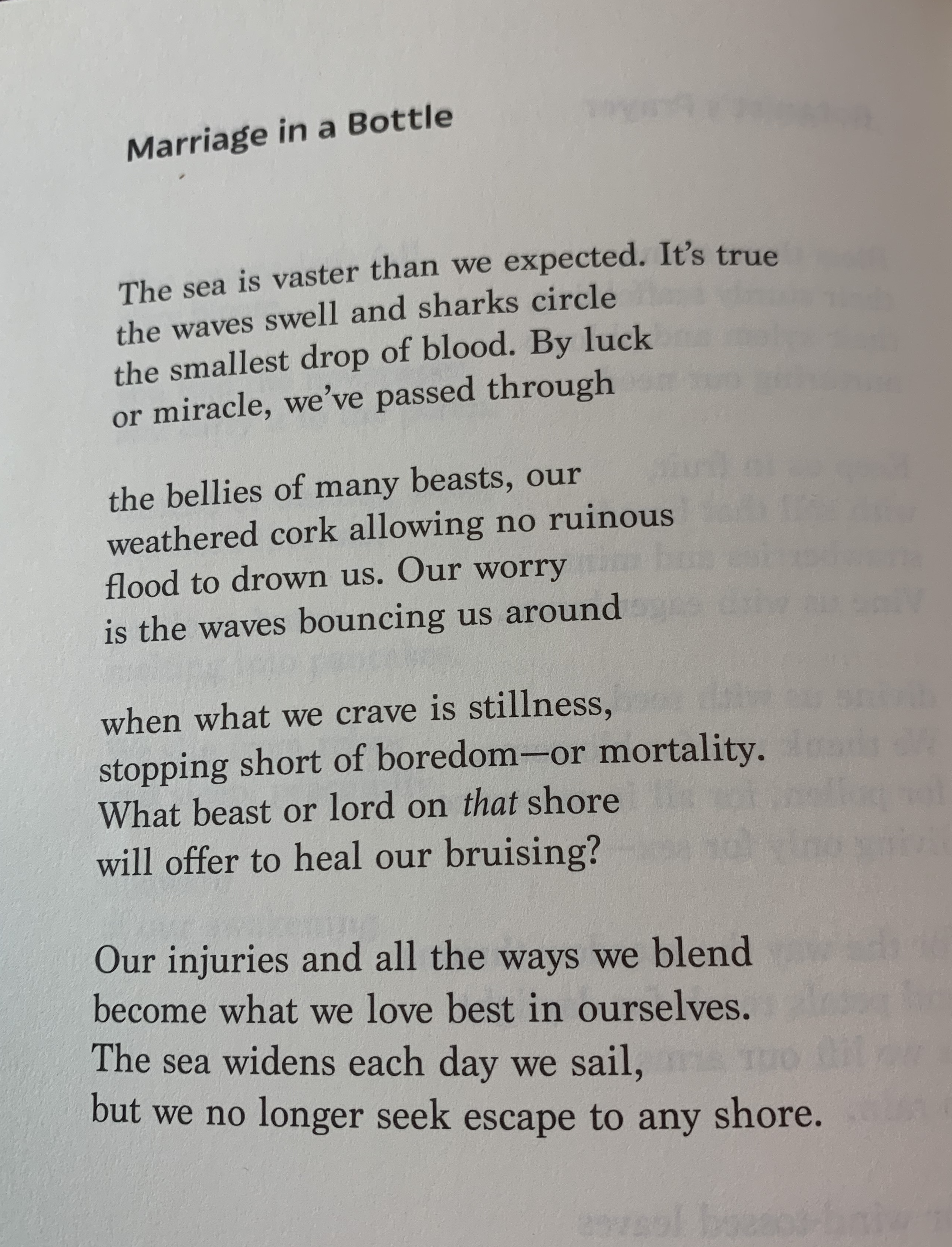
The latest books I’ve read are Irene Latham’s The Sky Between Us and Tracy K. Smith’s Life on Mars. Irene gave me her little chapbook years ago. Since then I’ve followed her blog, bought most of her books, and become friends with her. The Sky Between Us is a love song.
In the “Author’s Note”, Irene wrote “One of the great joys of my life continues to be the discovery of all the beauty this life offers, both in the natural world and in relationships.” In this way, The Sky Between Us slides in beside and between the pages of Life on Mars.
“Marriage in a Bottle” by Irene Latham
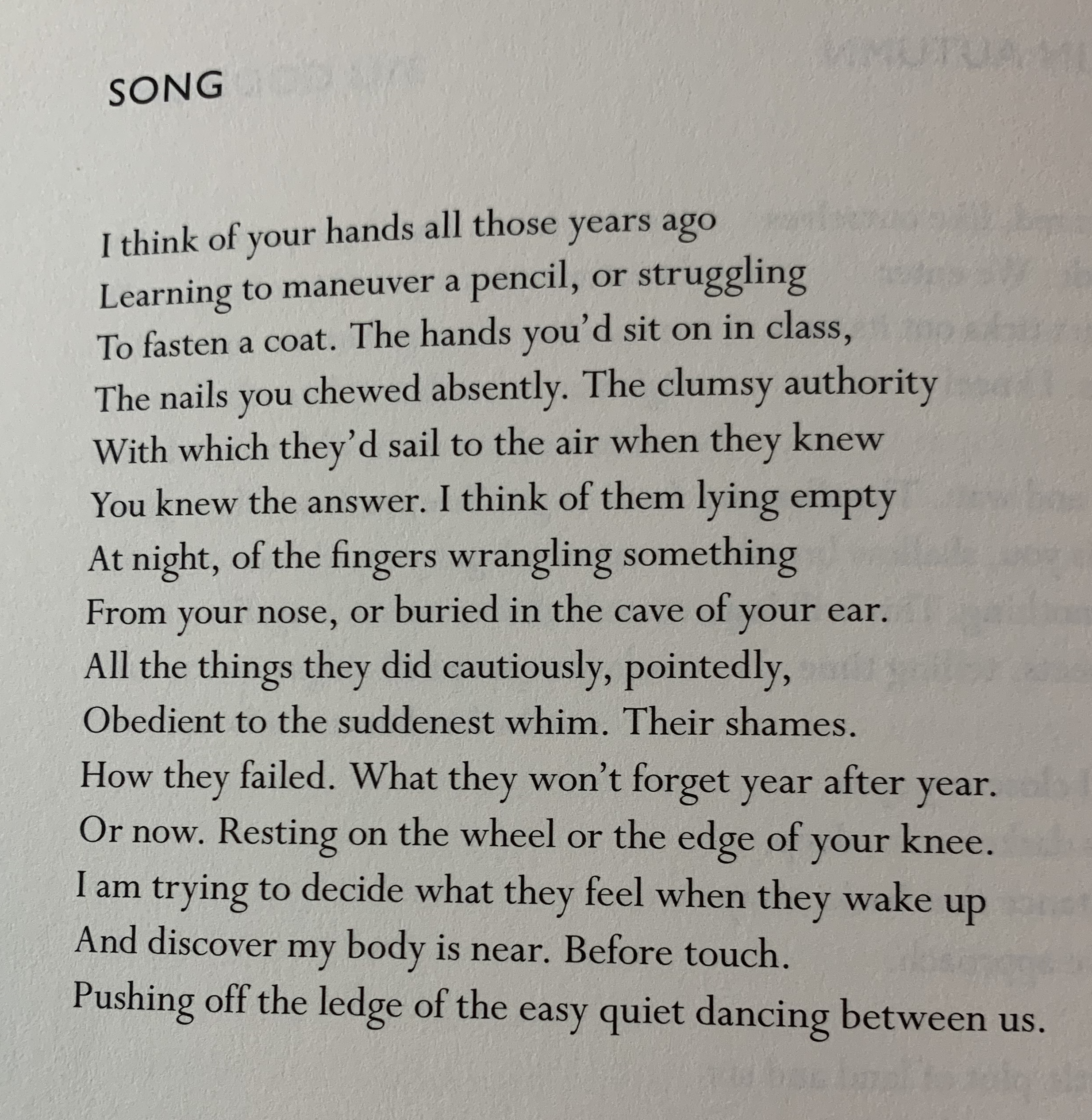
In 2017, Tracy K. Smith served as Poet Laureate of the United States. I loved her poetry podcast, The Slowdown. Her book Life on Mars (2011) won the Pulitzer Prize for Poetry. This book was written as an elegy to Smith’s father who was an astronomer who worked on the Hubble telescope. But, of course, it’s so much more. The poem I chose to share sits beside Marriage in a Bottle. I’ve tucked away the last line for stealing. Celebrating my 39th wedding anniversary this weekend has put me in the mood for marriage poems, poems that speak to the complexity and simplicity of loving another human for a lifetime.
Margaret Simon lives on the Bayou Teche in New Iberia, Louisiana. She is a retired elementary gifted teacher who writes poetry and children's books. Welcome to a space of peace, poetry, and personal reflection. Walk in kindness.