Feeds:
Posts
Comments

Archive for the ‘Teaching’ Category

DigiLitSunday Logo

Please use this button on your site for DigiLit Sunday posts

stones-1372677_960_720

The image above makes me imagine metaphorically that I am that big green rock holding in balance the different colors of my students.  Teaching is a delicate balancing act.  As teachers, we must set goals for our students, individually and collectively.  Our job is to get on the train every morning and move down the tracks to that goal.  (Excuse the mix of metaphors.)

Sometimes one student can topple the whole balancing game.  We must stop whatever it is we are doing and pay attention.  Focus on needs rather than goals.

This week I had to call on a colleague for help.  I was not meeting a student’s need, and I wasn’t sure where to go next.  I had tried many directions, but none were working very well.  This is humbling.  However, I found strength and comfort in the shared experience.  Reaching out when you feel defeated is tough to do.  I am so grateful now that I did.  My student is better for it.  I am better for it.

My students write every day.  Writing is a brave act. So different from answering questions or working out a math problem.  Writing is personal and hard.

This week one of my goals was teaching essay.  The kind of essay that testing will require in which the student writes about a literary element (in this case, theme) comparing two texts.  We worked with a nonfiction article and a poem.

During a conference with one of my students, I read aloud to her what she had written.  “Blah, blah, blah” was her response.  “I can’t stand writing essays.  They’re so boring!”  After our chat, she typed up her boring essay.  I had to laugh when I read it.  She began with, “Hey, world. Listen here!”  And at a later point, she wrote, “Now that is awesome!”

My students need to be able to express themselves.  Sometimes these expressions come out in loud exclamations, quiet tears, or interjections. No matter the goal, needs may throw us out of balance, or may be the very thing to keep the balance.

Please join the conversation by leaving a link below:

Read Full Post »

DigiLitSunday Logo

Please use this button on your site for DigiLit Sunday posts

Personally I have become very suspicious of news lately.  The skeptic in me is showing.  On social media, I hesitate to click through to a website for fear of ad invasion or some pop-up wanting me to sign up, and then there’s the creepy fact that everything you search becomes part of your history and everyone knows.  I placed an order on Jet.com and for a week, every website I went to popped up a Jet.com ad.  Really? Modern day commercials geared to who some cyberspace robot thinks I am.

How do we protect our children in these times of everything is news, real or fake?  When the topic came up, I originally thought I didn’t need to worry about it.  Our school district has safety blocks in place; however, lots of fake news sites have ways of circumventing these blocks.  And in the name of good research, my students were finding them.  Time for a talk.

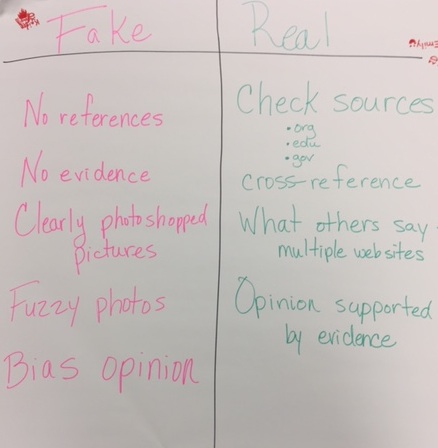
Armed with chart paper, I wanted to find out what my students already knew about the difference between fake and real news stories.  Here’s what we came up with.

fake-real-news-chart

Then I asked my students to pick a story on the internet that they are interested in investigating and write about their findings.  One student made an interesting discovery when she wanted to find out if Donald Trump supports LGBT rights.  She was confused by the reports and the images of Trump holding an LGBT flag.  Which is true?  In this case, both.  So now we are on to another issue, what do we believe by the actions and the words of a person in politics?  My response was yes, it’s confusing, so write about that!

Kevin Hodgson tweeted a Google slide show that he created for his students.  I plan to show this next week to keep the conversation open.

I don’t have all the answers.   This world of news at our fingertips, real or fake or just plain confusing, can be daunting.  I want my students to be discerning citizens.  So I keep the doors open.  We wonder.  We question.  We look for answers.

Please add your link to the conversation below.

Read Full Post »

Join the Two Writing Teachers blog for the Slice of Life Challenge.

Join the Two Writing Teachers blog for the Slice of Life Challenge.

The writer has to be like the firefighter, whose job, while everyone else is fleeing the flames, is to run straight into them. — Jonathan Franzen in The Best American Essays 2016

After reading Katherine Bomer’s book The Journey is Everything, meeting her virtually by hosting a Twitter chat, and meeting her face to face at NCTE16, I have a new understanding of the power of essay. Katherine’s passion for the resurgence of the real essay came through in the panel she hosted at NCTE with Corinne Arens, Allyson Smith, and Matthew Harper. These teachers experienced the transformative power of essay in a writing institute, and transferred that understanding to their classrooms.

Unpacking my notes, I rediscovered this way of thinking and writing. In real essay, we explore Hot Spots, Buried Truths, and Freedom. We write to think, leaving space for unknowing. Like a conversation with your best friend, real essay uses words like maybe and perhaps while circling around an idea, unwinding your thinking.

Essay is literature. Essay includes ideas, voice, and risk. It is the risk that stood out to me. Isn’t all writing risky? Yes, but adding the element of risk to essay has been funneled out by the Common Core testing. And when we remove risk, we remove what makes us human. Jonathan Franzen agrees as he writes in the introduction to the 2016 collection of The Best American Essays, “A true essay is ‘something hazarded, not definitive, not authoritative; something ventured on the basis of the author’s personal experience and subjectivity.'”

Writers are not born, they are made. In order to discover what we think, what we know, what we are passionate about, we need to be real in our essays, in our blog posts, with our students. When we trust this process of discovery, we allow our students an opportunity to express themselves beyond 5 paragraph essay structure.

The writer holds the paintbrush. Rather than painting an image with authority, paint with abandon to the rules. The image will be creative, expressive, and all yours.

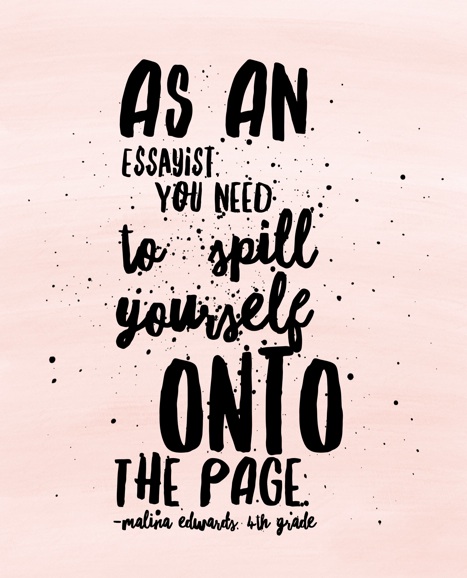
student-essay-quote

Read Full Post »

A breakfast conversation in the lobby of the Hilton in Atlanta for the NCTE 2016 conference, Collette turns to me and points her finger saying, “Words matter!”

We talked about this a lot.  Words and their importance was in the theme of every presentation I attended.  What we say, what we write, how we express ourselves and how we lead our students to express themselves matters.

The first gathering I attended on Thursday afternoon featured the work of Thomas Newkirk.  Friends and colleagues gathered to share how Tom’s words had influenced the ongoing work of writers like Penny Kittle, Jeff Wilhelm, and Ellin Keene. Jeff Wilhelm shared this Marge Percy poem, “To Be of Use.”   I wondered, “Am I of use?”

Our theories are disguised autobiographies often rooted in childhood.  –Tom Newkirk

Penny Kittle repeated this quote like a mantra, 3 times.  Long enough for me to write it down.  Long enough for me to contemplate what that means for me and for my students.  This idea leads us to empathy. How can we not be empathetic if we consider everyone’s theories come from their roots?  We must respect the roots to offer ourselves and our students wings.

This theme of empathy and the value of words continued on Friday morning at the Heinemann breakfast honoring the work of Don Graves.  Katherine Bomer reminded us that kids want to write.

Writing is the way children’s voices come into power, reminding us that we are all human.–Katherine Bomer

Following all of the amazing, articulate speakers, we were asked to create our own credo.  Here’s mine:

Student voices are precious, like a tiny fragile egg.  I must crack it open without destroying the life inside. –Margaret Simon

NCTE is a powerful, inspirational gathering of gentle, generous, kind and brave teachers and authors.  We know that words matter, but hearing the message in this atmosphere ingrains it into our hearts, and we are empowered to move forward.


Read Full Post »

Note: Header image art by my sister, Beth Gibson Saxena.

Join the Two Writing Teachers blog for the Slice of Life Challenge.

Join the Two Writing Teachers blog for the Slice of Life Challenge.

jane-yolen_

Jane Yolen

Poets love words. Poets play with words. Poets want you to love language as much as they do.

In my classroom, we read poems together, searching for sounds, images, and meaning. Jane Yolen is a master. I’ve admired her poetry for years. But only a year ago, maybe less, I signed up for her daily poem email. She believes in writing a poem a day. She practices what she preaches and sends out her daily drafts trusting that we receivers will honor and respect her words.

I shared one of these gems with my students, “Seven Ways of Kneeling on the Ground.” My first intent in sharing this poem was to show students how to use a pattern of 7 stanzas with 3 lines each, but in further examination, the poem offered so much more. We found imagery bouncing off the page. Her poem exemplified the magical sounds of words without using end rhyme: “Kneeling in the high bracken/ the brown crackle of it.”

There is JOY in reading a poem together, marking it up in colorful markers, and discovering how language (the sounds of words, double meanings, metaphor) leads us to a deeper understanding of our world.

jane-yolen-quote

Read Full Post »

Find more celebration posts at Ruth's blog.

Find more celebration posts at Ruth’s blog.


roses-paint

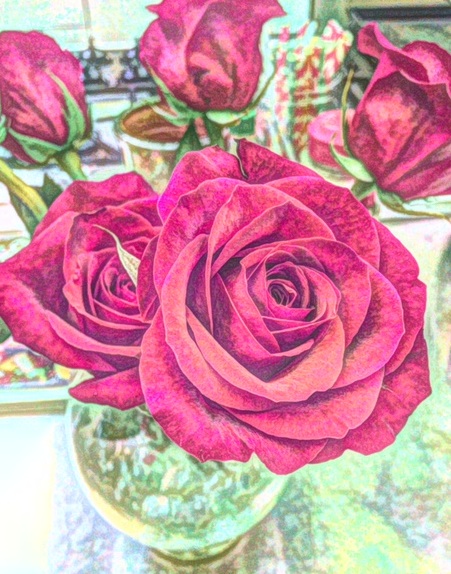
Celebrate #1: He bought me roses.  The beauty of a single rose is enough to take my breath away.  Something so small and simple is really a sign of the hope. I need that hope this week.

Celebrate #2:  NCTE is coming!  I leave on Thursday and will be meeting up with many friends.  I celebrate that I am co-moderating two panels.  I will also be involved with 2 roundtable discussions.  But most of all, I will be surrounded by like-minded people who want the best for their students.


writing-for-a-better-world-poetry-as-an-agent-of-changencte-2106saturday-nov-19-20169-30-amb210-copy


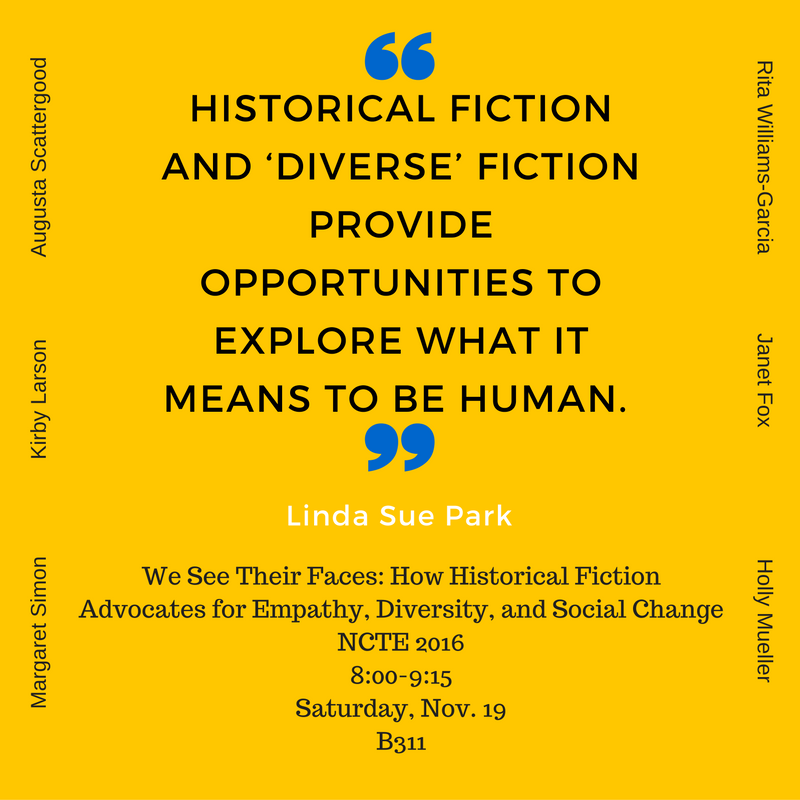
historical-fiction-and-diverse-fiction-provide-opportunities-to-explore-what-it-means-to-be-human

My NCTE schedule:

Sat., 8 AM: F.21 We See Their Faces: How Historical Fiction Advocates for Empathy, Diversity, and Social Change B311

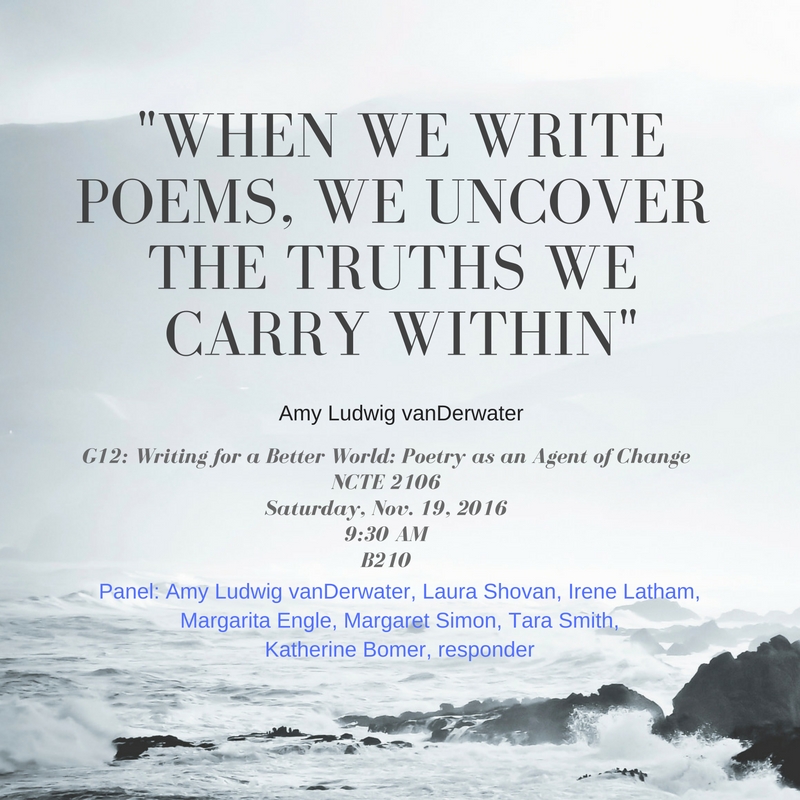
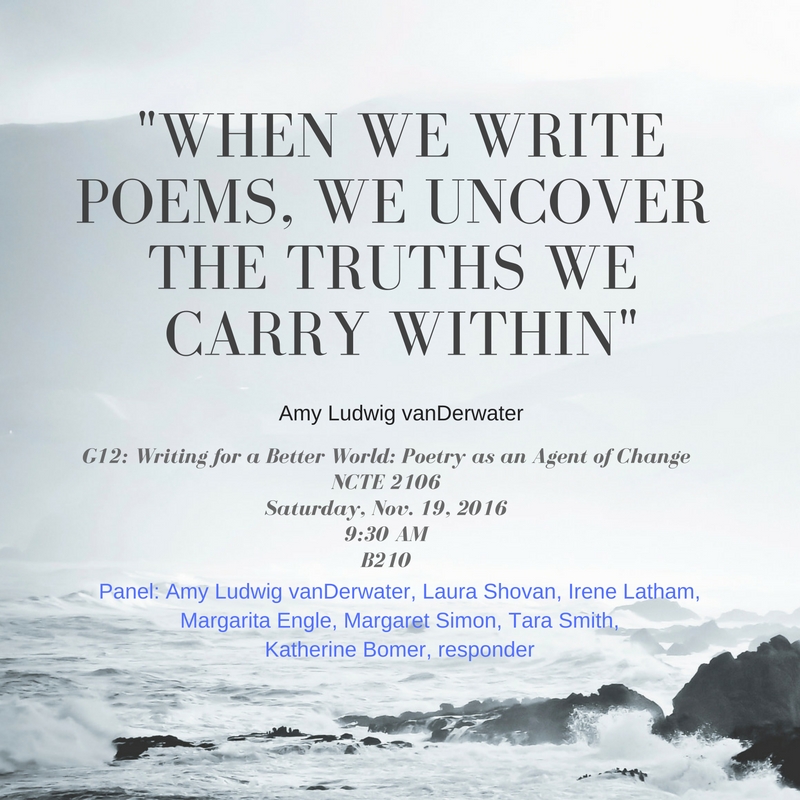
Sat., 9:30 G.12 Writing for a Better World: Poetry Response to World Events B210

Sat., 1:15 I.27 Authentic Voice in a Digital World: Using Technology in Our Literate Lives B215

Sunday, 1:30 N.20 Teachers as Writers: Practices and Possibilities (an NCTE Roundtable Session) b206 


Celebrate #3:  Class Twitter account: @MrsSimonsSea.  My students are excited to have their very own Twitter account.  I look forward to exploring ways we can connect with authors and other classrooms.  If you have a class account, please follow us.  Our first Tweet was a 4th grade student’s podcast about the importance of pets.

Jenn Hayhurst tweeted back.

I can’t wait to share this with Andrew on Monday.  I celebrate online connections and building student confidence with social media.

Please come back tomorrow for DigiLitSunday! Our topic this week is “Purpose.”

the-purpose-of-lifeis-a-lifeof-purpose

Read Full Post »


Please use this button on your site for DigiLit Sunday posts

Please use this button on your site for DigiLit Sunday posts


A friend once told me that I have an artist’s mind, random and all over the place.  While it was a nice way to put it, what she was really telling me was I lack focus.  I’ve always hopped from project to project, idea to idea.  It’s difficult for me to stay tuned in to one thing for any length of time.

Last weekend I had a chat with Irene Latham on the steps of the State Museum at the Louisiana Book Festival.  We were talking about conferences.  She said she realized she could be a conference junkie but questioned whether that would serve her mission.  Her mission?  Yes, Irene has a mission statement.  Don’t we all?  She wrote about how to find your own mission statement in her post on Smack Dab in the Middle. 

The first question, “Who do you admire?” reminded me of a process my friend Kimberley talked about; Find the person who is doing what you want to do and find out how they got there.  In other words, “Be the change you want to see in the world.”

When creating a mission statement, I had to consider my personality type.  I really care what people think of me.  It’s a fault, except that it keeps me behaving in ways that are kind and thoughtful.  I want others to respect me, so I respect them.  Not a bad way to be.  It’s tough when I chew on an incident for a long time.  I’m not good at letting things go.  

What does this all have to do with digital literacy and teaching?  In creating a mission statement, a focus for my life, I see clearly that I want to empower others to be the best they can be.  I want to bring creativity into the world.  Through my teaching and writing, I can be both wind and wings.

My students worked all week on their podcasts.  They created scripts from their research and collaborated on making something creative and new.  Yet, the learning curve was high.  I wasn’t sure we could meet it.  I am still waiting on tech help from our district department; however, the glitches didn’t really bother the kids.  They understand that’s all part of making something new in this digital world.

When I reflect on the projects we do in my class, I realize the ones that encourage the strongest focus are ones that are highly creative, honor choice, and are student-driven.  My classroom mission statement is not that different from my personal mission statement.  Margaret and Mrs. Simon walk hand in hand to find their focus and meaning in this world.

focus


Post your link below:

Read Full Post »

Poetry Friday is with Laura at Writing the World for Kids

Poetry Friday is with Laura at Writing the World for Kids


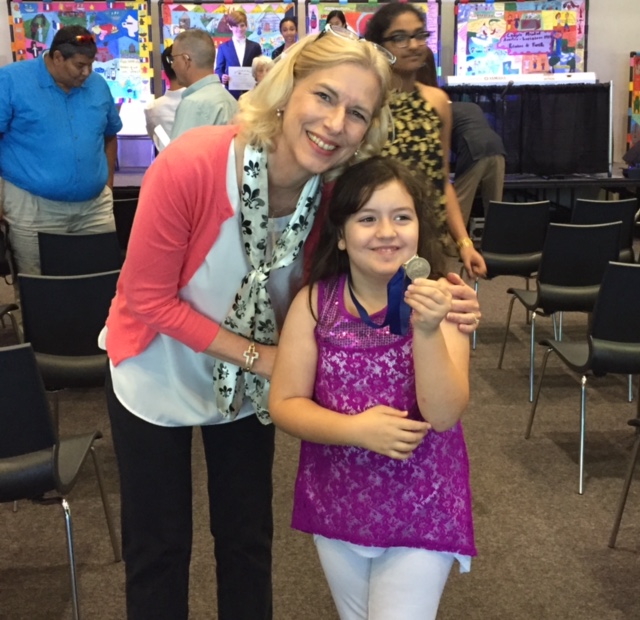
Do you enter contests?  I don’t.  But I pretty much insist that my kids do.  I even will go so far as to write it as a goal on their IEP.  At the end of the school year last year, most of my students entered a piece of writing into our state writing contest, LA Writes.  I was pleased to hear in September that three of them had placed.  The awards ceremony was last Saturday at the Louisiana Book Festival at the State Museum in Baton Rouge.  When Madison came to the microphone to read her poem, she introduced herself as “the author.”  What a thrill for this writing teacher to hear her describe herself as an author.

Madison shows off her first place medal.

Madison shows off her first place medal.

Madison wrote her first place poem after Irene Latham’s “Tree for All.” In May, we had a Skype visit with Irene.  She wrote about my students’ poems here.

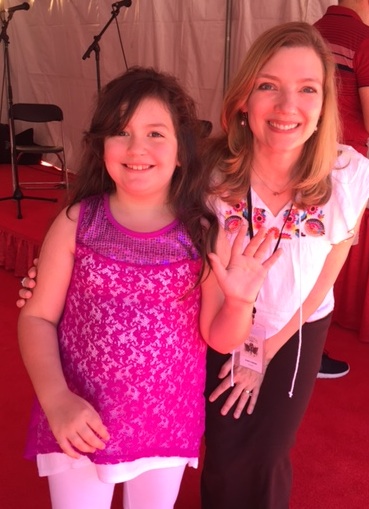
I secretly wished that Irene was there to hear Madison read.  Sometime wishes do come true.  Irene was at the Book Festival.  We met up later in the day.  She presented in the Children’s Storytelling Tent and guess who walked by?

Madison meets her author hero, Irene Latham.

Madison meets her author hero, Irene Latham.

Reef for All

after Irene Latham’s “Tree for All”

Sharks feast on my citizens;
my restaurant never closes.

Eels hide in my caves;
my shelters provide homes.

Sea worms play peek-a-boo in my tubes;
my tubes allow all ages.

Fish hide in my caves;
my cradle caves are cozy for new fins.

No sea animal can resist my charm:
I am a coral reef.

Madison

Tree for All (in Dear Wandering Wildebeests)
Giraffes feast on my leafy crown;
my buffet never closes.
Rhinos doze beneath my broad branches;
my umbrella selters and shades.
Baboons scramble up and down my trunk;
my playground delights all ages.
Owls nest in my hidden knothole;
my cradle cozies brand-new wings.
Skinks sleep in my thick, spotted bark;
my camouflage keeps them safe.
Safari ants trail along my roots;
my roadways help build a city.
No grassland beast can resist my charms;
I am a wild bush willow tree.
– Irene Latham
Contests make us feel famous.  They give students an opportunity to shine.  Thanks to Irene for being such a beautiful role model to budding author, Madison.

I will be presenting with Irene and some other awesome poets at NCTE 2016 in Atlanta:Sat., 9:30 G.12 Writing for a Better World: Poetry Response to World Events B210

writing-for-a-better-world-poetry-as-an-agent-of-changencte-2106saturday-nov-19-20169-30-amb210-copy

Read Full Post »

Poetry Friday is with Tricia at The Miss Rumphius Effect

Poetry Friday is with Tricia at The Miss Rumphius Effect


https://twitter.com/MargaretGSimon/status/789264438255820801

What a joy to join Georgia Heard on the Good to Great (#G2Great) chat Thursday night! Georgia sent me a copy of her latest book a few weeks ago. I was so excited to see that three of my students’ heart maps were included.

I questioned how Georgia could write a whole book about heart maps. But this book is a gem. In each section, not only do we get another idea for another type of heart map, twenty in all, but we also get a list of writing ideas and mentor texts. A side bar on each template asks questions to lead the student to his own heart.

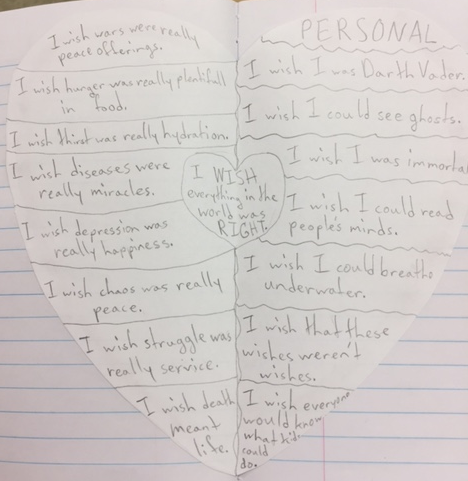
I used the wish heart map this week with 6th graders. These students are embarking on a yearlong project. As we begin this journey, my colleagues and I wanted them to explore deeply a problem they see in the world. The heart maps were a way to visually get them to the “heart” of the matter. Some students went straight to writing. This student’s wish map became a list poem of wishes.

wish-heart-map-angelle

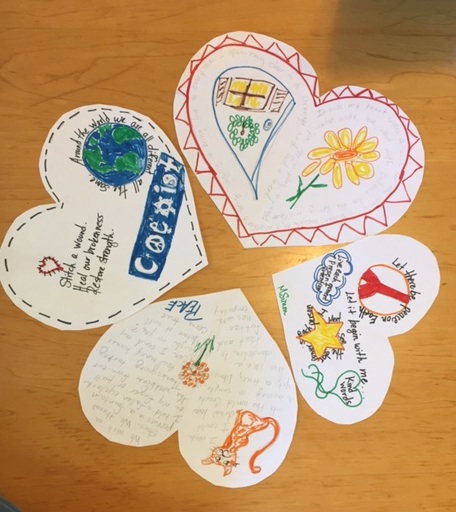
I usually write with my students, so why not make heart maps? The students rotated to me 4 times, so I have 4 hearts. Each one is different. Some are completely visual, but two of them became poems.

My wish heart maps

My wish heart maps

I Wish

I wish I could draw love
into the world.
Blow it freely
like a dandelion seed
to fertilize lives
with empathy.

We wish on falling stars,
on rainbows,
pennies thrown in the fountain.
There’s the obligatory pull
of wishbone, a tug between my brother and me.
If I win this time,
can I send this wish to you?
Will it come true?

–Margaret Simon

Thank you, Georgia Heard, for leading me, as well as countless children, to our hearts.

https://twitter.com/MargaretGSimon/status/789263683641802752

Read Full Post »

Join the Two Writing Teachers blog for the Slice of Life Challenge.

Join the Two Writing Teachers blog for the Slice of Life Challenge.

The air is turning cooler, and the leaves are changing color. Satsumas are ripening on our satsuma tree. They are so heavy the branches are dragging on the ground. And when I take Charlie out at six in the morning, it’s dark, very dark, and the sun doesn’t rise until we are almost home. All these signs should have made me realize that the first nine weeks of school is ending.

Each grading period, I ask my students to revisit all the books they have read and select one to present to their classmates. This is a fun activity for them. I also want to make it a learning activity, so we talk about elements to include: title, author, genre, tone, characters, setting, plot…

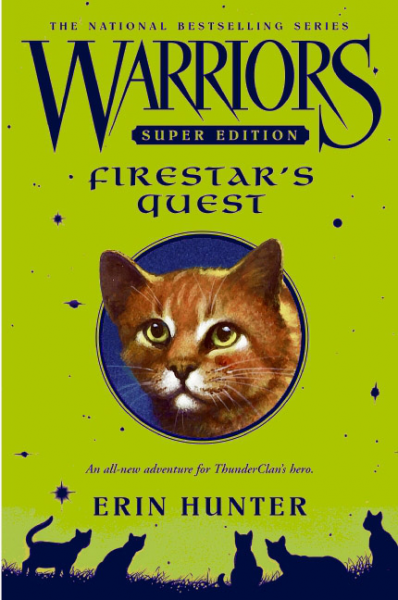
Madison was excited about her book trailer. Animoto was her choice and she carefully selected pictures, music, and background. When I looked at her finished product, I noticed that she had identified the genre of the Warrior Cat series as realistic fiction. This gave me pause. Maybe she just didn’t have a clear understanding of genres.

I started a private discussion with Madison that I’m afraid made her cry. I was confused about her tears. She just kept repeating, “It’s the point of view of the cats.”

I finally realized that to her the story was very real. By then a few other classmates had joined into the conversation. Jacob recalled that they had learned about lucid dreams. He said, “It’s like that lucid dream when you feel like you are really doing all those things.”

Ding! The Aha bell rang. I told Madison that it was OK that she feels like the story is real. The author writes as if everything is real, like a lucid dream.

The next thing I knew, Madison had created a new genre, the lucid book. At this point she excitedly went back to her video and changed the genre to lucid. I did not correct her this time. Some things are best left to the imagination of children.

To see Madison’s Animoto book trailer, click here.

firestars-quest

Read Full Post »

« Newer Posts - Older Posts »