More Spiritual Journey posts are gathered at Karen Eastland’s blog. Click the image.
This month Karen chose Beauty as the theme for our Spiritual Journey posts. I was looking through a magazine and came across the word “Beautiful,” so I decided I needed to make a collage. I love making collages, but don’t do it often. When other things get in the way, we tend to put aside the little creative things that make us happy. You feel guilty spending time on a frivolous pleasure. But it’s that very pleasure that keeps us creative and happy.
Beauty is… giggles from a grandson roses in bloom hot-air balloon on a summer morning kitten running sideways glass of red moss swaying in the breeze egret flying over the sugarcane field chocolate, dark with mint a cuppa latte with a petal in the froth these words, I love you.
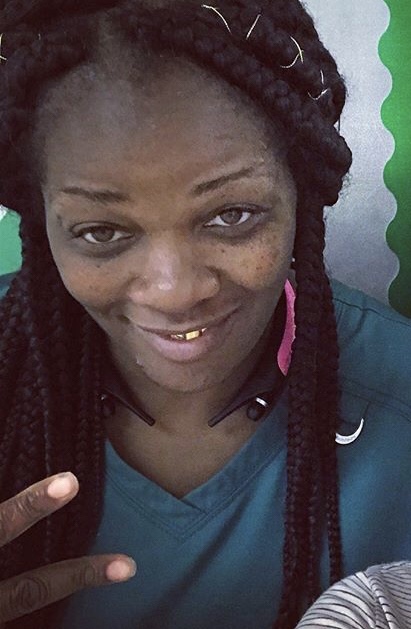
Kelo is gone. I can’t wrap my head around that fact. With her long weaves, gentle hazel eyes, and golden front teeth, Kelo danced with a mop and sang while she worked. She would greet you in the hallway with a genuine kindness that made you want to stop and talk.
“How’s that grand baby?” she’d ask me often because she knew I had a new grandson.
Kelo was so much more than a custodian at our school. Last year when I first started coming to the school to teach gifted, she knew my name well before I knew hers. She was pregnant with her 4th son, and my daughter was having her first, so we always had things to talk about. She’d encourage me with, “Girl, that baby’s coming soon!” We’d share photos and anecdotes. She was a friend.
I don’t understand how one day you’re here and the next, you’re gone. So much can change in an instant. Taken too soon by an innocent ATV accident, Kelo’s death has left a hollowness in the halls. My heart is heavy.
Kelo makes me want to be better about caring for others, to show genuine kindness as she did, and to sing like no one is listening, except Kelo from above.
Waiting for the Harvest, by Mickey Delcambre. First place in the Sugarcane Festival Photography Contest
Ralph Fletcher’s new book, Focus Lessons, is coming out, so I took advantage of Heinemann’s offer to read a sample.
There are strong links between photography and writing. This is true in substance and process, as well as language. The world of photography provides a visual, concrete language (angle, focus, point of view, close-up, panorama) that is enormously helpful in teaching writing.
Ralph Fletcher, Focus Lessons
When I saw Mickey Delcambre’s photo on my Facebook page, I was compelled to write a haiku.
Equinox harvest– Slow down days, long resting nights Autumn changes time.
Margaret Simon, draft, 2019
On Monday, I talked with my students about the Fall Equinox. I was surprised how well they know the solstices, but they were less familiar with the meaning of equinox.
In New Iberia this weekend, there is the annual Sugarcane Festival, celebrated on the last weekend of September as harvesting begins. We only have to look out of the window to see the tall cane waving in the fields.
One of the Craft Lessons included in the book sample focuses on Mood. Ralph explains how mood can be expressed in a photograph as well as in writing. I look forward to finding more crossovers between photography and writing Ralph says, “Photography is writing with light.”
I put Mickey’s photograph up and ask my students to do a quick write about it. Our quickwrites are typically 5 minutes. Then we share. Sometimes (it’s always a choice), a quickwrite will become a poem.
Seeing the Days Change
I see the days changing around me, going from day to night and night to day the marks of tires only from the day before seeing the sun go down getting ready for the night, goodnight sun.
Breighlynn, 4th grade
Sugar
Sugar in the fields, still as a cane. Growing, oh so tall, ready for the harvest. Burning leaves make the sweet smelling smoke.
Can you smell the sugar? Smelling, oh so sweet. Have you ever eaten the cane? As pure as sugar comes.
A.J., 6th grade
This morning on my morning walk I smelled the sweet air that A. J. wrote about. One of the gifts of fall.
See more posts at Two Writing Teachers Slice of Life
She appeared like a tiny white handkerchief waving in the breeze, barely noticeable on the windowsill of my husband’s office, mewing with every strength she had.
Over the course of a week at the end of August, one of the hottest weeks ever, my husband fed her, getting closer and closer, but she always darted back to safety under the steps at the house next door.
Jeff enlisted my help. “Do you want to try to catch her?”
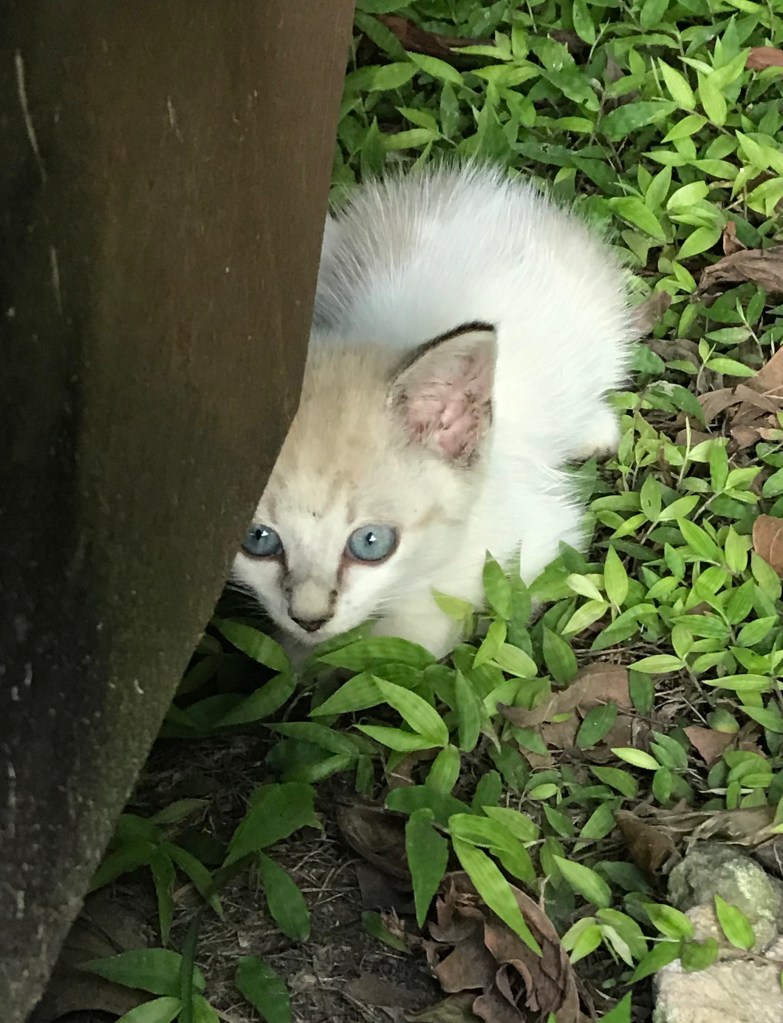
When I was able to get close enough to take a picture, I could see how beautiful she was, with bright blue eyes and a white coat. Three colors hinted that she may be a female kitten. I called her, “Sweet Kitty! Come here, sweet kitty!” She’d respond with a mew, but she wouldn’t venture out far enough for me to grab her. And I was soaked in sweat and covered in mosquito bites. I tried for three evenings.
Peeking out from her home under the steps, no older than 4 weeks.
Finally, we bought a little can of Fancy Feast. She couldn’t resist it, and I was able to grab her. We brought her home and set her up in the “Cat Camp” on our back porch. Named her Fancy, of course.
At her first visit to our trusted vet, Dr. Eric, she was too young for shots. We treated her for worms and fleas and were to take her back in a week for shots.
Unfortunately on her visit the next week, she had a hypoglycemic episode. They revived her with fluids, and gave us instructions to feed her every four hours. Things began to go wrong after that.
At home for another two days, she was eating, but she developed a terrible case of diarrhea. Back to Dr. Eric. He was cautiously optimistic and diagnosed her with colitis. They kept her for two nights treating her with antibiotics, feeding, and fluids. Dr. Eric rejoiced when she went from one pound to 1.4 lbs. He took a special interest in our pretty kitty.
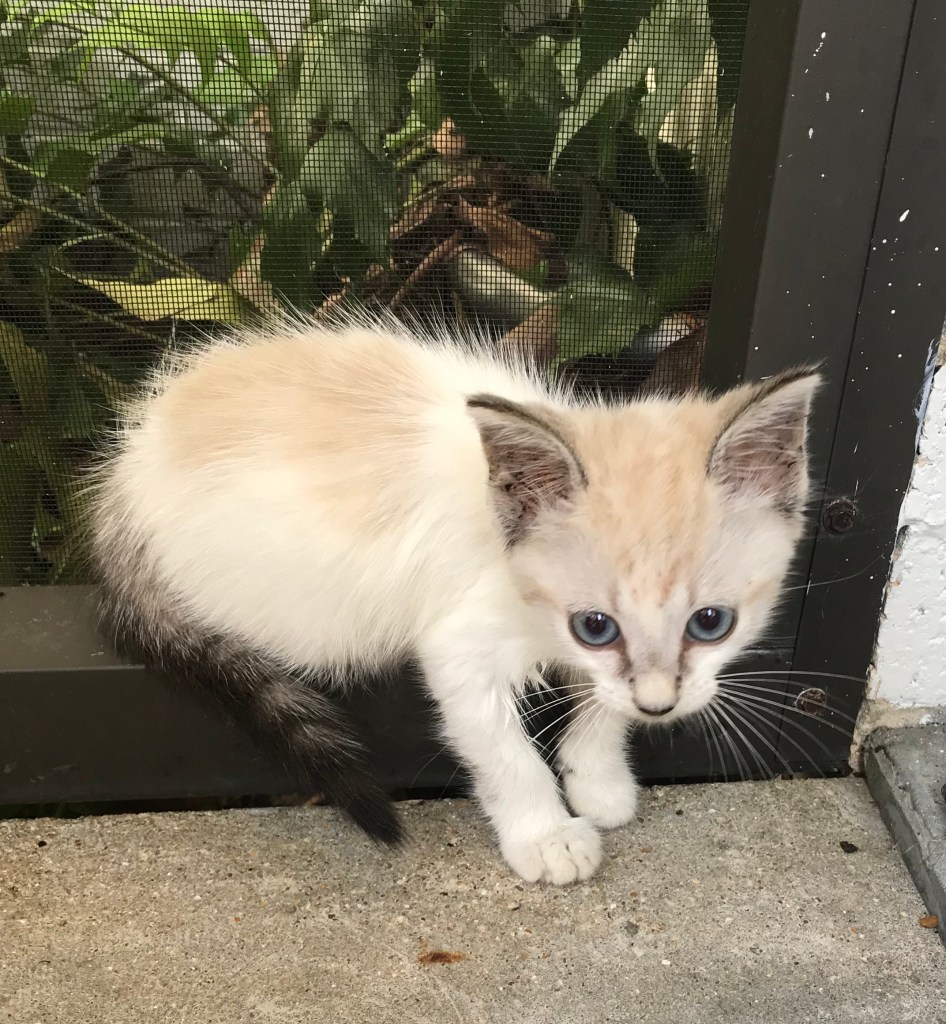
This weekend we enjoyed a new kitty, one who jumped and played and ate and ate. She is getting better. Hallelujah!
Poetry Friday round-up is with Linda at Teacher Dance
My students this year look forward to Poetry Friday when we read a poem and talk about what we notice, then try the form on. A few weeks ago we read Jane Yolen’s poem, “A Word is Not a Poem” that I had saved from her daily email poems. Having the form of her poem in hand, my students created interesting poem responses.
A Laugh is Not a Smile
A laugh is not a smile but it is a feeling inside you. You can laugh once but it’s best to laugh twice. laugh laugh
A smile is not a frown but it is a feeling inside you. used in several ways, to express love, and happiness. smile smile
Jamison, 4th grade
A Book is not a Word
A book is not a word , but a forest in a tree . Used in many ways , it can even be funny .
A book is not a poem You can only read it once , but best to read it twice . Book , Book .
A book is not a song , the words you cannot spin . Won’t know it going in you will though coming out . Tone , Note .
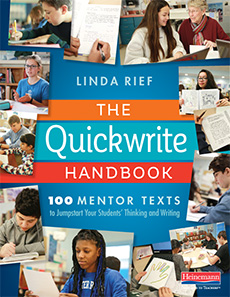
With my gifted kids, I’ve been using Linda Rief’s Quickwrite Handbook. She offers mentor texts and prompts for writing. These mentor text quickwrite prompts give a jumpstart to a blog post. I write with my students. Today I want to share a few responses to “When I was Young in the Mountains” by Cynthia Rylant. Linda Rief wrote “When I was Young at the Ocean” and included many sensory images. We were able to see how using senses in our writing creates strong imagery for the reader to understand. Karson took us to his eye doctor appointment.
When I was young at the eye doctor, I was very nervous. I did not know what I would look like with glasses on. I did not know if I would even end up with glasses! We went to the eye doctor at Lens Crafters in the mall. They called me,” Karson, we are ready for you.” When I was young at the eye doctor they had to check my eyes. The room was really small. The light was dim. I sat in a rolling chair like my teacher’s. They made me look at a farmhouse while they took pictures. Then they made me look at a green light. That scanned my eyes. When I was young, I cried and cried because I did not want to do the thingy where it blows air. The doctor was a woman, and she was so nice, she let me skip it. When I was young at the eye doctor, I thought I had to dilate my eyes but I also cried and cried and I had tears dripping with sweat because I was scared. But because I was crying, I did not have to do that either. When I was young at the eye doctor, I eventually got glasses. I was okay with it because I look so cool. My glasses are my friends. They still are.
Karson, 5th grade
This summer I had to say good-bye to my parents’ house on the lake. The memories are bringing me back, and writing helps me process them.
When I was a Daughter at the Lake
When I was a daughter at the lake, I swung on the porch swing pushing off from a little plastic stool and listening to the squeak of the chains. Sometimes my father sat near me with his newspaper and a bowl of cereal. He’d look up to tell me a bit of news. “Listen to this!” he’d exclaim, and I’d laugh internally at his total exasperation at the world.
When I was a daughter at the lake, I’d sleep late with no alarm set, waking to the scent of coffee and pancakes, maple syrup, melting butter. Mom in her robe stood near the griddle and greeted me with a smile. “Good morning, sleepy-head.”
When I was their daughter at the lake, worries melted away like the sunset on the horizon. We’d talk and talk. Sometimes we’d sit silently watching the heron fishing. Their presence was enough. It still is.
Margaret Simon, draft, 2019
Shaelon remembered his vacation to Florida this summer. Using the form helped him describe many details of the trip. This is just one of his four paragraphs. The repeated line is helpful in creating a framework for writing.
When I was nine at the beach, we got to the beach.I ran and felt the nice soft sand on my toes.I ran to the water and touched it.It felt warm and soothing.I ran in until it was to my waist.Now it felt cold.I hurried back to the shore and look for my mom.My sister and I sat down on the sand next to my mom and attempted to try and make a sand castle.We had made good progress until the tide came in and washed it away.I gave up and walked along the shore, picking up shells and looking at their beauty.I tried to see if I can hear the water lapping in the shell because my sister had told me I can.I ran back and showed my mom all the shells I had collected.
Shaelon, 6th grade
I will continue to find inspiring writing prompts in Linda Rief’s book. When we study other authors, we discover our own way to writing.
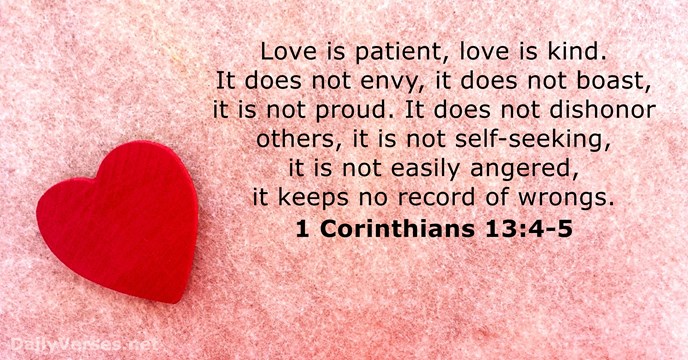
As long as I am here, I will continue to grow and change and learn. I once thought that the first Corinthians verse was about love between a husband and wife. It’s often read aloud at weddings and speaks clearly about how you successfully love your spouse, with patience and kindness, without self-seeking and anger.
This year I’ve been engaged in a study of The Course in Miracles. My instructor reads the lessons daily to me (and others) using Voxer. She offers a meditation practice as well. The process of growth has been slow and gradual, hardly even noticeable if you know me. The language is what is changing. My instructor has changed the word God to the word Love. This seems small and insignificant, like a little nudge to my thinking.
I have attended church all my life. I’ve heard the words of the Bible over and over. Yet changing God from a person-like thing to an emotion has had profound effects on my thoughts. When God is with us, Love is with us.
We are called to be Love to one another. To be patient and kind in all that we do. Not to envy or boast or look out for ourselves. This is a call to service. God is Love. Love is God. How simple! How true!
I find peace in the knowledge that God has already given me everything I need to be successful. Love. It really is all we need. Love is everything. Love is enough.
A few weeks ago the Sunday Night Swaggers, my online writing group, posted a new form created by poet and teacher Heidi Mordhorst, the definito: a free verse poem of 8-12 lines that uses word play to define a word. The word is the last line of the poem.
I introduced the form to my students. Every Friday we are deconstructing poetry and writing our own. We name and mark poetic elements. This activity inspired me to write definitos about poetic terms. I am sharing three of them today, alliteration, imagery, and personification.
Letters, linked and lively, Lindy-hopping on the page Notice how some sounds repeat Tongue twister Word sister …alliteration.
Make a movie in your mind Imagine all that tastes, feels, sounds– hands gripping, feet slipping, Writers show me how to see with imagery.
If the wind waves If flowers wink If hummingbirds tell a tale. A thing you know A thing you love becomes a person real and alive walking across the page personification.
See more posts at Two Writing Teachers Slice of Life
Last week I read my teacher-blogger-writer-friend Molly Hogan’s Slice of Life post. It touched the poet in me. Molly wakes early and goes on photography quests. When we’re lucky, she takes us along on her Facebook posts or blog. Last week she wrote this post entitled A Generous Morning.
Inspired, I copied her words into a found poem. Her generous morning became my generous morning. That’s how it works with creativity; it’s all big magic.
A Generous Morning
Lightening sky in the east as surely as the birds were migrating south, I missed the swallows.
The sky seemed lonely. Then a couple of swallows dart and dive through the air currents, and a bird approaching in the distance-
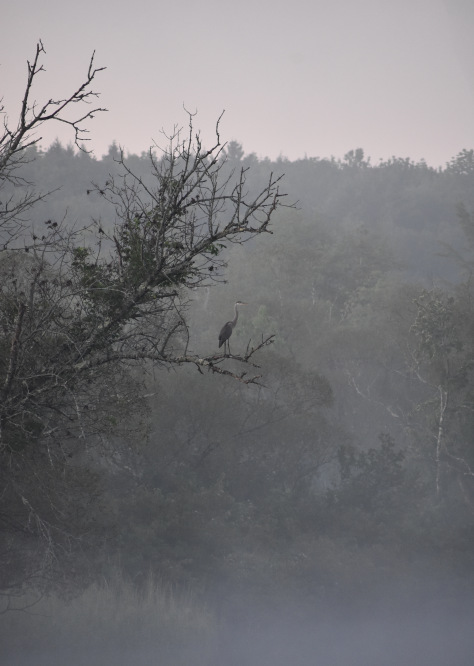
a heron
Sun rose higher, lit the mist. Cedar waxwings flittered. I watched it all, the generosity of morning.
a found poem by Margaret Simon using Molly Hogan’s words.
The children’s poetry community lost a friend and a mentor when Lee Bennett Hopkins died on August 8th. I never had the pleasure of meeting him, but in everything I’ve read about him, he was a gentle leader and proud father of poetry.
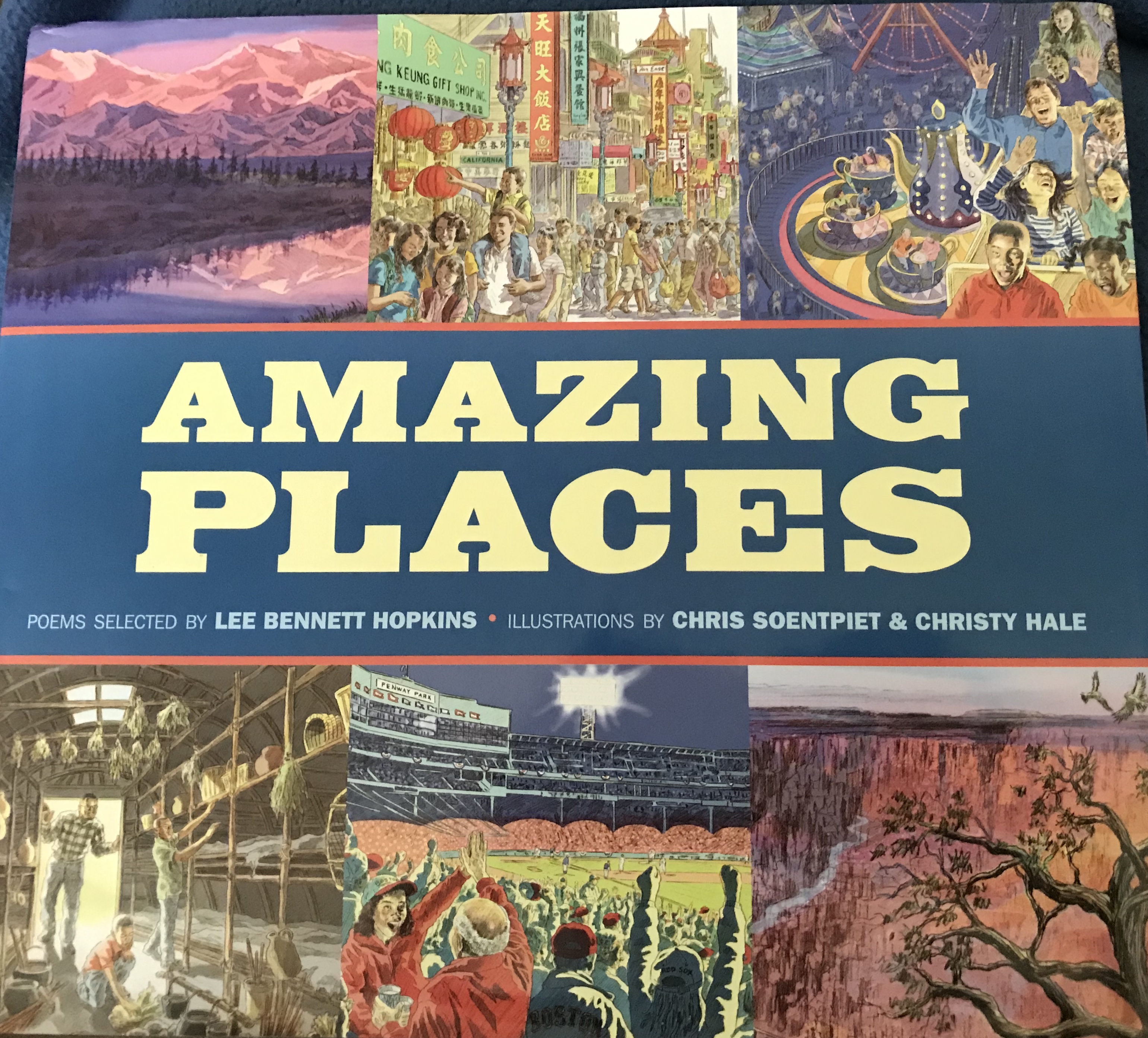
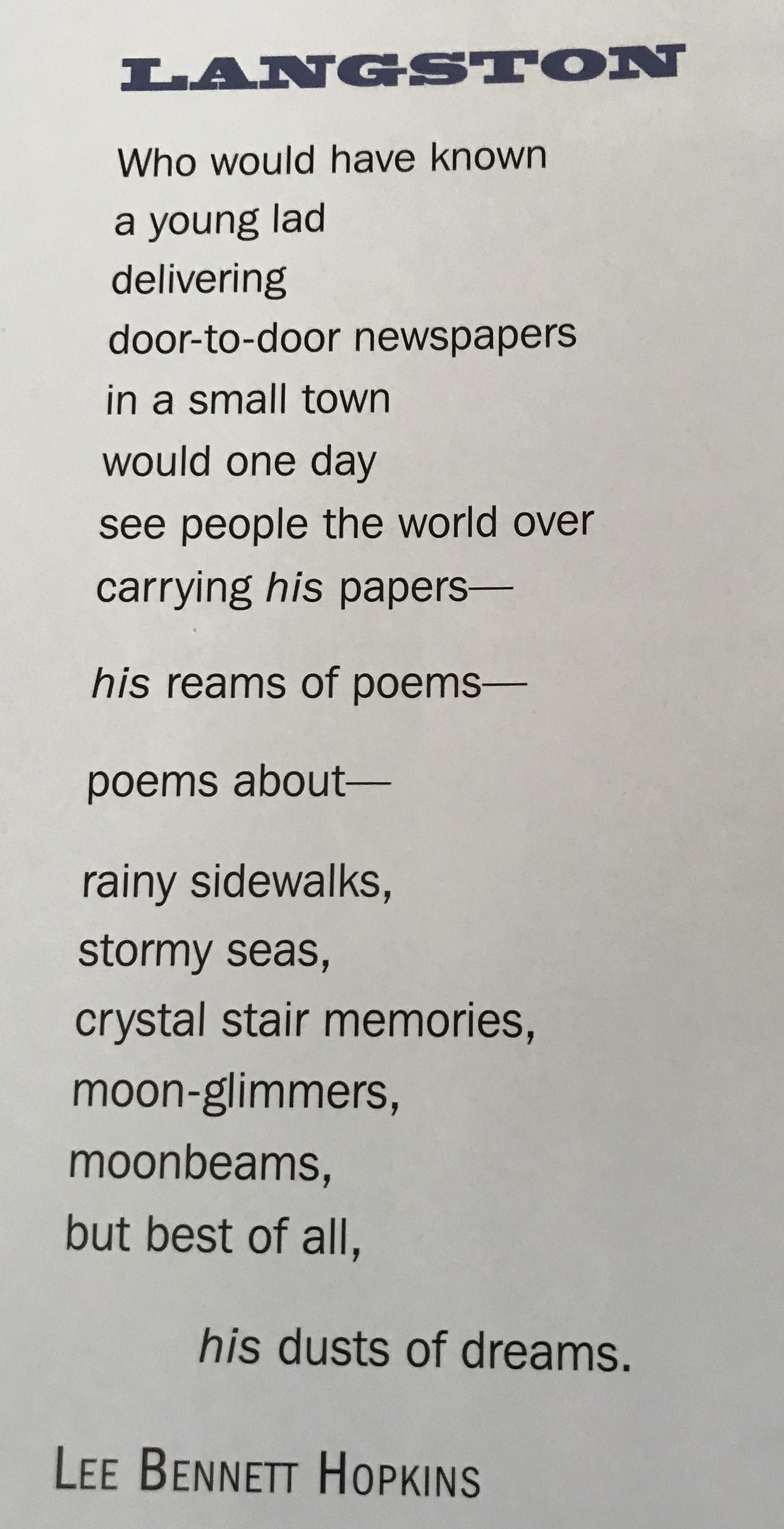
Among his many anthologies, I have Amazing Places on my classroom shelf. In it, Lee Bennett Hopkins collected poems about places around our country. His contribution was a poem titled Langston.
Though his professional writing was successful, it was the death of poet Langston Hughes in 1967 that proved to be a spark for Hopkins’s career of anthologizing poetry for children.
By Shannon Maughan | Aug 13, 2019
Amazing Places: Poems selected by Lee Bennett Hopkins, Lee & Low Books, 2015.
While borrowing a few lines as well as the form of this poem and reading his obituary on Publishers Weekly, I wrote this poem for Lee.
His Dusts of Dreams after Lee Bennett Hopkins “Langston” for Lee Bennett Hopkins, 1938-2019
Who would have known a young boy of divorce, a poor student inspired by a teacher would find his footing in education–
from student to teacher to collector of poems, With greetings to all Dear Ones, he left his dusts of dreams.
Margaret Simon lives on the Bayou Teche in New Iberia, Louisiana. She is a retired elementary gifted teacher who writes poetry and children's books. Welcome to a space of peace, poetry, and personal reflection. Walk in kindness.







 Reflections on the Teche