Welcome to my weekly photo writing prompt. Take a peaceful moment to lose yourself in words. Write a poem of 16 words or so and place it in the comments. Write encouraging words to others by commenting on their poems. This week we are writing with the hashtag poeticdiversion that Molly Hogan started on Twitter.
This week’s image comes from my friend and neighbor James Edmunds. James does a lot of creative work including photography. I once took a class from him about iPhone photography and learned some cool tricks. I don’t know if he took this picture with his phone, but I doubt it. James, if you stop by, let us know.
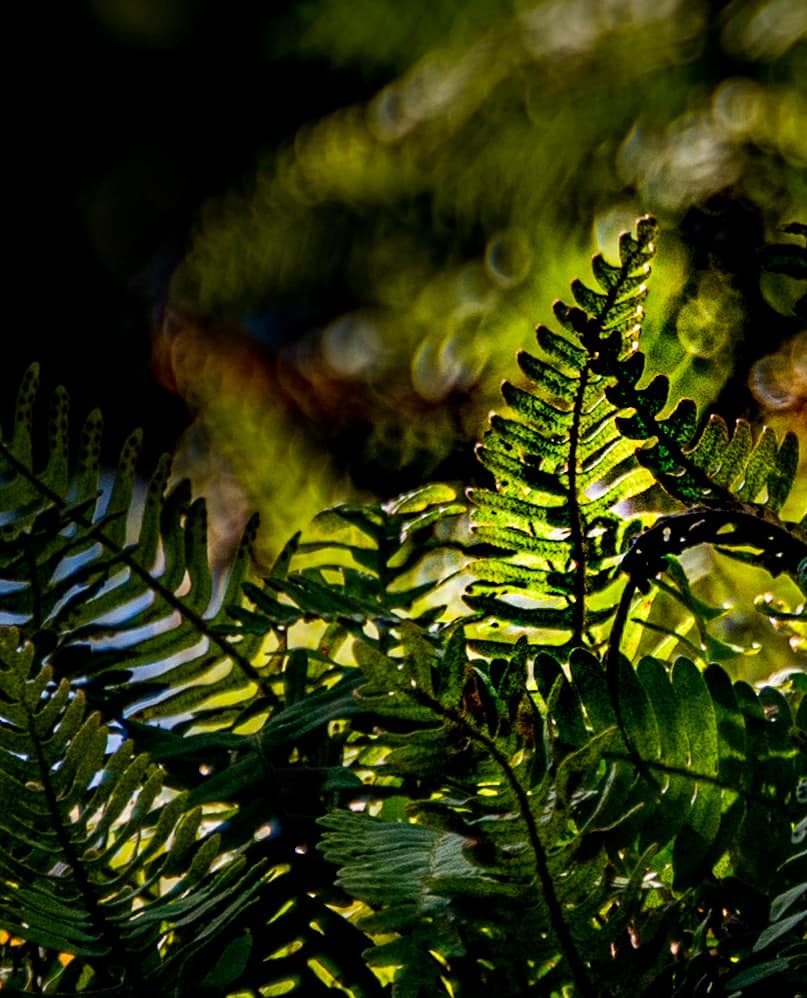
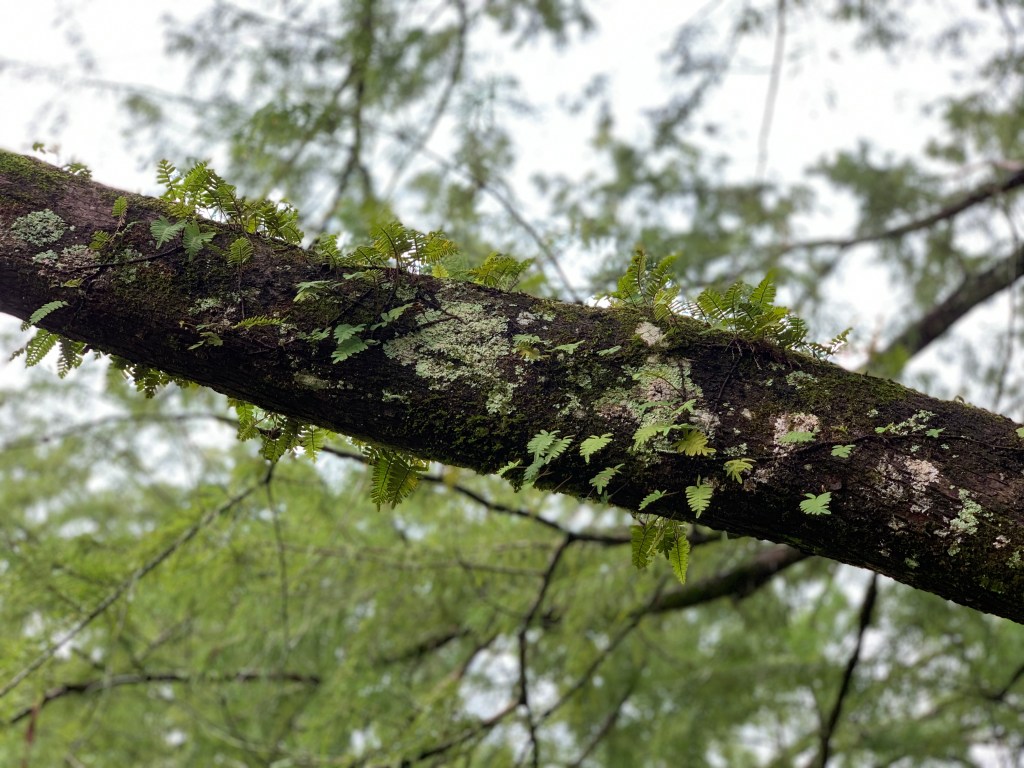
Way down south here we’ve been getting a great deal of rain lately. The resurrection fern loves rain, and it pops up in beautiful green carpets on our trees. In nature, there are small miracles like this every day.
Resurrection Fern by James Edmunds, all rights reserved
Inside the depths of fronds and rhizomes fairies twinkle & dance.
Thank you to Two Writing Teachers for creating an amazing community of writers and a safe, welcoming space to write and share.
Early in the first days of the pandemic, people were posting about cleaning out closets. At the time, my attention was on my students, my family, and the gorgeous spring we were having. I did Zoom meetings and made videos outside. I was fulfilled. Not at all bored. And couldn’t imagine why I should clean out anything.
But here we are 5 months in, and the weather has turned to mush: wet, hot, and humid. Going outside you risk all sorts of maladies, mosquito bites, dehydration, etc. So now I have turned to the closets.
I am not sure why we humans hold on to so much stuff. I’ve been looking at everything from photos to Christmas ornaments to baby stuff. The cleaning is cleansing. I’m also creating a room just for the grandkids. With show tunes in the background, this process has been rewarding and fun.
Speaking with my writing group last night, we are all making our way through with a variety of diversions. Heidi is making playful poems using magazine cut-outs. Check out her post here.
Molly started a new hashtag on Twitter. #poeticdiversion I posted this photo and poem that captures the beauty of resurrection fern after the rain. I never get enough of this miracle.
All day rain Brightens green Resurrection
What are your diversions? How are you coping? Consider joining in with poetry. #moreplay #magazineticpoetry #makesomething #poeticdiversion
Poetry Friday round-up is with here! Link up at the end of this post with InLinkz.
Before the pandemic, I had applied to the Summer Poetry Teachers Institute to be held in Chicago at The Poetry Foundation. Alas, a trip to Chicago to hang out with poets and poetry teachers is a dream yet to come true, but the foundation offered a viable alternative in a 3-day virtual institute last week. It was wonderful! The presentations were all professionally done, the hand-outs were well organized, and they facilitated a real time Q & A. By far the best PD of my summer.
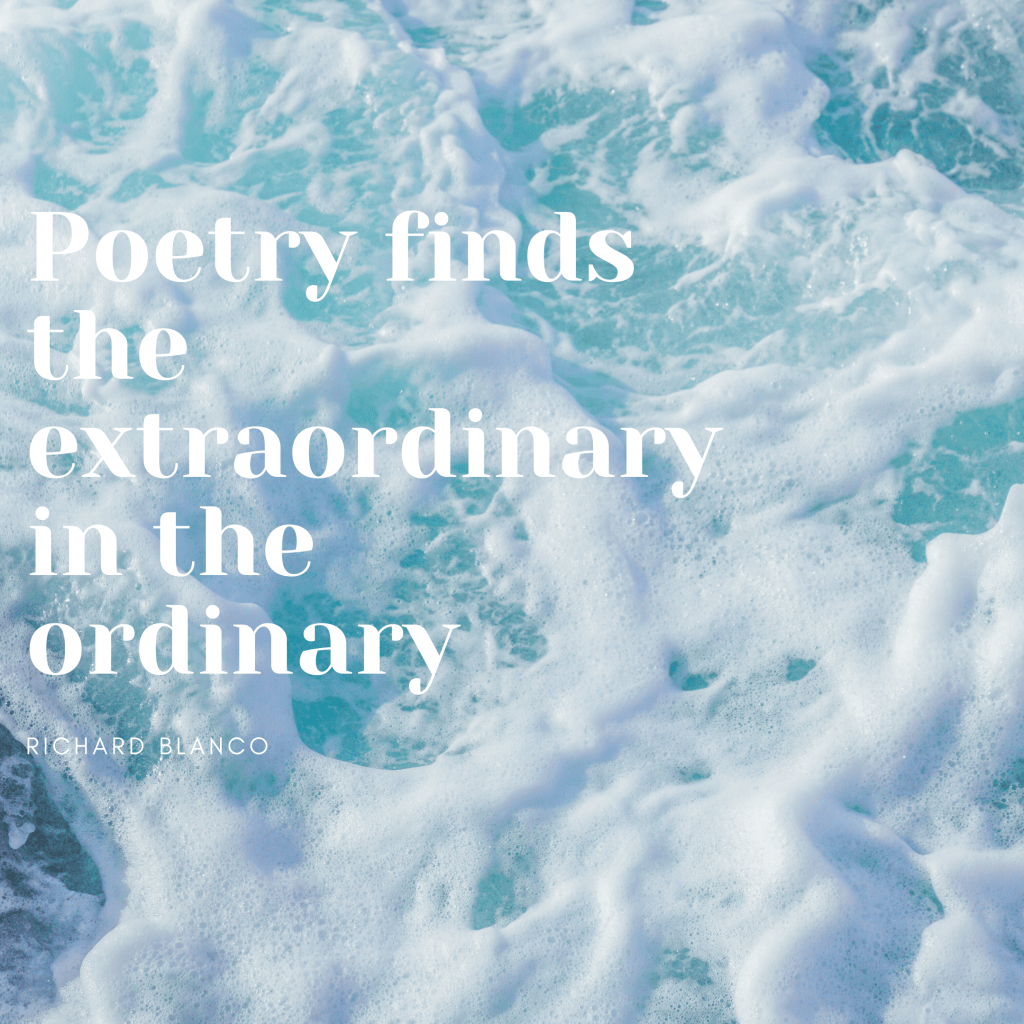
One of the Big Essential Questions was “What is Poetry?” This was the topic of Richard Blanco’s presentation. Oh, my! Swoon. He could read poems to me all day! For today’s Poetry Friday, let’s consider this question. Here are some quotes from the conference.
Poetry is someone standing up and saying, with as little concealment as possible, what it is for him or her to be on earth at this moment.
Galway Kinnell
Poetry is a bird. Sometimes its song is shrill, sometimes its song is sweet. It preens its feathers so they shine brightly in the sunlight. It nurtures its own and delights all who gaze upon it.
Isman, fellow institute participant
In the comments, write your response to What is Poetry? I’d love to gather them together into a collaborative poem. And don’t forget to link up your post with InLinkz.
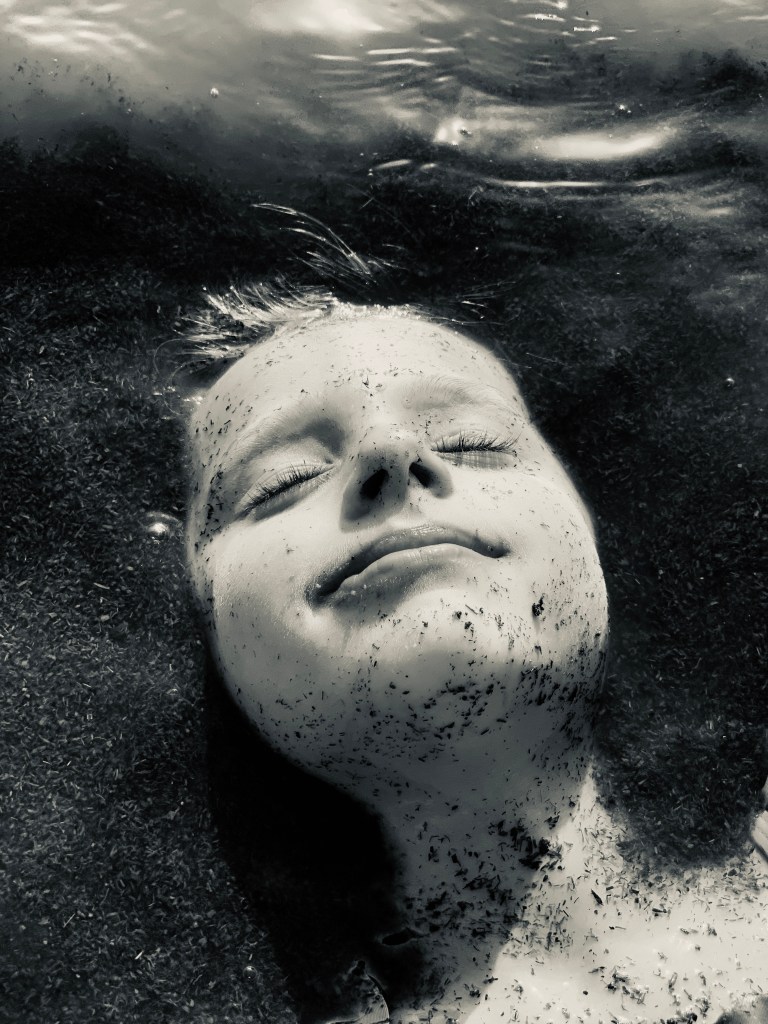
This week’s photo comes from an art teacher whose specialty is photography. Jennifer Graycheck (click to read an article I wrote about her family for our local newspaper) is a young mother of two adorable children. Her talents at capturing and sharing her experiences add light and love to my social media feed. Recently her family took a beach trip. That’s an ironic statement when you live in South Louisiana. Our coastline is marshy with spider-leg inlets cut to allow for boats carrying fish and oil. Not many beaches to speak of.
Jennifer’s family took a Sunday day-trip to “The Point.” Cypremort Point is a local state park where many families have camps. The man-made beach is a far cry from white sands of Alabama and Florida. But Jennifer and her family did not let that stop them from having a safe and fun day together.
Lorelei’s mud bath by Jennifer Graycheck, all rights reserved
This photo of Jennifer’s daughter, Lorelei, may take you somewhere else, and that’s the point. Be creative. Imagine you are the child. What is she dreaming? Write a poem of 16 words or so. Be sure to comment on other writers with encouraging support.
Cajun Queen senses sun in her soul becomes one with the mud whispers Follow me forever.
Last week I wrote down two lines from Poetry Friday posts. The first was a line from Amy, “If you let yourself.” The second was a clunker that Linda was giving away. “the wish is the thing.”
From those two line gifts, I wrote this draft that I haven’t thrown away yet.
If you let yourself fail & appear worthless, a freedom sets in. Instead of focus on results, you can concentrate on the work of being human.
If you let yourself trust the sun to fertilize, you can leave the blooming to God & be still– the wish is the thing.
Margaret Simon, draft
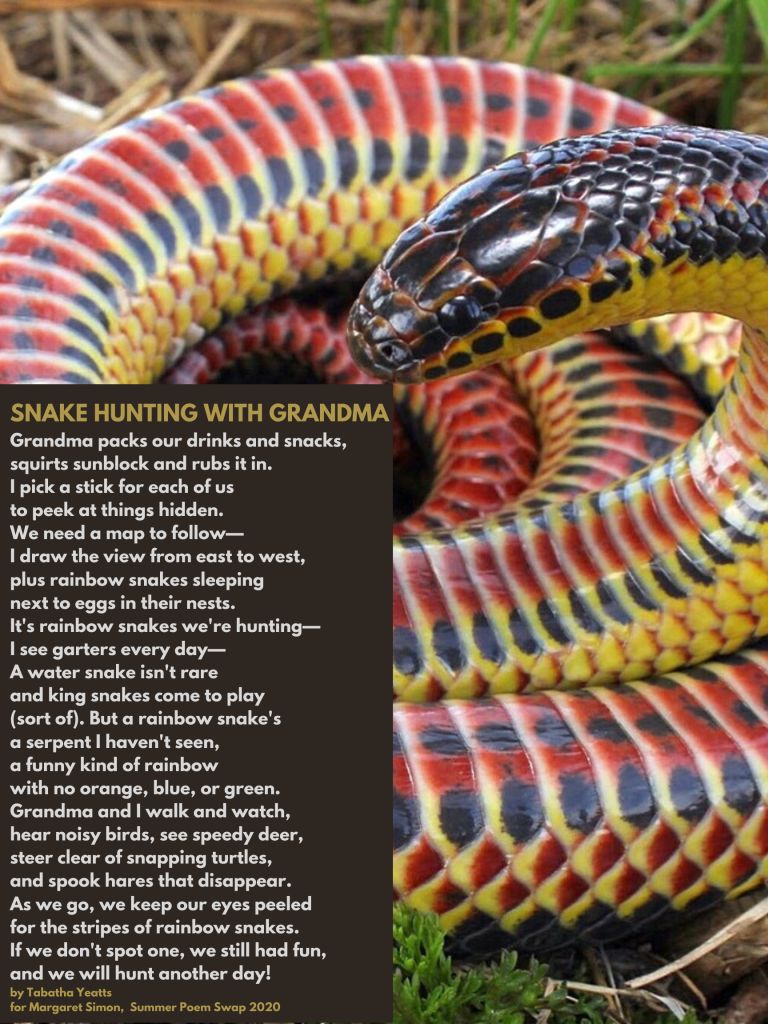
I received two gift poems today from Tabatha’s wonderful summer poetry swap. Tabatha herself sent me a snake poem. Apparently July 16th is World Snake Day . Who knew? On that day, I opened my storage shed to get the hidden key to our house, and a small very wiggly snake was at my feet caught up in a spider web. I grabbed the key and ran, leaving the door open in case the little scoundrel got itself loose.
For her poem, Tabatha imagined me going on a snake hunt with my grandson. Coincidentally, Leo and I did find a dead snake in our yard a few months ago. He still remembers that snake and points to the spot where we saw it every time. “Nake gone.”
SNAKE HUNTING WITH GRANDMA
Grandma packs our drinks and snacks,
squirts sunblock and rubs it in.
I pick a stick for each of us
to peek at things hidden.
We need a map to follow—
I draw the view from east to west,
plus rainbow snakes sleeping
next to eggs in their nests.
It’s rainbow snakes we’re hunting—
I see garters every day—
A water snake isn’t rare
and king snakes come to play
(sort of). But a rainbow snake’s
a serpent I haven’t seen,
a funny kind of rainbow
with no orange, blue, or green.
Grandma and I walk and watch,
hear noisy birds, see speedy deer,
steer clear of snapping turtles,
and spook hares that disappear.
As we go, we keep our eyes peeled
for the stripes of rainbow snakes.
If we don’t spot one, we still had fun,
and we will hunt another day!
by Tabatha Yeatts
for Margaret Simon,Summer Poem Swap 2020
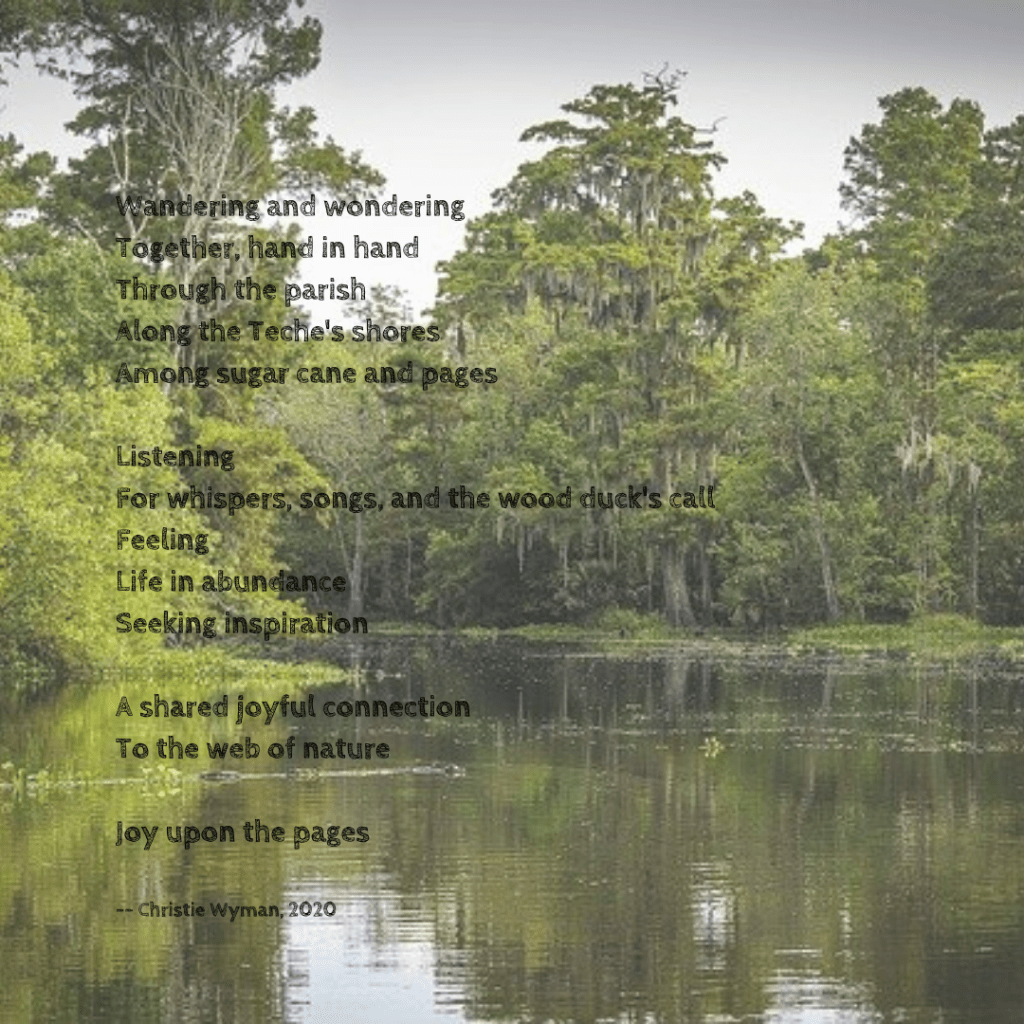
I also received a poem from Christie Wyman. She, too, captured the bayou life and joy of grandparenting.
Wandering and wondering Together, hand in hand Through the parish Along the Teche’s shores Among sugar cane and pages
Listening For whispers, songs, and the wood duck’s call Feeling Life in abundance Seeking inspiration
“Even a happy life cannot be without a measure of darkness and the word ‘happiness’ would lose its meaning if it were not balanced by sadness.” – C.G. Jung
Ruminating on balance today with my Spiritual Journey Thursday group.
Balance doesn’t happen all in one day. Like love, balance is a process. I strive to be stable, but some days are riddled with self-doubt. Even in these sheltered days, I lose sleep, lose faith, slip off the stack of stones onto the cold hard floor of reality.
“It’s always about balance,” says my daughter in defense of screen time. My brother-in-law’s philosophy is “Eat a donut, then have a grapefruit.”
After a long walk in the sun, your body craves water, water, water… There are some balance rules you must obey. Your body is one of them.
In the chiaroscuro of light and dark, we see clearly and in blurred lines where our balance lies. Tip-toe in, but don’t worry if you have to hold onto the rails sometimes.
I miss traveling. I usually have a trip or two planned for the summer. A few summers ago my husband and I took a trip to the Pacific Northwest. The beaches there are very different from Gulf Coast beaches. For one thing, the temperatures are colder. With our heat rising to 95 or more degrees these days, I wish for the cool breeze of a Northwest beach.
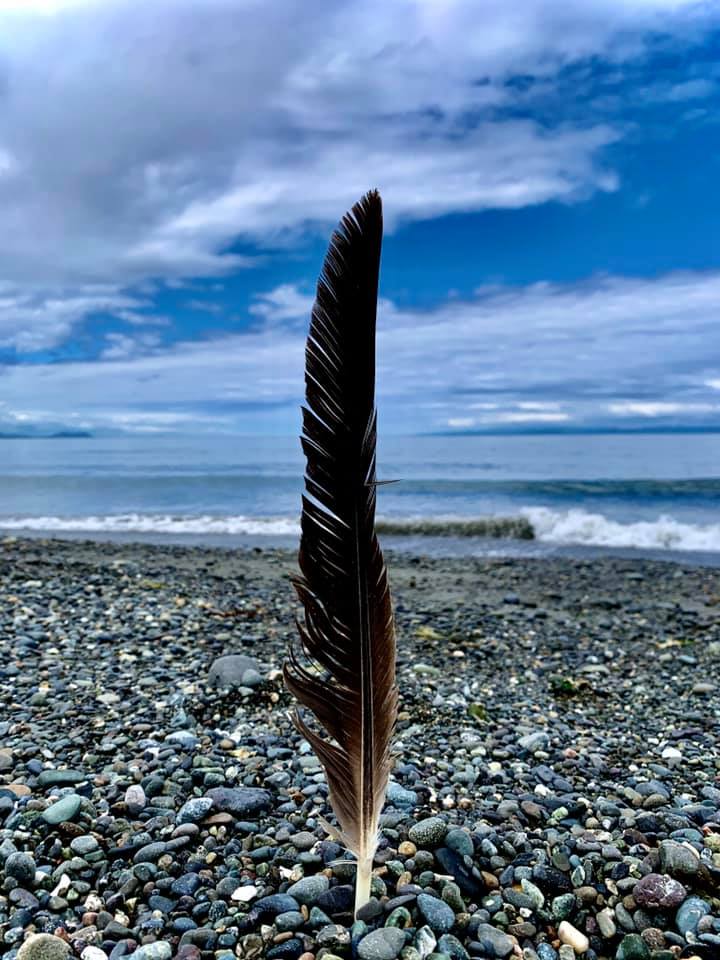
My friend, JoAnne Duncan lives in Washington state within driving distance of beautiful mountains and beaches. She’s traveling near Seattle this week. She’s been posting some gorgeous photos of her trip on Facebook. This one just begged to be a poem.
Feather at Sea by JoAnne Duncan.
I am a feather tethered to blue stones tossed from sea. Notice me before I fly.
Margaret Simon, draft
Take a minute to look outside at this image, look inside to your heart, and put down a few words, 16 or so, in the comments as a small poem. Please encourage other writers with your comments. Poetry is balm.
Thank you to Two Writing Teachers for creating an amazing community of writers and a safe, welcoming space to write and share.
The greatest joy of my summer has been spending time with my grandsons. Leo is 19 months and is learning new words every day. One of his words is “bird” that sounds more like “bir,” and he has the cutest tweet sound.
In our courtyard, I’ve been working on attracting more birds. We’ve hung a few feeders. We have chickadees, titmice, and cardinals visit. Leo has noticed them. He will stop what he’s doing to look up at the sound of a chickadee.
It was time to change the suet feeder. I wanted to involve Leo, so I googled “DIY bird feeder for kids.” This video popped up.
I wondered if the recipe would work using the wire suet feeder rather than cookie cutters.
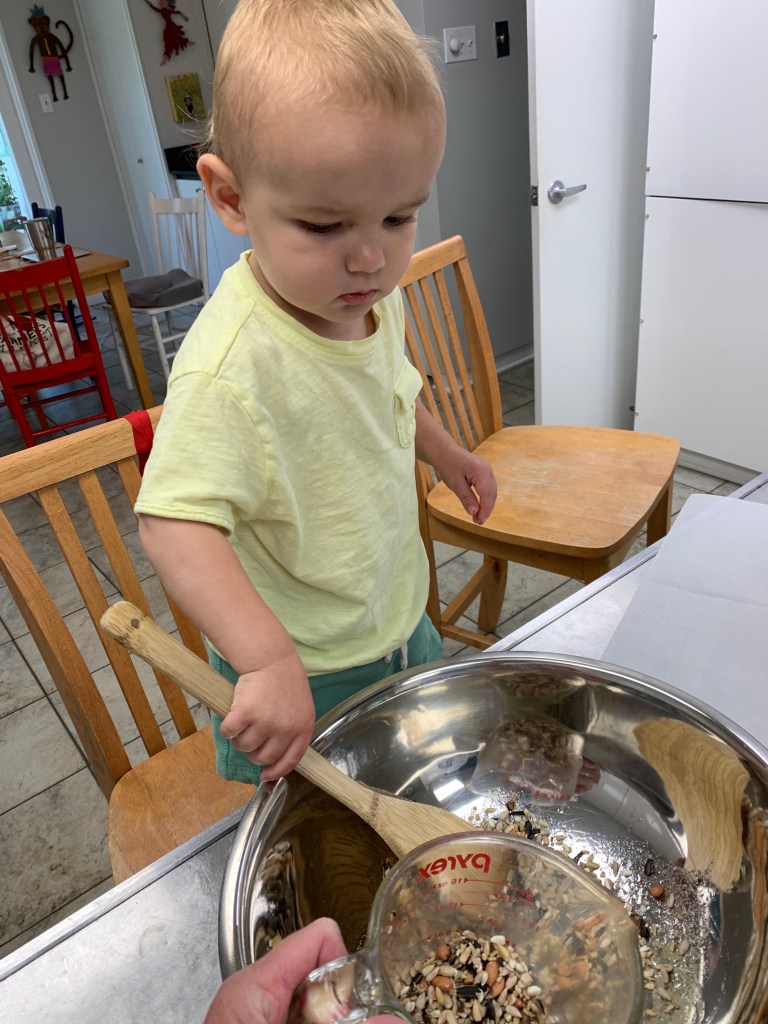
Easy peasy and great for toddler time. I boiled a quarter cup of water in the microwave and added it to a large metal bowl along with one packet of gelatin. Leo understands the concept of hot. He said, “Hah. Hah.” I gave him a wooden spoon to stir with. After stirring the gelatin, I held a measuring cup of bird seed (about a cup) while Leo scooped the seed using an ice cream scooper.
Leo focused on stirring and scooping.
With the metal frame on a baking sheet, I scooped the mixture in ready to wait and let it harden. When I took Leo off the chair he was standing on, he immediately screamed “more! more!” while making the more sign. It’s the only sign he knows, but it’s an important one. So, we did another batch. Why not! The metal frame was big enough to hold two batches.
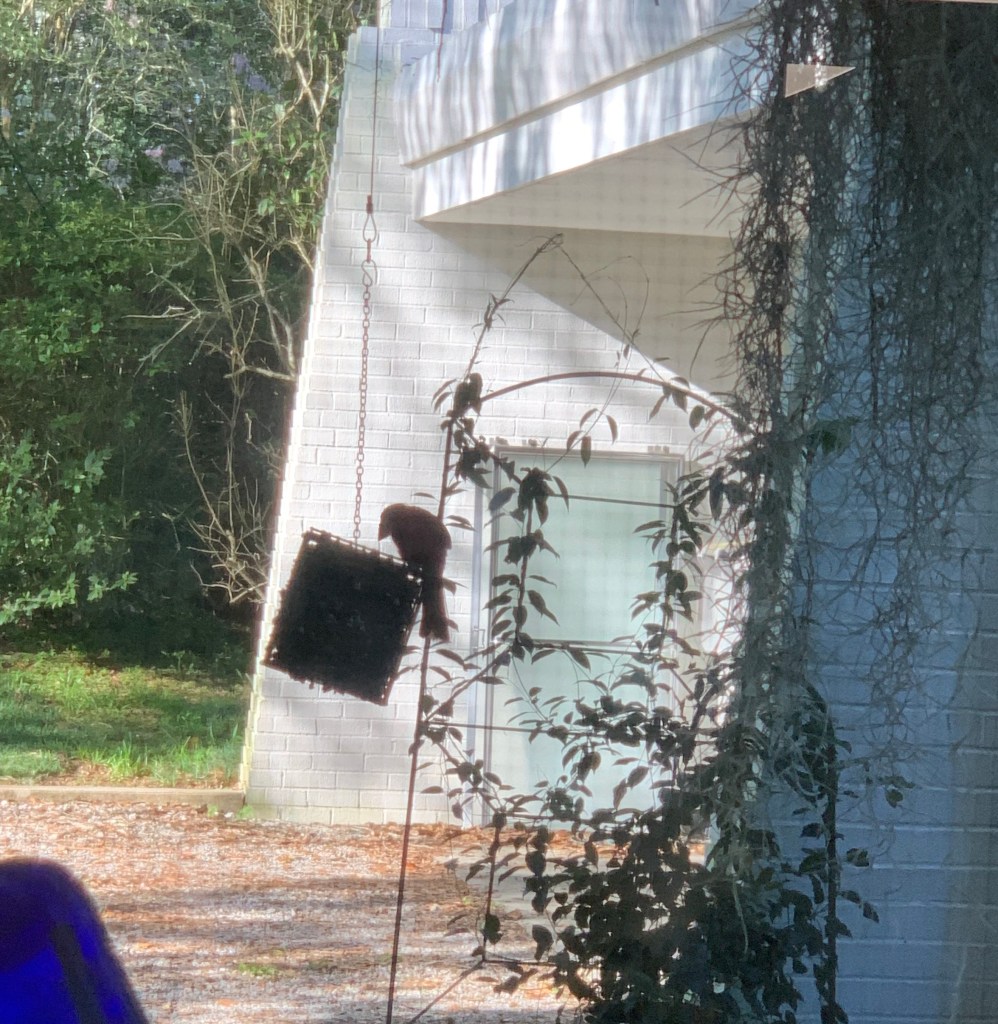
I am amazed that, with heat indexes in the 100s, the mixture is holding up, not melting. I sent Leo (his mom) a picture I took looking out the kitchen window of a male cardinal perched on the feeder.
Cardinal at the feeder.
While the news is bleak, let’s remember the simple joy of watching birds. “Bir! Bir! Tweet! Tweet!”
How often does one follow a book from its idea to formation? I have been privileged to know Nancy Rust and Carol Stubbs, co-authors of Andrew Higgins and the Boats That Landed Victory in World War II. Nancy and Carol started our local branch of the Society for Children’s Book Writers and Illustrators (SCBWI). We meet monthly, so I heard about this book from its beginning and was privileged to read multiple drafts. I never imagined the illustrations, however, to be as stunning as the ones from Brock Nicol.
If you ever plan a trip to New Orleans, the World War II museum is a must see. The Higgins Boats are amazing structures. It’s difficult to believe they can actually float. Not only do they float, but they are credited for winning the war.
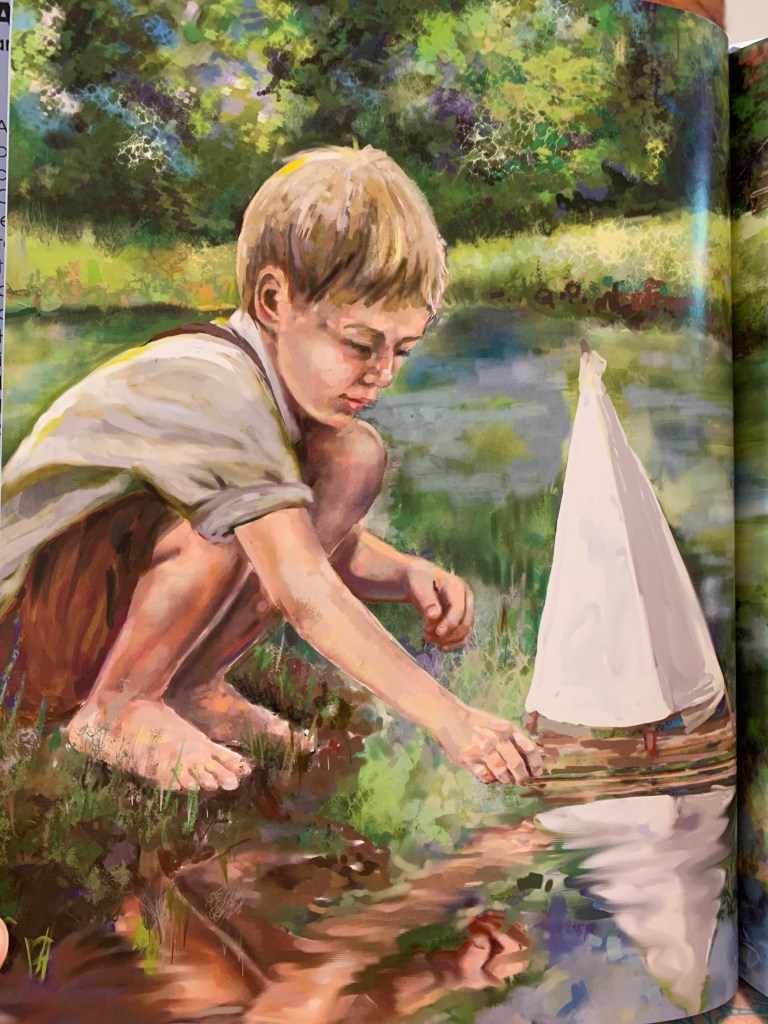
Andrew Higgins as a child; illustration by Brock Nicol.
Nancy and Carol’s book follows Andrew Higgins from his childhood in Nebraska where his imagination led him to wonder. He did not stick with school, so he became a soldier, truck driver, lumber jack, as he struggled to find his passion.
Through his lumber business, Andrew experienced the difficulty of maneuvering boats through cypress swamps. His mind started working on a design to navigate more easily and quickly. He studied different types of water dwellers, from a Cajun pirogue to a blue whale and spoonbill. He was able to make boats better and faster.
One little known aspect of Andrew Higgins’ character was his commitment to hiring women and men of all races and paying equal pay for equal work. This book highlights the compassion and creativity of a man of history with engaging text and impressive illustrations.
If you are interested in hearing more about this new book, tune into the World War II Museum Young Readers Author Talk on July 22 at 11:00 AM Central. Click here to register.
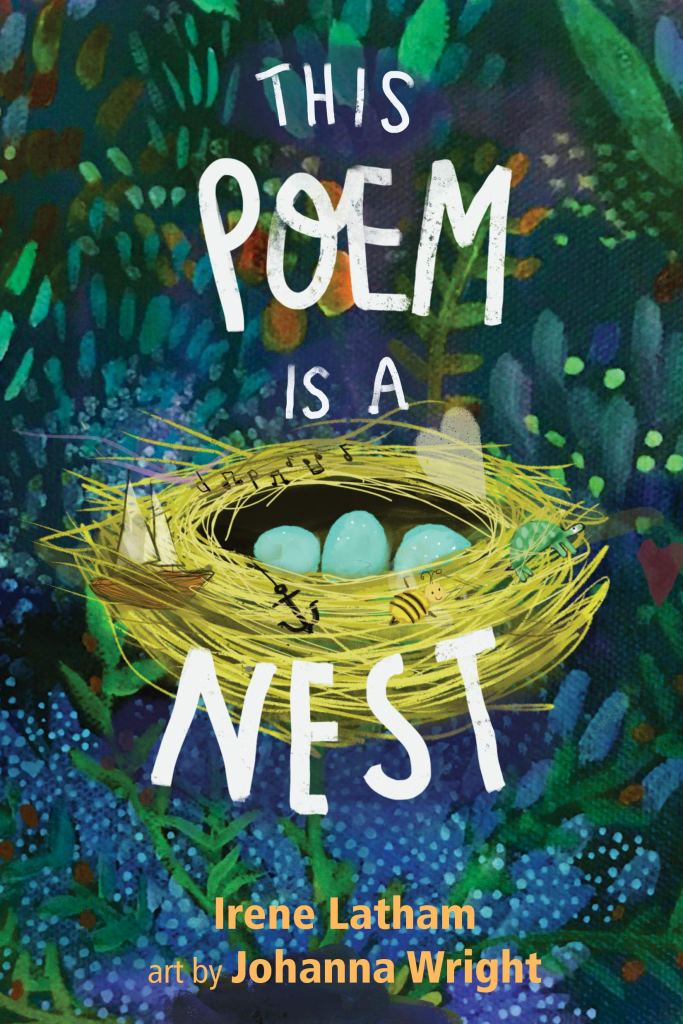
Irene Latham is as charming and lovely in person as her poems are on the page. Her new release This Poem is a Nest opens with an invitation. In Part I, we read the poem “Nest.” This seedling is divided into 4 seasons of 3 stanzas each of free verse poetry. “Nest” has everything I love in a poem, lyrical language, alliteration and onomatopoeia, imagery of nature, and inquiry that touches my heart, “Won’t you climb inside?”
Nest is the seed poem for Irene’s creativity that grows into day poems, before & after poems, calendar poems, color poems, animal poems, feeling poems, and just when you think she could not possibly find any more poems in Nest, there is word play, alphabet, and ars poetica.
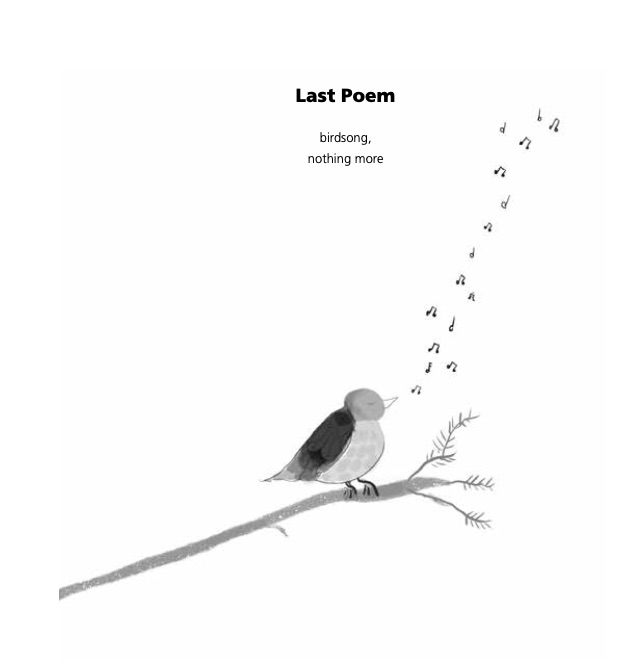
With all of these nestling poems, you would think the poems would lose magic, lose originality, or become repetitive, but the experience of them is quite the opposite. Each new poem needs to be held for a minute or two. Each one reveals a surprise, all the way to the last poem:
Last Poem
birdsong nothing more
Irene Latham, This Poem is a Nest
The end papers of this wonderful book offer writing advice to budding poets. Irene gives tools to me and teachers like me who want to inspire students to write. The art of “found poetry” has been elevated to “nest-poem” or “nestling.”
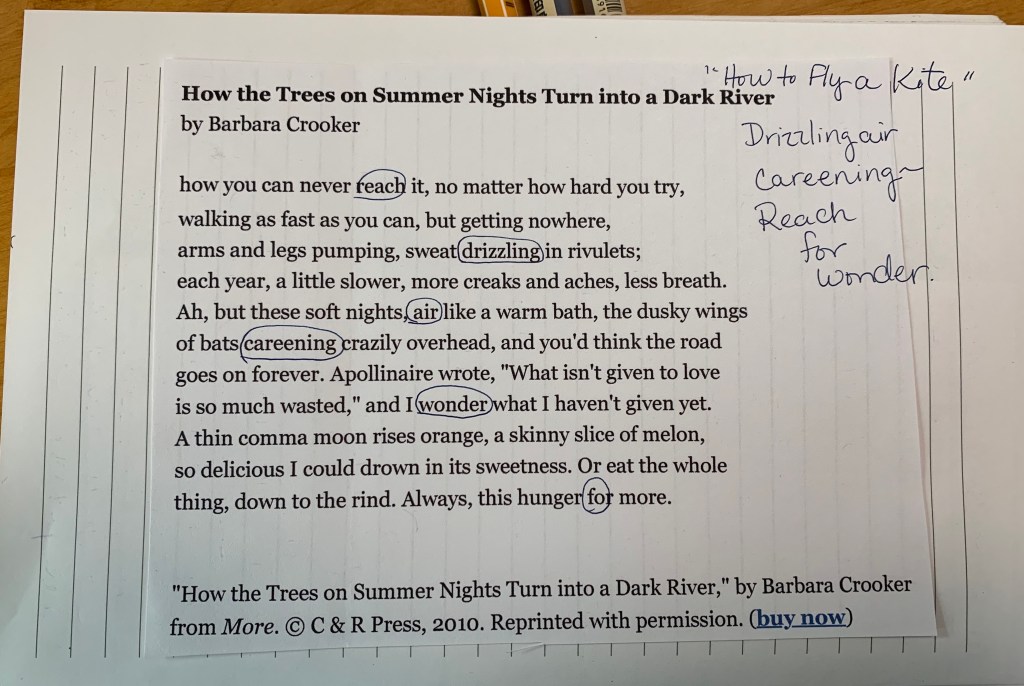
I wanted to try it out, so I went to a poem by Barbara Crooker that I had cut out and glued into my journal. “How the Trees on Summer Nights Turn Into a Dark River.”
Step one: Circle words that appeal to you. I circled drizzling, air, careening.
Then I looked up careening to check my understanding of the word. “move swiftly and in an uncontrolled way in a specified direction.”
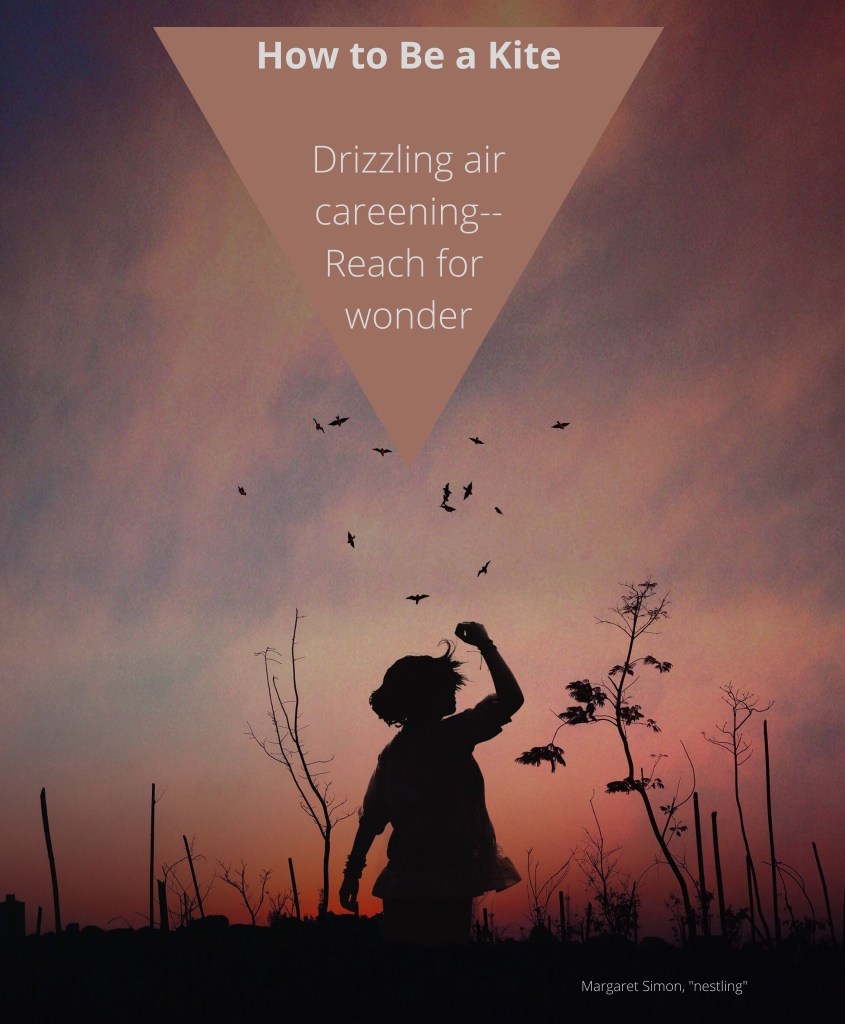
Step two: Choose a subject. I thought a lot about this. Air, careening…a kite.
Unlike found poetry, nestlings do not have to follow the order in which you find the words, so I went back and grabbed “reach” from the first line, which led me to “wonder” and “for,” finishing my image of a flying kite.
Image poem created on Canva.
Now as I look again at the nestling I created, I think it would be better like this:
How to be a Kite Careen with drizzling air Reach for wonder.
By going through this process, I realize how much work went into Irene’s book of poems. Writing nestlings is a fun challenge. I had to use critical thinking skills that are imperative to teaching students to write. I encourage you to try writing nestling poems. Thanks, Irene!
Margaret Simon lives on the Bayou Teche in New Iberia, Louisiana. She is a retired elementary gifted teacher who writes poetry and children's books. Welcome to a space of peace, poetry, and personal reflection. Walk in kindness.








 Reflections on the Teche