Feeds:
Posts
Comments

Posts Tagged ‘teaching poetry’

Thank you to Two Writing Teachers for creating an amazing community of writers and a safe, welcoming space to write and share.

On Fridays, I usually post a poem for my students to read and discuss. This week we looked at Billy Collins’s poem Today. This has been a favorite of mine for a long time. When I looked back on my blog, I found a poem I wrote after Today in 2011. (See the post here.) My students were shocked by this because none of them were even born at that time.

Today begins with a wonderful line for getting into a poem, “If ever there were a spring day so perfect,” As the poem continues with two lined stanzas, there is no end punctuation until the last line, “today is just that kind of day.” The whole poem is one sentence. I love how this works to make the poem sound more urgent and energized.

I invited my students to use these lines to create their own poems about a perfect day.
Spring 2025
after Billy Collins 

If ever there were a spring day so perfect,
so full of bird song

that it made you want to join
with your own singing

and open your whole mouth
to the world of nature,

a day when dew drops cool grass,
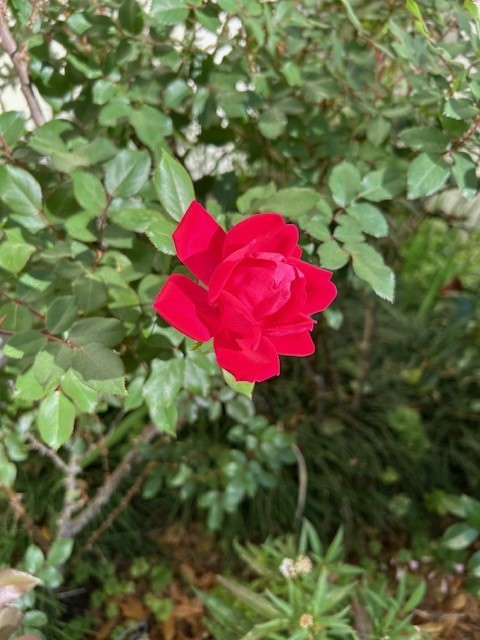
and the garden roses popping

with red reflect the sun, so much light
that you feel like breathing,

releasing the grief you’ve held in
and cry real tears at the beauty

of it all, walk with light
pink and orange rising before

you, welcoming you with open arms
of rose and green and sky.

Today is that kind of day. 

Margaret Simon, draft

As we head into spring, Avalyn and some other students are still dreaming about the amazing snow we had this winter. She asked if she could write about a winter day. “Of course, it’s your poem.”

If there were a winter day so perfect
so cold with icy air

Could I pretend to hunt ghosts
while drinking a warm cup of hot chocolate

Could I put on layers of clothes
and roll in the snow

Could I sit in my warm bed
watching TV and “being productive”

Could I play outside bands
performing plays

Could I read a book
my best days

Dreaming of presents can you imagine?
Well you can because today is that day.

Avalyn, 5th grade
Read Full Post »

Thank you to Two Writing Teachers for creating an amazing community of writers and a safe, welcoming space to write and share.

Where did I read that we should be teaching living poets in our classrooms? I try to include poetry every day. This is a goal, but some days, as you well know, don’t go as planned. I’ve made a Google Slide Show for a Poem-a-Day, so I have a place to save poems I want to explore with my students. When I announced yesterday that we had time for poetry, my students were excited. I love this about elementary gifted kids!

First we read the poem through. Then I ask, “What do you notice?” I ask my students to notice 3 things about the poem. Using annotation on the smart board, I underline what they see and if they don’t, I name them.

I presented Danusha Lameris’s Small Kindness. I invited my students to write. They could borrow a line, make a list poem of small kindnesses, or write about their own topic using free verse.

I’ve long held the belief that I should write alongside my students. I also welcome their critique. Usually they just say, “I like it.” Then I know we need to work on how to offer critique with specifics such as “I like the way you used personification or metaphor or rhyme.” Naming the specific poetic elements.

Yesterday I was surprised when a student actually said, “I think it’s too clumped up.” As I questioned him further about what he meant, I realized that I read it like a paragraph, no line breaks. Danusha Lameris’s poem uses enjambment masterfully. She understands line breaks. It is definitely a skill I want to work on, and this student nailed it.

So I worked on it, revised, and will share today the current working draft.

Small Kindness

after Danusha Lameris

I’ve been thinking about the way
when I open a car door, and a little kinder kid jumps out,
how the driver says, “Thank you.”

How on the way to school, a white suburban slowed
to let me merge ahead.
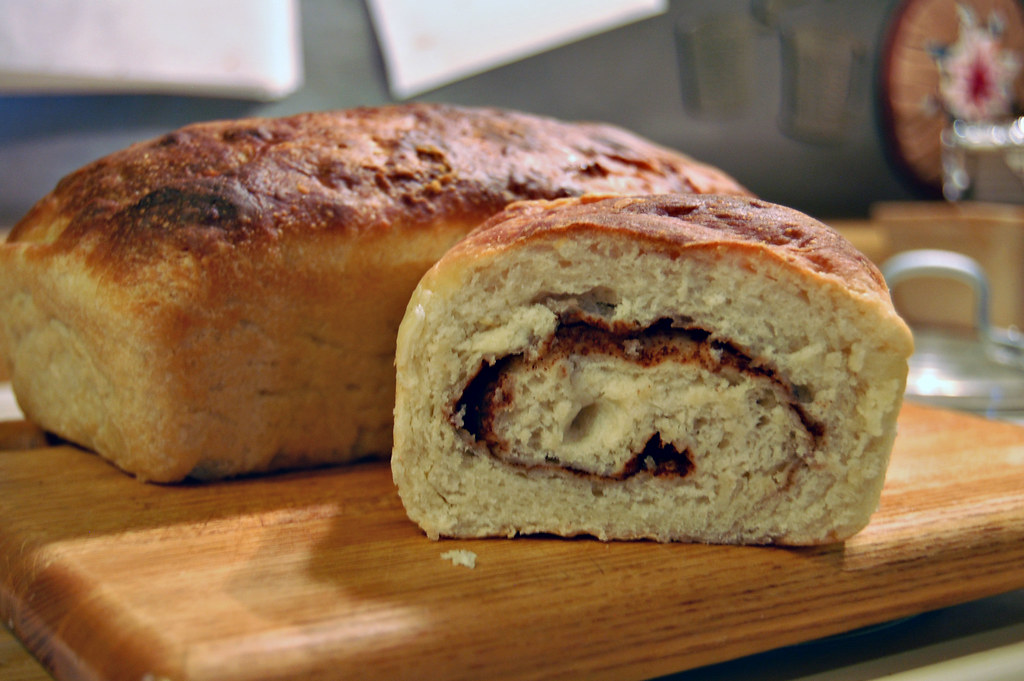
How cinnamon bread, a gift from my neighbor
fills the kitchen with sweetness.

I want to believe everyone
is kind and thoughtful. I want to find grace

in the corner of the parking lot
waiting for me to notice her. 

Margaret Simon, draft

https://www.flickr.com/photos/20705353@N00/3565199892

Read Full Post »

Thank you to Two Writing Teachers for creating an amazing community of writers and a safe, welcoming space to write and share.

I read Beautiful Hands to my youngest students, 1st-3rd grade. The question “What will your beautiful hands do today?” is the theme of this short and inspiring book by Kathryn Otoshi and Bret Baumgarten.

The story of this book is both sad and joyful. From a Bookology article by Nancy Bo Flood:

Beautiful Hands was done for Bret Baumgarten, who was diagnosed with pancreatic cancer. When we found out, it was at stage 4. It was heartbreaking. He and I both wanted to do a book for his children, Noah and Sofie. I found out every day he would hold his kids’ hands in his and ask them, “What will your beautiful hands do today?”

I wanted everyone whom Bret loved to be in this book. We arranged for his family and friends (mine too!) to make handprints as part of the illustrations in the book, so that they could participate and be a part of this narrative. Over 100 people’s handprints are in the rainbow at the end of the story. So many people loved Bret, we didn’t know where to put our grief. The book became a positive way to remember the message he wanted to impart most: love, creativity, compassion, and our connection with one another.

Kathryn Otoshi

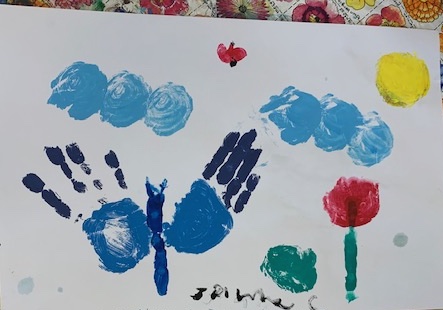
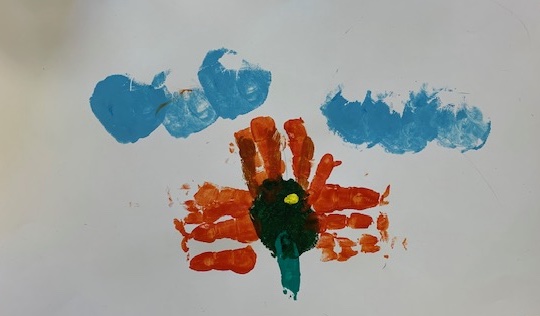
With my youngest students, we practiced using acrylic paints.

1. You must put on a t-shirt to avoid stains on your clothes. (I provide old t-shirts.)

2. Mrs. Simon will squirt the paint. It comes out fast and can splatter.

3. We only have primary colors, so how do we make other colors?

4. Which illustration do you want to make?

5. You can only use hands, no paintbrushes. We used the paintbrushes to apply the paint to their hands.

Here are some samples of final works of art.

My Painting

by Carson

Sunflowers bloom.
My heart booms!

Clouds float in the air.
My hands show that I care. 

Carson is brand new to poetry writing. He gets very nervous about it, so we have to use some breathing techniques while I prompt him with sentence stems. We worked on making lists of rhyming words. He wrote “Clouds float in the air” with little prompting. And selected the word care from our list of rhyming words. All I said was, “Look at your hands in your painting. My hands…?”

“Show that I care!” shouted Carson. We celebrated with a high five and a glowing smile. When I typed it and let him tape it to his artwork, he was as proud as Vashti from Peter Reynold’s book, The Dot. ( If you don’t know about Vashti yet, you must go Google The Dot right now.)

Read Full Post »

Thank you to Two Writing Teachers for creating an amazing community of writers and a safe, welcoming space to write and share.

On Fridays with my 6th grade gifted kids, we unpack a poem. We discuss everything from form to figurative language, assign tone and theme, and write a poem in response. This is my favorite lesson of the week. The Promethean Board with the annotation tool makes it even better.

Yesterday we focused on Irene Latham’s spring poems. She posts a video each week designed for homeschoolers, but it works for me, too. This week we watched this video:

Using Irene’s Art Speak Padlet, we located the poems she highlighted and selected one to unpack. My first group chose “because every day is a symphony in spring.” So many things to see, imagery, personification, word choice, rhyme…

When yellow rings,
green cannot await
its return.

As white fades
in discord,

yellow rings.
Once again

as purple, pink
orange, and red
splash the fields.

Jaden, 6th grade

When green season 
arrives, 

the rainbow comes out
from every direction
and all around
you. 

Red triangles grow with yellow spots
on green string,

orange sky falls
and the orange sky rises.

Yellow lights
shine through the heavy white marshmallows,

green spikes
poke out of the ground.

The sky’s blue
falling down in may,

with purple and pink petals
that have been waiting for 
this season. 

Green season, 
green season,
full of delight
and color.

Katie, 6th grade

Read Full Post »

NPM2016

During this monthlong survey of poetry, there is trouble.

So many decisions to make.

What should I teach today?
Line breaks,
literary elements,
limericks?

I want to say stop to
sing-song rhymes
and simple forms.

Then one turns to another and says,
“Let’s write a rap abecedarian.”

Like the messiness of art class,
the instructor must allow
for paint splatters and stains,
for stalled-out cinquains
and skip-to-my-loos.

Poetry is hard.
Poetry is easy.
There are rules in poetry.
There are no rules:
Let the poem find its way.
This is the trouble with poetry.
This is the joy of poetry.

–Margaret Simon

Follow the Progressive Poem to  Charles Waters.

Follow the Progressive Poem to Charles Waters.


Read Full Post »