
If you are a blogger and would like to add a line during National Poetry Month to our Kidlit Progressive Poem, please make a comment or send me an email with a date choice and a link to your blog. Everyone is welcome to play!

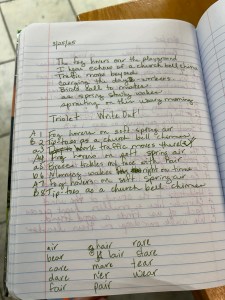
The early morning school playground was covered in a sheet of fog. Avalyn and I went outside to write. This is something she often requests. There is an old oak with a picnic table in a just right spot for writing in our notebooks. I wrote about my surroundings, observations of the morning.
The fog hovers over the playground.
I hear echoes of a church bell chime.
Traffic moves beyond
carrying the day-workers.
Birds call to mates
as spring slowly wakes
sprouting on this weary morning.
Form can give us a container for our words. I looked up the triolet form. I labeled my paper with the number of lines and the rhyme scheme. The poem changed shape while still holding the mood.
Fog hovers on soft spring air,
tip-toes as a church bell chimes.
Work day traffic moves on everywhere.
Fog hovers on soft spring air.
Breeze tickles my face with hair.
Morning wakes right on time.
Fog hovers on soft spring air,
tip-toes as a church bell chimes.
(Margaret Simon, draft)
I used these two drafts to discuss revision with my students at the next school in the afternoon. I suggested they go back to a poem and revise it.
Max who is a humble poet will rarely share his poems out loud, so I asked his permission to share his revision here. He wrote it on Fanschool, and you can leave comments specifically for him there.
“Insects buzzing all around,
Bugs are feeding on the ground,
For there is no need for them to hurry,
So why should they need to worry?”
March 25th, 2025: I absolutely despise the quality of this poem. REVISE!
Insects hover in the air,
Gracefully, glide without care.
Spot a flower, beautifully white.
Harvesting energy, basking in the sunlight.
Insects, bugs, air and the ground.
Moving, flying, all around.
To hurry is not a worry, for them.
Unless by something, they’re found.
Then Scurry!
I would add something else, but this is just about it.
(Max, 6th grade)
How do you approach revision? Is it hard for you? I think students don’t usually like to revise. They like to write and move on to the next thing. Honestly until I read Max’s post, I thought the class didn’t think much of my little revision lesson. Modeling our own writing process with our students makes us vulnerable, but in the long run, shares how we all are in this together, writing side by side.



 Reflections on the Teche
Margaret I am struck again by how lucky these young poets are to learn with you! I LOVE revision! And I’m often thinking about ways to change writers’ perceptions/feelings about it. It’s especially a challenge in our right-now/instant-gratification culture. If I’ve learned anything about poetry, it’s that it takes TIME. Instead of judgment about revision (“this is hard!”), maybe we should simply instead be curious. Be investigators of what’s on the page. Be happy experiementers. Give it the time it requires. I’ll go leave a comment for Max! xo
Fyi: Fanschool wouldn’t let me comment.
I’m sorry you couldn’t comment. If you want to write one in an email, I’ll make sure he gets it. They love getting comments from famous authors!
Revision is often where the magic happens! I feel like it was Irene who said that the first draft is putting the sand in the sandbox and the next drafts are making a castle with it. Your demonstration is wonderful and yay for Max!
I love the way Max slowed his poem down and let us linger with the insects.
I love the revision. So hard for kids and adults alike. I often revise it has just become a habit. Write, read over and revise. The change in both yours and Max’s poem are wonderful to see.
To Max: Love your lines and changes to the poem. I really like the line – hurry is not to worry – thanks for sharing your work with us.
I love the poem, but what I love more is the time you spend with your students SHOWING them your thinking process. That’s really a great model!
What a gift you give to your students, Margaret! Revision is often so hard to explain and encourage, but your students embrace it.
Every time you share more about your work with students, Margaret, I know how lucky they are to have you as their teacher, to work with you, learning, growing. You can see it in Max’s revisions. He listened! And I enjoyed the changes you made because you chose a form to shape what you had written, often another great idea!
I really love that you write with your students and that they are learning to revise (it’s hard!).
So pleased this writer wanted to revise and make is idea even better. Thanks for sharing your students with us. Your triolet is lovely with the fog hovering and church bell chimes.
Margaret, yes, I think modeling revision is one of the ways to a young poet’s revision-resistant heart! In the Brave Writer classes I teach, we often emphasize that writing is meant to be a messy process and when they see us rearranging the mess, revision is sometimes a little more attractive.
I don’t do enough revision. I write then move on. I wonder if I will live long enough to return to my poems and think about revising them?! Max did a wonderful job on his!
Margaret, I think revision is one of the hardest things. I love your lesson and modeling this to the students. Obviously, Max took it to heart! Great job, there! Thanks for what you do with your students. They are lucky to have you.