
Should an instructor touch a student’s work? As a teacher, this can be an “it depends on the situation” question.
Last week I was with my grandson who is nearing the end of kindergarten. For homework, he had to write a sentence about the story he was reading. He knew what he wanted to write, but the line given was short, and he didn’t think it would fit. I debated. Could I write the sentence he dictated to me?
I decided not to. Obviously, he was not only supposed to practice comprehension, he also needed practice in writing. The option I came up with was to write the sentence he dictated on a notepad and let him copy it on the back of the paper since the line wasn’t long enough. This is what he did, but he completely filled the back of the paper (with no lines) and creatively elongated the tail of the letter p and the top of the letter h.
I have never been a kindergarten teacher, so I was keeping my fingers crossed that I did the right thing.
Recently I have been taking a watercolor class. The instructor is an artist. His teaching method is demonstration. So on both the first and second lessons, he came to my side and painted on my painting to demonstrate a technique. I felt defeated. I had a taste of what Thomas might be feeling when his teacher writes on his paper. The art piece I left with was not mine to claim. Was the art teacher wrong?
I talked with my daughter about this, and she suggested that I ask him to demonstrate on a scratch paper. But still, yesterday he did it again. This time, he asked permission. What was I going to do? I did want to see how he would darken the tree and how he would draw a piece of grass, but again, I have a work of art that is not truly mine. I refuse to sign these pieces.
One of them I cut up into a collage. Another I’ve tucked away. It’s hard for me to totally throw them in the trash. Do I just need to relax and be a good student?
What do you think?
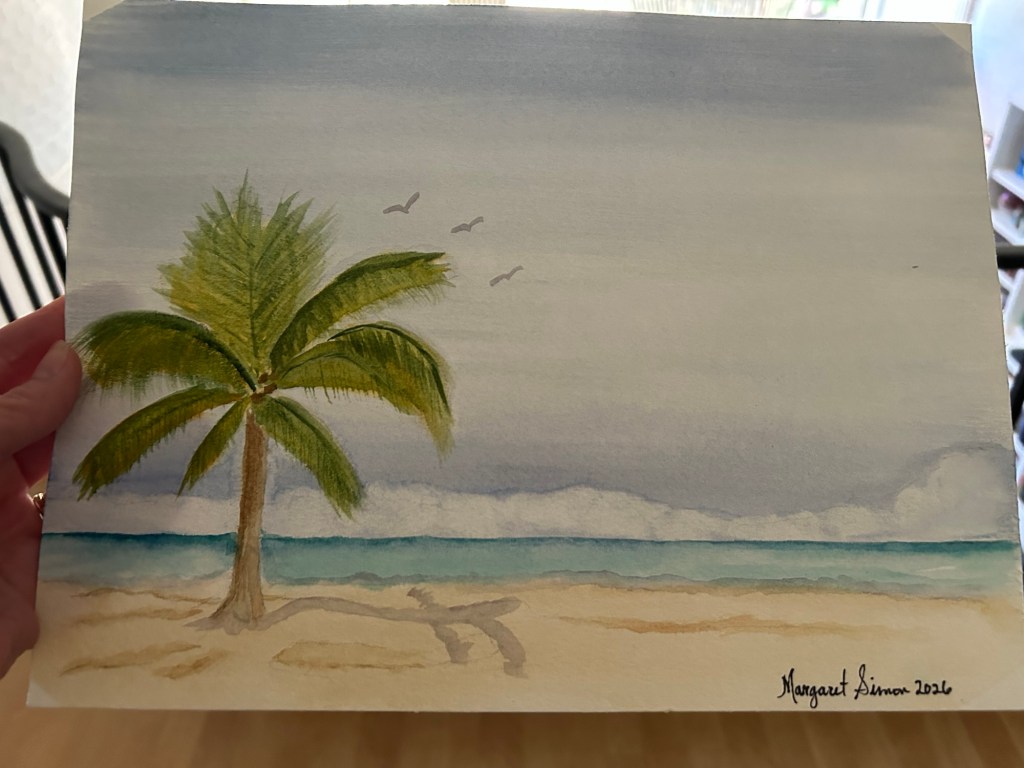
Here is the only painting from the class that I did all on my own. I decided to sign it.


 Reflections on the Teche
Margaret, your painting is beautiful, and I’m so glad you have found the inspiration to paint – – and hopefully to illustrate your next book! I’m firmly in the camp of not touching students’ artwork – – no matter the age. I think back to having a conversation about first little marks by a toddler, and how precious those marks are to parents. The same holds true of the authenticity of artwork – – when someone else touches it up, it is no longer the artist’s original work. Many times in younger grades, we did write dictated sentences if we were having a response to a question that all students answered – – if the handwriting and structures were not part of the importance of the product. But if they were, we didn’t touch it. I think this raises an ethical question of the integrity of finished products and I’m so glad you raised that question – – I can’t wait to see others’ responses as well. Kudos on the painting!
Margaret,
I wish your teacher was as thoughtful as you were with providing your grandson support and allowing him to do the hard work on his own.
Art and writing our so personal and special. It does feel like a violation to have a teacher take over.
Thank you for sharing this question and your beautiful painting. I especially love the way the water and the sky meet in waves.
FYI, Kim also posted about watercolor painting today.
I also love the image of your kindergartener grandson filling the whole back page with his writing.
Thanks for responding. I think it has taken me a whole career as a writing teacher to feel confident I am doing the best for kids when I don’t touch their work. Today I was doing watercolor with students and they were digging the paint out rather than pooling the color with water. I did have to hold a few students’ paintbrushes to show them, but I resisted the impulse to paint on their papers. It’s harder than you think to stay out of it.
Margaret, your painting is lovely and your thoughtful reflection is a part of who you are as well as your lens of “caring grandma.” As a teacher of kids who struggled with writing, usually, I never ever wrote on a child’s paper and encouraged all the teachers in my building to use sticky notes if they needed to comment on anything. If kids ask for help spelling, I would encourage them to try but would always give them the conventional spelling if that was stopping them, on another paper. I would offer lines or extra paper but never ever a critique on their work. I had a teacher who destroyed me and my first college English paper with a red pen. It took decades and a doctorate in writing for me to recover. You are wise to be thinking and encouraging. When one of my own grands was in kindergarten during the stay at home pandemic era, I used those little thin sticky notes as she loved them to offer points of praise and questions about intent. It has become a love language we use even today, although our shared writing is mostly on google docs these days.
The magic of sticky notes! Love this idea. I definitely used them with my students but hadn’t thought of it with my grandson. Next time I’m babysitting, I will bring sticky notes!
Margaret, what a good question to ask. I was fascinated to see that you had examples of being the one who might have touched your grandson’s work and had yours touched, in the same week. I agree with you about not wanting the teacher’s work on your own. Our art, as our writing, is so personal, and we have our own style. Perhaps you will like your style of grass and darkening trees better than his. Seeing the teachers and then making your own is best, so I think your little guy’s homework was perfect.
I think a better way for the teacher to have handled this would have been for him to notice the help you needed and conduct a mini lesson for everyone because I am sure others faced similar situations. For him to have altered your painting is like writing something and then having AI rewrite it.