I warned my kids who are 4th and 5th graders that this form would be a challenge. Not all of them were ready and willing and that’s OK when we are creating our own poems. I wanted to share a few because the prompted lines work in a unique way so that each student (and myself) felt a sense of a successful poem.
Kailyn loves candy and has written a fantasy story that takes place in Kind Candy Kingdom. This is her pantoum poem.
Yummy candy I see, A candy shop is your home. At the mall I beg my mom, then my brother takes you from me : (
A candy shop home seems nice! When you are with me I feel happiness and joy… you being taken from me. It tastes sweet but sometimes sour.
You fill me with joy and happiness, the sounds of crinkling wrappers. When I put you in my mouth, you are sweet and sour, tingling on my tongue.
The crinkling wrappers from kids inside, at the mall I beg my mom. Tingling on my tongue, Yummy candy I see.
Kailyn, 5th grade
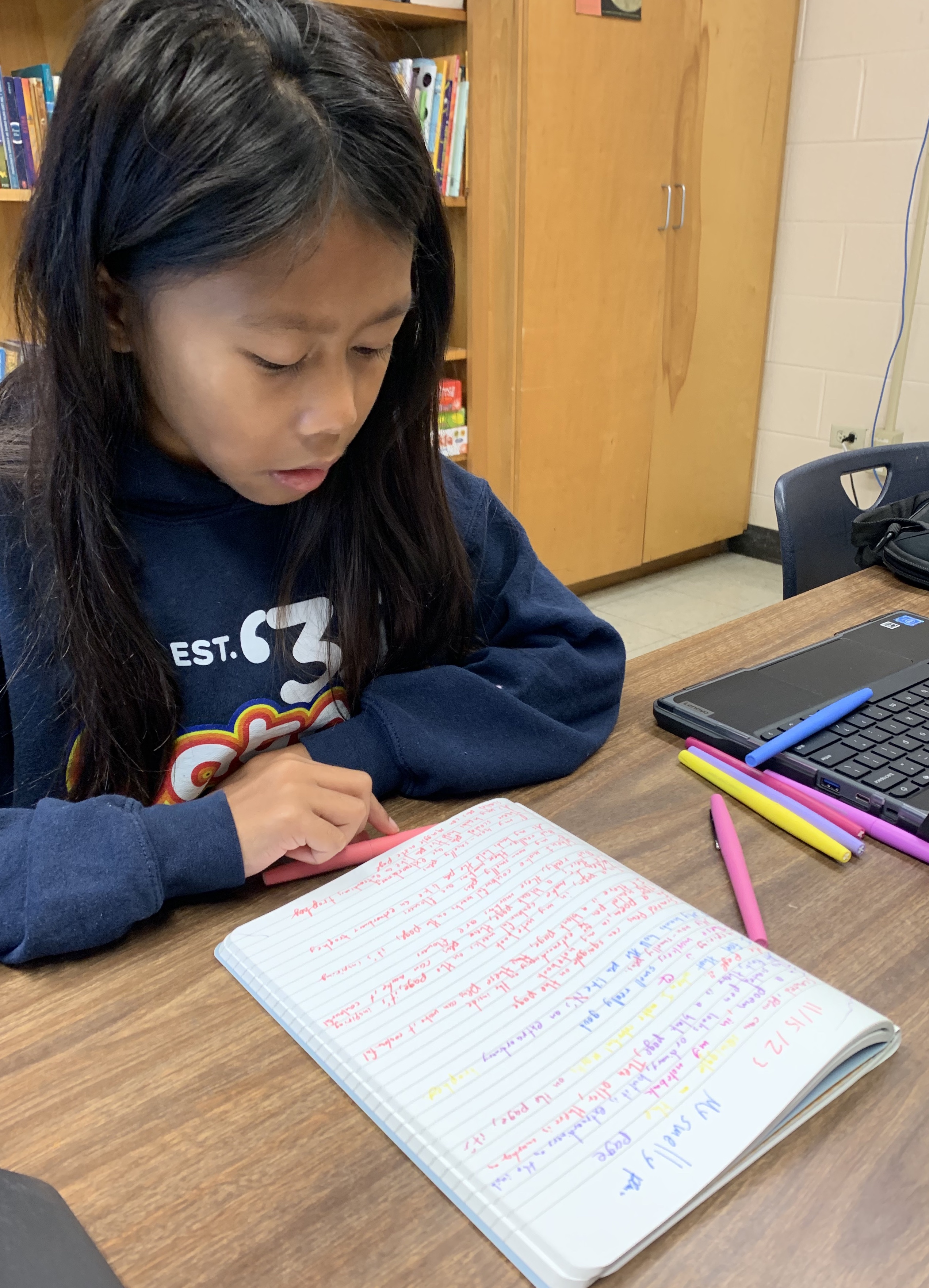
In my classroom, I have a collection of Flair pens. My students are allowed to choose from them to write. When Avalyn’s mother gave me a gift card to Target, I bought a set of scented flairs. She wrote a pantoum praise poem for her scented pens.
Scented pens can squiggle on the page In a poem in my notebook These scented pens are extraordinary on the inside If there is a blank page, these pens can make it colorful
In a poem in my notebook When I make colorful marks on the page, it’s inspiring If there is a blank page, these pens can make it colorful But really these markers are flowers
When I make colorful marks on the page, it’s inspiring O’ my non-smelly pens But really these markers are flowers As my hands hold the pen like an extraordinary trophy
O’ my non-smelly pens These scented pens are extraordinary on the inside As my hands hold the pen like an extraordinary trophy Scented pens can squiggle on the page
Thank you to Two Writing Teachers for creating an amazing community of writers and a safe, welcoming space to write and share.
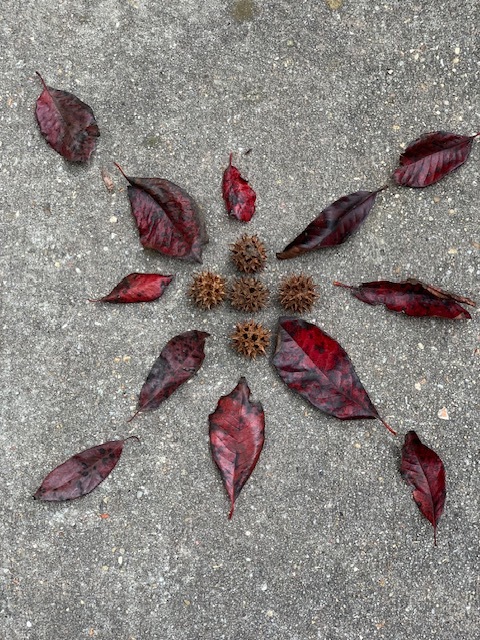
Nature art by Marifaye
Write Out is a National Writing Project event that takes place for 2 weeks in October. Using the concept of getting kids out in nature and writing, I planned a field trip for our district’s gifted students to Palmetto Island State Park in Vermillion Parish. We arranged for a park ranger to lead the kids on a hike, but we wanted to do something creative.
Prior to the field trip my colleague and friend Beth called with an idea–Andy Goldsworthy art. Andy Goldsworthy creates designs with things he finds in nature. His idea is don’t take anything in and don’t take anything out. Whatever he creates, he photographs and leaves it to melt, decay, fly away, whatever may be. A wonderful teaching video can be found here.
The park worked out perfectly for this project. Our students, as well as the parent chaperones, spent time looking at fallen leaves, seed pods, acorns, etc. through a creative lens. Every child that I talked to was proud of the artwork they created.
Back at school on Monday, my students turned to poetry to express their thoughts about their creations.
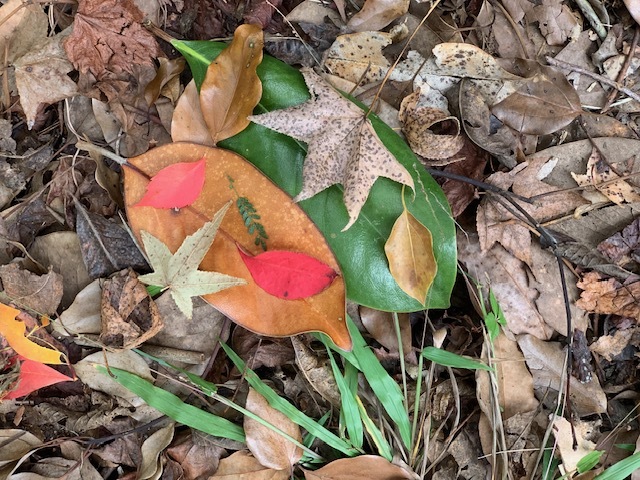
Green and brown leaves
With a yellow leaf on top
And little red leaves and a very tiny fern
Shaped so perfect
To make the right art
Everything in nature is beautiful
Marifaye, 4th grade
Creating something, looks like a portal,
Even if destroyed, it remains immortal,
Standing strong through the test of time,
Eventually destroyed, fell out of its prime.
Max, 5th grade
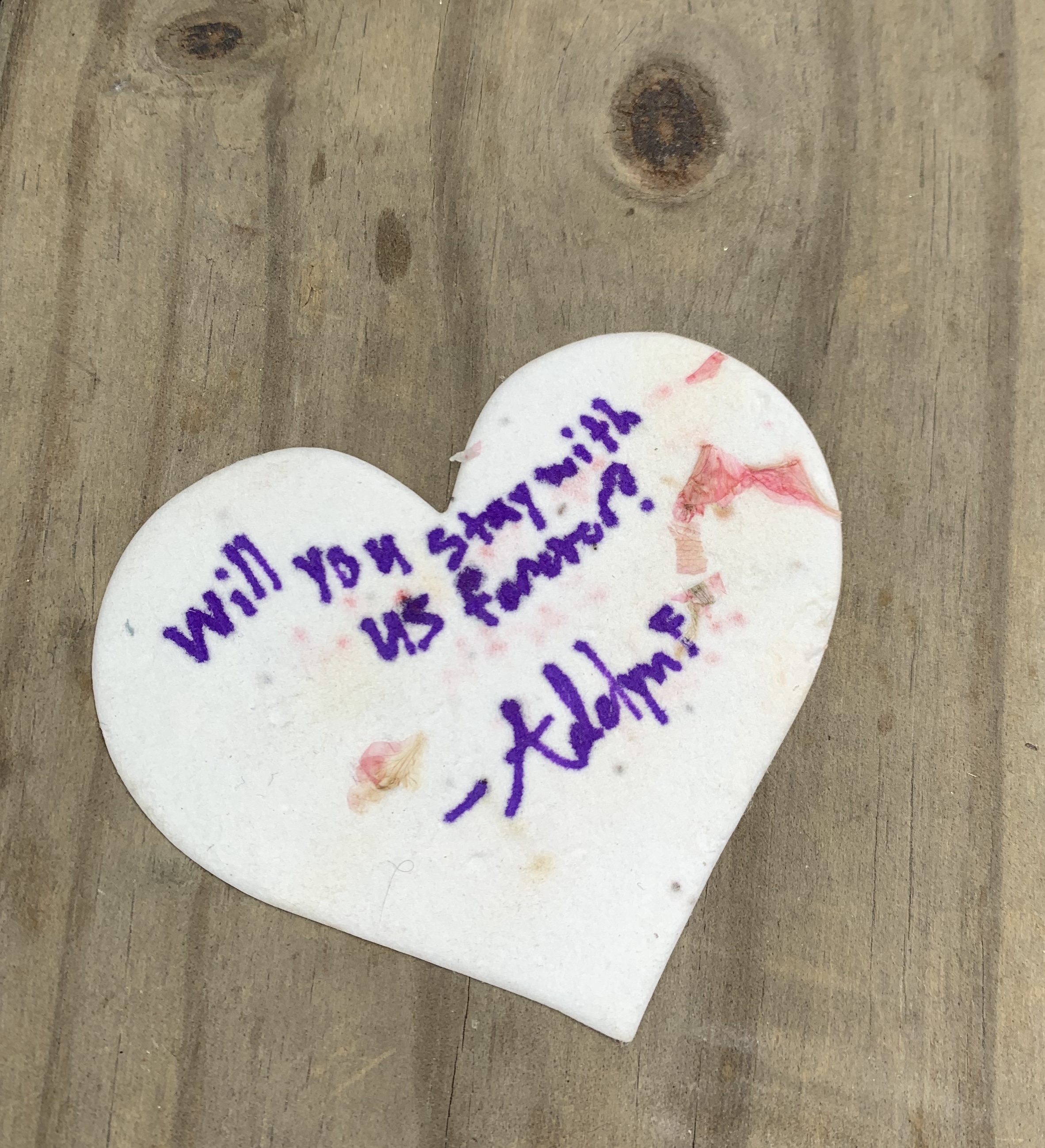
Working with Georgia Heard’s idea of messages to the earth, each student wrote a 6 word message on seed paper. They took these hearts home to plant.
In my humble opinion, I think these kids will look at nature as art, a palette for creativity. They will see with artists’ eyes, finding an arm in a seed pod, a mirror in a leaf, and a kingdom in a circle of sand.
This week I am heading to Columbus, Ohio for NCTE. I hope I see you there!
The National Writing Project’s Write Out ended last Friday with the National Day on Writing. All the wonderful content is still available, and my students aren’t ready to stop writing. Yesterday we perused the site and found information about Phillis Wheatley from the Boston National Historic Park. When I was researching to write poems for my forthcoming book Were You There: Biography of Emma Wakefield Piallet, I used a line of Phillis Wheatley to write a golden shovel. I shared the mentor text with my students.
They were fascinated to try writing golden shovels, so we found a poem written by Phillis Wheatley on Poetry Foundation. We read “A Hymn to the Evening.”
Soon as the sun forsook the eastern main The pealing thunder shook the heav’nly plain; Majestic grandeur! From the zephyr’s wing, Exhales the incense of the blooming spring. Soft purl the streams, the birds renew their notes, And through the air their mingled music floats. Through all the heav’ns what beauteous dies are spread! But the west glories in the deepest red:
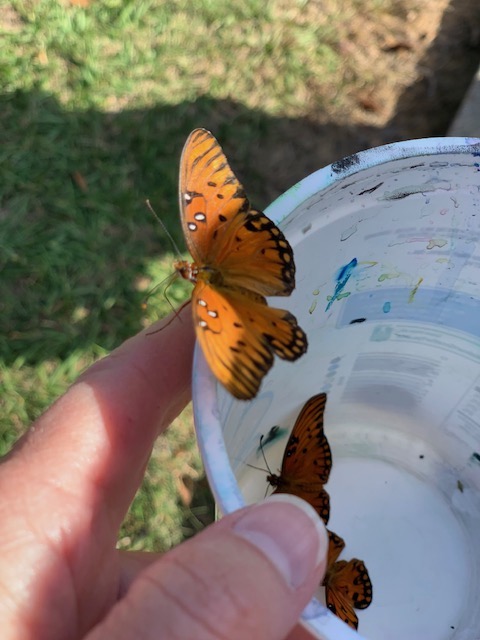
Thursday was a special day in our small room. The butterfly whose chrysalis lay on the zipper finally emerged. We were excited because it meant we could finally open the enclosure to release them all. We had four that I had been feeding with mandarin oranges from the cafeteria.
We had the privilege of watching their daily antics and marveling at their beauty. The butterflies were Gulf fritillaries. And flit they did. This breed was less tame than the monarchs we have raised before. They did not light easily on a finger. We had some exciting moments trying to catch them all. But we did and together released them into the butterfly garden. Luckily one of them hung around for a photo.
My mind and my golden shovel poem were both on this miracle of Mother Nature.
A Hymn for the Gulf Fritillary after Phillis Wheatley “A Hymn to the Evening”
Fritillary soft petals purl from enclosure to the spread of wings, flitting over streams, freedom like the birds who renew, survive and thrive singing their tender, sweet notes.
Thank you to Two Writing Teachers for creating an amazing community of writers and a safe, welcoming space to write and share.
My students and I have been looking forward to the National Writing Project’s Write Out, a writing event that takes place in October. NWP partners with the National Parks to create videos and writing prompts designed to get kids outside to write. Last Friday, I handed each student a 5×7 blank book and told them it would be their Write-Out notebook. What is it about having a new clean colorful book that makes you want to write?
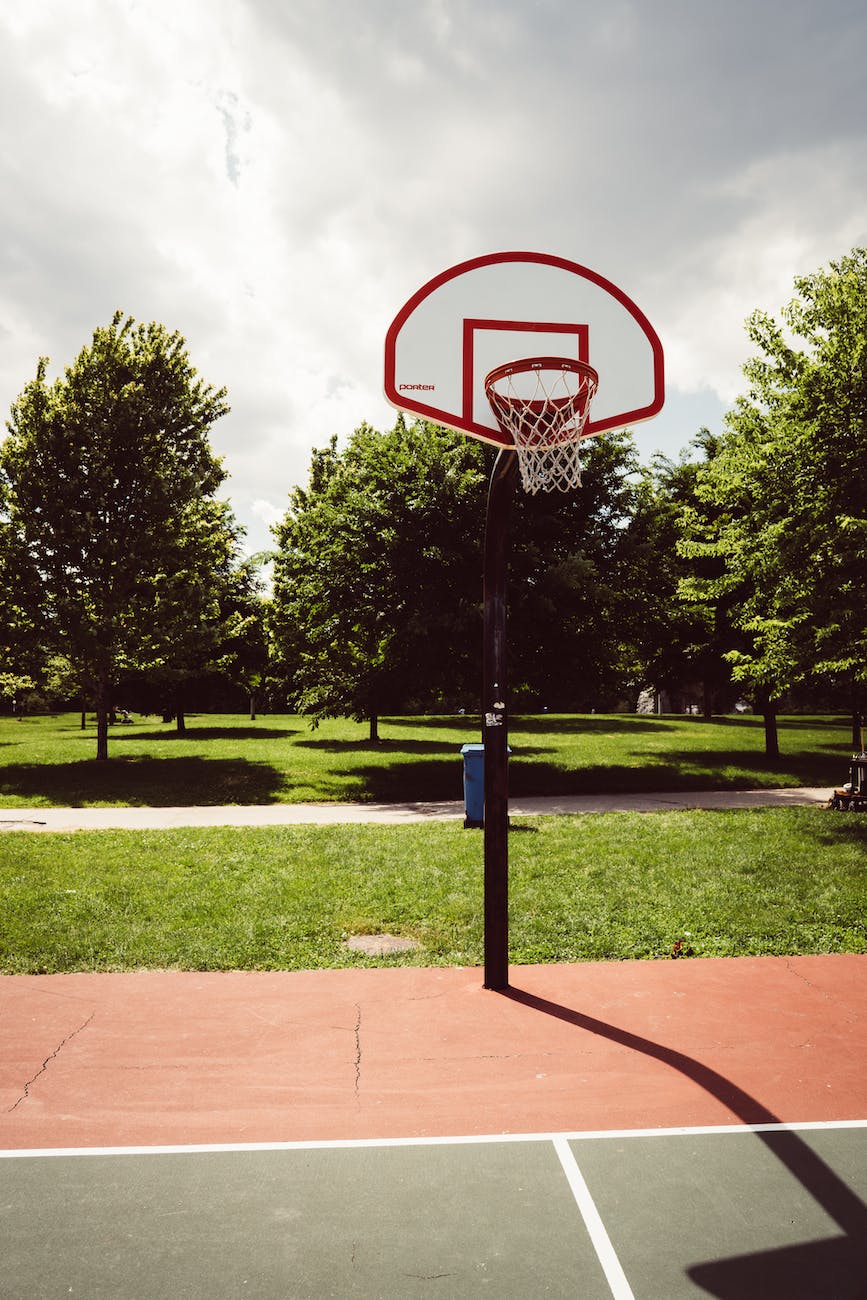
After watching a short video from Ranger Chris from the Delaware Water Gap National Recreation Area, we went outside to the playground to observe nature and write haiku poems. I wrote alongside them. I shared how I sketch in my notebook. Sketching is low-stakes art. Sketching helps to motivate and enhance writing while making their notebooks a safe place to explore.
Back inside, students were enthusiastic about sharing their poems. Because I teach multiple groups at two different schools, we use Fanschool for sharing our writing.
If you have a minute, it would be exciting to my students if you wrote comments on their first ever haiku poems:
Thank you to Two Writing Teachers for creating an amazing community of writers and a safe, welcoming space to write and share.
Where did I read that we should be teaching living poets in our classrooms? I try to include poetry every day. This is a goal, but some days, as you well know, don’t go as planned. I’ve made a Google Slide Show for a Poem-a-Day, so I have a place to save poems I want to explore with my students. When I announced yesterday that we had time for poetry, my students were excited. I love this about elementary gifted kids!
First we read the poem through. Then I ask, “What do you notice?” I ask my students to notice 3 things about the poem. Using annotation on the smart board, I underline what they see and if they don’t, I name them.
I presented Danusha Lameris’s Small Kindness. I invited my students to write. They could borrow a line, make a list poem of small kindnesses, or write about their own topic using free verse.
I’ve long held the belief that I should write alongside my students. I also welcome their critique. Usually they just say, “I like it.” Then I know we need to work on how to offer critique with specifics such as “I like the way you used personification or metaphor or rhyme.” Naming the specific poetic elements.
Yesterday I was surprised when a student actually said, “I think it’s too clumped up.” As I questioned him further about what he meant, I realized that I read it like a paragraph, no line breaks. Danusha Lameris’s poem uses enjambment masterfully. She understands line breaks. It is definitely a skill I want to work on, and this student nailed it.
So I worked on it, revised, and will share today the current working draft.
Small Kindness
after Danusha Lameris
I’ve been thinking about the way when I open a car door, and a little kinder kid jumps out, how the driver says, “Thank you.”
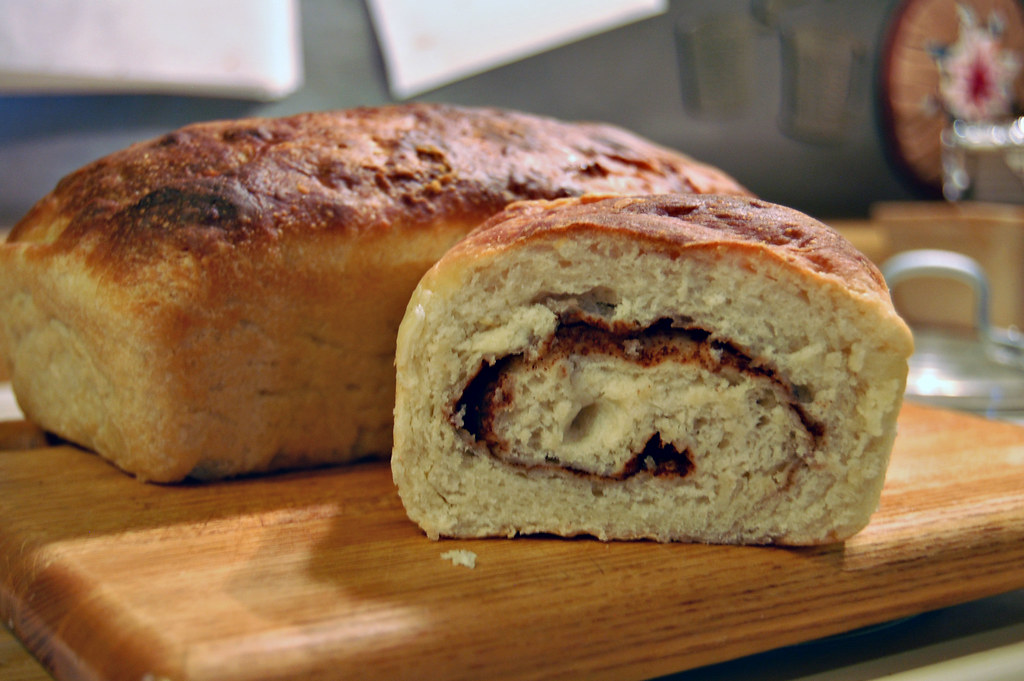
How on the way to school, a white suburban slowed to let me merge ahead. How cinnamon bread, a gift from my neighbor fills the kitchen with sweetness.
I want to believe everyone is kind and thoughtful. I want to find grace
in the corner of the parking lot waiting for me to notice her.
I’ve had a wonderful week getting back into the classroom. I have some new students as well as the ones I taught last year. I teach gifted ELA pull out for two elementary schools. The hardest part of the job is packing up the cart and moving to the next school. Once I am there, though, all is right with the world. I am meant to be a teacher!
On Wednesday I led my kids through “This Photo Wants to be a Poem.” We use Fanschool and I place the same photo from my blog post to Fanschool. The kids write their own poems in the comment section. Two of my students who signed into gifted this week had never written a poem before. I find joy in the process. I think I spread that passion to them. Their responses were amazing.
This week was Ethical ELA’s Open Write. I wrote about one of my students in response to Barb’s prompt here. A comment from Kim Johnson gave me an idea for the ending metaphor. This is a wonderful community of teacher-writers. Join us in October, 21st-25th.
Volleyball Team
Last year in fourth grade she would skip recess awkwardly reading in a corner of my classroom.
Fifth grade offered a volleyball team. She arrived with a brightly colored volleyball, tossed it with confidence, leaning on it while writing.
“I’m on the volleyball team this year.” We talked about the serve I could never master. She showed me how it’s done now– from the palm-up wrist rather than the thumb.
A flower blooming through a crack in the concrete, hoping to find its way to shine on the court.
Earlier this week I posted my Pile of Good Things Poem prompted by Stefanie Boutelier at Ethical ELA. Stef encouraged us to use technology and shared a design she made in Canva. I shared the prompt with my students on Monday. My little ones in 1st and 2nd could put together this idea for a poem. I am amazed at how easily they use technology at such an early age. Second grader James turned his pile into the shape of a tree.
I’ve been thinking about my pile of not so good things lately. You might say it’s a gripe poem, a pile of pet peeves.
My Pile of Peeves
Scent of cat pee Anxiety at 3 AM Morning cafeteria duty When I’ve lost something Hitting Send before proofing A colleague diagnosed with cancer An unconsolable child weeping over a mistake The sound of my alarm when I’m actually sleeping In carpool line, putting a student back into a toxic environment The big white truck with extra tires passing me to make a right turn from the left lane.
Margaret Simon, ongoing draft depends upon the day
The Kidlit Progressive Poem schedule for April is full. You can copy and paste the code found on this post. Contact me by email if you have any questions.
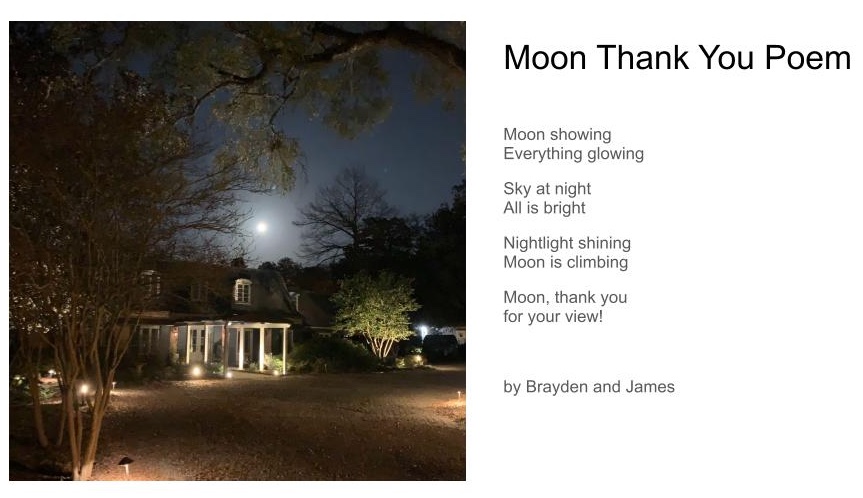
I am privileged to have the opportunity to write poetry with gifted kids. Their minds are open and in tuned to ideas. Most days they can’t wait to tell me what they are thinking about. Most days they want to write, welcoming the blank page. This week I shared with two of my young students (2nd and 3rd graders) photos of the full moon that I had collected from social media. I actually had another idea for them, but as we were looking at and discussing my picture of the moon above my neighbor’s house, they were full of questions and wonderings and a poem emerged. It was a happy moment because somedays little boys would rather be running outside than writing a poem with their teacher.
Click the image to see a larger view. Photo by Margaret Simon.
There are still a few dates available to sign up for the 2023 Kidlit Progressive poem. Click Here.
Thank you to Two Writing Teachers for creating an amazing community of writers and a safe, welcoming space to write and share.
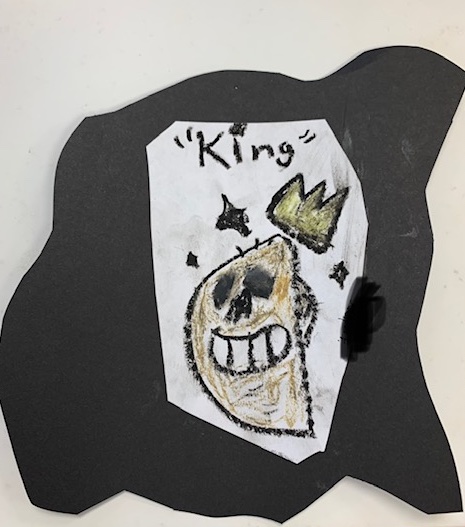
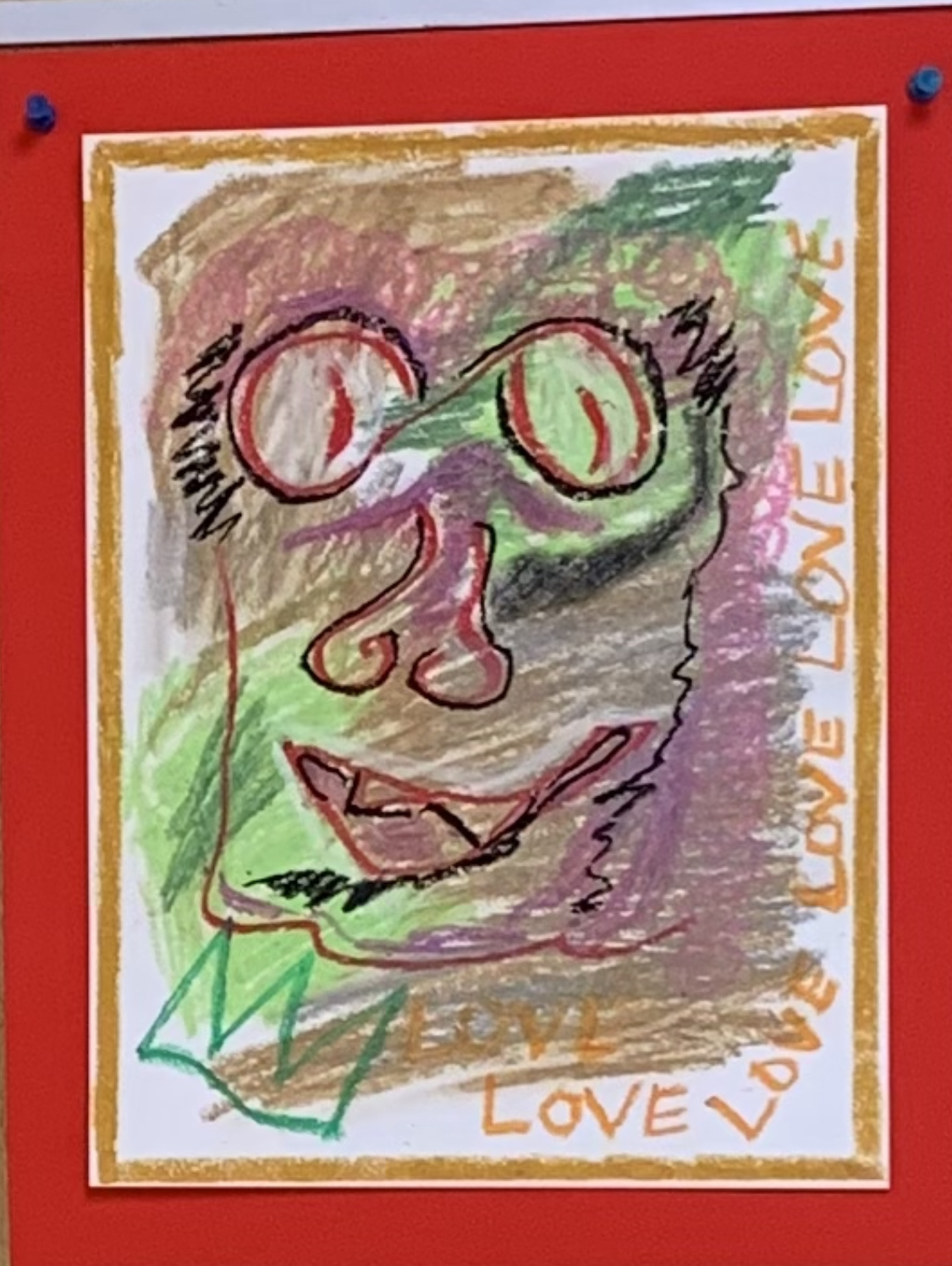
Remember Alice? The sleep-deprived child from my Slice on Saturday? She wanted me to let all my readers know that she took my advice and read The Lightning Thief, our current class novel, before falling asleep rather than watching TV. If you’ve ever read The Lightning Thief, you may not think this is such a good book to read before going to sleep. Talk about wild crazy dreams filled with Minotaurs and such. But the book helped Alice fall asleep at a reasonable hour, so she was enthusiastically ready for class today.
She also wanted me to share her Basquiat art piece.
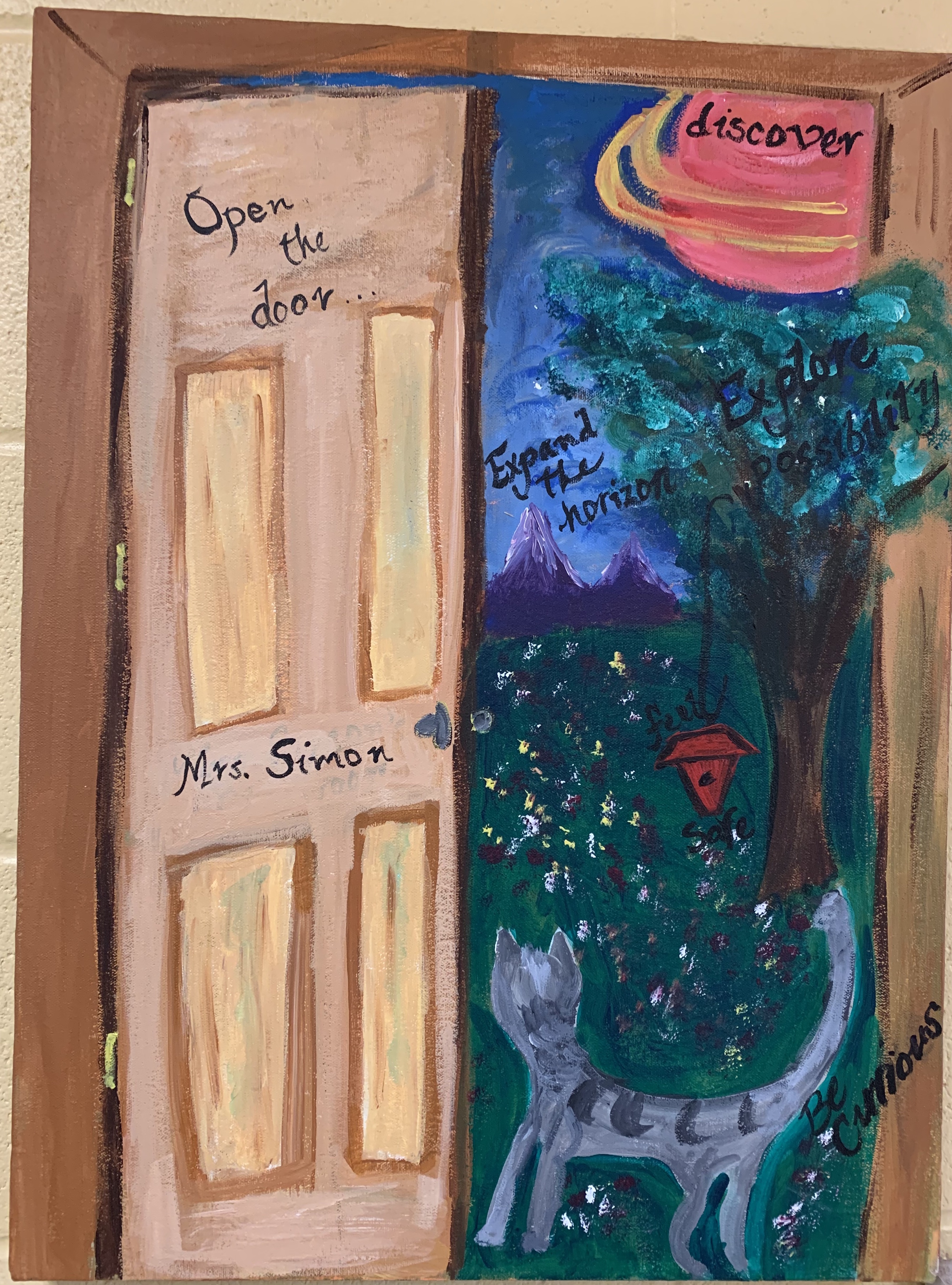
I asked my students for an idea for today’s Slice of Life, and they pointed to a painting I created years ago in a creativity class for my gifted certification. That class was one of my favorites. I loved my teacher and the projects we did. I went searching for the binder. More than any other class, this one taught me how to embrace my own creativity so that I could encourage it in my gifted students. This was a reminder I needed today.
I found the binder, my final project, in a cubby and hugged it close. I’m so glad I kept it. Looking through the binder was like looking into a time capsule. So many things I had forgotten. But my painting with my teaching philosophy remains on the wall of my classroom today. I still believe in it and try to live it everyday.
In the painting, I analogized creativity with opening a door. In my classroom, I want to make the students feel safe as in a birdhouse that gives them the freedom to explore ideas, discover relationships, and ask questions. A cat symbolizes curiosity; the tree, exploring possibilities; and the planet, discovery. The purple mountains symbolize expanding the horizon, and the wildflowers, flexibility.
Thank you to Two Writing Teachers for creating an amazing community of writers and a safe, welcoming space to write and share.
I teach gifted kids in grades 1-6 at two elementary schools in my district. We use a pull-out program, so I see my kids every day. Alice (not her real name) comes to me at the end of the school day, after second recess and before dismissal. Yesterday she was tired, and I could tell. Her eyes were half closed and she had very little patience for the suggestions I was making about her work.
Alice is very talented, not just in academics, but also in art. However, her perfectionism can get in the way. We were doing an art project in the form of Jean-Michel Basquiat. We watched a video from a Pace artist from the Acadiana Center for the Arts. Following the directions of the teaching artist resulted in a Baquiat-esque painting. Alice did not like what happened when she created her background. “I hate it,” she cried. And tears fell down her little cheeks.
I knew this melt down was not just about the art. She was tired. She had an idea in her head of what she wanted her art to look like, and it wasn’t happening. She’s a calm child. She didn’t tear up the paper. She didn’t cry loudly or need to take a break. I let her figure it out, and by the end of class, she had cut out one of her practice drawings and glued it to a solid background. And I think she left for the weekend somewhat pleased with how she had gathered the strength to at least have something to put in the hall display.
But before all this happened, we talked about her exhaustion. I know that gifted kids have a hard time shutting down their brains to sleep. I also know that research shows you should turn off all screens at least an hour before going to sleep.
Alice: “I’m just tired.”
Me: “Did you watch TV before you went to sleep?”
Alice: “Yes, I always do.”
Cringe on my face, “You know research says that TV stimulates your brain so you won’t get restful sleep if you use it to fall asleep.” I tried to sound logical and not degrading.
A: “I just can’t stop thinking! I need a Notes app for my brain!”
I couldn’t help but laugh! Then I explained to her how a notebook next to her bed could be her notes app for her brain.
She admitted that she would probably totally forget this conversation by the time she would be going to bed. I think we could all use a Notes app for our brains.
Margaret Simon lives on the Bayou Teche in New Iberia, Louisiana. She is a retired elementary gifted teacher who writes poetry and children's books. Welcome to a space of peace, poetry, and personal reflection. Walk in kindness.







 Reflections on the Teche