Feeds:
Posts
Comments

Archive for the ‘Poetry Friday’ Category

Click over to Buffy’s Blog for more Poetry Friday.


I know the importance of reading nonfiction texts with my students; however, I am not a fan of assigning an essay after every reading, especially in December.  I wanted my students to think critically about the text, to absorb it fully, and to demonstrate comprehension.  So I turned to the found poem.

To write a found poem, the writer must make decisions about which text to keep and connect to.  This requires critical thinking skills. For a found poem to work, the words and phrases need to be placed creatively.

We read “Shattered Sky”, a narrative nonfiction story in the November issue of Scope magazine published by Scholastic.  In this story, my students read about a little known disaster in Halifax Harbor in 1917, one hundred years ago.  They were fascinated.  The author of the text, Kristin Lewis used craft moves to heighten the emotions of the story.  I instructed my students to underline phrases and words that brought about an emotional response.

When we had written and were sharing our writing, Faith said, “I am amazed at how different everyone’s poem is.”  And she was right.  Each one was different.  Each student had found a unique voice.  Each poem reflected a different aspect of the article.

When Andrew posted his poem on our blog, he titled it “I like this poem, so you should.”  Mason thought it was the best poem he’d ever written.

This exercise of finding a poem gave my students confidence to recognize craft moves as well as create a unique piece of nonfiction poetry.


Poem for Halifax

December 6th
They ring a bell
The image they see
They want to repel

Children getting ready, grabbing their schoolbooks,
Fathers, ready to work, grab their coats, off the hook.
Dartmouth and Halifax, buzzing with activity,
while mothers make oatmeal, hot and ready.

Two boats, Mont-Blanc and the Imo
With explosives and munitions, ready to blow.
There was no saving them, as far as we know.
Neither ship changed course and tore into the other and
put on a dangerous light show

Orange and blue fire ignited the boats
People rushed to rescue, thought they could help.
They succeeded but some retreated up.

Andrew, 5th grade

Shattered

The water had a thin mist of terror of WWI

The chimney swirled of smoke and ash

The people of Halifax were doing their everyday things

From eating to cooking and going to work

Then a sudden rumble and crackle of the two ships of cargo collide

They rush outside as every thing burst into flames and then boom

A sad tragedy will forever live in our hearts.

Mason, 5th grade

See more found poems at our Kidblog site.

Read Full Post »

Click over to Steps & Staircases for more Poetry Friday.


Inspired by Project 1,2,3 originated by Amy Krouse Rosenthal and continued by her daughter, Lisa challenged us to make a metaphorical poem from an object/image.  Many of us took the challenge.  To see more poems, click over to Lisa’s blog to read more posts.

I brought this idea to my students and combined it with a lesson from Amy Ludwig VanDerwater’s book Poems are Teachers, “Make Metaphors” on page 136. We looked at model poems and talked about how an object can become a metaphor.  In one class, I passed around a paintbrush and said, “A paintbrush is…”  In another, I blew bubbles and said, “Bubbles are like…”  Each of these inspired beautiful responses from my kiddos.

  • A paintbrush is your imagination.
  • A paintbrush paints your path.
  • Bubbles are sparkling rainbows.
  • Bubbles are in orbit flying around Saturn.

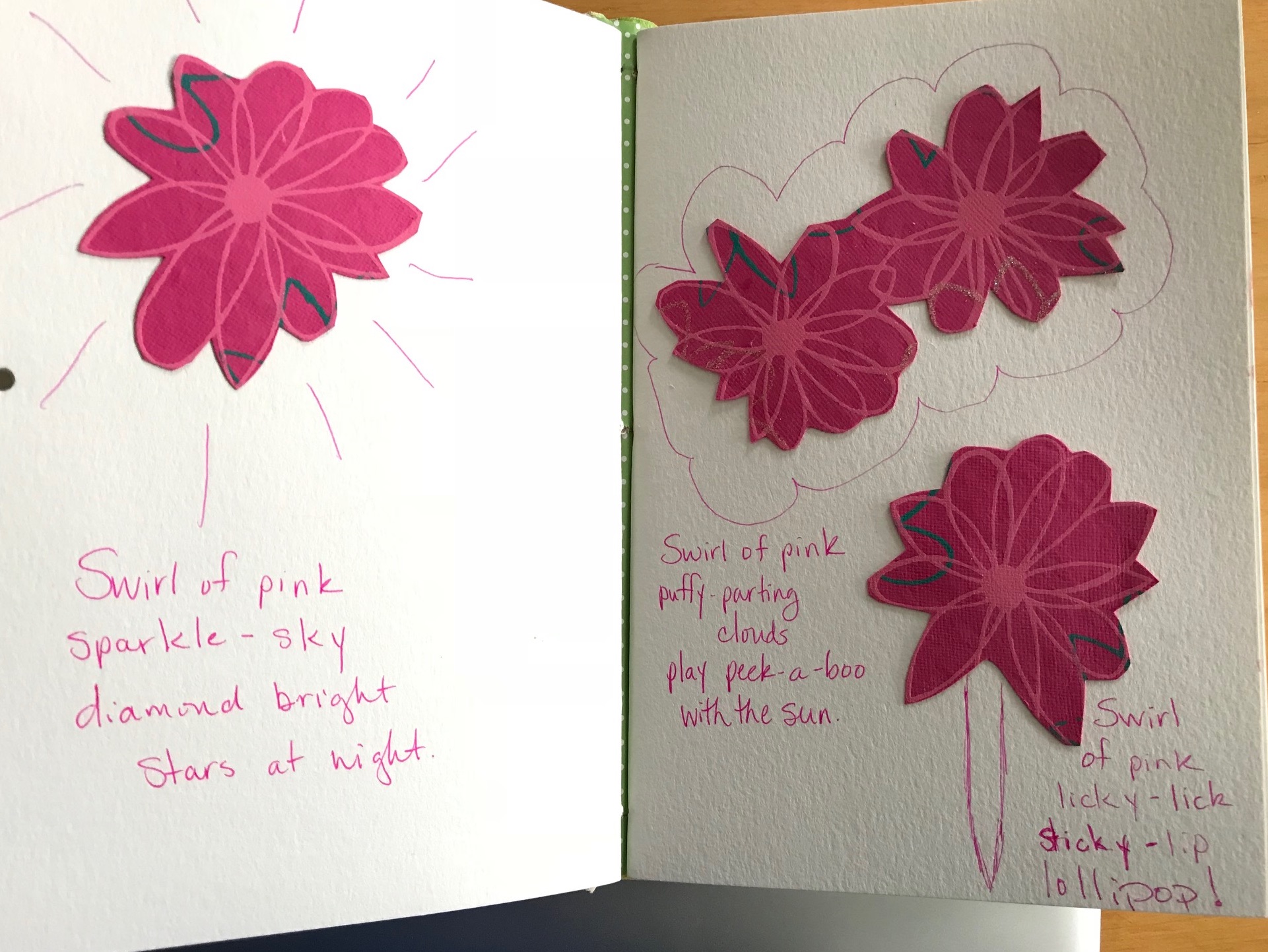
As I wrote with my students, I grabbed a pink marker and made three swirls on my paper.  Back at home with a little time to craft (snow day!), I cut and pasted pink swirls in an art journal.  Thanks, Lisa, for the fun prompt.


Swirl of pink
sparkle-sky
diamond bright
stars of night

Swirl of pink
puffy parting clouds
play peek-a-boo
with the sun

Swirl of pink
licky-lick
sticky-lip
lollipop

–Margaret Simon, 2017


Chloe’s Bubble poem

Trace’s pink paintbrush poem

Austin’s wooden flute poem

Lynzee’s angel poem

After we wrote and shared our poems, Andrew had an idea.  “Why don’t we take a line from each of our poems and make a new poem?”  Sounds like a great idea.  Here’s the resulting poem.

To dream it, all you have to do is start.

Don’t erase yourself from the real world.
Paint your true colors.

There is no fright.
Not to lose but to gain.

Flying high above
a swirl of pink puffy parting cloud,

The sea is my world.
The sand is my happiness.

–Caneview GT Allstars


Read Full Post »

Click over to Mary Lee’s site for more poetry.


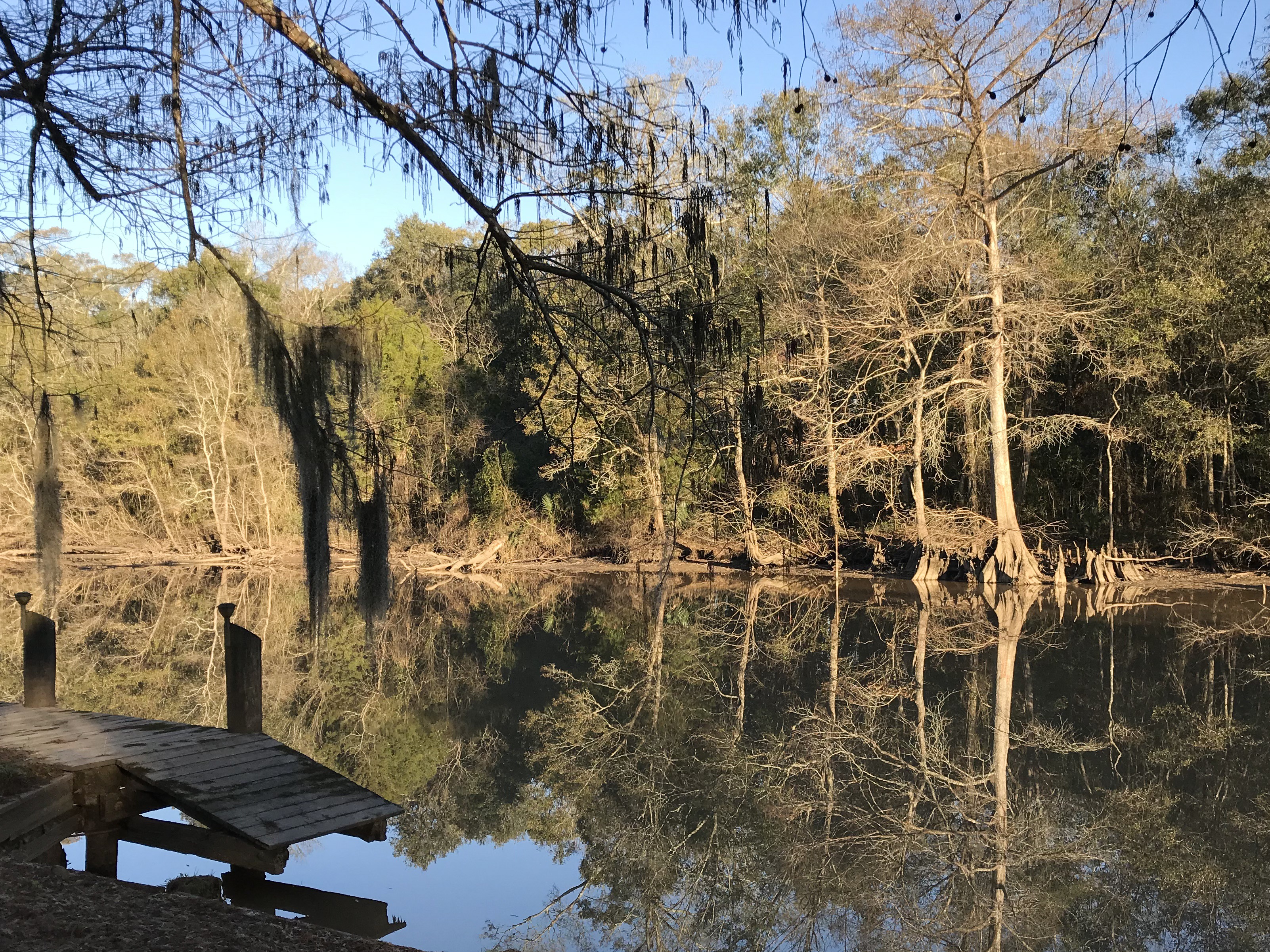
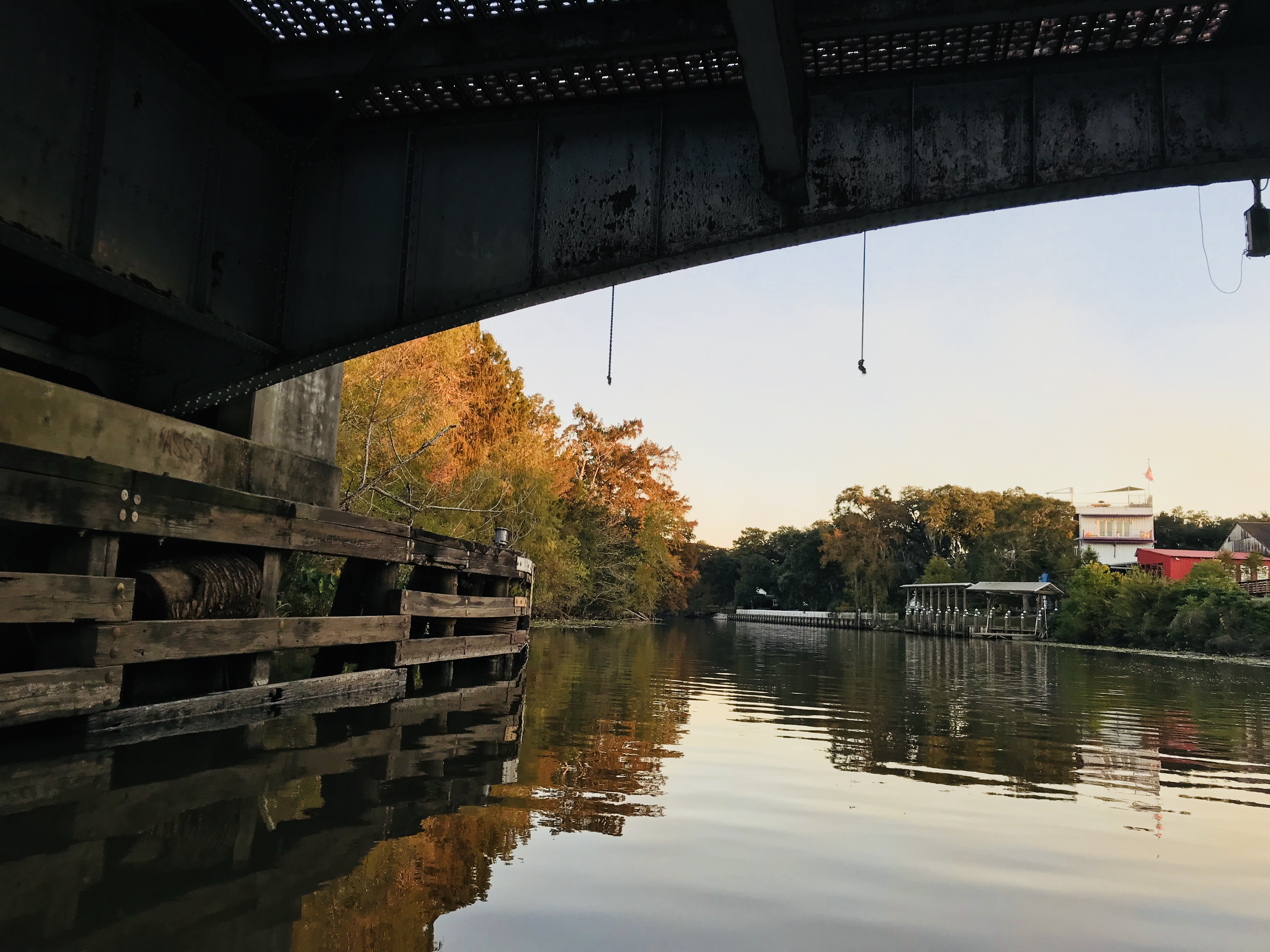
Fran McVeigh gave me a magnet at NCTE: “Explore new possibilities.”  I’m considering the word explore for my 2018 One Little Word, but for today, it inspired the title for a poem requested by Carol Varsalona for her #AutumnAblaze gallery.  She saw my photograph on Facebook from a recent canoe voyage on the Bayou Teche (pronounced “tesh”).  I loved the photo, too, and was resistant to writing about it.  I want you to know this is still in draft, so you can leave soft critique in the comments.

Duperier Bridge on Bayou Teche, New Iberia, LA. photo by Margaret Simon

Explore New Possibilities

On the water,
the canoe turns
toward a horizon
I do not know.

I paddle-pull
under a bridge,
listen to the rumble-
a passing car

like thunder from rolling clouds.
Under a bridge
where teenagers
huddle close and smoke,

where wooden gates
direct water
as if one could
contain such a wild thing,

a golden sunset
draws me toward
a new destination.

–Margaret Simon

Mary Lee Hahn invites us to join #haikuforhealing. Inspired by the same photo, a haiku:

where road meets water
a bridge, a golden sunset
a new horizon.

–Margaret Simon


Read Full Post »

Click over to Carol’s Corner for more Poetry Friday.

Over at Today’s Little Ditty, Carol Hinz challenged us to write a poem that finds beauty in something that is not usually considered beautiful.  On a family Thanksgiving Day walk to City Park in New Orleans, we came upon an old outside bar covered in overgrown weeds and graffiti.  On the walls were a few amazing black and white drawings.  One of them caught my eye and then inspired a poem.

New Orleans City Park

At Violet Nesdoly’s blog, I discovered a new-to-me poetry form, Shadorma. The form is a Spanish version of the haiku with six lines and a syllable count of  3,5,3,3,7,5. The form fit well to what I wanted to say about the Graffiti Girl.


Graffiti Girl, City Park, New Orleans. Photo by Margaret Simon


Graffiti Girl

I am drawn
in hard black charcoal
staring out
of stone walls
yet when you see my image
your heart cries for me.

If you could
hold this star light high
a mirror
in my eyes
step into my wall, hold me,
would you come so near?

–Margaret Simon, all rights reserved


Read Full Post »

Click over for Coffee and Donuts with Jama and more Poetry Friday.


Laura Shovan’s 5th annual February Poetry Project continues with one of us selecting an article each month and pulling out ten words.  This month Kathy Mazurowski selected this article and these words: nostalgia, reflect, interferes, cope, memories, personal, uncertainty, crystallized, bittersweet, science.

One morning I sat at my computer determined to get some words in for the day. I looked at the words Kathy selected, at my reflection in the kitchen window, and this poem appeared.  Every once in a while the muse visits me. I just need to sit here every day.


Glass reflects
the shape of things–
shadows of me
sitting here:

a cup of coffee
a vase of daisies
a cat
a stack of books

crystallized in a photograph
nostalgic for
the bittersweet taste
of uncertainty.

News interferes.
Memories flee.
How do we know what
tomorrow will bring?

Somehow we cope–
put on the cloak
of science and move on.
It’s not personal.

I reach over
to pet the cat.
Her fur is soft,
and she purrs.

–Margaret Simon, all rights reserved

Read Full Post »

Poetry Friday posts are with Linda at Teacher Dance.

Much has been written about this amazing new resource for teachers.

There’s this one at Live your Poem by Irene Latham.

And here is a review by Laura Purdie Salas.

The Two Writing Teachers featured an interview with Amy.

Literacy Lenses includes words of wisdom from a Good to Great (#G2Great) Twitter chat with Amy.

Like many others, I have a personal connection with this book because some of my students have featured poems.  Amy’s book not only teaches in a wonderfully accessible way; it also celebrates teaching poetry.  Lots of student samples sit alongside poems by children’s poets worldwide.  The depth and breadth of the message reaches well beyond the pages.

I am passionate about teaching poetry in my classes, but I am never quite sure how my lesson plans look to the administrators who check them.   Poems are Teachers is the affirmation I’ve been looking for.  In my heart, I know that practicing poetry is playing with language in a way that can inform other writing as well.  Sometimes writing poetry is just plain fun.  Nothing makes me prouder than a student frantically waving his hand in the air to share his poem.  If we use Amy’s book to create active writing experiences for our students, they will rise up and feel the amazing power of poetry, too.

Emily’s poem is in the chapter “Marry Music and Meter to Meaning.” She wrote this poem after a real lock down.

Jacob’s poem appears in the chapter “Let Art Inspire.” Jacob wrote this poem after looking at Van Gogh’s Starry, Starry Night.

Amy with Heinemann has generously offered a give away for this blog post.  Please leave a comment by November 10th and I’ll randomly pick a winner.  You definitely want this book in your professional library.


Read Full Post »

Poetry Friday posts are with Leigh Anne at A Day in the Life

Last week my students and I studied the poem “A Letter in October” by Ted Kooser.  In response, some of us wrote golden shovel poems.  A golden shovel is a poem that uses the line of another poem stretched out down the right hand margin.  The writer then fills in words to create a whole new poem.  This method of writing a poem forces the writer to use enjambment in an interesting way.  Today I am sharing two student responses as well as my own.


I lay still in my bed in the moonlit night

A sweet blowing breeze passes in

And out  filling my room with its

soft and warm thick

Scent of snow and hushed winter

Whispers wrapping me in a chilly jacket.

–Erin, 6th grade


 You are sitting. Watching
                          while birds fly around the
trees. The sun going down, light
fading. You hear kids walk
down the street. The sun is down,
everybody collecting the candy the
people are giving out. You look at the hill.
You see something, a pumpkin. You carve it.

–Andrew, 5th grade

Every day I drive by a mighty oak tucked between the frontage road and the highway, Mr. Al.  In South Louisiana, the oldest oaks are named and cataloged and cared for.  Mr. Al has had an interesting journey as he was transplanted by the state highway department about 3 years ago.  He is thriving in his new home.

Mr. Al in October.


An oak tree spreads its mighty wings then
beckons us to see
another way the
world can be. Light
dances with the leaves, a casual step,
strong and easy, bouncing out
the noisy beats upon.
-Margaret Simon

Read Full Post »

Poetry Friday posts are with Irene at Live Your Poem

Last week, my friend, poet, blogger, writing partner Linda Mitchell posted her found haiku along with the inspirational poem Letter in October by Ted Kooser.  See her post here.  I took it all to create a lesson for my students.  After study of and talk about Ted Kooser’s poem, I shared Linda’s haiku and talked about how these haiku could stand separate from the original poem.  I challenged my students to try finding haiku.

Madison created this lovely poem, but first she gave the form a name “re-ku” as in recycled haiku.

A late light dawning
finding a world of darkness.
Silhouettes of the

lost leaves, soaring
on a draft. They have lost
their way. I watch the

darkness, sipping tea.
The night has wrapped the light, sowing
reflections ‘cross
my window. Watch.

Madison, 4th grade

Free image

I’m fascinated by the rhythm and repetition that Noah used to create his artistic expression of A Letter in December.

The icy water
a letter in December
Sowing reflections

The icy writing
a letter in December
in the window pane

The icy fingers
a letter in December
wrapped around the hearth

The icy shingles
a letter in December
frozen in its place.

–Noah, 6th grade

Read Full Post »

Poetry Friday posts with Violet who is celebrating Canada’s Thanksgiving.


There are only a few signs that October is here.  The temperatures are still quite warm, but on my morning walks, the sun does not peek over the horizon until I am close to home.  The bald cypress trees in our backyard are turning brown.  And the grass is growing slower, so my mower (dear husband) can spread out the weeks between mows.

In the classroom, when the calendar changes, attention turns to the end of the month.  You know the day, Halloween!

I have subscribed to the Academy of American Poets newsletter “Teach this Poem.”  The lessons are just right for my gifted students. From this site, I introduced Robert Frost’s poem October this week.   We discussed the poem, the rhyme scheme, imagery, and new vocabulary.  We talked about odes and how an ode is like a praise poem to something ordinary.  Then we wrote our own poems, stealing words and ideas from Robert Frost.

I tried a golden shovel with my favorite line, “Enchant the land with amethyst. Slow! Slow!”

O, autumn, your winds Enchant
birds into song, the
sugarcane drapes the land
in swaying soldiers with
suits of green-gold amethyst
Step, step Slow!
Swish, swish, Slow!
Marching to harvest all.

–Margaret Simon, after Robert Frost “October”

Lani, a 6th grader, took a line from Robert Frost and built her own poem around it.

How do you know when fall is here?
When the leaves from towering branches
that loom over us fall into colorful
browngreen leaf piles to plunge into until
twilight makes its unveiling.

When you don’t have to set your
alarm-instead being woken by
The crows above the forests call.

When football starts and your bedtime
changes to fit the Monday, Tuesday,
Thursday, and Sunday games.

When you can wear a sweater
outside and cold fronts become
more persistent.

When the flu sets in and
the doctor is occupied.

When fuzzy socks come out of
the dark hole called
your sock drawer.

When summer clothes
go to Goodwill.

When you stuff your face
on Thanksgiving.

When the days are shorter and
the sunsets more memorable.

When you grieve when it’s over.

Lani, 6th grade

Read Full Post »

Poetry Friday posts with Laura Purdie Salas at Writing the World for Kids


While summer seems far away as I end my eighth week in school, my poetry swap gifts continue to come.  Jone and Iphigene both contacted me by email to say their poetry gifts were late.  I was late, too, so I didn’t mind.  In fact, I love receiving a surprise in the mail…anytime.  Iphigene’s gift included this beautiful painting of the bayou.  She lives in the Philippines, so she had to use images from my blog to imagine this scene.  She definitely captured the peacefulness.

Bayou Teche by Iphigene Daradar. Acrylic on paper.

This is what Iphigene said in her note to me about composing the poem:

“When I was conceptualizing the poem, I thought I’d write about the Teche, but as I read your recent blog posts, the idea of impossible, possible, and overcoming kept surfacing.  In the end, I wrote a poem with those words in mind. The tone of the poem, too, is not my usual.  It was influenced by the biopic of Emily Dickinson called A Quiet Passion.”

The Extent of Our Souls

By Iphigene (For Margaret)

There is an extent by which our soul stretches
One that is measured by words
Short phrases echoed through
In the silence of our minds

In the loose utterance of
‘stupid’ and ‘can’t’
Mingled in laughter, our skin
Think as nothing

Our souls call as truth
Like a seed planted
In perfect day, bears root
Bears bloom, each day

And so, our soul, fits itself
In the limits of our bodies
Brittle for the measure—
Impossible.

However,
As those who know words
Who play with the scales of phrases
Our measures change with space
And rightly placed punctuation

I’m possible.
Feel the impossible stretch
And the soul re-tells its truth
Stretching to ‘greatness’
And knowing it can.

Bearing roots that bloom
Perennial in the hearts
Of those who try to stretch
Their souls to possibility
and its truth.

This week I was blessed by a gift from Jone MacCulloch.  She takes beautiful photographs.  She sent an amazing close-up of a dahlia and her poem printed on a plaque that stands.  In addition to the photo-plaque, she sent a copy of her book  Solace in Nature which is a collection of her photos and poems.

photo and poem by Jone MacCulloch


Here is a photo and poem from her book, Solace in Nature.

winged fighter pilots
dive bomb daily
over sweet nectar
by Jone MacCulloch

Read Full Post »

« Newer Posts - Older Posts »