Feeds:
Posts
Comments

Archive for the ‘Poetry Friday’ Category

Find more Poetry Friday at Tricia's place, The  Miss Rumphius Effect.

Find more Poetry Friday at Tricia’s place, The Miss Rumphius Effect.

I am proud to announce the finalists for the CYBILS Award in Poetry. Being on this panel was such a privilege. I worked with Sylvia Vardell, Nancy Bo Flood, Kelly Fineman, Tricia Stohr Hunt, and Bridget Wilson. Jone MacCulloch was our fearless leader who kept us on task, even during the holidays.

The books are not in any particular order. All will proceed to the final judges.
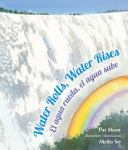
Water Rolls

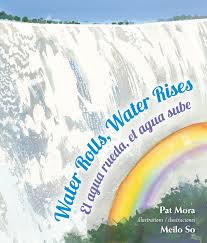
Water Rolls, Water Rises: El Agua Rueda, El Agua Sube by Pat Mora, published by CBP

In a series of free verse poems in English and Spanish, our most precious natural resource takes center stage. Water rolls, rises, slithers, hums, twists, plunges, slumbers and moves across the Earth in varied forms and places. Mora’s three-line poems are filled with imagery and emotion. “Water rises/ into soft fog,/ weaves down the street, strokes and old cat.” (In Spanish: “El agua sube/ formando suave neblina/ que ondula pro la calle, acacia a un gate viejo.”) The lyrical movement of water described in verse is accompanied by Meilo So’s gorgeous mixed media illustrations highlighting 16 landscapes from Iceland, to China, to Mexico, the United States and more. Back matter includes an author’s note and information about the images in the book. A joyous, bilingual celebration, this collection brings water to life.

Tricia Stohr-Hunt
The Miss Rumphius Effect
http://missrumphiuseffect.blogspot.com
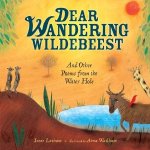
Dear Wandering Wildebeest

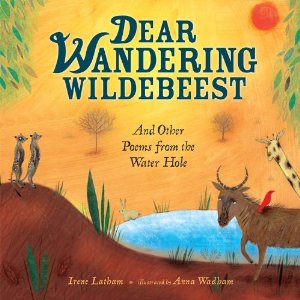
Dear Wandering Wildebeest:and Other Poems from the Waterhole by Irene Latham, illustrated by Anna Washam, published by Millbrook.

In Dear Wandering Wildebeest, Irene Latham’s poetry bounces with the impala and peeps like the meerkat. With childlike illustrations by Anna Wadham, Irene Latham takes us on a journey to the water hole of the African grasslands. Each poem is accompanied with factual information that will inform even the oldest readers.

To All the Beasts who Enter Here, there is word play with “Saw-scaled viper/ rubs, shrugs,/ sizzzzzzzzzzzzzzzzzzzzzles,” form experiments in Triptych for a Thirsty Giraffe, humor of “Dung Beetle lays eggs/ in elephant poop,” and even danger, “Siren-howls/ foul the air./ Vultures stick to task.” Children and adults alike will love the language and learning that wanders in this book along with the animals of the watering hole.

Margaret Simon
Reflections on the Teche
https://reflectionsontheteche.wordpress.com
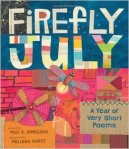
Firefly July

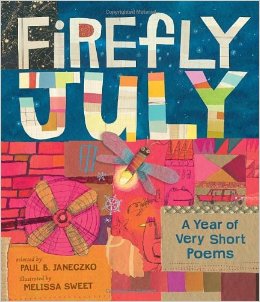
Firefly July: A Year of Very Short Poems selected by Paul B. Janeczko, illustrated by Melissa Sweet, published by Candlewick.
Prolific anthologist Paul B. Janeczko brings the old and the new together in Firefly July: A Year of Very Short Poems. The collection of 36 poems contains poems by classic poets such as Emily Dickinson and Robert Frost. Intermingled with these are poems by well known children’s poets including J. Patrick Lewis and X. J. Kennedy. Firefly July takes readers through the seasons beginning in spring and ending with winter. The poems take readers to different locations as well. Both city and country settings appear in the poems. As the subtitle states, the poems are short, but the images they evoke are almost tangible. Melissa Sweet’s mixed media illustrations are colorful, playful, imaginative, and whimsical. They draw readers into the poems. Firefly July is a stellar collection that will likely be a family favorite for years to come.

Bridget R. Wilson
What Is Bridget Reading?
whatisbridgetreading.blogspot.com
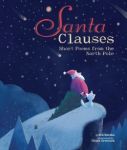
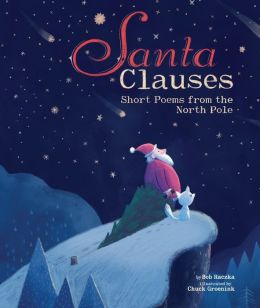
Santa Clauses

Santa Clauses: Short Poems from the North Pole by Bob Raczka, illustrated by Chuck Groenink, published by Carolrhoda.

Who knew that among his many talents, Santa was an expert at writing haiku? In this collection of 25 poems using the 5-7-5 format, Raczka brings us Santa’s many observations, some about his job: “Wishes blowing in/from my overfilled mailbox–/December’s first storm” and others about the weather, the time of year, and Christmas preparations: “Clouds of reindeer breath/in the barn, steam rising from/my hot chocolate”. A fun read all at once, or one per day in anticipation of Christmas, some of the haiku work for winter in general as well: “Just after moonrise/I meet my tall, skinny twin–/’Good evening, shadow.'”

Kelly Ramsdell Fineman,
Writing and Ruminating
http://kellyrfineman.livejournal.com/
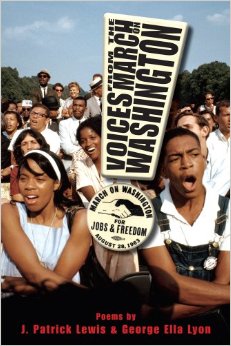
Voices from the march

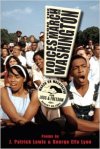
Voices from the March: Washington, D.C., 1963 written by J. Patrick Lewis and George Ella Lyon (WordSong/Boyds Mills Press, 2014) is a historical novel in verse that focuses specifically on the momentous march on Washington, D.C. on August 28, 1963, where Dr. Martin Luther King, Jr. gave his landmark “I Have a Dream” speech. Six fictional characters (young and old, black and white) tell their tales on this historic day in cycles of linked poems alongside the perspectives of historic figures (the “Big Six”) and other march participants for a rich tapestry of multiple points of view. It’s been fifty years since the signing of the Civil Rights Act in 1964, when discrimination on the basis of race, color, religion, sex, or national origin became against the law, but as recent events attest, we still have progress to make as a nation. In this powerful work, Lewis and Lyon tackle issues of racial and social justice in 70 lyrical poems that reflect the perspectives of young people and adults struggling with taking action for positive change in peaceful ways. In addition, extensive and helpful back matter includes a guide to the fictional and historical voices, bibliography, index, and list of websites and related books.

Sylvia Vardell
Poetry for Children
http://poetryforchildren.blogspot.com
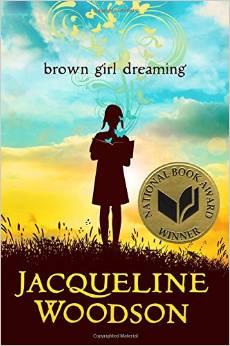
Brown Girl Dreaming

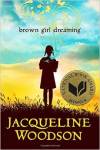
Brown Girl Dreaming written by Jacqueline Woodson, published by Penguin Group, Nancy Paulson Books, 2014, is many things in one rich collection – memoir, history, biography – and lyrical, exquisite poetry. Events of the author’s personal and family history provide the framework for a series of individual poems. Woven throughout are key events of the Civil Rights journey and also personal effects of racism and discrimination. In this beautiful and powerful tapestry of verse, one hears the poignant reflections of Jacqueline Woodson, “one of today’s finest writers,” who kept on dreaming through tough times and good times and who keeps on writing in “mesmerizing verse.”

Nancy Bo Flood
The Pirate Tree; Social Justice and Children’s Literature
www.thepiratetree.com
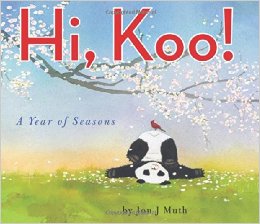
Hi, Koo

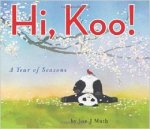
Hi Koo!: A Year of Seasons by Jon J Muth, published by Scholastic.

Inspired by his twins, Muth wrote a haiku book that doesn’t followe the often used three line, 5-7-5 syllable form. This made this title a stand out among other haiku books.
Readers take a seasonal journey from summer through spring by Koo the panda. (Thus the pun in the title: Hi Koo!) Beginning with a simple observation about the wind: found!/ in my Coat pocket a missing button/ the wind’s surprise, to the last haiku: becoming quiet/ Zero sound/ only breath, Muth offers to young readers a new way to experience haiku.

The watercolor and ink drawings complement the text. The subtle alphabet theme adds another dimension to the book.

The author’s note at the book’s beginning sets the tone: “…haiku is like an instant captured in words–using sensory images. At its best, a haiku embodies a moment of emotion that reminds us that our own human nature is not separate from all of nature.”

This book of poetry will help readers to slow down to appreciate the small moments of nature and daily happenings.

Jone Rush MacCulloch
Check It Out
http://maclibrary.wordpress.com

Read Full Post »
Find more Poetry Friday at Holly's blog, Reading, Teaching, Learning.

Find more Poetry Friday at Holly’s blog, Reading, Teaching, Learning.

Carol Varsalona sent out an invitation to all poets to submit to the Finding Fall Gallery. I had the pleasure of meeting Carol in person at NCTE. She has an enthusiasm that is contagious. I know she spent all Christmas Day putting together her FInding Fall Gallery. I know because I was getting emails and Tweets about it. She has graciously featured my students and myself. Please treat yourself to a walk through the gallery of poems. It’s a beautiful space to be in. Thanks, Carol. Link to Finding Fall Gallery.

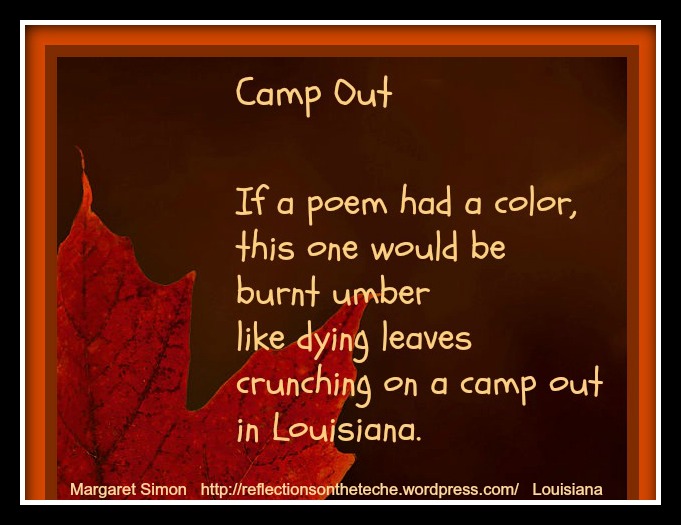
My fall poem with an image chosen by Carol.

My fall poem with an image chosen by Carol.

Emily's fall zeno poem.

Emily’s fall zeno poem.

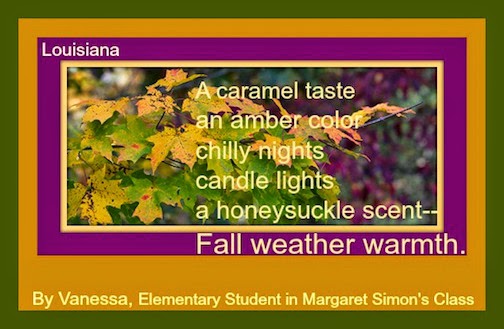
Vannisa's fall poem.

Vannisa’s fall poem.

Kielan made an Animoto video with her fall poem.

Don’t forget to link over to Carol’s site for more beauty and words.

Read Full Post »

Find more Poetry Friday at Buffy's Blog.

Find more Poetry Friday at Buffy’s Blog.

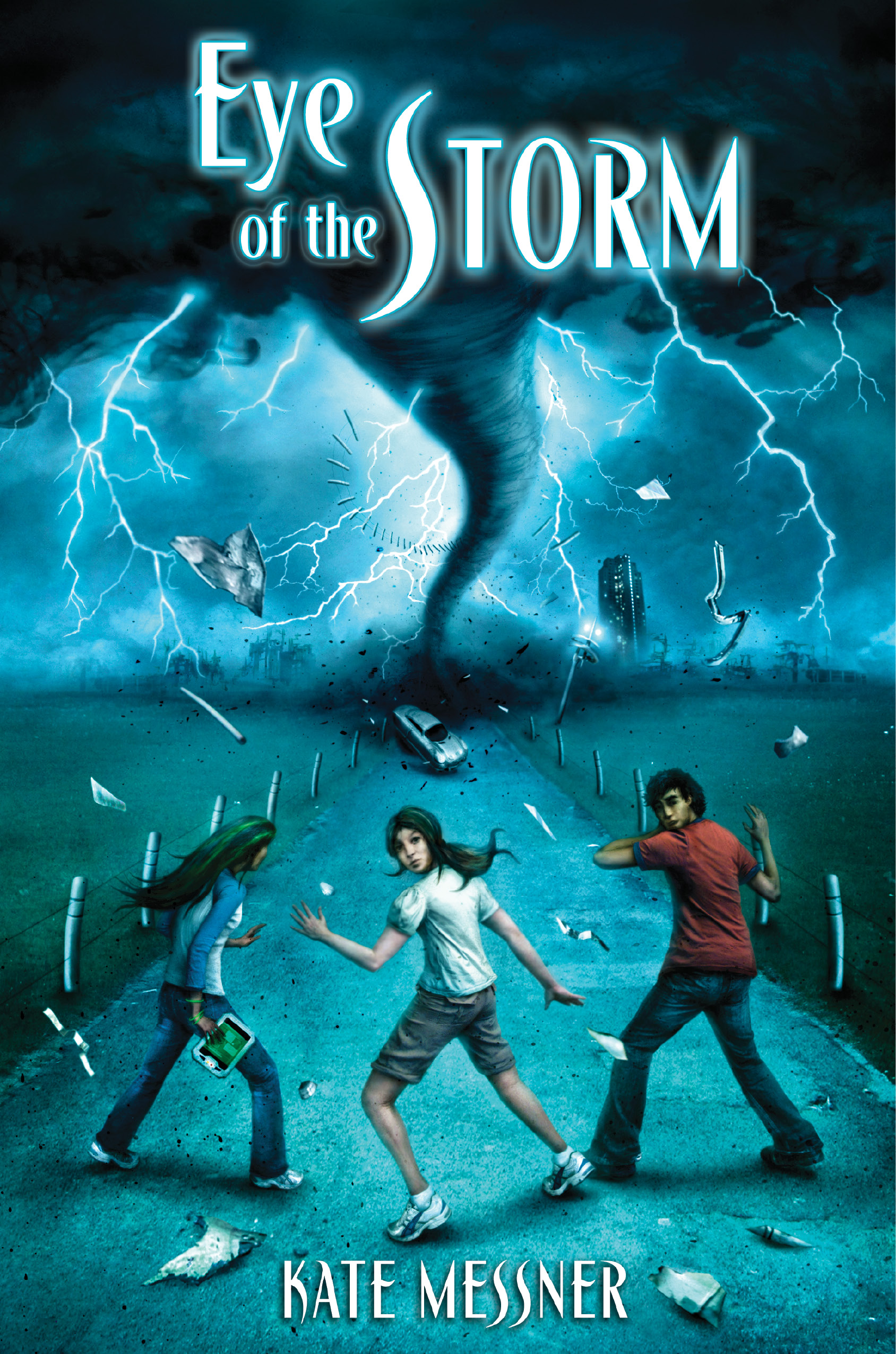
EyeofStorm

My students have been working on book talks this week. Some of them wrote poems about their books. Tyler reviewed Eye of the Storm by Kate Messner. He wrote the following poem as an acrostic with the word storm. One student’s response, “I like how you included the theme in your poem.”

Saving lives from disaster
Taking risks
Only to see a surprising face
Revenge is never the answer
More and more problems appearing

–Tyler

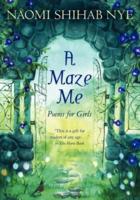
A Maze Me

Kielan reviewed Naomi Shihab Nye’s poetry book A Maze Me. Kielan said she selected the background and theme of her Animoto because it reflected the dreamy tone of the poem “Necklace.” This is the kind of poem that stays with you. “Can Monday be a porch?”

Read Full Post »

Find more Poetry Friday with Paul at These 4 Corners

Find more Poetry Friday with Paul at These 4 Corners

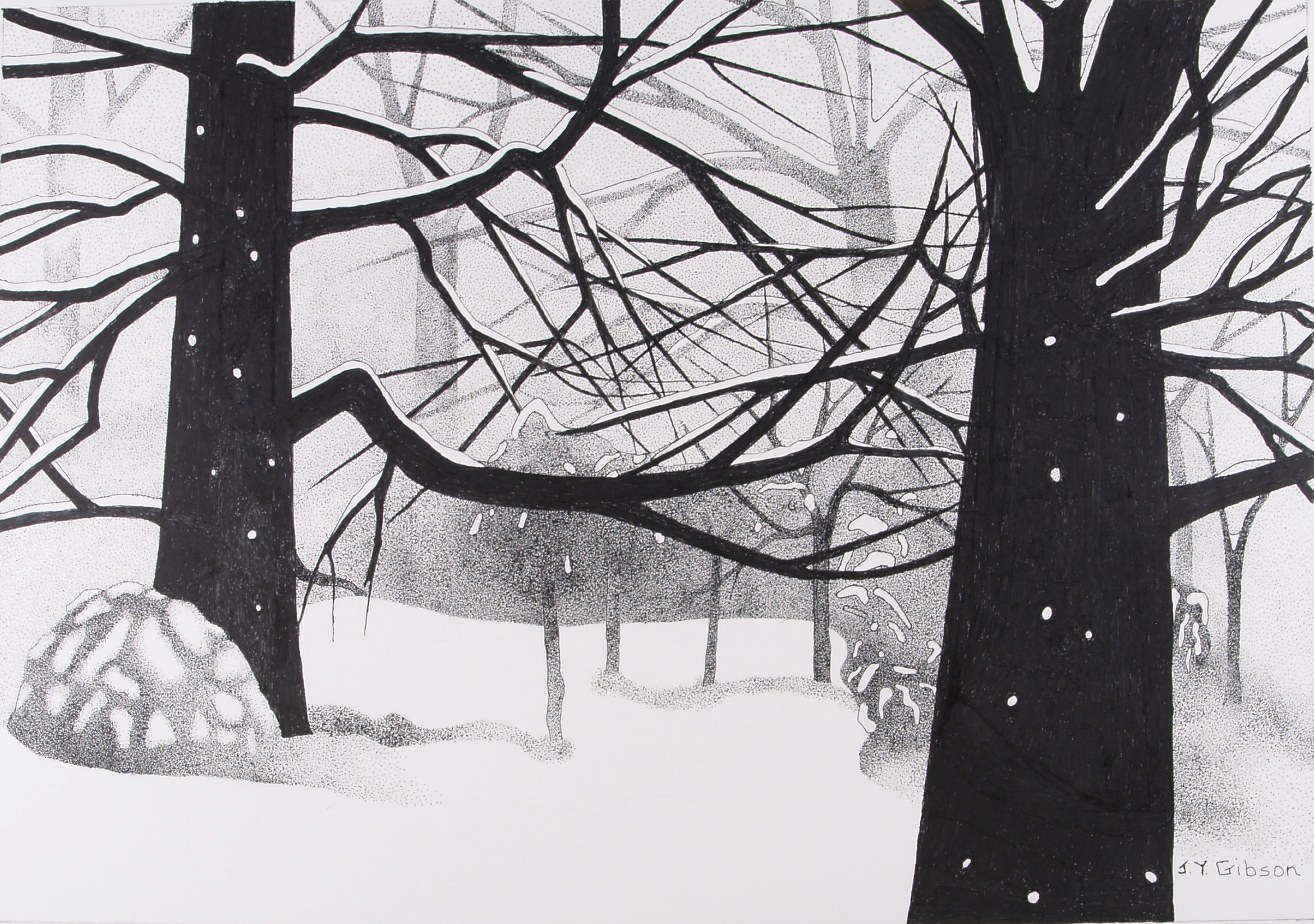
Silence in the Snow by John Gibson

Silence in the Snow by John Gibson

We don’t get snow here, but the colder weather made me think of presenting Robert Frost to my students. I started with the beautiful Susan Jeffers illustrated book, “Stopping by Woods on a Snowy Evening.” Then we read together Frost’s poem Acquainted with the Night and talked about rhyme scheme. A terza rima is a difficult form to write even for gifted kids, so we worked together. We started with a line from my own poem, Snow Day from Illuminate. My first group of students incorporated a repetitive pattern that I reminded them is called anaphora.

Collaborating, stealing lines, playing with rhyme, and writing from an image worked together to result in a nice poem.

Lost in the Snow
a terza rima after Robert Frost

I wake to a field of white
where a bunny rabbit hides,
where a night owl takes flight,

where Santa’s sleigh slides
where I stand on the ground
where a snowflake above me glides,

where something is lost, not found,
where sight begins to fail,
where a whisper is the softest sound,

where dreams set sail
and miles to go before I sleep
I am strong, not frail.

Proclaimed the time was neither wrong nor right.
I wake to a field of white.

–A collaborative poem by Mrs. Simon’s class

Acquainted with the Night by Robert Frost

My second group of students was larger, so the collaboration became more cumbersome. Too many different ideas don’t mix well with strong wills and sensitive writers. I don’t think the poem is as strong, either; however, I am struck by the sense of loss and sadness and overcoming that permeates each one. The images of snow covering the page and the words of Robert Frost set a tone for both of these poems.

Winter

Snow fell silently through the night.
These streets I have walked across
into the darkness, out of sight.

The sun I have lost,
Frosting over the glass in this faded frame,
The windows are covered in frost.

Each pattern has its own fame.
Sun rises, suddenly the cold vanished.
Once it is gone, it will never be the same.

Stars above shining bright.
Snow fell silently through the night.

a collaborative poem by Mrs. Simon’s class

Read Full Post »

Find more Poetry Friday with Anastasia at Booktalking #kidlit

Find more Poetry Friday with Anastasia at Booktalking #kidlit

Cybils-Logo-2014-Rnd1

Round one for the CYBILS judging has begun. I am a round one judge for poetry. What this means for this poetry lover is there is a new book at my door every day. My collection is building, and I love reading them all. I look forward to discussions with other judges to see what they are thinking. I also love poetry people.

Today I’d like to review two of the books I have received. Note that this review does not in any way reveal where these books will go in the line-up for the CYBILS award. It is merely my opinion.

Dear Wandering Wildebeest

I have met Irene Latham thanks to a quick pass at a session at NCTE. She is as lovely as her picture. I did not know what a wildebeest was until I got her new book of poetry. It is a good thing that each page not only features a poem but also factual information.

beasts poem

The poetry bounces with the impala “twig pops/grazing stops” and peeps like the meerkat, “I sing my song:/peep peep peep/ It means, we’re safe!/ Forage! Sleep!”

Word play with “Saw-scaled viper/ rubs, shrugs,/ sizzzzzzzzzzzzzzzzzzzzzles.”
Form play in Triptych for a Thirsty Giraffe.
Humor of “Dung Beetle lays eggs/ in elephant poop.”
And even danger, “Siren-howls/ foul the air./ Vultures stick to task:”
Children will love the language and learning that wanders in this book along with the animals of the watering hole.

P is for Pirate

You may be inclined to say enough with the ABC books, and I was too until I saw this delightfully evil book by Eve Bunting. The seven to eleven year old boys that I teach would love this book of short poems and loads of nonfiction commentary about pirates. I am saving it for next year’s Talk Like a Pirate Day. The illustrations by John Manders are full of action and character. My favorite one is the Movie Pirates. There is a hidden cheat sheet at the end of the book for identifying the actors.

Pirates in movies

What I love about both of these poetry books is students can gain a love of language while reading about an interesting and engaging topic. I am off to read more poetry!

Read Full Post »

Find more Poetry Friday with Becky at Tapestry of Words.

Find more Poetry Friday with Becky at Tapestry of Words.

A few weeks ago I attended a poetry writing workshop with our Louisiana state poet laureate, Ava Leavell Haymon. I posted about one of the exercises here. The second exercise she led us through began with an image. We were to remember a room, kitchen or bedroom. Then we drew it, recognizing that this was a prompt for writing and no great work of art.

I thought of my daughters’ bedroom, the one two of them shared growing up. The room was small. My husband had built a bunk bed for them. He is a good carpenter, but he doesn’t make anything halfway. This bed filled up the small room. In fact, when we moved, we left the bed. We could not get it out of the room.

Bunk Bed Fills the Room

That is the bedroom where
I looked at the mess,
sheets unmade,
the angry child
red with fury.

Her bunk bed filled the small space.
No room for my approval.

I could only see
the mess,
the wild squealing.

I forgot to look
under the sheets,
under the pile of toys,
under the dirty clothes
to see her child-heart.

–Margaret Simon

Mary Cassatt Young Mother Sewing

Read Full Post »

Find more Poetry Friday at Keri Recommends.

Find more Poetry Friday at Keri Recommends.

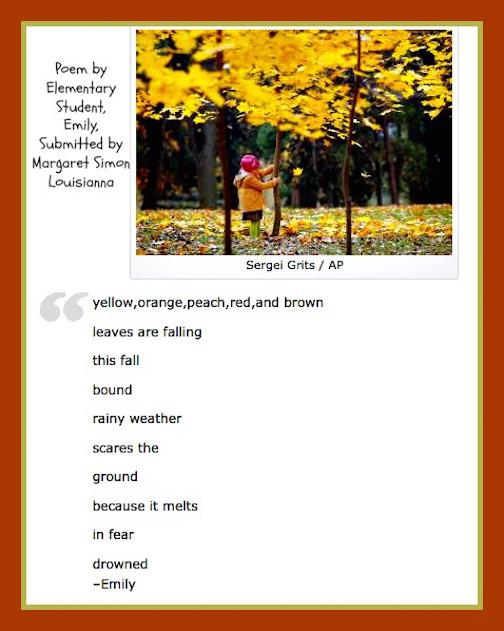
A few weeks into fall Carol Varsalona put out a call for submissions to her Finding Fall Gallery. I wanted my students to try some fall poetry writing. I pulled up an image gallery from NBC news. I think images make for richer, image-filled poetry. Many of the images were striking, and we had a hard time choosing just one to write to. So I allowed some students to keep their favorite frozen on the Promethean while others found the gallery on other computers. Kielan captured a list poem from different images and made a poem movie on Animoto. Emily remains the Zeno master with her Fall Zeno.

Sergei Grits / AP

Sergei Grits / AP

yellow,orange,peach,red,and brown

leaves are falling

this fall

bound

rainy weather

scares the

ground

because it melts

in fear

drowned
–Emily

Read Full Post »

Find more Poetry Friday at Random Noodling with Diane.

Find more Poetry Friday at Random Noodling with Diane.


Even purple lemurs named Violet can write.

Even purple lemurs named Violet can write.


My students make really good guinea pigs when it comes to trying out new writing activities.  This week I showed them a free writing activity I did with our state poet laureate, Ava Leavell Haymon, at the Book Festival Wordshop last Friday.  I was not sure how this rather random exercise would work for producing a poem.

We started with a clean piece of drawing paper.  Each edge of the paper, we filled with sense words (colors, sounds, tastes, smells, and physical feelings.)  Then I asked them to draw a large circle in the middle of the paper.  When Ava gave us this exercise to do, she talked about the negative voice that often invades our minds when we are trying to write, saying terrible things like, “You are stupid,” and “Why do you think you have anything to say?”  Each student selected a bad color to use to make a shape around their negative voices.  Some students had no shapes and others had multiple ones filled with ugly words.  I think this helped those who feel intimidated by writing.

Inside the circle, I told my students to free write for 7 minutes.  Free writing is anything that comes into your mind.  Just keep the hand moving.  I even gave them ink pens to use, a treat.

Select six concrete words from your writing.  Then write a six-lined poem.  The poems were as varied as the students themselves.  I enjoyed hearing how the free writing influenced the final poem.  I think they were richer somehow.  We then created a folded book from the art paper and wrote the six lines on the six pages of the book.

Fall weather warmth

A caramel taste
an amber color
chilly nights
candle lights
a honeysuckle scent–
Fall weather warmth.

by Vannisa


I remember

I remember
sucking on an orange butterscotch,
being embarrassed about something I said
(what a thing to feel).
I remember it all happened
on Thanksgiving.

by Matthew


Night Warrior

Be a warrior.
Ride on your unicorn.
To battle the bullies,
be a sweet, kind hero.
Climb into the sunset.
You become a pink image.

by Erin

Folded book poem

Folded book poem


NCTE is around the corner.  I am getting nervous and excited.  If you plan to be there, please try to attend the Elementary Get Together to support me as I receive the 2014 Donald H. Graves Award.  I am also presenting with colleagues from the National Writing Project on Friday.


NCTE Presentation Flier


Link to my presentation at NCTE: Friday, Nov. 21st at 12:30 PM. 


Read Full Post »

Find more Poetry Friday at Teacher Dance with Linda.

Find more Poetry Friday at Teacher Dance with Linda.

Join the Chalk-a-bration at Betsy Hubbard's site Teaching Young Writers.

Join the Chalk-a-bration at Betsy Hubbard’s site Teaching Young Writers.

Halloween chalk

It’s Chill-a-bration Time! That’s Halloween language for Chalk-a-bration. Halloween language for Poetry Friday is “Poetry Freakday!” I hope you enjoy our Freaky chalk poems. My students chalked up the sidewalks and chilled up an Emaze presentation. It was a sunny day, so we added some spooky shadows to our chalk poems.

http://app.emaze.com/1012993/chill-a-brationPowered by emaze

A chilling chalk zeno by Emily

A chilling chalk zeno by Emily

Candy chalk choka by Nigel and Tobie.

Candy chalk choka by Nigel and Tobie.

Shadow poem by Reed.

Shadow poem by Reed.

Read Full Post »

Find more Poetry Friday at Merely Day by Day with Cathy.

Find more Poetry Friday at Merely Day by Day with Cathy.

One of my Poetry Friday poet heroes is Laura Purdie Salas. She is the author of Bookspeak and Water Can Be, both of which I recommend for any classroom. She recently published an e-book What’s Inside: Poems to Explore the Park It’s a great resource for teaching young poets.

solar eclipse

There was a solar eclipse happening on Thursday. I decided to combine teaching about this phenomenon with a new poem form, “What’s Inside?” We read a few model Laura Purdie Salas poems and discussed the elements in her poems, rhyme, rhythm, along with factual information. I am posting some student poems and my own. To make comments to the students, click on their name.

What’s inside a solar eclipse?
A moon hatching out of its cocoon
“Now is my time to rule the day”
The sun is secret
Hidden away
Coming back soon
“Once again I will rule over moon”
-Kielan

Above the cosmos,
The moon still glows.
Blocking the light,
It’s a time of fright.
In the position of the sun,
It’s no fun.
When it goes away,
No more for today.
Like a Clash of Clans war,
It’s done for.
–Nigel

Tobie wrote his poem in three voices: the solar eclipse, the sun, and the moon. (I love how he marked each one.)

The sun will be covered by the moon. <———————Solar Eclipse
I just wish it would come again soon.

What's inside this ball of fire? <————————Sun
It's like life, ton of desire.

What's inside this big rock? <—————-Moon
Too bad, there's only one in stock.
–Tobie</blockquote>

Mrs. Simon tries rhyme once again. I was pleased by the unexpected rhyme of sun and phenomenon.

What’s Inside a Solar Eclipse?
Make a pinprick hole in a paper plate.
Sunset horizon, stop and wait.
A new moon crosses the path of the sun,
eclipsing our vision,
a sky-born phenomenon.
–Margaret Simon

Read Full Post »

« Newer Posts - Older Posts »