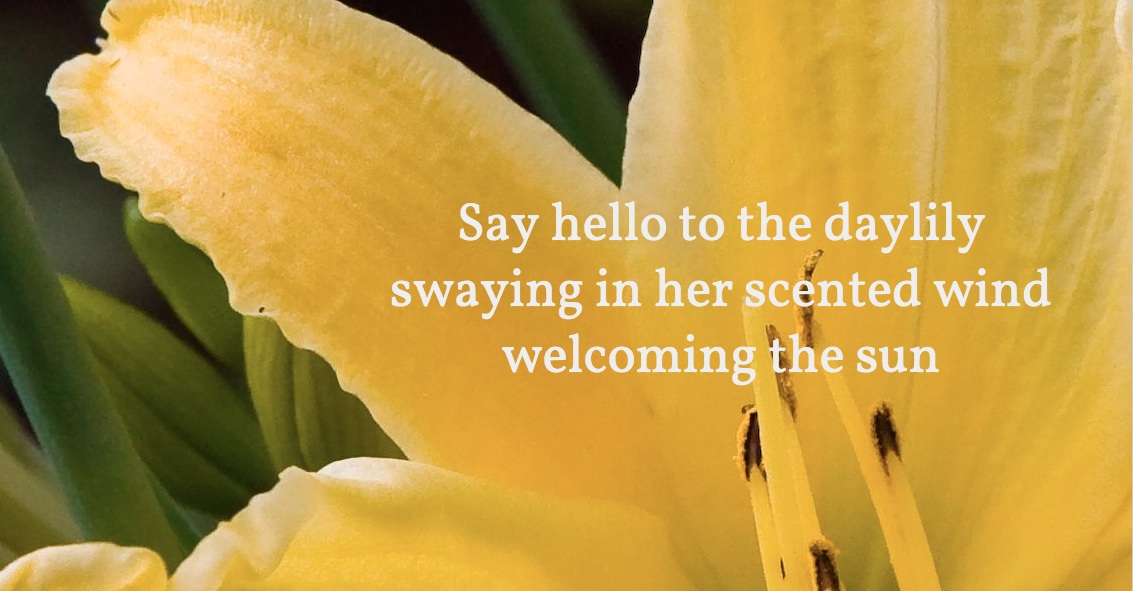
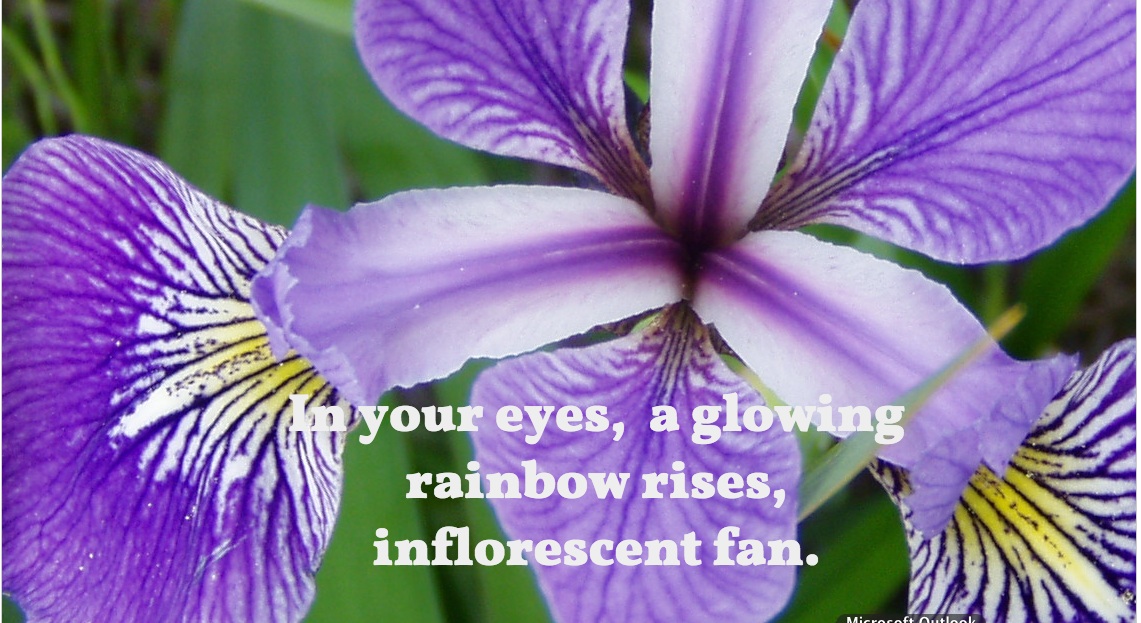
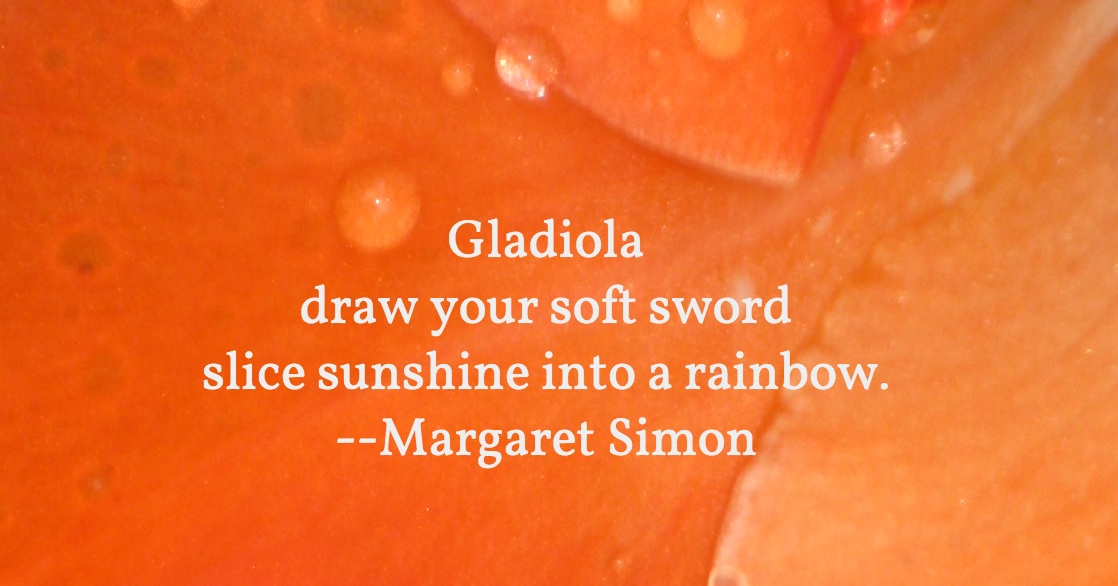
A friend posted a video on Facebook. You may have seen it, too, of the elapsed time photos of flowers blooming. I was inspired to write short poems, haiku-type, about the different flowers. For each one, I googled the flower and used facts in the creation of the poem. For example, a gladiola is also known as a sword lily. Then I found creative commons photos, uploaded to Tapestry, and wrote a poem. I would like to include more poems in my Thinglink video creation, so if you would like to add a poem, please write one in the comments. Or you can do it in Tapestry and send me the link. I’ll post the link for the final video on Sunday on my DigiLit Sunday post. Also, on Sunday I’ll have an offer code from Thinglink for early access to Thinglink for video.
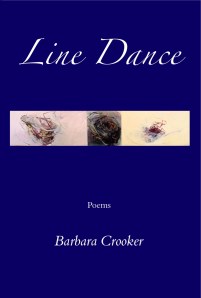
I do not remember who introduced me to the poetry of Barbara Crooker, but I want to thank you. I am reading Line Dance published in 2008 by Word Press. Barbara Crooker speaks to me. She writes with rich imagery and real life events, touching my heart and my inner poet. She is also a very nice person. When I decided to review her book here on my blog, I wrote her an email from the contact information on her website. Imagine my excitement when, not 24 hours later, she had written me back!
I had a hard time deciding which poem to feature because they are all so good. In the title poem, the lines dance literally on the page as Barbara connects the people she loves in a dance at her daughter’s wedding. “everyone I’ve ever loved/ is here today, even the dead, raising a glass/ and dancing, circling around the bride/ in her frothy gown, bubbles rising/ in a fluted glass, spilling out, running over.”
The collection begins in winter when her father dies “through the narrow window, the cold sky/ stretched blameless, white and blue, behind him.” We are taken on a journey through grief, but not without hope. “this old blue world will keep on spinning, without you.” from Blues for Karen. And then comes Valentine’s Day when she strings hearts in all the windows. “The heart wants and wants and wants some more. Spring so far in the distance.”
Our hearts break with hers and are put back together with the puzzle pieces of her words.
Listen,
I want to tell you something. This morning
is bright after all the steady rain, and every iris,
peony, rose, opens its mouth, rejoicing.
I want to say, wake up, open your eyes, there’s
a snow-covered road ahead, a field of blankness,
a sheet of paper, an empty screen. Even
the smallest insects are singing, vibrating
their entire bodies, tiny violins of longing
and desire. We were made for song.
I can’t tell you what prayer is, but I can take
the breath of the meadow into my mouth,
and I can release it for the leaves’ green need.
I want to tell you your life is a blue coal, a slice
of orange in the mouth, cut hay in the nostrils.
The cardinals’ red song dances in your blood.
Look, every month the moon blossoms
into a peony, then shrinks to a sliver of garlic.
And then it blooms again.
— Barbara Crooker, from Line Dance, all rights reserved.
The natural world sings in Barbara Crooker’s poetry. In Peony, “Imagine the hard knot of its bud,/ all that pink possibility.” Her poem, One Song (after Rumi), sounds like a concert of birds, beginning with a cardinal in all its red, then a chickadee adds percussion. The sun even comes out to join the chorus. And ends with “All the world breathes in, breathes out./ It hums, it throbs, it improvises./ So many voices. Only one song.”
So many voices. Only one song. Thank you, Barbara, for allowing me to be witness to your song. What a joy!
Thanks to Tabatha Yeatts for organizing the Summer Poem Swap.
My own poem written for Robyn Hood Black for the Summer Poetry Swap is featured on Robyn’s site today.
Join the Poetry Friday round-up at Jone’s site: Check it Out.
Revision? Ugh! If you are a writer, revision is a necessary evil. Maybe not evil, but definitely necessary. If I am going to urge my students to revise, I must experience it myself.
I have a copy of Kate Messner’s Real Revision in my stack of professional books for the summer. It’s already dog-eared, written in, and sticky-noted. Each chapter ends with a section “Meet Mentor Author…” I decided for this post that I would take one piece of advice and apply it to an old draft of a poem. However, when I got started, I went in a different direction.
I’ve “met” Jeannine Atkins through Poetry Friday. Her exercise in Real Revision begins, “Try It: Jeannine Atkins tries to use concrete nouns- specific, precise words- and verbs that really suggest action.”
I pulled out my poem “Singing the Blues” that I wrote in a wordlab setting. I liked it but felt that it needed work. Jeannine’s exercise helped me attack the challenge, but once I started pinpointing precise words, I also made other changes. This is a good lesson for my work with students. A revision strategy such as this one by Jeannine can be a starting point, but I also should encourage other changes. Jump in with finding precise words, then move on to confirming the theme, changing the order, or adding in senses, metaphor, etc. Revision can be endless. We should teach our students that it can also be fun and satisfying when your writing takes shape and looks like a bird that may fly.
My mother sang blues in rhythm with her cleaning,
mopped on out to the shade of the oak tree
to cool off and cool down. That Mississippi sun
shone like Jupiter on a summer night.
We played with fire.
The front yard burned.
Smoke rose to the gods,
Chatty Cathy and a set of Lincoln Logs—ashes.
Mom cried when she saw her begonias
seared like sausage on a stick.
I buried my Barbies in the flowerbed, knelt
beside the snake of Eden—I am a sinner. I Guess that’s Why They Call it the Blues
echoes from the microphone.
Brother now plays the keyboard,
sways his Elton John head
above the noise of a crowded bar.
Does he remember?
We were only children, for God’s sake!
What did we know about heat and rage then?
Our phoenix rose long ago.
Over at Today’s Little Ditty, Michelle H Barnes is hosting a poem movie challenge issued by her guests Sylvia Vardell and Janet Wong of the Poetry Friday Anthology of Science. I love a creative challenge and since I am trying to be OPEN in the year 2014, I need to learn new things. I knew nothing about using iMovie, but I have it on my computer, so I gave it a try. This is a user friendly program. If I can do it, anyone can.
I pulled out a poem I wrote for Laura Shovan’s Pantome poem project and uploaded pictures I had in my files. I must have recorded my reading 5 times or more. That was the hardest part. What is it about doing something like this that makes you feel so smart and accomplished? I will definitely try this with my students next year. Thanks, Michelle, Sylvia, and Janet for the motivation to try something new.
Join the Poetry Friday round-up at Carol’s Corner.
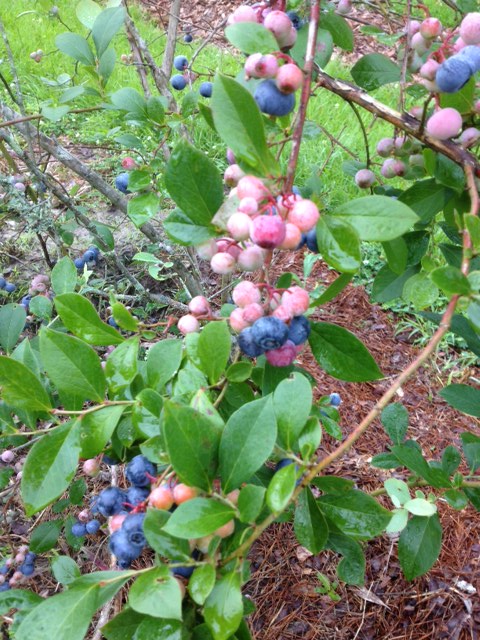
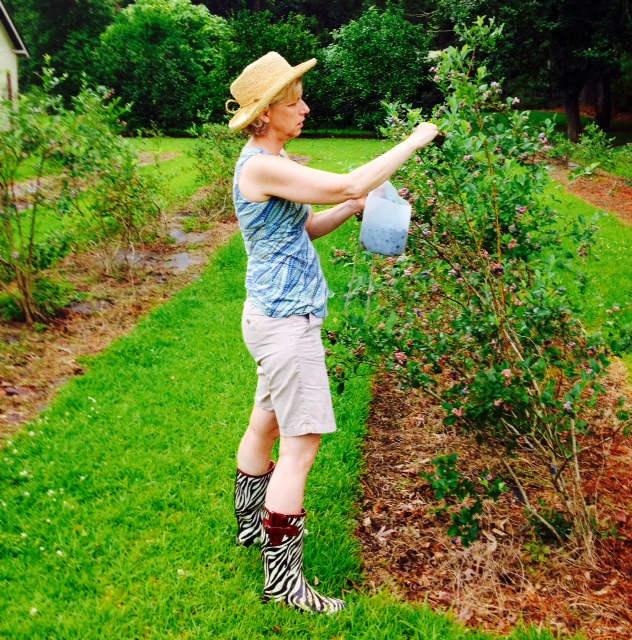
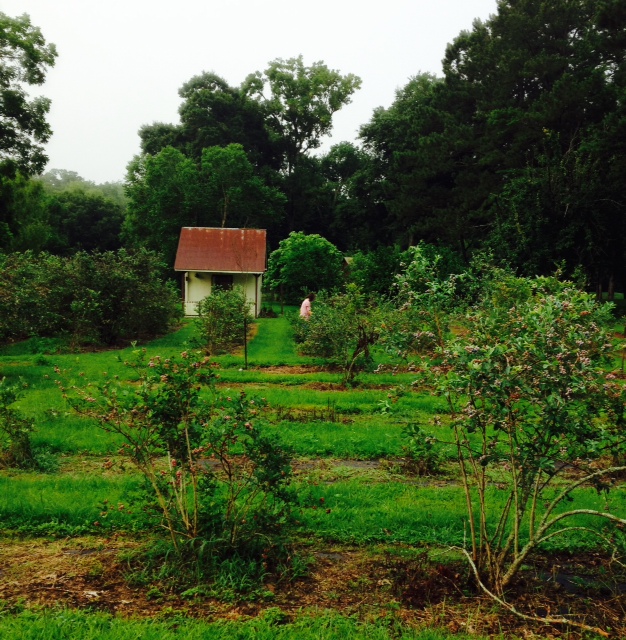
Blueberry Picking
with a line from Mark Doty, Verge
Some things wear their becoming,
like this blueberry, for example,
plump and perfectly indigo
surrounded by pinky-red brothers and sisters,
it boasts to be chosen
falls easily into my palm
joyfully plinks the plastic bucket.
On this dewy June morning,
I wander from bush to bush
silent in my reverie
picking, picking, picking.
The berries do not wear a costume.
They linger here in this field
waiting for the juicing of the sun’s rays,
becoming all I need
to take summer in
to hold on to the gift of life.
Join the Poetry Friday round-up with Diane over at Random Noodling.
Photo from Maya Angelou visits YCP 2013 on Flickr
I suspect that Poetry Friday will be full of posts about Maya Angelou. She died this week at the age of 86. She was a gentle giant, a force in the world, an inspiration for us all. I spent the last few days absorbed in Maya’s wisdom, watching YouTube videos, reading articles, and reading her poetry. I was inspired to write a poem, an elegy. At first, I thought it would be created around her words, so I copied 13 quotes from USA Today. But when I started writing, the poem became my first sestina. Whoa, Maya, I didn’t think I had this in me. You are indeed an inspiration!
The Lessons of Maya Nothing can dim the light which shines from within.
Her words touched many hearts,
this phenomenal woman
with volumes of work,
a head full of rhyming curls,
she made us feel
with her deep toned voice
speaking, “I will raise my voice!”
finger pointing to heaven’s heart,
she strived to thrive, feel
compassion of a passionate woman.
Her hand to my hand curls
around my calloused work
enveloped in her precious work.
She knew who heard her voice
above all others; her curls
were born to adorn our hearts.
Now with Him eternally, this woman
will always make us feel
that we have every right to feel
worthy in our daily work
living as a phenomenal woman
lifting this one and only voice
to touch as many hearts
as hairs on her head curl,
Like the contrail in the sky curls,
we are called to feel
no barriers in our hearts.
Our deep and strong voices
can make forces work
driven by this one woman.
Believe in your woman-
the specialness of your curls.
Believe you have a voice.
Don’t fear to feel.
Find your glorious work
and what feeds your soul and heart.
Find the voice of your heart.
Yes, God made woman his best work.
Make the time to feel
Alive.
Join the Poetry Friday round-up at Violet’s place.
For Mother’s Day, I spent the weekend in New Orleans with my daughters. Katherine and I went to church on Sunday morning on the campus of Tulane, The Chapel of the Holy Spirit, where the Reverend Minka Sprague, close friend of my parents, was preaching. I am a word collector, and in her sermon, Minka used the term anastasis to refer to the resurrection. I recorded a Soundcloud of the portion where she spoke of its Greek meaning.
Minka’s words, the beautiful day, and the resurrection feeling I get when I visit New Orleans came together in this poem.
Anastasis
The storm cloud moves,
a hole of blue,
lined in shining white,
opens–
this is sky.
When you feel fear,
say your name.
To say your name,
breathe–
this is air.
On a Sunday in May,
flooded New Orleans streets,
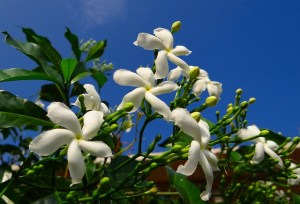
blooming jasmine
reflect–
this is resurrection.
Poetry news: Amy VanderWater has adopted a manatee over at The Poem Farm in honor of my students who wrote manatee poems. You can read them at our ongoing kidblog site. Today is our final day of school (report card hand-out), but I hope some of my students will continue to write and post over the summer.
Poetry Friday Round-up is with Elizabeth Steinglass.
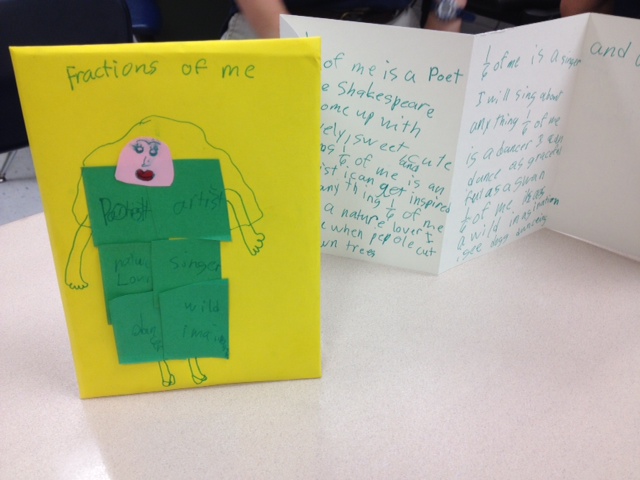
State testing is done, so I took the opportunity to shift focus in my small math group. In this group, I teach one 4th grader, two 3rd graders, and one 2nd grader. The resource I used was Betsy Franco’sMath Poetry. In this book, there are mentor texts from Betsy as well as student models. Each type of poetry is explained in simple instructions with a form for copying.
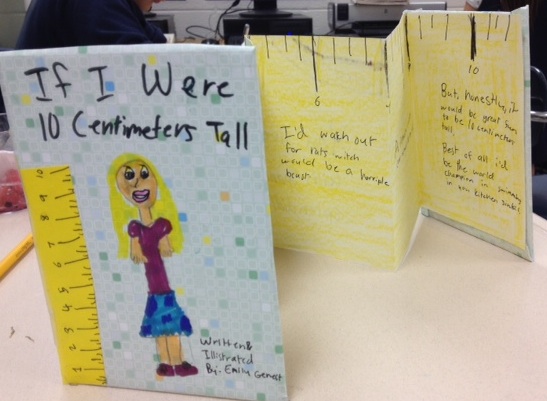
My students wrote a draft on the form and posted their poems on our kidblog site. For a final product, they made accordion books. I am not usually a fan of using fill in the blank forms for writing, but these leave space for creativity as well as the safety of a formula to follow. It was successful for my young students. They enjoyed writing and especially loved posting on the class blog. (If you click on the blog link, you will also see that a group of boys had a good time challenging each other with Riddle-ku poems after Laura Purdie Salas.)
If I were 10 Centimeters Tall
If I were only 10 centimeters tall,
I’d use a sponge as my bed and the softest cotton ball as my pillow,
A remote control car would be my ride
An Iphone would be a plasma screen T.V.
I’d watch out for rats which would be a horrible beast.
But it would be seriously fun if I could be 10 centimeters tall,
I’d be the world champion in swimming in your kitchen sink.
by Emily, 3rd grade
Emily’s accordion book
160 Beautiful Bows (an addition poem)
160 beautiful bows
On a cheerleaders head.
80 of them shimmer in the light,
The other 80 speak to you.
‘You can do it’
Together,
They make a perfect couple
Which is a cheerleaders dream.
They can have shimmering
Speaking baby bows.
Oh how I, Kielan,
Would love
To have some bows like that!
–Kielan, 4th grade
Fractions of Me
1/6 of me is a poet like Shakespeare
I come up with lovely, sweet, and cute poems.
1/6 of me is a artist.
I can get inspired by any little thing.
1/6 of me is a nature lover.
I hate when they cut down trees.
1/6 of me is a singer.
I will sing about anything.
1/6 of me is a dancer.
I can dance as grateful as a swan.
1/6 of me has a wild imagination.
I see dogs dancing and unicorns kissing.
–Erin, 2nd grade
Poetry Friday Round-up is with Jama at Jama’s Alphabet Soup
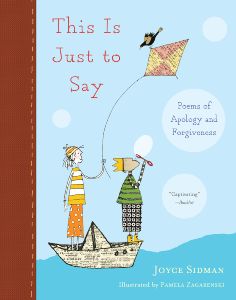
Amidst the season of post tests and field trips, I am still trying to squeeze poetry in to the school day. For the letter G, I decided to teach poems of apology using This is Just to Say: Poems of Apology and Forgiveness by Joyce Sidman. This is a delightful book of poems written by Mrs. Merz’s sixth grade class. Joyce begins this book with the classic apology poem by William Carlos Williams. Can you recite it?
This is Just to Say
I have eaten
the plums
that were in
the icebox
The first character, Thomas, uses this form to write the poem “This is Just to Say/ I have stolen/ the jelly doughnuts/ that were in/ the teacher’s lounge…” to Mrs. Garcia in the office. Mrs. Garcia responds with her own poem ending with “Of course I forgive you./ But I still have to call your mother.”
When my students and I were writing poems of apology, some used the WCW title as first line. I love how this small poem from Kendall expresses a common problem among 6th graders, hurt feelings.
This is just to say
I am sorry for this day
that I have treated you this way
you don’t have to accept my apology but hey
I didn’t mean to offend,
it sort of just slipped out along with shame
I hope you did not take it the wrong way
–Kendall
I gave my poem to my principal to apologize for being late. She said I set the bar for apology notes. The funny thing is many of these things listed actually do happen and do make me late.
Mrs. Heumann , Mrs. Heumann,
I just want to say
I’m sorry for being late today.
The alarm didn’t shout;
the dog got out;
My coffee over-flowed,
while I watched oatmeal explode.
There was a 50 car-train,
a truck hauling sugarcane.
The bridge was open, cars were slowed.
A trash can blew into the road.
The sun in my eyes, oh the glare.
Then a cow, would he dare?
Enough, you say. OK?
Just sorry,
I was late today.
–Margaret Simon, all rights reserved
And Kaylie stopped by the kidblog and saw all the Apolo-G poetry and added her own to her pencil.
I’m sorry, pencil, for dulling your head
Your sharp-tipped graphite point
I’m sorry for gnawing on your side,
My teeth-prints etched in your cedar
I’m sorry, pencil, for tapping your eraser on the desk,
For rubbing on the soft pink curls of your hair
And sweeping them away
I’m sorry for losing you and dropping you and trading you.
I’m sorry for putting your end in the pencil sharpener,
For tossing you away when you got too small.
Pencil, I’m sorry for hurting you all these years.
Will you ever be able to forgive me?
Join the Poetry Friday round-up is hosted today by Robyn Hood Black at Life on the Deckle Edge.
My celebration of National Poetry Month with my students has been interrupted many times by testing, field trips, and now spring break, but this week I had a few days to work with my youngest students, grades 1-3, on origami and poetry.
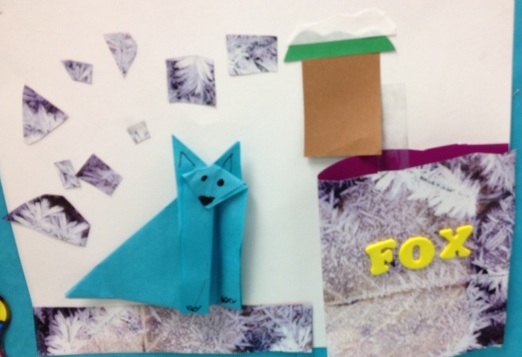
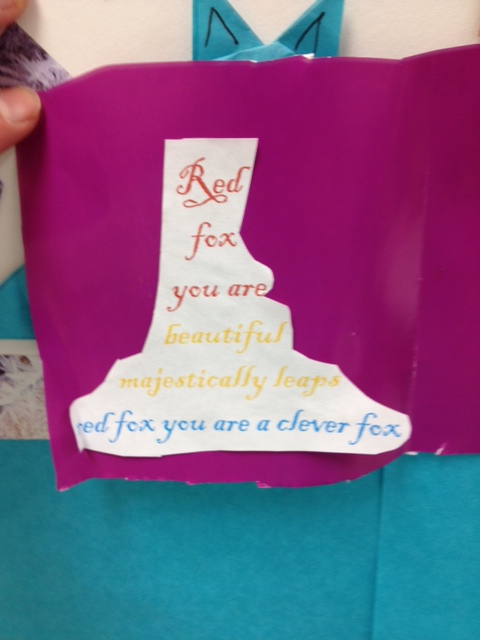
In a teacher workshop last week, I learned how to make an origami fox. I brought the activity to my little ones and we wrote Fib poems about foxes. A Fib poem follows a syllable count that corresponds to the first 6 numbers of the Fibonacci series, 1,1,2,3,5,8.
Here is Erin’s. She put her origami fox in a snow scene and made the poem appear in a flip-open book.
Origami fox in snow
Fib poem by Erin.
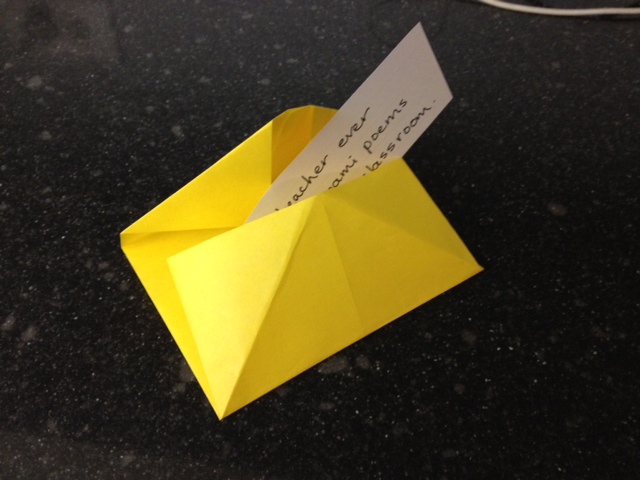
On Thursday, we made origami envelopes, read I Haiku You, and wrote love haiku. Some favorite teachers are going to be very happy.
Best teacher ever
makes origami poems
shine in the classroom.
Margaret Simon lives on the Bayou Teche in New Iberia, Louisiana. She is a retired elementary gifted teacher who writes poetry and children's books. Welcome to a space of peace, poetry, and personal reflection. Walk in kindness.







 Reflections on the Teche