Feeds:
Posts
Comments

Archive for the ‘Slice of Life’ Category

A Slice of my Art Journal

Join the Two Writing Teachers blog for the Slice of Life Challenge.

For 2018, I chose the word Explore.  I’m not sure if this means I need to get out of my comfort zone, but I have somewhat interpreted it this way.  I long to be an artist.  I’ve tried many kinds of art, but this year I am trying art journaling.

In the fall I took a class about making your own books by sewing pages together.  Using a discarded falling apart book, I took out the pages and sewed my own pages into it.  I decided that this would be my art journal for 2018.  I glued in a postcard from a postcard exchange that started me on a path of using color to define each month.  The postcard was blue, so January was my blue month.

February became my red month. I am working in collage. Each month I will collage a heart map reflective of the month.  My art journal is only for me.  It only needs to please me.  And it does.

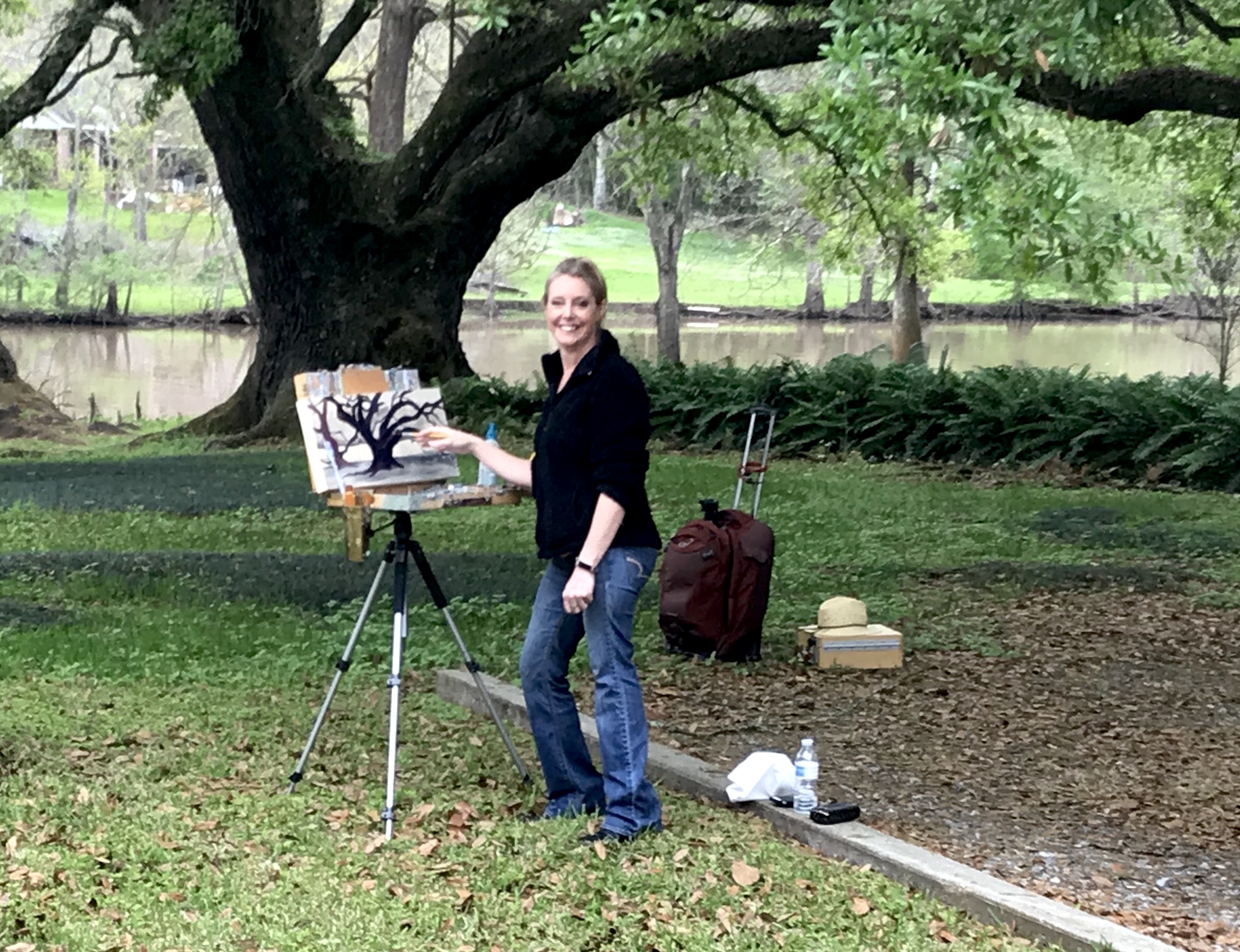
On Saturday, there was a free open workshop at a local gallery.  I decided to take my journal and work on some of the pages.  This is a work in progress, but I am happy to be Exploring possibilities and expressing myself with creativity.


Read Full Post »

Join the Two Writing Teachers blog for the Slice of Life Challenge.

What is a change maker and who are the change makers in our own community? I asked my students. I made a list on the board of people I know from our area who are making a difference.  Each student chose one to interview based on his/her own interest.

I called Vicky Branton, a feature writer for The Daily Iberian, our local newspaper.  She agreed to come visit with my students about interviewing for and writing a feature article.  She had good advice:

  1. Begin with the 5 W’s: Who, what, when, where, why?
  2. During the interview, listen.
  3. Record the interview in order to be completely present and to go back for direct quotes.
  4. Elaborate: Find the interesting thing.

For the first three days of last week, I scheduled interviews.  In all, we had 5 interviews.  Students then began writing.  We had to juggle the computer around for them to listen to their recorded interviews.  Eventually, they had a draft of a feature article.

This was a motivating project for my students.  They were elevated by their interviewer status.  They learned a great deal about the good things happening in our city.  They learned how to take a quote and turn it into narrative.  They learned about themselves in the process, too, and have renewed aspirations for what they may want to do to be a change maker.

Faith is interested in an anti-bullying program that is in the early stages in our community:

Mrs. Dawn and Mrs. Sharon say they really feel like Chez Hope is impacting the community. Russo expressing,”…What we do is not easy, it’s not easy work at all, it’s hard.” Over time they are helping the community. These crises are a big problem in our community. And many people are afraid that they aren’t going away any time soon. To add on to that, I would like to say that I feel like Chez Hope has impacted our school. When Mrs. Sharon and Mrs. Dawn came to our school, they left an impact on me and others as well. Once I walked out of that room, I knew I had to do something to help stop bullying. I also took away that I should never bully anyone. Also, if some one bullies me, then I need to tell an adult. I don’t need to be put down and be bullied. So stand up for yourself and tell an adult. (Faith, 6th grade)

Bully Free Kids T-shirt from Chez Hope


Jennie Lallande, Acadiana Lifestyles “Women Making a Difference 2016”

Andrew wanted to know more about how Jennie Lallande became involved in the community garden and school garden programs.

Jennie Lallande is a massive change maker. She helps in the community garden, but the garden is made in a place where people don’t have much access to fresh food like lettuce or carrots. She was recruited because she has a experience in sustainable agriculture.

Erin is doing a fundraiser to make care packages for foster children, so she wanted to know more about the system from someone who had adopted a foster child.

When I interviewed her I got a lot of information about her and the foster system, which will help me with my research because I want to learn more about the foster system. A lot of new information was revealed to me.  I thought the social workers were supposed to help the parents. But according to Mrs. Schlicher they don’t really help.  She said they provided her with false information so that she would take children in.

From interests to interviews to writing, my students are discovering who is making a difference as well as planting seeds for their own future as change makers. 


Read Full Post »

Join the Two Writing Teachers blog for the Slice of Life Challenge.

Once again this year I have joined Laura Shovan’s February writing challenge.  Her birthday is this month, and she celebrates by inspiring others to write a poem every day.  I thought this was maybe my third year of doing this challenge, but the other day one of those Facebook memories came up and reminded me that I’ve done this for 5 years.  That’s a lot of poems!

This year’s challenge is writing ekphrasis which is poetry about art.  Every day a participant posts a work of art for us to respond to.  I’ve managed to write each day since the warm-ups started.

I’ve set up rules for myself.  When I see the image on Facebook, I save it and place it in a Google doc.  Then I do not allow myself to read other people’s poems until I’ve written mine. (I cheat on this one.) I write and revise quickly, no overthinking the process, and copy and paste my poem into the Facebook post as a comment.  I comment on at least 3 other poets.  The group has grown to over 100 people, so it’s just not feasible to comment on them all.

Ekphrasis is a good way to inspire poetry because there is no form attached.  You can write in any way you choose, form or free verse, short or long.  You can write a mask poem from the painting/sculpture’s point of view.  You can be on the outside looking in or on the inside looking out.

The flexibility of form appeals to me.  Some days the poems come easily and others I have to let sit a while.  Sometimes I research the artist.  When a sculpture by Rodin came up, I researched and found a quote to work from.  Sometimes I research the topic. I collect words and then write.

Writing a poem a day is a challenge.  But when you are participating in a group of kind responders, the writing is worthwhile and rewarding.  We need each other.  We need to feel a part of something bigger. We need affirmation and acceptance.

One of the most profound for me was Laura’s son Jay’s self-portrait.  Here is the portrait by Jay Shovan and my poem.

Unfinished portrait by Jay Shovan

Unfinished

Deep brown eyes
stare at me,
look through me,
hold me still.

Slashed and dripped
with strokes of green,
baby blue, white
on flesh, each brush
from the palate played

like a piper in a parade
leading me to you,
but all I see now
are your eyes

drawing me into a window
of my own soul. These
are my eyes.

–Margaret Simon, (c) draft 2018

On the more whimsical side was this funny spoon sculpture by Raul Zuniga circa 1971.

Owls three
Smiley, Cranky, and Boastful
perched on a branch of a safety pin.
Bring me your wise ole thoughts
Find me a place to perch
Help me be the Who
I am meant to be.

–Margaret Simon, (c) draft 2018

Read Full Post »

Join the Two Writing Teachers blog for the Slice of Life Challenge.


Last week my students and I read together a Scope magazine article titled, “Escape from Alcatraz.”  The title alone was enough to interest my students as well as the images of three fugitives believed to have escaped the highest security prison that ever existed.

Armed with the article and a video from MythBusters, I asked my students to make up their own minds about whether or not the fugitives escaped.  Students worked on rough drafts and by Wednesday were poised at the computers to type up their essays.

Alcatraz_Island_photo_D_Ramey_Logan

Photo from Wikipedia by D. Ramey Logan.

They were still bothered, however, because they didn’t know the truth.  Did the three men escape or not?  Searching for images to put into their blog posts, a student came upon a recent news report, recent as in “3 hours ago.”  We all eagerly gathered around the computer, reading over his shoulders.

A letter allegedly written by one of the escapees recently came to light. CBS San Francisco exclusively obtained it from a source.

“My name is John Anglin. I escape from Alcatraz in June 1962 with my brother Clarence and Frank Morris. I’m 83 years old and in bad shape. I have cancer. Yes we all made it that night but barely!”   

CBS News Jan. 24, 2018


What happens to an essay that has been written and worked on in conferences when new evidence emerges?

Different students responded in different ways.  One student placed the link to the article into his post.  Another changed his whole essay and threw away the rough draft.  Others adjusted and added to what they had already written. And some were not convinced by the evidence.  They kept their original theory.

In a recent blog post by Kate Roberts on The Educator Collaborative, Kate asks these questions: “Is it ever worthwhile to read as a community, to read a text someone else chooses for you, one that you would never read on your own? ”

Like Kate Roberts and many reading workshop gurus, I believe strongly in choice.  But when it comes to nonfiction, experiencing the text as a whole class is engaging and exciting.  Nonfiction encourages more research.  Students push each other, ask questions, and engage in a deeper way when reading nonfiction together.

This week we are reading aloud Poison by Sarah Albee to prepare for a Skype visit with her on Thursday, World Read Aloud Day.  I look forward to discovering where this will lead us.  Keeping kids engaged, wondering, and curious is what teaching is all about.


Read Full Post »

Join the Two Writing Teachers blog for the Slice of Life Challenge.

I am a co-moderator with the #TeachWrite chat on Twitter. (Note the graphic on the side bar.) One of my colleagues in this endeavor is Michelle Haseltine.  Michelle put a photo on Facebook of a journal page from one of her students.  The page was filled with the outline of a jar and words and sketches were drawn inside the jar.

I took this idea and presented it to my students with a Brene’ Brown twist from Braving the Wilderness. 

We all have times when we feel lonely.  Have you ever felt alone in a crowd?  Like you just don’t fit in? There’s no one around who sees you or that you connect with.

We all have these times.  But when we do, we can take with us a jar of things that make us feel joy, make us feel safe.  What would be in your jar?

One student jumped up from her seat to draw a jar on the board.  She labelled it “Our Happy Place Jar.”  Her instructions were for everyone to draw one thing from their jar onto our shared jar.  (I love it when kids respond to the lesson with such leadership and participation.)

My students drew a variety of jars.  Some were filled with specific things from our class, Slice of Life, read aloud, computer (blogging), friends.  Others find joy in nature or family or funny memes.  Whatever their choices, they engaged with the idea and filled their jars.

Near the end of the week, Chloe announced, “Even if I have to throw away this journal, I will tear out this page and save it forever!”  That’s what I call Joy!

Mrs. Simon’s Sea

We are fish,
fish swimming through a treacherous sea,

a book,
open and full,

a nest,
a place of warmth,

a pencil and paper
for expression,

and a poem.

by Lynzee, 3rd grade

Austin’s Double E Jar

Andrew’s Rainbow Jar

Read Full Post »

Join the Two Writing Teachers blog for the Slice of Life Challenge.


Music has always been a part of my life.  From very young listening to my mother play the piano to teenage years hearing my brother through the walls between our rooms.  The musical talent was passed on through the lefties in our family, my mother and my brother.

I took piano lessons until I entered college.  In high school and beyond even to today, I’ve sung alto in multiple choirs. So you could say music is part of me, but I’ve never felt very musical when it came to playing an instrument.

At NCTE this year, I sat in a circle of ukulele players.  Jan Burkins placed her instrument in my hands and taught me three easy chords.  She said, “You could do this!”

I asked Santa (my husband) for a ukulele for Christmas.  He loved the idea.  He researched and visited local music stores to find the just right one. I started practicing early Christmas morning. I’ve practiced every day since.


I cut my fingernails on my left hand.  Those fingers are sore and numb from pressing hard on the strings.  They say this gets better with time. I am determined not to give up because of a little pain.  My husband, the runner, says you have to move past the pain.

I haven’t been able to sing and play at the same time which is my end goal.  I do have an awesome teacher, though.  Her name is Cynthia Lin.  She’s patient and kind and takes it slow.

I’ve decided to take on the word EXPLORE for my One Little Word for 2018.  No better way to begin my exploration than to learn to play an instrument.  I will be exploring chords, strumming, and patience.

This photo is a bridge over the Mississippi River near New Orleans.

Read Full Post »

Join the Two Writing Teachers blog for the Slice of Life Challenge.

Not every student is made to be a mentor.  A common thought about gifted kids is to encourage them to mentor other students.  As a teacher of gifted, I’ve seen students who work well with other students and I’ve seen those who don’t.  I feel it is important to know a student well before pushing him/her to help other students.

I haven’t taught Chloe long, but I knew she would make a great mentor. She is confident without being condescending.  She’s enthusiastic about whatever we are doing in class and spreads that enthusiasm.  So when I asked her if she wanted to teach her regular class about color poems, she literally jumped up and down.

At NCTE I grabbed an Advanced Reader’s Copy of Polly Diamond and the Magic Book by Alice Kuipers and Diana Toledano. I also picked up a teacher’s guide which led me to the color poem pattern from Read, Write, Think.  (Polly writes a color poem that her teacher loves.) Chloe wanted to write a color poem like Polly.

First she chose her favorite color, pink, and made a list of pink things.  We talked about figurative language and how she could use it in her poem.  Chloe wrote this poem:

Pink is cotton candy.

Pink is a horn of a unicorn.

Pink is my blanket.

Pink is a flower.

Pink tastes like bubble gum.

Pink smells like a rose.

Pink sounds like a violin.

Pink feels like a pillow.

Pink looks like my mom’s lips.

Pink makes me beautiful.

Pink is magnificent!

When Chloe shared her poem with her classmates, they were ready to write their own.  Having a form helped.  Her friends selected their own favorite colors and used the form to guide their writing in their writing notebooks.  As she walked from group to group, Chloe checked in to see what they needed help with.  She was patient and helpful.  Her classmates were focused and serious about their writing.  Chloe was a proud teacher.

Writing is hard work!


by second grader Kelsie.


Read Full Post »

Slice of Losing a Life

Join the Two Writing Teachers blog for the Slice of Life Challenge.

I put off going to visit.

I took my time finishing a prayer blanket. Then busy days kept me away. Until Sunday.  I knew I needed to go before it was too late.

I knocked tentatively on the door.  No answer.  Another knock. No answer.  I hung the bag with the blanket inside on the door handle and tip-toed back to my car.  I texted her daughter, “I left a package at the door.”

She responded, “No one answered the door?  I’m not home.  They must be on the back patio.”

I turned my car around.  Ok, here I go.  I walked around to the back and met her husband and her sister.  “I have the monitor, so I can hear her,” her husband said. “It’s time for her medicine. It’s a good time to visit.  She will be more alert.”

“You may be shocked to see her,” he added.  I remembered seeing my husband’s father near death.  I felt prepared.

I wasn’t prepared.

She lay in the bed. Her face pale, almost stone-like, but still soft and warm.  I lay next to her, placed the blanket over her, and cried.

When I spoke her name, she opened her eyes.  Did she see my tears?  She tried to reach out to hug me, but her arms had no direction.  I held her hand and rambled:

“You are beautiful.

You are a queen.

I love you.

God is with you.”

She mumbled.  I didn’t understand her words.

I think she said, “I’m sick.”

I think she said, “I love you.”

I think she smiled.

When her husband came in with her medicine, I saw true love.  He climbed onto the bed, raised her up, and said, “Breathe, breathe. I love you. Breathe.”

As I left, I hugged him.  A man I just met.  He was doing the best he could.  He’s holding on to a small thread and knows that it will soon break.  He will lose her.  She will die.  My eyes met his.

“I’m sorry,” I said.  “I’m so sorry.”

Read Full Post »

Slice of Life: Racism

Join the Two Writing Teachers blog for the Slice of Life Challenge.

Up early this morning, I was reading my email and read a blog post from my friend Julieanne. She lives in Los Angeles, but a few weeks ago we were together at NCTE in St. Louis.  NCTE planted seeds. We left feeling refreshed, renewed, and challenged in our thoughts about teaching and about our lives.

This morning Julianne wrote:

I have been afraid to face racism straight on in the classroom. Fearful of being wrong. The thing is, it’s a done deal. I am wrong. I had manufactured a dilemma to hide in.
–Julieanne Harmatz

Her post reminded me of a conversation in the hallway returning from lunch.  Noah said to Jacob, “You know, you are my slave.”  He did know.  They had both figured out without any words from me that in the play they are rehearsing for the Shadows, a local plantation home, that they are acting as owner and slave.

My students have done this play for years, but this year I wanted to be clear about what their roles were.  I hadn’t talked about it yet with these boys, but they figured it out.  Jacob said, “I’m OK with it.  It’s just a play.”

But is it just a play?  What is our role in stopping racism?  How are we perpetuating the story without saying anything?

Back in class, we were looking through the collection of books I got at NCTE.  One book was Can I Touch Your Hair? by Irene Latham and Charles Waters.  I explained that Irene is a woman who looks like me, and Charles looks like Chloe’s dad.  In their book, Charles and Irene face racism head on. (No pun intended.) We came across a poem about the N-bomb.  What is the N-bomb?  My students wanted to know.

We had an honest discussion about how that word (I spelled it because I couldn’t say it out loud.) is racist.  And what is a racist?  Someone who judges another person by their race and not by who they really are.

Like Julieanne and many teachers affected by the words of Jacqueline Woodson and Jason Reynolds at NCTE, I will take the opportunities when they arise to have these tough conversations.  Teachable moments.  I am a white southern woman. I am part of the dilemma, but I can also be part of the solution.  So can you.

Read Full Post »

Join the Two Writing Teachers blog for the Slice of Life Challenge.


As I sit at home rummaging through my notes and photos from NCTE, I wonder how I can capture this amazing weekend in a single post.  Then I wrote my title, “A Slice of NCTE.”  I can do a slice, a snippet, a taste.

The overarching message that I came away with was equity.

From Katherine and Randy Bomer, as they accepted the NCTE award for Outstanding Elementary Educator, equity is communicated in their core values.  Meet every child with an air of expectancy and listen with love.  When I attended Katherine’s session “Appreciative Response for Writers: Words and Ways to Reclaim our Voices and Instill Agency in All Students,” once again the word equity arose as she and her teacher educators gave very practical ways to give students what they need in feedback to writing. I stopped by Corwin Books to buy Patty McGee’s new book Feedback that Moves Writers Forward.  In the session, Patty showed us how to honor what students are already doing and yet, move them toward growth.  I look forward to digging into this book.

From Jason Reynolds, the equity message was evident in his acceptance speech for the NCTE Charlotte Huck Award.  The story of Ghost is based on Jason’s real life friend, Matthew.  The real Ghost also loved to eat sunflower seeds.  Jason challenged us teachers by asking us what kind of sunflower eater would we be.  One who puts the whole seed in your mouth and sucks all the salt off to spit it out whole?  One who chews the whole seed and spits it out?  Or one who carefully finds the perfect place to crack the shell, hides the tiny seed in a safe place, then takes out the hard, cracked shell?  #sunflowerseedchallenge.


Jack, the lemur, eats sunflower seeds slowly.

From a panel of moving educators (Sara Ahmed, Katharine Hale, Jessica Lifshitz, Donalyn Miller, Katie Muhtaris, Pernille Ripp, and Katherine Sokolowski), all women who have a story, a story of inequity, a story of how they were called to stand up and stand out for justice.  There wasn’t a dry eye in the room.  I was more than moved by their stories.  I resolved to be better, to do better.  I resolved to carefully eat my sunflower seeds and offer a place a safety, a place of equity, a home for all student voices.


Read Full Post »

« Newer Posts - Older Posts »