Feeds:
Posts
Comments

Archive for the ‘Teaching’ Category

NPM2016

Poetry Friday round-up with Michelle at Today's Little Ditty

Poetry Friday round-up with Michelle at Today’s Little Ditty

This month as I go through poetry every day with my students, inevitably favorite forms emerge.  From her blog, Amy Ludwig VanDerwater introduced my students (and me) to the abecedarian form.  One by one my students are trying this out.  I have said it’s a very challenging form.  Some rise to a challenge.

Kaiden has risen to this challenge not only using the form, but also repeating the word wonder.  When he got stuck on a letter, he searched a list of Shakespeare words.

All the time wondering
Batty in the night for wonder
Can’t get any sleep from wondering
Dying to quench my thirst for wonder
Enclosing myself in books of wonder
Fascinated by wonder
Going insane from wonder
How did it become this way
I have no idea
Judged because of my wild hair from wondering too much
Kindling the fire of wonder
Loving every drop of wonder
Mourning without wonder
Not having any time for doing work because of wonder
Oblivious of all my dirty and messy ways
Prowling the library for wonder
Quivering without wonder
Rest is impossible with all this wonder
Sleep I can’t
Tearing up books
Unfortunately, I am addicted to wonder
Vigorously turning pages
Withering with out wonder
Xhaling because my wonder is filled
Zzz’s I can finally catch

–Kaiden, 5th grade

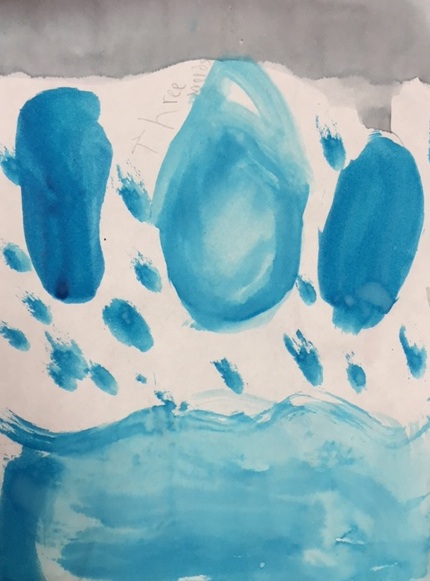
Earlier in the week we danced with paintbrushes, making watercolor abstract paintings while listening to music.  One selection led some of us artist/poets to think of water (rain).  It’s been raining every morning for the last few days.  I wrote a more playful poem while my 5th grader, Tobie, is thinking deeply and writing serious poems.


Tobie's painting of water

Tobie’s painting of water

As I sit intently
listening to the music that played
I thought of how there were many others
much more
than you could even imagine

Before you think
of planets in space
imagine drops of water in a sea
grains of sand on a beach
every blade of grass in a lawn
every second before dawn

–Tobie, 5th grade


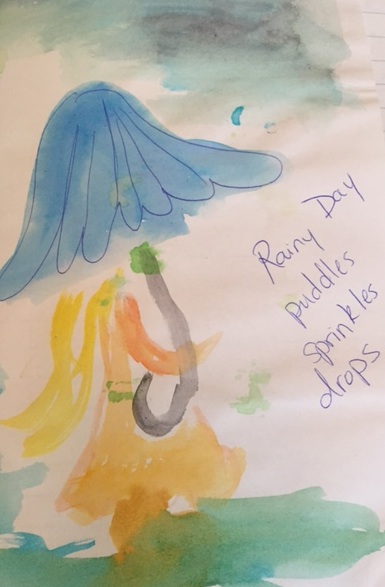
Rainy Day

Rainy Day by Margaret Simon

Rainy Day by Margaret Simon

Popping in puddles
painting balloons.
Sprinkles bubble.
Wet air
Wet hair.
I don’t care.
Let’s play anyway.

–Margaret Simon


Follow the Progressive Poem to Matt Forrest's Radio, Rhythm & Rhyme

Follow the Progressive Poem to Matt Forrest’s Radio, Rhythm & Rhyme


Read Full Post »

NPM2016

Join the Two Writing Teachers blog for March Slice of Life Challenge.

Join the Two Writing Teachers blog for March Slice of Life Challenge.

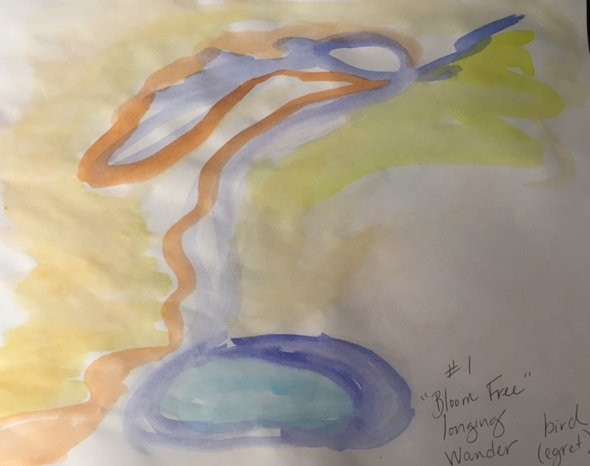
We brought out the paintbrushes and watercolor paints.  Each table had a stack of white paper.  I turned on the music.  Painting flowed in time with the beat.

This is dancing with a paintbrush.  When the music stops, we title the piece of art and list three words that come to mind.  This continues for three rounds.  The songs are all instrumental, one sounds oriental, another symphonic, and another Irish.

Following this painting activity, we write.

Freedom of expression, playing with words, making associations with music and poetry, the resulting poems went in all kinds of directions. (My students share their poems on Kidblog.)

In reading Tara Smith’s book review of Writing with Mentors, I pulled out this piece of advice: “Mentors Show Students How to Play: In order to grow as writers, students need safe places to play with writing – places that aren’t assessed or evaluated or given a grade.  They need places where their work can be messy, where thinking outside the box and being wild with ideas is encouraged.”

When I was struggling to write a poem with my painting, I turned to a favorite author, Mary Oliver.  From A Thousand Mornings, “Poem of the One World” begins “This morning/ the beautiful white heron/ was floating along above the water.”

Writing beside this master poet helped me to follow the rhythm that my own words wanted to take.

This longing
the beautiful white egret
wanders from known to unknown waters

And then
onto the shore of this
one stream we all swim in

where everyone
is part of the blue vein
where we can throw a stone in

which thought made me feel
for a small moment
welcomed home.

–Margaret Simon, after Mary Oliver

Dancing with a paintbrush

The abstract painting that led to my poem.


Follow the Progressive Poem to Today's Little Ditty

Follow the Progressive Poem to Today’s Little Ditty

Read Full Post »

NPM2016

Day 5 is with Carol at Beyond Literacy Link

Day 5 is with Carol at Beyond Literacy Link

Charles Simic in his poem “Stone” invites us to “go inside a stone.”  So I invited my students to explore rocks.  I found a collection in the closet.  Some child of mine collected them.  I thought I remembered them being there.

I tried to write with my kids.  I listed 5 steps for finding a poem: 1. describe it, 2. analyze it, 3. compare it, 4. associate it, 5. apply it.  Source for this activity is found here in the River of Words teacher’s guide. 

But I was stuck.  Oh, I wrote some lines like these:

The stepping stone
for my foot
grips and holds
me in wonder.

Another try:

On this smooth stone,
time stands still.

Some days I can start and stop like this all day, but eventually something emerges.  Today, nothing.  I was taking myself way too seriously.

Until Jacob said, “Inside a rock is a rock and a rock and another rock, a never ending chain of rocks.”

I wrote his words down in my notebook.  Took them straight out of the air and a poem started rolling out right there.

Jacob wasn’t as successful.  He was disappointed.  No, not disappointed exactly.  He was mad.  I took his words and made a poem with them.  This is my disclaimer.  With complete credit of the original lines to Jacob.

Jacob’s Rock

Inside a rock
is a rock
and a rock
and another rock.

A never ending chain of rocks.

Inside a shell
is a shell
and another shell
and a crab,
a crab?

A creepy, crawling crab in a never ending shell.

Inside my heart
is a beat
and a beat
and another beat

Beating hard as a rock for you.

–Margaret Simon (with help from Jacob.)

Free image from Pixabay

Free image from Pixabay

Read Full Post »

NPM2016

Join the Two Writing Teachers blog for March Slice of Life Challenge.

Join the Two Writing Teachers blog for March Slice of Life Challenge.

Day 5 is at Penny and Her Jots

Day 5 is at Penny and Her Jots

napo2016button2

Writing poems can be serious business. The first day back after spring break I asked my students to think hard about poetry. We read together a poem from the Teaching Guide for the River of Words Young Poets and Artists on the Nature of Things. (Handout 4:Writing from film) I highly recommend this guide for great poetry lessons written by my friends Harriet Maher and Connie McDonald.

The poem spoke in an ominous tone about the destruction of our earth. Students picked out these word, demented, shattered, purged, and monsters, as negative tone words. They noticed that the poem was a sad commentary on what we humans do to our earth home.

Then I played the first 8 minutes of the documentary of Ansel Adams.

While we watched the video, we collected words and phrases. We all wrote poems. Many of the students’ poems reflected the negative tone of the poem we read together. My favorite student poem is from Erin. She wrote how the silence was too loud. You can read her poem here.

Free image from Wikipedia.

Free image from Wikipedia.

Ansel Adams, 1902-1984

The artist transformed
moments into wild majesty
expressing in
exalted language of photography
how small we really are.

Among the tall trees
or the great mountains,
our humanness is separate–
a communion in the presence
of mystery.

Even in the absence of color,
in shades of black and white,
fragments are shattered
into a mosaic of truth.

We understand the fragile nature of things.

–Margaret Simon

Read Full Post »


Poem-a-day #3, lune by Margaret Simon, image poems

Poem-a-day #3, lune by Margaret Simon, image poems

napo2016button2


Please use this button on your site for DigiLit Sunday posts

Please use this button on your site for DigiLit Sunday posts

Yesterday was a glorious day to spend outside. But inside there was a valuable video conference, free PD in PJs at The Educator Collaborative.  So many rock stars in the education field all in one place.  I couldn’t pass it up, so after a walk with my dog, I came inside to watch and learn.

Some of my online friends were there, too.  I saw their Tweets.  I’ve invited them to reflect on this conference as well, so I am hoping we will have other DigiLit link-ups today.

The first hang-out presentation that I watched was #PoetryLove with JoEllen McCarthy, Amy Ludwig VanDerwater, Janet Wong, Alan Katz, Kim Doele & Members of the Poetry Club.  I enjoyed hearing some poems read aloud and the talk around how poetry has a place in the curriculum all year long.  Amy is writing a poem a day to Wonders from Wonderopolis.  My students love Wonderopolis, and I will show them Amy’s work this week as we begin our own poem a day writing projects. 

Kim Doele shared how she leads a Poetry Club at her school and writes grants to get visiting poets to her school.  Here is her post on hosting a poet at your school.

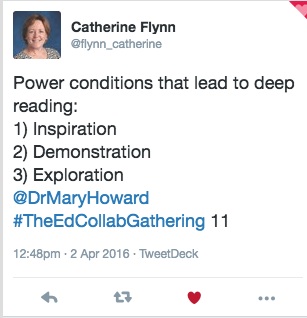
Catherine Flynn captured Mary Howard’s three power conditions that lead to deep reading.

tweet deep readingMary Howard repeated often that passion is important to reading.  If we don’t have a passion for what we are reading, we will not be able to do deep thinking.

 “Passion drives the deep thinking bus.”  –Dr. Mary Howard 


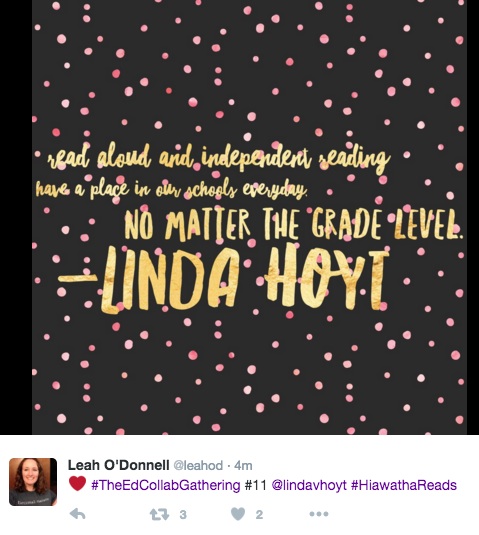
read aloud tweet

Joining Dr. Mary Howard was Linda Hoyt who discussed the importance of read aloud in every grade level.  I loved how some Tweeters were capturing quotes in fancy backgrounds.  The above Tweet was created by Leah O’Donnell.

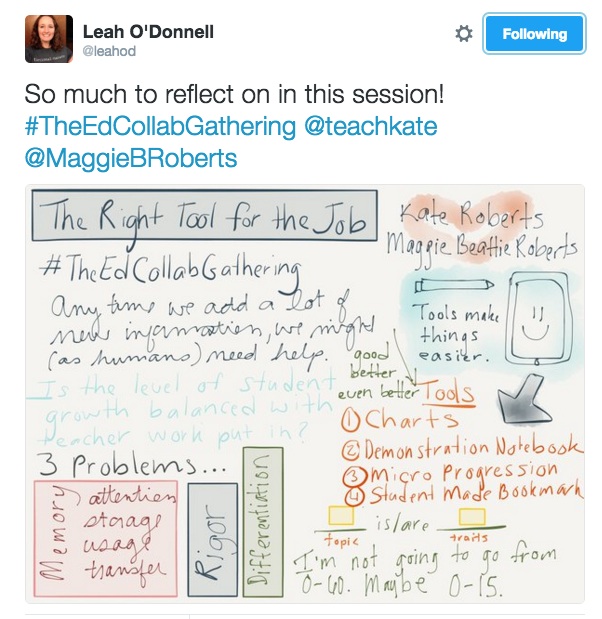
Leah also captured her reflection about Kate Roberts and Maggie B Roberts’ closing session.

Notes from Leah O'Donnell

Notes from Leah O’Donnell

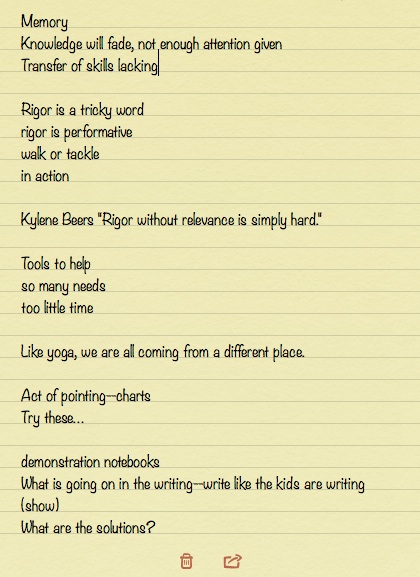
I used the notepad on my computer to capture thoughts.

notes on ed collab roberts

After the closing session, I went to Walmart to buy a sketchbook to make a demonstration notebook.  What a practical idea!  Kate and Maggie have a video about this teaching tool on their website here.

This rich conference went on in my kitchen, my living room, and in my bedroom.  It went wherever my laptop would go.  I ate lunch, folded clothes, and took notes and notes. I will go back to the archived sessions that I didn’t see.  Thanks to Chris Lehman and his fabulous team for this free and amazing video series.

If you have written a post reflecting on the Ed Collaborative Gathering or on any aspect of digital literacy, link up below.  Please read and comment on other posts.


Read Full Post »

Join the Two Writing Teachers blog for March Slice of Life Challenge.

Join the Two Writing Teachers blog for March Slice of Life Challenge.

Please use this button on your site for DigiLit Sunday posts

Please use this button on your site for DigiLit Sunday posts

Happy Easter, friends!

I considered taking today off from writing a post; however, an issue concerning digital literacy occurred in my classroom this week that needed to be addressed. There are two ways that I process things, by talking and by writing. In fact, today on the Two Writing Teachers call for Slices, there is this quote, “Writing floats on a sea of talk.” Britton. This weekend my sea of talk was with my father and with my Voxer writing group. Both helped me think in a deeper and more logical way about what happened.

My students use Kidblogs daily. They have since the first day of school. As a teacher of multi-grade gifted students, blogging is the way I encourage individuality and independence. One of the many advantages is that students can continue to work on their writing projects outside of class and when I am not at school. Last week I had an inservice, so I wasn’t at school. When I checked the blogs, I discovered that one student had “hacked” another student’s blog and wrote a post about it. I know she was just being playful, but I took it seriously. I commented to this student personally and removed the post. I also had a conversation with the whole class about trust.

When we read posts, we assume that the person who owns the blog wrote the post. I explained that I get an email whenever there is any activity on our Kidblog. I am watching, but more importantly, hacking is wrong. It breaks our trust and messes with the community we have built.

Another more serious incident occurred. As I have mentioned, I teach different grade levels, so my students have social lives with their grade level peers that our class is not a part of. There is safety in our community to talk about and write about things outside of our class. One student wrote a post about a conflict she was having with friends. Fairly typical sixth grade social issue; however, a 5th grader decided to take the matter into her own hands. She printed the post and gave it to one of the sixth grade girls. This post made the rounds all the way to the assistant principal. Not the intended audience of the original post.

When we write on a blog, the world can take our work and use it for any purpose, whether or not it is our intent. This is the reality of digital writing. This reality hit home this week. No real harm was done, but trust was compromised. Our classroom community was broken.

My father (wise as he is) pointed out that my students were able to fail in the safety of my care. Making mistakes is part of the learning process. Breaking trust is part of life. We will all do it at some point. What better way for my students to learn the dangers of digital writing than in the safe environment of school and class blogging?

I could make new rules: no hacking, no printing, but rules will not keep kids form being kids. My friend Julianne talked about the reins of control, how we let them go and then tighten them up. Push and pull. This digital world is amazing and wild and wonderful. We need to be able to fail and pick up the pieces, move on, and be wiser.

Trust is a powerful word. Trust is fragile. Trust is difficult to build and easy to shatter. Luckily, my students were not harmed by their breaches of trust, and they learned an important lesson. These are not the kinds of lessons teachers can design or plan on. My first reaction was disappointment. How could they do this? In reflection and conversation, I realize that all will be well as my little ones maneuver their way through this digital world.

Continue the conversation about digital literacy and trust by leaving a link to your blog post and reading other posts here. Click the linky below.

Read Full Post »
Join the Two Writing Teachers blog for March Slice of Life Challenge.

Join the Two Writing Teachers blog for March Slice of Life Challenge.

Please use this button on your site for DigiLit Sunday posts

Please use this button on your site for DigiLit Sunday posts

My husband says to me, “Look at this!” He is not on any social media, but he reads USA Today on his tablet every day. He is a learner who always wants to know more. Yesterday he showed me this amazing video about a tiny poodle in a nursing home. Get your tissues out.


I want my students to know that learning is a part of life. Last week I brought in a snap circuit kit and just let them play with it to try to figure it out. My administrator was observing me, and I am hopeful that she understands the lack of instruction on my part. Discovery was the point, and the answer doesn’t always come immediately.

Discovery is an important aspect to any learning. Because we have so much available at our fingertips, discovery is easy and constant. “Look at this, Mrs. Simon” are words I hear often. Jacob wanted to know how many moons Jupiter has. That’s not something I keep tucked away in my brain. “Check NASA’s site,” I tell him.

Each week my students are engaged in discovery about whatever interests them. During the Slice of Life Challenge, their Wednesday Wonder has become a Wonder SOL. I ask them to write a paragraph about how they became interested in their topic and to conclude with ideas for further learning. Their research is now framed by a personal connection.

I wonder about a lot of things. Do tree trunks grow fungus to make their colors?

Were the leaves flowers at first but it just lost its petals?

Chlorophyll is a large molecule. It absorbs light from the Sun and because it is a green color it makes the plants green.

I was very surprised that Chlorophyll was a word and that it even existed. I didn’t know it made plants green. I wonder why plants are green and not different colors like,pink,black,brown,red,green,orange, or tan. I think that there is another planet out somewhere that has a atmosphere and has different colored plants.
–Jacob, 2nd grade

In what ways is discovery a part of Digital Literacy in your classroom? Join the discussion by leaving a link.

Read Full Post »
Join the Two Writing Teachers blog for March Slice of Life Challenge.

Join the Two Writing Teachers blog for March Slice of Life Challenge.

kindness rock

Over at Today’s Little Ditty, Michelle Heidenrich Barnes interviewed Amy Ludwig VanDerwater who set out a challenge this month to write about small things. We wrote our poems on Friday and I posted some student poems here.

When my kids write, I write. I looked at my desk for inspiration and found the rock. We had decided to do something nice for teachers, so Emily brought in rocks.  My students wrote inspirational words on the rocks and gave them out to teachers. This was a Halloween treat, so this rock has been sitting on my desk for a while. I think it was supposed to go to the art teacher, but whatever, there it sat…and inspired this prose poem in me.

She gave me a rock,
a smooth small stone
on which she wrote a quote
from a book about a boy who was bullied.

If you have a choice
of being right or being kind,
be kind.

Thirteen words to turn
my attention everyday
to the world
of choices, that choice
within myself to be kind.

I take her small kindness
into my hand and wonder
about the river bank
the stone lived in before,
a place where violent waves
smoothed rock.

I wonder
about the larger truth:
Can violence smooth out
the edges and leave behind
kind?

–Margaret Simon

Read Full Post »
Join the Two Writing Teachers blog for March Slice of Life Challenge.

Join the Two Writing Teachers blog for March Slice of Life Challenge.

As winter transitions to spring, there is an argument in the skies.  High winds, thunder, rain, and more rain.  In parts of my state, flooding.  Transitions can be ugly, hard, and unpredictable.

In a digital classroom, transitions come slowly and with less fanfare.  In fact sometimes the transition is barely visible.  You have to look hard to see it happening.

On Thursday, when winter was fighting with spring outside, inside the room was quiet.  Every student was focused on the work of reading and writing.  I didn’t want to breathe.  I was afraid to make a sound for fear this was a fleeting moment.

When I look at this scene through the reflections of my students’ faces, I realize that they have become exactly who I had hoped they would be…independent learners.

Later that night I took some time to read their blog posts.  I saw independent writers making craft moves, writing with voice, and creating complete stories.  While I wasn’t looking, the transition happened.

There are some reasons for this growing independence:

  1. Routine: Students thrive on routine.  They like to know what is expected and when.  Within a routine, students feel comfortable to be themselves.
  2. Writing Daily: We have been participating in the March Slice of Life Challenge.  Anything that you practice daily gets better and better.  My students are no longer afraid of the blank screen.  They usually walk into class knowing what they will write about that day.
  3. Freedom:  Within the framework of routine, my students have freedom of choice.  They know the checklist and expectations, but they can choose what they write about and how they respond to learning.
  4. Safety: Building a safe environment for students is at the top of my list.  I respect (and love) each child and expect them to treat each other with kindness and respect.

March may be a turbulent time in the weather forecast, but inside things are calm and running smoothly.

Consider joining our community of bloggers around Digital Literacy.  Add your link below.

Please use this button on your site for DigiLit Sunday posts

Please use this button on your site for DigiLit Sunday posts

Read Full Post »
Join the Two Writing Teachers blog for March Slice of Life Challenge.

Join the Two Writing Teachers blog for March Slice of Life Challenge.

When Wonder Wednesday comes around on a Slice of Life Challenge Day, we write in a slightly more personal way about what we wonder about.  My students scan the internet for information sometimes having a hard time committing to a subject.  And as they sit side by side, ideas spread across the room and before I know it, I have 3 or 4 kids gathered around a computer screen watching a video about ghosts.

Later when I check blog posts, I find that not only do their interests spread, their writing decisions do, too.  Wonder poems have been cropping up on Wednesdays.  I am afraid to tell my students how much this pleases me.  I think maybe I should leave well enough alone.

Tara Smith posted this quote on Facebook: “The fact is that kids learn to make good decisions by making good decisions, not by following directions.” Alfie Kohn

As my students write daily on their blogs, they are making more and more decisions about their writing without me.  I read and see so much development, so many craft moves, and so much care to write well.   I also see them becoming aware of the pleasures of writing for writing’s sake.  They are pleased with themselves.

Lani shared with me her Wonder SOL, “Look at my poem!  I rhymed and I didn’t even know it.”

I Believe

There is the world

where the dead

are still alive

and they

spy

on the living.

Maybe one day

everyone will

have a

belief that this

is true

that ghosts

can haunt you

and they indeed

say BOO!

Lani, 4th grade

Lynzee sat close to Lani and wrote about ghost towns.  She created a poem, too.

Montana Ghost Town

Deserted,

No one to be seen or heard,

You suddenly think,

“Ghost Town.”

 You run,

And run,

And run until you get home

Then you think,

“Home, Sweet, Home.”
Your parents then say,

“Where were you?”

You say,

“Just playing.”

–Lynzee, 1st grade

Emily perused some pictures from a local newspaper photo contest.  I cut out the photos, mounted them on colored paper, and left them on the table for inspiration.  She didn’t realize that she was writing a mask poem until I told her.  Don’t you love when a student just naturally has a gift for writing a poem?  What a pleasure to see this one appear in her Slice.

Photo by Kim Bayard.

Photo by Kim Bayard.

I walk across a gravel road with my 3 little cubs,

We search for  berries and  fruits to eat, but we can not find them,

From behind some type of yellow shelter emerges a little child,

With hair of blonde and eyes of blue,

We run for a bit, but stop,

She approaches with berries of blue,

With even amounts for each,

I thank the young  girl with a friendly rub at her knees,

She laughs and runs  back  home,

She won’t understand how grateful I am for feeding my children and me.

–Emily, 5th grade

Poetry Friday round-up with Irene Latham at Live your Poem

Poetry Friday round-up with Irene Latham at Live your Poem

Read Full Post »

« Newer Posts - Older Posts »