Feeds:
Posts
Comments

Archive for the ‘Teaching’ Category

Please use this button on your site for DigiLit Sunday posts

Please use this button on your site for DigiLit Sunday posts

220px-Function_machine2

Last week for DigiLit Sunday, I wrote about form. I was pretty deep into teaching and writing poetry, grappling with form or no form. Julianne suggested that we follow form with function this week. When I googled function, the images suggested one right answer. That answer leads to points on a graph. Points on a graph remind me of testing.

Testing is the necessary evil, in my book. I teach gifted kids, and for the most part, the reason they are in my class is they can take tests well. They’ve figured out the function, so to speak.

So my question is how do I further my students learning beyond what the standardized test is going to require? My students are outside-of-the-box thinkers. I have to find ways to keep them thinking this way while, at the same time, capable of going back into the box come test time.

There is much grumbling in my class about testing. I have had students enjoy this time because it is quiet, and they get to read for long stretches. But one student complained that her teacher-proctor punished her for recess because she finished the session in 20 minutes. I’m sure the logic was “There is no way you can get all the answers right in 20 minutes.” That very well may be true, but my thinking tells me this teacher did not know this child.

The function of a teacher is to know her students. If you were to ask me about any of my students, I could tell you their favorite books, what genre they prefer to write, and their favorite activity to do outside of school.

The only thing about my kids that I could plot on a graph would be their reading levels. Yet their reading levels say nothing about their interest levels. And interest is everything when it comes to reading.

I take my function seriously, but I will never function to produce a right answer or a point on a graph. I strive to make my classroom one of discovery and development, creativity and caring.

How do you interpret function as it pertains to literacy? Be sure to leave a link to your own blog post today.

Read Full Post »

NPM2016

During this monthlong survey of poetry, there is trouble.

So many decisions to make.

What should I teach today?
Line breaks,
literary elements,
limericks?

I want to say stop to
sing-song rhymes
and simple forms.

Then one turns to another and says,
“Let’s write a rap abecedarian.”

Like the messiness of art class,
the instructor must allow
for paint splatters and stains,
for stalled-out cinquains
and skip-to-my-loos.

Poetry is hard.
Poetry is easy.
There are rules in poetry.
There are no rules:
Let the poem find its way.
This is the trouble with poetry.
This is the joy of poetry.

–Margaret Simon

Follow the Progressive Poem to  Charles Waters.

Follow the Progressive Poem to Charles Waters.


Read Full Post »

Please use this button on your site for DigiLit Sunday posts

Please use this button on your site for DigiLit Sunday posts

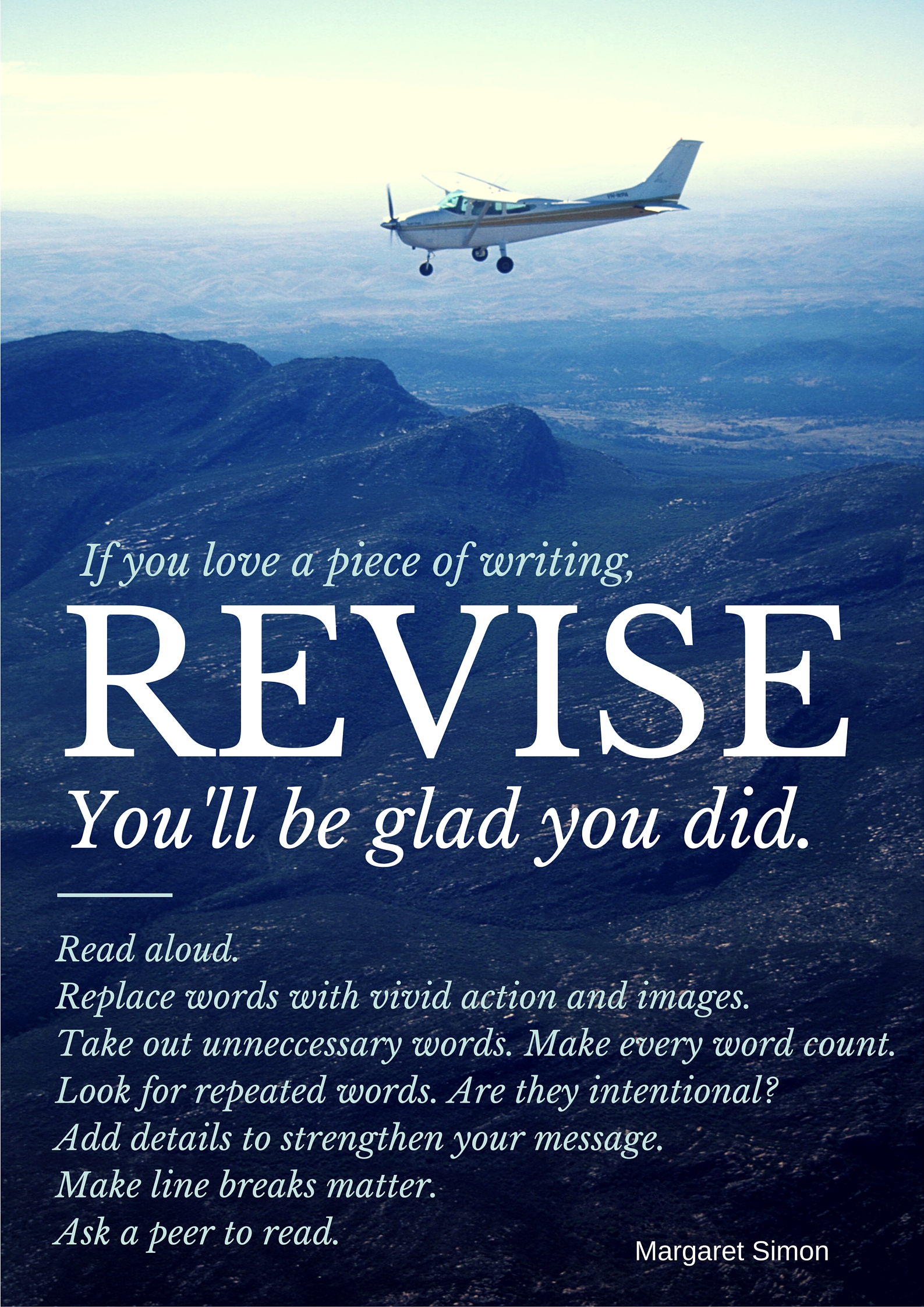
In my world of teaching and writing, revision is a constant companion. I look at my teaching and revise. Rarely am I following the lesson plan I wrote. I revise based on the direction my students need to take. And last week revision was something we needed to talk about.

I believe that revision is a mature behavior. Revision is having the confidence in a piece of writing to take the risk of changing it. Without even realizing it, I write in constant revision. As I write this post, I backspace. I save and read. Go back. Rephrase.

My students do this, too, as they type their pieces into the blog. Many of them are resistant to the two steps of rough draft in their notebooks, then typing into a final draft. But as I watch them, I see that revision becomes organic to this process.

Sometimes, revision comes from talk. We read the piece together. Discuss what we like. And look at where the words can be stronger.

I sat down with Kaiden to revise his abecedarian about wonder posted here. For the most part, this was an excellent piece of writing. The repeated word, wonder, was intentional and served a purpose. Yet there were a few words that weren’t quite working. So we looked at a list of Shakespeare words. This elevated Kaiden’s poem. There we found kindle. What a great word for K and for wonder! Engaging in this work with him was fun for both of us.

Ralph Fletcher tweeted:

revision by Ralph Fletcher

Let’s relax about revision. If a piece of writing is a stepping stone to another piece, let it be. Use revision strategies on those gems, the ones you want to embrace and hug a little longer.

Revision canva

Read Full Post »

Discover. Play. Build.

Ruth Ayres invites us the celebrate each week. Click over to her site Discover. Play. Build. to read more celebrations.

NPM2016

Marilyn Singer is a master poet. At NCTE in the fall, I had the pleasure of meeting her. I was also a lucky participant who won a copy of Follow, Follow. Marilyn invented the reverso poem and has published 3 books of them, two based on fairy tales and her latest Echo, Echo based on mythology.

On Today’s Little Ditty, Michelle Heindenrich Barnes interviewed Marilyn Singer and offered a ditty challenge to use the word echo in relation to a poem. I was determined to try the reverso form.

With my students as cheerleaders, I worked hard and produced something worthy of being called a reverso poem. The process began when we watched this video together.

I asked my students to select an insect to be in a mask (or persona) poem. I selected this image to inspire my writing.

screenshot from the film Microcosmos by Jacque Perrin.

screenshot from the film Microcosmos by Jacque Perrin.

Then I did some caterpillar research. I wrote “zig zag stitch” and then discovered that caterpillars excrete a silk line as they crawl in addition to using the silk to create a chrysalis.

Creepy crawly caterpillar
munch munch
munching milkweed
at tremendous speed.

Life changes
slowly
creeping, crawling
leaf to leaf.

Sunlight glimmers
on fuzzy bristles.
I zig-zag stitch
a silkthread path
leaf to leaf.

Leaf to leaf
a silkthread path
I zig-zag stitch
on fuzzy bristles.

Sunlight glimmers
leaf to leaf.
Creeping crawling
slowly.

Life changes
at tremendous speed.
Munching milkweed
Munch, munch
creepy, crawly caterpillar.

This is a tough form to get just right. I don’t think mine successfully creates a different meaning in reverse. But my students liked it, so I am celebrating it none the less.

Read Full Post »

NPM2016

Poetry Friday round-up with Michelle at Today's Little Ditty

Poetry Friday round-up with Michelle at Today’s Little Ditty

This month as I go through poetry every day with my students, inevitably favorite forms emerge.  From her blog, Amy Ludwig VanDerwater introduced my students (and me) to the abecedarian form.  One by one my students are trying this out.  I have said it’s a very challenging form.  Some rise to a challenge.

Kaiden has risen to this challenge not only using the form, but also repeating the word wonder.  When he got stuck on a letter, he searched a list of Shakespeare words.

All the time wondering
Batty in the night for wonder
Can’t get any sleep from wondering
Dying to quench my thirst for wonder
Enclosing myself in books of wonder
Fascinated by wonder
Going insane from wonder
How did it become this way
I have no idea
Judged because of my wild hair from wondering too much
Kindling the fire of wonder
Loving every drop of wonder
Mourning without wonder
Not having any time for doing work because of wonder
Oblivious of all my dirty and messy ways
Prowling the library for wonder
Quivering without wonder
Rest is impossible with all this wonder
Sleep I can’t
Tearing up books
Unfortunately, I am addicted to wonder
Vigorously turning pages
Withering with out wonder
Xhaling because my wonder is filled
Zzz’s I can finally catch

–Kaiden, 5th grade

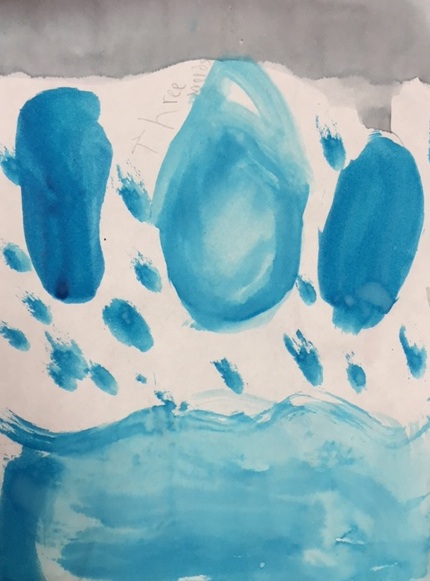
Earlier in the week we danced with paintbrushes, making watercolor abstract paintings while listening to music.  One selection led some of us artist/poets to think of water (rain).  It’s been raining every morning for the last few days.  I wrote a more playful poem while my 5th grader, Tobie, is thinking deeply and writing serious poems.


Tobie's painting of water

Tobie’s painting of water

As I sit intently
listening to the music that played
I thought of how there were many others
much more
than you could even imagine

Before you think
of planets in space
imagine drops of water in a sea
grains of sand on a beach
every blade of grass in a lawn
every second before dawn

–Tobie, 5th grade


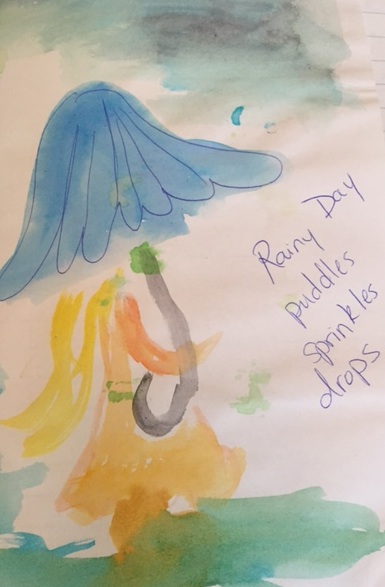
Rainy Day

Rainy Day by Margaret Simon

Rainy Day by Margaret Simon

Popping in puddles
painting balloons.
Sprinkles bubble.
Wet air
Wet hair.
I don’t care.
Let’s play anyway.

–Margaret Simon


Follow the Progressive Poem to Matt Forrest's Radio, Rhythm & Rhyme

Follow the Progressive Poem to Matt Forrest’s Radio, Rhythm & Rhyme


Read Full Post »

NPM2016

Join the Two Writing Teachers blog for March Slice of Life Challenge.

Join the Two Writing Teachers blog for March Slice of Life Challenge.

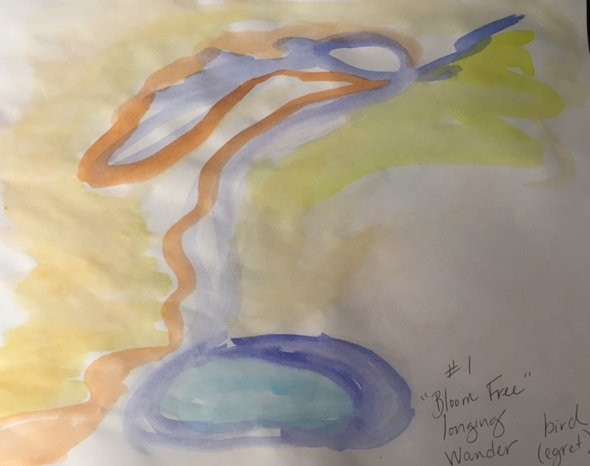
We brought out the paintbrushes and watercolor paints.  Each table had a stack of white paper.  I turned on the music.  Painting flowed in time with the beat.

This is dancing with a paintbrush.  When the music stops, we title the piece of art and list three words that come to mind.  This continues for three rounds.  The songs are all instrumental, one sounds oriental, another symphonic, and another Irish.

Following this painting activity, we write.

Freedom of expression, playing with words, making associations with music and poetry, the resulting poems went in all kinds of directions. (My students share their poems on Kidblog.)

In reading Tara Smith’s book review of Writing with Mentors, I pulled out this piece of advice: “Mentors Show Students How to Play: In order to grow as writers, students need safe places to play with writing – places that aren’t assessed or evaluated or given a grade.  They need places where their work can be messy, where thinking outside the box and being wild with ideas is encouraged.”

When I was struggling to write a poem with my painting, I turned to a favorite author, Mary Oliver.  From A Thousand Mornings, “Poem of the One World” begins “This morning/ the beautiful white heron/ was floating along above the water.”

Writing beside this master poet helped me to follow the rhythm that my own words wanted to take.

This longing
the beautiful white egret
wanders from known to unknown waters

And then
onto the shore of this
one stream we all swim in

where everyone
is part of the blue vein
where we can throw a stone in

which thought made me feel
for a small moment
welcomed home.

–Margaret Simon, after Mary Oliver

Dancing with a paintbrush

The abstract painting that led to my poem.


Follow the Progressive Poem to Today's Little Ditty

Follow the Progressive Poem to Today’s Little Ditty

Read Full Post »

NPM2016

Day 5 is with Carol at Beyond Literacy Link

Day 5 is with Carol at Beyond Literacy Link

Charles Simic in his poem “Stone” invites us to “go inside a stone.”  So I invited my students to explore rocks.  I found a collection in the closet.  Some child of mine collected them.  I thought I remembered them being there.

I tried to write with my kids.  I listed 5 steps for finding a poem: 1. describe it, 2. analyze it, 3. compare it, 4. associate it, 5. apply it.  Source for this activity is found here in the River of Words teacher’s guide. 

But I was stuck.  Oh, I wrote some lines like these:

The stepping stone
for my foot
grips and holds
me in wonder.

Another try:

On this smooth stone,
time stands still.

Some days I can start and stop like this all day, but eventually something emerges.  Today, nothing.  I was taking myself way too seriously.

Until Jacob said, “Inside a rock is a rock and a rock and another rock, a never ending chain of rocks.”

I wrote his words down in my notebook.  Took them straight out of the air and a poem started rolling out right there.

Jacob wasn’t as successful.  He was disappointed.  No, not disappointed exactly.  He was mad.  I took his words and made a poem with them.  This is my disclaimer.  With complete credit of the original lines to Jacob.

Jacob’s Rock

Inside a rock
is a rock
and a rock
and another rock.

A never ending chain of rocks.

Inside a shell
is a shell
and another shell
and a crab,
a crab?

A creepy, crawling crab in a never ending shell.

Inside my heart
is a beat
and a beat
and another beat

Beating hard as a rock for you.

–Margaret Simon (with help from Jacob.)

Free image from Pixabay

Free image from Pixabay

Read Full Post »

NPM2016

Join the Two Writing Teachers blog for March Slice of Life Challenge.

Join the Two Writing Teachers blog for March Slice of Life Challenge.

Day 5 is at Penny and Her Jots

Day 5 is at Penny and Her Jots

napo2016button2

Writing poems can be serious business. The first day back after spring break I asked my students to think hard about poetry. We read together a poem from the Teaching Guide for the River of Words Young Poets and Artists on the Nature of Things. (Handout 4:Writing from film) I highly recommend this guide for great poetry lessons written by my friends Harriet Maher and Connie McDonald.

The poem spoke in an ominous tone about the destruction of our earth. Students picked out these word, demented, shattered, purged, and monsters, as negative tone words. They noticed that the poem was a sad commentary on what we humans do to our earth home.

Then I played the first 8 minutes of the documentary of Ansel Adams.

While we watched the video, we collected words and phrases. We all wrote poems. Many of the students’ poems reflected the negative tone of the poem we read together. My favorite student poem is from Erin. She wrote how the silence was too loud. You can read her poem here.

Free image from Wikipedia.

Free image from Wikipedia.

Ansel Adams, 1902-1984

The artist transformed
moments into wild majesty
expressing in
exalted language of photography
how small we really are.

Among the tall trees
or the great mountains,
our humanness is separate–
a communion in the presence
of mystery.

Even in the absence of color,
in shades of black and white,
fragments are shattered
into a mosaic of truth.

We understand the fragile nature of things.

–Margaret Simon

Read Full Post »


Poem-a-day #3, lune by Margaret Simon, image poems

Poem-a-day #3, lune by Margaret Simon, image poems

napo2016button2


Please use this button on your site for DigiLit Sunday posts

Please use this button on your site for DigiLit Sunday posts

Yesterday was a glorious day to spend outside. But inside there was a valuable video conference, free PD in PJs at The Educator Collaborative.  So many rock stars in the education field all in one place.  I couldn’t pass it up, so after a walk with my dog, I came inside to watch and learn.

Some of my online friends were there, too.  I saw their Tweets.  I’ve invited them to reflect on this conference as well, so I am hoping we will have other DigiLit link-ups today.

The first hang-out presentation that I watched was #PoetryLove with JoEllen McCarthy, Amy Ludwig VanDerwater, Janet Wong, Alan Katz, Kim Doele & Members of the Poetry Club.  I enjoyed hearing some poems read aloud and the talk around how poetry has a place in the curriculum all year long.  Amy is writing a poem a day to Wonders from Wonderopolis.  My students love Wonderopolis, and I will show them Amy’s work this week as we begin our own poem a day writing projects. 

Kim Doele shared how she leads a Poetry Club at her school and writes grants to get visiting poets to her school.  Here is her post on hosting a poet at your school.

Catherine Flynn captured Mary Howard’s three power conditions that lead to deep reading.

tweet deep readingMary Howard repeated often that passion is important to reading.  If we don’t have a passion for what we are reading, we will not be able to do deep thinking.

 “Passion drives the deep thinking bus.”  –Dr. Mary Howard 


read aloud tweet

Joining Dr. Mary Howard was Linda Hoyt who discussed the importance of read aloud in every grade level.  I loved how some Tweeters were capturing quotes in fancy backgrounds.  The above Tweet was created by Leah O’Donnell.

Leah also captured her reflection about Kate Roberts and Maggie B Roberts’ closing session.

Notes from Leah O'Donnell

Notes from Leah O’Donnell

I used the notepad on my computer to capture thoughts.

notes on ed collab roberts

After the closing session, I went to Walmart to buy a sketchbook to make a demonstration notebook.  What a practical idea!  Kate and Maggie have a video about this teaching tool on their website here.

This rich conference went on in my kitchen, my living room, and in my bedroom.  It went wherever my laptop would go.  I ate lunch, folded clothes, and took notes and notes. I will go back to the archived sessions that I didn’t see.  Thanks to Chris Lehman and his fabulous team for this free and amazing video series.

If you have written a post reflecting on the Ed Collaborative Gathering or on any aspect of digital literacy, link up below.  Please read and comment on other posts.


Read Full Post »

« Newer Posts - Older Posts »