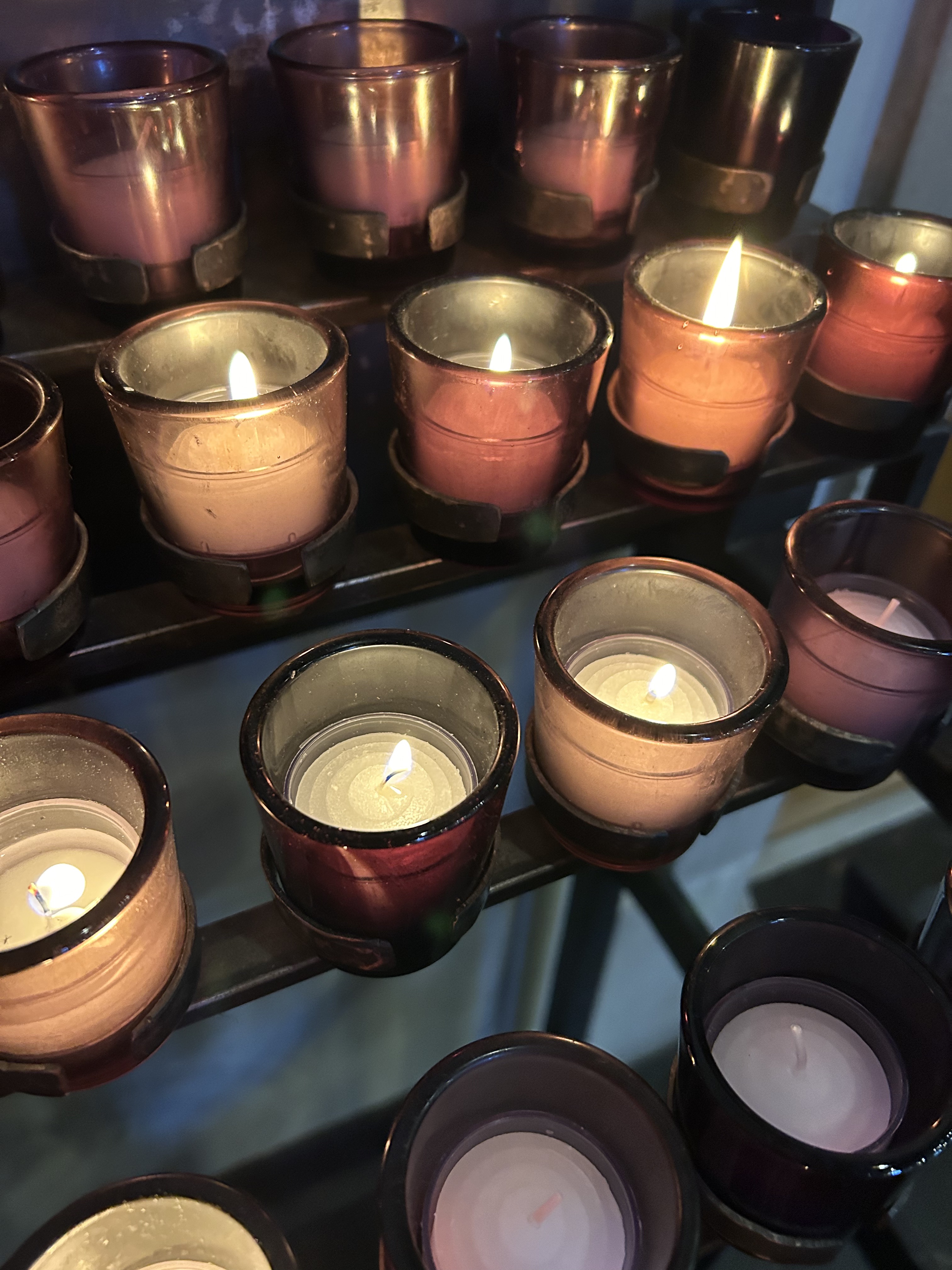
Prayer candles in St. James Episcopal Church, 2024 by Margaret Simon
I was in my childhood home church on Sunday. While the scent of incense lingered, I walked over to the columbarium to say hello to my dad. I saw the metal rack of votive candles. I decided to light a candle for my mother, in hospice care at the end stages of Alzheimer’s, and one for my daughter’s mother-in-law who is battling cancer. To light a candle for someone symbolizes the prayer intention. Do we need this symbols? I believe we can pray without them, of course, but something in me was comforted by the act of lighting.
I invite you to consider holy moments, whether they be in church or out in nature, perhaps even in the quiet of your day. We can set intentions and practice mindfulness. What are your intentions today? Write a small poem in the comments and encourage others who write with us.
Instead of empty… fill Instead of fallow… fertile Instead of loss… love Instead of lies… truth Instead of hopelessness… faith
Happy November! This is the first day and first Friday, so it’s time for a new challenge from the Inklings. This month Linda, who is also hosting Spiritual Thursday, selected a poem by Joy Harjo Fall Song. She asked us to respond in some way to the poem. I collected words that pleased me for their sounds: blue, you, divine, mind, behind. I was thinking of my mother’s blue eyes.
Her Eyes Blue like the Sky
(after Joy Harjo “Fall Song”)
All you leave behind is blue– blue lace wings–
tinted with night sky. Your divine sign forever will be a blue bird.
I cry for more– more of your soft touch,
the gleam of love lighting
from your crystal blue eyes. Margaret Simon, draft
Linda's One Little Word for 2024 is "World". She has been writing poems all year on a padlet using her word. I admire her dedication to this daily writing. Since she sent out the prompt for Spiritual Journey, I have been noticing that poets often use the word "world".
I recently read Evie Shockley’s poem “job prescription ” and striked a line for a golden shovel: “poetry may not change the world, but might change you.” I believe in poetry. I want to believe that it could change the world, but I’m satisfied knowing that it has changed me. I am a better person, a better teacher, a better child of God because I breathe in poems every day.
What is poetry? An acorn that may or may not become an oak, change leaves for the next season of the world. We read & write, but are never sure which words might sprout to change and inspire the deepest you. Margaret Simon, draft
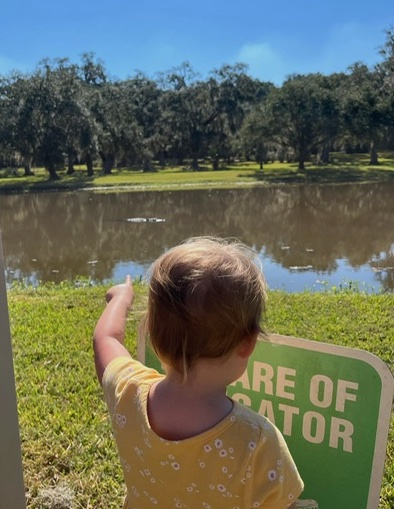
Granddaughter June, 22 months, pointing at an alligator at Avery Island, Louisiana.
My daughter joined my older daughter and her kids at Avery Island, Louisiana, a few miles south of us. It’s the home of the Tabasco plant. The place is beautiful, set on an inlet from the Gulf of Mexico. The water is fresh water and yes, there are gators there. Alligators are generally not aggressive animals. They peacefully float along the surface. I’m not sure, but this might have been June’s first time to see an alligator out in the wild.
Let’s play with enjambment today. Enjambment is a poetic element in which a sentence or phrase continues from one poetic line to the next, without end punctuation. Enjambment can create a surprise or suspense.
Here’s an example from Maggie Smith’s poem “First Fall”:
“I’m your guide here. In the evening-dark morning streets, I point and name. Look, the sycamores, their mottled paint-by-number bark. Look, the leaves”
Here is my draft:
Your finger is the guide here, pointing, noticing, identifying first gator. You say, “Foggie,” and Mom repeats, “That’s an alligator!” You point again, fumble over new syllables, soaking up space, place, and being a toddler on tour. Margaret Simon, draft
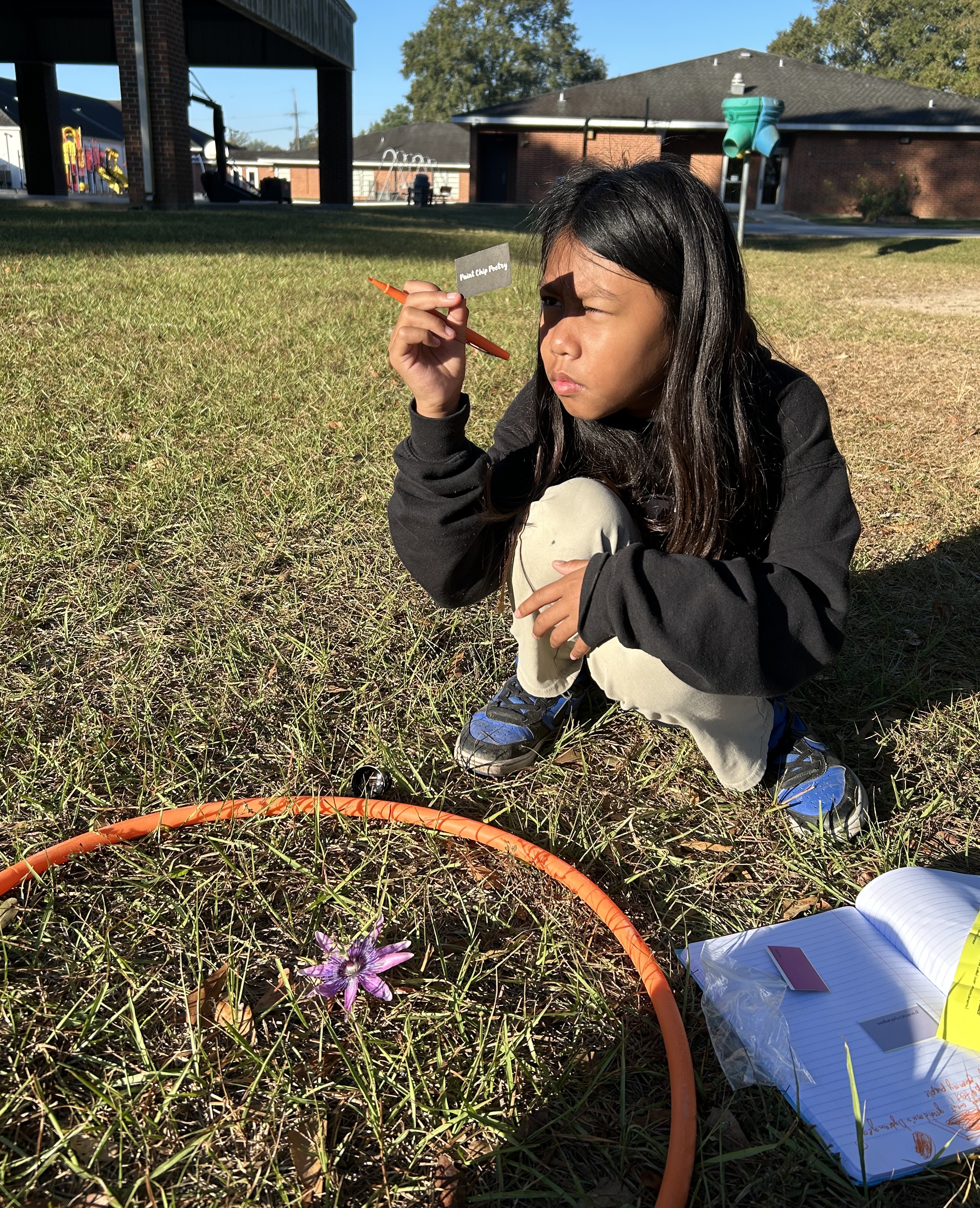
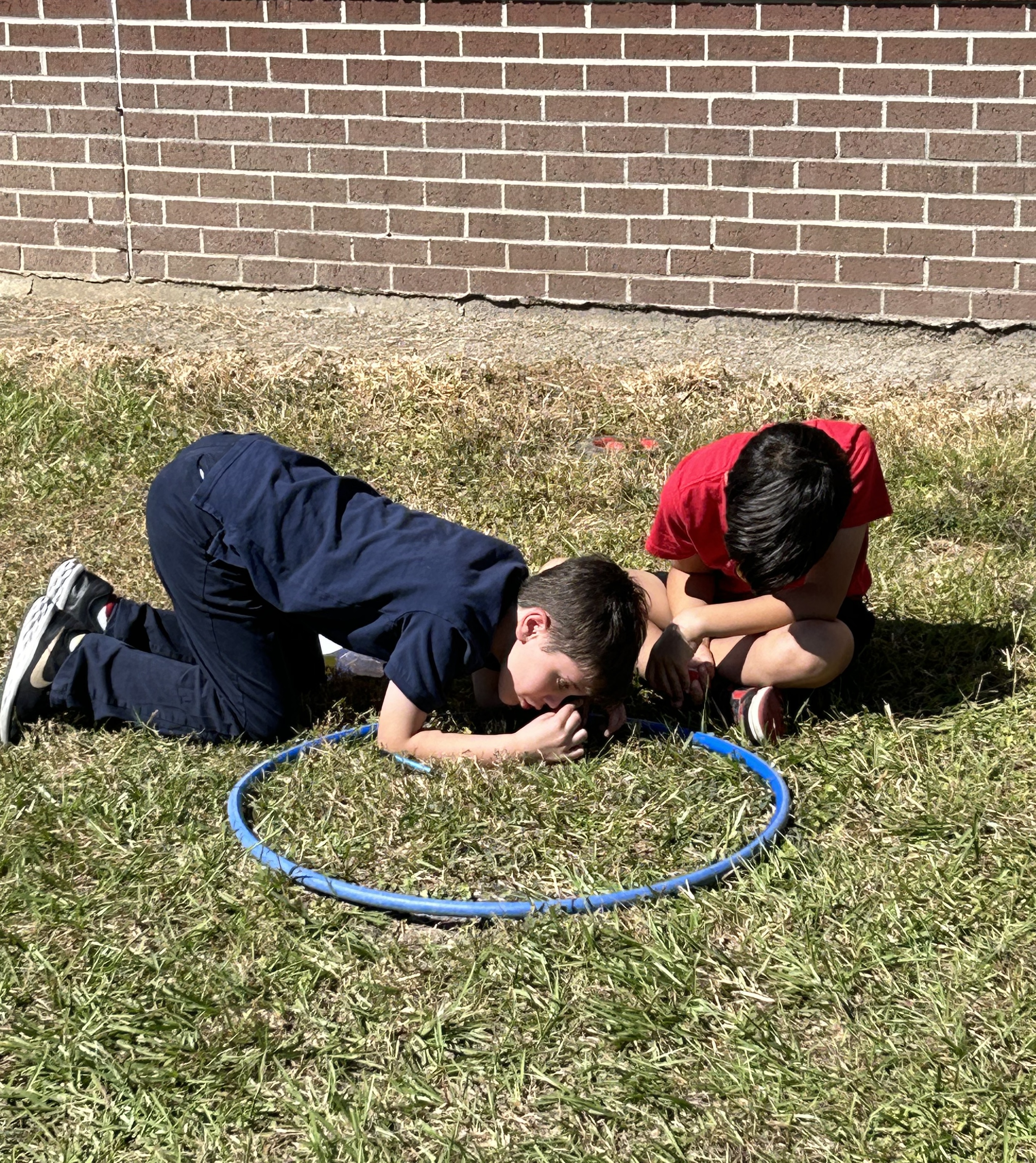
These past two weeks I’ve been trying to squeeze in Write Out opportunities for my students. Write Out is an annual event sponsored by the National Writing Project and the National Parks. This year Kate Messner was the Author Ambassador. One of her prompts asked students to take a hula hoop outside and focus on their circle when writing. Because I can’t leave well enough alone, I added paint chips and jewel loupes to the writer’s toolbox.
Our weather has been perfect the last two weeks. Cool mornings. High sun. Warm afternoons. Perfect for writing outside.
The paint chip words were just the thing to add a little twist to the poems my students and I wrote.
Purple flowers are community of the grass, some clustered some isolated in the sea glass waves.
by Adelyn, 6th grade
The grass has a shine from the blazing sun spitting out embers like a swarm of yellow jackets.
by James, 4th grade
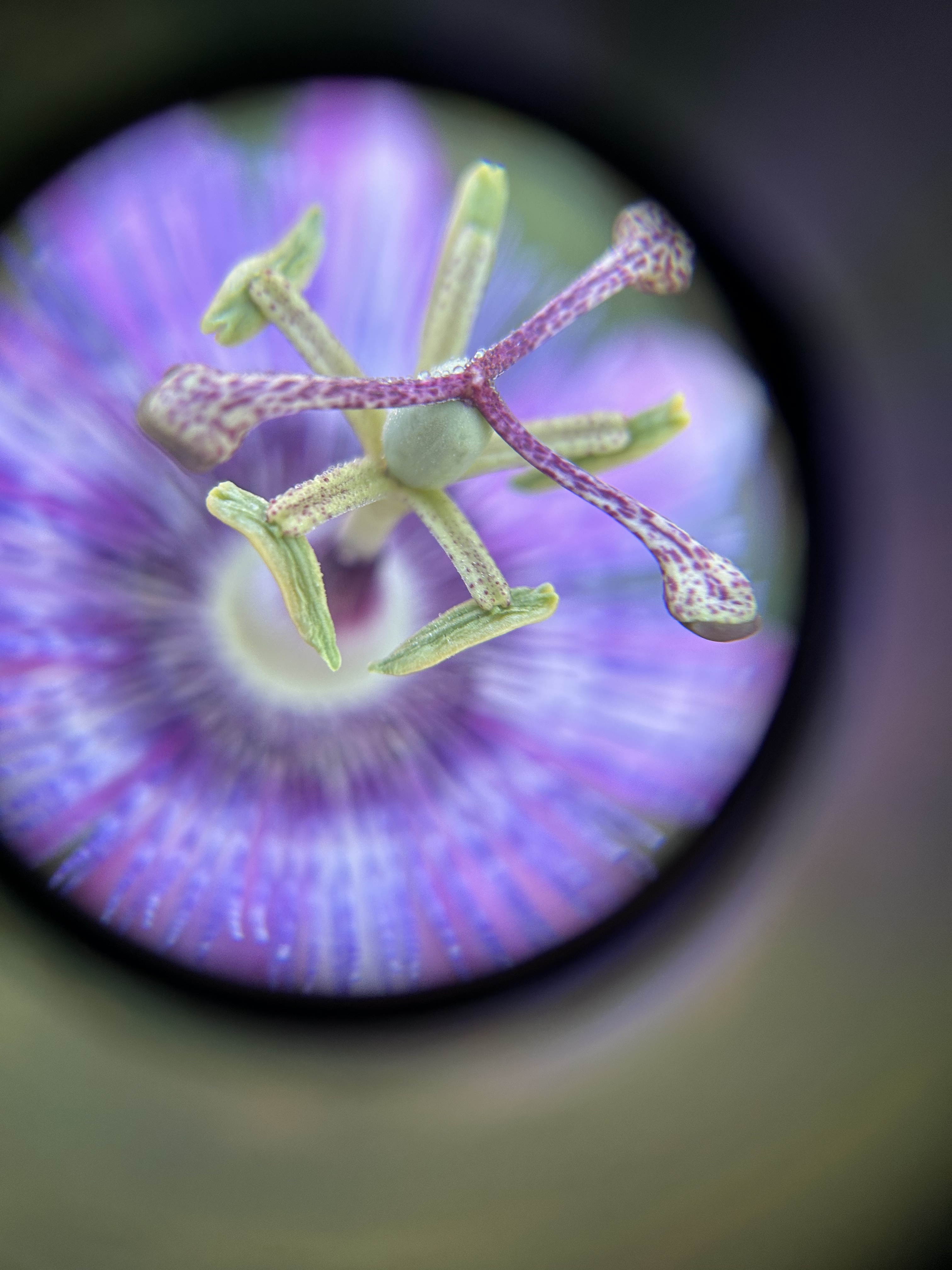
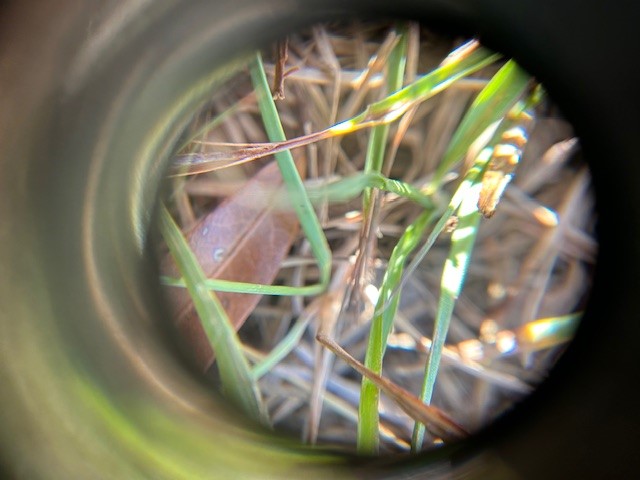
Looking through the jewel loupes helped us see intricate designs and stretched our metaphorical thinking. I love using the jewel loupe with my camera lens on my phone.
Circle of Grass The blades of grass are a kaleidoscope reflecting after the fire in a tangerine dream. by Margaret Simon, draft
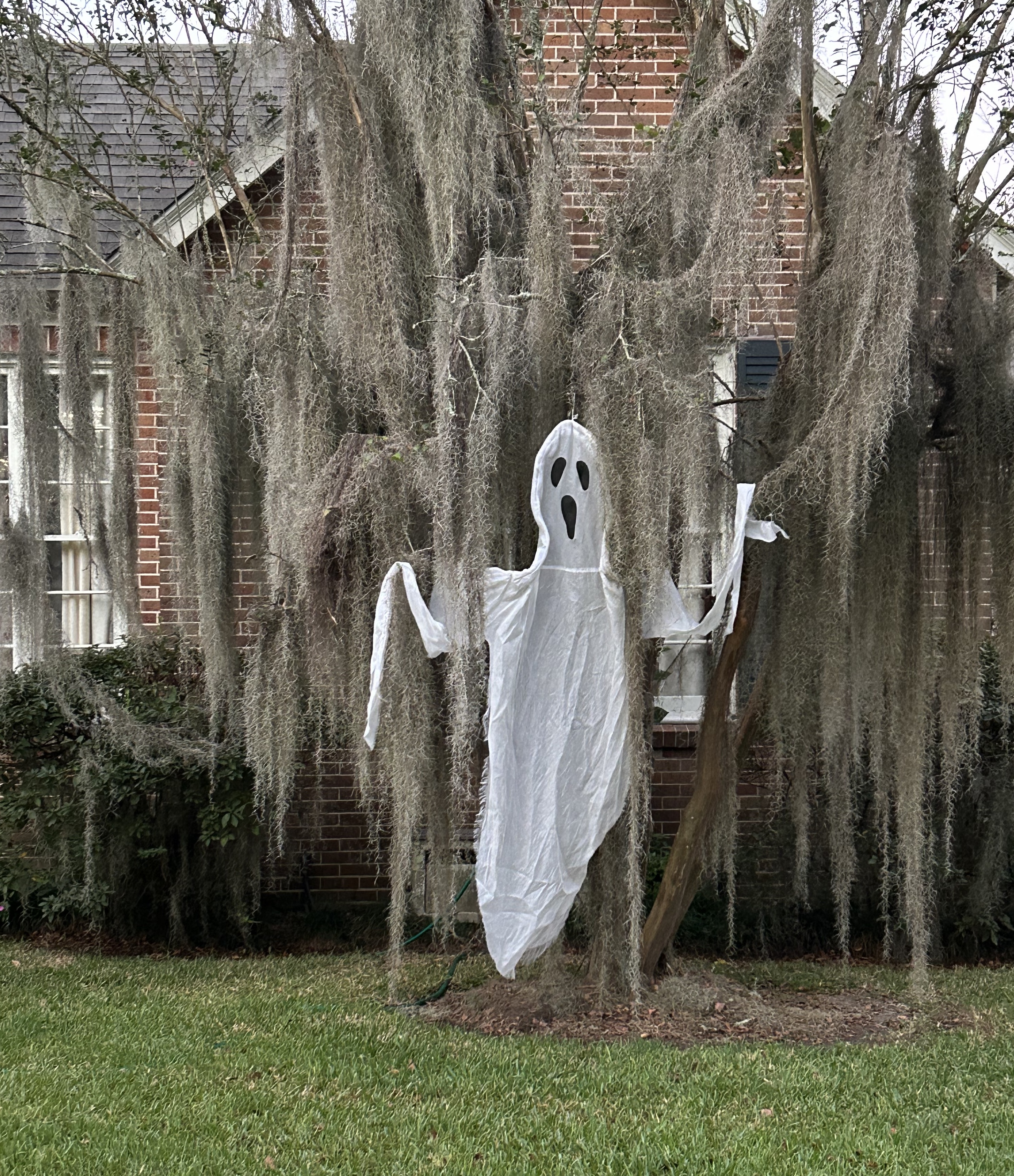
If you have a tree covered in moss, then you must hang a ghost there.
I’ve taken a number of pictures of Halloween decorations thinking about the photo for this week. This one is the winner. In my neck of the woods (South Louisiana), moss covered trees are common. My husband grew up calling it “spooky moss”. It is the common Spanish moss, and on some trees, the stuff practically takes over the tree, even though I’ve read that moss is a bromeliad in the pineapple family and does not harm the tree.
“Many homeowners think that Spanish moss kills their trees. This is not the case because the moss is not parasitic. The only thing Spanish moss uses trees for is support.” University of Florida.
Yesterday as we were writing metaphors for artifacts in nature (#WriteOut), Avalyn created this form: The (A, An) object in nature is/is like … describe how it is like end with a connection to life
I tried the form when writing about milkweed seeds. I combined it with a prompt from Ethical ELA to write with words from paint chips here.
A milkweed seed is a great white egret showing off its lacy wings to the mirrored pool in the sky. Margaret Simon, draft
Spanish moss are stalactites hanging on a crepe myrtle hosting ghostly terrormites. Margaret Simon, draft
Now it’s your turn. You can try Avalyn’s form or use your own. Please encourage other writers with your responses. Happy Halloween!
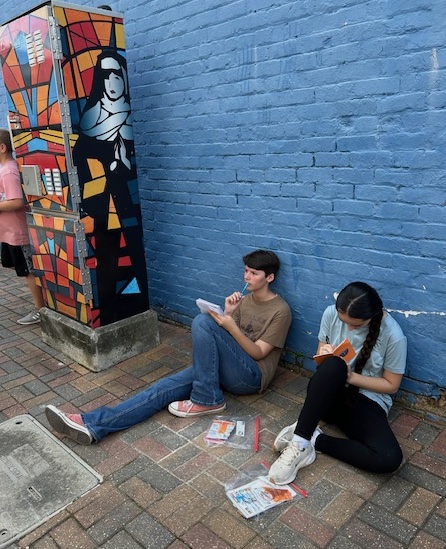
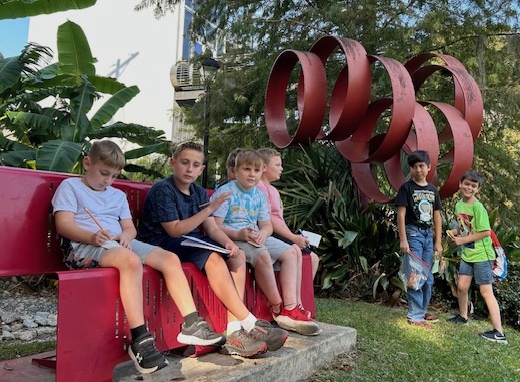
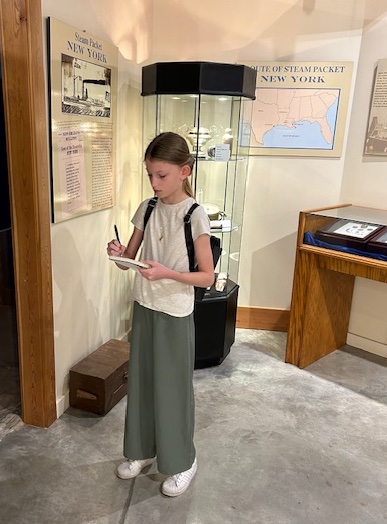
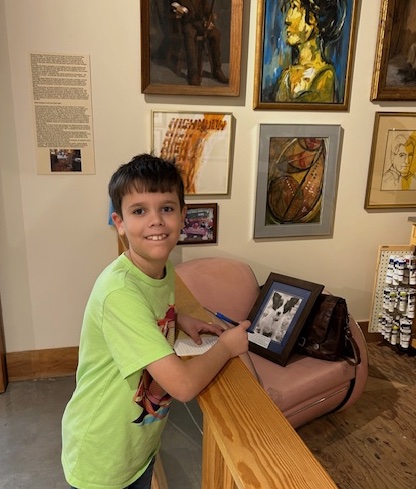
What a wonderful first week of NWP’s Write Out! On Tuesday, our schools were on fall break, but two other teachers and I decided to create a Write Out Field Trip. Twenty-seven kids attended from K-8th grade. Our local Bayou Teche Museum graciously opened its doors for us. We wrote at 4 different places, the museum, a sculpture garden, Bayou Teche kayak dock, and Church Alley.
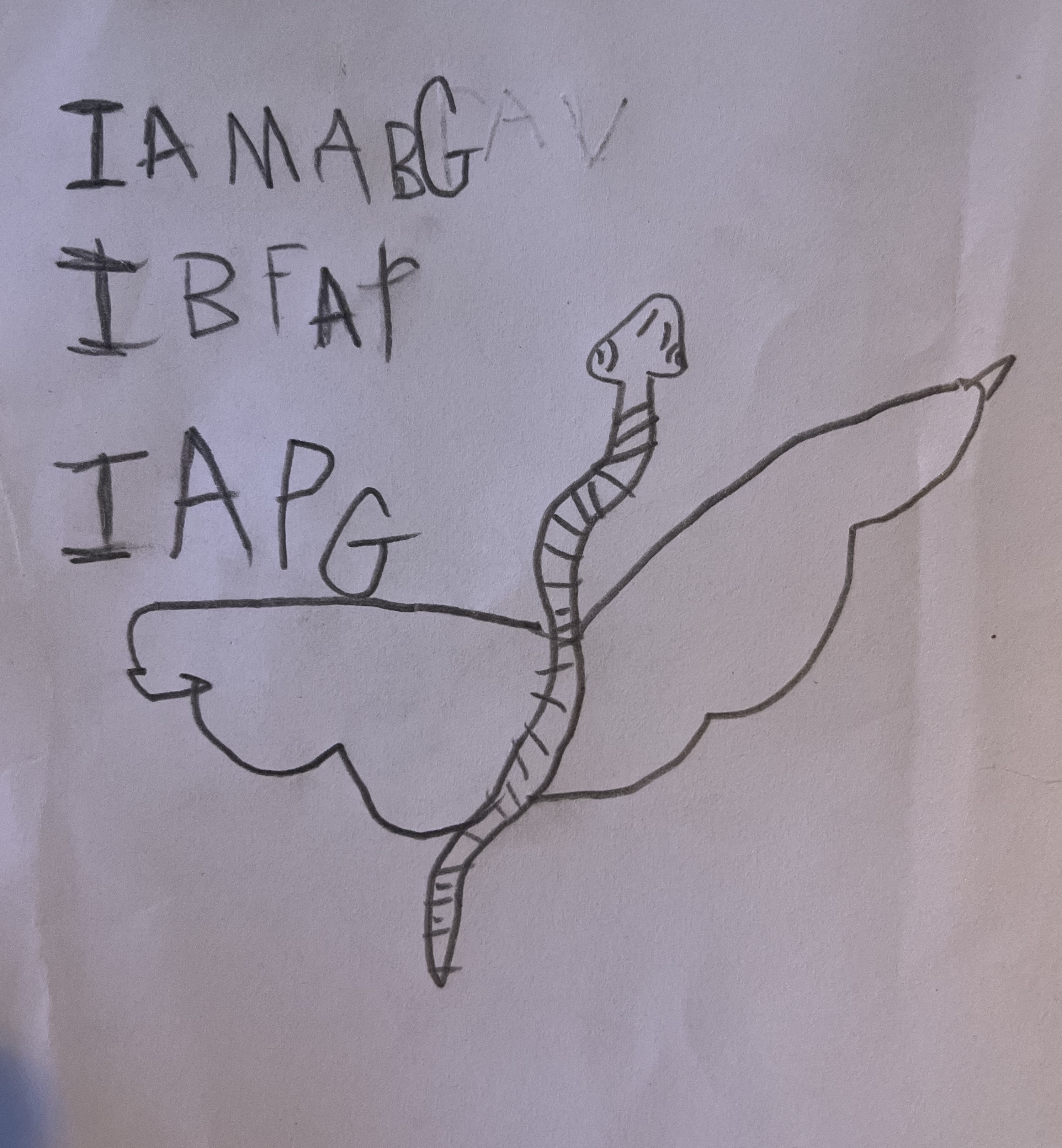
Because he was on fall break, too, my grandson Leo joined us. He is at the earliest stages of reading and writing. He loves to draw, but by our third stop, he wanted to be a writer.
I am a brave dragon. I breathe fire. I am a poisonous dragon. by Leo, Kindergarten
A proud Mamére moment!
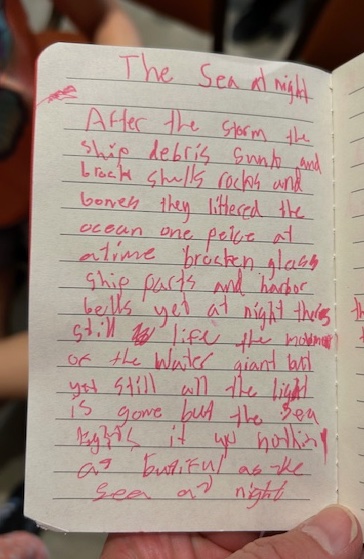
My colleague Beth’s granddaughter, 4th grade, wanted to read all her poems at the read around. Here’s her notebook with a poem about a museum exhibit of a shipwreck.
The Sea at Night
After the storm, the ship debris sunk and broke shells, rocks, and bones. They littered the ocean one piece at a time, broken glass ship parts and harbor bells. Yet at night there’s still life– the movement of the water, giant but yet still. All the light is gone but the sea lights it up. Nothing as beautiful as the sea at night. by Annie, 4th grade
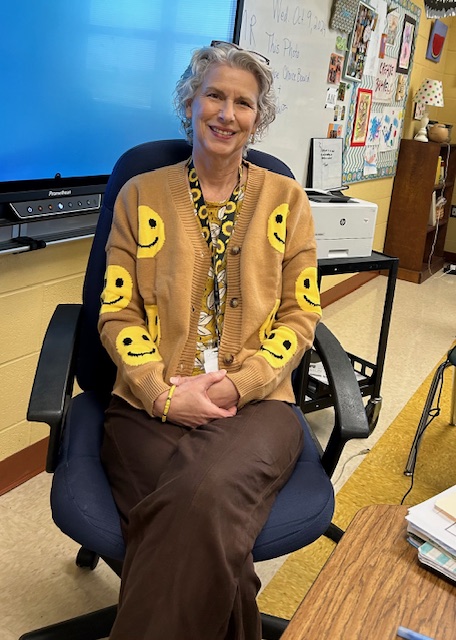
Last Friday was World Smile Day. There are so many fun holidays on a calendar. Do you know any? I don’t usually keep up with them, but Kelly reminded me on Kelly Bennett’s Fishbowl newsletter. Today I am wearing my smiley face sweater. It just makes me happy.
photo by Danielle, 2nd grade
Poetry makes me happy, too. Here’s Kailyn’s smile poem using Kelly’s form based on the number of teeth adults have. (8-4-8-8-4)
by Kailyn, 6th grade
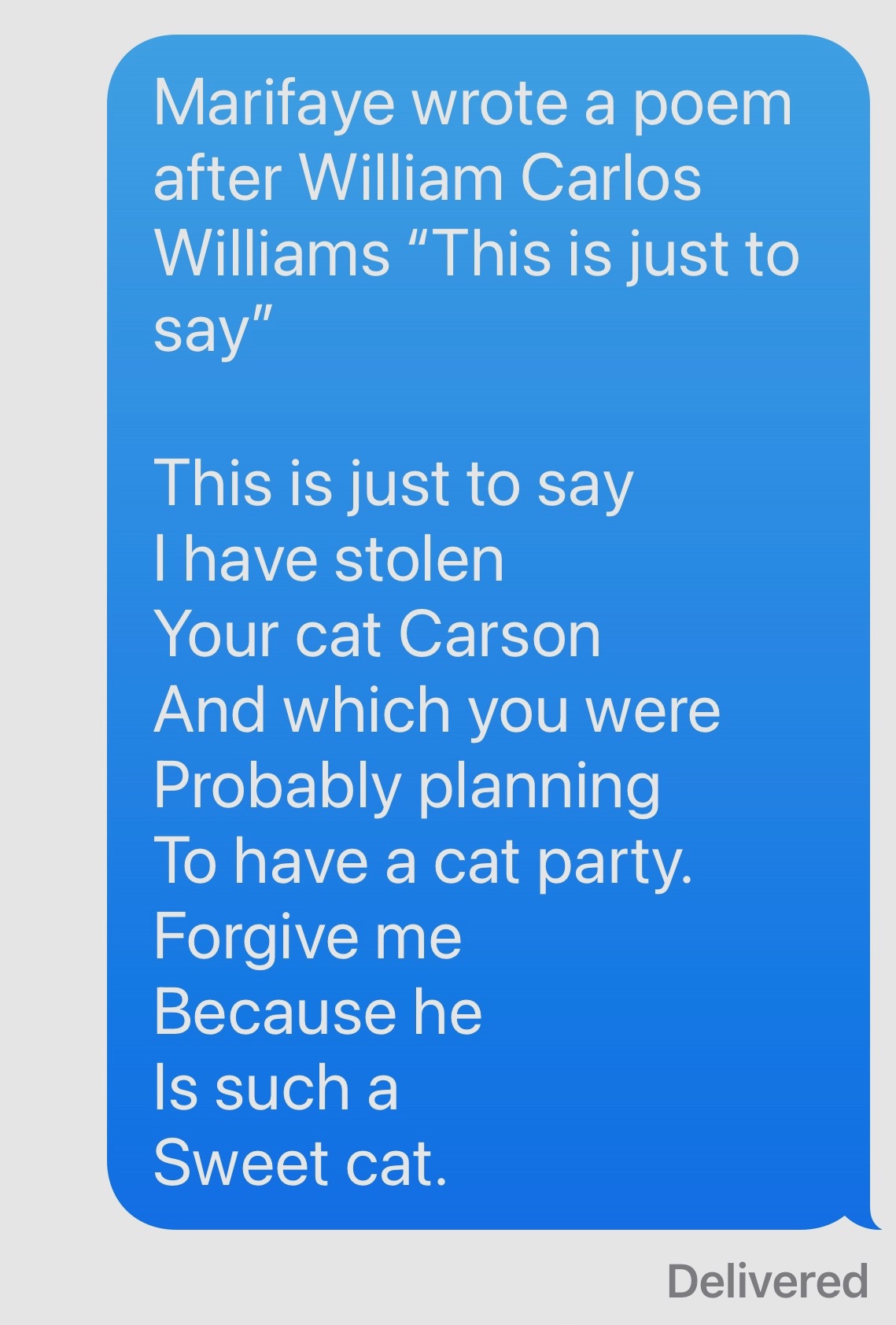
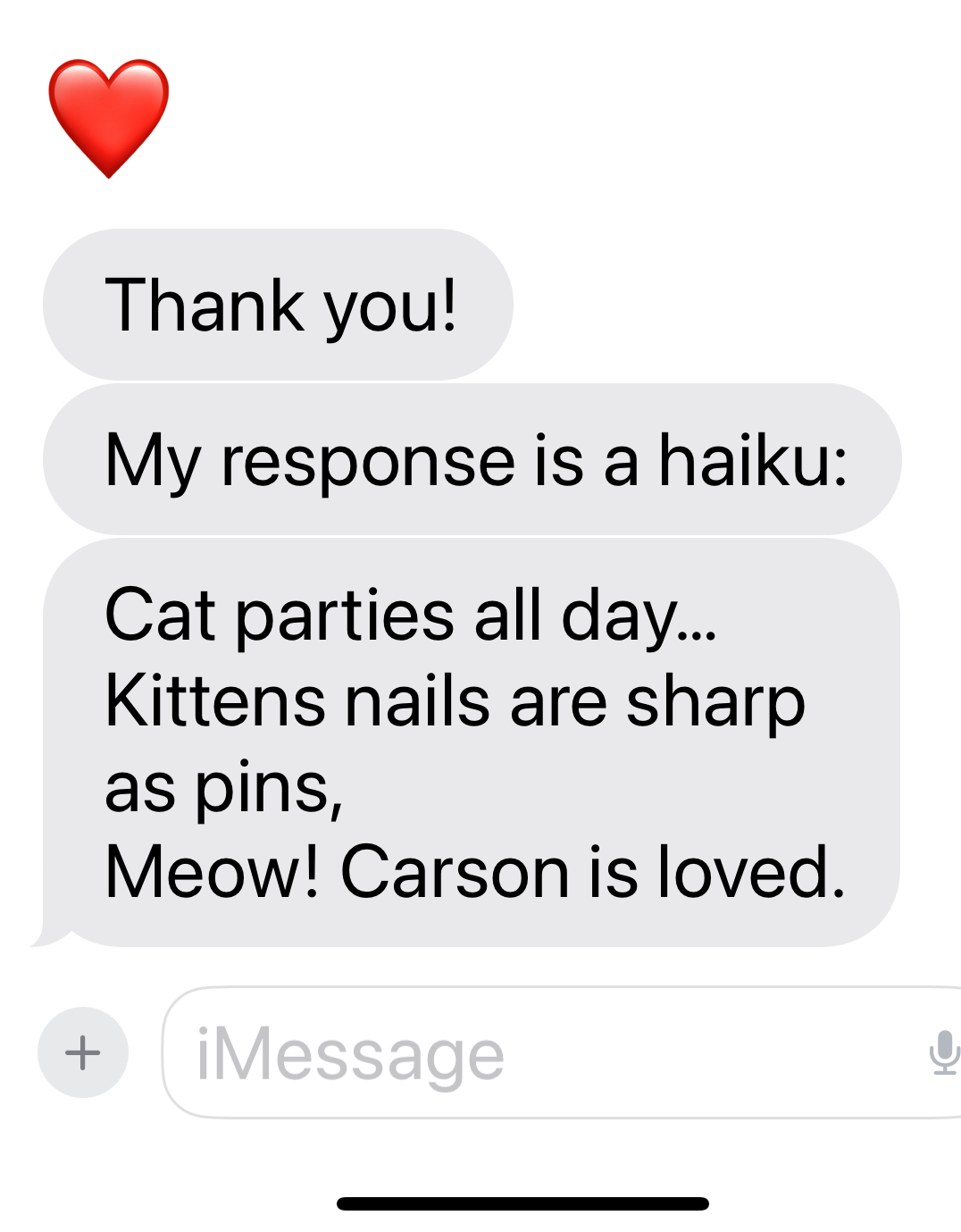
In July we found three young kittens in my mother-in-law’s yard. With my friend Corrine’s help, we trapped them and she willingly fostered them. Last week I gave the yellow cat “Carson” to a brother and sister that I teach. This week when we wrote poems of apology after William Carlos Williams, Marifaye wrote this poem. (I texted it to Corrine.)
The National Writing Project’s #WriteOut begins on October 13th. Next Tuesday we will be on Fall Break, so I am leading a group of kids on a Write Out writing marathon in our downtown. NWP has many resources and prompts on their site. Join in the fun!
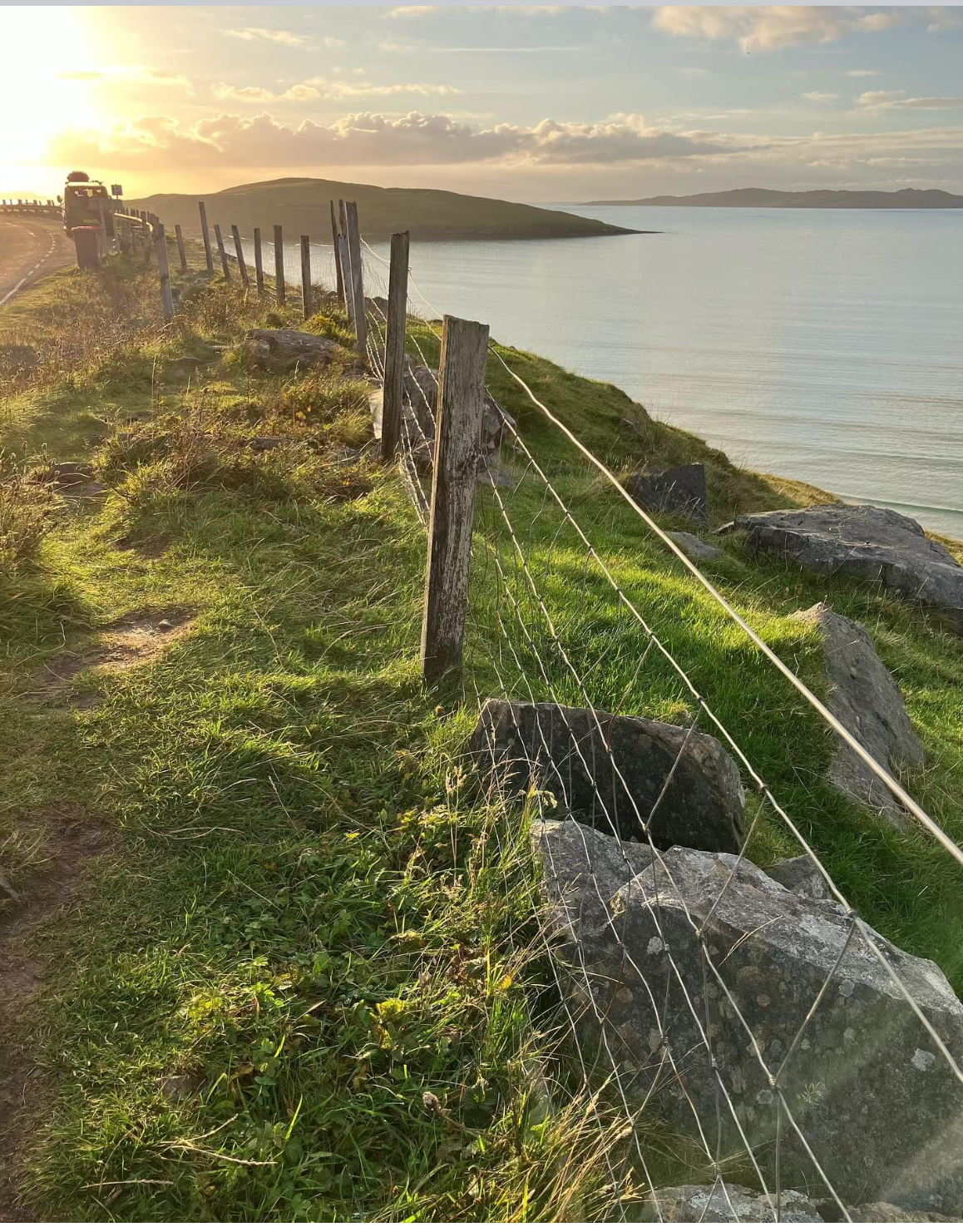
Recently I’ve had three different friends travel to Scotland. I think it’s a sign that I am meant to travel there. And, of course “Outlander” on Netflix is my current binge obsession. Mary Lee has been posting daily albums on Facebook of her travels. I chose this one, but they are all amazing. Can’t you just hear the bagpipes and feel the cool breeze?
Let’s travel today in our poems. Where would you like to go? Maybe a stay-cation is all you need. Close your eyes and dream. Please leave a poem in the comments and respond to other writers.
Mary Lee is writing daily cherita poems of one line, two lines, three lines that tell a complete story. So I chose the cherita form.
Scotland calls me
to hear the wind roar across the sea
and be a traveler wondering isle to isle seeking Skye.
Thank you to Two Writing Teachers for creating an amazing community of writers and a safe, welcoming space to write and share.
This is Just to Say
I have forgotten the words to that song you sang to me
and which you are probably humming in your head while you sleep.
Forgive me: I will sing along with you anyway.
Margaret Simon, after William Carlos Williams
I believe in daily poetry, but I fell off the Stanford Challenge for writing a poem a day. Lately the new book from Sarah Donovan, Mo Daley, and Maureen Young Ingram, 90 Ways of Community is helping. Each day I present one of the prompts to my students and write alongside them. They are responding so well to this daily practice. I hope you don’t mind if I share a few here. First up is a skinny poem by Grayson.
White void endless space just waiting wondering no thoughts waiting, I’m tired of waiting in this endless void, white space that is just too empty.
by Grayson, 5th grade
We’ve explored ourselves and written I am From poems.
I am from crunching leaves and windy days.
I am from books, and books, and even more books.
I am from the Bayou, and I am from the trees. I come from murky waters and lush green leaves and sturdy branches.
I am from the scratching of a pen, and the flick of a brush.
I am from the smell of cigarette smoke and an autumn evening.
I am from a household, a household holding four. A mother of books, a father of autumn, a daughter of both, and a sister of all.
by Adelyn, 6th grade
Each week I invite my students to write to a photograph. They are free to choose their own form even as I model a form for them.
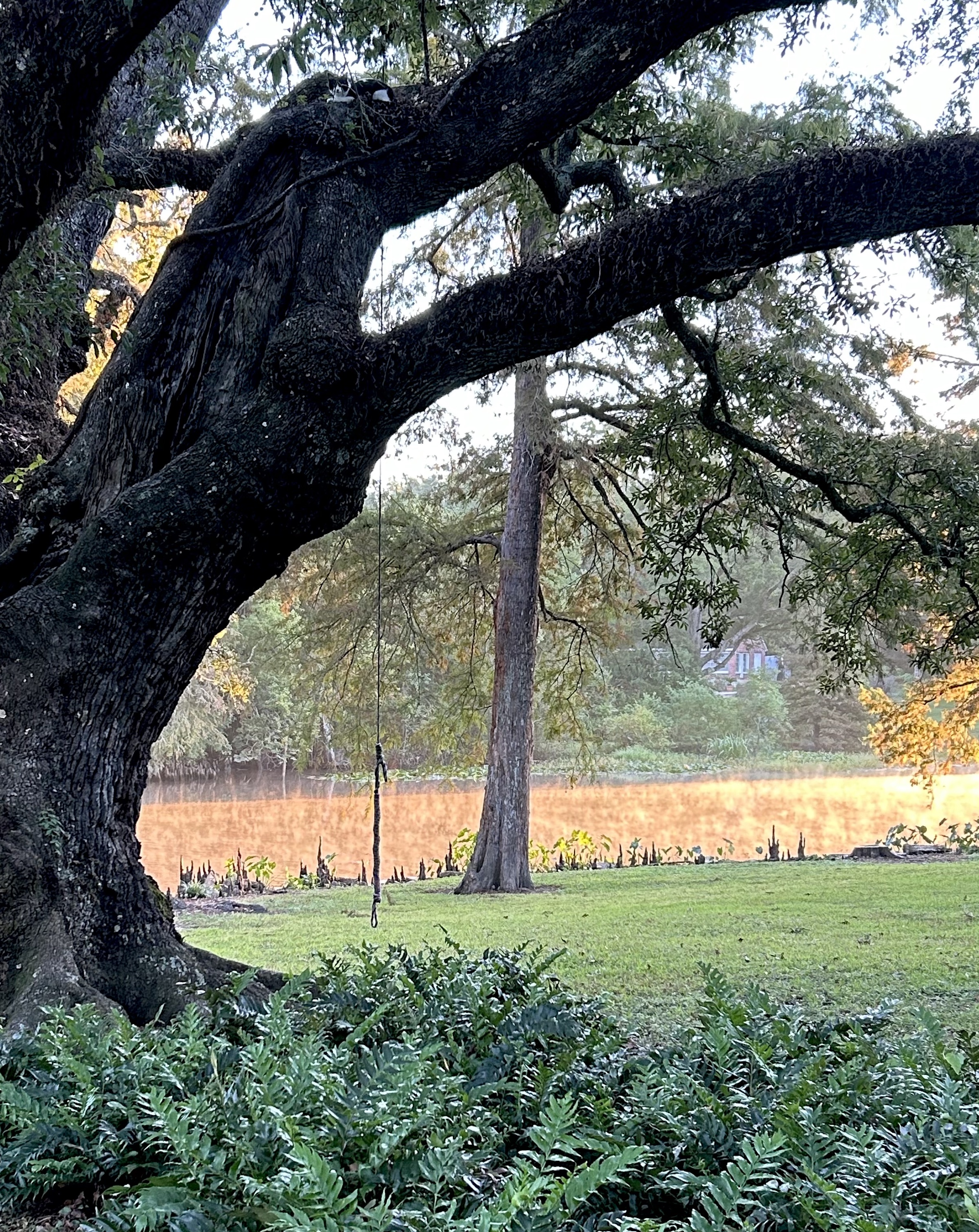
Old tree Stays in the backyard Is surrounded by water and ferns Waiting outside on the porch for the sunrise Lovely morning
by Marifaye, 5th grade
If you would like to write a poem to a photo, please join me on this blog on Wednesdays: This Photo Wants to be a Poem. I wish for you daily poetry.
The Pythagorean poem is another modern poetic invention using a mathematical pattern. Shari Green shared the form with Laura Shovan who shared the form with me and other PF folks. I challenged the Inklings to write one for our monthly challenge before trying one myself. It’s not as easy as it looks.
Like the Pythagorean theorem of geometry, the word count is based on a right triangle. Shari’s instructions:
Here’s the math background: Pythagoras’ theorem is a2 + b2 = c2. One possible “triple” is 3, 4, 5.
3×3 + 4×4 = 5×5
9 + 16 = 25
Using the triple, the poetic form works like this:
1st stanza: 3 lines of 3 words each
2nd stanza: 4 lines of 4 words each
3rd stanza: 5 lines of 5 words each*
* The third stanza must be composed of all the words found in stanzas one and two (in any order; variations okay). The third stanza should be a progression of sorts, a product of the first two in thought or theme or meaning.
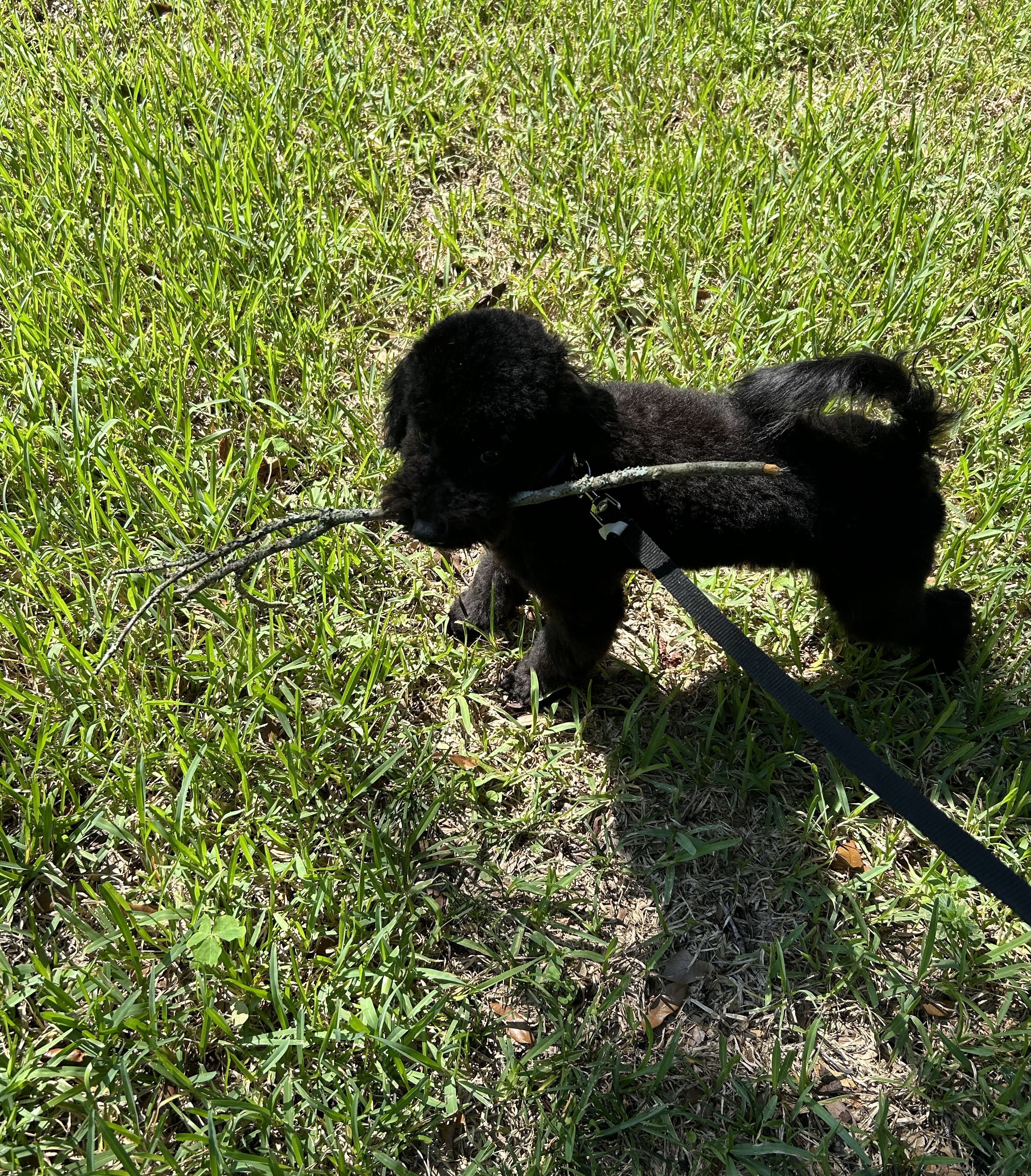
The trickery comes when writing the third stanza. I wrote one about butterflies here. As I tried to write another one, I thought I should have saved that first one for this post. I chose another topic close to my heart, my puppy golden doodle “Albert (Albear)” Albert has been with us for almost 4 months, and he’s really doing well about most things, but he has an annoying habit of barking at us when we eat dinner. As we take our daily walks, he loves to pick up a stick and prance like the prince he is. My poem takes words from Mark Doty’s Golden Retrievals.
I hope you will try the form and tag Shari Green and me. Honestly, I haven’t tried it with my students yet. They are getting their feet wet with cinquains and fib poems.
Margaret Simon lives on the Bayou Teche in New Iberia, Louisiana. She is a retired elementary gifted teacher who writes poetry and children's books. Welcome to a space of peace, poetry, and personal reflection. Walk in kindness.






 Reflections on the Teche
