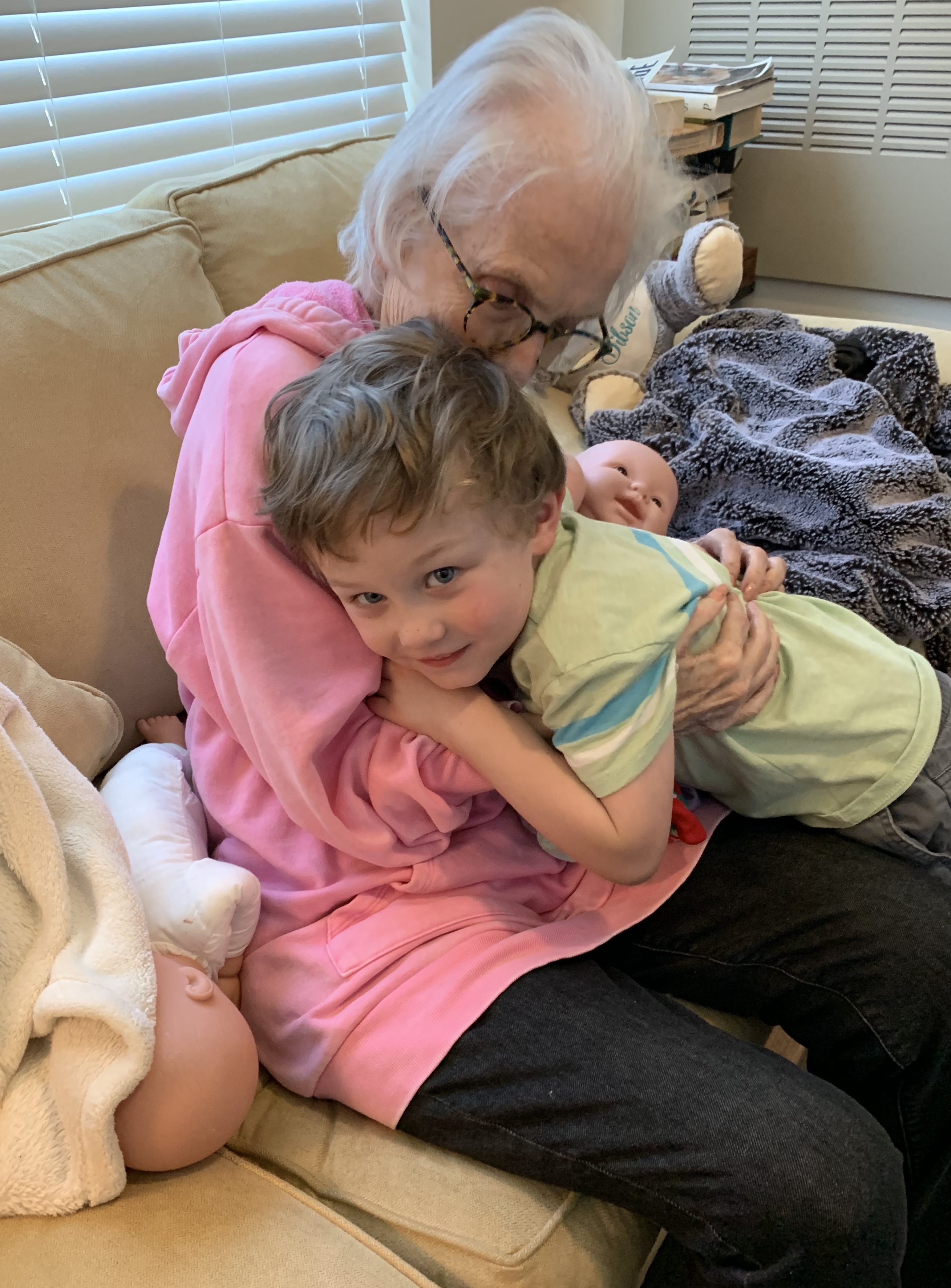
Visits with my mother are hard on me. I don’t live near enough to get used to her Alzheimer’s silence, the confused look in her eyes. I keep thinking one of these days I will accept this. But it seems so unfair. She was such a vibrant and thoughtful person. She is safe and happy and generally in good health, so I convince myself I should feel gratitude. Despair and grief take over. I can’t even look at this photo without tears welling up.
At Ethical ELA, we were prompted by Katrina to write about a photograph. I chose the one above.
We see a child delighted to hug his great grandmother generations of love passed on with a kiss on top of his head.
We don’t see the grief seeping into the moment the loss of a mother whose memories fleet past through empty eyes always questioning.
The Kidlit Progressive Poem originated from an idea that Irene Latham had to celebrate National Poetry Month in 2012, to bring a community of writers together as they collaborated on a poem. I began coordinating the effort in 2020. Each writer who volunteers creates a new line of the poem.
The poem has passed to me today. Patricia Franz started it off in the form of couplets. I’ve structured it into quatrains to see how it rides. The poem will take shape as it moves along toward 30 lines.
Thinking about this character who dreams of peace and lullabies of hope, he/she begins a journey across a border. Is this a literal border or figurative one? Irene set the character in motion with action. She also gave me a good word to rhyme; however, rhyme isn’t a rule in this ongoing pattern. I hand off this adventure to Marcie Atkins. The full schedule is on the sidebar. Stay along for the ride.
cradled in stars, our planet sleeps, clinging to tender dreams of peace sister moon watches from afar, singing lunar lullabies of hope.
almost dawn, I walk with others, keeping close, my little brother. hand in hand, we carry courage escaping closer to the border.
My feet are lightning; My heart is thunder. Our pace draws us closer to a new land of wonder.
This first Friday of National Poetry Month, we have an Inklings challenge brought to us by Mary Lee Hahn. Mary Lee asked us to write a haiku sequence about poetry without using the word poetry.
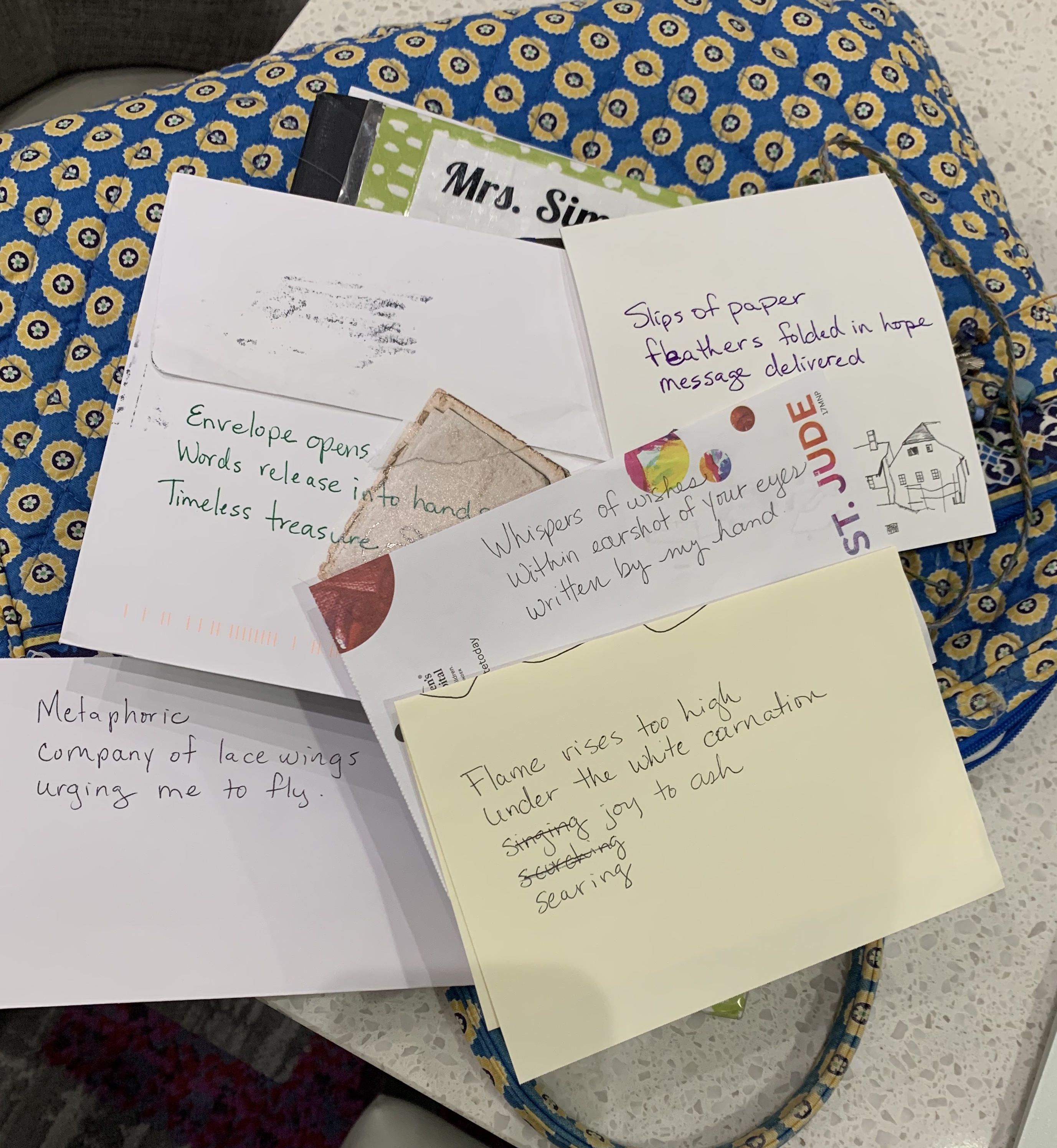
I’ve been on an Emily Dickinson kick watching the surreal series “Dickinson” on Apple TV and reading through a dog-eared collection of her poems. When I read Mary Lee’s challenge, I decided to write individual haiku on slips of paper from the pile on the kitchen counter. That way I could arrange them in a logical/ illogical/ artistic/creative way.
random collection of haiku
I played with the order and this is what I have, for now. One of the best parts of writing poetry is revising, so I am open to rearranging and rewording or throwing it all into the flame.
Envelope opens words release into hands timeless treasure
2. Flame rises too high under the white carnation searing joy to ash
3. Whispers of wishes within earshot of your eyes written by my hand
4. Slips of paper feathers folded in hope message delivered
5. Metaphoric company of lacewings urging me to fly
Robert selected the topic of everyday miracles for this month’s Spiritual Journey posts. Jennifer Jowett led us at Ethical ELA to explore a letter of the alphabet. Combining both prompts, I wrote about the letter M, my first initial that carries the legacy of my grandmother as well as the letter of my grandmother name, Mamère.
M is for miracle, mountain of twin peaks, how mothers are made, become Mamères watching a boy learning to write his name- “up, down, up, down” ride the pen roller-coaster how calligraphic M wears a fancy dress to the letter party. Maybe M moves mountains, makes miracles, but most of all M glows in the heart when your child mutters, “Mom, I missed you.”
Margaret Simon, draft
I continue to find fascinating words to write about. Today’s word lulu means an outstanding example of a particular type of person or thing. Years ago we rescued a greyhound who came with the name Lulu. I had no idea that the name had this meaning. This poem is sometimes called taking a word for a walk.
Lulu is a luxurious word we say with a lulling lilt calling the lazy dog- a lulu of a greyhound- blond furry wind a blur when she ran. She loved lulu weather. We love our Lulu memory.
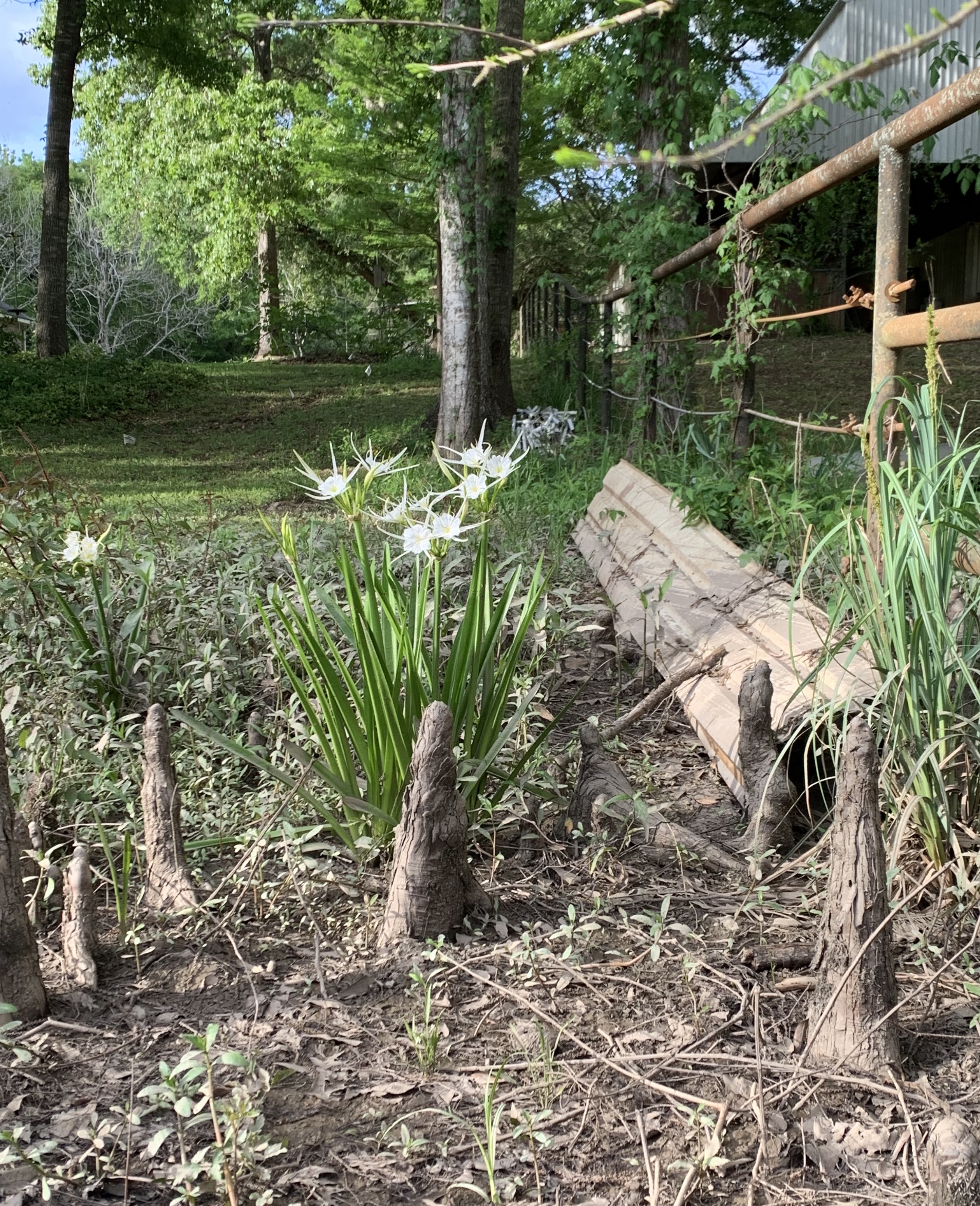
Spider Lily among cypress knees on Bayou Teche, Louisiana
I wanted this swamp lily to be a star lily, but research is telling me it’s a variety of spider lily. On Ethical ELA, the prompt by Wendy Everard asks us to explore the place of a favorite poet. I chose Mary Oliver and a striking line from her poem Fall: “what is spring all that tender/ green stuff”
I’m not sure what heaven is but amazement like spring when all green that was hiding in tender seed fills green bridal bouquets blossoming beautiful stuff.
Margaret Simon, draft
I’m also writing a word poem each day. Today’s word is vernal which means of, in, or appropriate to spring. Today’s form is an acrostic.
Variety of colors eagerly popping- resurrection- nature’s recital. April, I Love you.
To begin our National Poetry Month adventure, start here with the Kidlit Progressive Poem. Today’s first line is with Patricia Franz at Reverie.
At Ethical ELA, Kim Johnson invites us to introduce ourselves using a hashtag acrostic. I was challenged by the repeated letters of my name. Like the spelling of Mississippi, I’ve always enjoyed the way my name repeats when spelled out: M-a-r-g-a-r-e-t.
#Margaret
#Mother of three strong women #Ask me to dance #Romantic hopelessly #Grandmother of four potential difference-makers #Artist of poetry #Reserved until I trust you #Early riser #Teacher of gifted children
I love a good form for poetry and one I’ve played with often is Heidi Mordhorst’s definito. It is a poem of 8-12 lines appealing to children that defines a word. The defined word ends the poem.
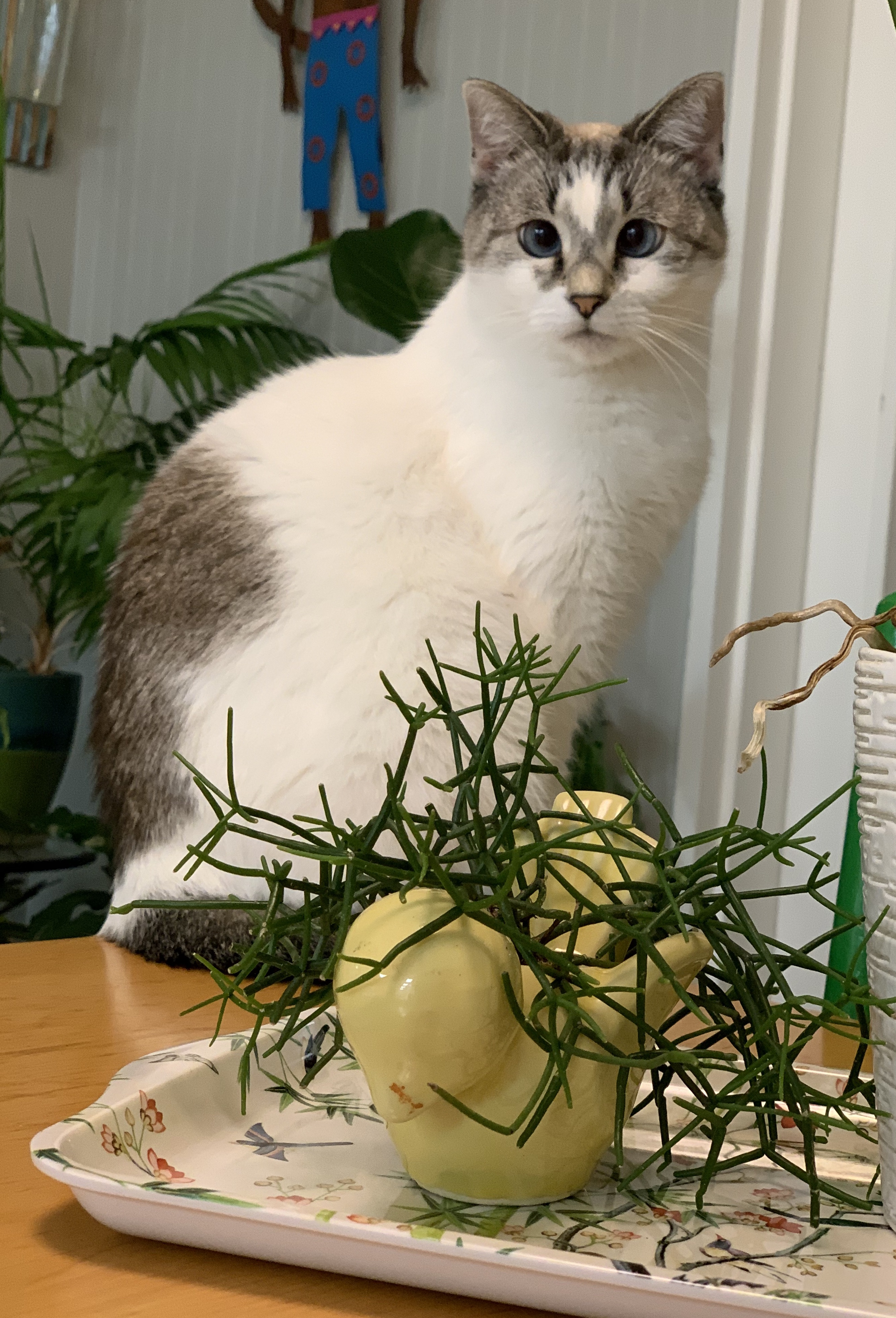
Feline flexibility, a natural mystery. That deliciously pink belly bouncing when she runs can’t hide a surplus of fat designed to save her, but try as you might to touch this soft spot, Watch out! She will bite. Don’t touch a cat’s tum-tum… primordial pouch.
I wasn’t going to bring it up. But she did. In our long conversation in the Lowe’s Garden Center, we reminisced the days when our girls were young and going to a “sweet school” that will close its doors this year.
I didn’t want to talk about it. She said, “I’m feeling afraid. I’ve lost three friends in the last week. I just came from another funeral.”
I tried to hold back the tears. “I know,” I said.
She brought up her own ailments, a torn up shoulder, an aching back. I said, “Oh, no. You are younger than me.”
“I’m 62,” she said.
“Me, too.”
The age thing… I wanted to switch the topic quickly, but wasn’t sure how.
Then Suzy walked up and hefted a huge bag of dirt. “Can we help you with that?”
“No. I got it.”
Then Suzy talked about her upcoming birthday. On Easter Sunday, she will be 83.
I want to be hefting bags of dirt and building a fountain and taking care of great grandchildren. Suzie gave us hope in this aging thing.
Aging Elfchen
Age ticks by before you realize a lifetime has flown– Dance-on!
Thank you to Two Writing Teachers for creating an amazing community of writers and a safe, welcoming space to write and share.
I was inspired by Michelle Kogan who wrote a pantoum for a hippo. I recalled the hippos of my Africa tour in 2016. I’ve been reading Margarita Engle’s verse novel Singing with Elephants. I collected lines from the verse and went to work on the pantoum form. This form is like a puzzle. Michelle fit hers together with rhyme. I didn’t use rhyme. When I googled pantoum, there doesn’t seem to be a rule about rhyme or line length. The rules show that each stanza is four lines with this pattern: (1,2,3,4) (2,5,4,6) (5,7,6,8) (7,3,8,1)
The Poetry Sisters respond to a challenge on the last Friday of the month. This month they are writing animal pantoums. Our host Tricia has more about the form and links to other Poetry Sisters posts.
The beauty of an elephant’s hum-hug, a language as common as buzzing bees, simple as spending time with kindness. Elephants embrace us with their music.
With a language as common as buzzing bees, I can catch good luck as it passes. Simple as spending time with kindness, these animals move like magical mountains.
I catch good luck as it passes: Photo from Africa is a touchstone of memory. These animals move like magical mountains with a touch of heavy gentleness.
My photo from Africa is a touchstone of memory, as simple as spending time with kindness– A touch of heavy gentleness– the beauty of an elephant’s hum-hug.
Margaret Simon, with thanks to Margarita Engle and PÁDRAIG Ó TUAMA.
George Rodrigue was born in New Iberia, LA and is famous for the Blue Dog. I never met him, but our town celebrates him with a pocket park on Main Street. The Bayou Teche Museum acquired a display of his studio.
Our students will be touring an exhibit of George Rodrigue’s work today at the Hilliard Museum in Lafayette, LA. To prepare my students for this field trip, I shared the story of the Blue Dog and let them choose a work of his art to write about.
John-Robert chose a painting with a gravestone for Tiffany. We googled the words “Tiffany + George Rodrigue” and found out that Tiffany was Rodrigue’s pet whom he based the Blue Dog on.
Page from a Blue Dog calendar
Oh Tiffany where have you gone after all you’re right here
under That Lovely Cyprus tree Why are you still hiding from me I’m just A Blue dog
I go to the village THEY SHUN ME AWAY “Leave evil spirit!”
They see me and run why even when I adore the limbs of humans they run
So I have left to roam near only friend to protect her in the stone box from them all I want is to see her again no matter when
Oh Tiffany where have you gone after all I’m back from the hunt so when is when
John-Robert, 6th grade
As a teacher of this bard, I hesitate to criticize at all. This is JR’s first and only year in my class. He has been writing poems every day in his notebook. None of them have capital letters or punctuation. When it comes to essays, I talk to him about the grammar choices he makes (or doesn’t make), but I still leave his poems alone.
I wish you could hear him recite them. He sounds like he’s reading from his very soul. I’m often left speechless. In my opinion, and I’m hoping it’s the right one, his creativity is a delicate thing. I want him to keep writing long after he’s been with me.
JR is my Emily Dickinson, writing far above my level of understanding. I think I will continue to leave him alone with his poems. He tells me he “knows” the grammar rules. He doesn’t know why he doesn’t use them. It’s as though his thoughts won’t allow for the crowding of periods and commas, capital letters, etc.
What’s an ELA teacher to do with that?
Thank you to Two Writing Teachers for creating an amazing community of writers and a safe, welcoming space to write and share.
Margaret Simon lives on the Bayou Teche in New Iberia, Louisiana. She is a retired elementary gifted teacher who writes poetry and children's books. Welcome to a space of peace, poetry, and personal reflection. Walk in kindness.