Feeds:
Posts
Comments
Poetry Friday is with Katie at The Logonauts.

Poetry Friday is with Katie at The Logonauts.

I hate snakes! I always have for as long as I can remember. I grew up running around the piney woods of Mississippi and now I live on a bayou in Louisiana. Snakes are a part of my world, but they terrify me.

This week one of the news stories that we poets responded to was about a snake coming out of a toilet in Texas. If you want to never look at a toilet the same way again, read this article.  I decided against posting a picture on my blog.  It was bad enough that I had to see it repeatedly on my Facebook feed.

The day this prompt was posted for Laura Shovan’s February ten found words writing project I was teaching cinquains to my students. They were writing them about their names. I chose to write about this snake menace. I enjoyed sharing the frightful article and resulting poem with them.

The rules for a cinquain are 5 lines with 2, 4, 6, 8, 2 syllables in each line.

rattle
in the toilet
camouflaged cryptic sign
surprising an innocent boy
Nightmare!

shovel
slamming down hard
killing snake in a clump
unknowing den of twenty three
silent

cellar
perfect hiding
for slithering secrets
wondering when their diamonds
will shine

–Margaret Simon, all rights reserved

if-you-were-the-moon

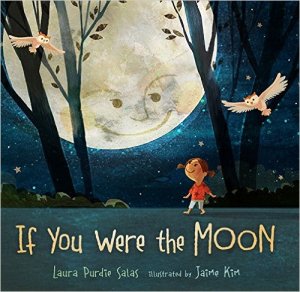
Before you begin to read If You Were the Moon by Laura Purdie Salas, turn this music on in the background.

Illustrated in dreamlike images by Jaime Kim, Laura takes us on a journey of discovery about the moon. In the beginning, the young girl muses on how easy the moon’s job is, but the moon explains. “If you were the moon, you would…” Along with delightful metaphor are embedded facts from how the moon was formed to Neil Armstrong’s iconic walk. Artists are inspired by the moon. Hence the musical piece, “Clair de Lune.” I remember listening to my mother play this on the grande in our living room.
A glossary and further reading section make this book teacher-friendly.

I often use picture books to lead my students to their own writing. I can imagine prompting my students with the words “If you were _________.” Students could research their favorite planet or natural disasters (my students love them!). Then they could write and illustrate their own books including interesting facts along the way. Finding a way to tie a book to writing enriches the classroom experience.

Laura sent me this amazing teacher’s guide written by Randi Miller Sonnenshine. This guide includes activities across the curriculum.

If You Were the Moon releases March 1st, 2017. Get your copy today!

Join the Two Writing Teachers blog for the Slice of Life Challenge.

Join the Two Writing Teachers blog for the Slice of Life Challenge.

Today marks post #1000 on my blog. Wow! This has happened one word at a time, one post at a time.  When I started this blog nearly 5 years ago, I had no idea where this writing journey would lead.  I have a wonderful community of friends through my connections with various weekly memes. Slice of Life was one of the first communities I joined. I appreciate all of you who read my musings. Here’s to the next thousand!

Through Poetry Friday, I connected with Laura Shovan. This year marks her 5th annual poem-a-day writing challenge for February, her birthday month. This year she’s hosting it on Facebook in a closed group. The theme is ten found words from current news articles. I check the morning post, copy the ten chosen words into a Google doc, and work on my poem whenever I have a chance throughout the day. At first, I didn’t want to have this much interaction with the daily news, but each article has been different. Not only am I reading poems, practicing writing, building community, I am also learning some amazing stuff.

nightly-sky-with-large-moon

On February 4th, the article was from earthsky.org, and I learned about the change in the moon’s orbit. Fascinating and certainly not an article I would normally have read. Sometimes the article informs the poetry, but more often the poems come from that inner poet, the one who surprises me constantly.

The axis turns
one rotation at a time
keeping in balance
this ancient path
tilting toward unity.

The gods knew this truth
when they painted pictures
in the night sky.

Our bodies want to return
to balance and knowing
and wandering; we look for a leader,
a shaman, a yogi master.

Analyze the words
of Langston, or Maya,
or Martin, and you’ll
see a common axis,
a dream that crept into each heart.

Spin around.
Face the stars.
Reach out.
Dream on.

–Margaret Simon

Please use this button on your site for DigiLit Sunday posts

Please use this button on your site for DigiLit Sunday posts

I hate to admit it, but I have not been the best at teaching vocabulary.  I’ve tried all kinds of methods from word lists to word walls, but I am still met with groans from kids when I say Vocabulary.  This year I’ve been using a workbook.  This goes against my whole philosophy of teaching, so please don’t tell my students.  This workbook provides an authentic text, so the words are in context.  We also work with synonyms and antonyms and always a writing piece.  But like most work with Vocabulary in the title, my students think drudgery.

It is time for a change.  I have been intrigued by Carol Varsalona’s word clouds.  I tweeted a question to her.  Turns out it was our mutual friend Holly who introduced Tagul to Carol.

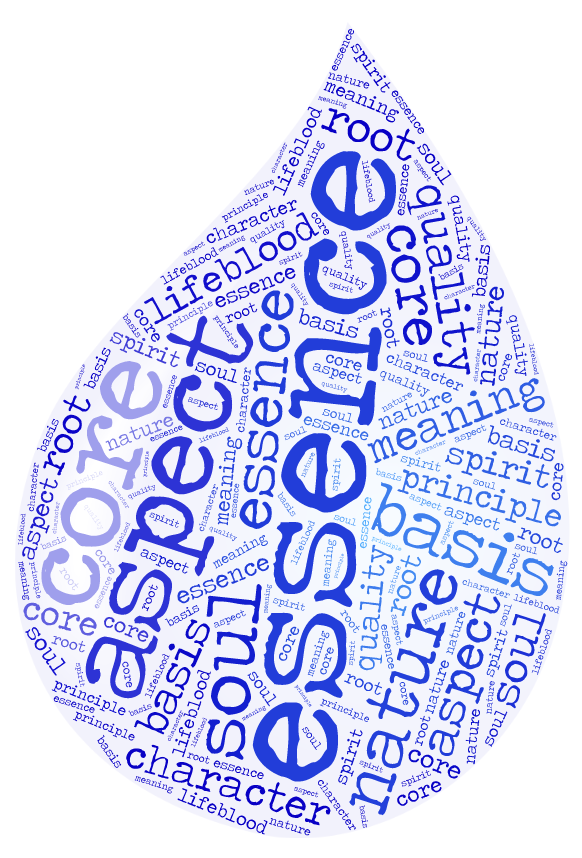
This leads me to an idea I will be trying this week with my students (crossing fingers the app works in our network).  I took one of our vocabulary words from last week, essence, and typed it into Thesaurus.com.  I opened Tagul and typed in a dozen synonyms.  Then I looked for a shape that would help define the word.  I chose a water droplet because water is the essence of our bodies.  The image shares common synonyms as well as makes this vocabulary work more motivating.

essence-word-cloud

In what ways are you digitizing vocabulary work?  Share your ideas on your blog and link below.


digilitsunday-215

Find more celebration posts at Ruth's blog.

Find more celebration posts at Ruth’s blog.


This week the flu made its way through my students.  I, thankfully, have remained healthy.  Today, I want to celebrate my student Andrew and his initiatives.  Before Christmas he became interested in the plight of orphaned elephants.  We read a Scholastic Scope magazine article that pointed to the David Sheldrick Wildlife Preserve.  Andrew wanted to raise funds to adopt an orphaned elephant at the preserve.  The adoption fee is $50 a year.  He decided to sell posters to classmates. I ordered Vista Print posters of a baby elephant picture from my trip to Tanzania, Africa.

baby-elephant-poster

Before the Christmas break, Andrew presented to his fourth grade classmates.  He raised about $32.  After Christmas break, he decided to present to third grade classes.  He raised the remaining funds he needed.  He crafted a letter to the David Sheldrick Wildlife Preserve explaining the project and selecting Malima as the baby elephant he wants to sponsor.  This video broke our hearts.  Andrew and I both already feel and love and affection for Malima.

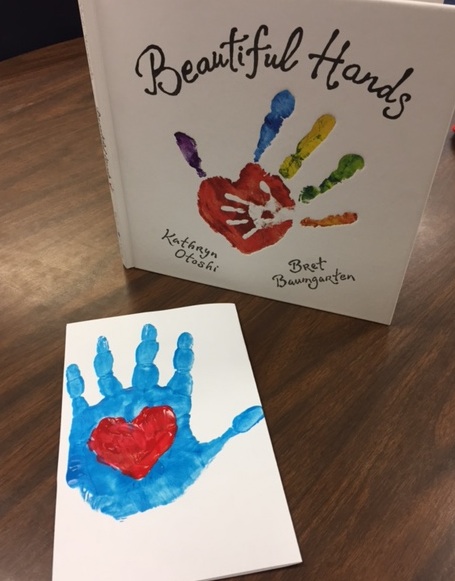
Andrew is one of those rare kids who wants to inspire and make a difference.  In January when preparing to choose our One Little Word, I read aloud the book Beautiful Hands.  The production of this book has a heartwarming story.  Kathryn Otoshi worked with Bret Baumgarten who was diagnosed with cancer to design this book from something he would say to his own children, “What will you do with your beautiful hands today?”

beautiful-hands


The artwork was created all with handprints and fingerprints, even a dog print from Bret’s dog.

“My hope that this story empowers love, creativity, compassion, and a 

connection to you and yours, in the fulfilling and remarkable way it has for me” 

~ Bret Baumgarten, 1970–2014

I think Bret would be proud to know what Andrew did with his inspiring words.  Andrew wanted to read the book to his sister’s first grade class and do a hand printing activity with them.  Some of Andrew’s gifted classmates helped him.  I was impressed with how smoothly the whole activity went.  I was not sure because we had to paint all the kids’ hands and help them print.  Andrew had selected some Valentine quotes for the kids to copy into their hand painted cards.  This creative service activity was a positive experience for all of us.


handprint


Poetry Friday is with Penny at Penny and her Jots.

Poetry Friday is with Penny at Penny and her Jots.

This week, I’m thinking about Naomi Shihab Nye’s bucket and how we need to share our buckets with each other. I shared her poem from Here We Go with my students.

from BLUE BUCKET
by Naomi Shihab Nye

What if, instead of war,
we shared our buckets
of wind and worry?
Tell me the story
you carry there,
steeping in old pain
and future hope,
rich with fragrant
savory spices,
ginger, turmeric,
tarragon, find me
a spoon in one
of your pockets,
even if we don’t
speak the same language…

maybe
you hold my bucket
a while, see what
the handle feels like,
and I hold yours,
and maybe both buckets
are empty and
we trade them forever…

We talked about what it means to carry someone else’s bucket. We talked about serious topics and playful ones. Then we wrote What if poems. I want to share a few with you today.

What if
the whole world
was listening, waiting
for the next word?

What if
you didn’t
know what
to say
but you say
it all?

What if
I speak
worldwide but
few hear me?

What if
you knew
what to say,
but you didn’t
say it at all?

What if
I speak
privately,
but lots of
people hear me?

by Noah, 5th grade


A Bucket Of Glitter

What if,
I could carry around a
bucket of glitter?
If I found someone without glitter,
I would sprinkle some on them,
What if I could carry around a
bucket of glitter?

by Lynzee, 2nd grade

What if-
I was the leader of the U.S.A
I would treat people fair
like how air lets us live,
live to spread joy and happiness.
I would give money
Maybe a little honey because it’s sweet
like people.

by Andrew, 4th grade

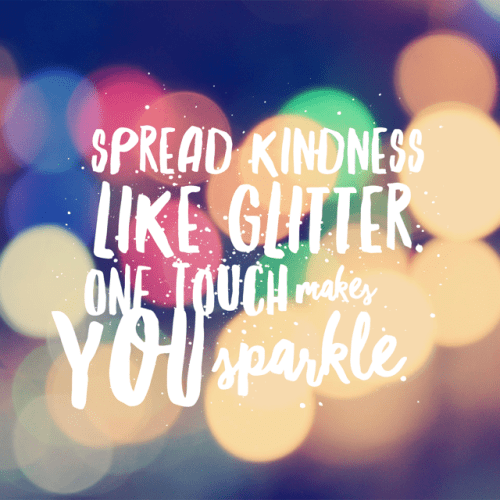
Today, I am wishing you a bucket of glitter to spread, a little honey to sweeten your day, and lots of poetry because poetry is where wisdom lies.

kindness-glitter

spiritual-journey-first-thursday

Finding spiritual journey fellows on the internet is such a wonderful gift. We are gathering each month on the first Thursday to blog together. Today, you may link up and read more posts at Leigh Anne Eck’s site Turn.

The theme of our posts today is Leigh Anne’s One Little Word, Rise. I love this word. Simple, one syllable, and yet full of hope and love and light. I immediately think of a spiritual I would sing with kids “Rise and Shine and Give God the Glory, Glory.”

This week I presented my students with the Maya Angelou poem, “Still I Rise.” What did they think of this old African American woman laughing out loud on the video and saying she dances like she has diamonds on her thighs? When you place her words in the context of her life and the Civil RIghts Movement, they resonate.
“You may trod me in the very dirt.
But still, like dust, I rise.”

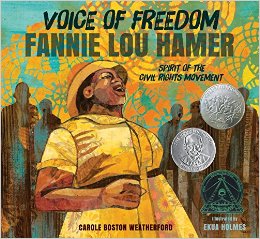
Maya Angelou speaks of the human spirit, the spirit that is guided by and held in the hands of God. I wonder if I have that kind of spirit. Preparing to teach about another Civil Rights hero, Fannie Lou Hammer, I read poem after poem about her being trod in the dirt, over and over, and still she rose. She didn’t give up. I am humbled by her resilience.

voice-of-freedom

Looking to these heroes who turned against adversity and prejudice and pain, and led their friends to Rise, I feel an obligation, a resolve to be strong and resilient. I cannot do that without being willing to be humble and kind and to turn my heart to the love of God.

rise-acrostic

Slice of Life Challenge

Join the Two Writing Teachers blog for the Slice of Life Challenge.

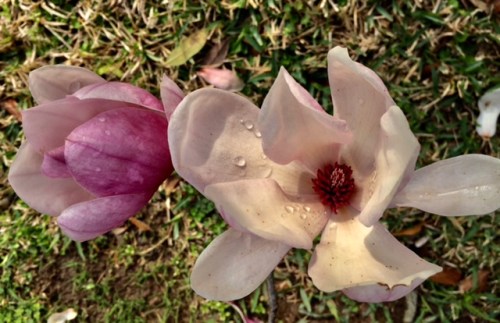
j-magnolia-dew

The Hallmark channel is on again.  I pour a glass of wine.  I search for something positive to say.  I’ve always thought of myself as an optimist, but these days are dark.  Winter is an apt metaphor for the state of our country.  I am carrying a weight of pessimism that I find too heavy and hard.

So I turn to my passion, poetry.  Poetry is like prayer for me.  I go inside my thoughts and work to make some sense of them.

Laura Shovan is getting ready for her annual February poetry project.  She has built a Facebook group.  It’s a closed group, but if you ask, you can join.  We are a bunch of liberals looking for ways to make sense of the news by taking 10 words from a current news report and writing poetry.

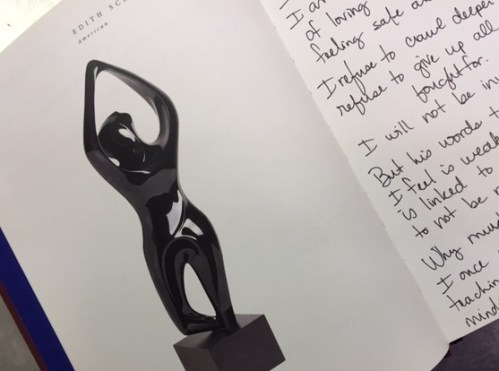
On Saturday, I found an empty journal on my shelf.  It is quite beautiful, a gift from someone, I’m sure.  The title reads, “Personal Journal with Quotes & Art by Women.”  I decided to use this book to pen the poems I am writing for Laura’s challenge.  On this page I share below is a sculpture called “Invocation” by Edith Schaller.  I wrote a poem for the January 25th warm-up using ten words from Janet Mock’s Women’s March speech.  I am not accustomed to being outspoken, political, or radical.  I am uncomfortable in this position, but I find solace in poetry, in writing, in words.

invocation


I am my sister’s keeper.
I hold her body.
I am committed to this work
of loving and comforting,
feeling safe and sensitive.

I refuse to crawl deeper into poverty,
refuse to give up all that we have fought for.
I will not be invisible or neglected.

But his words tear at a core
I fear is weak.  My liberation
is linked to my resolve
to not be moved, to hold fast.

Why must I turn into a revolutionary?
I once was a peaceful woman,
teaching, learning, writing,
minding my own business.

Why must I be confrontational?
Someone who has written herself
into this story of marches,
signs and petitions?

Sister, help me be this new me.

–Margaret Simon

IMWAYR 2015

I grew up in the 1960’s and 70’s in Jackson, Mississippi. I didn’t really know about prejudice, but I remember well when our schools were integrated. I was in the fourth grade. We went home for two weeks and came back (I still attended a neighborhood school) to new students and new teachers. Mrs. Love was my new 4th grade teacher, the first African American teacher I had ever met. She beamed with joy and kindness. Her name completely expressed who she was. Her classroom was fun and engaging. The color of her skin made no difference to me. I was just so happy to be back in school.

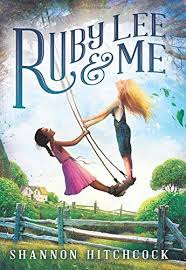
In Ruby Lee and Me, the schools of Shady Creek, North Carolina, were being integrated. Sarah would attend school with her best friend Ruby Lee, but it’s not as easy as it sounds. Sarah is dealing with a huge load of guilt. Her sister was hit by a car and hurt badly, and Sarah thinks it was her fault. While her sister is in the hospital, Sarah stays with her grandparents. She messes things up with her good friend Ruby Lee and calls her the “N” word. Apologizing in the midst of small town racial issues is difficult. Can Sarah save her friendship?

Sarah and Ruby Lee meet their new seventh grade teacher, Mrs. Smyre who reminded me of Mrs. Love, the new African American teacher in a previously all white school. I was curious about author Shannon Hitchcock’s process to publishing this book. She shares some of her story in the end pages. Like me, she was raised during this time period of school integration. Her favorite teacher, like Mrs. Love and Mrs. Smyre, was Mrs. Pauline Porter.

I contacted Shannon and interviewed her by email.

When writing about the past for children of today, I focus on the universal. RUBY LEE & ME is about the love Sarah has for her sister and her best friend. Those are feelings kids still experience today, and along with the universal, I sprinkle in a generous dose of history. Kids may be surprised that Ruby Lee couldn’t swim in the town pool, or eat in Bubba’s Grill, but hopefully, they’ll be outraged on Ruby’s behalf. Historical fiction touches our hearts because we experience the past through characters we care about.

Interracial friendship is at the heart of RUBY LEE & ME. I hope the book sheds light on how hard it was for blacks and whites to be friends in the 1950s and 60s. That may even lead to a discussion of how things have changed and remained the same. For instance, have today’s students faced friendship challenges with kids who are disabled, or of a different religion, or maybe speak a different language? We all struggle to understand people who aren’t like us.

My advice for writers is to read, read, read, especially books that have been published in the last five years or so. I’m also a big proponent of SCBWI. I met my editor at the Orlando SCBWI conference, and sold RUBY LEE & ME to her after revising on spec. I also love taking writing workshops because authors never stop learning.

From her post on Nerdy Book Club, April 4, 2016: The 1960’s were a turbulent time in my family and in my town. Though Brown v. Board of Education became the law of the land in 1954, our public schools remained segregated until 1967. I started first grade that year, and my school’s first African-American teacher taught in the classroom beside mine.

Mrs. Porter had a special gift for working with reluctant readers. So every afternoon, she changed classrooms with my teacher and worked with those of us struggling to read… I shudder to think what might have happened if I’d never caught up.

Thanks, Shannon, for your bravery in writing this book, for sharing a piece of your own life story, and helping students to see how things have changed, and how some things, like friendship, love, and understanding, are universal.
ruby-lee-and-me

Please use this button on your site for DigiLit Sunday posts

Please use this button on your site for DigiLit Sunday posts

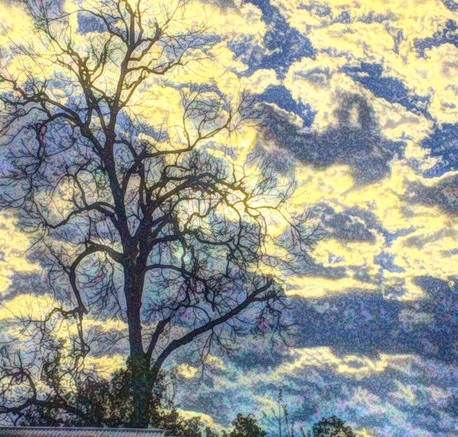
Digitally enhanced iPhone image

Digitally enhanced iPhone image

A few weeks ago, I set up a plan for the month of January DigiLit posts. I promised to tweet the topic on Thursdays. I have not fulfilled that plan. I have been barely making it with a tweet on Saturday. Forgive me. I’m adjusting the plan somewhat. I’ll place the topic for next week in the current DigiLit Sunday post and tweet a reminder on Saturday. If you are writing posts, or want to join us, please go to the Google doc to add your information and your topic ides.

I enjoy playing with photographs on my phone using various photo-enhancing apps. The technology available to us today allows for regular people like me to make cool, professional looking photos with a click.

My students have discovered that in their Kidblog, they can change, manipulate, add features, etc. to their avatars. While this is fun, it can take away time from focusing on the real stuff of blogging, the writing. What place does digital design have in our classrooms, if any?

I struggle with this question. I think it is important to encourage creativity in the classroom, but where does creativity end and just fooling around begin?

My answer has been in setting purposes for digital design and creativity. When my students work on blogging, the design for their posts must serve a purpose. The design should communicate. Setting backgrounds, changing fonts and font size, manipulating images should communicate a tone or theme.

What are some ways you encourage digital design in your classroom? Join the conversation with the link below.

I am blogging for Kidblog. To see my latest post on Tapping into the World of Wonder, click here.

Next week’s topic comes from Maria Caplin: Increasing student vocabulary beyond definitions.

digilitsundayfebruary-5-2017-copy