Thank you to Two Writing Teachers for creating an amazing community of writers and a safe, welcoming space to write and share.
One of our family’s spirit animals is the turtle. As my daughters were growing up, my husband would always stop for a turtle crossing the road. We never had a domestic turtle, but we spend time together in nature trying to spot turtles on a log.
Turtles have spiritual symbolism.
Trust your path. Strength and endurance Stability Ancient wisdom Longevity
“The turtle is a symbol of the World and the Earth, inspiring us to chart our own course with energy and determination.” (fauna-protect.com)
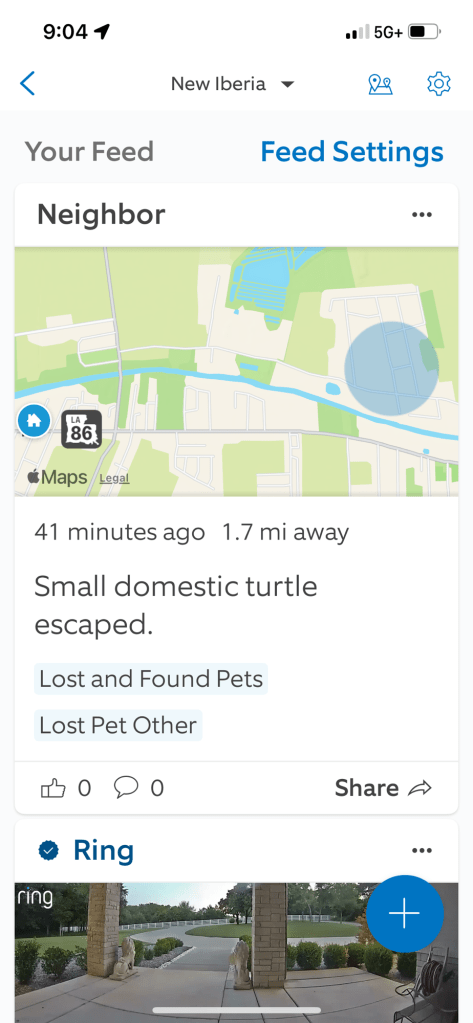
Recently, my husband and I were on a long drive and I got an alert on my phone from the Ring neighborhood alert system.
It was dark and I was getting a little punchy, but this announcement cracked me up.
I sent it to the girls in a text group.
My daughter sent a response, “Your small domestic turtle is safe and sound.” Along with a photo of our dog, Albert, perched on her lap.
Are you enjoying retirement? Isn’t retirement fun?
Questions I’ve heard nearly every day since retiring, but I haven’t settled into it quite like I thought I would. This morning my enneathought of the day said “Ignore your feelings.” Yeah, sure, you try!
In my notebook I wrote about this nagging anxiety, how every day I feel like there’s something I’ve forgotten to do. I had to buy a day planner. I’m making more lists than I ever did before. But I can’t shake the feeling.
A Box for my Anxiety
I’m putting anxiety away in a wooden box that latches with a key like the one for my childhood diary. Two matching tiny silver keys on a chain buried beneath bracelets where I can’t find them readily.
This feeling that belongs to me is useless, a hidden weed choking vibrant growth.
Be still, my sweet heart, you got this. You know what to do. Get busy.
Margaret Simon, draft
What feelings are you grappling with and need to put away?
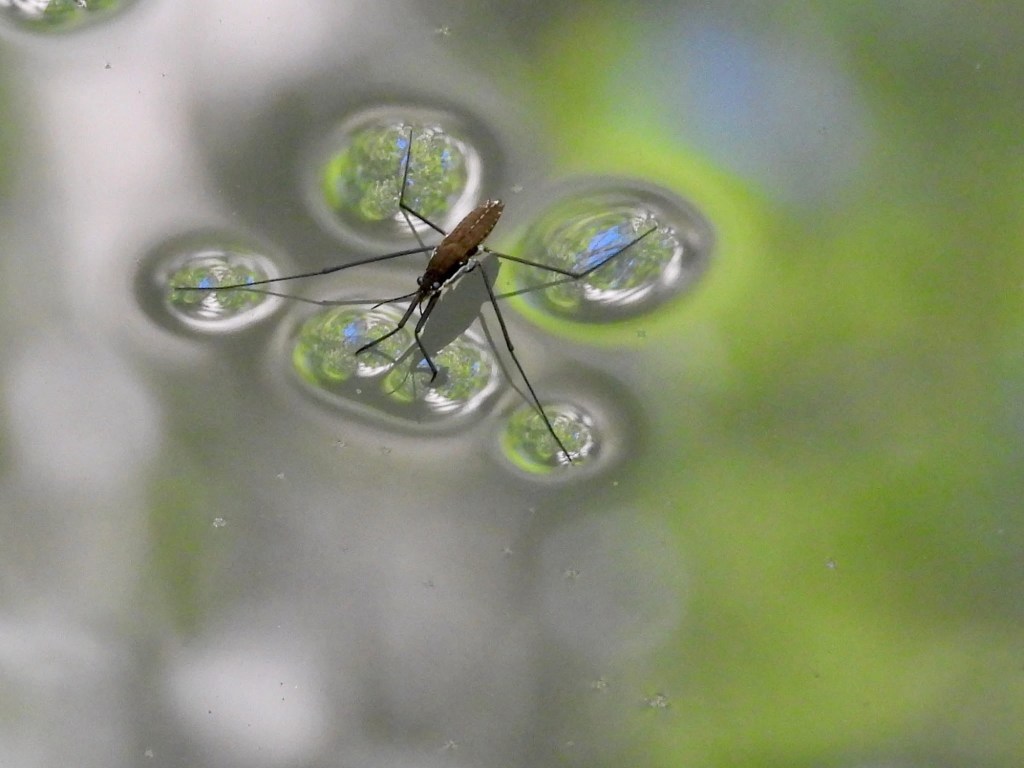
Summer is winding down. Although, the temperatures remain high. Once again, I turned to teacher-writer-photographer Molly Hogan for a photo prompt. Molly captured this water strider in perfect stride to open up a world. The photo itself is a poem.
It’s a just right day for a haiku. Please consider writing a response poem. Leave encouraging comments for other writers.
Glass pebbles glide below water strider toes tapping into green.
Thank you to Two Writing Teachers for creating an amazing community of writers and a safe, welcoming space to write and share.
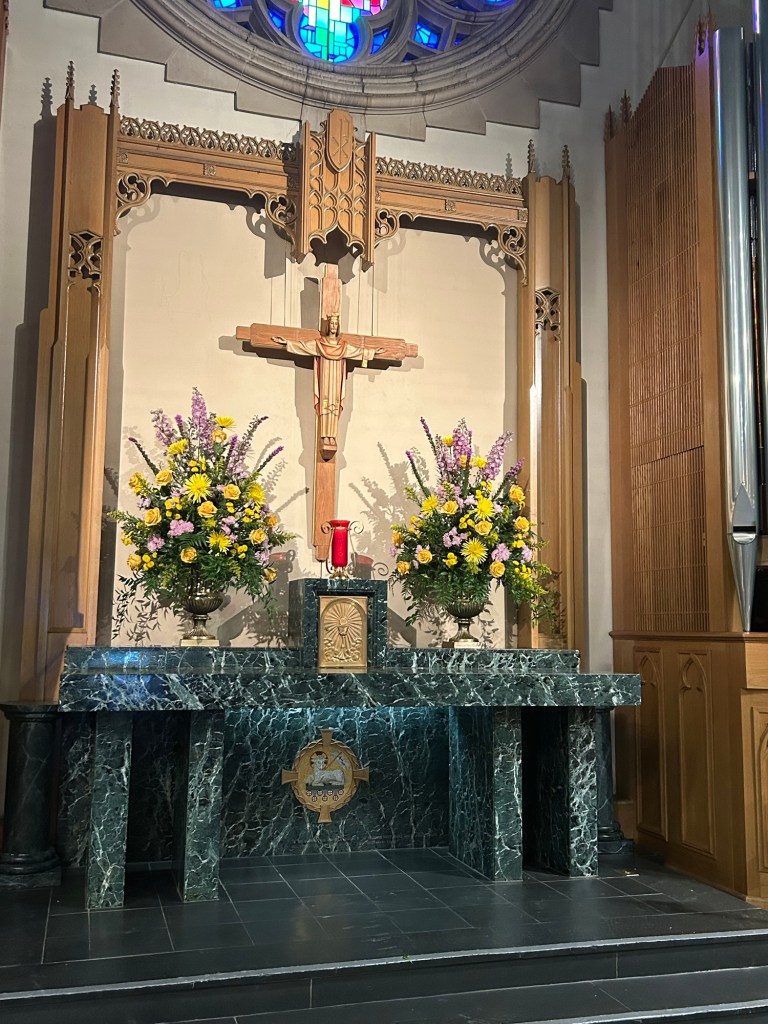
The altar flowers were purple and gold, a nod to LSU where my parents met.
This weekend my family and I celebrated the life of my mother, Dot Gibson. The funeral service was held at the church where I was baptized, where my parents were married, where my mother’s ashes are placed next to my father’s in the columbarium, St. James Episcopal Church in Jackson, MS.
The musical prelude was sung by my brother. He is a musician, and the song he sang was an original one he wrote about our parents. We were blessed to be raised by loving parents. They supported Hunter’s aspirations to be a performer, even when it didn’t seem like a practical vocation. In more recent years, Hunter has been performing at senior living places. My parents found their independent living apartment because Hunter had played there many times, and he felt it was a safe place for them.
Music has always been an integral part of my family’s life. Mom taught piano lessons and studied piano, receiving her masters and performing with the Chaminade Club of Jackson. She was on the founding board for the Music Forum of Jackson. Her legacy lives on in my brother.
Here are the words to his song, followed by a link to it on YouTube.
Reason That I Am
When I was just a boy, time went by in such a hurry.
Carefree days and tender nights, growing up without a worry.
Mother, Father, reasons for the man I am.
Don’t let go of the memory. Let it guide you to the truth. Don’t let go of the memories of the ones who tried to pave the way for you.
Even through the troubled years, love was always there to guide me. Not afraid to chase a dream. Knowing that you’d be there beside me.
Mother, Father, you’re the reason that I am.
Don’t let go of the memory. Let it guide you to the truth. Don’t let go of the memories of the ones who paved the way for you. The ones who never strayed from you. The ones who let you be just you.
The Roundup today is hosted by Heidi Mordhorst at My Juicy Little Universe. We switched dates, so I will round up on Friday, Sept. 5th.
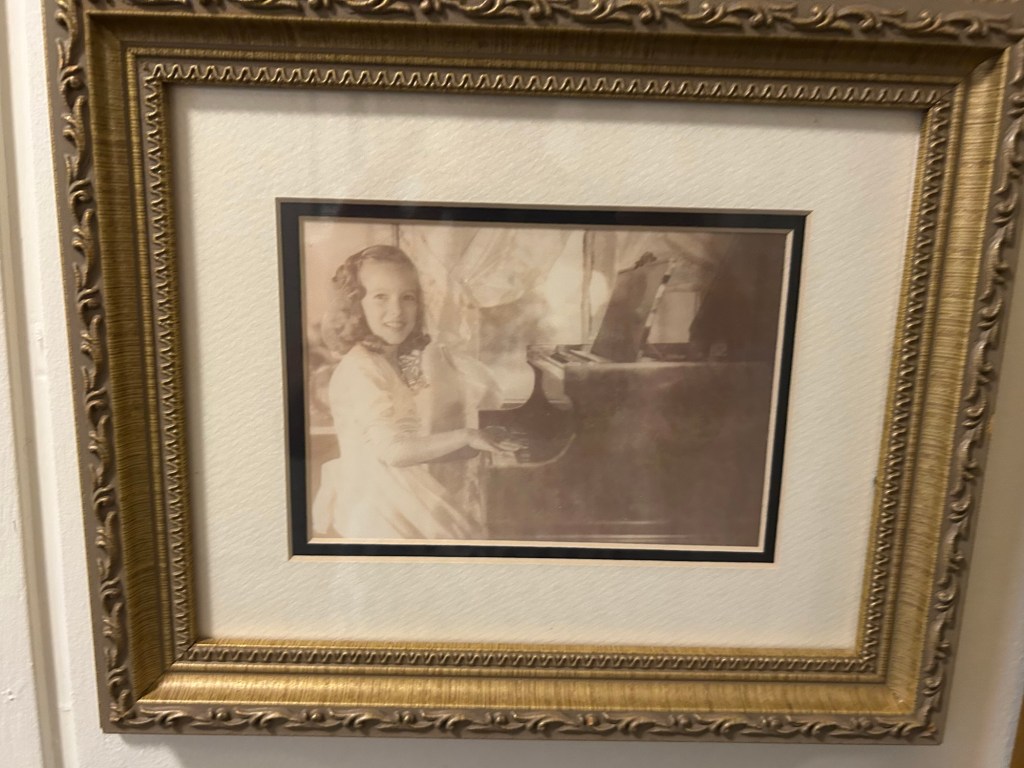
My mother at the piano
After Packing my Suitcase for the Funeral
Then I turn to a portrait of you at the piano (Were you 12 or 13?), your smile the same one I saw in the last days when moving was hard. Your long fingers like a metronome holding rhythm on the bedding. At the funeral, we will cry. We will let you go, ashes to ashes and all. Sing you into heaven and praise the glow of the summer sky.
Margaret Simon, draft
Today I will be traveling to Mississippi where our family will gather and celebrate the life of my mother. I can’t seem to write a poem this summer that does not have her in it. Forgive me, but it seems necessary at this time.
Tabatha Yeatts of The Opposite of Indifference coordinates a poetry exchange. She sent me a poem she wrote based on a podcast she heard and thought of me. I love this Poetry Friday community and how we share poems as well as life events. Thanks, Tabatha for sharing your creativity with me.
Butterfly children
by Tabatha Yeatts
Jo Nagai, boy-scientist,
believed in love-memory,
thought his caterpillars greeted him
after becoming aeronauts, hovering
close as though he was
a dark-eyed flower.
Their memory not wing-scale thin,
but thick as honey.
He loved the before,
the tickle of their round bodies
held on his arm as he conducted his tests
so he shared their small pulse of discomfort.
He loved the after,
the wobbly wings,
the legs slim as a kite’s string.
Jo noted everything,
page after page,
as the butterflies responded
the same as their caterpillar child-selves.
No matter how great the metamorphosis
of being swaddled in the chrysalis
and rebuilt in the soup of creation,
even into the next generation,
young butterflies swooped into
the future’s flowers with messages
from their ancestors:
before you break open,
here’s what I know.
Inspired by Radiolab’s episode “Signal Hill: Caterpillar Roadshow” about a Japanese second-grader who scientifically studied what butterflies can remember.
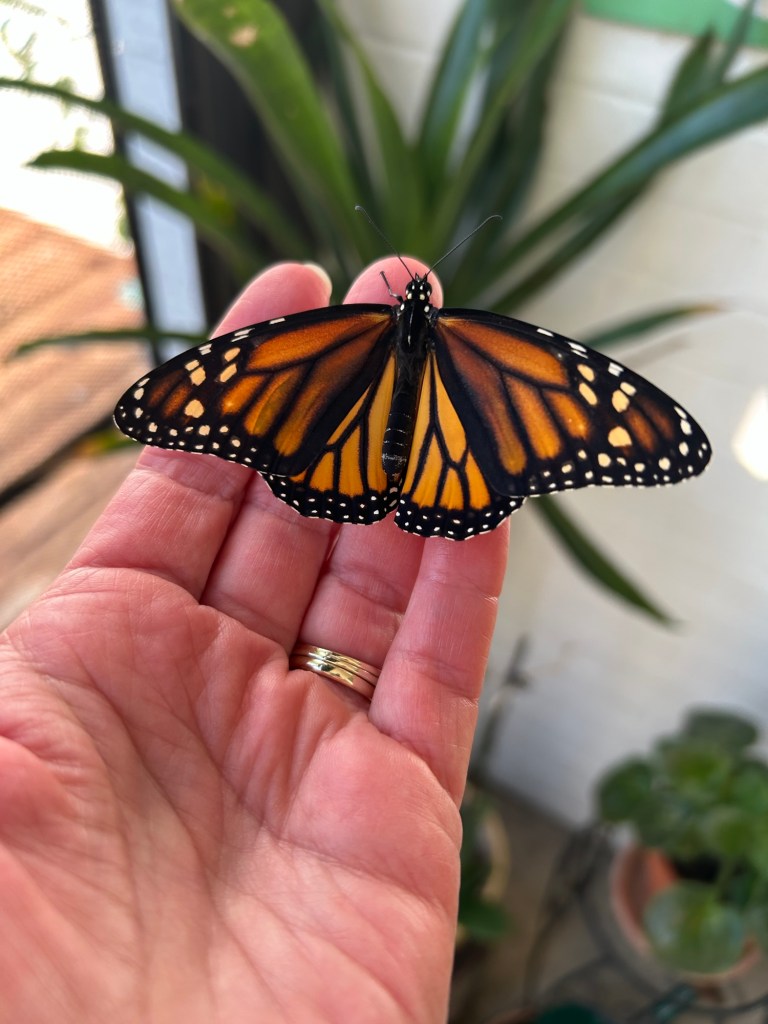
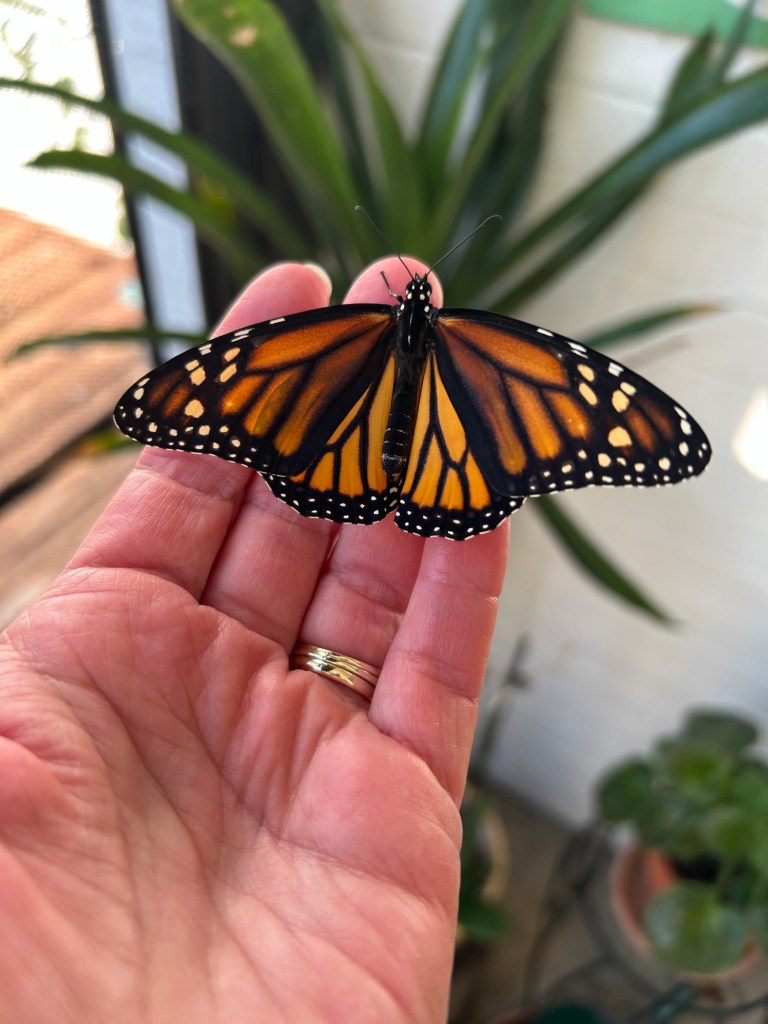
One of my recent monarchs, “legs slim as a kite’s string.”
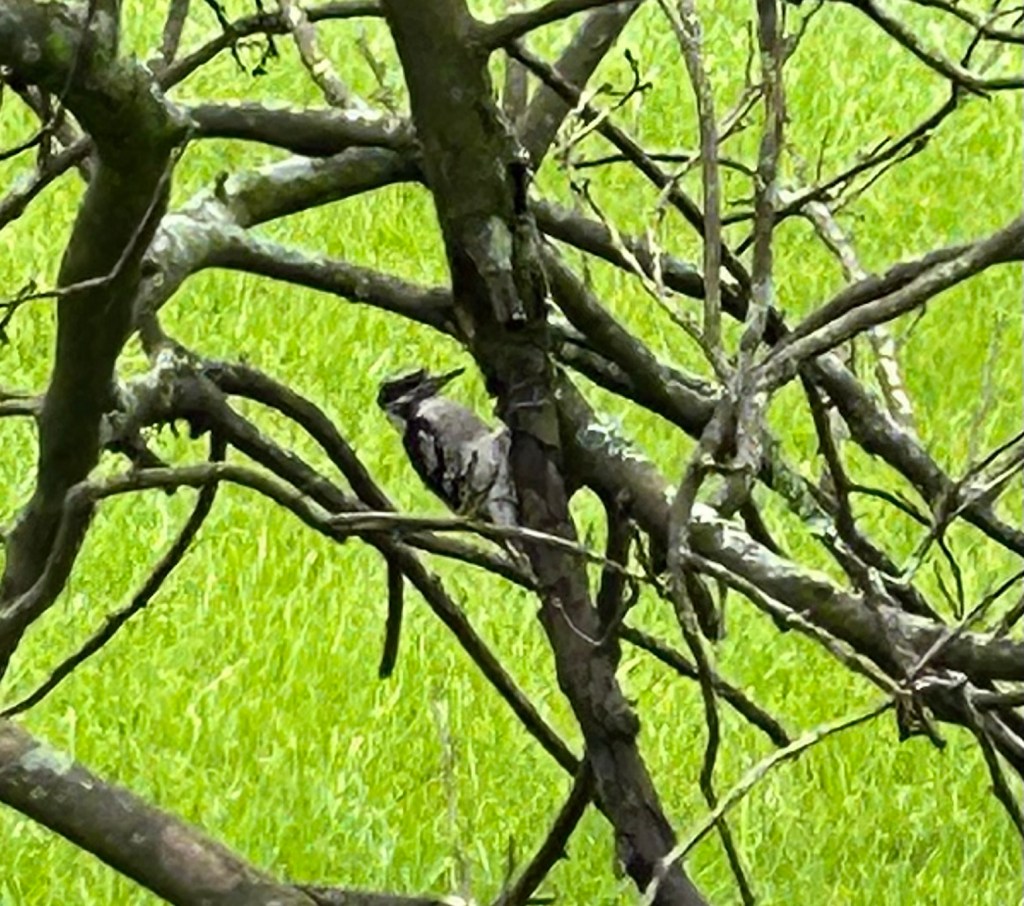
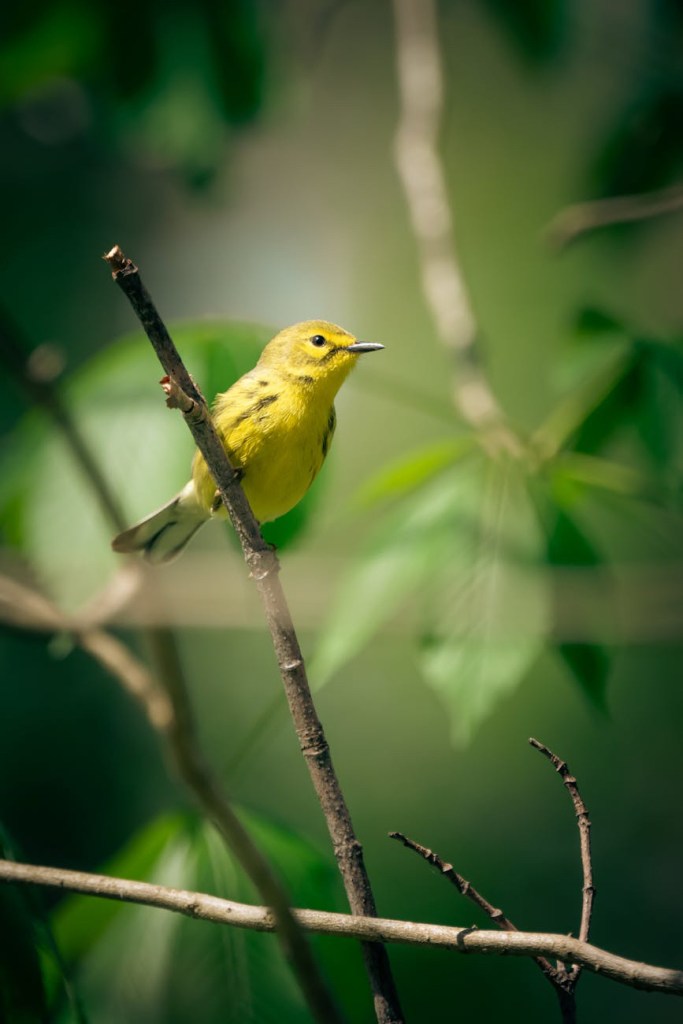
I wish I was a better photographer of birds. This one was taken with my phone out of my kitchen window. I wish you could see the red crown, but I do like the profile and how you see that sharp beak.
This tree is a satsuma tree that succumbed to the freeze this past January. I’m grateful we haven’t taken it down, though, so this beauty could come visit.
I’ve been taking an online poetry workshop with Rosemerry Wahtola Trommer. One of her mentor texts was a poem titled “Romance” by Timothy Liu. I borrowed the opening line for this poem.
Renew
There is nothing renewable about the frozen satsuma tree, unwieldy branches outside the kitchen window, grey with age, dead from winter’s storm.
Yet I see a small downy woodpecker tapping the old tree’s skin, jump-tap, jump-tap, searching for insects to eat.
How I search my fractured memory for signs of my mother, holding comfort of a long life lived, given over at the right time for renewal.
Margaret Simon, draft
Please consider writing your own small poem inspired by this photo. Respond to other writers with encouragement.
Spiritual Journey First Thursday is being gathered by Leigh Anne Eck at A Day in the Life.
Leigh Anne asked us to write about family this month. Family is my priority always, but since retiring, I find myself dedicating more time to my children and grandchildren.
This week as my husband and I celebrate 43 years of marriage, I am caring for my grandchildren in New Orleans. My colleagues are going back to school and while I admit to feeling a pang of “I should be there”, I am grateful I am not. My mind and body are more relaxed, and I am able to devote energy to my family. What a blessing!
Next weekend we will all gather in Jackson, MS to celebrate my mother’s long life of 89 years. My mother, Dorothy Liles Gibson, was dedicated to family. She taught me the value of being fully present. I have selected this poem to read at her service: “Let the Last Thing Be Song.” My mother was a musician all her life. She taught piano lessons and got her masters in piano. She was a founding member of the Jackson Music Forum. She was also an active choir member at St. James Episcopal Church. I look forward to being with all of my children and grandchildren, siblings and their families, as well as friends and cousins. We will raise our voices to praise her life.
I am taking a poetry workshop with Rosemerry Wahtola Trommer. This week she used a model poem by Alberto Rios, “When Giving is All We Have” to talk about paradox in a poem. She gave us a prompt with a variety of anaphoric phrases. I chose prayer. “We pray because…” I’m sharing the draft of my poem.
When Prayer is all We Have
After Alberto Rios “When Giving is All We Have”
We pray because we are lost. We pray because we are found.
We pray because prayer changes us. We pray because prayer changes nothing.
We hold hands to pray. We kneel alone in the sand.
Prayers have many ways to begin: Our Father Dear Lord Ah, me I am here
Silence can be a prayer.
Prayers connect us to the dead. We are helpless in prayer.
What I do not have, I offer to prayer—an empty voice, a sigh of desperation. Does it matter who is listening?
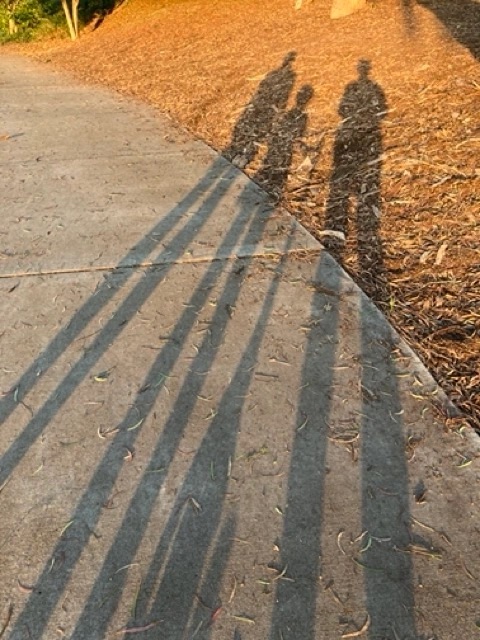
On Poetry Friday, Mary Lee used this photo she took of herself with her brother and her nephew to inspire a triptych poem. I am reposting here with permission.
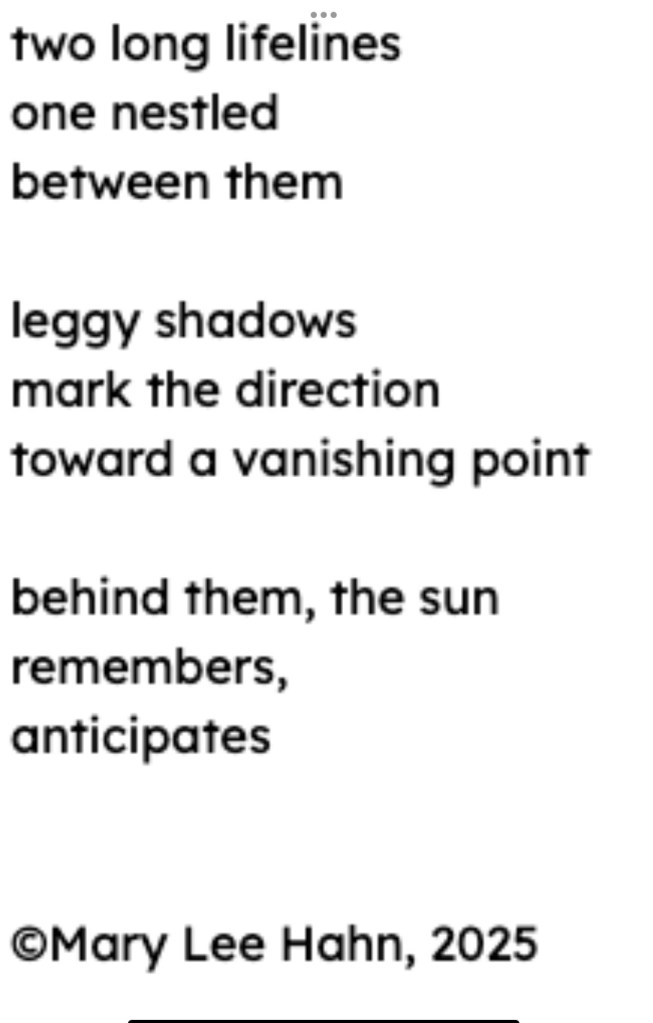
A triptych poem follows the guidelines similar to a triptych painting with three distinct panels tied together by color and theme. Here is a copy of Mary Lee’s poem about the photo.
I’ve been taking a course with Rosemerry Wahtola Trommer. Last week she shared a poem by Matthew Rohrer, “There is Absolutely Nothing Lonelier”. I borrowed his first line to write my photo poem today.
There is nothing more hopeful than summer shadows following a path— reaching long, like stilts on festival clowns. I wonder if my shadow would fit in; it’s certainly tall enough. Shadows still to welcome all. Margaret Simon, draft
Please join me in writing today to this photo. Leave a small poem in the comments and offer encouragement to each other.
Thank you to Two Writing Teachers for creating an amazing community of writers and a safe, welcoming space to write and share.
The old adage “Build it and they will come” has certainly worked for me this year. Instead of planting milkweed outside in my butterfly garden, I planted two varieties in pots. This was due to a discovery that milkweed is poisonous to dogs. And our dog loves to romp in the butterfly garden.
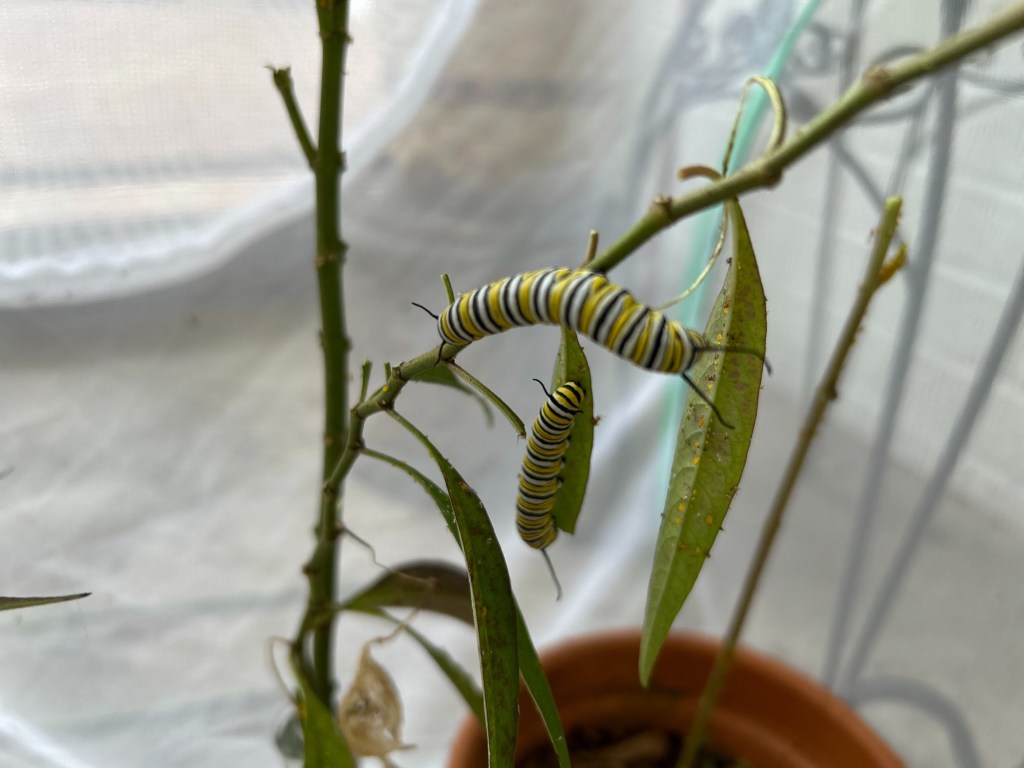
In the spring, I found monarch caterpillars on the swamp milkweed. A few weeks ago I found two tiny ones on the tropical milkweed. Because of all the predators (lizards, birds, etc.), I decided to put the two babies in an enclosure. What I thought was two became 6 very healthy caterpillars munching away on both varieties. I was hoping I could keep them fed for the growth period.
Healthy monarch caterpillars
All six made chrysalises. Four of them had moved appropriately to the top, but one made its chrysalis on a stem and another on the side of the cup holding the demolished milkweed.
Over the past two days they all emerged, two on one day and the other four the next.
Beautiful monarch!
I feel a sense of accomplishment that I successfully raised 6 new monarchs to fly free into the world.
This first day of August is time for a new Inklings challenge. Catherine Flynn asked us to write a triptych poem using Irene Latham’s model poem here. I also looked at Summer Triptychby Linda Pastan.
This summer with my mother’s passing, I have been thinking about the three summers that stand out in my mind in the long process of losing my parents. The first summer I had to face the reality of their aging was 2019 when they decided to move to an independent living apartment. They left the house full, and my siblings and I had to clean it out.
In the summer of 2022, I was grieving the death of my father and searching for a sign of him. And this year, my mother…
Solace, peace, comes to me in this poem. I hope you find it there, too.
Summer Bird Triptych
July 2019
The hummingbird feeder, blown glass swirling primary colors, reflects the sun, attracts a ruby throat hovering while I sit alone on the porch,
Remembering.
July 2022
I hear a tap, tap at the window. A bright yellow prothonotary. Does he see his reflection? Does he want me to come out?
Is it you, Dad?
July 2025
The crows seem angry. The Merlin app identifies fish crows. They call with a fervor I feel deep in my belly, calling me back to nature
Margaret Simon lives on the Bayou Teche in New Iberia, Louisiana. She is a retired elementary gifted teacher who writes poetry and children's books. Welcome to a space of peace, poetry, and personal reflection. Walk in kindness.





 Reflections on the Teche