Feeds:
Posts
Comments

Celebration Jabber

Discover. Play. Build.

Public domain image

Public domain image


I am celebrating another week of poetry. This was testing week. I had the time (while monitoring a small group of 5th graders) to read and to write. I spent some time with my new favorite poetry book, Gold by Barbara Crooker. A poet-blogger friend recommended it. I love Barbara’s style. I sat with the poem At VCCA, I Hear a Red-Bellied Woodpecker, and Think of Martha Silano. I used the line This morning deliquesces. I had a dictionary nearby, so I looked up deliquesces. Then jumped over to the J’s. I found some great J words: jazz, jay, jettison, joyful.

I love playing with words. Thanks for being a part of my month of ABC’s in poetry.

I wish Storybuilder would appear in WordPress, but you have to click the link to see it.

http://goo.gl/971wHa

Jabber

The blue jay jazzes up to the birdbath
looks left, then right
bobs his head up and down
jettisons oak leaves and pollen curly Qs
lifts his nutcracker beak
to let the water flow down his throat.

I watch from the porthole of my kitchen,
think I should clean it today. This king
of jays shouldn’t have to drink dirty water.
This morning deliquesces, softens edges
of the dark night. I want to join
Mr. Jay making his daily rounds,
here and there, collecting
for his new nest. I would gather
blossoms from the fruit tree,
place their fragrance in your path
to let joyful praise of simple beauty
give your heart wings.

–Margaret Simon, all rights reserved

For this poem, I just wrote. I didn’t change much from the written draft to the typed one. This rarely happens to me. I did play around with the line breaks. I enjoy reading about other poet’s processes. Amy Ludwig VanDerwater shares her process on her site The Poem Farm. At the Two Writing Teachers, Betsy Hubbard shares a process she learned from Georgia Heard. I celebrate being a part of a community that learns together.

Why Poetry?

Poetry Friday Round-up is at  Today's Little Ditty.

Poetry Friday Round-up is at Today’s Little Ditty.

teacher-poets

For National Poetry Month, Chris Lehman has invited teacher/poets to join together to read, listen, and discuss poetry. Chris posed this question to the group, “Why Poetry?” Inspired by Kevin Hodgson, I tried out Tapestry for my response. Click on the link to view my response.

https://readtapestry.com/s/6Bs7sVEW7/

Earlier in the week, I posted about my writing life responding to fellow blogger/writer Sandra Sarr’s questions. I am From poems have been around for a while and are written in many middle grade classrooms. But I wanted to take a different spin on the I am From and write about where my writing life comes from.

I am from a short story contest in tenth grade.
I won for my row.

I am from Dear Diary, “I want to be a writer
if only someone would give me the confidence.”

I am from “Where is Papa going with that ax?”
to “Blue is cackling something awful this morning.”
from Children’s Literature class to
the National Writing Project Teacher Institute.

I am from retreats, marathons, and critique groups
holding me accountable to find an authentic voice
and make writing a daily practice.

I am from pen to paper,
fingers to keyboard,
opening my veins and bleeding
my words,
trusting them to
the world.

–Margaret Simon, all rights reserved

Haiku is here

Butchart Gardens vintage postcard, Victoria, B.C., Canada. Photo by John L. Barnard

Butchart Gardens vintage postcard, Victoria, B.C., Canada. Photo by John L. Barnard

Once again the postcards Laura Shovan sent me, along with Pantone colors, inspire my writing. This postcard shows the Rose Garden at Butchart Gardens in Victoria, B.C., Canada. The postcard states that the gardens were once an abandoned quarry. A quick Google search found that they are still blooming today, “over 100 years in bloom.”

Butchart Garden Haiku

Red fiesta blaze
arching overhead, a wreath
crowns this sanctuary.

–Margaret Simon, all rights reserved

On Laura’s blog, writers are sharing their source poems. Diane Mayr wrote about the haiku in this post.

"I would love to be a writer if only someone would give me confidence!"

“I would love to be a writer if only someone would give me confidence!”

Why do I write what I do?
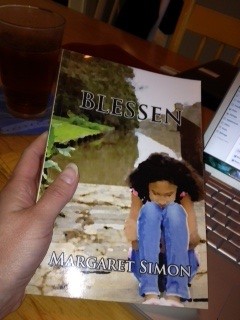
I often tell my students that the only way to get good at something is to practice. We all would rather a short cut. I know I would. I wish that I had stuck with writing when I was younger. I wrote often as a teen, and I was bad at it. I unearthed one of these diaries, “I want to be a writer, if only someone would give me confidence.” And as any writer knows, it takes a great deal of confidence. Confidence must come from within, though, not from someone else. But it also takes perseverance. And maybe I don’t have enough of that because I turned to self-publishing for Blessen and for Illuminate. Both projects have brought me great courage. Now I feel more confident in writing for others to read. I trust my voice and allow her to say what she will.

Writing a blog is about connecting. Through this format, I connect to other teachers, poets, authors, and readers.

I write poetry because it’s my passion. My passion comes from falling in love with poets. They are some of the coolest people on this earth. They can say what I meant to say and so much better. I want to be like Mary Oliver when I grow up, walk my dog along the bayou and write beautiful words. I believe the world is more beautiful, more meaningful, more pleasurable because of poetry.

How does my writing process work?

I have different writing processes for different types of writing. For blogging, I just do it. I save a draft, re-read a few times, and publish.

For poetry, I am usually attracted by a prompt. That prompt can come from anywhere: an image, a presenter in Wordlab, a fellow blogger’s post, or the site of a hawk flying over the highway.

Fiction is tougher for me. I have a strong resistance to writing it. Blessen took 6 years. I started it in a writing workshop on fiction writing. I had many starts and stops, months would go by. And now, I have readers asking for her sequel. I just can’t get myself to open the document. What am I waiting for?

Some of my favorite books on the writing life include:
Bird by Bird by Anne Lamott
Writing Down the Bones by Natalie Goldberg
One Writer’s Beginnings by Eudora Welty
Views from a Window Seat by Jeannine Atkins (Reading presently and love how it feels like having coffee with a best friend.)

My National Poetry Month commitment is to write a poem a day using ABCs of forms, techniques, and tools. Today is brought to you by the letter G for ghazal. (pronounced “guzzle”) I am writing my ghazal in a form borrowed from a poet-friend, James McDowell. He writes using three line stanzas rather than the traditional couplet. This ghazal form is credited to Robert Bly and is called a ramage to the Mideastern ghazal, or American ghazal. “In its classic form, each stanza stands alone–has its own landscape, so to speak–and the theme of the poem is never stated. So the reader has much more to do than he would be used to in the contemporary English poem. When the ghazal has its full development, each stanza in a given poem ends with the same word.”

I wrote this loosely formed ghazal to a postcard sent to me by Laura Shovan. It ends with the Pantone color candy pink.

postcard candy pink sky

…candy pink sky

Purple-tipped clouds stroke the air
while the red-tailed hawk soars high,
a child points to azure sky.

Clipping waves ride the ocean
cradle the rocking schooner
air balloons a sail through sky.

Creator draws a straight line
separates water from air,
holds horizons of dazzling sky.

I am not old enough to
remember how war feels,
bombs exploding erase sky.

Heaven is here in colors.
Our eyes can see the rainbow
when the sun chases storms from the sky.

Every story has its lesson,
the one for Margaret is this:
Throw confetti to the wind.
Celebrate a candy pink sky.

–Margaret Simon, all rights reserved

  Join the Two Writing Teachers Slice of Life Challenge.

Join the Two Writing Teachers Slice of Life Challenge.

I was invited by my friend, Sandra Sarr, to participate in a writing process blog tour. Sandra completed her MFA from the Northwest Institute of Literary Arts, Whidbey Writers Workshop, in 2013. She is currently seeking representation for her first novel, The Road to Indigo. I met Sandy last May when she was visiting Louisiana to complete her research for her novel. Sandy blogs at The Road to Indigo. I wrote a poem for her last year and posted it here.

What am I working on?

I don’t like this question because it so presumptive. Like a writer should be working on something all the time? Ok, I guess if I’m going to call myself a writer, I should be working on something. In my writing folder, you will find a completed verse novel, a sequel to my first young readers novel Blessen, and many poems. I can’t say I am working on the sequel because that would mean I need to open the file and write something. Who knows why it is sitting there incomplete.

Lately, poetry has been the draw for my time and energy. I am trying to post a poem a day in April. In February, I wrote poems with Laura Shovan for her Pantone color project. She published quite a few on her blog. My favorites are here and here.

In March I wrote a blog post every day for 31 days for the Two Writing Teachers Slice of Life Challenge. This was my 3rd year and I was surprised by how much easier it was this year. I participate in four blog round-ups, Slice of Life Tuesdays, Poetry Friday, Celebration Saturdays, and (my own creation) DigiLit Sundays.

So what am I working on? Writing, that’s it.

How does my work differ than others in its genre?

If I look at other books in the young readers genre, I see few that are as placed based as Blessen. She is growing up in St. Martinville on the Bayou Teche. My own backyard was my muse. Many of the locations are real, such as St. Martin de Tours Catholic church. The place looms even larger at the end when Blessen and her father face danger on the bayou.

Blessen
Blessen is a mixed-race child. I’ve read recently how children of other races are missing from young readers’ choices. Blessen lives with her white mother and grandfather. She does not know who her father is and discovers in the course of the book that he’s a black man. One of the most touching relationships is the one she builds with her paternal grandmother.

In poetry, I write with children between the ages of 9 and 12, but I’m not sure if what I write is children’s poetry. I tend to stay away from rhyme because I am not very good at it. My poems often speak of nature. My muses include poets Mary Oliver, Natasha Tretheway, Ava Leavell Haymon, and Naomi Shihab Nye. I get inspiration and support from Poetry Friday bloggers, Amy Ludwig Vanderwater, Diane Mayr, Laura Shovan, Laura Purdie Salas, and Irene Latham, and more.

This post is getting long winded, and I wanted to also post a poem today, so the last two questions will wait until tomorrow: Why do I write what I do? and How does my writing process work?

F is for Fibonacci poems. The master of the Fib poem is Greg Pincus of The 14 Fibs of Gregory K which I haven’t read yet because my boys are passing it around. The fib poem is based on the Fibonacci series in mathematics; 1,2,3,5,8,…which in nature creates a beautiful spiral as in the sunflower.

We
find
magic
when poems
reveal inner truth
and breathe out a sigh of Ah, yes!

–Margaret Simon

sunflowers

The Writing Process Blog Tour continues here tomorrow and next week on my poet/friend Clare Martin’s blog, Orphans of Dark and Rain.

Elocution

E is for Elocution. My younger students are preparing for elocution, memorizing and reciting a poem of choice. They tend to select funny poems, and one of the funniest kid poets is Kenn Nesbitt. Erin picked out “I Think I’m Related to Big Foot” and memorized it quickly. I recorded her little 2nd grade voice reciting the poem. I love the giggles at the end. She can’t keep from laughing. She also has very large dimples that make her even more adorable.

I think I’m related to Bigfoot,
though nothing has ever been proved.
I sort of suspect he’s a cousin,
just seven or eight times removed.

Read the rest of the poem here.

If you use Safari as a browser, you may not be able to hear the Soundcloud. Linda Baie found the solution here: http://help.soundcloud.com/customer/portal/articles/1464535-why-can-t-i-hear-tracks-using-safari-
Thanks, Linda.

DigiLit Diamante

Please use this button on your site for DigiLit Sunday posts

Please use this button on your site for DigiLit Sunday posts

wisteria collage

This beautiful wisteria vine grows outside my bedroom window. I think I write a poem about it every year. Today for DigiLit Sunday, I am posting a collage made with Pic Stitch. One of my favorite teacher sites is Read, Write, Think. Supported by two amazing organizations, International Reading Association and National Council for Teachers of English, this site offers a wealth of literacy-based lesson plans. I also love the interactive applications available. I made a diamante poem on a Read, Write, Think Interactive. For students, the app works well because it prompts them for each word. The form for a diamante creates a diamond shape with 7 lines:

Title
Two adjectives
Three -ing words
A phrase that connects title to ending word (antonym or synonym)
Three -ing words
Two adjectives
Ending noun, antonym or synonym

Wisteria diamante

Link up your Digital Literacy post with Mr. Linky.

Discover. Play. Build.

Happy Celebration Saturday. Ruth Ayres is gathering celebration posts over at her blog, Discover. Play. Build.

First I want to shout out and celebrate fellow poet-blogger, Laura Shovan. For her birthday month, Laura posted Pantone colors as writing prompts. As a prize for my participation, she sent me a package of prompts, colors and postcards. What a great gift! Thanks, Laura.

colors and postcards

Sometimes you try a poetry activity and think it didn’t go so well, but then the kids ask for it again. So when C came up, my students asked to do Book Spine Centos. I said, “OK, but you have to spend some time and try to make them have a theme, not just see who can stack up the most books.” Making a well composed cento poem is harder than it looks.

So with a little collaboration and an ever-growing classroom library, my students went to work. While some were perusing the shelves, Vannisa quietly went to the side and lifted the title, “Roll of Thunder, Hear my Cry,” and wrote a couplet poem.

by Margaret Simon A thousand mornings view from the window seat blackbird singing state of wonder

by Margaret Simon
A thousand mornings
view from the window seat
blackbird singing
state of wonder

By Nigel Once upon a marigold, The Twits wake up missing side by side.

By Nigel
Once upon a marigold,
The Twits
wake up missing
side by side.

By Kendall Roll of thunder, hear my cry day by day. A jar of dreams choosing up sides worth things not seen-- eye of the storm.

By Kendall
Roll of thunder, hear my cry
day by day.
A jar of dreams
choosing up sides
worth
things not seen–
eye of the storm.

If you like this idea, step on over to 100 Scope Notes with Travis Jonker and view his 2014 gallery.

Today, I celebrate a week of poetry writing and reading in my classroom. Poetry makes everything better, even storms.

The thunder is very loud,
rain falls from the cloud.

Perfect nonsense is what I say,
I like this rainy thundering day

Roll of thunder, hear my cry,
don’t be so loud, I hear you nearby.

Give me back the blue sky,
or else everyone will be on standby.

The lightning flashes bright,
making the sky turn black and white.

The thunder stops as my teacher reads the poem,
the peacefulness makes me feel at home.

Vannisa, age 10, all rights reserved

Poetry Friday Round-up is at  The Poem Farm.

Poetry Friday Round-up is at The Poem Farm.

Some days don’t go as planned. As you know, I am trying to do a poem a day using ABCs of styles, forms, and techniques. For Day 3, letter C, we got so wrapped up in book talks that we had little time left for writing.

As we reviewed the results of Round 4 on MMPoetry, we found the words for the final round. Incontinent, kerfuffle, confabulation, and defenestrate. After discussion, collaboration led to a haiku using the word defenestration. I showed my students this new app I learned about from Kevin Hodgson and Michelle Haseltine, Notegraphy. It works well for a collaborative haiku.

Defenestration copy

The line lifter lurked on my students’ blogs and left some cool response poems. The kids were so excited that their poems had been hacked! Thanks, Kevin.

Me –
the mold on the wall,
sticks to you like thoughts in your head
that you can’t ever shake loose
or clean with a swipe
or maybe I am more like a poem
that one shares on the Web
which then whispers melodies of meaning in your ear
all day.

– Mr. Hodgson
Sixth Grade Teacher
Norris Elementary School
aka, the line lifter
🙂

Kaylie stopped by our class blog and saw no poems using the letter C. That didn’t stop her from contributing. She wrote a beautiful couplet about pelicans.

The pelican flies out towards dawn
Past the orange sunrise and so on

They travel in pairs across the sky
When the bayou has gone bone dry

They long for the feel of the wet on their feathers
The bayou is where their hearts are tethered

The pelican flies out towards dawn
Past the orange sunrise… on and on and on…
–Kaylie, all rights reserved

pelican

Please click on over to Caroline Starr Rose’s blog where I am the guest writer. My post is more about anaphora.

I am convinced that writing poetry is a gift from God. The magical words that float around my classroom amaze me.

I am also the mellifluous sound of a pencil writing on paper.
–Kendall

I know the title is confusing. Bad poetry? From Billy Collins? If you do not know the poem Litany by Billy Collins, then you must go to these sites and read or listen to it. Bet you can’t keep a straight face. In print on Poem Hunter.

Recited by a 3 year old on YouTube:

And…Billy Collins himself:

I explained to my students that Billy Collin’s poem was so bad it was good. They got that. Having primed them with this poem, I let them loose to borrow the structure, think outside the box, and create wildly creative metaphors. I was amazed by the results and would love to share them all. You can read them on our class blog: Slice of Life Challenge at kidblog.org.
The lurking line lifter struck in the wee hours of the morning, so read the comments, too.

I am excited about the poem I caught on this fishing trip. I was thinking about how writing poems together connects us.

Our Ship

We are all on this ship together
whether or not it sails.
We are side by side like the freckles on your mother’s face.
We are closer than the love bugs on the windshield.
You, and I, and he, and she.
We are not like the blown away balloons
at the 3 year old’s birthday party.
We are not the shavings of wood mulching the flower bed.
No, we are this way, that way,
you know what I mean,
intertwined like the vines of wisteria,
joined and connected, tumbling and reaching.
Give me your hand.
I will give you mine.
Let’s go on this voyage together.

–Margaret Simon, all rights reserved.

Vannisa wins the prize of being published on this blog with her poem. She just looked around the classroom and found metaphors galore.

Everything in the Classroom

You can be the air that comes through the vent
You can be the memory I regret
You can be the board I write messages to
You can be the painting that just sits
You can be the pencil sharpener, only useful when needed

As for I,
I could be the mechanical pencil that doesn’t need you
I could be the clip that makes you sit
I could be the eraser that deletes your notes
I could be the person who creates you, the memory I regret
I could be the thermostat, who shuts you down

–Vannisa, all rights reserved