Feeds:
Posts
Comments
Thank you to Two Writing Teachers for creating an amazing community of writers and a safe, welcoming space to write and share.

On Sunday afternoon, the rain had stopped, the air was a perfect 70 degrees, and my house was full. Full of people with great admiration for my mother-in-law, Anne Simon, who once served as a district judge in a three parish area of Louisiana. She was not holding court, but the respect and honor was present. Minga (her grandmother name given by my oldest daughter) was signing her 5th book. Her first book Blood in the Cane Field came out in 2014. She has only been a writer for 10 years. She is 92 years old.

Actually, Anne has been working on being an author for a long time. She graduated from Wellesley and was the token woman chosen from her class to attend Yale Law School. Mona Lisa Smile was a movie based on her Wellesley class. At Yale, “They didn’t even have female bathrooms,” she told me. At Yale, she met Jerry Simon, a young man from an exotic place, New Iberia, Louisiana. In 1956, she was the only woman law school graduate in her class at LSU Law School. Jerry had swept her away from Yale to plant her firmly in Louisiana soil. From 1956-1984, Anne and Jerry practiced together as partners in a law firm. My husband Jeff joined the practice in 1981. In 1985, Anne ran for District Judge and became the first woman to hold that office. In her retirement, she served as an ad hoc judge for the Louisiana Supreme Court. All that time, she collected stories.

On Sunday, Anne told the group gathered in our home about how she came to write this latest novel, Blue, Gray, and Black Blood: The Civil War in the Bayou Country. She was interested in Civil War history. In her studies, she found that farm boys from western Massachusetts volunteered for the Union Army. She knew this area of the country well (Wellesley is located in Massachusetts) and imagined that they might have crossed paths with French speaking African Americans in Acadiana.

This photo shows Anne talking with Phebe Hayes, a historian and founder of the Iberia African American Society. Phebe was studying her family’s genealogy when she had lunch with me and Anne on the back porch of Anne’s house. I was there when the two discussed Phebe’s discoveries about her ancestry. Her ancestors were French speaking Creoles who joined the 52nd Massachusetts volunteers heading west. Through Anne’s thorough research, she wrote a historical fiction book “so you could imagine what it would have been like to live during that time.”

Phebe Hayes, left, and Anne Simon, right, celebrate the publication of a book that shares their history.

“We need to know every group’s history, not just our own. They intersect and we understand more when we know more,” said Anne to the crowd gathered. I was honored to be able to provide my home for the book signing. And many thanks to the people who helped with the event.

The Poetry Friday Roundup is with Anastasia Suen

The first day of December is here and it is raining, raining, raining. We’ve gone months without rain, so I guess it’s catch up time to meet our rainfall for the year. But I’m not happy about it.

Back in October I learned a new poem form, the luc bat, Vietnamese for six-eight. Wendy Everard posted a prompt on Ethical ELA. The form is quite easy in that each line alternates between 6 and 8 syllables. It’s free with no limit on the number of lines. However, there’s this twist of rhyme. The last syllable of the line of 6 becomes the rhyme for the 6th syllable in the line of 8. Then the word at the end of 8 becomes the next rhyme for 6:

xxxxxA
xxxxxAxB
xxxxxB
xxxxxBxC

Molly Hogan challenged the Inklings to write a luc bat for our December challenge. I’ve written a few of them now and I love how the internal rhyming is both challenging and satisfying.

I wrote a short luc bat for this week’s This Photo Wants to be a Poem. I also tried the form on a previous Photo post here: Ancient Door.

Photo by Burcu Elmas on Pexels.com

Today I am posting the poem I wrote in response to Wendy’s prompt. I used one of her lines to get started. This poem reflects on the process my husband and I went through during my illness this past summer. We’ve made it through and are stronger together for our resilience. “In sickness” is one of the hard places in a marriage.

When leaving words unsaid,
our shared trauma wed and silent,
fears become resilient.
Illness causes consistent stress,
silence under duress.
Feelings close off, repress our love.
Searching within, whereof
words we can speak with love to heal.
Find our way back to real and us.

Margaret Simon, with a line by Wendy Everard

If you want to read more amazing responses to this form, here are the links to my Inkling friends.

Linda Mitchell
Molly Hogan
Heidi Mordhorst
MaryLee Hahn
Catherine Flynn

Perspective by Leigh Anne Eck

Leigh Anne Eck has been naming moons. I was taken by this photo she posted and her commentary about it:

I have been naming skies for a few months now. Typically I capture the morning sky on my way to school. Tonight I captured this one on my way home from a basketball game.

I have named it “perspective.” Sometimes when we look at something from another perspective, our eyes and hearts become open to new possibilities! I hope you see something with new eyes this week!

Leigh Anne (Facebook post)

When I was walking in the early morning on Tuesday, the sky was a deep blue with the moon glowing its heart out before the sunrise. We are often mused by the moon, I know, but I hope you will write another time and another about this mysterious and magical being. Leave a small poem in the comments and write encouraging words for other writers. Your vulnerability is safe here.

I’ve been listening to The Book of Common Courage by K. J. Ramsey. She writes poems and prayers as she is going through a healing journey. I loved the term “holy margins” and borrowed it here to write a luc bat short verse.

Sometimes clouds bloom above
clouding the image of your light.
An orb of love this night
you fold in my tears, tight and true
with holy margins blue.

Margaret Simon, draft

Poetry Friday: Bird Poem

The Poetry Roundup is with Ruth at “There is no such thing as a God-forsaken town.”

This week was the Open Write for Ethical ELA. I love how this event once a month inspires me to sit each day and write. I’m often surprised by what comes out on the page.

Fran Haley prompted us to write a bird story. To see her wonderful model poem and the prompt, click here. It brought back a memory for me.

Eagle over Bayou Teche, Louisiana

Everyone has a bird story

Remember the time we saw the eagle
atop the bridge to Seattle?
A few days later, you read
the eagle died, a car hit it.

Once we saw an eagle while canoeing,
elegantly soaring over our bayou–grand beauty
symbol of strength. Then you recalled
the Seattle eagle. That tragic death
hit us hard. He was “our” eagle.

How can we claim ownership of a wild thing?
Freedom is temporal.
The story remains.

Margaret Simon, draft

Fran is not only a wonderful poet, writer, teacher, she also supports other writers and me with lovely comments. I feel the comments that most resonate with me are ones in which the writer makes a heart to heart connection. This was what Fran wrote about my poem: “I’d have mourned long over this loss as well. I find, as I grow older, these things strike deeper than they ever used to. Yesterday I came through a crossroads where woods had long grown over an old farm and it’s all being bulldozed for building houses, I presume. I thought of the majestic hawks and “my” eagle and wanted to weep – how far will the birds have to go to find a new home? “How can we claim ownership of a wild thing?” Because the wild thing is connected to us, to our essence, in some deep way; as the wild thing goes, so go we. I cannot help thinking of the eagle in your verse in another way, as our national emblem, especially in these true and haunting lines:”Freedom is temporary. The story remains.”

May this holiday season bring you lots of small moments of great joy!

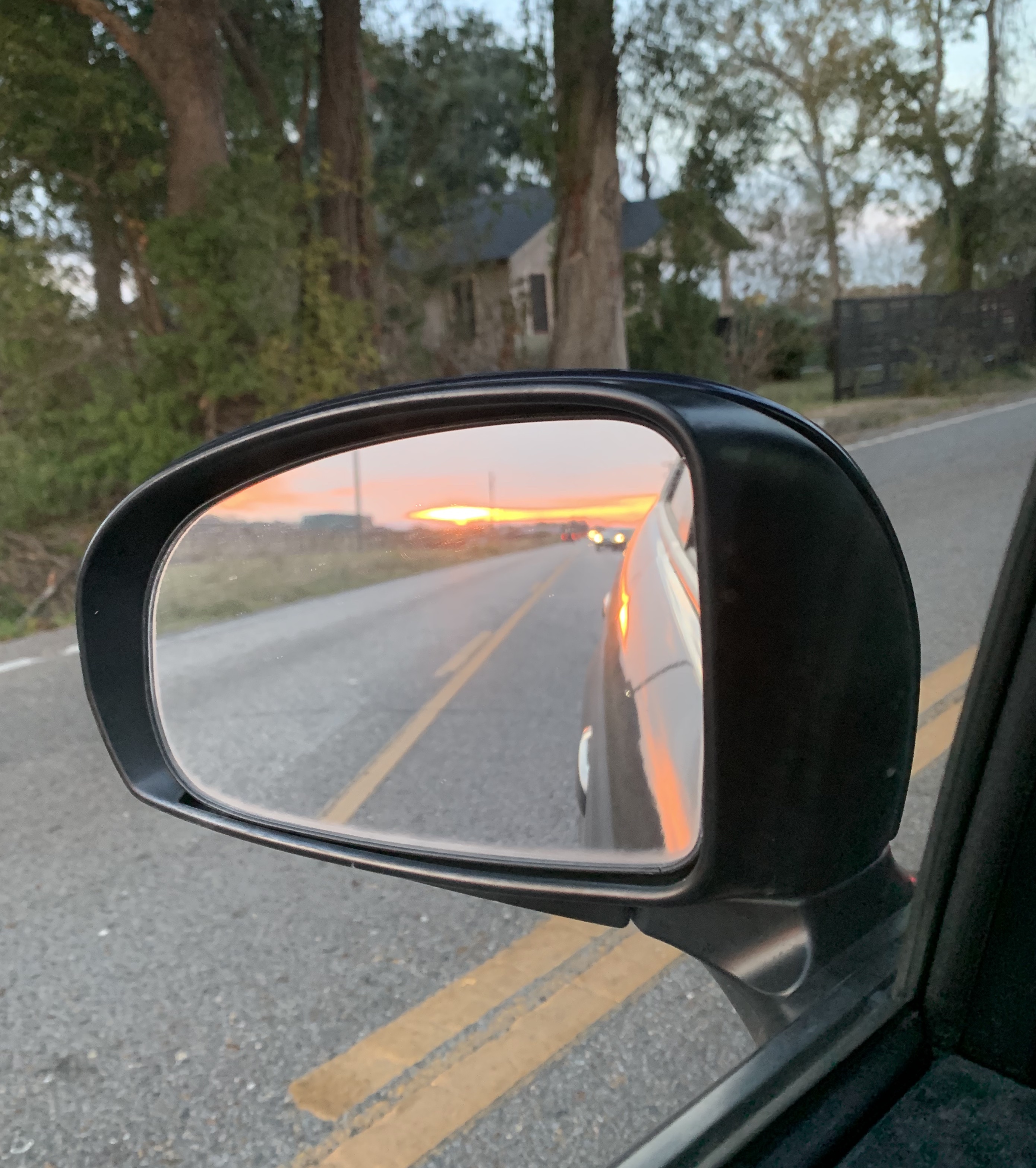
While I was in Ohio for NCTE, my husband sent me this photo of a harvested sugarcane field under an awe-inspiring sunset. He described it to me this morning, “It covered the whole world!” Ethical ELA held its Open Write this week. Kim Johnson prompted us to write a poem using Ada Limón’s poem Give Me This. I wrote a golden shovel about this photo using a striking line: “Why am I not allowed delight?”

So many sunset photos, I wonder why

attraction to orange, pink, purple sky is what I am

with you. Loving this mirror–I

with you, noticing. We are not

the same, yet we’re always allowed

a sunset delight.

Margaret Simon, after Ada Limón

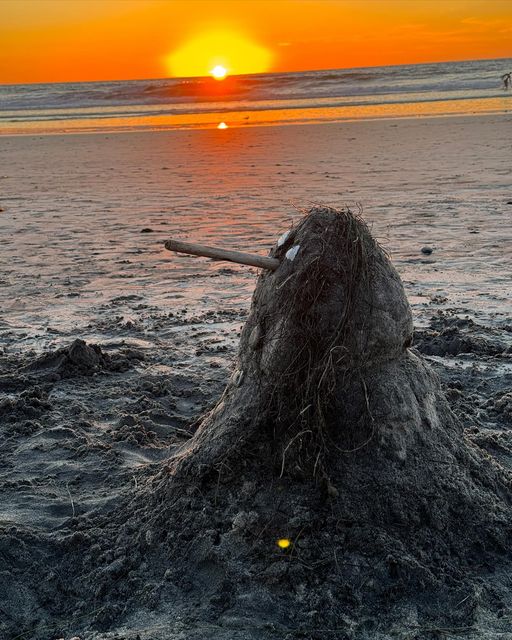
I invite you to write an ekphrastic poem about this photo. Imagine the bigness of the sky, the awe-inspiring sunset, a field of brown…wherever the muse takes you. I hope you take a moment away from your Thanksgiving preparations to write. Come back if you can to comment on others’ poems with encouraging words. Most of all, “Happy Thanksgiving!”

Thank you to Two Writing Teachers for creating an amazing community of writers and a safe, welcoming space to write and share.

Poetry is a tool to unlock magic in the ordinary.

I spent the weekend in Columbus, Ohio at the NCTE conference. What a whirlwind of feelings! Anxiety over my presentation, awe when seeing and hearing Jacqueline Woodson and Tom Hanks, and pure joy hobnobbing with my fellow wizards. Now that I’ve had a few days to download and process the experience, I am feeling gratitude and inspiration.

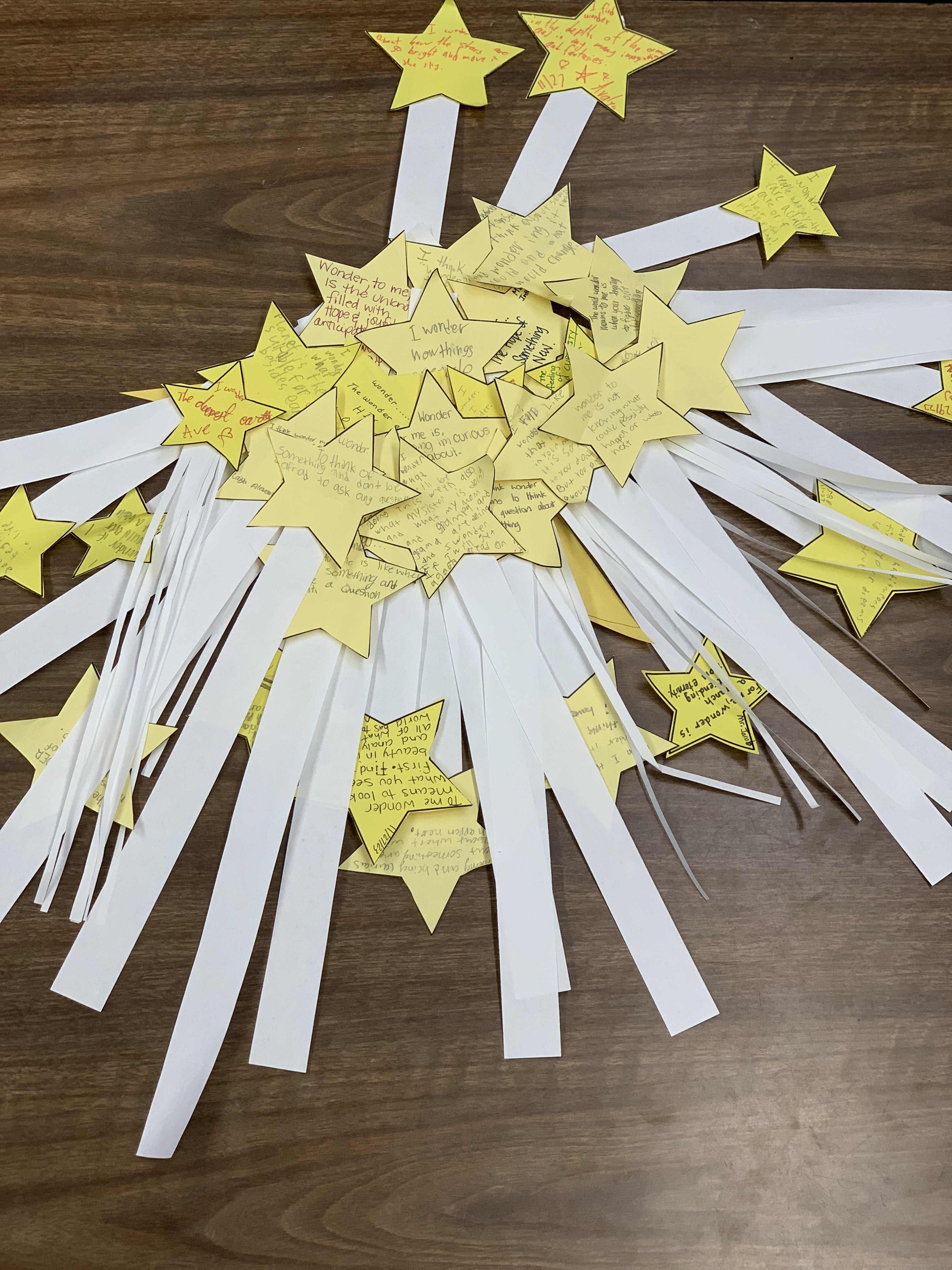
The sessions I enjoyed the most were those in which an invitation to writing was given. Georgia Heard, the 2023 winner of the Award for Excellence in Poetry, led us into a community writing about wonder. She asked, “What does wonder mean to you?” and “Where do you find wonder?” Each of us wrote our response on a sentence strip and then gathered together to make a group poem. I want to take this idea to my schools. I imagine strips flowing down the hall creating a community poem.

Simon Simon, the sloth helped me write my line. I find wonder “in the voices of children.”
I find wonder in the ephemeral bloodroot that peppers
the forest floor with white blossoms.
The coyote who crossed my path
In an egg in a nest in a quiet place
In the voices of children
In the depth of memory that pop like champagne bubbles
on my heart’s surface.
Wonder leads me down the rabbit hole
in search of more.

Irene Latham has the roundup today.

This week my students and I practiced writing pantoums using a prompt from Pádraig Ó Tuama of On Being. He guides us through line by line to write about an ordinary object. I used the prompts to write for This Photo Wants to be a Poem: Just a Rock.

I warned my kids who are 4th and 5th graders that this form would be a challenge. Not all of them were ready and willing and that’s OK when we are creating our own poems. I wanted to share a few because the prompted lines work in a unique way so that each student (and myself) felt a sense of a successful poem.

Kailyn loves candy and has written a fantasy story that takes place in Kind Candy Kingdom. This is her pantoum poem.

Yummy candy I see,
A candy shop is your home. 
At the mall I beg my mom, 
then my brother takes you from me : (

A candy shop home seems nice! 
When you are with me I feel happiness and joy…
you being taken from me. 
It tastes sweet but sometimes sour.

You fill me with joy and happiness,
the sounds of crinkling wrappers. 
When I put you in my mouth, you are sweet and sour,
tingling on my tongue. 

The crinkling wrappers from kids inside,
at the mall I beg my mom.
Tingling on my tongue, 
Yummy candy I see.

Kailyn, 5th grade

In my classroom, I have a collection of Flair pens. My students are allowed to choose from them to write. When Avalyn’s mother gave me a gift card to Target, I bought a set of scented flairs. She wrote a pantoum praise poem for her scented pens.

Scented pens can squiggle on the page
In a poem in my notebook
These scented pens are extraordinary on the inside
If there is a blank page, these pens can make it colorful

In a poem in my notebook
When I make colorful marks on the page, it’s inspiring
If there is a blank page, these pens can make it colorful
But really these markers are flowers

When I make colorful marks on the page, it’s inspiring
O’ my non-smelly pens
But really these markers are flowers
As my hands hold the pen like an extraordinary trophy

O’ my non-smelly pens
These scented pens are extraordinary on the inside
As my hands hold the pen like an extraordinary trophy
Scented pens can squiggle on the page

Avalyn, 4th grade
Rock through a jewel loupe, by Margaret Simon

I discovered The Private Eye Project years ago and have a set of jewel loupes in my classrooms. For our nature field trip last week, I brought them with us. One of our goals was to look at nature from different perspectives, as art and as explorers.

I took this picture of a rock one of my students shared with me. There is a whole kingdom inside one sedimentary rock. Use your imagination to write about this ordinary object in an extraordinary way. Make a list of what the rock looks like. You can create an extended metaphor poem. Leave a small poem in the comments and encourage other writers.

I used a formula for writing a pantoum about an ordinary object by PÁDRAIG Ó TUAMA from On Being.

A rock can be a kingdom
if you look through a jewel loupe.
Pick a small rock on a walk
before you embark on a new journey.

If you look through a jewel loupe,
this rock seems insignificant,
but you can embark on a journey.
If you look closely, you may find yourself.

This rock may seem insignificant
but a student thought it a gift.
If you look closely, you may find yourself.
When I hold it tight, I feel warmth.

A student gave me a gift–
a small rock.
When I hold it tight, I feel warmth.
A rock can be a kingdom.

Margaret Simon, draft
Thank you to Two Writing Teachers for creating an amazing community of writers and a safe, welcoming space to write and share.
Nature art by Marifaye

Write Out is a National Writing Project event that takes place for 2 weeks in October. Using the concept of getting kids out in nature and writing, I planned a field trip for our district’s gifted students to Palmetto Island State Park in Vermillion Parish. We arranged for a park ranger to lead the kids on a hike, but we wanted to do something creative.

Prior to the field trip my colleague and friend Beth called with an idea–Andy Goldsworthy art. Andy Goldsworthy creates designs with things he finds in nature. His idea is don’t take anything in and don’t take anything out. Whatever he creates, he photographs and leaves it to melt, decay, fly away, whatever may be. A wonderful teaching video can be found here.

The park worked out perfectly for this project. Our students, as well as the parent chaperones, spent time looking at fallen leaves, seed pods, acorns, etc. through a creative lens. Every child that I talked to was proud of the artwork they created.

Back at school on Monday, my students turned to poetry to express their thoughts about their creations.

Green and brown leaves

With a yellow leaf on top

And little red leaves and a very tiny fern

Shaped so perfect

To make the right art

Everything in nature is beautiful

Marifaye, 4th grade

Creating something, looks like a portal,

Even if destroyed, it remains immortal,

Standing strong through the test of time,

Eventually destroyed, fell out of its prime.

Max, 5th grade

Working with Georgia Heard’s idea of messages to the earth, each student wrote a 6 word message on seed paper. They took these hearts home to plant.

In my humble opinion, I think these kids will look at nature as art, a palette for creativity. They will see with artists’ eyes, finding an arm in a seed pod, a mirror in a leaf, and a kingdom in a circle of sand.

This week I am heading to Columbus, Ohio for NCTE. I hope I see you there!

Karen Edmisten is gathering Poetry Friday posts here.

I am still riding the wave of a silent retreat last weekend. I wrote about it for Slice of Life and This Photo Wants to be a Poem. Our guide, my friend Susan, gave us a small notebook. The jottings I made are feeding my poetic soul while I busily prepare for NCTE next week.

One of the meditations took place around a lotus pond.

The Lotus Pond
The lotus is a flower that grows in muddy ponds and swamps. It is a symbol of spiritual growth and enlightenment. In the midst of difficult or chaotic circumstances, one can remain grounded and find inner peace and clarity.

photo by Margaret Simon, lotus flower in a sugar kettle.

Lotus Water

Mindful listening
gazing every moment-change
Nothing can be forced

Margaret Simon, draft