I’ve been following a number of different poetry projects this month. My friend and fellow Inkling Catherine Flynn is using a form she is modeling after a book Q is for Duck to write short poems about Hope. We can all use more hope these days, so today I am borrowing her form.
I’m traveling today in Mississippi from Jackson where I grew up and my mother and brother still live to Hattiesburg for the Fay Kaigler Book Festival where I’ll be presenting on Friday. I won’t have much time to respond to poem posts, but I invite you to drive along the southern highways and see the buttercups in bloom. Write your own poem in whatever form you choose in the comments. Support other writers with encouraging responses.
B is for Hope
because
buttercups bloom along the roadside, opening pink palms to a foggy morning inviting me to … presence.
Margaret Simon, draft
The Progressive Poem is with Dave Roller, Leap Of Dave.
I am following #VerseLove at Ethical ELA. A few days ago the prompt was taken from a poem by Clint Smith (linked here). Spending time back in my home town of Jackson, MS always brings up memories. When I was 15, I spent my summer volunteering at a church sponsored camp for underprivileged children who were referred by their teachers as struggling readers. The experience launched me into a lifetime career of teaching. Do you remember why you became a teacher? or whatever your chosen career? Why do we make these choices in life? How do we know it’s the right choice? I’ve always known teaching was right for me.
I became a teacher the summer I turned 15, volunteering for “Operation Life Enrichment” Ole’!
We gathered the underprivileged children from the dregs of Jackson Public Schools– children struggling to read and know things like zoo animals and swimming pools and reciting the ABC song.
Their skin was the color of cafe ole, smooth caffeine that entered my veins in their hugs, their fingers in my soft blonde hair.
I learned how to cradle their heads, singing to them the lyrical language of picture books.
I knew then as I know now my passion, my calling, my purpose is teaching.
Margaret Simon, draft
Thank you to Two Writing Teachers for creating an amazing community of writers and a safe, welcoming space to write and share.
I traveled north to Mississippi to be with my mother for Easter. Since I don’t see her every day, it’s hard to know what to expect. She was surprised and overjoyed to see me. She knew my name. It was like old times, except when she’d start a sentence, she would pause because something was lost. I got her dressed for Easter services and discovered she had pajama pants on underneath her jeans. She misinterpreted my directions to the caretaker and said, “Now look what you did. I have to take all these pills.”
Church was the balm! We arrived early and were able to hear the brass ensemble and the choir practice. Mom sang along. She used to be an alto in the church choir. She can still read all the words and the notes. Alzheimer’s is a puzzling disease. She could call out names I had forgotten in my years away, and then tell me that Dad would be the usher today. Dad’s been gone almost a year. One lucid moment, she said, “I wish John (my father) was here. I’m doing OK, but I just think he would love this service.” Both of my parents passed down to me a love a good Episcopal ceremony with incense, bells, and trumpets!
In her book, Braiding Sweetgrass, Robin Wall Kimmerer speaks about ceremony and its importance in our traditions, in our souls. I felt this strong connection sitting next to Mom on Easter Sunday. I will hold onto this moment when things get harder.
Ceremony
breathes life into an ordinary day. My mother next to me laughs and remembers all the words, even the alto part. We sing in ceremony together, closing a circle of love around us– the two of us mother daughter incense, gerber daisies, brass bugling, a woman preaching, “It is not raining! New life is the path beyond the empty tomb.” We look at each other with glowing tears. I see her love. We celebrate life on an extraordinary day.
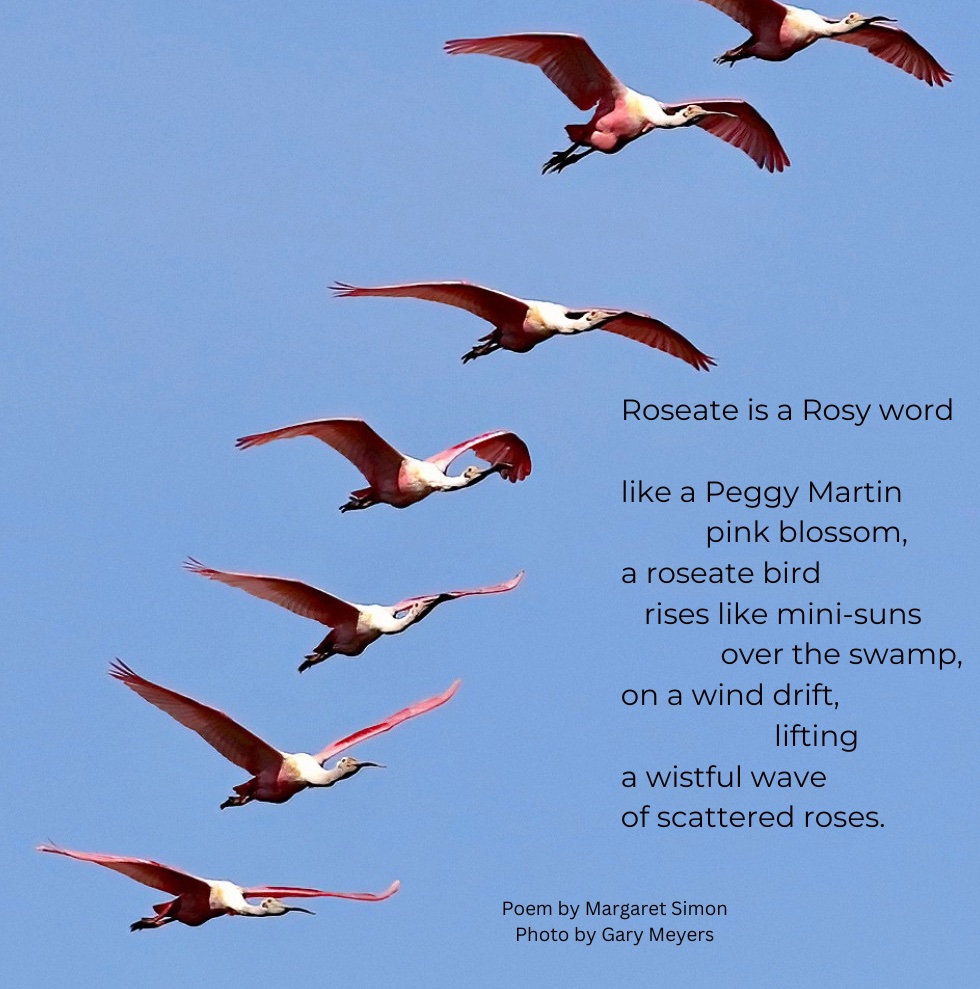
Happy Easter! I gave myself permission to not post today, to take a day off after writing 31 Slices of Life in March and 7 poems-a-day, but inspiration comes as inspiration will. On Facebook, I was tagged by a friend who knows I love birds, Louisiana wildlife, and photography. This photo by Gary Meyers is an amazing photo of roseate spoonbills in flight. I remembered that I wrote a poem once about the bird. One of the ideas Molly and I had for our poetry project was to revise an old poem, so what better exercise to do when I don’t want to write. I borrowed the photo and created a Canva to include the poem.
The Progressive Poem is with my friend, Inkling, best librarian poet I know, Linda Mitchell. Hope to this link to see her Easter bunny gift of a line.
To celebrate National Poetry Month, #AuthorsTakeAction2023 is organizing a community poetry project for kids.
Children’s poets and authors from all over the country are offering poetry prompts and inviting teachers and children to write poems on the topic of climate change.
My poem prompt is a Things to Do Poem. This is a form I used in my book Bayou Song: Exploration of the South Louisiana Landscape. The alligator snapping turtle is not endangered as far as I know, but it is a celebrated Louisiana critter.
To begin, select a bird or animal that is endangered in your area. I did a Google search for my state “Endangered animals in Louisiana.” I was amazed to find out that Kemp’s Ridley sea turtles had hatched near New Orleans. And I also thought they were very cute to draw.
My friend Julie Burchstead sent me instructions for a crayon resist art project.
With a pencil, draw your chosen bird or animal on watercolor paper. Create a contour drawing with no shading. It will look like a coloring book page.
2. After drawing, outline the pencil lines in Sharpie marker. (The marker must be permanent or the ink will smear.)
3. Color with crayon or Cray-pas. Julie says, “Note: The crayon must be applied darkly (thick). If it is too light, there will not be enough wax to resist the wash, and the crayon work will be lost. Any areas that must remain white, must be colored white with crayon. ”
4. Using watercolor paint, select a single color of paint. Pool a few drops of clean water into the chosen color with a wide brush. (Do not use the skinny one that comes with the kit.) Wash (spread) the paint over the whole image. Where there is crayon, the wax will resist the paint.
5. Create a list poem using action words to begin each phrase. You may personify your chosen animal.
Things to Do if You’re a Kemp’s Ridley Sea Turtle
Hatch for the first time in 75 years. Crawl toward the ocean. Leave tracks in sand for researchers to find. Return to your nest on the Chandeleur Islands. Find a protected sanctuary. Restore hope in Louisiana’s wetlands. by Margaret Simon
Here are a few student examples:
Things to do if you’re an Eagle
Fly in the air. Attack little fish. Snag on meat. Glide over the ocean. Soar over 10,000 feet! Symbolize our nation.
by Brayden, 3rd grade
Things to Do if You’re a Grasshopper Sparrow
Land on a fingertip. Eat earthworms, snails, and spiders. Let your wings soar on the ground. Carry on with the wind. Find a sanctuary of protection.
Today I am juggling many hats. First, I am hosting the blog roundup for Poetry Friday. If you participate, the link up will be at the end of this post. 2. I have the next line for the annual Kidlit Progressive Poem (gentle hand-off from Donna who is wearing many hats of her own lately). 3. It’s the first Friday of the month which means a challenge from an Inkling (our writing group’s cute nickname).
The Kidlit Progressive Poem is the dream-child of Irene Latham. I am carrying the torch these days which means I round up all the volunteer writers and send them a reminder if they forget. Not a terrible job, really. So far, it all seems to come together in an amazing poem by the end of the month. You can follow the progression by clicking on the links on the side bar. Six days of April means six lines. I feel like I’m cheating because the line came to me immediately. Repetition is good in a poem and so are similes. Here is the poem with my line added in italics.
Suddenly everything fell into place like raindrops hitting soil and sinking in.
When morning first poked me, I’d wished it away my mind in the mist, muddled, confused.
Was this a dream, or reality, rousing my response? The sun surged, urging me to join in its rising,
Rising like a crystal ball reflecting on morning dew.
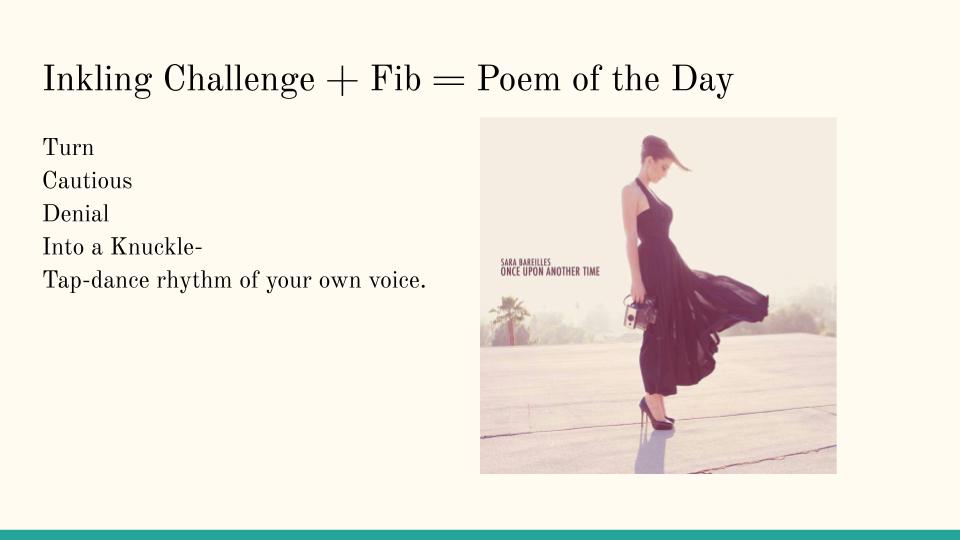
The Inkling challenge this month comes from Mary Lee Hahn. She decided to choose random words as a prompt for a poem. The words were knuckle, denial, turn, cautious.
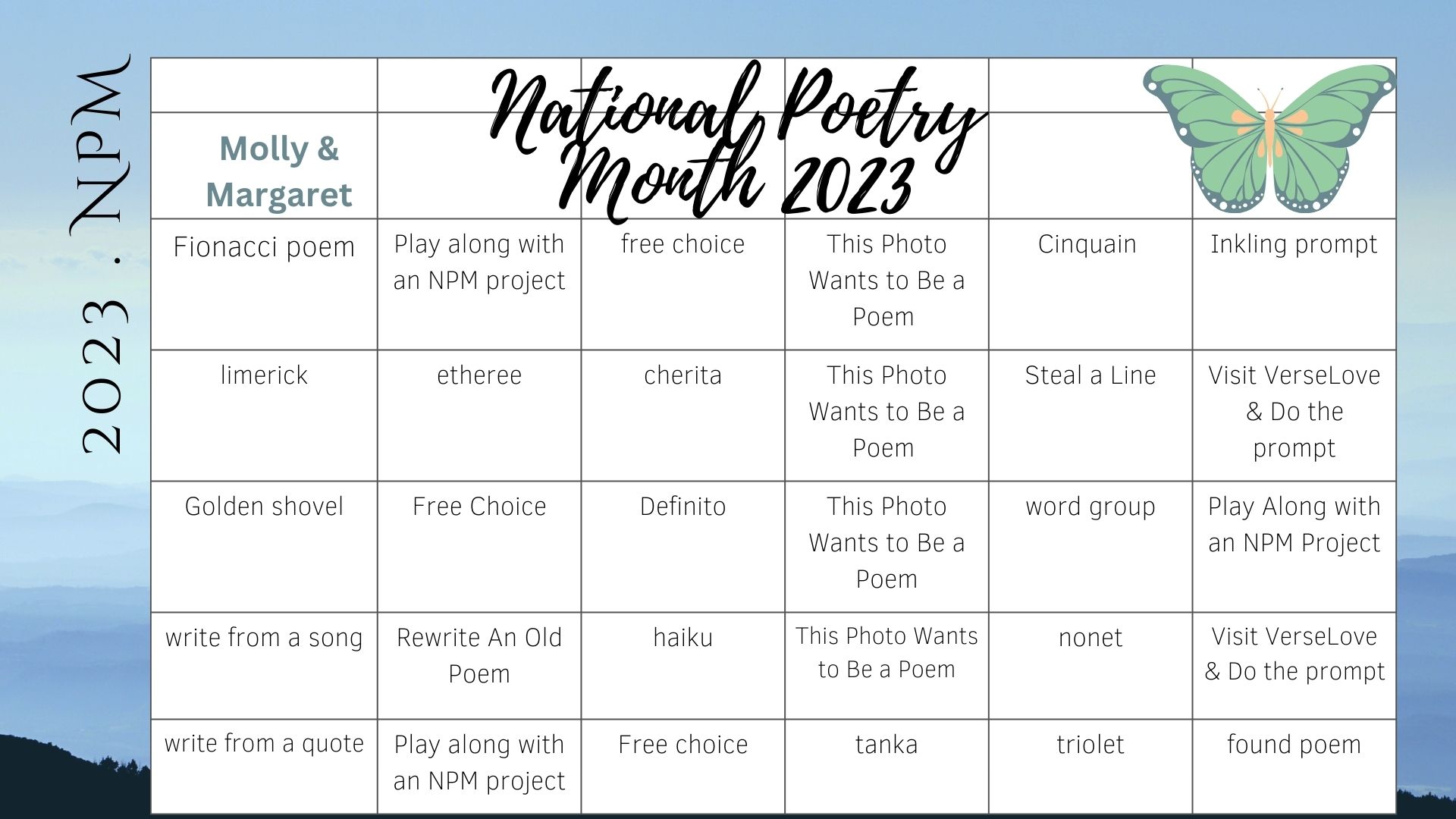
Molly Hogan, fellow Inkling, and I are using a calendar grid for National Poetry Month. Here’s a copy of our calendar which you are welcome to use if you need ideas. I chose to write a Fib poem, a form that uses the Fibonacci Series for syllable counts: 1, 1, 2, 3, 5, 8. (I just realized I didn’t repeat the one syllable line. Fudge it. Too late to revise now.)
On Palm Sunday we sang an anthem in the choir “Lamb of God” by Twila Paris, choral setting by Lloyd Larson. In practice before church, I made the same mistake twice. (For this recording I think I finally said it correctly: I’m the alto voice you hear.)
My choir known as the Heavenly Choir at the Church of the Epiphany, April 2, 2023. “Lamb of God”
The lyrics include “I was so lost, I should have died, but you have brought me to your side to be led by your staff and rod and to become a lamb of God.” I kept mindlessly saying held by your staff and rod. After making this same mistake a third time, I wondered why my mind replaced led with held.
My spiritual journey has been long now. I tuned into my Episcopal upbringing while I was in high school. I attended youth retreats and memorized the words to “Let There be Peace on Earth and Let it Begin with Me.” Even at age 15 I felt the weight of the world on my shoulders.
Over the last decade or so, our larger national church has been controversial. Things have settled a bit, but I am hurt by the numbers of people who have left our church over issues of equality. Where was their faith? In the Baptismal Covenant we agree to “respect the dignity of every human being.”
In my spiritual journey, I am Held by God in dignity with grace that is freely given, given because I was simply born. Amazing, really. Traditionally on Maundy Thursday, we have a foot washing ceremony at the evening service. I imagine what it would have felt like to have Jesus wash my feet.
Footwashing
He held my foot as cradling an infant with tender touch caressed a cloth over and under soiled skin I should have been embarrassed but I felt no shame. only love.
Margaret Simon, draft
The Kidlit Progressive Poem is with Donna Smith today. It will be here tomorrow for Good Friday/ Poetry Friday.
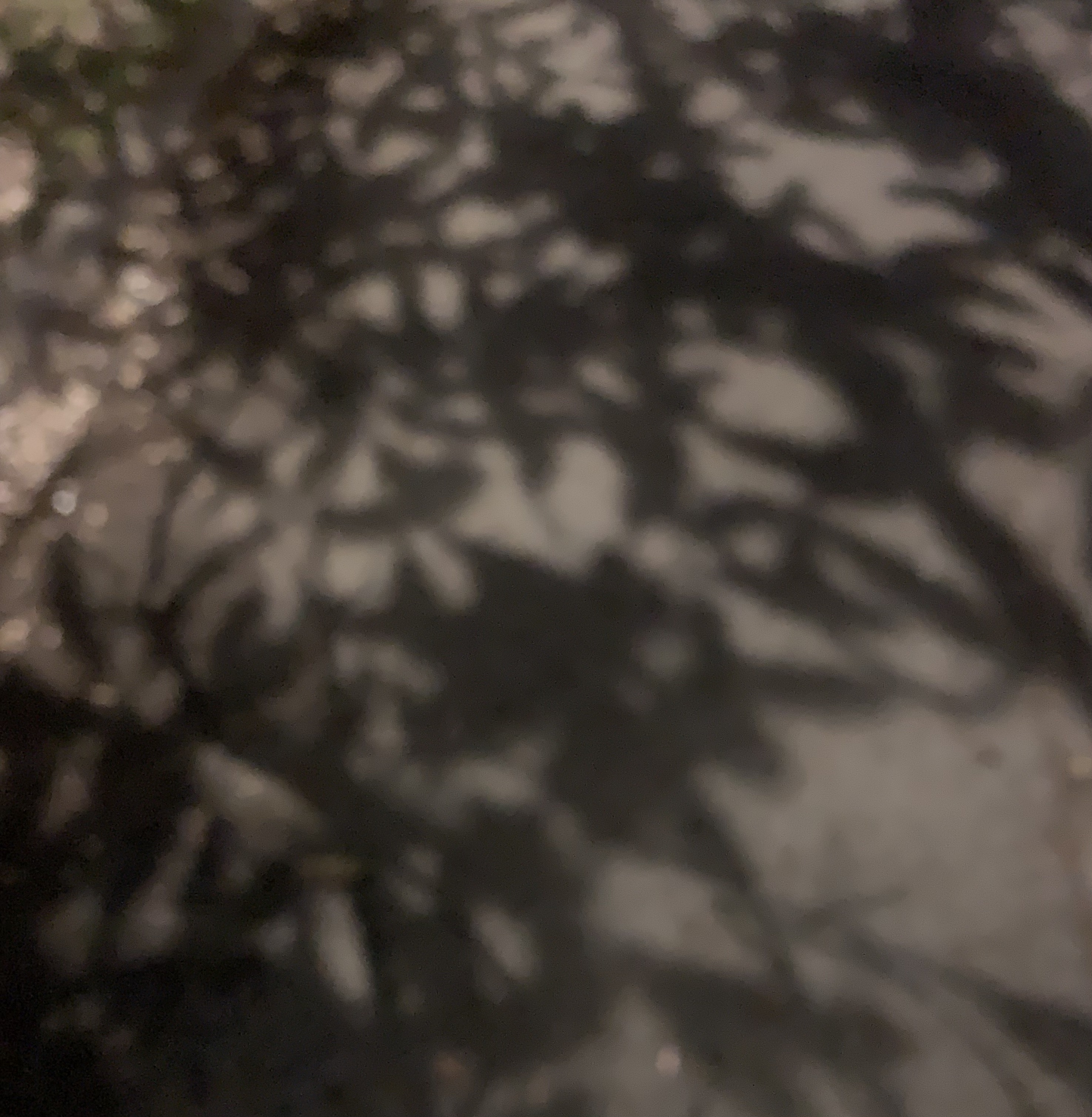
For National Poetry Month, Molly Hogan and I committed to a flexible schedule of writing different forms of poetry, but I insisted on a weekly space for writing to a photograph. While out on my walks these days, I may open the Notes app and hit the microphone to dictate a poem. Yesterday while I walked, I contemplated the Ethical ELA prompt from Jennifer Jowett to write from an ungrammatical stance making nouns into verbs. See her prompt here. I observed the trees along my path, and spoke the words, “When I tree.” Then I saw the shadows from an overhead street light. Shadows are intriguing. I took this photo.
Shadows, by Margaret Simon
Broken Dawn
When I tree, bayou-bell’s song echoes in me. Yellow twinkle of sweet olive scents my breath. Legs ache from last night’s climb. Turn to eastern broken dawn.
Margaret Simon, draft
Please leave a small poem in the comments and respond to other writers with encouraging words. Are you poeming daily this month? Here is a safe place to play with words.
A little over a year ago, my grandson Leo, who was not quite 3 at the time, had a conversation with my daughter. He was sleepy and seemed to be recalling a dream about being bitten by a monster.
“He was sleeping,” recalled Leo.
“And he woke up and bit you?” Maggie inquired.
“Yeah, and it was bleedin’,” Leo said. Then he smiled and said, “You love bleedin?”
“Do I love bleedin’?” Maggie asked in a soothing voice.
“That’s rearry scary! And you might cry, too.”
The words “You love bleedin'” have remained since in our unofficial book of family lore.
Yesterday I had to go have a yearly blood test. Not my favorite thing, but I made it through, and the nurse was as nice as could be, but on the way to school, I thought about the Ethical ELA prompt. Stacey Joy had a wonderful post with links to beautiful words she encouraged us to try. I abandoned that part of the prompt and focused on creating a haiku sonnet in my notes app. Sometimes you just have to say what you want to say. And bleedin’ was on my brain.
Bleeding on the Page
I worry I can’t do what other poets do bleeding with deep love.
I gave blood today opening my elbow for piercing, dark red flow.
A tiny bruise dot reminds me I’m human– Blood tells a story.
Hemmingway says write, it’s easy, open your veins Bleed the words that flow.
So here I am sharing my bloodsong with you.
Margaret Simon, #verselove 2023
Today’s post is part of the ongoing Tuesday Slice of Life Story Challenge at Two Writing Teachers.
Does a poem ever wake you up in the morning, in that liminal space between sleep and awake? I had to get up an hour before I usually do to make sure I captured it.
My mother-in-law whom I wrote about yesterday refuses to write her memoir. She’s written five books now, three mystery novels based on stories from her days as a District Judge, and two historical fiction books. She asked me “What should I write next?” I emphatically said “Your memoir.” Yesterday she looked at me and turned the proverbial key on her lips meaning her lips are sealed. There are some things I already know. She grew up in New Jersey, went to Wellesley then to Yale Law School where she met my father-in-law and moved to Louisiana with him, a shocking move for her parents to grasp.
Mary Lee is writing cherita poems this month. “Cherita is the Malay word for story or tale. A cherita consists of a single stanza of a one-line verse, followed by a two-line verse, and then finishing with a three-line verse…The cherita tells a story.”
Storytelling is about healing the heart and mind.
It enables us to remember and not forget those who went before us, and also of those who loved or hurt us with their words and deeds. The recording, both oral and written, and sharing of stories is age-old. When we start to write, we bring to life the lost words of yesterday – from just a few moments ago to the time of our ancestors huddled around a roaring fire in some smoky cave of all our beginnings.
Be the storyteller and healer you are meant to be. Make us laugh, cry and be entranced by six lines of your words.
Margaret Simon lives on the Bayou Teche in New Iberia, Louisiana. She is a retired elementary gifted teacher who writes poetry and children's books. Welcome to a space of peace, poetry, and personal reflection. Walk in kindness.








 Reflections on the Teche