Thank you to Two Writing Teachers for creating an amazing community of writers and a safe, welcoming space to write and share.
At the beginning of November, our local Bayou Teche Museum hosted Allan Wolf who wrote two books based on a disaster that happened on Jefferson Island in 1980. I posted about his presentation and books here.
Allan had school visits planned for New Orleans and Lafayette, so he worked into his schedule another day. He wanted to further interview people concerning the disaster. He stayed with us on Friday night.
Early Saturday morning I woke up to a text from Allan that he was staying through lunch to be able to meet once again with Mike Richard, the owner of Rip Van Winkle Gardens at Jefferson Island. I joined him on this venture.
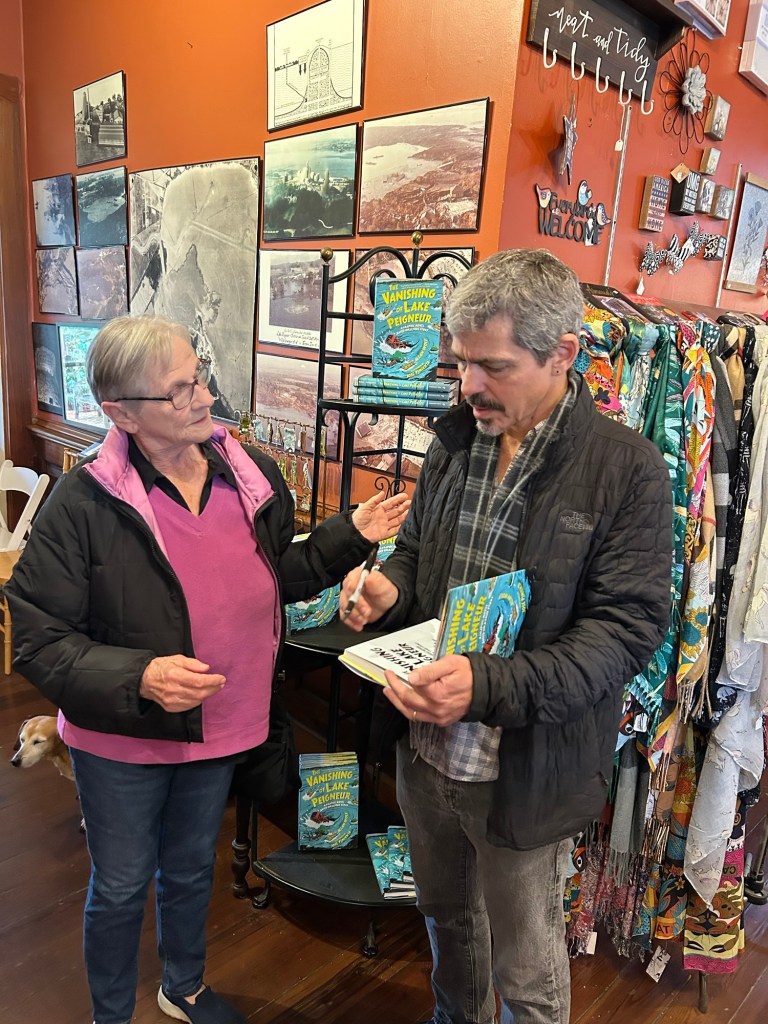
When we walked into the gift shop, we were struck by a display of Allan’s graphic novel. While there a woman walked up and bought the book, an impromptu signing.
Allan Wolf signs “The Vanishing of Lake Peigneur” for Mona in the gift shop of Rip Van Winkle Gardens.
Mike led us out to view the lake and then into the bustling restaurant. We had gumbo and enjoyed hearing Mike’s stories about the geography of the lake and salt mine that is still bubbling in places due to trapped gases.
It was fun to be a bystander listening to Allan and Mike talk and talk. I am fascinated by their fascination. Even though the books are published, Allan can’t stop digging into the story.
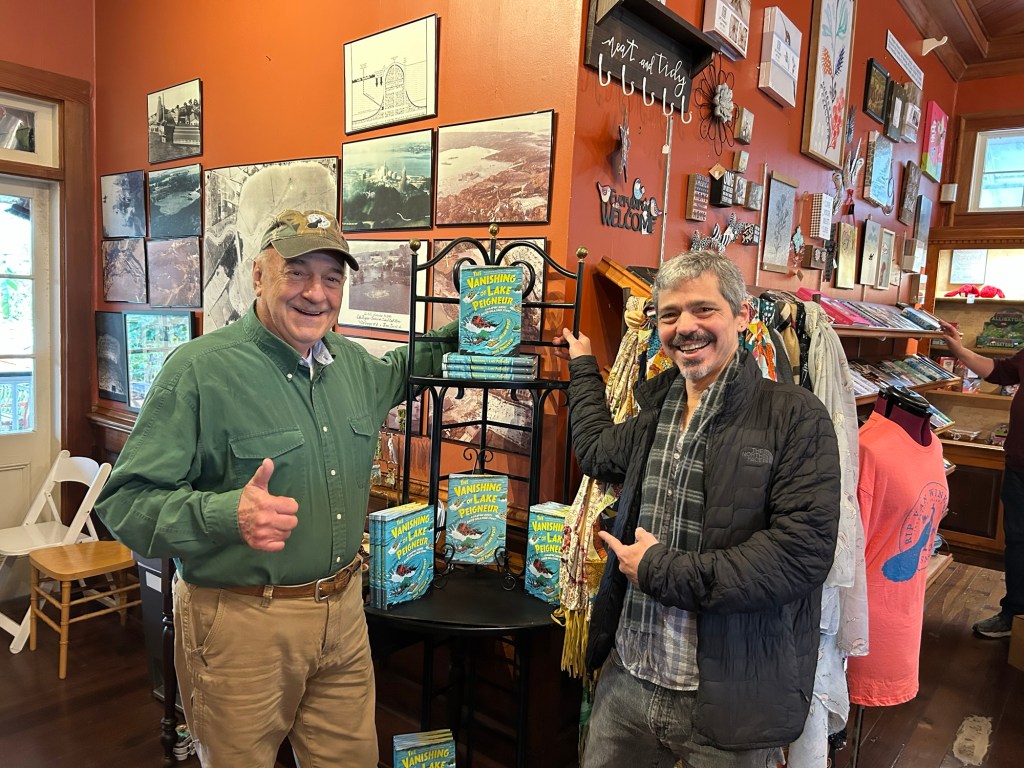
Mike Richard, owner of Rip Van Winkle Gardens, and Allan Wolf, author of The Vanishing of Lake Peigneur.
On the 45th anniversary of the mine disaster, Myrna Romero was interviewed by a local TV station, KATC. Here is that quick interview.
Thank you to Two Writing Teachers for creating an amazing community of writers and a safe, welcoming space to write and share.
When I heard from Allan Wolf by email that he had been invited to the Louisiana Book Festival, I grabbed at the chance to have him come to our Bayou Teche home.
Allan started coming to South Louisiana in 2007, performing at schools and libraries and leading teacher workshops at the Acadiana Center for the Arts. I became a fan. The first time he visited Jefferson Island and saw a chimney in the lake, he became intrigued by the disaster in Lake Peigneur of 1980.
A brief summary of that disaster: An exploratory drilling rig from Texaco accidentally punctured a salt mine and set off a harrowing series of events. The miraculous thing is all the miners, fishermen, and tug boats escaped and there was no loss of human life. The lake turned into a whirlpool and the Delcambre Canal flowed backward.
This historical disaster happened 45 years ago in my home town of New Iberia, Louisiana. Allan wrote two books based on the event, and no one in my town knew about these books. I set out to change that.
It became my mission to get him here and to organize a book talk at our local Bayou Teche Museum. With the way news media works these days, I advertised mostly by word of mouth (The “Teche Telegraph”) and by email and social media. Allan and I were hopeful that 20 people would show up, even though I ordered 50 chairs.
Allan was hoping people who had been there that fateful day (Nov. 20, 1980) would come and share their stories.
We had an overflowing crowd of 65 people. Allan paid tribute to the tug boat captain, Ores Menard (age 95), who sat on the front row with his wife and daughter. Allan had interviewed Mr. Menard for hours.
A woman walked in early and shared that she was one of two women in the mine. Allan brightened up. “I knew there had to be women in the mine. I knew about one, but I didn’t know about you!”
Allan Wolf and Myrna Romero, survivor of the 1980 Lake Peigneur disaster.
Myrna brought him her typed story and showed him the jumpsuit that she wore. Allan told her on one of his last interviews, he discovered there was a woman, so he had the artist place her into the graphic novel.
The thing about research that Allan has learned (and I have as well with my biography of Emma Wakefield Paillet) is it’s never finished. Once a story is told, it becomes a living document.
In his presentation, Allan explained that some of the characters in his book are composite characters, more than one person rolled into one. Three dogs became one. Two boats became one. However, the gist of truth is there.
This has been an April full of poetry. In between the dreaded test prep, I have offered my students poetry breaks. I pulled out all of my poetry books and let them dig in. We also wrote some poetry. My students, when they hear the word poetry, breathe a sigh of relief and joy. I am lucky they are young and haven’t been stained by the bee that says poetry is hard.
We’ve watched a few of Allan Wolf’s Poetry Month videos. They are all on YouTube. It’s like having him visit my classroom with all his humor, antics, and natural Po-Love. My students loved watching him juggle while teaching them about dactyl meter. Sadie, 4th grade, is writing her own poems using dactyl meter.
My emotional bees
Make me want to have pet fleas!
My emotional bees
They just never seem to ease!
Sadie, 4th grade
My third grade student, Avalyn was drawn in by Marilyn Singer’s reverso poems in Mirror, Mirror and Follow, Follow. I sent Marilyn a message on Instagram, and she sent us a “Tips for Writing Reverso Poems.” Avalyn borrowed a few lines and created a poem of her own. We discovered reversos are really hard to write well.
Very pleasant, happily ever after. Luggage is packed. You sob. Nobody is there.
Nobody is there, you sob. Luggage is packed. Happily ever after, very pleasant.
Avalyn, 3rd grade
Each week I present This Photo Wants to be a Poem on my blog and with my students on Fanschool. You can see their Prime Number Haikus this week at this link by clicking on the comment button at the bottom of the page.
Prime Number Haiku
Bubble Blossoming Grows great and strong but Will not stay for very long You try to win but you will pop very soon
Adelyn, 4th grade
April has been a wonderful month of poetry. Thanks to all of our Poetry Friday friends who have contributed to the Kidlit Progressive Poem which is still traveling, almost done. Today it’s at Karin Fisher-Golton.
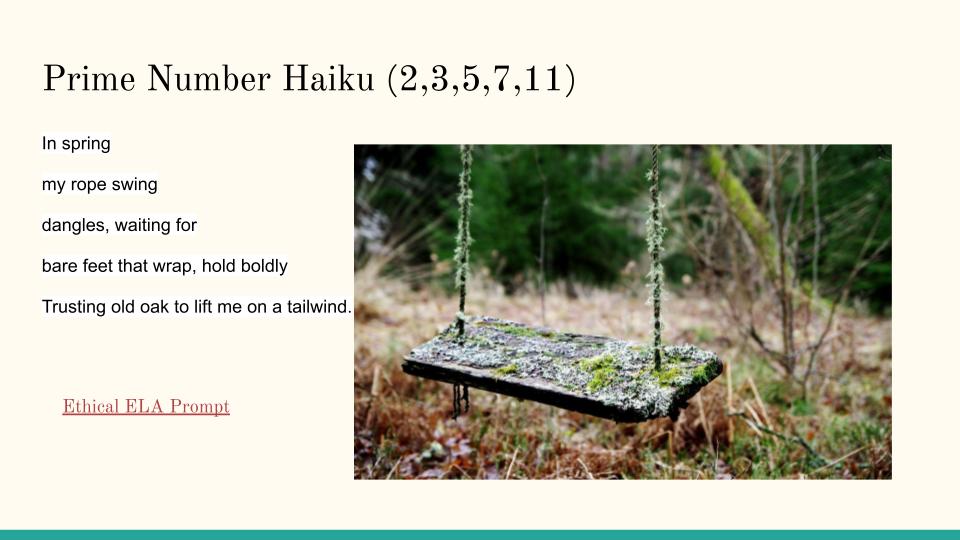
I am keeping all of my daily poems in a slide show. Here’s my own Prime Number Haiku which was a prompt from Ethical ELA.
My birthday is in August. August is the first month of school when everything is getting put into place, so when the birthday buddy list was circulated, my birthday had passed. I never gave it a thought.
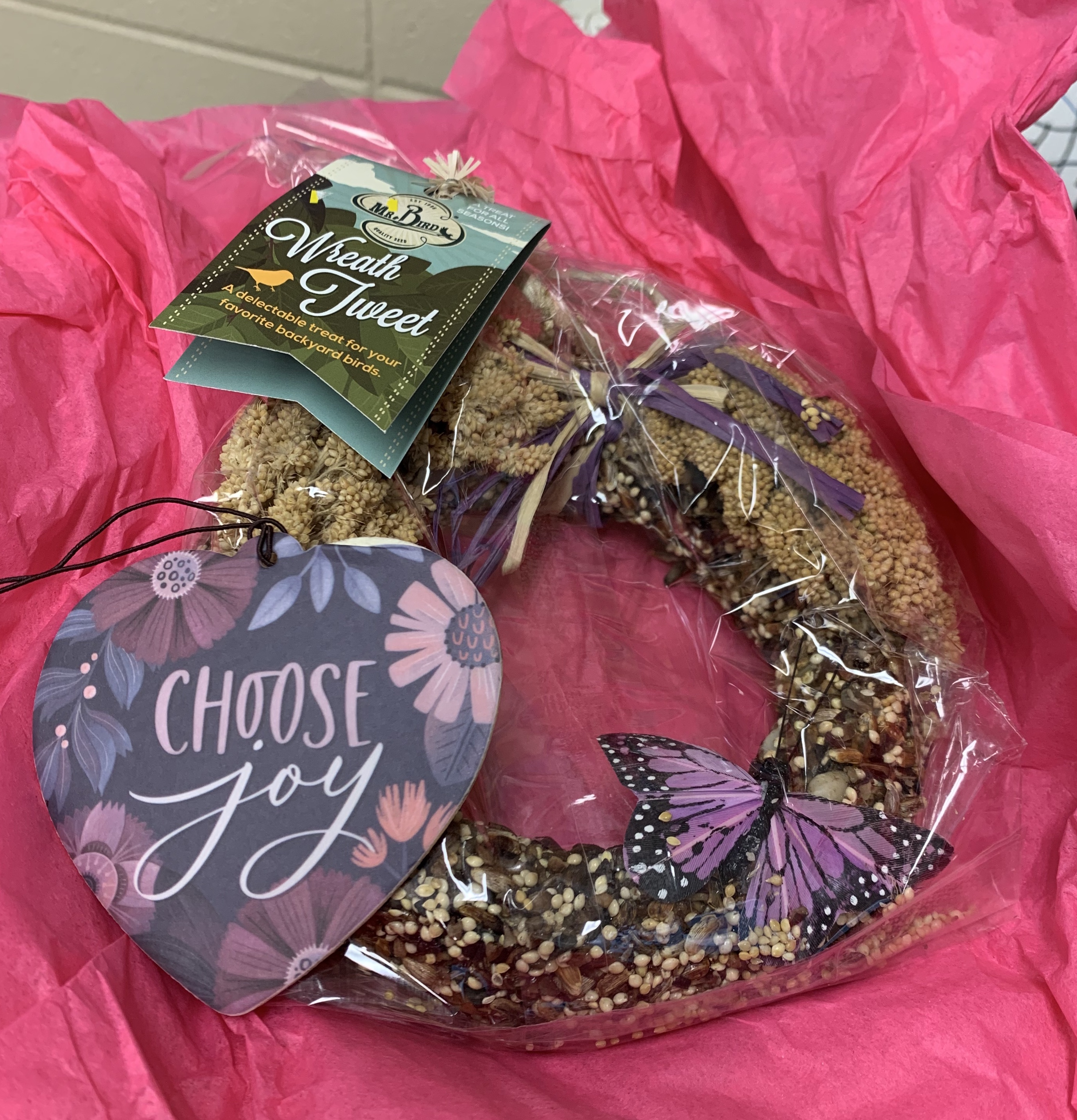
Until Monday when a special gift was delivered to me from a third grade teacher. On the note, she wrote “Happy Birthday from your Birthday Buddy! Since your birthday had passed when I received your name, I got to choose today to celebrate you!”
Not only was the thought of a nonbirthday-birthday fun for me, the gift was just right, a bird seed wreath to hang near a window to watch the birds come to eat. Thoughtful, kind, and all about me!
On Monday, I shared Allan Wolf’s poem “Living the Poet’s Life.” Each line begins with “A poem can be…” Allan is sharing videos each day of this month on his Instagram as well as YouTube.
Allan Wolf reciting “Living the Poet’s Life”
My students and I borrowed the form to write our own poems repeating the line “A poem can be…” I made my poem into a zine thank you note for my birthday buddy.
The Kidlit Progressive Poem is with Cathy Hutter, Poeturescapes.
I met Allan Wolf years ago when he visited and presented in our area. He’s incredibly entertaining in real life. He is also one of the kindest people I’ve ever met. So when an opportunity appeared to get an ARC of his latest book of poems, along with an interview, I jumped at it.
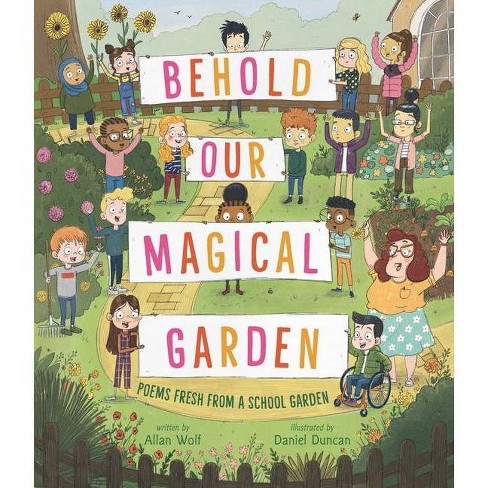
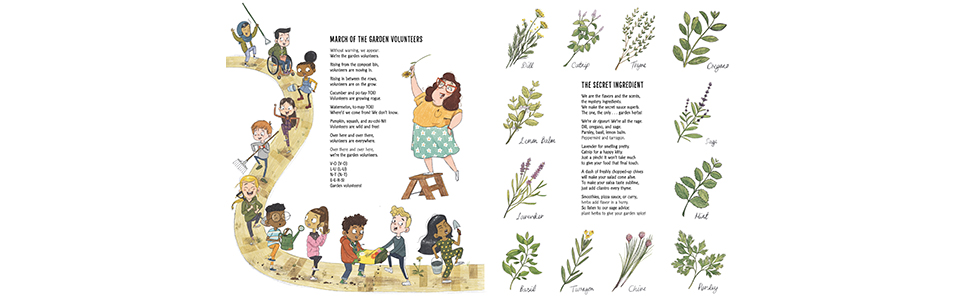
Behold our Magical Garden is full of poems that take us into a school garden. You can jump in without getting dirty. The poems are lyrical, funny, and informative. They beg to be read aloud. Behold Our Magical Garden was released on March 8. Please enjoy this delightful interview with Allan.
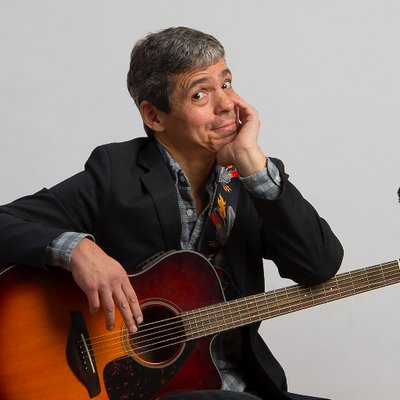
Allan Wolf is a member of the species Poemo sapien. He often vocalizes in verse from atop chairs. He spends many hours alone sitting at his nest using his imagination to make things. Although he is 59 years old and 5’8” in height, he imagines himself much younger and much taller. He is a writer of poetry, novels, and picture books, and a serious believer in the healing powers of poetry. His latest collection of poems is Behold Our Magical Garden: Poems Fresh from a School Garden, illustrated by Daniel Duncan.
What inspires your writing?
Reading is a big inspiration. Listening to music. Watching performances of all kinds. Observing and experiencing any creative expression that resonates and moves me. While I certainly am a writer, I am more specifically a creator. I have an urge to create. We all have these urges to create life from the clay of our imaginations. And in that respect, we are all amateur gods. Writing and poetry is my default medium.
Why poetry?
Since I first discovered rhythm when I was four years old (I remember it as if it was yesterday!), my thought process has lent itself well to poetry, metaphorical thought, rhythms, rhymes, music, story. And most importantly, my brain is something of a non-linear array of constellations of thought bubbles, with observations flying in and out, unbidden as birds.
Words give a poem sense, while the space between the words give it resonance. Poets can arrange words based on craft, style, and clarity, just as prose writers do. But poets don’t have to stop there. Poets can arrange words based on prescribed patterns . . . or not. Poets can even arrange words wherever the words instruct them too. Space is key. Space between words. Space between lines. You can even remove a word, like you would remove a superfluous wisdom tooth. Line-breaks can be purposefully clunky or smooth. When a line breaks, the words turn. The poem’s rhythm may also turn. The poem’s pace may turn as well. The reader’s eyes, heartbeat, and attention all turn. (Bonus Fact: The word “verse” comes from the Latin, verso, to turn.)
The poet chooses
where
the lines break.
Three things you love?
One) I love juggling (just juggling balls, not clubs, or rubber chickens, or chainsaws! Well, maybe I would love to juggle rubber chickens. That would be really funny!)
Two) I love making music, playing the guitar and the drums, singing, and making up songs.
Three) I love being an author of books! There is such a feeling of closure to have your thoughts and ideas and words and revelations enshrined within a book that is widely available to all. It is a sense of relief, that my words will continue to live and to speak, long after I’ve stopped doing either one.
Oh and, Four) Puppets! Let’s not forget puppets. I love puppets.
During the pandemic, how did you keep creating?
Like many of my writing colleagues, I was surprised how hard it was to keep creating new work, even with two years of mandatory “free time.” I had already been reassessing my work, even before the pandemic. At that time the Black Lives Matter and Me Too movements were already in full swing. As a white male writer, I felt like it was more a time to listen than to speak. Then the pandemic, with its forced stay-at-home quarantine, provided the necessary Petri dish to amplify the whole conversation. During that time, I temporarily set aside my most pressing novel, the one I’m back at work on now. It has taken me all this time away from it to reassess what I was trying to say. So much has changed. Meanwhile, throughout my writer’s block, I was actually writing poetry and picture books, which can be a little easier to carry around in your head without going nuts. I also made a lot of videos and I organized my private journals (which I’ve been keeping since I was 12 years old).
What are you most proud of?
I’m most proud of my wife and my children, Simon, Ethan, and James. As for writing, it’s hard to say. I’m proud of the Iceberg character/narrator in The Watch that Ends the Night. That character’s voice is written in iambic pentameter that gradually melts to tetrameter, trimeter, dimeter, and finally, monometer. The Iceberg’s last two spoken words, “I am,” are actually an iamb!
Do you have a writing activity to pass along? (I’d like to challenge my readers and my students to respond.)
What’s In a Name?
ONE) Begin by generating a list of all the “names” you are known by. General Names, like son, daughter, best friend, hero, helper, athlete, or alchemist. And Specific Names like Elizabeth, LaQuesha, Darius, or David. And Nicknames like Doodle, Tutu, Junior, or Jack.
TWO) Choose one example from your list. Using informal prose write “the story of your name.”
THREE) After you’re done, circle (or highlight) five to ten words or phrases that seem integral to your story. Next, use those chosen words or phrases as the building blocks of a poem.
Note to readers: If you do Allan’s challenge, add your poem to this padlet.
Gifted by Nature Day was coming up, and I had forgotten that it was my job to do a poetry activity. Yikes! What would I do? Some middle school students would be doing a play based on The Jungle Book. Their teacher explained in an email to me that the theme would be Be Yourself.
I typed into Google search “Bio-poems.” I didn’t want to use the same ole bio-poem form. Up pops one of my favorite performance poets, Allan Wolf. On his website, he had this mentor I Am poem.
I created a document that outlined each line. As each student completed their art activity, they came over to my poetry table. My first question was “Do you know what alliteration is?” Most of the kids didn’t recall this term, but that’s OK. I taught them very quickly, and they said, “Oh, yeah!”
Writing that first line proved the most difficult. The students I was working with are gifted, and there’s nothing better than watching a gifted kid feel a challenge. Encouragement came from other kids who had found a first line.
Wyatt was happy to share his first line. “I am an All Star Athlete.”
Noah, who loves to hunt, created, “I am a hard-headed hunter.”
A young Laotian girl named Patra sat next to me and said with complete honesty, “I am a little, lovely lark.” I encouraged her to use that metaphor throughout her poem. Her teacher texted me a copy to feature here.
I am a little, lovely lark. I wonder what it’s like to fly. I hear people talking. I see the puffy, fluffy clouds. I want to fly.
I am a little, lovely lark. I pretend to fly. I touch feathers. I worry when I’m late. I cry when–I don’t cry much.
I am a little, lovely lark. I understand Laotian language. I say, “Ha! Ha! Ha!” (me laughing) I dream about flying. I try to do my best in school. I hope to grow wings!
I am a little, lovely lark.
Patra, 3rd grade
Jacob missed Gifted by Nature Day, so I presented the activity to him back at school. He decided to take his poem in a different direction and become a planet, specifically Mercury. You can read his poem here.
This form worked for multiple elementary grade levels from 2nd graders to 6th graders. If you chose to use this activity in your classroom, I’d love to hear from you.
Poetry Friday round-up is with Carol at Beyond LiteracyLink.
Allan Wolf…
Just like the animal
Allan Wolf…
Just like the animal
We chanted these words back and forth in a delightful performance at the Lydia library. Allan Wolf performs and teaches about poetry with pizazz. He makes poems sing, shake, and shine.
I invited my students to join me in seeing Allan Wolf’s performance at the library. Four of them came. I loved seeing them and catching up on what they are reading and doing this summer.
Allan Wolf engages the audience. Through singing and dancing, he demonstrates how poems are musical. We all wiggled, made sound effects, and echoed to participate in the fun of poetry.
In this video he is showing kids how nursery rhymes are our first exposure to poetry, and they work because they rhyme. But mostly, the kids are just enjoying his humor when he gets the words wrong.
My students write a lot during the school year and for Poetry Month, they write a poem every day. Kaiden wanted to share his favorite poem “Wonder” with Allan Wolf. After the performance, Allan continued to engage with my students. Erin told him about our Slice of Life challenge and how she hates having to write an SOL every day.
Allan turned to a box on the table that he hadn’t used in the performance. He was sharing a secret with just us. He opened it to show two vials, one looked like water, the other thick syrup. He explained the process of getting syrup out of the tree sap. The sap must be boiled down. Then he showed them a gallon jug of tree sap. “It takes this much sap to make that much syrup.” That’s how writing is. You have to write and write to get the best, sweetest writing.
Allan Wolf did more in that metaphor moment to bridge the summer to next school year than any summer program could. His performance was fun, but the time he took to interact with my students and me afterwards was invaluable. Authors are my heroes.
At the beginning of his performance, Allan points to words on a makeshift clothesline to introduce himself. When he talks about the word “author”, he pronounces it with two gestures: “Aw” with sweet eyes and soft voice, and “Thor” with a raised arm as if he is holding a torch and a strong voice. Because authors are both sensitive and brave. Allen Wolf is a true “Aw-Thor”!
A selfie with Allan Wolf and Sami Sion, the best librarian ever!
Margaret Simon lives on the Bayou Teche in New Iberia, Louisiana. She is a retired elementary gifted teacher who writes poetry and children's books. Welcome to a space of peace, poetry, and personal reflection. Walk in kindness.









 Reflections on the Teche