Feeds:
Posts
Comments

Posts Tagged ‘Darrell Bourque’

Thank you to Two Writing Teachers for creating an amazing community of writers and a safe, welcoming space to write and share.

A few weeks ago I attended a writing workshop with one of my mentors Darrell Bourque, former poet laureate of the state of Louisiana. He asked us to look at common language to explore in a poem form. He suggested a pantoum. I wrote one there, but there were parts that didn’t work for me, some rhymes that seemed forced. Was my heart in it? I knew what I wanted to say. Sometimes a form is the just right thing to contain all that your poem wants to say.

This workshop, Darrell’s gentle guidance, have stayed with me. Last week I copied into my Notes app a billboard catch phrase, “I triple-dog-dare you.”

Yesterday I read Fran Haley’s post, a beautiful pantoum about a rainbow. I looked up the form again and took another shot. This one satisfies me.

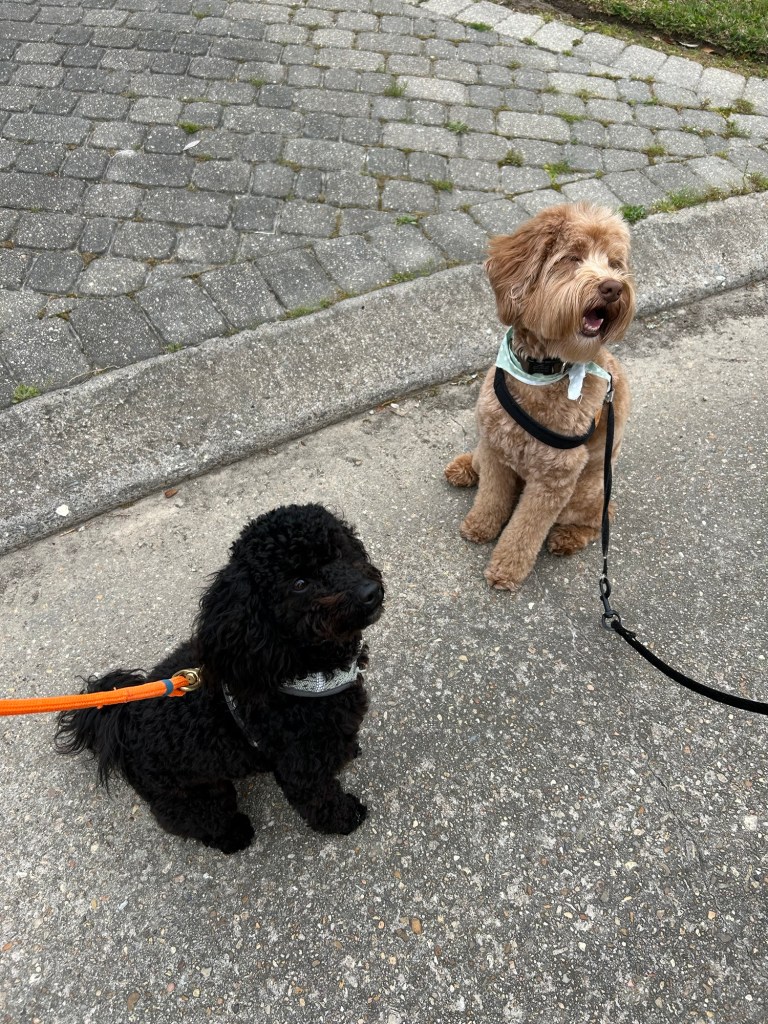
On Sunday I texted my neighbor to go for a walk with our doodle dogs. Her husband passed away last Sunday. I didn’t know if she would be up for it, so I was pleased when she agreed to go. Even though she thanked me profusely for reaching out, I felt it was my honor to be with her. Grief can be a weird time, and we are often not sure of the “right” thing to do to help someone through it. The dog walk was the right thing for both of us.

Dog Walk Pantoum

Split in a million heart pieces,
I triple-dog-dare you to go.
We walk our dogs on their leashes
connecting puzzle pieces as we go.

I triple-dog-dare you to go
to the place where grief hides in shadows. 
Connecting our puzzle pieces as we go.
Comfort in our walk-talk grows. 

The place where grief hides in shadows;
Listen close to the sound of the wind.
Comfort in our walk-talk grows.
Each of us finds a good friend.

Listen close to the sound of the wind
chimes, like a million heart pieces.
Each of us finds a good friend.
We walk our dogs on their leashes. 

Margaret Simon, draft

Albert and Ruby

Read Full Post »

National Poetry Month 2019: I am playing with poetry alongside Mary Lee Hahn, Jone Rush MacCulloch.Christie Wyman, Molly Hogan, and Catherine Flynn.
This weekend in New Iberia was the third annual Books along the Teche Literary Festival.  On Friday, I attended a reading by former state poet laureate and one of my mentors, Darrell Bourque.  He brought along accordion artist Mary Ardoin Broussard. 

Mary Broussard plays the old Creole style of Zydeco music known as La La music.  Darrell’s poems from his book Where I Waited (Yellow Flag Press, 2016) are written in the voices of early Cajun and Creole musicians from the 1930’s and 40’s.  Cajuns and Creoles in Louisiana spoke French.  I don’t speak French, so sometimes I have a hard time following along.  I love this music for its dancing beat, but I can’t sing the lyrics and rarely know what they mean. 

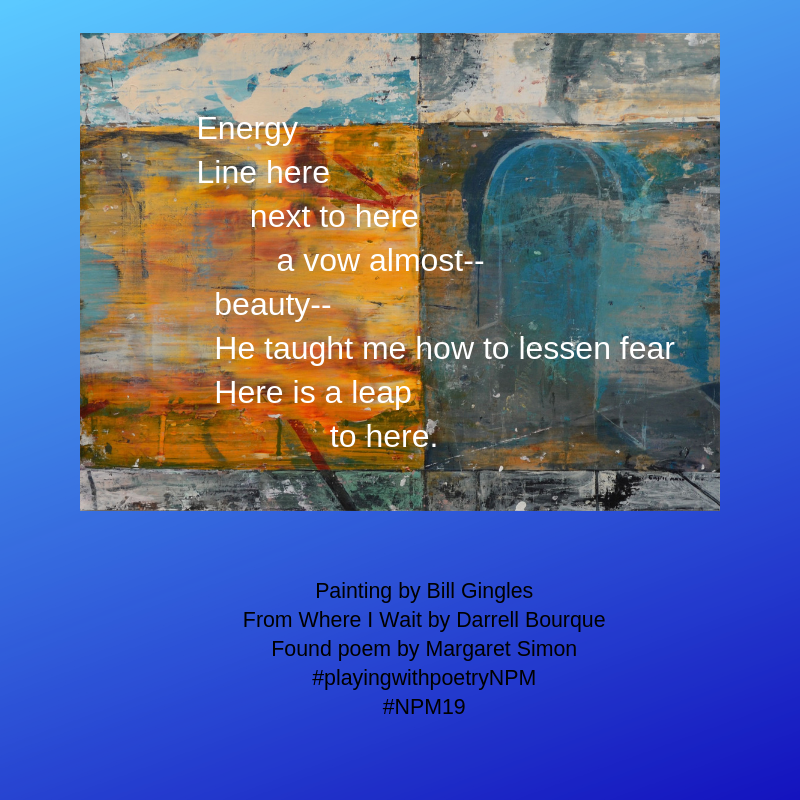
Darrell wrote about the song Quoi Faire in his poem for Golden Thibodeaux with the title “Here and Here.”  Mary said quoi faire means “Why you broke my heart like that?” 
 
Darrell then spoke of the energy in Golden Thibodeaux’s music.  I, however, listened to the energy between Darrell and Mary, making their own kind of music by echoing and honoring the voices of the past.  

I played in a different way with my own poetry finding new lines within the lines of Darrell’s poem Here and Here.


Read Full Post »

Join the Tuesday Slice of Life

Join the Tuesday Slice of Life

As a fundraiser for the Festival of Words, Darrell Bourque, former Louisiana state poet laureate, offered a master class. I submitted 3 poems and was accepted. Twelve poets gathered in Darrell’s home on Saturday afternoon. His house is set in a grove of bamboo. To get to the house, you walk through a shaded garden, enter a beautiful courtyard then into his art-filled home. I immediately relaxed and felt welcome.

Once the others arrived, Darrell quickly began teaching. I’ve known Darrell for more than 15 years. I’ve taken a number of workshops with him, but this was different. While I missed the interchange of ideas of the workshop style, I adjusted to just listening. His knowledge did not intimidate me as I expected. Instead, I understood. I followed. I wrote notes. I was a student and a poet.

He started off by telling us that there are no mistakes. He compared writing a poem to making a quilt. You get all the pieces laid out, and then you can move them around until a new pattern emerges. He challenged us to look for a pattern.

He took each person’s heart out, held it up to the light, and shaped it into something more beautiful, more glowing.

In an email to us all on Sunday, Darrell wrote this verse about this group of poets:

Brushing a child’s hair,
sitting by a powerful river,
taking a lunch break and really listening while being at work,
seeing angels,
standing next to sleeping Gypsies,
traveling toward the beloved,
salvaging the essential after rupture,
letting footsteps become prayers,
searching for traiteurs and medicine men,
sewing a new seam,
visiting monasteries,
standing in the presence of natural wonder
or grieving for a lost child—
these are all common experiences which you made extraordinary by your making them a part of your most essential human experiences. I thank you heartily and I wish you all continued good luck.

To show the results of Darrell’s shaping, I am posting one of my poems in both versions. He found the pattern of commands to make my poem-quilt clearer, stronger, and just plain better.

After the Storm (version 1)
If you want to study the skeletons of frogs,
take a walk after the storm when the sun comes up.
Listen to mockingbirds sing, high-pitched, discordant.
Walk the path of fallen limbs, clustered leaf-puddles.
We are washed yet still unclean. New day sun breaks
deepening the green, solid, and strong earth. Red spots
glitter after I glance at the spotlight. God’s eyes
peak through the ghost of a waning moon. Wren gathers
twigs for nesting, flutters off like a thief with goods.
No need for imagination here; all life breathes.
The beat of my footsteps become my prayer.

After the Storm (Darrell’s reshaping)
Study the skeletons of frogs.
Take a walk in the light after the storm.
Listen to mockingbirds in discordant songs.
See the sun deepening the green earth.
Glance at the sun; see the red spots glitter.
Peak through the ghost of a waning moon.
Gather twigs for nesting; become the wren.
Flutter off like a thief with his stolen goods.
Imagine nothing; all life breathes.
Let my footsteps become prayers.

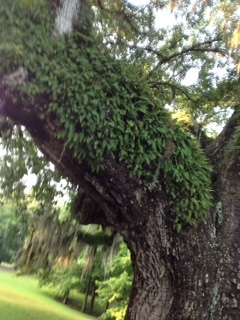
After a storm, resurrection fern fluffs up and becomes a green blanket on the live oaks.

After a storm, resurrection fern fluffs up and becomes a green blanket on the live oaks.

Read Full Post »

Ekphrasis: Poetry confronting a work of art.

I was first introduced to this poetry form by my mentor and Louisiana’s 2011 poet laureate Darrell Bourque.  In our workshops, Darrell would pass around a postcard collection of works of art and inspire us to write.  This was usually successful for me, so I have passed this process on to my students.  The book I use most is Heart to Heart, edited by Jan Greenberg. In her book, the poems are placed beside the work of art.  I use this book to model the different forms ekphrasis can take.  The ekphrastic poem can be a description loaded with imagery or a story poem in which the poet becomes a part of the painting.  Here is a link to my students’ poems on our classroom wikispace: http://gtallstars.wikispaces.com/Ekphrastic+Poetry

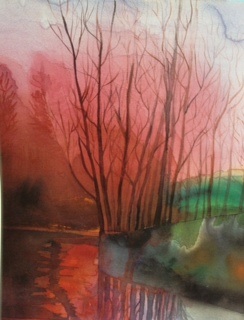
Today I wrote with my students as I usually do.  I have this beautiful book of the River of Words award winners. The painting I chose was titled Sunset in River.

by Khumar Gumbatova, age 13

The sunset becomes a rainbow
in fields where
silhouettes of trees
stand like soldiers
guarding this sacred land.

Sun reddens water
now a glowing sea where
hidden flowers grow.

Sometimes
at sunset I imagine
all life praises
God.

The 30 Day Poetry Challenge Day 23: Write a seven line poem that begins with “it’s true that fresh air is good for the body” (from Frank O’Hara’s poem “Ave Maria”) and ends with “this is our body” (from Gary Snyder’s “The Bath”).

It’s true that fresh air is good for the body.
Breathe with your eyes closed like the sleeping Tom;
Taste the sweet honeysuckle nectar
while the wind tickles your cheek,
and you listen for the distant call of the cardinal
red in his cocky plumage.
This is our body.

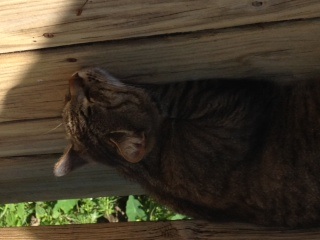
Buzz naps while I write. He inspires a line.

Read Full Post »