Feeds:
Posts
Comments

Archive for the ‘Poetry’ Category

Join the Tuesday Slice of Life
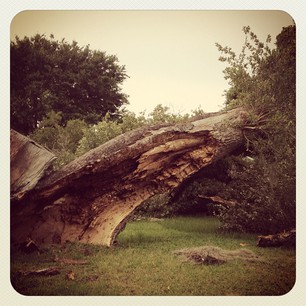
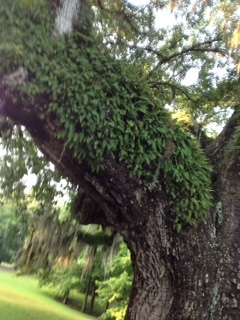
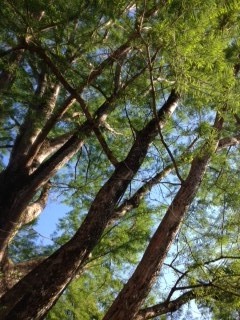
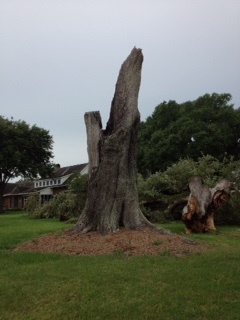
Ever since this old oak fell more than a week ago, I knew it had a poem to give me. I have learned and continue to learn to wait for writing. First, I walked down to the empty lot where it lay and took pictures. I played with Instagram for the one here. Then I sat with a favorite poet, Mary Oliver. Mary doesn’t fail me. I felt like we were writing side by side. I opened her book, Red Bird, to the poem Night Herons, and one line jumped off the page, “what do we know/ except that death/ is so everywhere and so entire–” Using her form of four lines per stanza and borrowing this line, I wrote a poem about the tree.

An oak tree
fell in the night
while we were sleeping,
unknowing.

Its body broken
by invisible flames,
trunk separated
from leaves, from life.

Happy resurrection fern
clings, even as
clouds form
rain again.

This keeper of stories,
survivor of hurricanes,
fell in a summer storm,
just tired, I guess.

That was the end of growing
as we know it, yet
what do we know
except that death

is so everywhere and so entire–
culling and clearing,
sometimes taking
an old friend.

One strike, one boom,
and the lot fills up
with sprawling branches.
How long

will we walk by
and watch the decomposing?
How long until the chainsaw
destroys?

Until then, I will stay
pray to this sacred sculpture
and to its sculptor:
Rise and sow again.
Read Full Post »

On the Lake

Join the Tuesday Slice of Life

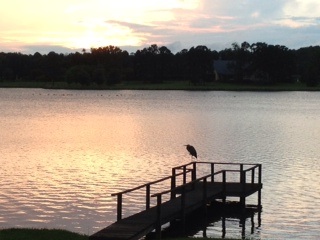
I spent the weekend on New Castle Lake with my parents. I never get tired of this place. Every night the sun set is new and beautiful. There is a great blue heron that hangs out on the peer fishing and guarding. Canada Geese, an unwelcome invasion, litter the far side of the lake while a mother duck swims by with her brood of five in a perfect line behind her. This place is inspiration for relaxing, reading, sleeping, and writing.

Because I was at home for a book signing at Jackson’s landmark independent bookstore Lemuria, conversation often turned to writing.

At lunch on Sunday, my father offered this wisdom, “When you don’t know what to write, WRITE.”

Mom echoed that Hemingway said there is no such thing as writer’s block.

Minka, their friend and priest, said, “I sometimes have to write, ‘Stay, Minka.'”

We all value the time and commitment writing takes.

At church, I was asked by a former high school classmate, “What possessed you to write a book?” I had to laugh out loud at the question. As though to be a writer one must be possessed.

I am possessed by a love of language.
I am possessed by the belief that a teacher of writing should be a writer.
I am possessed by the story, the poem, the words that want to be written.
So, yes, I guess I am possessed.

The great blue heron guards this lake
standing on wrought-iron legs firm and tall
while his blue-grey wings fan the breeze.

Mother mallard leads her paddling through
the canal, picking at the grassy border,
feeding class for the day.

At sunset, I fish with my brother.
His casts are smooth and long,
Mine awkward and clumsy.

Cast on this side
Don’t release your thumb until you swing,
Fishing class on the dockside.

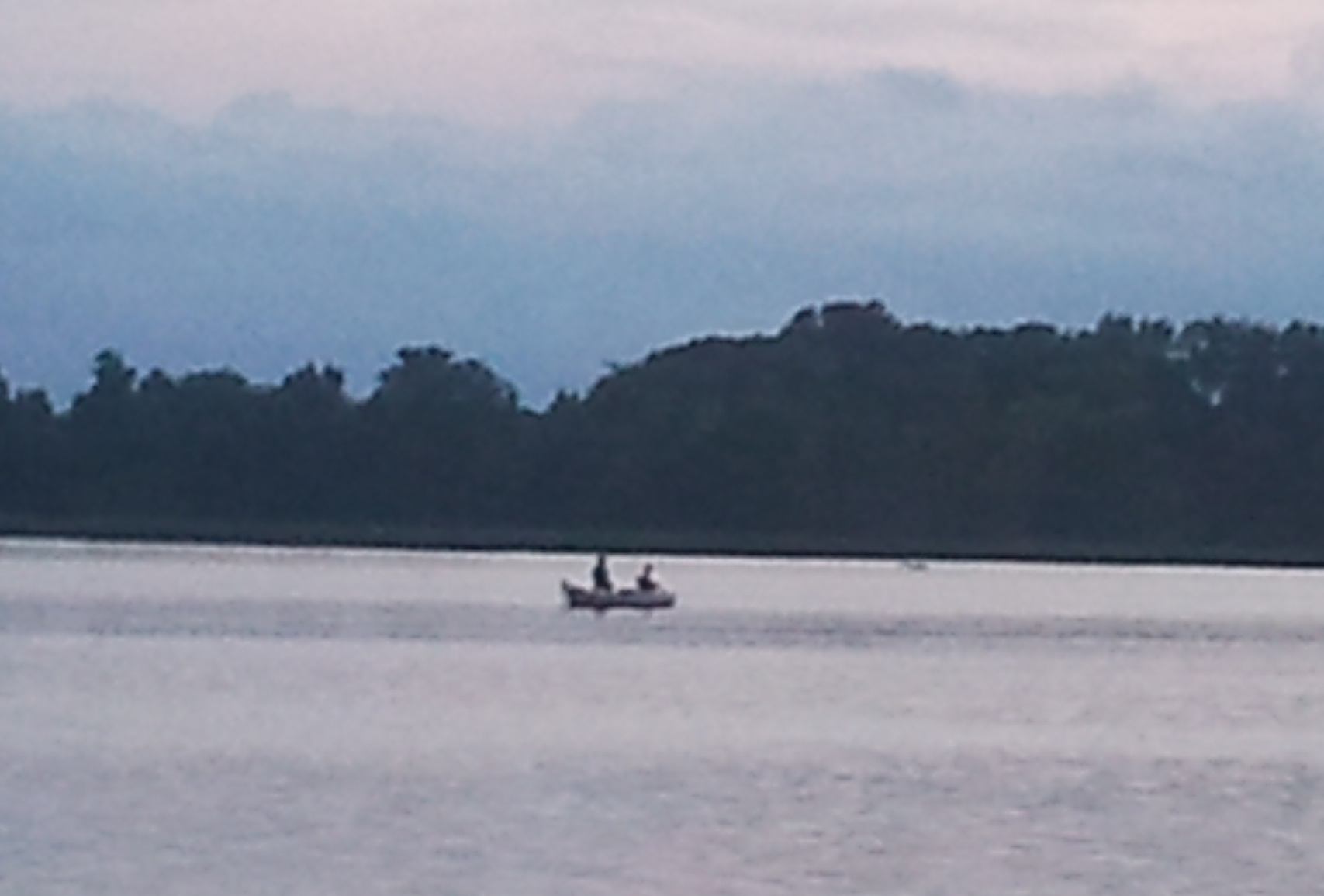
In the distance, a boat anchored with a father and son
creates a silhouette on the horizon.
We cast and draw in silence.

It has taken this long life to learn
fishing is not about catching fish.

Read Full Post »

On my early morning walk today, I was alone. My cell phone came along to track my mileage and pace, but it ended up recording my poem. Later when I checked the text, I discovered some funny misinterpretations. “High in the sky” became “Pie-in-the-sky.” “Workday” became “birthday.” The words didn’t really work with the poem I was trying to speak-write, but I had to smile at the idiosyncrasies of language.
After I worked on it, the poem became a grossblank, 12 lines with 12 syllables.

If you want to study the skeletons of frogs,
take a walk after the storm when the sun comes up.
Listen to the mockingbird song, high-pitched grating
like fingernails on the chalkboard. I walk the path
of the fallen limbs and clustered puddles of leaves.
We are washed yet still unclean. New day sun breaks
deepening the green, solid, and strong earth. Red spots
glitter after I glance at the spotlight. God’s eyes
peak through the ghost of a waning moon. Wren gathers
twigs for nesting, flutters off like a thief with goods.
No need for imagination here; all life breathes.
The beat of my footsteps become my prayer.

After a storm, resurrection fern fluffs up and becomes a green blanket on the live oaks.

Read Full Post »

I get a weekly writing prompt from Poets and Writers called The Time is Now.  This week’s nonfiction prompt was as follows:  “In Bird by Bird (Pantheon, 1994), Anne Lamott’s classic instructional treatise on writing and life, the author writes: “Writing a first draft is very much like watching a Polaroid develop. You can’t–and, in fact, you’re not supposed to–know exactly what the picture is going to look like until it has finished developing.” Keeping this in mind, write the beginnings of an essay whose direction and ending you don’t yet know. Start small, focusing closely on a single place, person, or incident, without thinking ahead. Then keep going: Allow the writing tell the story, and see what develops.”

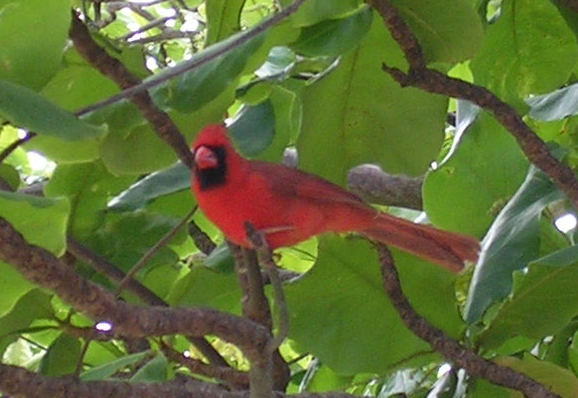
This morning was a beautiful summer morning.  After walking my dog, I sat on the back deck eating my breakfast and drinking coffee.  A cardinal hopped into a nearby tree and starting singing loudly.  I wrote as I listened.

The red bird calls
from the crape myrtle branch
while the cat prowls,
Tee who, tee who, tee
who, who, who, who

He flutters higher into the cypress tree.
The cat jumps in, crouches
in the valley of trunk and branch.
The cardinal call is echoed across the water–
a conversation for soul mates
staccato notes in harmony
with the rising song of cicadas

As the breeze blows, the wind chime
joins the tune. I am the audience only
writing alone while
June rises with the sun
dancing with patterns on the bayou.
Cerulean sky domes the shapes of trees,
a horizon to this landscape.

Thich Nhat Hanh tells me to be mindful of the moment,
to tune in to my breath, in and out.
This moment of mindfulness
full of sounds, the cardinal and his mate,
makes me wonder
of the Almighty Hand
who created my world and guides my breath.
How am I so privileged to be here?
I hear this song so clearly;
I feel the breeze so softly,
an embrace from God,
my everlasting mother.


Audio of Morning Song

Read Full Post »

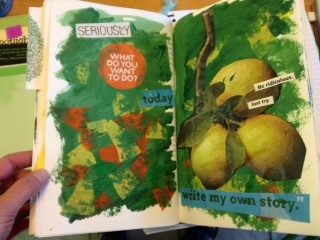
Altered Books

Seriously,
What do you want to do?
Today.
Be ridiculous.
Just try.
Write my own story.

I took a workshop this year on creating altered books. The process is fairly simple but a little time consuming. You take a discarded, old book. Tear out pages, glue together some of the pages to add thickness, and prepare the surface with gesso. I started mine at the workshop and then left it on the shelf to come back to later. I found some old discarded books for my students and introduced the idea. I offered them this option when they were doing poetry projects near the end of the year. A few of my students took this option and spent the time to create their poetry books. I decided to save them for next year, so they can add to them.

As I was cleaning my classroom this week with no more gifted services for my students, I pulled out my altered book. I decided to use it to gather the poems I had written alongside my students during the year. I would gesso a page, then work on something else, come back and paint the page, then glue on the printed poem. What fun to add a little interest to these last boring, chore-filled days. Students came in and out to talk, play on the computer, or join me in painting. A satisfying, creative end to the school year.

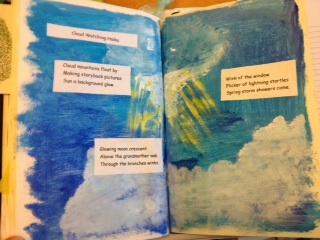
Cloud Watching Haiku
Cloud mountains float by
Making storybook pictures
Sun a background glow.
Glowing moon crescent
Above the grandmother oak
Through the branches winks.
Wink at the window,
Flicker of lightning startles.
Spring storm showers come.

Read Full Post »

Join the Tuesday Slice of Life

In my classroom, things are winding down to the last day, and we are only on P in our journey through the ABCs of poetry.   Yesterday, we wrote skinny odes for the letter O.  The skinny ode lesson I used was from a master poetry teacher, the late Sandford Lyne.  Sandy was so good at front loading, getting us ready to write.  I often rush through this step.  But on Monday, I decided to take the full ride, no short cuts.  So I read a few Pablo Neruda odes along with some other models Sandy had given us.  Then I led a full brainstorm exercise.  The questions asked about everything from shape to taste with many other questions in between, 16 in all.  The kids grumbled about all the questions, but they worked.  We writers had plenty of ideas for writing our skinny odes. The trick when writing skinny odes is to fold the paper hotdog style down the center and not to write over the line.  This keeps your lines short or skinny.   I will feature my ode and one of my students, a third grade gifted writer.

Ode to a Student

O, how you look
with curiosity
at the pages
of your book,
studying, learning,
making crevices in your brain.
How can I reach in?
Will you listen to me?
Enter my room in
wonder, ready
to create, think,
question, answer,
be yourself.

Can we walk together?
Forge ahead,
make new inventions,
new ideas,
write new stories?
Together, not as parent
and child, but coach
and team.
Shout the cheer!
The world is ready
to hear you.
Be kind.
Discover horizons.
Make known
your potential.
Be the best
you can be!

Ode to a Canvas
by Kylon

White rectangle,
my hands stretch over it.
I stroke it with a dry brush,
light strokes
testing myself,
testing my painting skills.
Paint finally collides
creating sprouts of orange and red.
The rectangle’s blanketed now.
Paint everywhere,
a season on material.
Coats and layers,
swirls of yellow
leaves fly back and forth,
a fall masterpiece.

Read Full Post »

A friend, mentor, fellow blogger, Diane Moore resides half the year in Sewanee, Tennessee.  I don’t think she has quite embraced the gray landscape of Gothic architecture and mountain mists.  Today, her blog came to me while I was looking out on our warm green landscape and feeling tired.  I loved her words and composed a found grossblank.  Found because these are her words.  Grossblank because there are 12 lines of 12 syllables.  Here’s to the contrasts of colors in our lives:

A Gray and Green Day

For Diane Moore

This neutral color of gray pervades The Mountain
This morning.  Gentle rain, iron-colored sky mists.
Pearl, charcoal, silver, gunmetal replace old gray–
Pessimistic hue no more uplifting than fog.
Color dignified by Gothic architecture.

To be creative, stare at green life, lighten up.
Walk in the woods; Alleviate anxiety.
Sacred shades of green and blue signify a new
Paradise of painted oceans, spirits lifted.

Poetry in emerald peace, trees leafing out.
Grass drinking dew, mint fragrant in spring memory.
Even the sky is the color of my opera.

Read Full Post »

This weekend our family gathered for the graduation of my youngest daughter from college.  What a whirlwind of events and emotions!  One of the treats for me was spending time with my nephew, Jack, who, at the end of his first grade year, is beginning to learn about the power of his words.  To my delight, his teacher uses writers’ workshop.  Prominently posted on the family refrigerator is Jack’s latest composition, a three-paged story about his two dogs.  He used words like “mischievous” and distinguished the two dogs as one is a “licker” and the other a “sniffer.”

Jack has his mother’s old iPhone.  Even with a cracked face, he enjoys using it to email.  So we started an email exchange.  He started with a typo that led to a little poem.  Being a poetry fan as well as a teacher, I prompted him on to create another poem.  I have transposed our exchange here.  Jack’s words are italicized.

I’m so gladys…

I’m so gladys, too, but mostly I love my Jacky.

I’m so gladys, too, but mostly I love you.

When we’re together,

We like to

Read, talk, and tell stories.

We tell our stories at night

When all is calm and quiet.

What is your favorite story?

Magic treehouse deep sea ocean.

Read Full Post »

I kind of gave up on the 30 Day Poetry Challenge, not intentionally, but life got in the way.  I got stuck on one challenge, then just plain refused to write a poem about a car, so I quit.  I did not, however, give up on challenging my students to write a different poetic form each day.  And I write with them, so technically I am still taking the poetry challenge.

In our classroom ABC daily poem challenge, we were on G on Thursday.  The only poetic form I could find for G was a Grossblank.  Grossblank is a poem with 12 lines of 12 syllables (a gross) written in blank verse, no rhyme.  Because I thought this form was particularly challenging, I allowed them to write a quarter Grossblank, 6×6.  Also to help bait the poetry fishing hook, I gave them lists of wordgroups, a technique introduced to me by my poet-friend-mentor Sandford Lyne.  So with groups of words in hand and fingers for counting, we got to work on our poems.

Once again, my students amazed me.  My fifth grader and sixth grader took the full challenge.  Kaylie is obsessed (and that’s putting it mildly) with Hunger Games.  Her poem, while it draws on the theme of the series, can stand alone.  Colby is new to my class, but he is slowly discovering his inner poet.  His poem draws a deeper meaning while he contemplates mirage and reality, a quite sophisticated theme, I think, for a sixth grader.  If you enjoy their poetry, please leave a comment that I can share with them.  They would love to hear from you.

But What’s to Come
by Kaylie
(inspired by and dedicated to the Hunger Games)

At sunrise, she runs, barefoot, in leaves of green, words
do not come to mind. She dunks under the fence, into
the woods, where stores are not seen, and hunger isn’t
abroad. Where no trespassing takes place. Into dreams,
she runs past men and voices, beyond the breaking
dawn, into a swirl of familiar places.
She lifts her bow at a rustle, her arrow finds
a home in a rabbit’s eye. She gathers berries
of the sweetest aroma, breath in the air, hush.
Out of the woods, names are called, unpromising to
the tributes, for they must survive to be victors.
Through the darkest times, many deaths will come alive.

The Magic Touch
by Colby
Along the road in the hot summer sun, a dog,
a mirage in the dust wandering in his wake.
The heat is unbearable with the sun floating,
unforgiving in the open. No shade in the still.
Starting to feel abandoned. Far, far, away. Fear
in his soul like a pup separated, detached
from its kin. The miraged dog leading the lonely.
Walking barefoot in along the trails through thick dust.
He walks and roams in spite of hunger and fatigue.
Still he follows the dog, his wake, his destiny.
The dog is getting closer. It’s close enough to
touch.The man speeds up inching ever closer. Touch. Oasis.

Read Full Post »

Ekphrasis: Poetry confronting a work of art.

I was first introduced to this poetry form by my mentor and Louisiana’s 2011 poet laureate Darrell Bourque.  In our workshops, Darrell would pass around a postcard collection of works of art and inspire us to write.  This was usually successful for me, so I have passed this process on to my students.  The book I use most is Heart to Heart, edited by Jan Greenberg. In her book, the poems are placed beside the work of art.  I use this book to model the different forms ekphrasis can take.  The ekphrastic poem can be a description loaded with imagery or a story poem in which the poet becomes a part of the painting.  Here is a link to my students’ poems on our classroom wikispace: http://gtallstars.wikispaces.com/Ekphrastic+Poetry

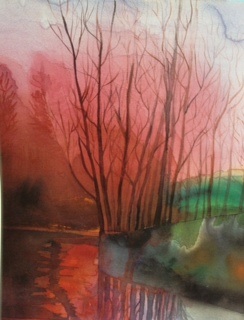
Today I wrote with my students as I usually do.  I have this beautiful book of the River of Words award winners. The painting I chose was titled Sunset in River.

by Khumar Gumbatova, age 13

The sunset becomes a rainbow
in fields where
silhouettes of trees
stand like soldiers
guarding this sacred land.

Sun reddens water
now a glowing sea where
hidden flowers grow.

Sometimes
at sunset I imagine
all life praises
God.

The 30 Day Poetry Challenge Day 23: Write a seven line poem that begins with “it’s true that fresh air is good for the body” (from Frank O’Hara’s poem “Ave Maria”) and ends with “this is our body” (from Gary Snyder’s “The Bath”).

It’s true that fresh air is good for the body.
Breathe with your eyes closed like the sleeping Tom;
Taste the sweet honeysuckle nectar
while the wind tickles your cheek,
and you listen for the distant call of the cardinal
red in his cocky plumage.
This is our body.

Buzz naps while I write. He inspires a line.

Read Full Post »

« Newer Posts - Older Posts »