Thanks to Robyn Hood Black for hosting Poetry Friday today.
Prepositions were on parade in my class this week. We brainstormed a list of prepositions. The list grew to 50 words. Wow! Who knew there were so many?
Students wrote poems in which each line began with a preposition. To help our readers along, we decided the title should give a clue to the theme. Students experienced through practice how to use prepositions, and it was fun.
Mother Nature
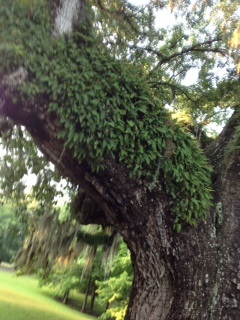
From the high branch
of that cypress tree
beyond the flowing bayou
near a wading heron
through the slightest breeze
toward my longing heart
upon this lonely landscape
for eternity.
—Margaret Simon, all rights reserved.
My Rainbow
under the setting sun
across the ocean
with rays of light
through the oak trees
over the valleys
to the depths of the bayou
through my heart.
—Emily, 2nd grade
Louisiana
Through the tallest sugarcane
on the fastest feet
over the wettest mud
with the newest creatures
until I am at home
—Brooklyn, 5th grade
The Innocent Mouse
in the classroom
nearby kids on top of their desks
inside the cabinet, scratching
out he comes
across the room
beyond the bathroom
under the desks
as the kids try to escape
from the tragedy
except he only wanted paper
—Keana, 6th grade
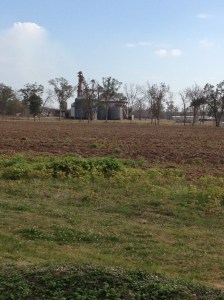
This weekend I was invited to read at a festival in Arnaudville, a small town about 40 miles north of New Iberia. The drive to Arnaudville along Highway 31 follows the curving Bayou Teche. Years ago, I drove this same highway to a fiction writing workshop. It was in this workshop that I wrote the first chapter of Blessen. The workshop took place in NuNu’s, an arts collective with a performance area and a cafe in the back. The building sat on a high ridge near the bayou. A few years ago, the place burned. Now Nunu’s is housed down the highway in a large old lumber company building. Walking into the place, you step back in time on long leaf pine floors and high ceilings. You look out onto endless rice fields. I felt a sentimental connection to this birthplace of my first novel. And it was here that I connected with new friends who write.
Clare Martin organized the event in conjunction with the Fire and Water Festival “Le Feu et l’Eae.” (All festivals in South Louisiana have French names.) She titled the readings, “Words of Fire, Words of Water.” I felt privileged to be among the readers. Clare read from her recent book of poetry, Eating the Heart First. I felt an immediate connection to this woman who has turned her grief into beautiful poetry. Talking to her after the reading, I shared something about not expecting to sell many books that day. (I sold 6! A good day!) Her response was so encouraging.
Each success no matter how small in practice of what I love is a lightning strike against the dark.
I loved this! Another woman-writer-friend, Chere’ Coen, (See her blog post about the event.) gave me a Gris Gris bag for courage. And guess what symbol it had on it? A lightning bolt! More synchronicity.
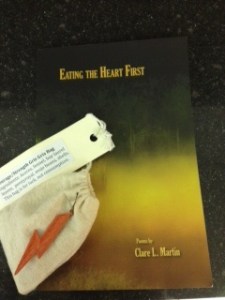
The gris gris bag for courage with Clare’s book of poetry, my prizes from Words of Fire, Words of Water.
Traveling home from the lovely day in Arnaudville, (not to mention, after a delicious catfish po-boy, hazelnut latte, and double-chocolate cake ball) I felt full. I was full of the spirit that brings us life and creativity and art.
This poem by Clare L. Martin moved me to tears:
ICE TO WATER
The hospital room is cool.
There are moths in your breath.
Circled in ice, you’re enwrapped in white fire.
Coffee-colored urine drains in a bag.
I swab your lips with lemon glycerin.
Your pulse beeps loss. I buzz a nurse out of the void.
I cannot watch you die.
The doctor scowls at my cowardliness.
Stunted from birth, plucked too early—
You were wingless.
It took me years to believe it wasn’t my fault
you despaired in an infant’s life.
I choose blue for the burial
like the thunderhead in your eyes.
The undertaker powders the fine
hairs of your face, seals you in secret.
First published in The Dead Mule School of Southern Literature
Reprinted by permission from the author
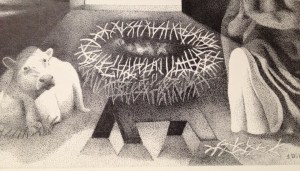
My father, John Gibson, created this drawing using pointillism. He creates a different image each Christmas for my parents’ Holiday greeting card.
The Pointillist
Patiently sitting at the drawing table,
he taps the paper as if strumming an instrument.
The music he creates comes forth
not in lines and shapes, but in shades
of dark and light.
This artist does not draw or paint.
He plays the dots, drumming them out
point by point.
What emerges is nothing short of miraculous,
like the first moving pixel on the television screen.
I marvel at the realism.
I could reach out and touch the cow.
The bed of straw even smells like a barn.
He places me there, at the birth scene,
waiting with Mary.
–Margaret Simon
The Pointillist is an ekphrastic poem, a poem about art. More about this style of poetry can be found at Poets.org.
Last week, Thanksgiving week, I was introduced to the “thanku,” a haiku thank you poem. Today, I introduced the idea to my students. Since I teach gifted kids, I had to give them a challenge. Since haiku originally was a style of poetry that not only used a set syllable pattern (5,7,5), but also used the theme of nature, I asked them to include a metaphorical use of nature. And, of course, I modeled with my own poem. This one I wrote for a friend.
Sunflowers open
to see the world around us
like your heart to mine.
Some of my students took on the challenge. Most of them chose to write to teachers. It was sweet watching them type up their poems, find just the right graphic, and print them out to give to their favorite teachers. At the very end of the day, Kylon slipped me this little gift of a thanku. My heart melted.
The seed of a rose
You sprout your knowledge like roots
We share our petals.
Yesterday my 14 year old niece interviewed me for her journalism class. While my family around me wondered why she would choose me to interview, I felt privileged that she asked me…as an author. Her questions were good. They made me really think, and I enjoyed telling her about this journey. She asked me when I knew I wanted to be a writer. I told her the story about finding my diary from 1975 when I was her age. (See this post.) When she asked what advice I would give to students who would like to be writer, I said surround yourself with people who affirm and support you.
Today, for the Two weeks of Thanksgiving, I am writing a thanku for all of my people who support this crazy writing life.
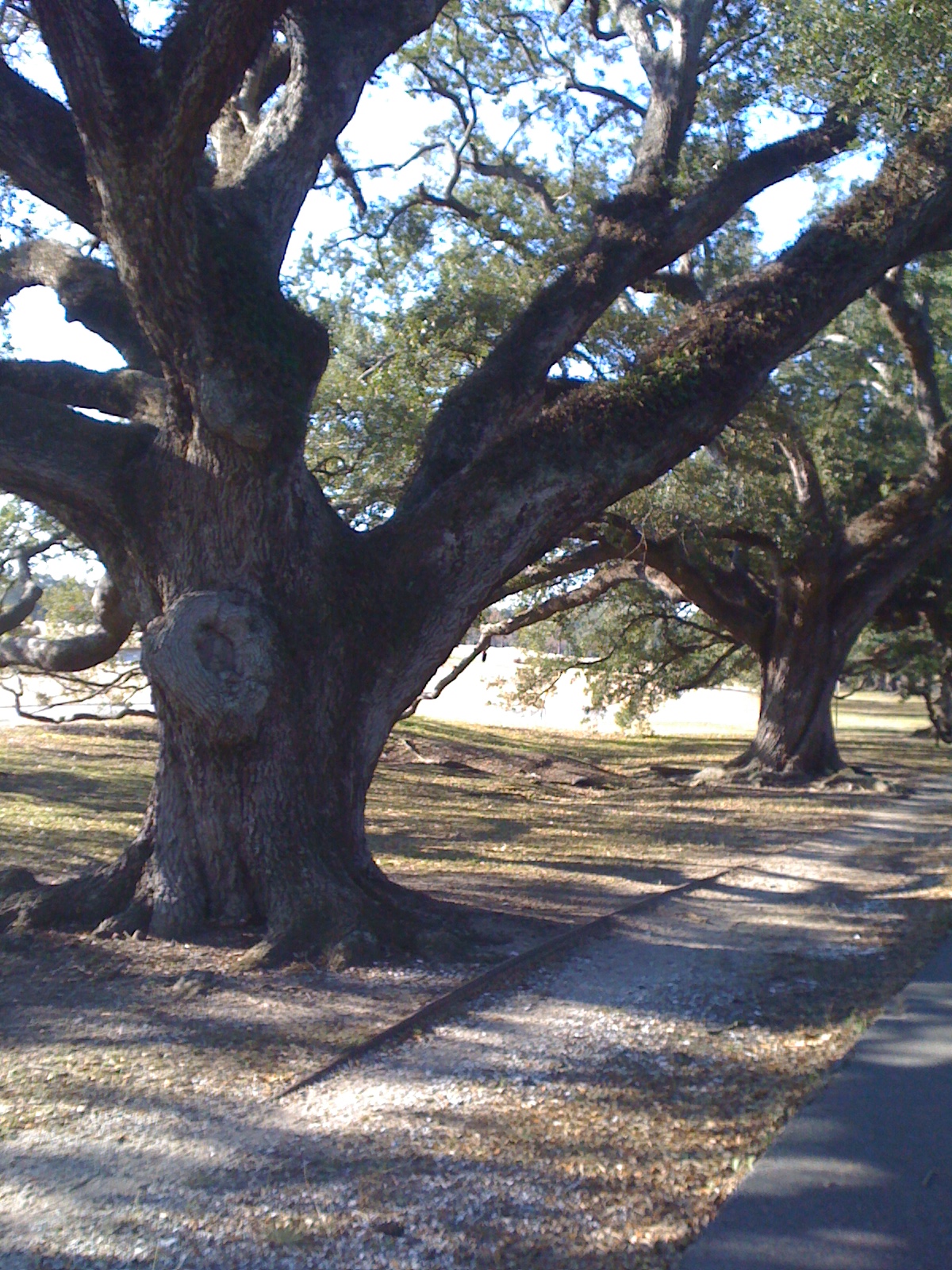
How the live oaks stand
On roots of strength and caring
I am blessed by you.
On the Two Writing Teachers blog this morning, I found these quotes:
“Walk through life like a writer.” –Lucy Calkins
“Tell the truth about your life and what’s really going on.” –Georgia Heard
“We know the truth of ordinary life events. Everything doesn’t end with ‘happily ever after’.” –Georgia Heard
I needed to hear all three. My ankle hurts. In our family when you complain like this, we call you (me) the “Bo-bo queen.” Something about annoying pain of an integral body part has made me thus. I am grateful for my new doctor-friend who fixed me up yesterday with an ankle brace and some powerful anti-inflammatory drugs. But I struggled with a blog post for this Tuesday slice because I didn’t want to whine, but I was unable to come up with something to write about. And then, this morning I read the wise words from Georgia Heard, “Tell the truth about your life and what’s really going on.” So I’m here letting you know that my ankle hurts.
But also, I am thankful.
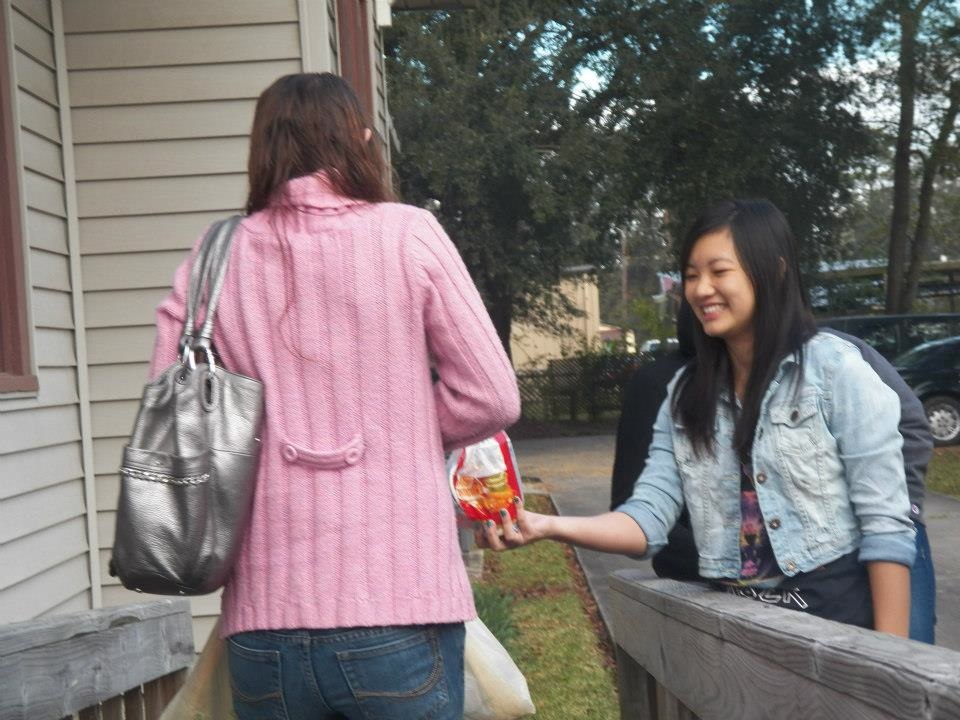
Teens from St. Barnabas youth group gave out candy-filled mugs in holiday wrap.
Every Tuesday morning I serve at our church’s outreach mission, Solomon House. This morning was filled with joy. Teens from a youth group showed up with bins full of mugs wrapped in holiday wrapping to give out to the clients. The clients lined up all along the sidewalk. Each of them greeted me with kindness. What do I have to complain about? Nothing. The truth is there are many hurting people out there. They heart in mind, body, and spirit. I can look them in the eye with true love and gratefulness.
Another slicer, Linda B. at Teacher Dance, introduced me to the thanku movement led by Teaching Authors. A thanku is a haiku of thanks. Here is my attempt to capture the morning:
Many hands spread joy
Many hands give thanks for you
Walk your path in peace,
knowing this.
This was my first year to participate in the Festival of Words in Grand Coteau. Grand Coteau is a small historical town about 35 miles north of New Iberia. This summer I met and chatted with Patrice Melnick, author of a new memoir Po-boy Contraband and owner of an artisan shop, Casa Azul. In late September, she hosted a reading and book signing for me. We made a connection, and she invited me to come back for the Festival of Words. I loved the feel of her place, artsy and comfortable, and the feel of the town with the main street lined with Cajun cottages.
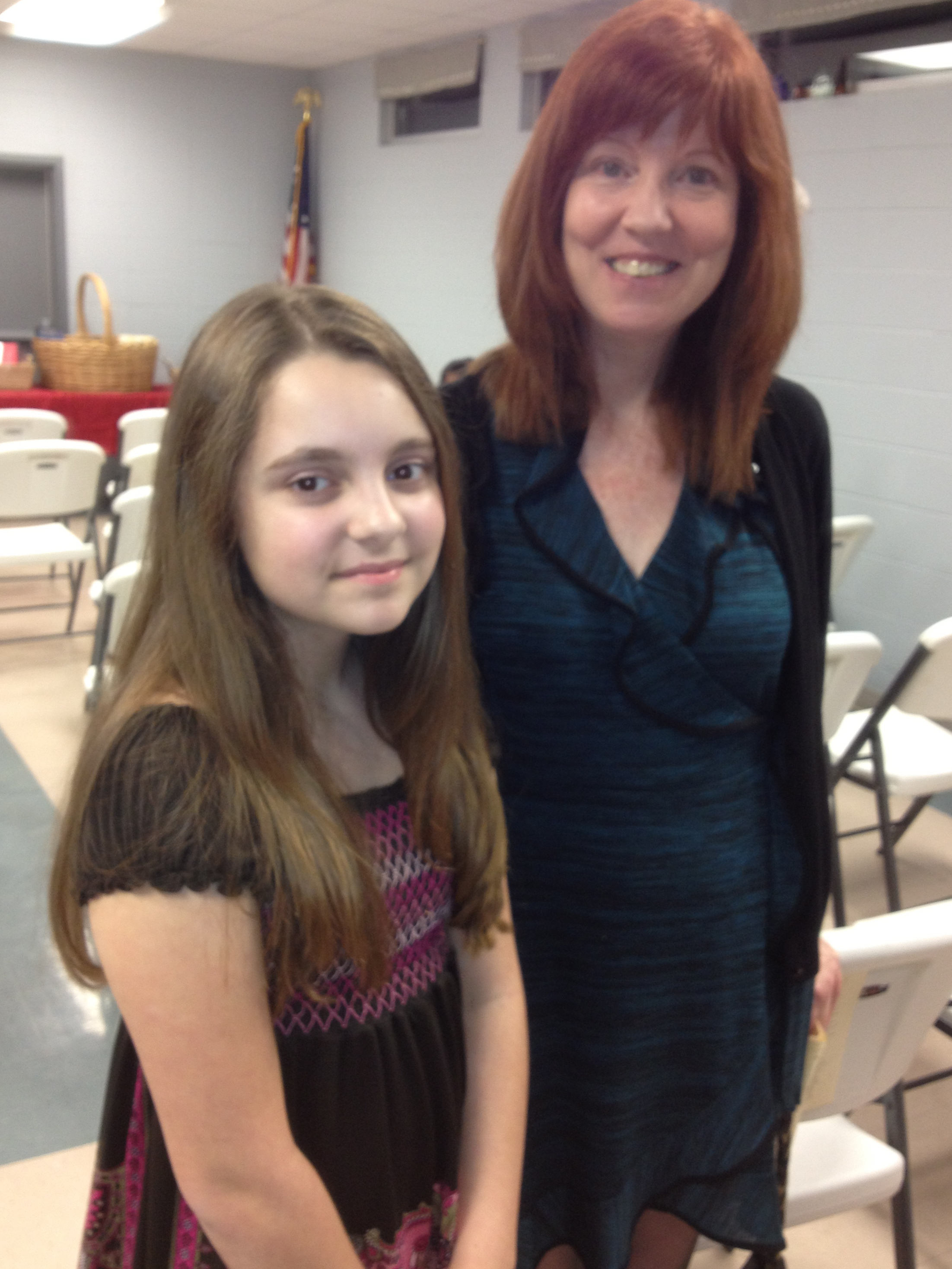
The Festival of Words began with an awards ceremony on Thursday evening for the winners of the writing contest. I was privileged to have a student winner, so I picked her up after school, and we drove the hour to the Sunset library, just west of Grand Coteau. She commented that she loved the name of the town “Sunset.” At the awards ceremony, I introduced my student to two state poets laureate, Darrell Bourque and Julie Kane.
My student poetry winner meets the current state poet laureate, Julie Kane.
Following the open mic when students read, we enjoyed two performance poets, Bonny McDonald and Chancelier “Xero” Skidmore. Here is a video I took of Bonny’s performance of “To A natural in E flat.”
On Saturday, I ventured back to Grand Coteau and the Festival of Words. I attended a fiction writing workshop with Randall Kenan. The workshop was small and intimate and we wrote and talked and wrote and talked, the best kind of workshop to me. In the afternoon, I attended Julie Kane’s poetry workshop. Again it was a small group. She talked to us about forms and had us try out combining a praise poem with using the same first word in each line. We brainstormed ideas for mundane things to write about. We wrote about fingernail clippers, mosquitoes, and a volume knob. I wrote about grass. I was actually satisfied with the result.
For today I will step lightly
For your tenderness
For the light of sun upon your greenliness
For tickling my belly
For wriggling between my toes
For your fresh sweet scent
For the settled earth you draw strength from
For your canvas of wildflowers
For clover crowns
For hiding rolly-pollies, fleas, and snakes
For grass.
I wish I had stayed for more readings, but the day was growing long, and my mind weary, but I’ll be back next year.
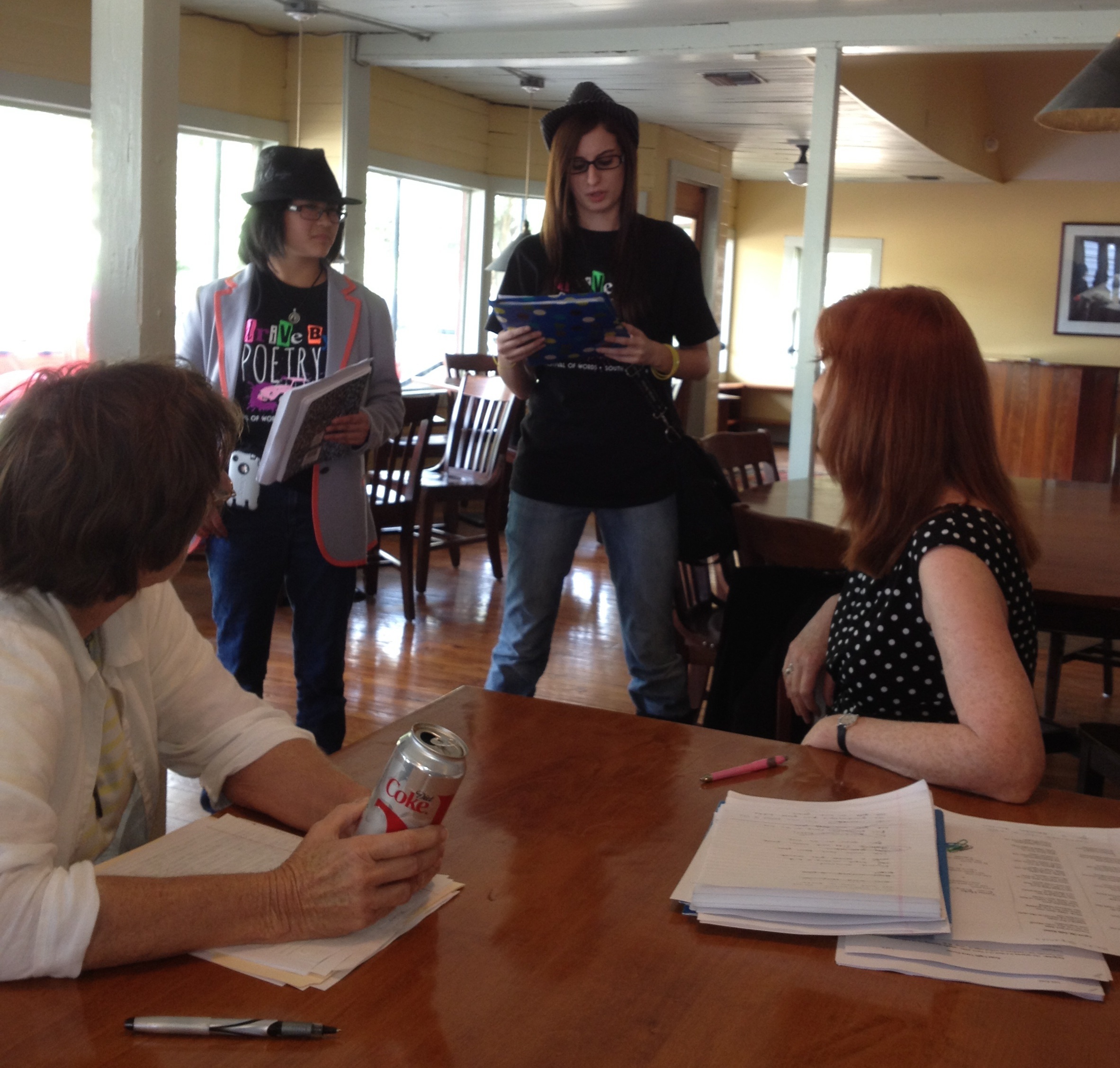
Students from area high schools did drive-by poetry. Here a student reads aloud a poem by Julie Kane to Julie Kane. She delighted in hearing her own poems performed by these talented students.
One of my favorite poets is Mary Oliver. She writes accessible, simple nature poetry. She recently published a new collection, A Thousand Mornings. When it came up on Amazon as a suggestion (how do they know me so well?), I had to buy it. This book was so special I had to go to the post office to pick it up. When I opened the package, I lifted the book to my cheek. It felt like silk. Seriously, soft and smooth like a silk blouse! Mary Oliver’s poetry is so clear that even elementary students can understand it. I wanted to share her with my students. Of course, first I let them feel the cover. They knew immediately that magical poetry lay within.
I read aloud Mary Oliver’s words, “This morning the beautiful white heron was floating along above the water.” My students know what this looks like, a common scene here in South Louisiana. I read a few more poems. But they were getting anxious.
“What are we going to do with the shells, Mrs. Simon?”
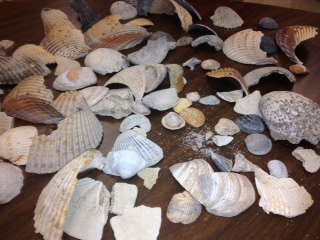
On the table, I had placed a plastic container of shells, real beach-collected shells from the storage closet. I dumped them out on the table with these instructions, “Find a shell that you like. Draw it slowly, paying attention to the details. Then write a poem.”
I played classical music and wrote along with my students. Some beautiful poetry emerged. Taking time to slow down, enjoy the beauty that nature creates, and to listen to simple true words, that is the joy of writing work.
My poem: Broken
My heart bubbles
like the shell in my hand
when air pours through
its tiny holes,
Shaped as a mountain
with jagged incuts
and paths of lined creation.
I am imperfect
battered by crashing waves like
this shell torn from the sea
collected by a child
who knows how to love
imperfection.
by Matthew (3rd grade)
I taste the sea in me,
the ocean of wonders I smell,
the bumpy texture sends chills down
my spine, the echo of the ocean awakens
me, I see the sea’s symbol,
it is in my possession,
shell
by Kylon (4th grade)
A spirit, a dead, lost spirit
a lost stray child, who cannot find her mother
no hope, no life, just darkness,
dark like a night sky with no stars,
a smooth seashell,
it’s washed up- the ocean didn’t want it,
but I did, and it’s safe with me.
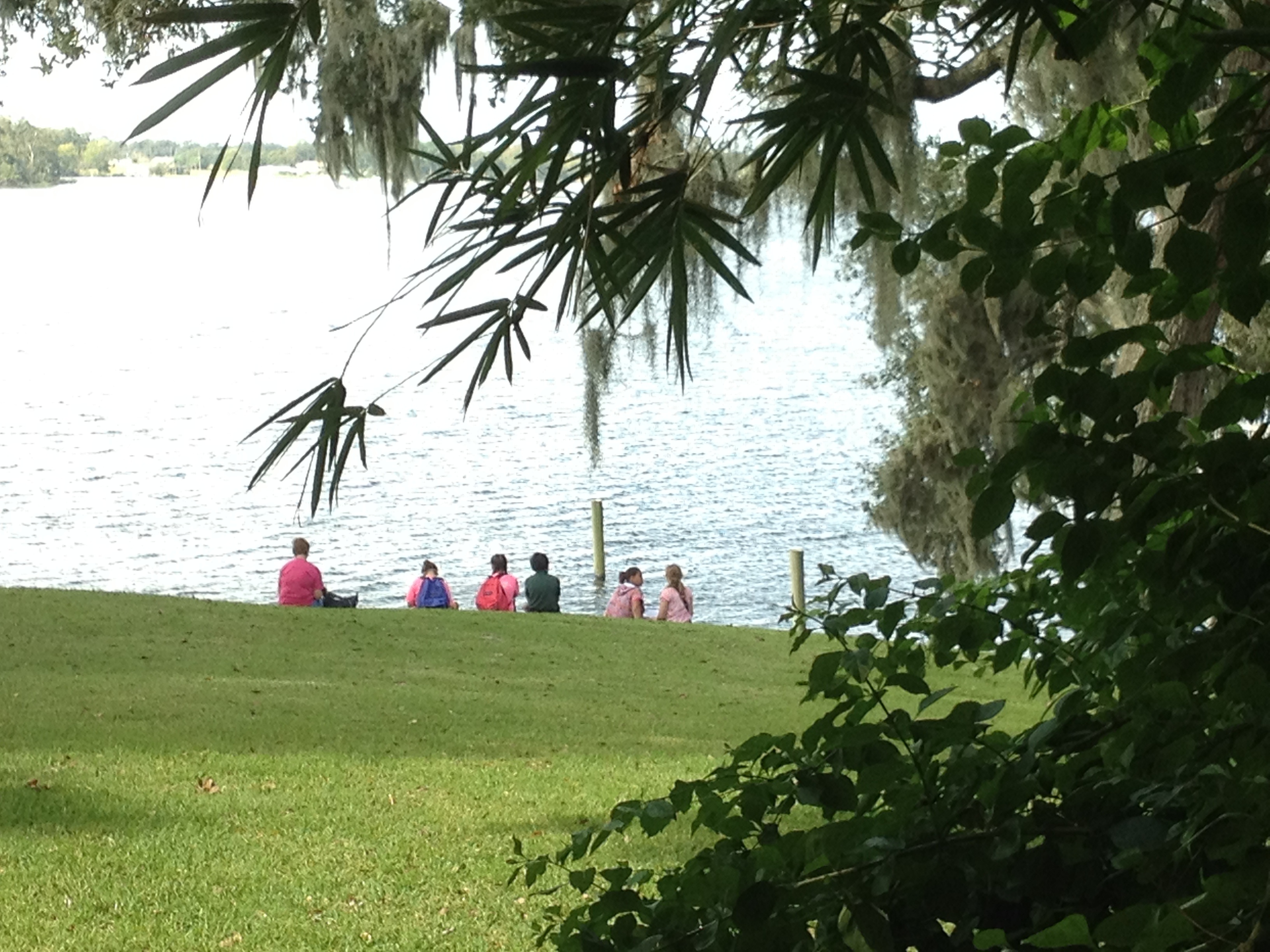
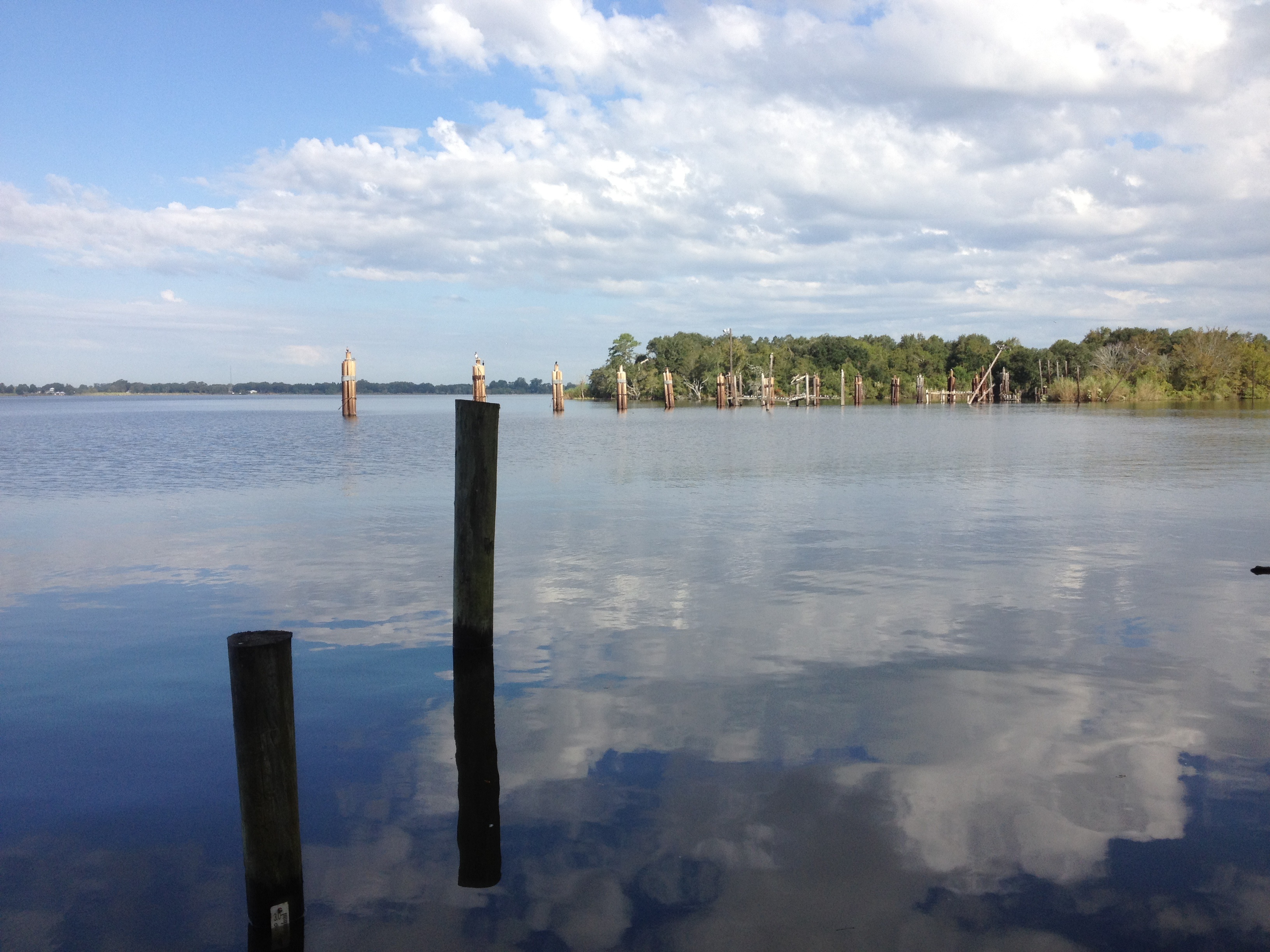
Our team of 6 elementary gifted teachers took the 6th graders from our parish (district) on a field trip to Rip Van Winkle Gardens on Jefferson Island. If you live around here, you know that Jefferson Island is not a true island. It is one of 5 land masses that rise up out of the South Louisiana marshes. Jefferson Island was once the home of Joseph Jefferson and holds a beautiful antebellum home with acres of tropical gardens.
Reflections on Lake Peigneur
The purpose of our field trip was to introduce our students to a natural place where water is integral to its survival. We will be working with these students once a month for the school year on a project of their choice about water. At Jefferson Island, we learned some history, discussed questions, and enjoyed the beauty around us.
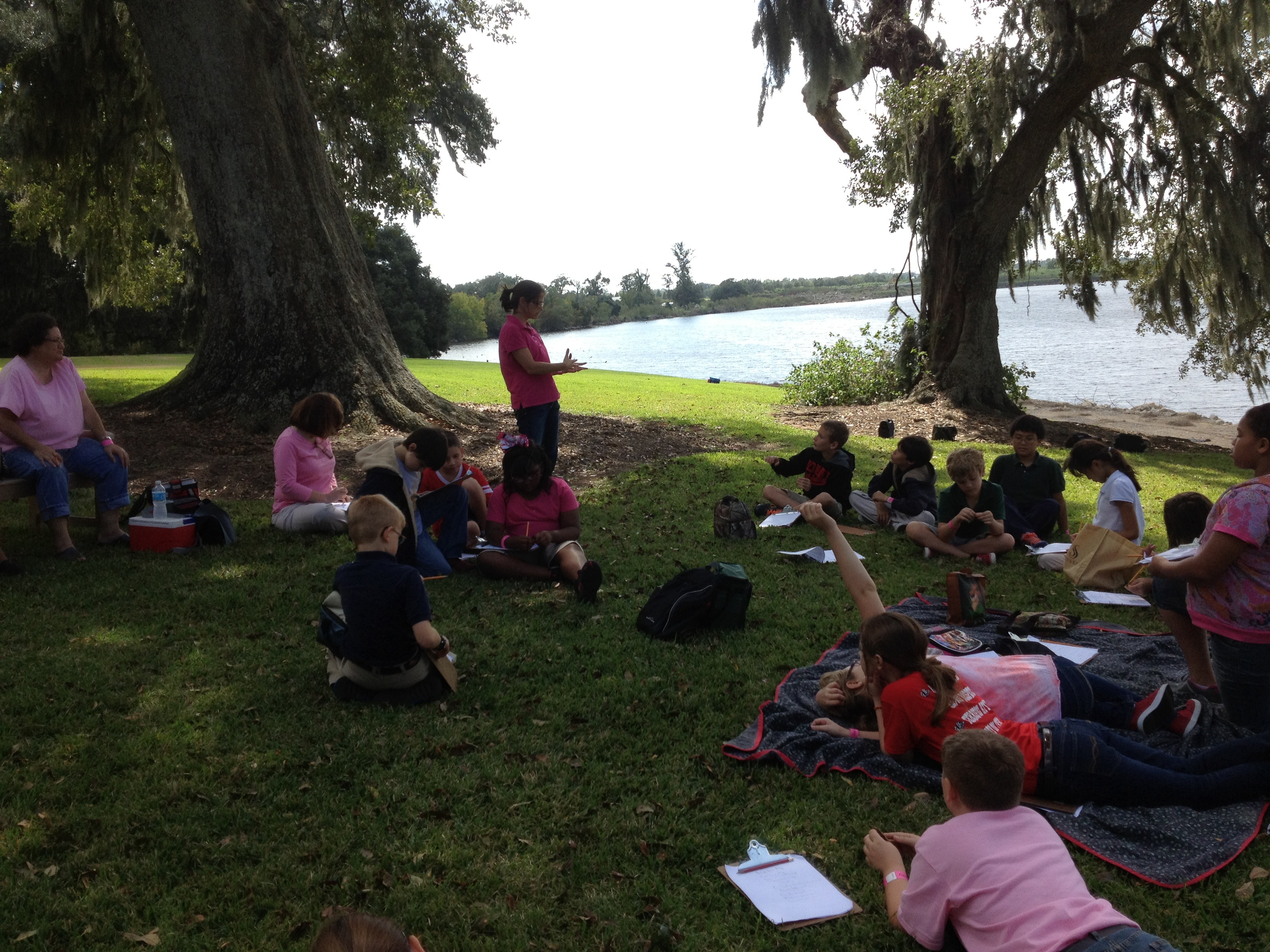
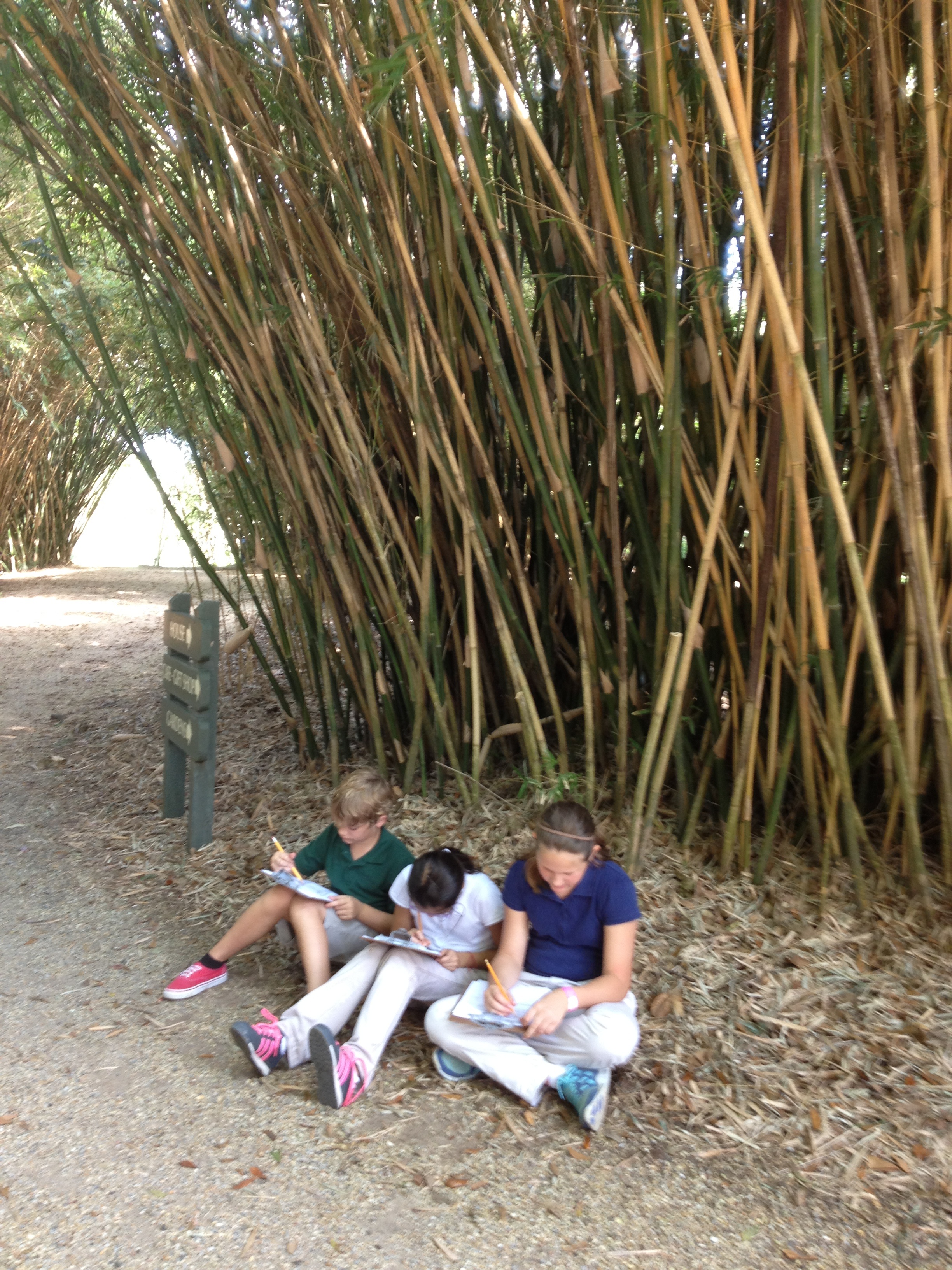
I led the students in a writing exercise from Georgia Heard’s book Awakening the Heart. The pre-writing exercise asks students to use an image. (In this case, the images were all around us.) There are 6 rooms, or divisions on the paper. Each room serves a purpose, such as “describe the image,” “what sounds do you hear,” or “describe the light.” Each room leads the writer to a deeper understanding of the image and often leads to a creative poem. We sent the students off to different areas of choice with a teacher. Teachers wrote, too.
Sharing time
Out at Jefferson Island, among the oaks, bamboo, and palmettos, we became a community of writers and explorers. We set the tone for the project yet to come and generally had a grand time.
Bamboo Poem
by Dustyn
Tall, arching, stalks of bamboo,
Bright and beautiful skies of blue,
Huge structures where flowers bloom,
Trees towering over you,
It relaxes me to feel the bamboo, so smooth,
And I’ll bet you’ll feel the same way too.
Writing in the bamboo forest
Rip Van Winkle Gardens
by Rhyan
We are in a mysterious land,
An enchanted garden,
Where the butterflies roam,
and the dock hangs over the lake.
The lake is screaming “I am a wonderful lake and I shall not be destroyed.”
But now it is silent.
The only sounds are rustling leaves and chirping birds.
Read other Slice of Life writers at The Two Writing Teachers
October 20th has been dedicated by the National Council of Teachers of English as the National Day of Writing. This year, the date fell on a Saturday, so my students and I celebrated on Friday, Oct. 19th. One of my favorite writing activities evolved from a workshop originated by artist Paul Schexnayder entitled, “Dancing with a Paintbrush.” Paul’s idea was to free up creativity by playing different selections of wordless music and having students paint whatever colors, lines, and shapes that come to mind. I borrowed this idea and added a writing element.
Dancing with a paintbrush
I selected some musical pieces. There is no magic in the selections I made, but basically I was looking for pieces that evoked different emotions. The ones I used were “Silent Moon” by Jia Peng, “A Day Without Rain” by Enya, “Tarantelle Styrienne” by Debussy, and “The Girl I Left Behind,” a Celtic selection.
With watercolor paints and drawing paper, the students and I painted while the music played. Then at the end of each piece, I asked them to write 4 words and a title for their painting. After all selections were played and they had a collection of 3 paintings with words and titles, I asked them to select one to write about. Make the title of the painting your title and use the 4 words in some way within the poem. The results were all different and creative.
Focused and listening leads to creative expression.
Here are some sample poems from this exercise:
Beauty
it comes with amazing colors
of red,
green,
blue,
and even yellow too
All the colors
could be a rainbow
just waiting for you
for beauty is true
telling of mood,
majesty,
and imagery.
Pure beauty comes from heart,
The Rightful Beauty.
by Kendall, 5th grade
The Chinese Gates
I am a girl
I live In China
Every day I paint swirls
Ah,so beautiful
I paint the sun and water
I paint the moon and rivers
Even some Chinese words
I learn new paintings every day
And maybe some day you could visit me in China by the Chinese Gates.
Margaret Simon lives on the Bayou Teche in New Iberia, Louisiana. She is a retired elementary gifted teacher who writes poetry and children's books. Welcome to a space of peace, poetry, and personal reflection. Walk in kindness.