Yesterday my 14 year old niece interviewed me for her journalism class. While my family around me wondered why she would choose me to interview, I felt privileged that she asked me…as an author. Her questions were good. They made me really think, and I enjoyed telling her about this journey. She asked me when I knew I wanted to be a writer. I told her the story about finding my diary from 1975 when I was her age. (See this post.) When she asked what advice I would give to students who would like to be writer, I said surround yourself with people who affirm and support you.
Today, for the Two weeks of Thanksgiving, I am writing a thanku for all of my people who support this crazy writing life.
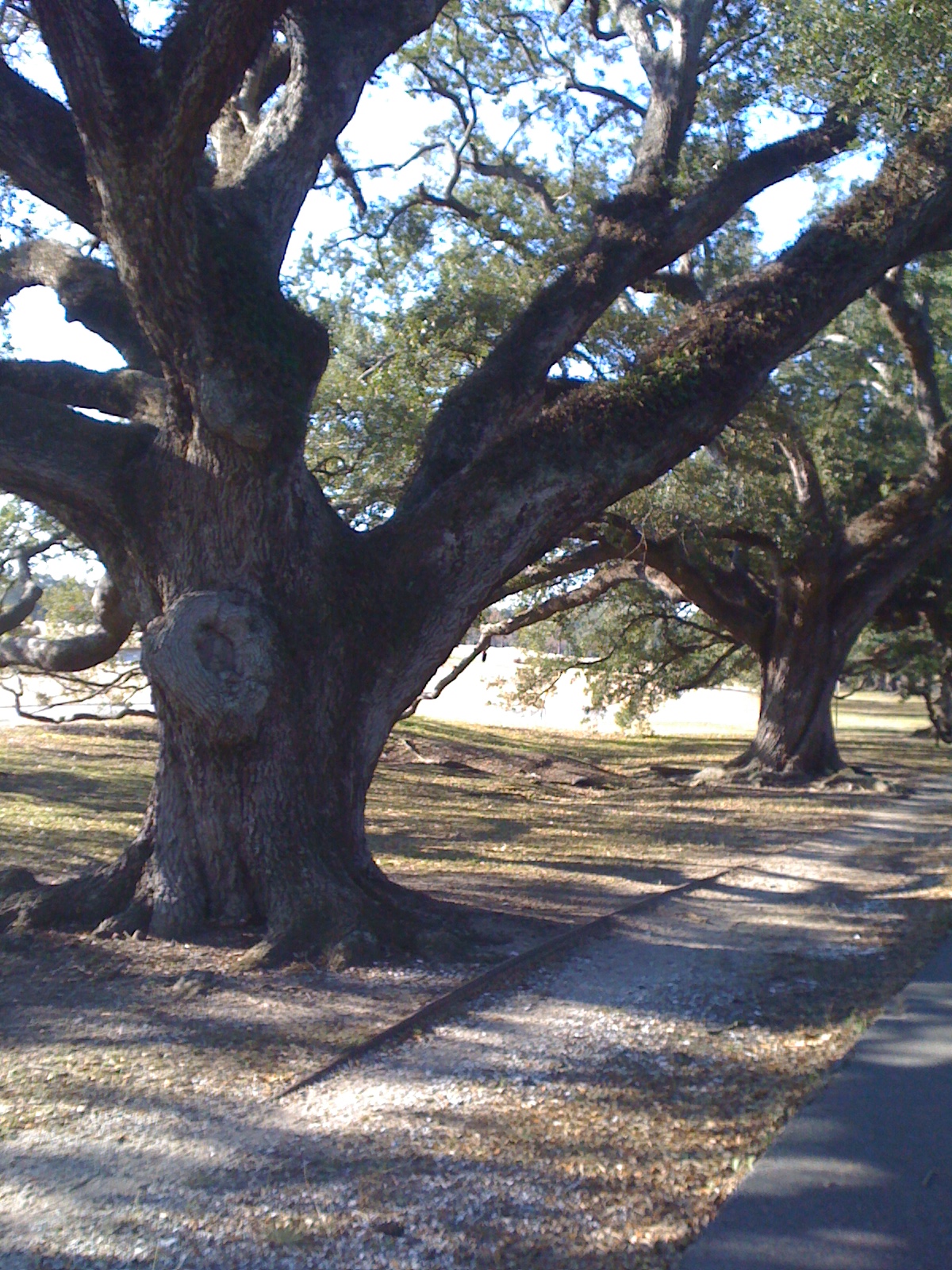
How the live oaks stand
On roots of strength and caring
I am blessed by you.
On the Two Writing Teachers blog this morning, I found these quotes:
“Walk through life like a writer.” –Lucy Calkins
“Tell the truth about your life and what’s really going on.” –Georgia Heard
“We know the truth of ordinary life events. Everything doesn’t end with ‘happily ever after’.” –Georgia Heard
I needed to hear all three. My ankle hurts. In our family when you complain like this, we call you (me) the “Bo-bo queen.” Something about annoying pain of an integral body part has made me thus. I am grateful for my new doctor-friend who fixed me up yesterday with an ankle brace and some powerful anti-inflammatory drugs. But I struggled with a blog post for this Tuesday slice because I didn’t want to whine, but I was unable to come up with something to write about. And then, this morning I read the wise words from Georgia Heard, “Tell the truth about your life and what’s really going on.” So I’m here letting you know that my ankle hurts.
But also, I am thankful.
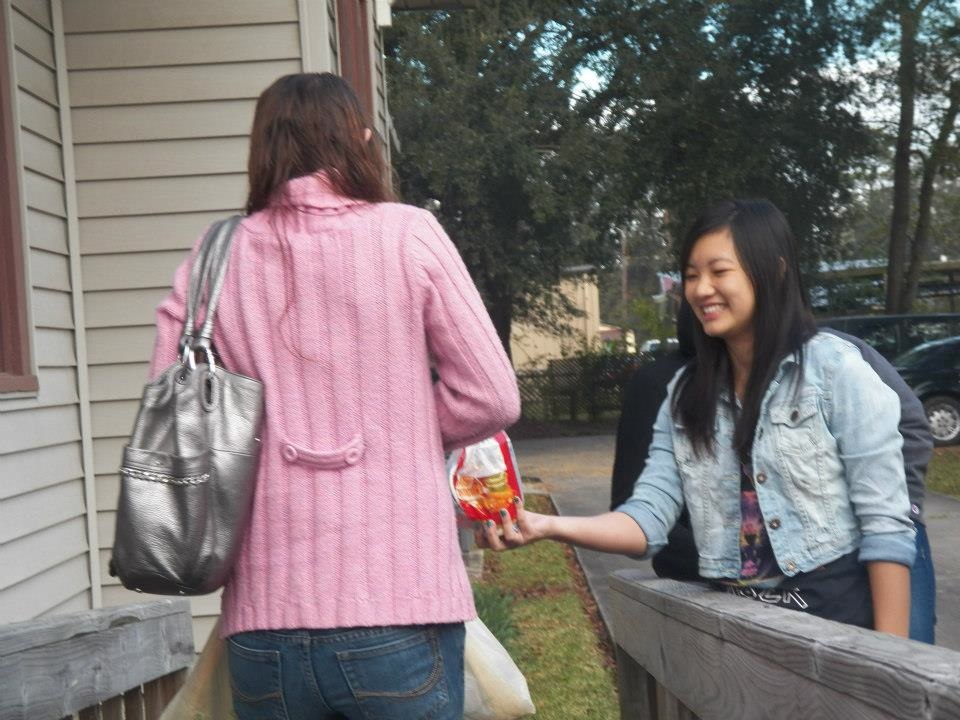
Teens from St. Barnabas youth group gave out candy-filled mugs in holiday wrap.
Every Tuesday morning I serve at our church’s outreach mission, Solomon House. This morning was filled with joy. Teens from a youth group showed up with bins full of mugs wrapped in holiday wrapping to give out to the clients. The clients lined up all along the sidewalk. Each of them greeted me with kindness. What do I have to complain about? Nothing. The truth is there are many hurting people out there. They heart in mind, body, and spirit. I can look them in the eye with true love and gratefulness.
Another slicer, Linda B. at Teacher Dance, introduced me to the thanku movement led by Teaching Authors. A thanku is a haiku of thanks. Here is my attempt to capture the morning:
Many hands spread joy
Many hands give thanks for you
Walk your path in peace,
knowing this.
This was my first year to participate in the Festival of Words in Grand Coteau. Grand Coteau is a small historical town about 35 miles north of New Iberia. This summer I met and chatted with Patrice Melnick, author of a new memoir Po-boy Contraband and owner of an artisan shop, Casa Azul. In late September, she hosted a reading and book signing for me. We made a connection, and she invited me to come back for the Festival of Words. I loved the feel of her place, artsy and comfortable, and the feel of the town with the main street lined with Cajun cottages.
The Festival of Words began with an awards ceremony on Thursday evening for the winners of the writing contest. I was privileged to have a student winner, so I picked her up after school, and we drove the hour to the Sunset library, just west of Grand Coteau. She commented that she loved the name of the town “Sunset.” At the awards ceremony, I introduced my student to two state poets laureate, Darrell Bourque and Julie Kane.
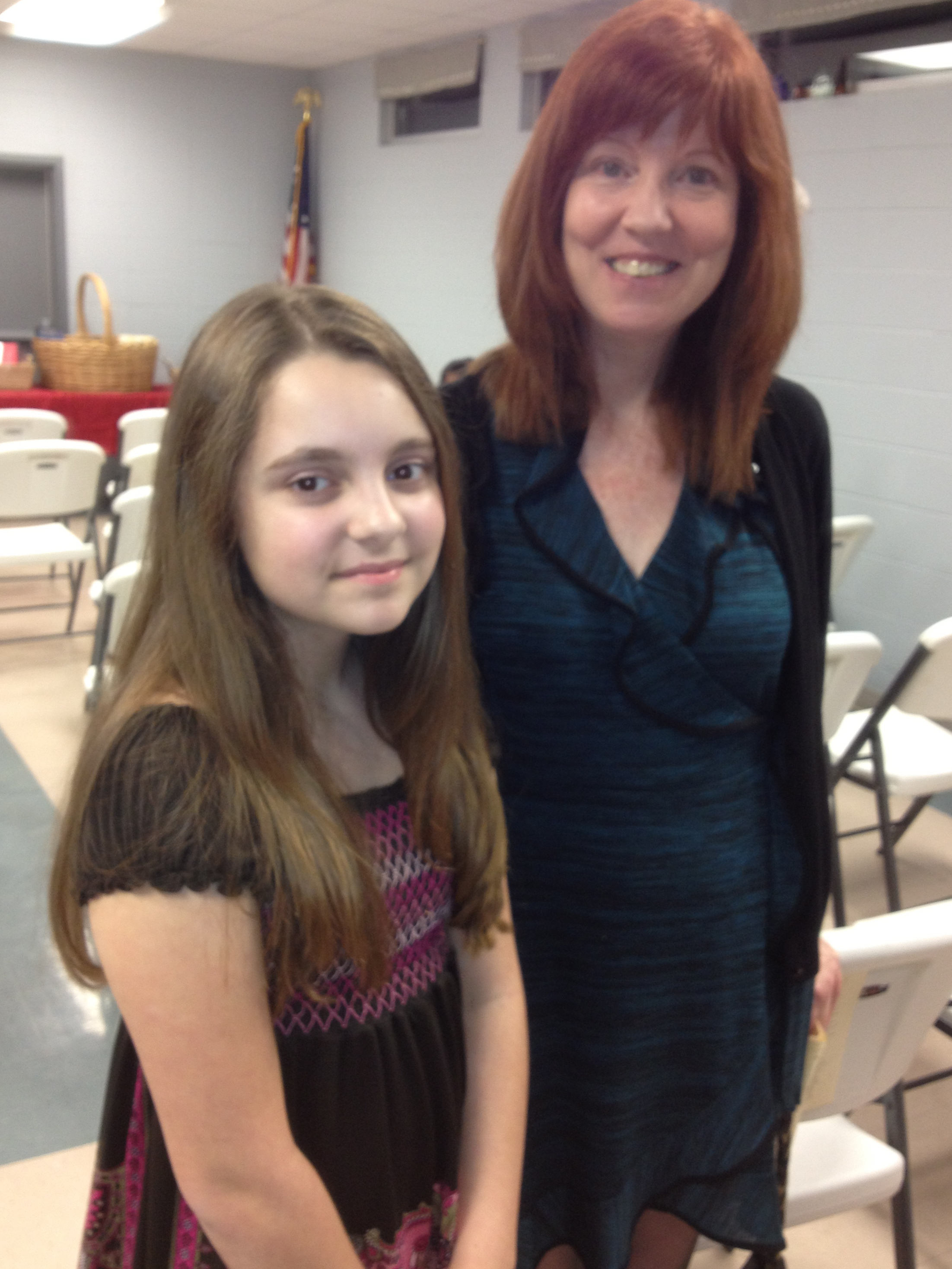
My student poetry winner meets the current state poet laureate, Julie Kane.
Following the open mic when students read, we enjoyed two performance poets, Bonny McDonald and Chancelier “Xero” Skidmore. Here is a video I took of Bonny’s performance of “To A natural in E flat.”
On Saturday, I ventured back to Grand Coteau and the Festival of Words. I attended a fiction writing workshop with Randall Kenan. The workshop was small and intimate and we wrote and talked and wrote and talked, the best kind of workshop to me. In the afternoon, I attended Julie Kane’s poetry workshop. Again it was a small group. She talked to us about forms and had us try out combining a praise poem with using the same first word in each line. We brainstormed ideas for mundane things to write about. We wrote about fingernail clippers, mosquitoes, and a volume knob. I wrote about grass. I was actually satisfied with the result.
For today I will step lightly
For your tenderness
For the light of sun upon your greenliness
For tickling my belly
For wriggling between my toes
For your fresh sweet scent
For the settled earth you draw strength from
For your canvas of wildflowers
For clover crowns
For hiding rolly-pollies, fleas, and snakes
For grass.
I wish I had stayed for more readings, but the day was growing long, and my mind weary, but I’ll be back next year.
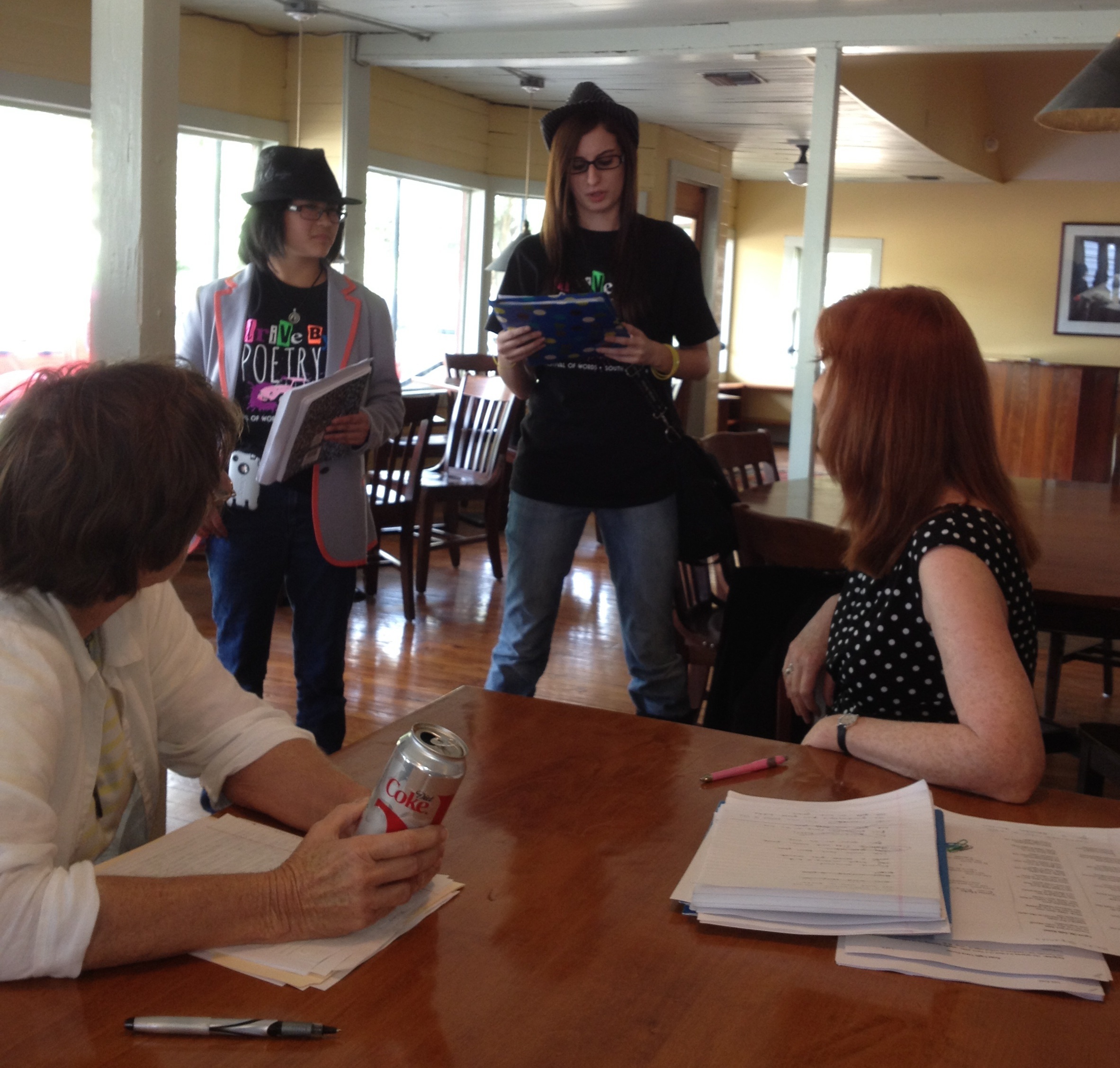
Students from area high schools did drive-by poetry. Here a student reads aloud a poem by Julie Kane to Julie Kane. She delighted in hearing her own poems performed by these talented students.
One of my favorite poets is Mary Oliver. She writes accessible, simple nature poetry. She recently published a new collection, A Thousand Mornings. When it came up on Amazon as a suggestion (how do they know me so well?), I had to buy it. This book was so special I had to go to the post office to pick it up. When I opened the package, I lifted the book to my cheek. It felt like silk. Seriously, soft and smooth like a silk blouse! Mary Oliver’s poetry is so clear that even elementary students can understand it. I wanted to share her with my students. Of course, first I let them feel the cover. They knew immediately that magical poetry lay within.
I read aloud Mary Oliver’s words, “This morning the beautiful white heron was floating along above the water.” My students know what this looks like, a common scene here in South Louisiana. I read a few more poems. But they were getting anxious.
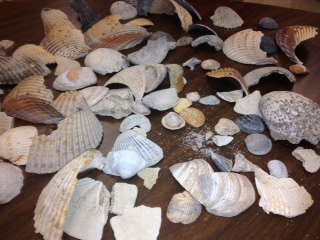
“What are we going to do with the shells, Mrs. Simon?”
On the table, I had placed a plastic container of shells, real beach-collected shells from the storage closet. I dumped them out on the table with these instructions, “Find a shell that you like. Draw it slowly, paying attention to the details. Then write a poem.”
I played classical music and wrote along with my students. Some beautiful poetry emerged. Taking time to slow down, enjoy the beauty that nature creates, and to listen to simple true words, that is the joy of writing work.
My poem: Broken
My heart bubbles
like the shell in my hand
when air pours through
its tiny holes,
Shaped as a mountain
with jagged incuts
and paths of lined creation.
I am imperfect
battered by crashing waves like
this shell torn from the sea
collected by a child
who knows how to love
imperfection.
by Matthew (3rd grade)
I taste the sea in me,
the ocean of wonders I smell,
the bumpy texture sends chills down
my spine, the echo of the ocean awakens
me, I see the sea’s symbol,
it is in my possession,
shell
by Kylon (4th grade)
A spirit, a dead, lost spirit
a lost stray child, who cannot find her mother
no hope, no life, just darkness,
dark like a night sky with no stars,
a smooth seashell,
it’s washed up- the ocean didn’t want it,
but I did, and it’s safe with me.
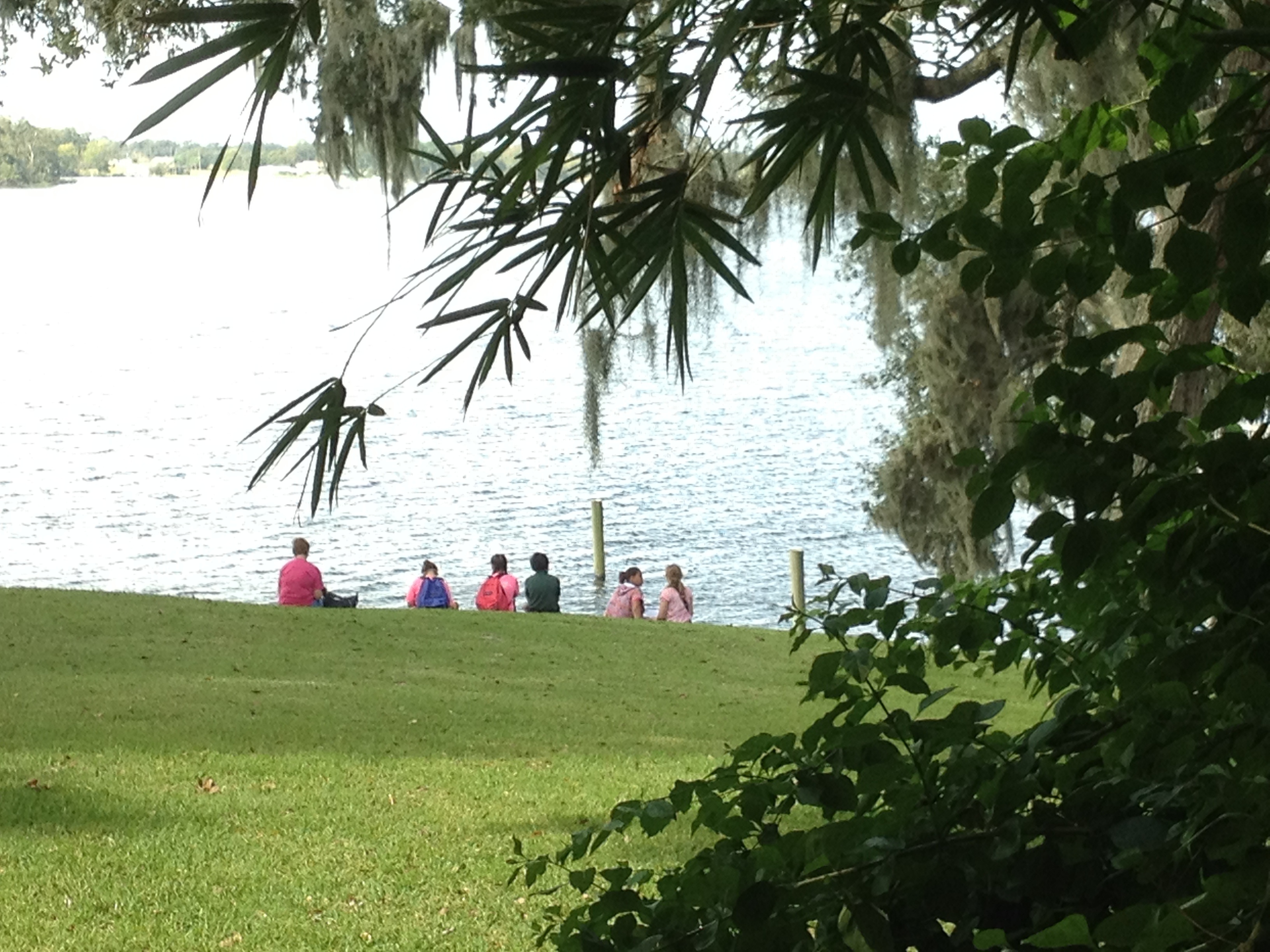
Our team of 6 elementary gifted teachers took the 6th graders from our parish (district) on a field trip to Rip Van Winkle Gardens on Jefferson Island. If you live around here, you know that Jefferson Island is not a true island. It is one of 5 land masses that rise up out of the South Louisiana marshes. Jefferson Island was once the home of Joseph Jefferson and holds a beautiful antebellum home with acres of tropical gardens.
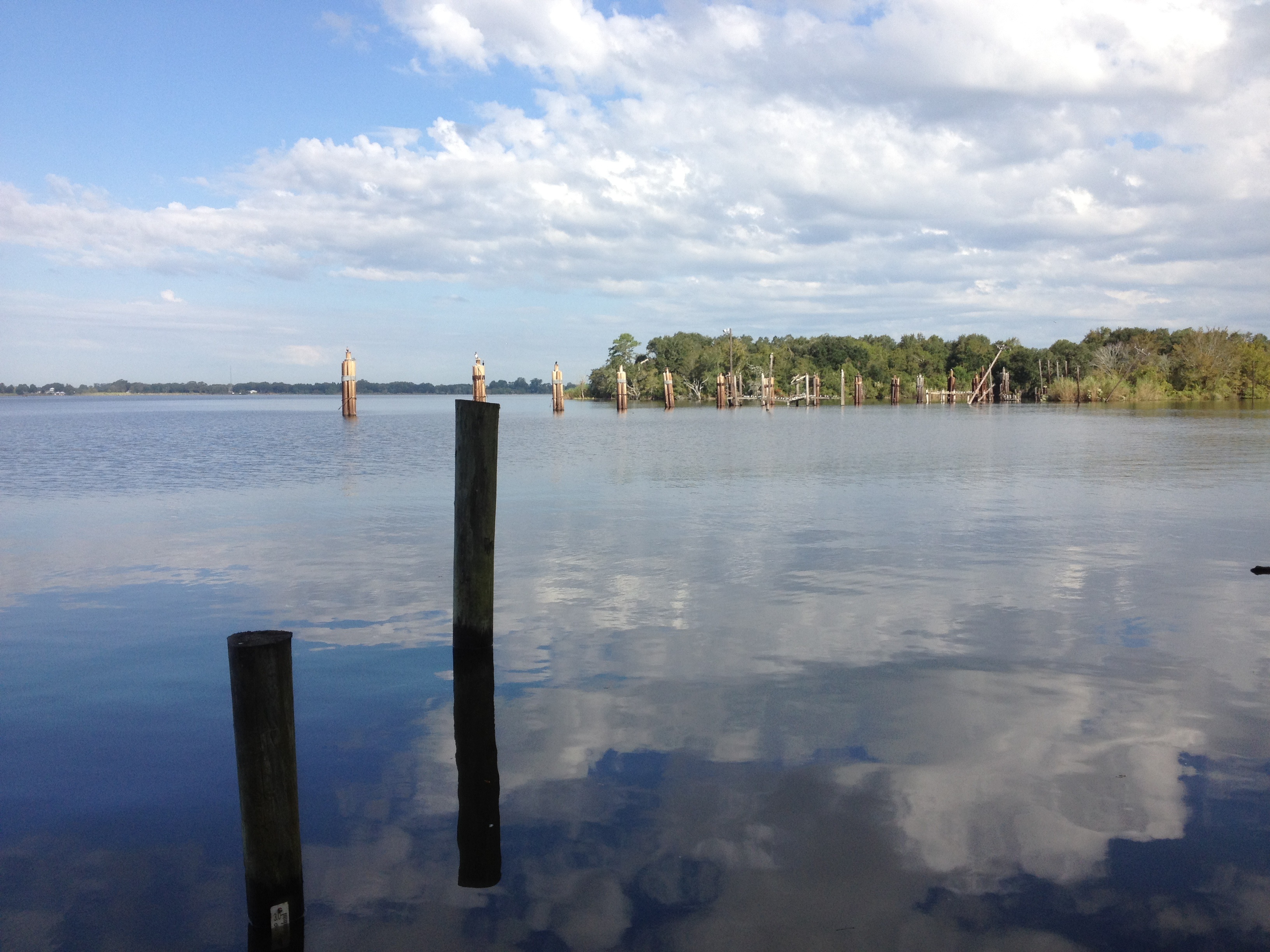
Reflections on Lake Peigneur
The purpose of our field trip was to introduce our students to a natural place where water is integral to its survival. We will be working with these students once a month for the school year on a project of their choice about water. At Jefferson Island, we learned some history, discussed questions, and enjoyed the beauty around us.
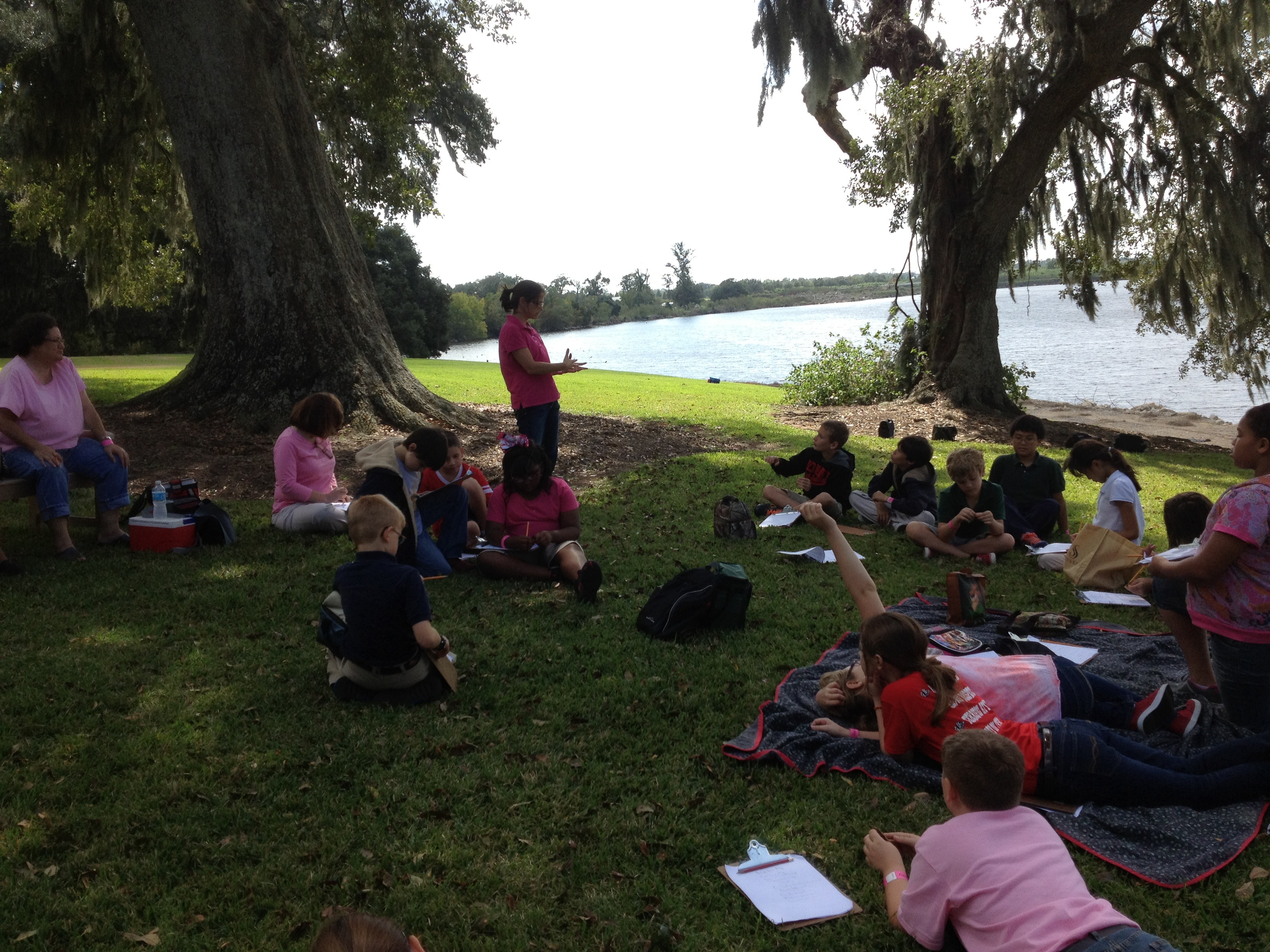
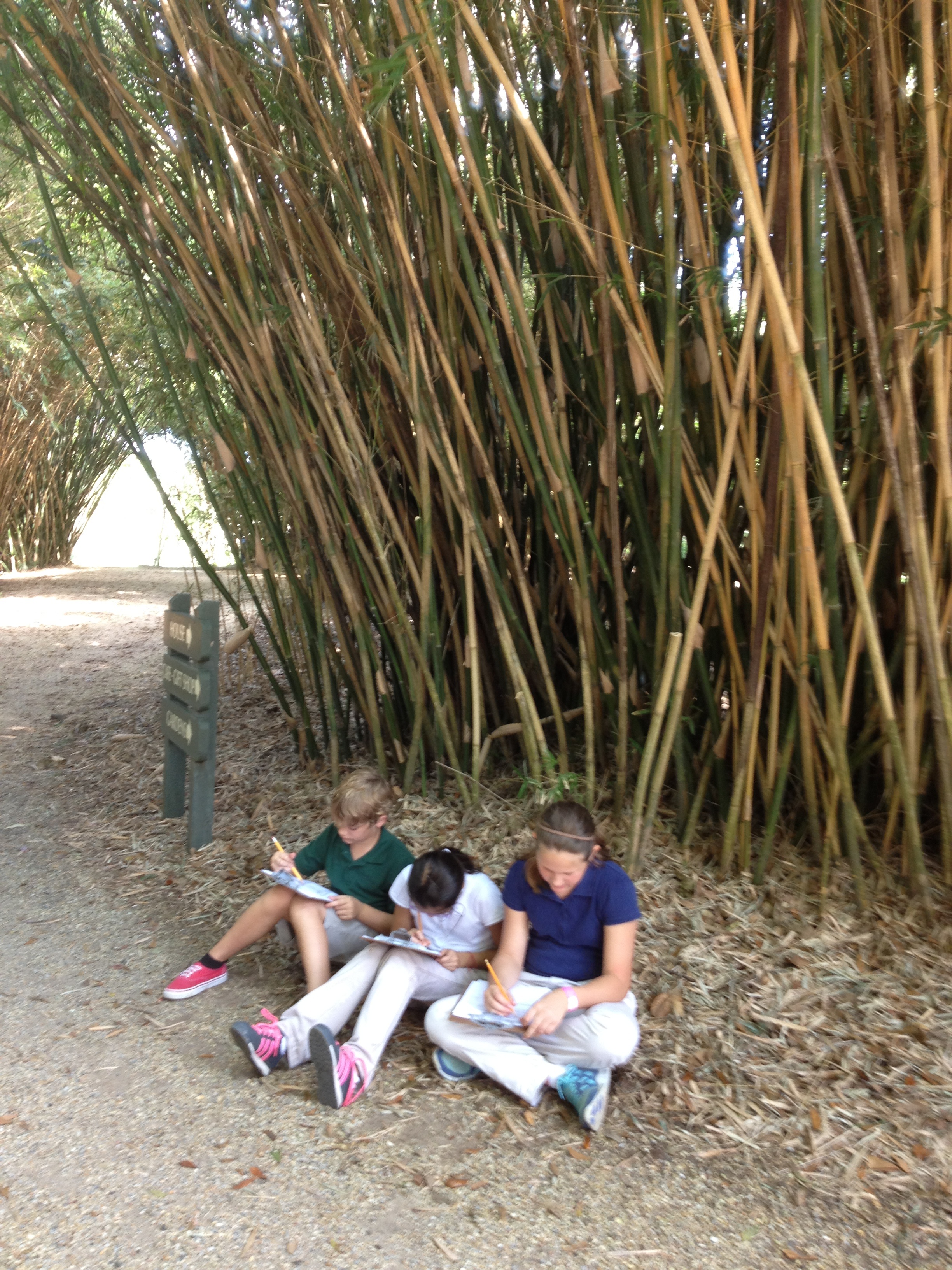
I led the students in a writing exercise from Georgia Heard’s book Awakening the Heart. The pre-writing exercise asks students to use an image. (In this case, the images were all around us.) There are 6 rooms, or divisions on the paper. Each room serves a purpose, such as “describe the image,” “what sounds do you hear,” or “describe the light.” Each room leads the writer to a deeper understanding of the image and often leads to a creative poem. We sent the students off to different areas of choice with a teacher. Teachers wrote, too.
Sharing time
Out at Jefferson Island, among the oaks, bamboo, and palmettos, we became a community of writers and explorers. We set the tone for the project yet to come and generally had a grand time.
Bamboo Poem
by Dustyn
Tall, arching, stalks of bamboo,
Bright and beautiful skies of blue,
Huge structures where flowers bloom,
Trees towering over you,
It relaxes me to feel the bamboo, so smooth,
And I’ll bet you’ll feel the same way too.
Writing in the bamboo forest
Rip Van Winkle Gardens
by Rhyan
We are in a mysterious land,
An enchanted garden,
Where the butterflies roam,
and the dock hangs over the lake.
The lake is screaming “I am a wonderful lake and I shall not be destroyed.”
But now it is silent.
The only sounds are rustling leaves and chirping birds.
Read other Slice of Life writers at The Two Writing Teachers
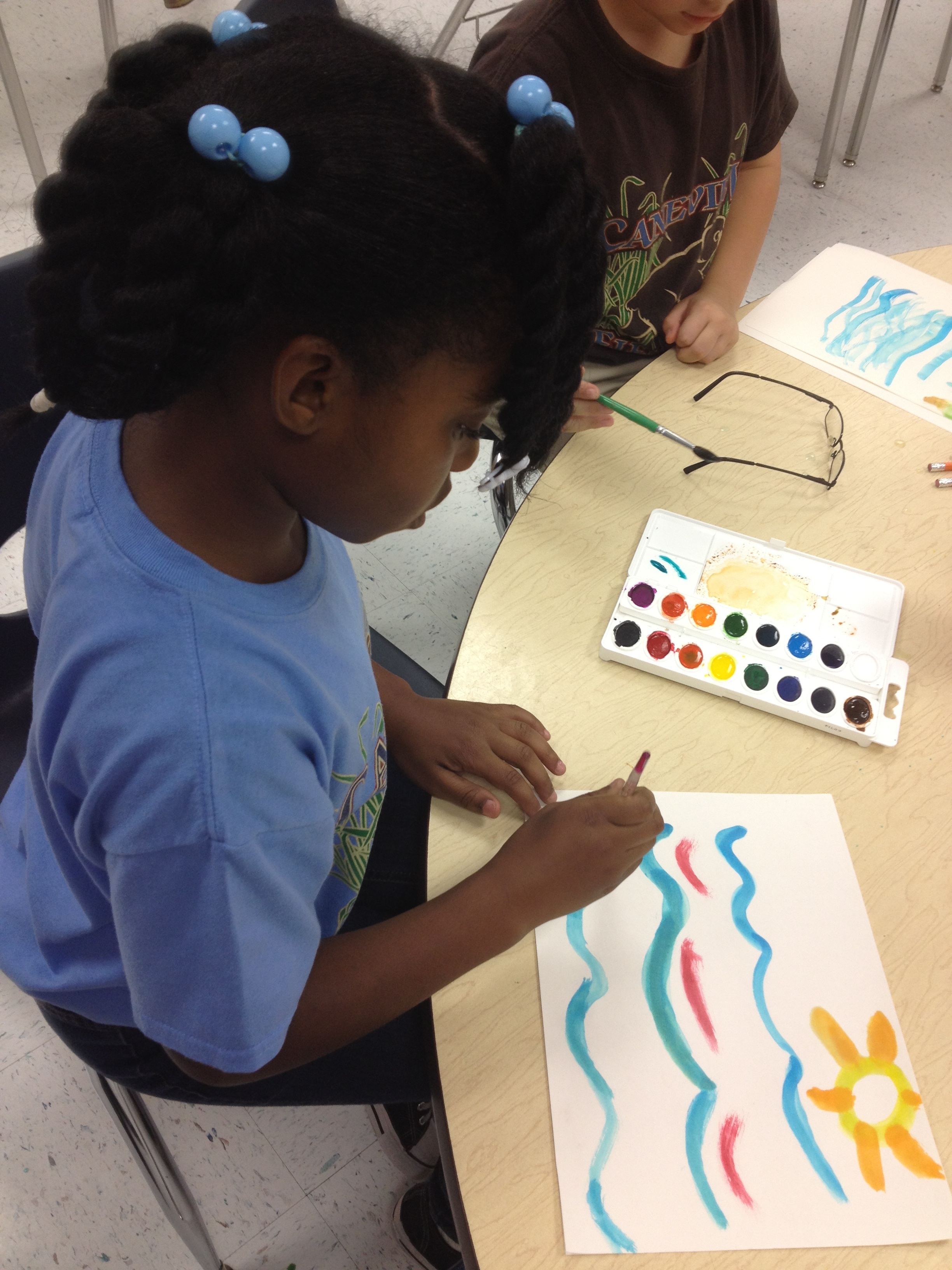
October 20th has been dedicated by the National Council of Teachers of English as the National Day of Writing. This year, the date fell on a Saturday, so my students and I celebrated on Friday, Oct. 19th. One of my favorite writing activities evolved from a workshop originated by artist Paul Schexnayder entitled, “Dancing with a Paintbrush.” Paul’s idea was to free up creativity by playing different selections of wordless music and having students paint whatever colors, lines, and shapes that come to mind. I borrowed this idea and added a writing element.
Dancing with a paintbrush
I selected some musical pieces. There is no magic in the selections I made, but basically I was looking for pieces that evoked different emotions. The ones I used were “Silent Moon” by Jia Peng, “A Day Without Rain” by Enya, “Tarantelle Styrienne” by Debussy, and “The Girl I Left Behind,” a Celtic selection.
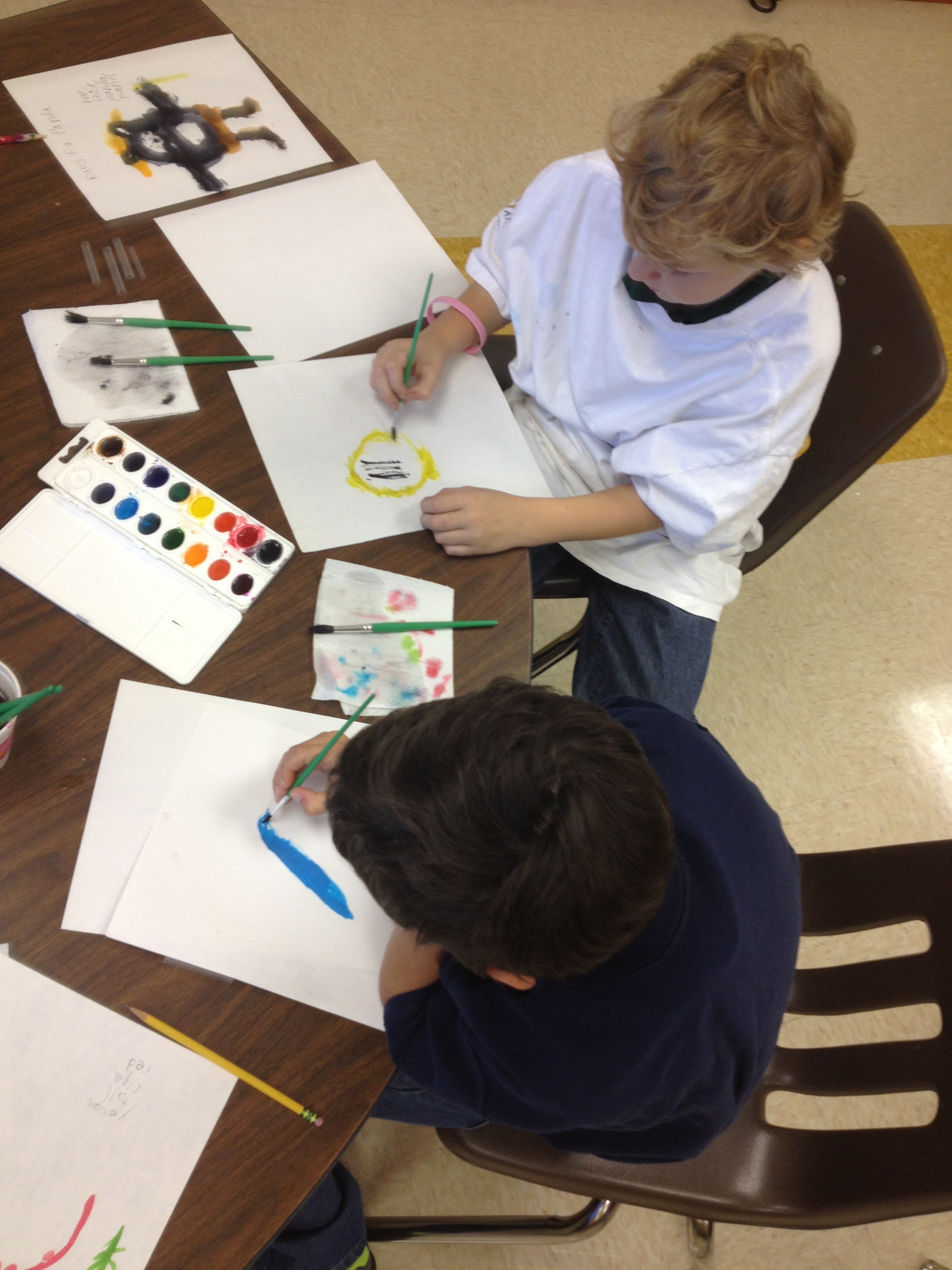
With watercolor paints and drawing paper, the students and I painted while the music played. Then at the end of each piece, I asked them to write 4 words and a title for their painting. After all selections were played and they had a collection of 3 paintings with words and titles, I asked them to select one to write about. Make the title of the painting your title and use the 4 words in some way within the poem. The results were all different and creative.
Focused and listening leads to creative expression.
Here are some sample poems from this exercise:
Beauty
it comes with amazing colors
of red,
green,
blue,
and even yellow too
All the colors
could be a rainbow
just waiting for you
for beauty is true
telling of mood,
majesty,
and imagery.
Pure beauty comes from heart,
The Rightful Beauty.
by Kendall, 5th grade
The Chinese Gates
I am a girl
I live In China
Every day I paint swirls
Ah,so beautiful
I paint the sun and water
I paint the moon and rivers
Even some Chinese words
I learn new paintings every day
And maybe some day you could visit me in China by the Chinese Gates.
Teaching gifted students means I teach multiple grade levels at the same time. This can be both a joy and a challenge. Some of my students come to me for their language arts block, some for math. My two second graders come to me at the very end of the day. They usually come in to an already active classroom.
One day last week when the second-graders came in, I had all the other students seated at the table writing fall poetry. On the projection screen was a collage of fall pictures for inspiration. We had collected words and were in the writing process. Tobie sat right down to write, but couldn’t find his journal, so someone found him a loose leaf page to use. Emily, however, was intrigued by the projector and started making finger puppets in the light. I sent her away to a desk in the classroom. I wanted to make sure she was behaving herself and that she wasn’t too upset about being punished, but when I looked up, I saw her perched on the edge of the farthest desk in the room quietly writing. I left her alone. Later after our lively sharing session, I encouraged the students to post their poems on our kidblog. Emily posted her poem. The next day I got an email from her mother praising me for inspiring Emily’s poem.
As I reflect on my classroom, I often worry about the constant activity and many levels going on at the same time. Sometimes, I have so many balls in the air, I just know one will clobber me in the head at any time. What I realize about writing workshop is that even when it doesn’t seem to be working, it is working. It’s about making writing an integral part of any day. It’s about safety. And it’s about providing the space for creativity to happen. And ultimately, it is about the students themselves.
I am posting Emily’s fall poem today. Originally, there were few periods and no line breaks, but I took the opportunity to have a little mini-lesson with her about this, so you are seeing the revised version.
Fall Leaves
I walk down the path.
It’s morning. The sun hasn’t even risen yet.
I watch the wind carry the leaves across the valley.
I see pumpkins in the pumpkin patch.
I love the colors falling from the trees.
I smell the sweet smell of sugarcane.
The sun is rising and getting warmer.
I feel the breeze. I find some leaves.
I pile up the leaves, and I jump in!
I love the fall,
the best season in October.
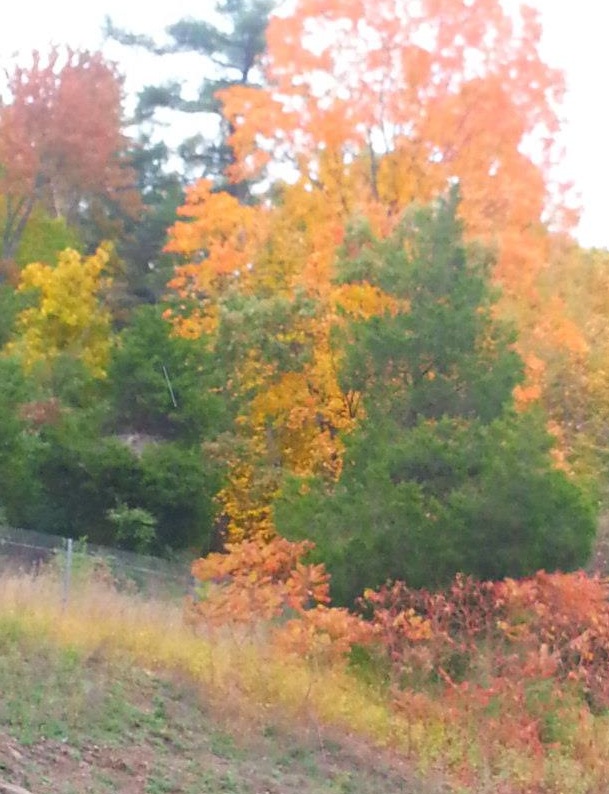
Massachusetts in October where leaves turn golden. Courtesy of my friend, Leon, who is traveling and posting beautiful pictures of real fall.
That undeniable feeling of defeat I haven’t been able
to tell anyone about, not in words anyway
despite hearing the advice of my daughter
who studies this kind of thing;
She warns me of the dangers of depression: don’t let this go on for too long
I can feel it pulse like my eyelids under my fingers which average 10 blinks a minute varying quite
a bit based on the individual,
and things like medication and nervous disorders.
So am I normal? I listened to the weatherman’s advice.
I trusted the image of storm clouds.
Trust your inner self, says Oprah,
in this month’s O magazine advertising 101 best pieces of advice—
ever! The right words at the right time
will direct my path.
Not today–today the path
is covered in acorns that pop when I step on them.
Pop! Pop! Something satisfying in the act of
stepping on this winter squirrel snack. Hear me
stomping, making rhythm by destroying.
Bake the Best Chocolate Chip Cookie
or How to Have a Conversation: Things I need to know
to be the perfect O-mag reader, but what about
this day when I can’t focus on the words? My eyes
flutter while I hold back the tears.
I am imperfect and annoyed that this is so.
First, get a drink. Seriously, she says that, get a drink.
Something to hold on to when all else fails.
A writing exercise that is often successful for me is to borrow a line. I have done this a number of times to jump start a poem. See The Day, Fallen Oak and also in the poem from the 30 Day Challenge Blackberry Time.
Last week my writing partner, Stephanie, led a writing camp. She used this exercise with the students. I joined them on Wednesday for their writing marathon. It turned into a virtual writing marathon due to rain, but we managed to spend time visiting different places (through pictures) and responding with writing. Stephanie posted pictures on the kidblog she set up for the camp. For one of the pictures, her prompt was an Emily Dickinson poem and a picture of a mountain waterfall with the sun bursting over the hillside. For some, the picture led the poem. For others, Emily Dickinson’s words. Later in the week, the students were asked to find a favorite poem and “steal a line.” While we instruct them on plagiarism and the correct way to credit the original author, this activity is often successful. Somehow it breaks through the barrier of “I can’t write,” and leads to deeper creativity.
Here are a few samples from the writers at Write Your Way Camp 2012:
From Sophia with a borrowed line from Emily Dickinson
I’ve heard it in the chillest land,
and stories of this place.
Its beauty just lights up my eyes,
and fills the land with grace.
I see the mountains, puffy clouds,
and greatly blinding sun.
But in some time,
I will realize,
That my journey’s just begun.
From Matthew with Emily Dickinson Hope is the thing with feathers,
hope is the thing with fur,
hope is the thing that rises the sun,
hope is the thing that purrs.
Kaylie with a borrowed title by Joe Fazio. This is… Our Life
This is the game we play,
start at the beginning of the day,
run in circles, having fun in the sunny rays.
Lie down in the dewy grass,
wait for the day to pass.
Go back home and start again.
I know you’ll be there tomorrow, my friend.
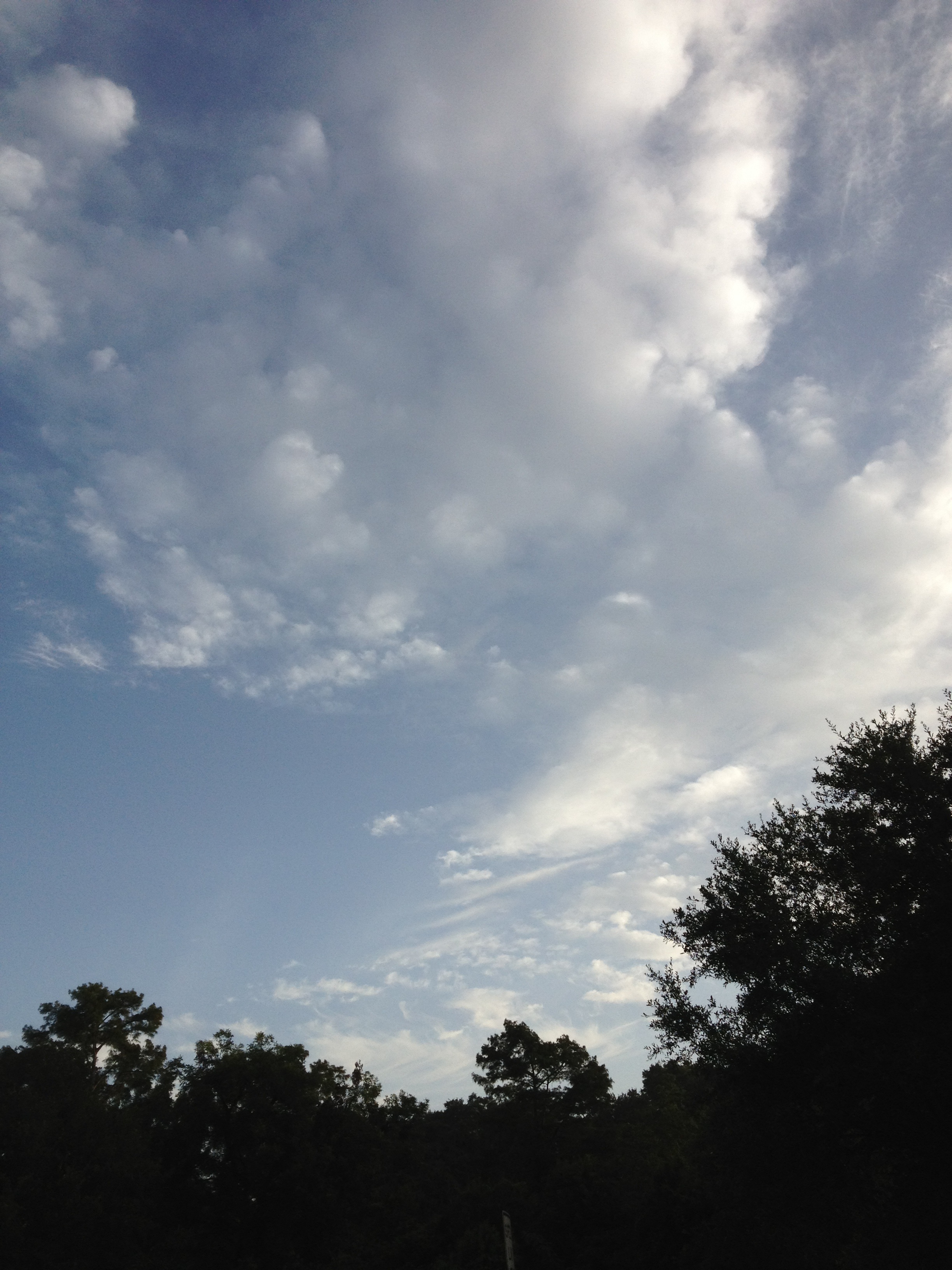
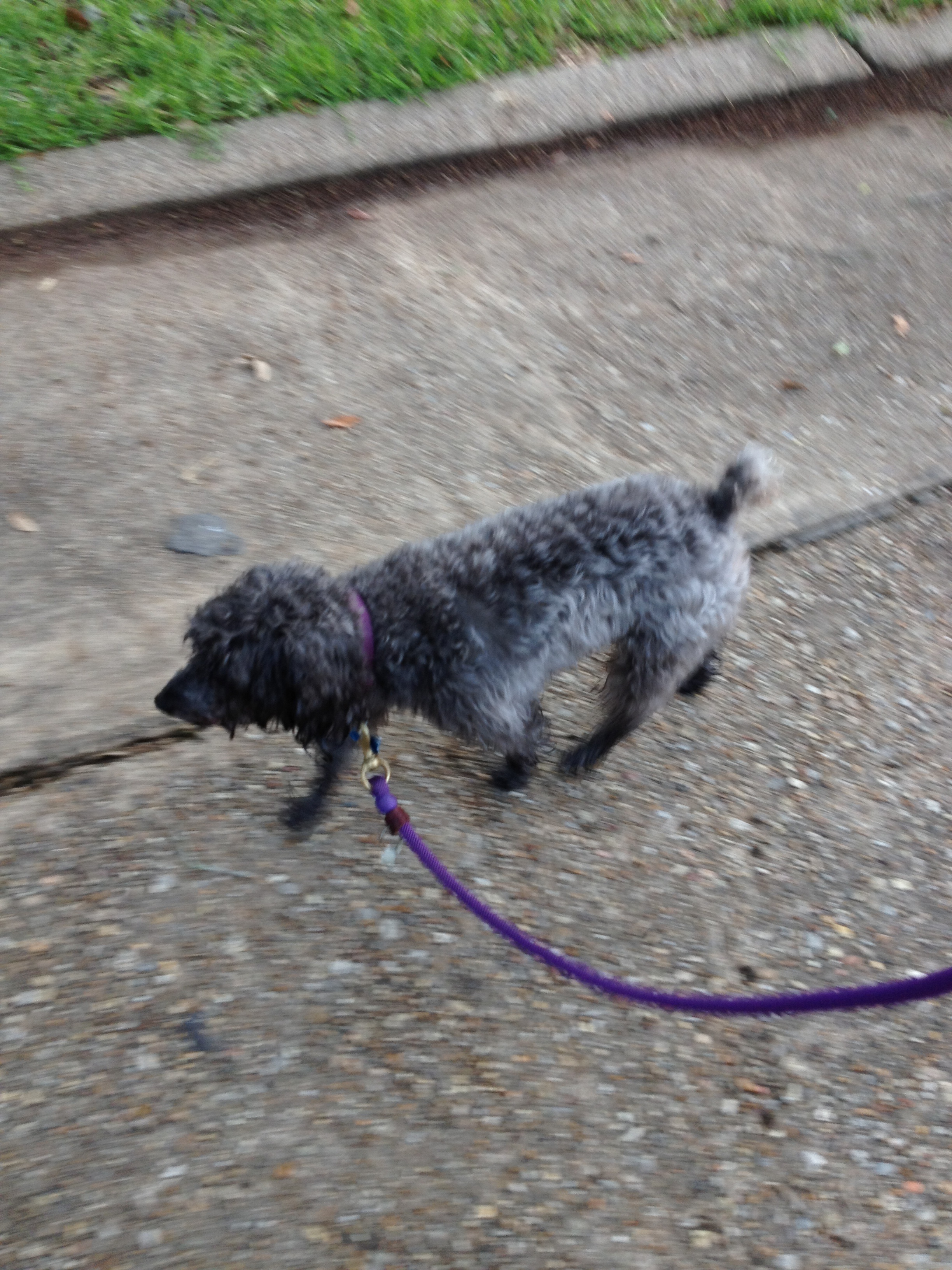
The poetry prompt this week from Poets and Writers The Time is Now asked me to collect six images and to use two to create a poem. I collected images on my morning walk using my iPhone.
Then I read the prompt from Teachers Write. Using two lenses, examine your landscape, panoramic and monocular, and write a description of the two views.
The sun rises over the oak trees,
a spotlight on the landscape.
Shadows painted on scaly trunks
guard my path like silent soldiers.
The distant bayou draws a border
on this land, this soft, soggy space
softened by the glowing rays of morning sun.
My companion trots like he belongs here,
black fur saturated and slinky after a romp
across an empty field.
He doesn’t pull or tug,
keeping the rhythm of his step in time with mine.
Never mind the cawing crow;
never mind the passing car.
We are happily walking, enjoying the morning,
drinking in new light and life.
Margaret Simon lives on the Bayou Teche in New Iberia, Louisiana. She is a retired elementary gifted teacher who writes poetry and children's books. Welcome to a space of peace, poetry, and personal reflection. Walk in kindness.