Feeds:
Posts
Comments

Archive for the ‘Teaching’ Category

Poetry Friday round-up is with Robyn at Life on the Deckle Edge

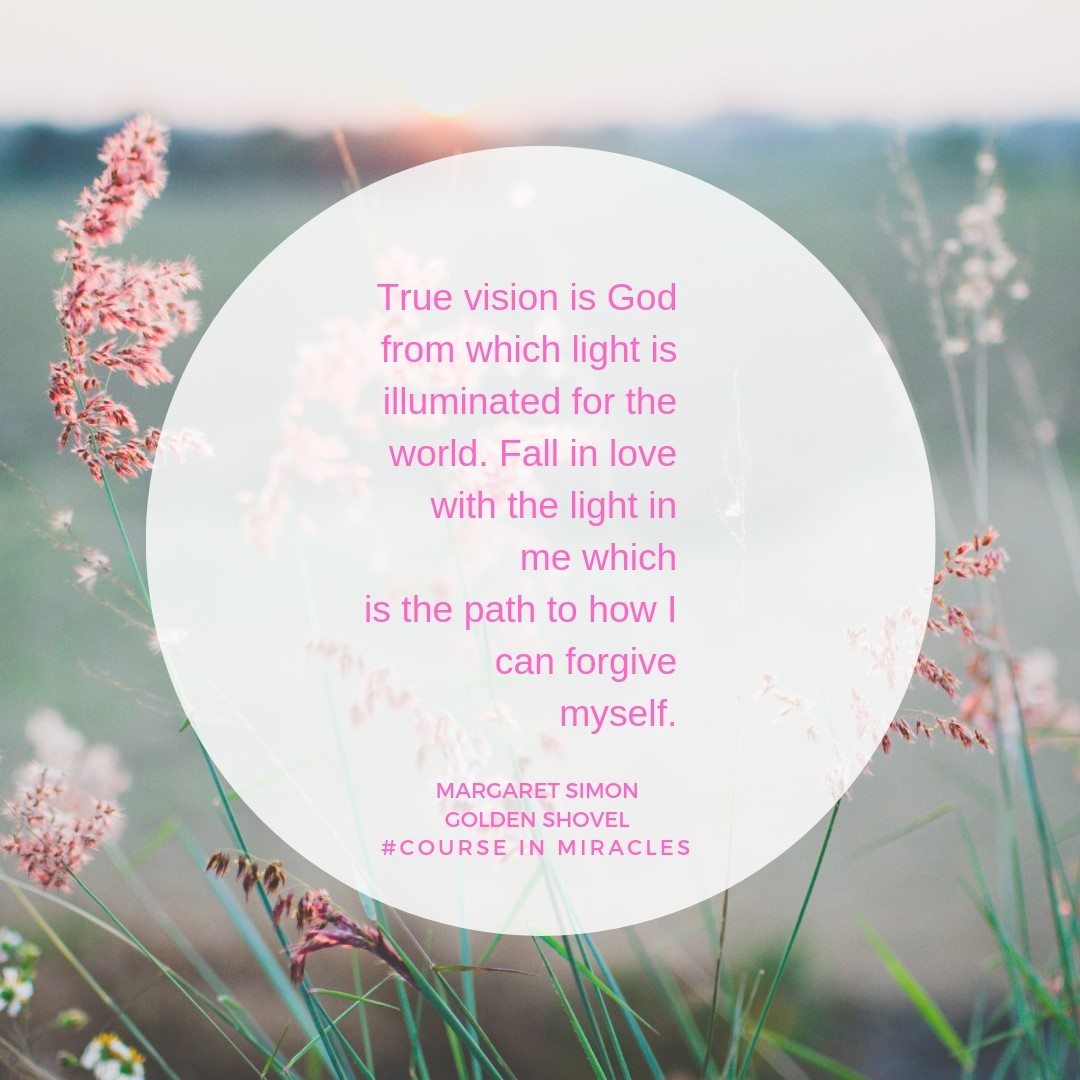
I am participating in a book study called “A Course in Miracles.” It is quite an amazing journey of meditations that lead to self-awareness and ultimately to inner peace.  Each day there is a new mantra.  One of the mantras for this week was “God is the love in which I forgive myself.”  I was drawn to creating a golden shovel poem and used Canva.com to design the graphic.

In my classroom, we have been using the golden shovel form to respond to quotes.  Invented by Nikki Grimes, a golden shovel form begins with writing the words of the quote down the right hand margin of the page.  Then you write a poem around the words, incorporating the quote into the poem.  On Martin Luther King, Jr. Day I wrote one together with Jayden around this quote, “The time is always right to do what is right.”

When someone knows the
right thing but time
goes too fast, and is
never around long enough, always
do what’s right
even when it’s hard to.
No matter what you do
Listen to what
your heart
knows is
right.

The golden shovel form is a way to honor the words of another while making them your own. Next time you read an inspiring quote, try to write a poem around it.


Read Full Post »

See more posts at Two Writing Teachers Slice of Life .
 

On Valentine’s Day last Thursday, I challenged my students to write a love poem without using the word love.  On Facebook I had read Charles Ghinga’s poem for his wife Debra.  I used it as a mentor text.

YOU ARE THE MOON

(for Debra)

You are the moon.
My only one.

You bring light
Where there was none.

©Charles Ghigna

After we read this poem, we brainstormed a list of things in nature that could serve as a metaphor as moon does in Charles’ poem.  I pushed my students to be specific.  Some of the more interesting things they listed:

sunflower
lily pads
stars
swans
sea eagle
grass
northern lights

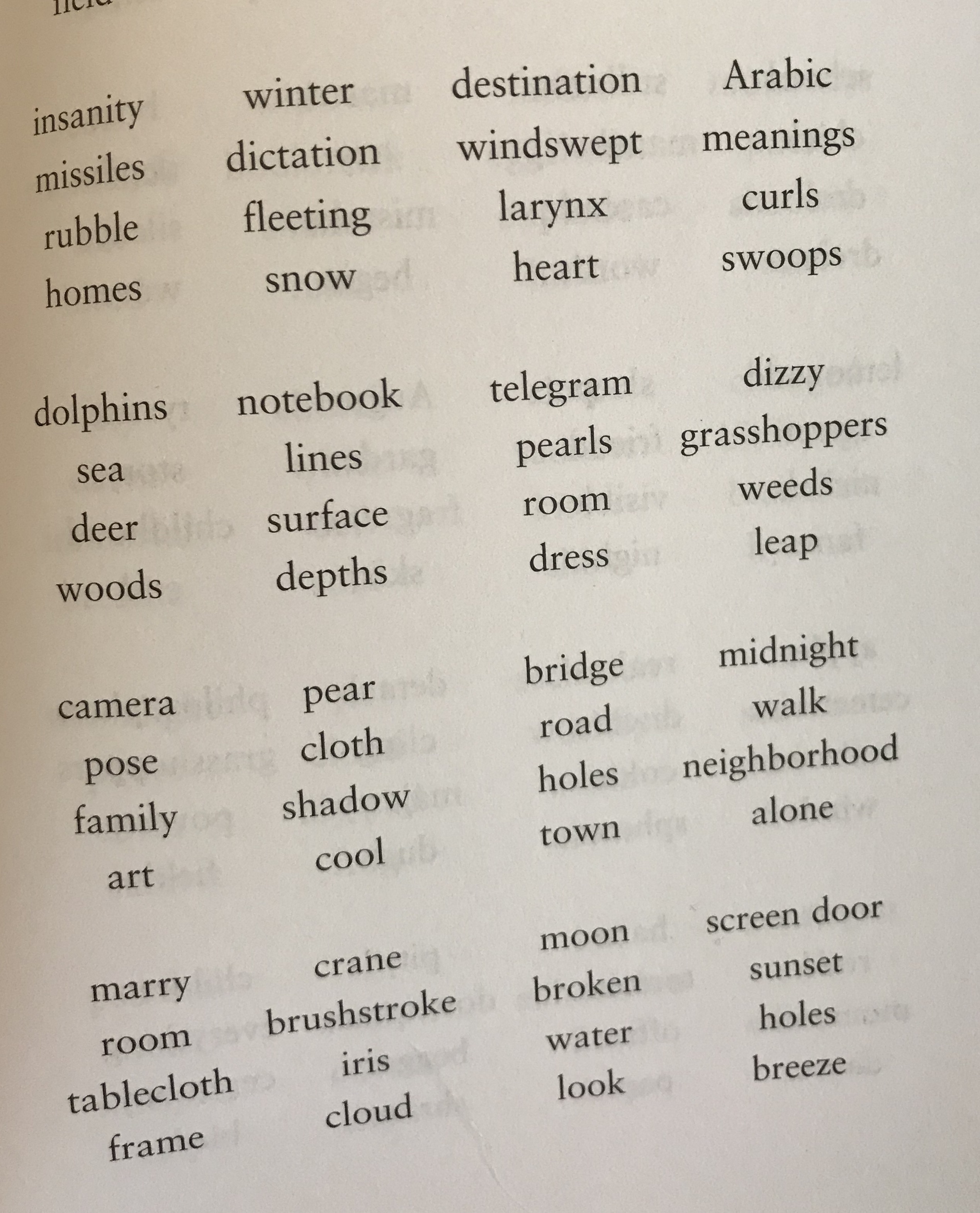
Page of word groups from Writing Poetry From the Inside Out by Sandford Lyne.


I used a poetry resource by Sandford Lyne called Writing Poetry from the Inside Out. In this book, Sandy writes about “Poem Sketching” with word groups.  The back is full of pages of word groups.  I photocopied one of these pages to give to my students.  Each student chose a word group to write from.

Magic happened.  Was it writing about love without using the word? the model poem from Charles? the word groups from Sandy? or the magic that happens when writing in a safe community?

We cut out construction paper hearts and wrote our poems on them to give to someone special.  I gave mine to Madison because I used a quote of hers.  Chloe gave hers to me, probably because I loved it.  And Madison gave hers to Chloe.  Poetry gifts from the heart.

Love poem gift from Chloe glued into my notebook.

You can read more poems on our kidblog site. 

Journey They Will Take

Two dolphins
under the sea
two deer
in the woods
and
the northern lights
watching
the four animals
coming together
On the journey they
will take.

Chloe, 3rd grade

I think your feelings for me

are a midnight walk

where it’s easy to get lost.

My feelings for you are as bright as stars

when I’m alone.

I’m a neighborhood of sadness,

a pool of cries,

an ocean of regret.

Our feelings are as wild as animals.
by Jayden, 5th grade

My poem for Madison:

She says, “Did you know the sea eagle
has a wingspan of eight feet?”
I write it down in my notebook
realizing that her knowledge
opens the surface
of our classroom
like the blossom of a tulip.
Digging into depths
of learning
makes everyday
as fascinating
as the sea eagle.

–Margaret Simon


Read Full Post »

Poetry Friday round-up is with Laura Purdie Salas this week.


Have you gotten a set of metaphor dice yet?  Here’s a link to them on Amazon. 

I’ve been playing with metaphor dice and the skinny poem form.  To make a skinny poem, roll the dice to find your first statement.

I got “Love is a silent blessing.”  This becomes line one.  Lines 2, 6, and 10 are all the same word.  Other lines are only one word long.  Line 11 repeats the same words as line 1.  Confused?  Try numbering your paper from 1-11.  Write your metaphor phrase in line one.  Choose a simple word for line 2, 6, and 10.  Fill in the rest.

Love is a silent blessing
a
whisper
touch
smile
a
soft
unspoken
wink
a
silent love blessing.

Here are a few student skinnies:

Beauty is a glorified dance
a
midnight
shining
flower
a
gentle
soft
breeze
a
beautiful dance glorified.

by Landon, 5th grade


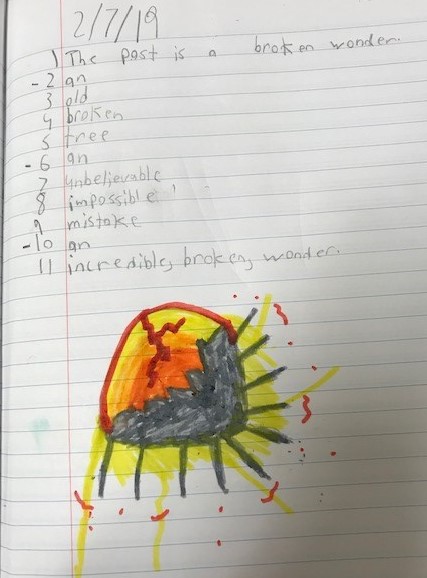
The past is a broken wonder
an
old
broken
tree
an
unbelievable
impossible
mistake
an
incredible, broken, wonder
by Daniel, 4th grade


We also wrote bug-ku this week inspired by Susan Bruck on her site last week. Check out all student poems on our kidblog site.


Read Full Post »

See more posts at Two Writing Teachers Slice of Life .


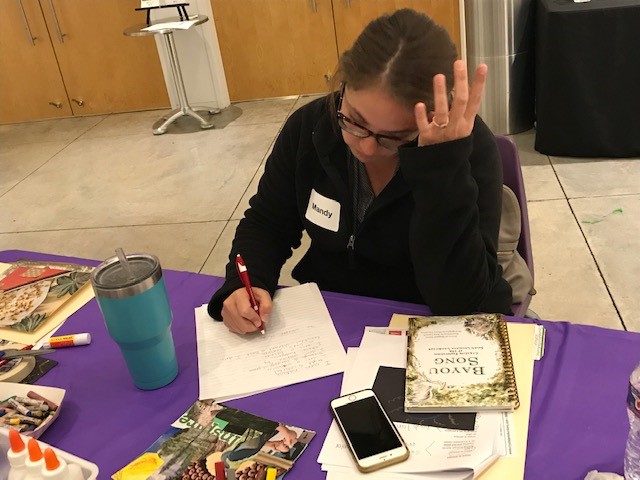
Last week I collaborated with artist Marla Kristicevich on a workshop for teachers designed around poetry and art collage.  The workshop was part of the Arts in Education professional development series held at the Acadiana Center for the Arts.

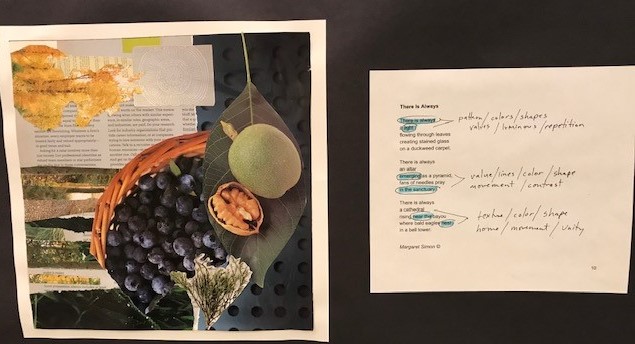
After I presented about finding elements of poetry in my poem “I am a Beckoning Brown Bayou,” Marla shared how she had taken words from 3 different poems from my book Bayou Song, and circled words that represented an element of art.  She then created a magazine collage to reflect those words and images.  While Marla’s complete presentation was in a PowerPoint slide show, the part that touched me were the amazing and beautiful collages she had created from my words.

Marla’s collage from interpreting the poem There is Always.

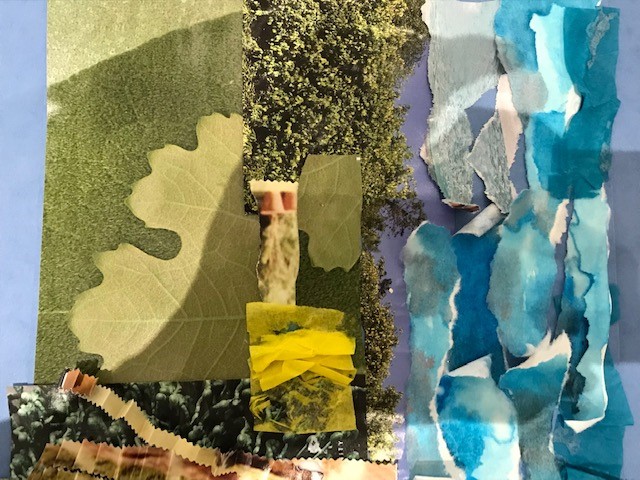
We had 12 dedicated teachers attend, and they enjoyed the time to sit and create with materials from magazines, painted paper, and other scraps.  The collages were varied and lent new meaning to the poems we worked with.

Then I led the teachers in writing their own poem by gathering new words from their own collages and selecting a form to use.  My hope is these teachers will take what they learned, their joy of playing with words and art, and bring it into their classrooms, but more than that, my poet’s heart was touched by the way my poems from Bayou Song led to more poems.

Collage from “There is Always” by Cissy Whipp.


Cissy’s Poem

Dance/Nature Triptych

I.

My dance is in the way
the leaves calmly curl and crinkle
under my feet.

II.

My dance is in the water
rippling, rising, rushing
around my ankles.

 III.

My dance is in the place
between land and water –
the muddy, mysterious marsh.


Finding the poem inside.


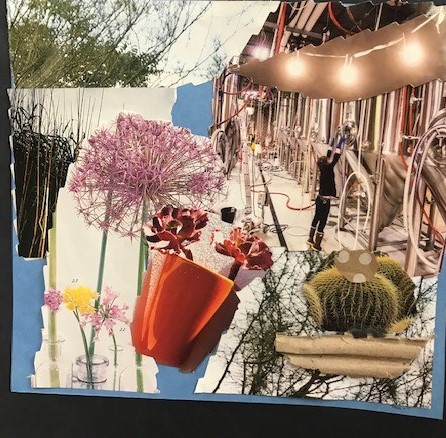
Kay chose the I Am form to use when her collage revealed things about herself.

Kay’s collage from the poem There is Always.

Hands Up High

Kay Couvillon

I am fiery red in summer beach walks,
I become lavender peaceful
with restorative yoga.

I hold my
hands up high
to the lights of
love, trust, dance, and
cold beer.

I am an
E. Broussard eagle
in awe of the
bald eagle’s nest.

I sway in the
wind of the leaves after
hibernating when I feel like
torn cardboard.

I love red, pink, and scented
geraniums in clay pots from
Mother Earth.


Read Full Post »

See more posts at Two Writing Teachers Slice of Life .

I enjoy learning from other teacher-writers who post on Slice of Life as well as on Poetry Friday.  That’s how I met Molly Hogan.  She blogs at Nix the Comfort Zone.   A few Fridays ago she posted a beautiful original I Am poem.  Her ideas for this poem came from poemcrazy by Susan Goldsmith Wooldridge, which is a book I have and value “freeing your life with words.” (Only $3.99 at Abe Books)

When I read Molly’s poem, I decided immediately to use it as a mentor text for my students.  We read the poem and noticed so many metaphors.  Using colored pens to underline the poetic devices, one of my students said, “This is a very colorful poem,” and she meant that literally.

I am granite grey
plain Jane, sturdy and dependable
but sometimes sunlight shoots across my surface
igniting flecks of mica and quartz
into quick showers of sparkles
here, then gone (Read the rest of the poem here.)

Following our reading and noticing and discussing, I asked my students to turn to a clean page and draw circles.  Oh, about 5-7 circles will do.  Then we read the poem again.  In the first part, she says “I am granite grey.”  What is granite grey? A color. Label one circle with color.

As we traveled through the mentor text, we filled in more circles: shape, tree, word, animal, nature, etc. We even made a split circle of inside and out.

During sacred writing time (10 minutes on the Zen Timer app), we filled in the circles with our own ideas and wrote a draft of our own poems.

I know that metaphor is a high-level concept that can take years for younger students to fully grasp, but I dare say that my students got it.  Their poems were long and beautiful.  Having this amazing mentor text helped greatly.  Thanks, Molly, for your inspiration.

Here’s a link to our kidblog site.  Please read and leave comments.  My students feel such pride when you do.  Thanks!

I Am…

I am pink,
chapped and worn,
supple and soft.

I stand on the base of a triangle,
stable, reasonable,
striving for perfection.

In my mind, I criticize–
a checklist of do’s and don’ts
a chapter of why I can’t be.

I am not like the oak
confident in its old age;
I am more of a willow,
seeking, bending in the breeze,
greening in spring.

I search for kind
in your eyes,
your song,
your words.

I do not hunt like the hawk;
I wait and watch like the heron
stepping carefully through the muck.

I am a magnolia blossom
open, fragrant but
easily bruised and brown.

Be soft with me.

(draft) Margaret Simon


From Wikimedia Commons


Read Full Post »

See more posts at Two Writing Teachers Slice of Life .


What is your vision for 2019?  We really can’t know what the future holds, but we can think about what we want to do and be in the coming year.  I’ve never done a vision board before, and I can’t say that I am any kind of expert. I started when my students were working on One Little Word magazine collages.

Yesterday I made the necessary step to add more yoga into my life.  I signed up and paid for a class beginning in February.  And I put it in as a regular alert on my phone.

I’ve been making smoothies for breakfast ever since the winter break when my middle daughter visited.  She made a smoothie every morning and got me hooked.  My youngest daughter gave me a Magic Bullet blender in which the container converts to a cup with a top, so I can blend and go.  My typical recipe is quarter cup Greek yogurt, quarter cup oatmeal, half cup milk, teaspoon of flaxseed, half a banana, half an avocado (or Kale, if the avocado isn’t riper yet), and quarter cup blueberries (or strawberries). I am amazed at how full I feel after drinking it, and I’m not hungry until lunch.

My students worked this week on their one little word projects. I gave them options for creatively representing their words.  I also invited them to blog about their words.  I was moved by Madison’s post.  This 5th grader has the wisdom that I have longed for all my life.  She is comfortable in her skin.  I hope she will hold onto her values of Possibility.

This year, my word is possibility. I like this word because there is no such thing as completely impossible, they say, but I’ve added on it: but there is such thing as possible. Always try because if you don’t, if you lay down and let others control and use and block you from your goal, leave them. Always try. Never set a true goal that limits yourself- whenever you achieve one, go higher and higher, always trying. Have confidence. Just because it’s hard doesn’t mean it’s impossible. The way it’s hard is what makes it a good challenge. Nothing ever comes easy, and it never should, or we’ll all be lazy and fat. Be aware of yourself, and don’t let yourself fall out of shape or routine or such just because you don’t feel like it even though it benefits you.

Because, as hard as it’ll seem…

It’s always

Possible.

(Blog post by Madison: to leave comments, click here.)


Read Full Post »

See more posts at Two Writing Teachers Slice of Life .

When we returned from our holiday break, I found a poem from Poets.org in my inbox.  I subscribe to Teach this Poem, a weekly lesson plan around a selected poem.  The poem Dead Stars by Ada Limón drew me in, and I felt compelled to teach the lesson. To begin, we looked at pictures of the Orion constellation and made attempts to draw it in our notebooks.

Before we read the poem, I talked about how I love poems that take notice of something in nature then go deeper to something more profound.

We find it hard to settle our brains down, and poetry offers us that silence, that quiet space, and allows us to reconnect with ourselves, or with an idea, or with an emotion. (Ada Limón)

When reading a poem with my students, I let them take the lead.  “What do you notice?” “Are there any words you don’t know?” “What do you think the poem is about?”

Each group of students takes the discussion in a different direction.  With my first group, we discussed an interesting metaphor in this line, “I am a hearth of spiders these days: a nest of trying.”  Daniel rephrased the line, “Laying eggs of attempt.” Then we noticed that both hearth and nest are places of caring.

With my second group, theme became the focus.  What is the poet trying to teach us? She wants us to rise above the tide (the hard times) and be alive.  Landon wrote a thematic sentence, “Be alive, reach for the stars, and shine!”

In my third group, stars, constellations, and the fact that we are made of stardust became the topic of discussion.  “But mostly we’re forgetting we’re dead stars too, my mouth is full of dust and I wish to reclaim the rising–” (Ada Limón)

I pulled up an article to read from National Geographic.

Everything we are and everything in the universe and on Earth originated from stardust, and it continually floats through us even today. It directly connects us to the universe, rebuilding our bodies over and again over our lifetimes. (Iris Schrijver)

In response I wrote a septercet, a form created by Jane Yolen with 3 lines of seven syllables each.  The last line is from Ada Limón’s poem “Look, we are not unspectacular things.”

When I work on poetry with my students, I try not to push them to complicated analysis.  There is time for that when they are older.  I hope to expose them to amazing language, to the art and craft of metaphor, and to understand that poetry is always available to them.  Even when they are “rolling their trash bins out.”

A cherita about the stars:

You say look up

Take notice of the stars
Name the one you are

We are the star
dust of many ages
collected as unique thoughts.

(c) Margaret Simon


Read Full Post »

Poetry Friday round-up is with Buffy at Buffy’s Blog.


I have grown-up children and am very grateful for it, especially in light of the new elf-on-the-shelf craze.  I think I would fail miserably at being in charge of creative ways to position an elf each night.  However, when December was coming, the elf-on-the-shelf became a topic in my students’ writing.  One afternoon I left the room for a bit and when I returned, my students had positioned Jack the lemur hanging from a chair.  Chloe said, “I think Jack has an elf inside him!”

Since then, Jack has found many creative ways to make mischief in our classroom.  This phenomenon led me to respond with a poetic letter to Jack.


Dear Jack-on-the-shelf,

Your personality is showing through
the things you like to do.
Play Bananagrams.
Spell “I Love You.”
Hang with Santa.
Curl up in tissue.
Each day, Chloe looks for you
to see where you’ll be found.
You make our class time
full of joy.
I hope you’ll stick around.

Love,
Mrs. Simon

I’ve been participating in Mary Lee Hahn’s #haikuforhope this month.  On Twitter, we are all using this hashtag to share our small poems of hope.  I’ve posted mine on this blog daily.

In class every day, we choose a quote to write from.  On Monday, I wrote a haiku from this quote by E. S. Bouton, “True wisdom lies in gathering the precious things out of each day as it goes by.” I was talking to a friend about the birth of my grandson, and she told me about a book called Full Catastrophe Living by Jon Kabat-Zinn. Even within the happiest of moments, catastrophe lies.  We need to use the art of mindfulness to be aware and live fully through these moments.

Gathering moments
of happy catastrophe
into precious life.

Margaret Simon


Read Full Post »

See more posts at Two Writing Teachers Slice of Life .

At NCTE 2018, I was excited to attend a session, Why Notebooks?, that some of my favorite people were leading: Jen Cherry, Amy Ludwig VanDerwater, Michelle Haseltine, and Linda Urban.  I’ve been a notebooker for some time now, and I always have my students decorate a marbleized journal at the beginning of the year, so I was drawn to finding more ways to use notebooks in my classroom.

As someone who loves little notebooks, I was delighted that there were handmade notebooks for us to keep (folded unlined paper with a colored cardstock cover).  They passed around puffy stickers for us to choose from.  I felt the thrill of creating something new.

Jen Cherry gave us reasons behind using notebooks with your students:

  1. Personalizes learning by providing choice.
  2. Encourages mindfulness.
  3. Builds stamina.
  4. Encourages risk.
  5. Students live like writers.

Michelle Haseltine prompted us to write an invitation to our notebooks.  On the first clean white page of the little green notebook, I wrote this poem.


I made a commitment to myself to be more intentional about notebook writing with my students.  On our first day back after Thanksgiving break, I asked my students to get out their notebooks.  In order to provide a structure that honors choice, I thought back to a workshop I attended with our Louisiana Poet Laureate Jack Bedell who told us about William Staffords’ daily writing discipline.

  1. date
  2. description of something that happened recently
  3. aphorism (cliche’)
  4. meditation (a poem-like thing)

After a few days of using this structure, I was hooked.  It was working for me, so why not share it with my students?  This is what I wrote on the board:

  1. Date
  2. Something that happened…
  3. Quote of the day
  4. Poem-ish writing

I set the timer for ten minutes and we wrote.  Some shared.  And some found their next blog post.  “I’m going to use this for my Slice of Life.”  We were doing the work of real writers.

We’ve been using the 365 Days of Wonder for quotes of the day, but I wasn’t doing anything more with it than having a student choose one and write it on a frame of glass.  They were enjoying the process of choosing and would often naturally start a conversation around the chosen quote.  Adding it to our daily notebook page gives more attention to the quote as well as possibly inspiring more writing.

This was our quote yesterday: “Happiness is a perfume you can not pour on others without getting a few drops on yourself.”  My poem-like meditation:

Happiness is the scent of flowers
in a bouquet
you give
just because
you’re happy.
Then the drops of perfume
fill your senses
and transfer
to whomever you hug.
Spread some happiness today!

As we get more and more adept at writing in our notebooks every day, my students and I will reap the benefits of sharing in a writing community.  Why Notebooks? So many reasons.  Pull them out of the desks, booksacks, or cubbies and just do it! You’ll be glad you did.


Read Full Post »

See more posts at Two Writing Teachers Slice of Life .


NCTE 2018 has come and gone as a quick wind beneath my wings.  The presentations, the authors, the people, the atmosphere lifts me up and says, “You are doing the good work.”

In his keynote with his twin brother Paul, Peter Reynolds said, “Your brain is beautiful.”  Everywhere I went, everyone I met helped me to believe this is true.

My husband calls the NCTE conference “hobnobbing with your fellow wizards.” My fellow wizards include poets from Poetry Friday, teacher-writers from Two Writing Teachers and TeachWrite, and dedicated educators from Good to Great.  These people are my tribe.

I was so privileged to be able to present with Ralph Fletcher, Naomi Shihab Nye, and Chris Crutcher on the theme of Voices in the Air.  These three authors are inspirational and powerful speakers.  Their message was one of hope, that when we write and put our voices out in the world, someone will be touched by it.

On a panel with my Poetry Friday peeps, Heidi Mordhorst, Laura Purdie Salas, Mary Lee Hahn, and Irene Latham, we inspired teachers to take their students outside of the classroom to write in the wild.  We talked about exploring the world through other perspectives and looking more closely.

In a session with Michelle Haseltine, Amy Ludwig VanDerwater, Linda Urban, and Jen Cherry, I felt renewed interest in writer’s notebooks, in providing a place for students to be themselves, to encourage mindfulness, build stamina, and encourage risk.  I felt braver writing in my own notebook, realizing that there is no perfect way to keep a notebook, my notebook is mine, and I should give my students more opportunities for free writing.

In a panel with Jan Burkins, Kim Yaris, Dani Burtsfield, Christina Nosek, and Kari Yeatts, I learned new ways to be responsive to my students as readers.  I learned to look at four characteristics of a reader: book choice, healthy habits, strategic process, and authentic response.  They said, “Learn about your student first; the teaching will come.”  I also noted this quote, “The awesome in us sees the awesome in you.” Back to that beautiful brain. These teacher-leaders did not say they had all the answers; they said, “We are with you.”

Sitting beside my students, I will have these people with me.  I am full! I am rich! I am renewed!

NCTE is…

presenting with author rock stars…

connecting with poets…

meeting your favorite author…

spending time with friends…

and more!


Read Full Post »

« Newer Posts - Older Posts »