Feeds:
Posts
Comments

Archive for the ‘Teaching’ Category

Find more celebration posts at Ruth’s blog.


Developing a mindset for presence is difficult in these busy fall days.  I am adjusting slowly to the shifting of gears three times a day as I travel from school to school.  I use the car ride to reflect on the last class and prepare for the next.  I’ve got the time down so that I’m not rushing.  I’ve noticed on the sign-in sheets at my schools that my time is the same every day even without my paying much attention to it.


EnneaThought® for the Day

Type Two EnneaThought® for November 11th

How can you fully experience your Presence here and now? Observe the many thoughts that pass through your awareness without becoming attached to any of them. (The Wisdom of the Enneagram, 47)


This week I’ve been practicing mindfulness and meditation with my morning group of kids.  They looked forward to this.  But Friday was Friday and their little busy minds just would not relax.  Eyes were opening, mouths were smiling, feet were fidgety.   So after the timer dinged, I asked my students to open their journals to free write about the word ripple.  I selected the word from the mindfulness card that said to imagine dropping a stone into the water and watch the ripples.  Adding this layer to the meditation practice brought my students to a vulnerable place.  I’m learning that when we open up our classrooms to the experience of mindfulness and safety, emotions can arise.  We have to be ready to treat them with gentleness and kindness.

Focus on nothing
everything becomes clearer
morning mindfulness


Read Full Post »

Join the Two Writing Teachers blog for the Slice of Life Challenge.


We’ve been talking about mood lately, in reading and in writing. I pre-ordered a box of mindfulness cards, Mindful Kids by Whitney Stewart. They arrived last week.  I started to use them along with meditation first thing in the morning.  I wasn’t sure how a group of various ages would respond to the concept of meditation.  So far, I’ve been pleased.

I pulled a card from the Mindful Kids box and the instructions were to draw a picture of your mood.  I asked my students to select a color that depicted their mood. I talked about the importance of being in touch with what you are feeling.  Each response was as different as the kids in the room.

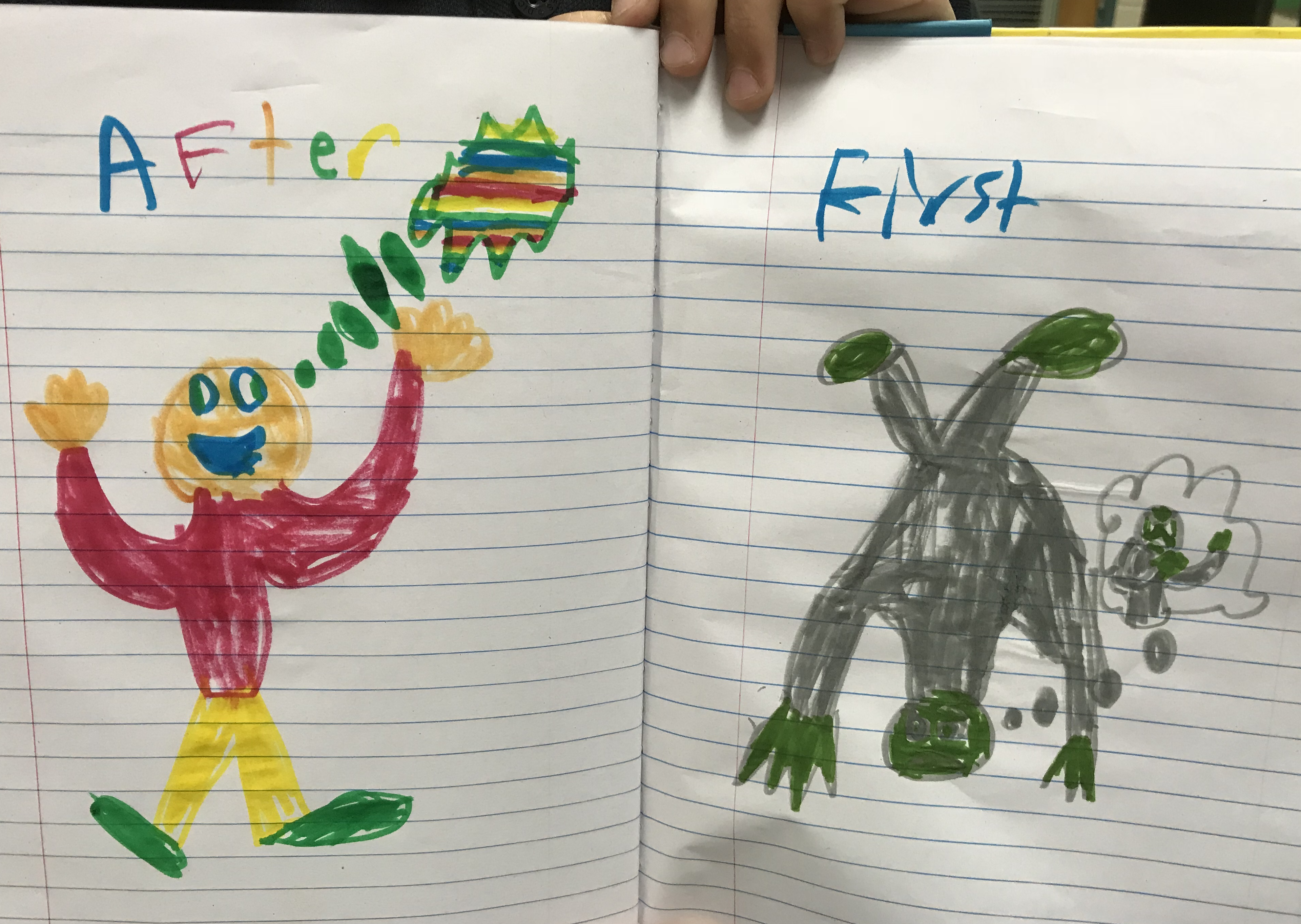
Dawson, 4th grade, said the picture on the right is how he felt when he came to school. On the left is how he feels in our class.


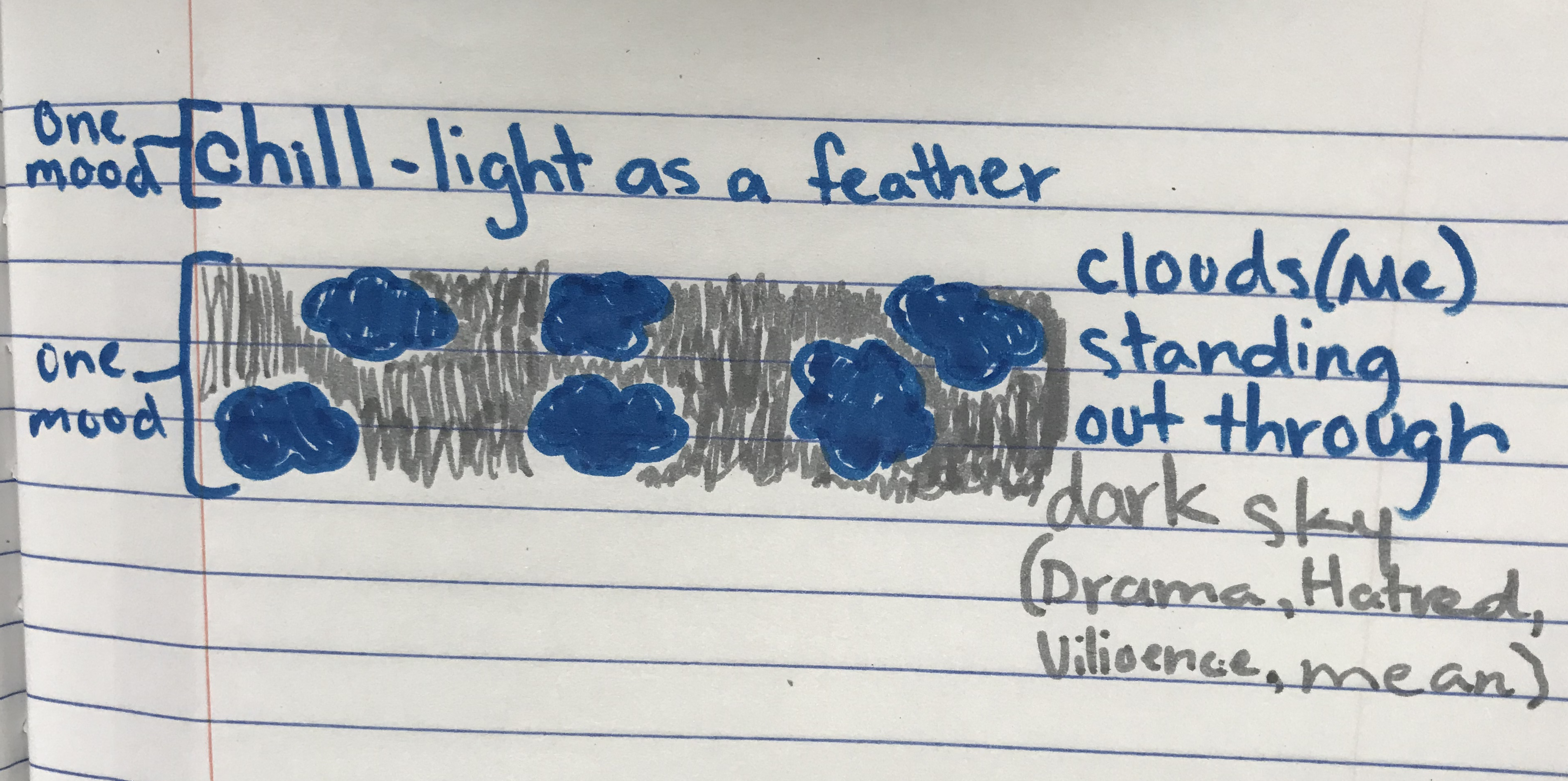
Austin, 6th grade, wrote a key to his color and image choices.

We turned off the overhead lights and sat in a comfortable position. I turned on the Insight Timer app, and we were silent together.

This was a beautiful and thoughtful way to begin a Monday morning, a Monday after another mass shooting, a Monday of a soft lockdown, a Monday in new time.  I am coming to believe more and more in the face of these troubling times, I need to create a safe place.  A safe place for expressing your mood, speaking your truth, and creating peace.

Read Full Post »

Find more celebration posts at Ruth’s blog.


Collaboration was the name of the game at all three schools this week.  At each school, I was working with my gifted students on projects that required cooperation, communication, creativity, and critical thinking, the 4 C’s of 21st Century education.

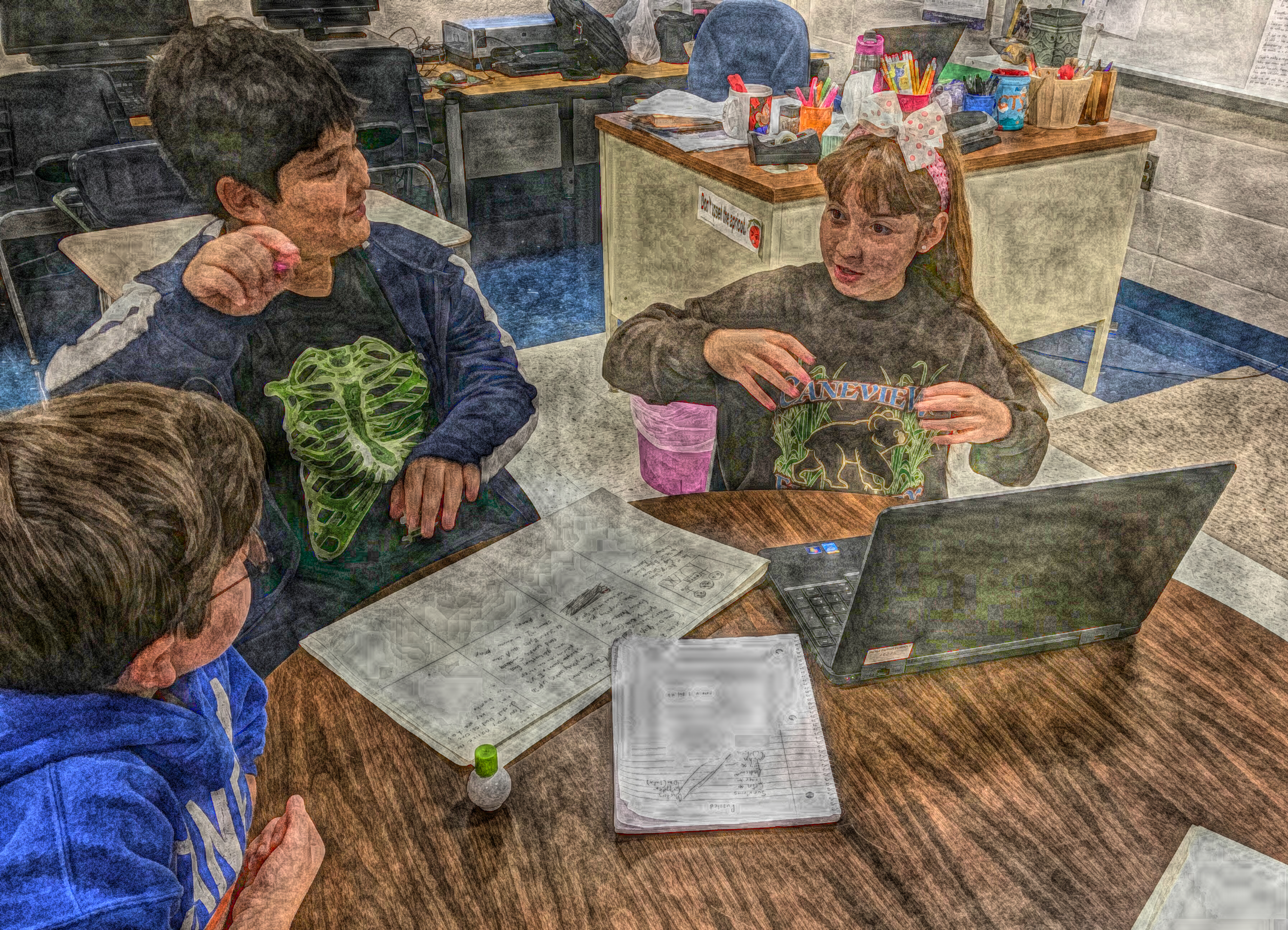
At school #1, students were working on “Mood” stories.  With the celebration of Halloween, most stories took on a scary mood.  Some of my students asked if they could work together.  I considered it and decided to let them, but I was skeptical about whether they could truly collaborate.  I was pleasantly surprised.  They gathered together and used a story board to plan their stories.  They talked and wrote, wrote and talked.  The class was buzzing with the sound of collaboration.

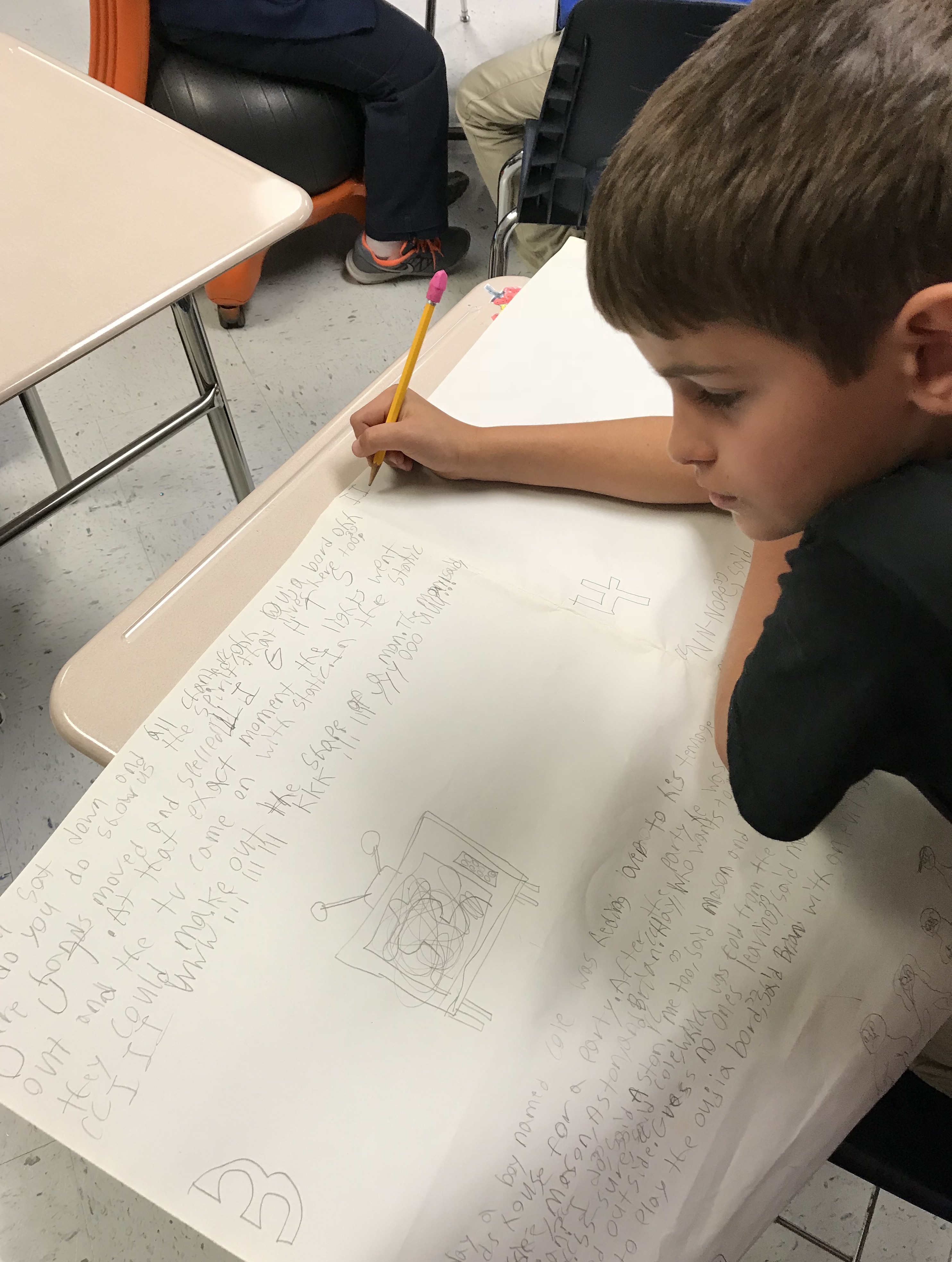
Dawson was writing on his own.  He asked for big paper to use for his story board.  He wrote his “longest story ever!”  I enjoyed his use of text features to create the mood.  This was his favorite part to read aloud.

They all sat down and chanted,”Oh Ouija Board, oh how do you do, show us the spirit that lives here too.” Their hands moved and spelled L I G H T S O U T. At that exact moment the lights went out and the tv came on with static.

In the static they could make out a man that said,” III WWW III LLL LLL KKK III LL LL YYY OOO UUU!!!

At school #2, we are working on podcasts about endangered animals.  Each student chose an animal to research.  One of the best things was when we were able to talk on the phone with a local bird expert.  My students are powering through the steep technology learning curve.  I am hoping we’ll be ready to publish them next week.  We are looking forward to a call with a marine biologist this Monday.

At school #3, we worked with Mystery Science lessons and made a chain reaction machine.  After many tries, I was sure it was going to work for this video.  I ended up giving a little hand in the chain.


I am a strong believer in project-based learning experiences.  My students become motivated and engaged, and they own their learning.  It doesn’t get much better than that!

Read Full Post »

Poetry Friday posts are with Linda at Teacher Dance.

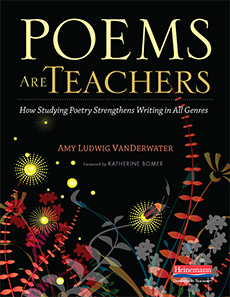
Much has been written about this amazing new resource for teachers.

There’s this one at Live your Poem by Irene Latham.

And here is a review by Laura Purdie Salas.

The Two Writing Teachers featured an interview with Amy.

Literacy Lenses includes words of wisdom from a Good to Great (#G2Great) Twitter chat with Amy.

Like many others, I have a personal connection with this book because some of my students have featured poems.  Amy’s book not only teaches in a wonderfully accessible way; it also celebrates teaching poetry.  Lots of student samples sit alongside poems by children’s poets worldwide.  The depth and breadth of the message reaches well beyond the pages.

I am passionate about teaching poetry in my classes, but I am never quite sure how my lesson plans look to the administrators who check them.   Poems are Teachers is the affirmation I’ve been looking for.  In my heart, I know that practicing poetry is playing with language in a way that can inform other writing as well.  Sometimes writing poetry is just plain fun.  Nothing makes me prouder than a student frantically waving his hand in the air to share his poem.  If we use Amy’s book to create active writing experiences for our students, they will rise up and feel the amazing power of poetry, too.

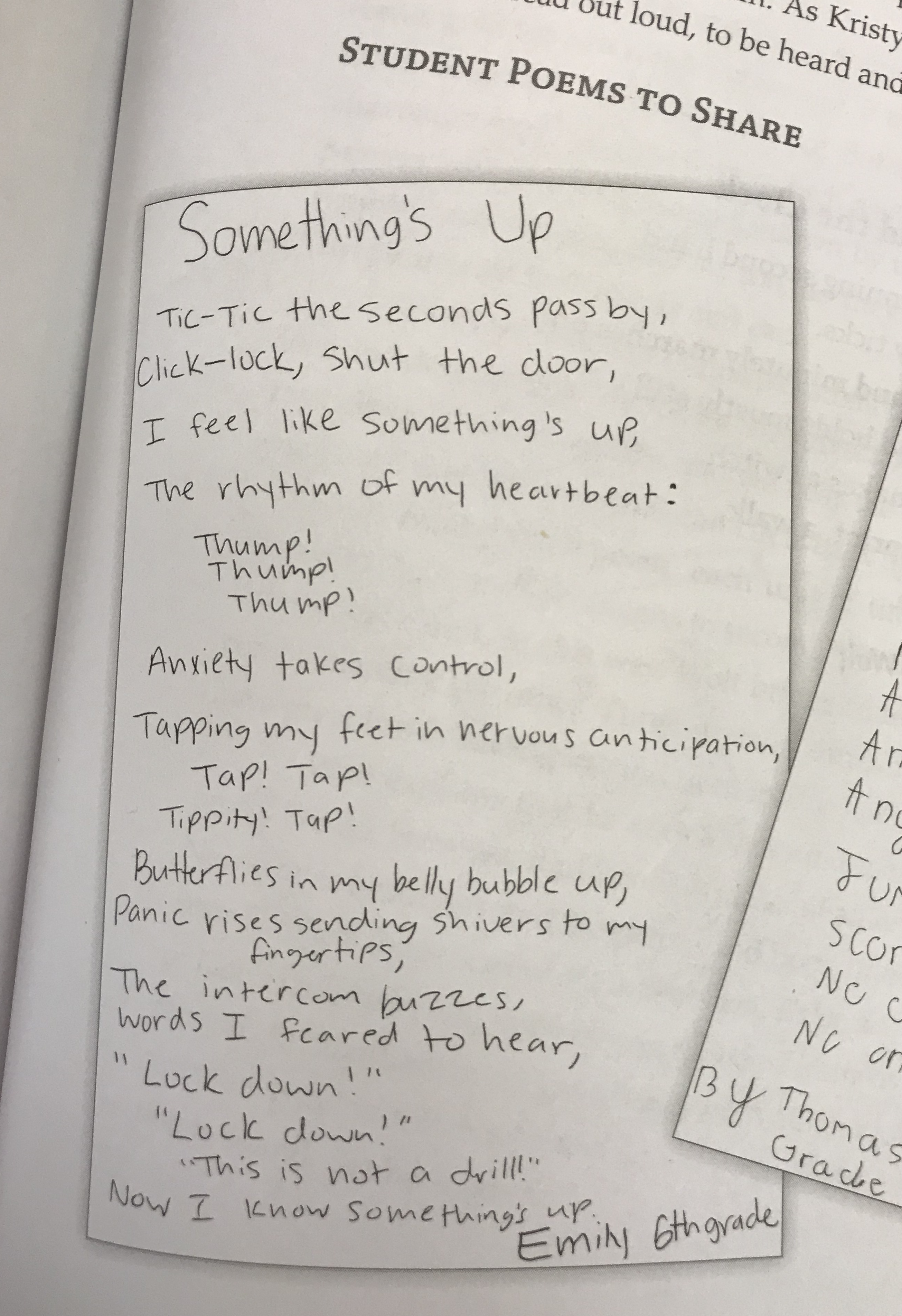
Emily’s poem is in the chapter “Marry Music and Meter to Meaning.” She wrote this poem after a real lock down.

Jacob’s poem appears in the chapter “Let Art Inspire.” Jacob wrote this poem after looking at Van Gogh’s Starry, Starry Night.

Amy with Heinemann has generously offered a give away for this blog post.  Please leave a comment by November 10th and I’ll randomly pick a winner.  You definitely want this book in your professional library.


Read Full Post »

Find more posts at Live your Poem.


Our Spiritual Journey first Thursday posts are centered around gratitude this month. When I think of what I am most grateful for this week, I think of the many voices in my life.

Sunday:  The voices of the choir up in the loft with me.  I am the only alto, but that’s OK.  I love to hear the harmony of my voice alongside the others around me.  I carry the anthem in my head all week long.  Today I can hear the echo of “even thine altars…O Lord, my king and my God.  Blessed are they that dwell in thy house.”

Monday-Friday: The voices of my students ring in my ear.  This week one group is writing mood stories.  A few students are collaborating together.  They hunch over the paper and computer and speak in excited voices about what happens next.  Another group is working on podcasts, so they have written scripts and are practicing and recording and re-recording.  Voices over voices, played and replayed.

Voxer voices:  I have a few friends I keep in touch with using the Voxer app.  I look forward to hearing their messages on my morning walks.  One of these friends is reading aloud a book.  She’s actually reading it for another friend, but she forwards them to me, so I can enjoy the book as well.  I love being read to.  Her soothing, friendly voice makes the experience of listening like a meditation.

As I write, my husband calls and offers to meet at our favorite restaurant.  There, we will catch up on the news of day and just be with each other.  I remember one of the first things that attracted me to him was his voice.  I’ll never tire of hearing it.

November is thanku season, a time for writing thank you haiku.


Read Full Post »

Join the Two Writing Teachers blog for the Slice of Life Challenge.

In September I received an invitation from Paul Allison of the New York Writing Project to participate in a discussion about a new website for publishing student work.  In 2010, we worked together to create a platform around the Gulf oil spill called “Voices on the Gulf.”  From this experience, Paul created Youth Voices.  My students participated for a little while, but eventually the content became inappropriate for my young students.  I moved away from using this site because it did not meet the needs of my students as younger voices.

When Paul contacted me that he was ready to open a new site for elementary students, I was thrilled.  An authentic audience is extremely valuable in teaching writing.  Many of my students are isolated as one of few gifted students in their class.  When they write, they want people to read it.  They crave a wider audience.

Kidvoices.live is now live! Some of my students have begun posting their creative poetry there.  The platform is similar to blogging at Kidblogs, but different enough to serve a slightly more sophisticated purpose.

Kidvoices.live is open to other elementary classrooms as well.  If you want to join and get your students involved, you can.  You have to provide a unique email for each student.  You can use a gmail + account or a parent’s email address.  Once they sign up, each student will have a user name and password for future log-ins.  I recommend sending home a parent permission letter.  Paul plans to post it on the site, but you can also contact me for a copy.

Last week we read a story from Scholastic’s Scope magazine that was very close to us. The Great Flood of 2016 occurred in our area as well as in the setting of the article, Baton Rouge.  We then read from Here We Go about helpers and volunteering. (PowerPack #8 on page 65)   My students wrote response poems about the flood, and the larger topics of fear and hope.

When students have the opportunity to share writing online, they grow as writers, as digital citizens, and as people navigating this world.

Read Full Post »

Join the Two Writing Teachers blog for the Slice of Life Challenge.

On Saturday night, storms ravaged through our area.  I was up for at least an hour comforting my dog Charlie who is afraid of thunderstorms.  I admit, though, I wasn’t sleeping anyway.  Word has it we had some tornado activity.  One school had a small electric fire that caused some smoke damage in their library.

When we arrived at school Monday morning, the internet was out.  For my first group, it was back to the basics of paper and pencil writing.  We read together at school two. But at school #3, where I am teaching 4th grade science, I had planned a video about roller coasters to show force and motion.  When the internet was still not up and running, I had to think creatively.  I grabbed some Jenga blocks and Dominoes.

We reviewed the idea of force and motion.  I sent them off to work on a chain reaction while I worked with a second grader on writing a story.  The two 4th graders were speaking in whispers and didn’t want me to see what they were building.  I promised not to look.  When they were ready, I found that they had been creative themselves and built the blocks in the shape of my name.  Of course, I had to smile and take a video.

This experience made me realize how dependent I have become on technology.  I expect it to work.  I plan for it to work.  I think I should plan for at least one day a week that we unplug and get back to the basics of writing with pencils, reading with each other, and playing with blocks.

Read Full Post »

Find more celebration posts at Ruth’s blog.

I have to thank NCTE for the National Day on Writing as well as all the many posts on #WhyIWrite and my many teacher-writer friends who inspire me every day to make my class a safe place for writers to bloom.

Michelle Haseltine told me she was writing quotes on pencils to give to her students as inspired by Malala’s Magic Pencil. (Her post is here.)  So early Friday morning, I grabbed some fresh pencils and Googled writing quotes.  Each student received a pencil with a quote.  This was such a simple, yet positive way to garner enthusiasm for a special writing day.

Betsy Hubbard posted last minute ideas on the Two Writing Teachers blog early yesterday.  I grabbed the idea of chalkabration!  Years ago, Betsy led a monthly roundup of Chalkabration posts.  The basic idea is writing poetry with sidewalk chalk.  My students were so excited to be able to go outside and chalk their poems.  I made an Animoto video to share.

https://animoto.com/play/LgQw4GWfJegD2qg9AnSsPA

Here are some of the wonderful fall themed poems my students and I created.

–Margaret Simon Fall Haiku

Fall The holy winter is waiting. Why keep it away when you could bring it in. Winter comes. –Trace, 5th grade

Fall Mysterious Admiring Happening Turning Winter Every Night Fall –Austin, 6th grade

Autumn Summer breeze turned cold. Bright sun into dim moon. Emerald leaves turn amber. Blue skies now dark. –Madison, 4th grade

Read Full Post »

Poetry Friday posts are with Leigh Anne at A Day in the Life

Last week my students and I studied the poem “A Letter in October” by Ted Kooser.  In response, some of us wrote golden shovel poems.  A golden shovel is a poem that uses the line of another poem stretched out down the right hand margin.  The writer then fills in words to create a whole new poem.  This method of writing a poem forces the writer to use enjambment in an interesting way.  Today I am sharing two student responses as well as my own.


I lay still in my bed in the moonlit night

A sweet blowing breeze passes in

And out  filling my room with its

soft and warm thick

Scent of snow and hushed winter

Whispers wrapping me in a chilly jacket.

–Erin, 6th grade


 You are sitting. Watching
                          while birds fly around the
trees. The sun going down, light
fading. You hear kids walk
down the street. The sun is down,
everybody collecting the candy the
people are giving out. You look at the hill.
You see something, a pumpkin. You carve it.

–Andrew, 5th grade

Every day I drive by a mighty oak tucked between the frontage road and the highway, Mr. Al.  In South Louisiana, the oldest oaks are named and cataloged and cared for.  Mr. Al has had an interesting journey as he was transplanted by the state highway department about 3 years ago.  He is thriving in his new home.

Mr. Al in October.


An oak tree spreads its mighty wings then
beckons us to see
another way the
world can be. Light
dances with the leaves, a casual step,
strong and easy, bouncing out
the noisy beats upon.
-Margaret Simon

Read Full Post »

Poetry Friday posts are with Irene at Live Your Poem

Last week, my friend, poet, blogger, writing partner Linda Mitchell posted her found haiku along with the inspirational poem Letter in October by Ted Kooser.  See her post here.  I took it all to create a lesson for my students.  After study of and talk about Ted Kooser’s poem, I shared Linda’s haiku and talked about how these haiku could stand separate from the original poem.  I challenged my students to try finding haiku.

Madison created this lovely poem, but first she gave the form a name “re-ku” as in recycled haiku.

A late light dawning
finding a world of darkness.
Silhouettes of the

lost leaves, soaring
on a draft. They have lost
their way. I watch the

darkness, sipping tea.
The night has wrapped the light, sowing
reflections ‘cross
my window. Watch.

Madison, 4th grade

Free image

I’m fascinated by the rhythm and repetition that Noah used to create his artistic expression of A Letter in December.

The icy water
a letter in December
Sowing reflections

The icy writing
a letter in December
in the window pane

The icy fingers
a letter in December
wrapped around the hearth

The icy shingles
a letter in December
frozen in its place.

–Noah, 6th grade

Read Full Post »

« Newer Posts - Older Posts »