Feeds:
Posts
Comments

Archive for the ‘Teaching’ Category

Find more celebration posts at Ruth's blog.

Find more celebration posts at Ruth’s blog.
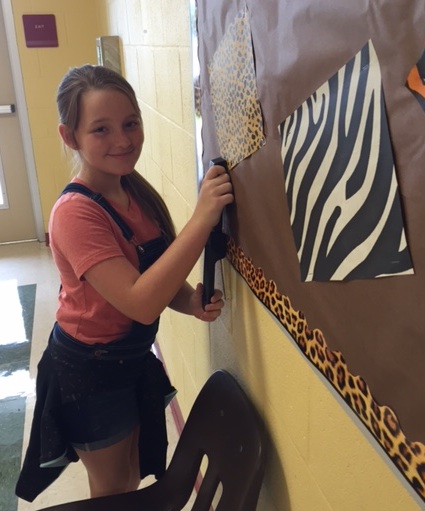
Kristina bulletin board

Kristina is a master with a stapler.

This week I prepared my two classrooms at two schools for back-to-school next week.  I was blessed to have helpers.  In one classroom, one of my students appeared.  Her mother was in a teacher workshop, so she was hanging out at the school helping out where she could.  At the end of the year, I have to pack up the books so that the floors can be cleaned, so Lani re-shelved the books.  I told her she could choose her own sorting method, so she put together books by the same author.  I’m sure the order will change once kids start pulling them out to read, but it’s nice to start the year with some kind of order.

At another school, my friend Kristina came to help.  She handled the stapler for the bulletin board and shelved my mountain of books.  She decided to order books by genre, and she even made signs for the shelves.
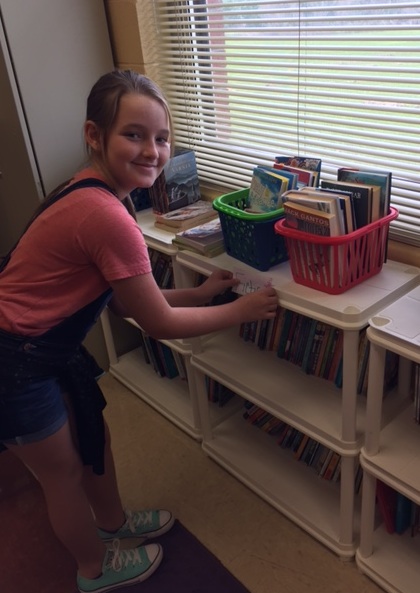
Kristina makes signs for the book shelves.

Kristina makes signs for the book shelves.

I celebrate my little helpers and that feeling of anticipation that comes with a new school year.
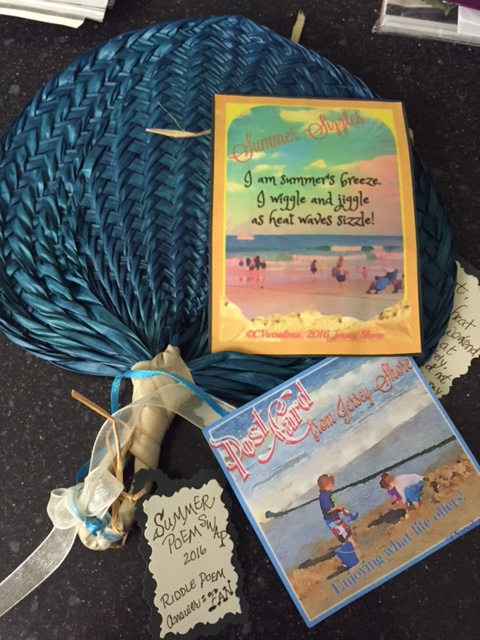
Poetry gift from Carol Varsalona.

Poetry gift from Carol Varsalona.

I celebrate the summer poetry swap.  I got this gift from Carol Varsalona.  Carol has a unique talent of pairing photos with poems and creating timeless images.  Her poem is a riddle poem about a fan.  I can use a fan when temperatures climb to 90+ daily, but this one is too pretty to use.  She also sent a necklace of handmade beads from paper.  Carol wrote, “The women in Masese, Uganda wove the beads from paper that is hung to dry. With the proceeds we built an elementary school where 550+ children are educated, fed two meals a day, and have clean water. The mothers of Masese are proud jewelry makers who now can make a living to raise their children.” I will proudly wear the beads.  Thanks, Carol.

happy rock
I celebrate Iberia Parish Rocks!  My husband found this rock on his doorstep on Friday.  He texted it to me.  That evening we saw an article in the paper about a Facebook group painting happy rocks to leave around town.  What a great project for just spreading a bit of joy!


My summer is quickly coming to an end, but what a summer it has been.  I am so grateful for my amazing trips to Tanzania, Africa and Old Bedlam Farm.  I am also grateful for lazy days spent with my constant companion, Charlie.  I wish I could take him with me to school.
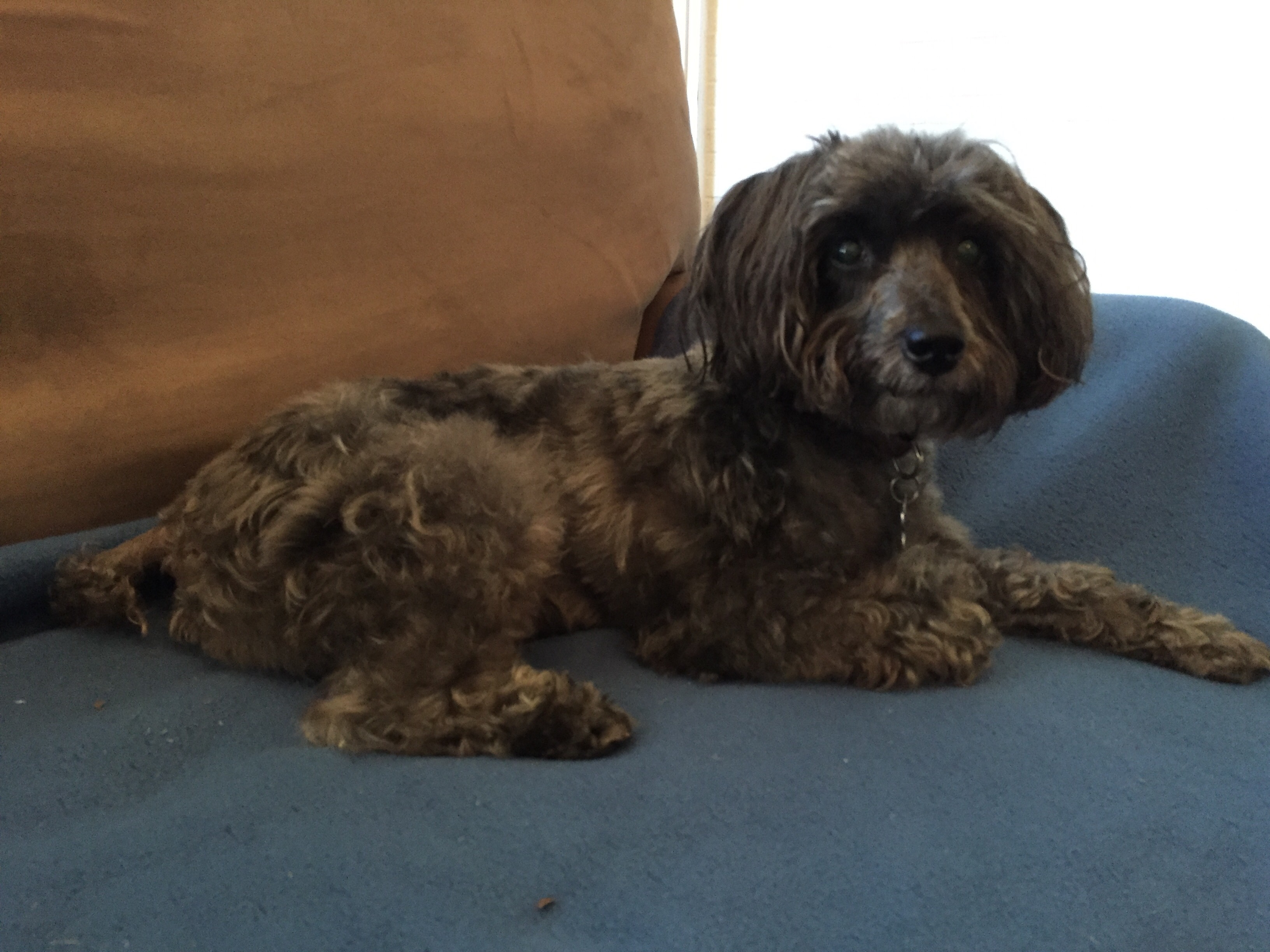
Charlie

Charlie


Read Full Post »

Please use this button on your site for DigiLit Sunday posts

Please use this button on your site for DigiLit Sunday posts

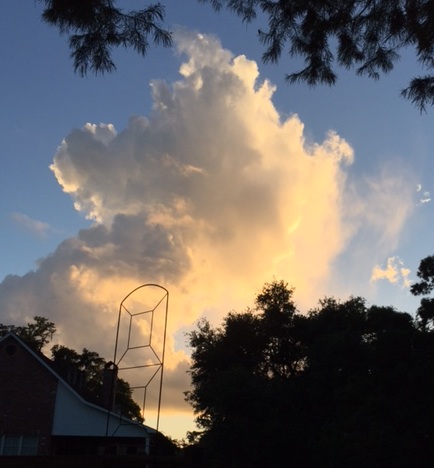
Into every day, a cloud must come. Here's hoping all your clouds are this filled with light.

Into every day,
a cloud must come.
Here’s hoping all your clouds
are this filled with light.

How often do you post on social media?  Once a day?  Once a week?  Occasionally?

I am curious about what makes us connect and why some share more than others.  And when I read a post, on Facebook or Twitter, who am I really seeing?

If I am honest, I am a pretty free sharer of my life.  I probably post at least once a day on Facebook.  I’m not as active on Twitter or Instagram, but I have a presence there.  And then there’s this blog right here.

I am partial to my blogging space.  I feel safe here.  I open the draft and spill out onto the page whatever is on my mind.

I’ve been reading Katherine Bomer’s book The Journey is Everything: Teaching Essays That Students Want to Write for People Who Want to Read Them.   In Chapter 4, Living Like an Essayist,  Katherine makes a case for the Writer’s Notebook as a place to think and generate ideas.  While I am determined to give this a good shot next school year, trying it out myself was not easy.  I have gotten better and better at typing and backspacing, type, delete, copy, paste, highlight, spellcheck.

The notebook has lost some of its usefulness to me, at least for writing rough drafts.  I still take notes in a notebook and apparently this is good for my brain.  NPR posted an article about the advantages of hand-written notes in college. But unless I need those notes for something I am writing, they get lost in the pages of my notebook.

From this chapter, I gleaned five ways to make use of notebook time.  (I think I’ll call it Notebook Time in my classroom.)

  1. Write daily for 12-15 minutes: Free writing that may lead to a good essay topic.
  2. A thinking space for slow pondering, not rushing toward an end product.
  3. Share notebook writing with a partner or small group.  Reading aloud what you have written can validate or deepen thinking.
  4. Writing leads to more writing.  Ideas lead to ideas.  Allow for this free range thinking time.
  5. Write what is true.  This space should be used to explore the deep dark corners of our lives.  Shake it all out.  Don’t write only what makes you look good. Be authentic on the page.

I truly believe in sharing our lives.  By putting our true selves out there, we can find connections in new and exciting ways.  As I read and think about what I want for my students, I am more convinced that writing your truth makes you a stronger person, reaches out to others, and creates a caring world community.

DigiLit Sunday will be on hiatus for the next 6 weeks as I will be traveling.  We will be back on July 31st.  Have a wonderful summer!

<!– start InLinkz script –>

<a rel=’nofollow’ href=”http://www.inlinkz.com/new/view.php?id=640618″><img style=”border:0px” src=”http://www.inlinkz.com/img/wp/wpImg.png”></a&gt;

<!– end InLinkz script –>

Read Full Post »

Slice of Life Challenge

At one of my schools, I coordinate a leadership organization called “Paw Pride.”  Students are nominated by their teachers to be in this group.  Throughout the year, we participate in service-oriented projects.

Yesterday we took an end-of-the-year field trip to Avery Island, home of Tabasco sauce.  I love field trips.  Yes, they exhaust me, but the kids are so excited and can’t wait to learn and play.  This group worked hard and raised enough money for this treat.  Avery Island is in our own backyard.  We should know and learn about the products of our own area.


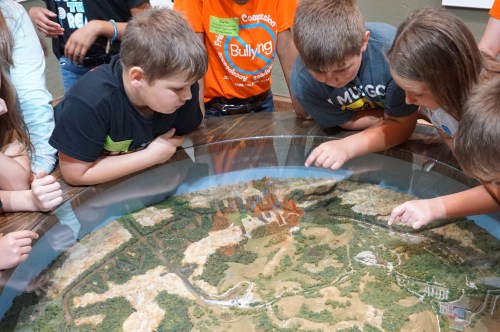
3D map

“Are we here?”

“Look!  There’s the warehouse!”

Seeing the overall, big picture on a 3D map intrigues the students.


salt barrels

The mash from the peppers are aged for three years.  Salt covers the tops of the barrels, slowly spicing the aging peppers. At the factory store, students sampled different Tabasco flavors and even Tabasco ice cream.


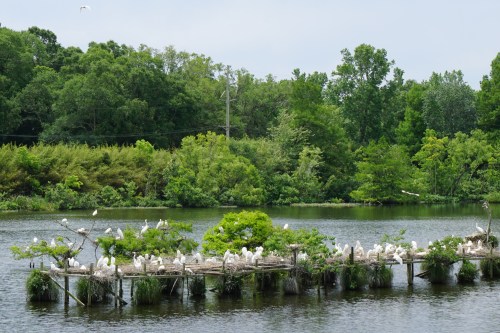
bird city 3

In 1895, the snowy egret was nearly wiped out by plume hunters.  E. A. McIlhenny created Bird City, a nesting ground for these majestic birds. I took this picture from the high look-out deck. It was a nice climb but worth it for this view.

Paw Pride with Buddha

E. A. McIlhenny acquired a gift of an ancient Buddha statue in 1936. The statue is surrounded by authentic Asian flora.  Visiting the Buddha is a highlight of any Avery Island field trip.

Jungle gardens

Jungle Gardens is often used for wedding photos, and you can see why. This is a beautiful setting just beyond the Buddha statue in Jungle Gardens.  At this point, the students had disappeared into a wooded area.  I sent a parent chaperone after them.  The magic of this place drew them in.  A wonderful way to celebrate May, these students were able to spend a day outside of the classroom learning about a locally made product as well as enjoying the beauty of nature.


Read Full Post »

Please use this button on your site for DigiLit Sunday posts

Please use this button on your site for DigiLit Sunday posts

I follow Kim Douillard’s blog, Thinking Through my Lens, and she posts a weekly photo challenge. Yesterday the challenge word was Curves. She wrote, “When your week throws you curves…take photos of them!” And I thought, if your week throws you curves, write about it. So I am going to combine the two, DigiLit and Photo Challenge.

May is a stressful time for me as I’m sure it is for most teachers. As I thought about this month and the many stresses, I realized I needed a new perspective.

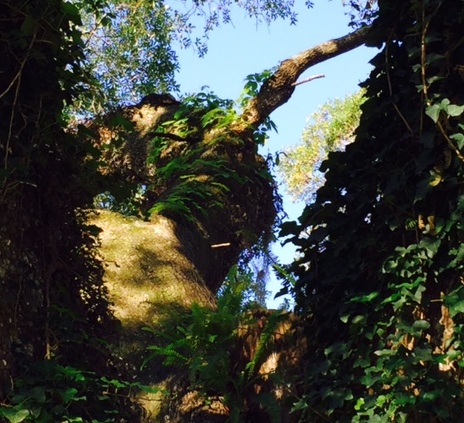
There is a large old oak in my front yard. I look at it every day. Yet this image shows a new perspective, looking between the branches.

between the branches

If I turn my perspective to the curve between the branches, I can see a new design. The branch that was trimmed has new growth. Some curves may be tough to take, but later allow for new growth.

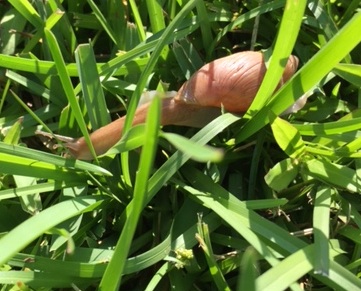
On a walk with my dog, we came upon this snail in the grass. Small and slow, the snail curved his slick body, stretching out as far as he could go, lugging along his shell. When we stopped to look, Charlie didn’t see it, so he stepped on it. The snail retreated back into his shell.

snail in grass

When I complain about May, my wise husband says, “May is followed by June.” So I can make it. I can stretch out and lug along because I am heading toward a safe harbor, a time of renewal, “the big weekend!”

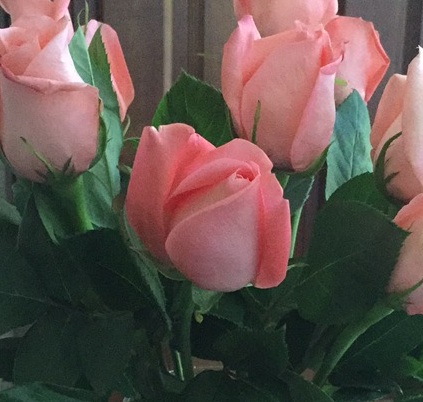
a single rose

The curves of a single rose fascinate me. These are my Mother’s Day flowers. They remind me that I am in this with others. I am not alone. I can turn to colleagues and friends. They will listen to my rants and my complaints and tell me that all will be well. And it will be.

Please consider joining the Digital Literacy conversation. Place your link by clicking the button.

Read Full Post »

Spiritual Journey framed

I thought I might give blogging a rest.  But in this wild world of social media, I have made connections.  Irene Latham is a poet/blogger and the kind of person I will do almost anything for.  She tweeted yesterday.

Here I am again because this is a subject I live with every day.
Be creative.
Be vulnerable.
These two walk together with me as I wander this writing terrain.

Big Magic by Elizabeth Gilbert speaks to me.  She writes for 272 pages about “Creative Living Beyond Fear.”  The reason this book has taken on such popularity is we are all battling this dualistic problem: creativity and fear.  On Goodreads, there are 333 quotes from Big Magic.  I could pick any one of them to make my point here.  That creativity and fear (or vulnerability) walk hand in hand.

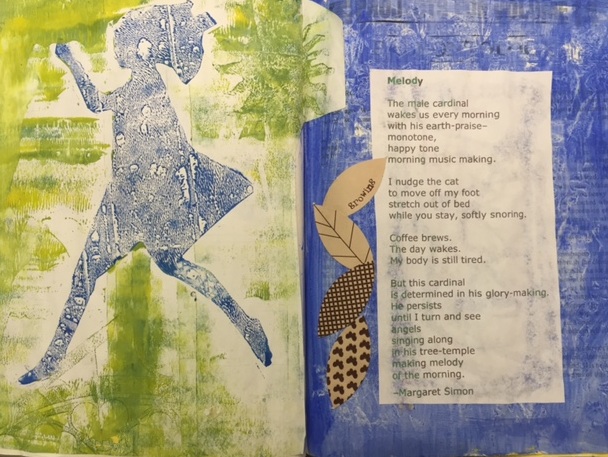
With my students this week, I have been creating an altered book.  We have taken books that were discarded from the library for repurposing as a collection of writing from this school year.  For the most part, we’ve been making a mess.  But in the midst of the mess, creativity is evolving.

A favorite page using gel printed paper, collage, and a poem.

A favorite page using gel printed paper, collage, and a poem.

This is the freest I have felt about painting and creating in a long time.  I’m just doing it.  I don’t expect anyone but me to ever care about this book, so there is no fear.  And since I feel absolutely safe creating alongside my students, I am not vulnerable either.

When I write for others to read, the stakes become higher.  And yet, in this blog space, I have found a safety net.  I have a group of people I belong to.  I’ve gotten to know you by reading your blogs.  You know me, and you leave encouraging comments.  I may not know your face, dear reader, but I trust you.

Vulnerability is lessened by safety, community, and camaraderie.

Creativity breeds creativity.  Endeavoring to express yourself artistically whether with a paintbrush, a musical instrument, or a pen exposes you to failure.  Yet creating makes us human,  and creativity is meant to be shared.

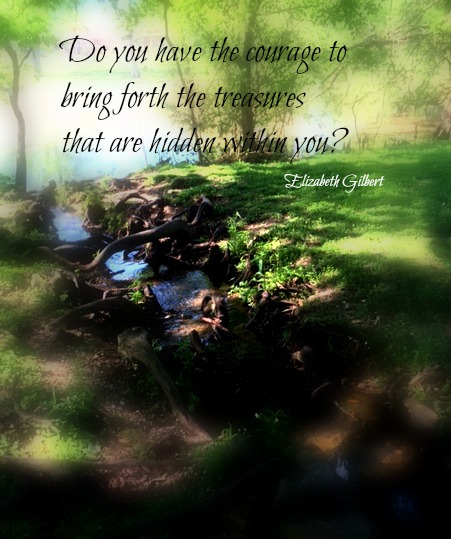
flowing stream with quote

Read Full Post »

Please use this button on your site for DigiLit Sunday posts

Please use this button on your site for DigiLit Sunday posts

220px-Function_machine2

Last week for DigiLit Sunday, I wrote about form. I was pretty deep into teaching and writing poetry, grappling with form or no form. Julianne suggested that we follow form with function this week. When I googled function, the images suggested one right answer. That answer leads to points on a graph. Points on a graph remind me of testing.

Testing is the necessary evil, in my book. I teach gifted kids, and for the most part, the reason they are in my class is they can take tests well. They’ve figured out the function, so to speak.

So my question is how do I further my students learning beyond what the standardized test is going to require? My students are outside-of-the-box thinkers. I have to find ways to keep them thinking this way while, at the same time, capable of going back into the box come test time.

There is much grumbling in my class about testing. I have had students enjoy this time because it is quiet, and they get to read for long stretches. But one student complained that her teacher-proctor punished her for recess because she finished the session in 20 minutes. I’m sure the logic was “There is no way you can get all the answers right in 20 minutes.” That very well may be true, but my thinking tells me this teacher did not know this child.

The function of a teacher is to know her students. If you were to ask me about any of my students, I could tell you their favorite books, what genre they prefer to write, and their favorite activity to do outside of school.

The only thing about my kids that I could plot on a graph would be their reading levels. Yet their reading levels say nothing about their interest levels. And interest is everything when it comes to reading.

I take my function seriously, but I will never function to produce a right answer or a point on a graph. I strive to make my classroom one of discovery and development, creativity and caring.

How do you interpret function as it pertains to literacy? Be sure to leave a link to your own blog post today.

Read Full Post »

NPM2016

During this monthlong survey of poetry, there is trouble.

So many decisions to make.

What should I teach today?
Line breaks,
literary elements,
limericks?

I want to say stop to
sing-song rhymes
and simple forms.

Then one turns to another and says,
“Let’s write a rap abecedarian.”

Like the messiness of art class,
the instructor must allow
for paint splatters and stains,
for stalled-out cinquains
and skip-to-my-loos.

Poetry is hard.
Poetry is easy.
There are rules in poetry.
There are no rules:
Let the poem find its way.
This is the trouble with poetry.
This is the joy of poetry.

–Margaret Simon

Follow the Progressive Poem to  Charles Waters.

Follow the Progressive Poem to Charles Waters.


Read Full Post »

Please use this button on your site for DigiLit Sunday posts

Please use this button on your site for DigiLit Sunday posts

In my world of teaching and writing, revision is a constant companion. I look at my teaching and revise. Rarely am I following the lesson plan I wrote. I revise based on the direction my students need to take. And last week revision was something we needed to talk about.

I believe that revision is a mature behavior. Revision is having the confidence in a piece of writing to take the risk of changing it. Without even realizing it, I write in constant revision. As I write this post, I backspace. I save and read. Go back. Rephrase.

My students do this, too, as they type their pieces into the blog. Many of them are resistant to the two steps of rough draft in their notebooks, then typing into a final draft. But as I watch them, I see that revision becomes organic to this process.

Sometimes, revision comes from talk. We read the piece together. Discuss what we like. And look at where the words can be stronger.

I sat down with Kaiden to revise his abecedarian about wonder posted here. For the most part, this was an excellent piece of writing. The repeated word, wonder, was intentional and served a purpose. Yet there were a few words that weren’t quite working. So we looked at a list of Shakespeare words. This elevated Kaiden’s poem. There we found kindle. What a great word for K and for wonder! Engaging in this work with him was fun for both of us.

Ralph Fletcher tweeted:

revision by Ralph Fletcher

Let’s relax about revision. If a piece of writing is a stepping stone to another piece, let it be. Use revision strategies on those gems, the ones you want to embrace and hug a little longer.

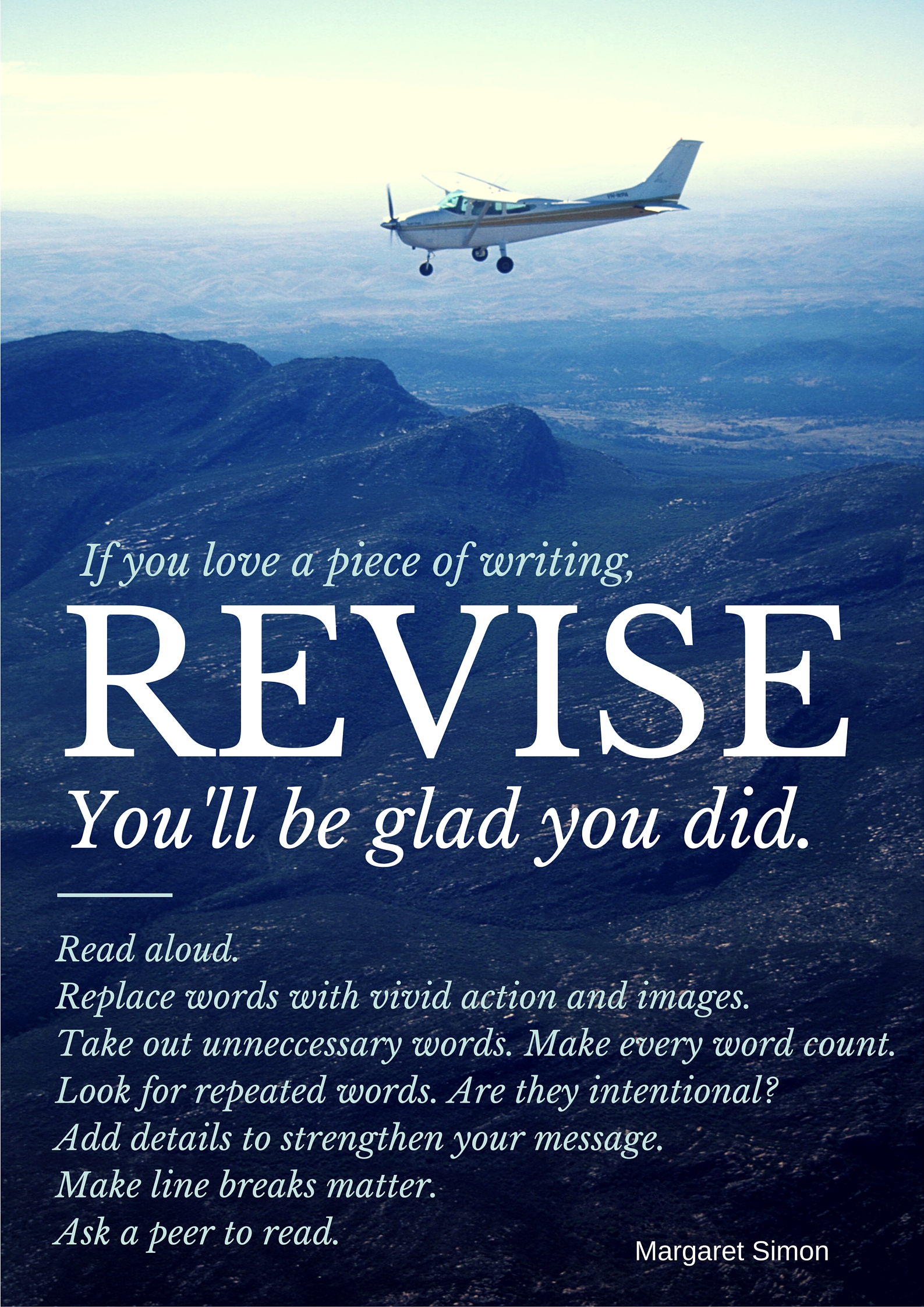
Revision canva

Read Full Post »

Discover. Play. Build.

Ruth Ayres invites us the celebrate each week. Click over to her site Discover. Play. Build. to read more celebrations.

NPM2016

Marilyn Singer is a master poet. At NCTE in the fall, I had the pleasure of meeting her. I was also a lucky participant who won a copy of Follow, Follow. Marilyn invented the reverso poem and has published 3 books of them, two based on fairy tales and her latest Echo, Echo based on mythology.

On Today’s Little Ditty, Michelle Heindenrich Barnes interviewed Marilyn Singer and offered a ditty challenge to use the word echo in relation to a poem. I was determined to try the reverso form.

With my students as cheerleaders, I worked hard and produced something worthy of being called a reverso poem. The process began when we watched this video together.

I asked my students to select an insect to be in a mask (or persona) poem. I selected this image to inspire my writing.

screenshot from the film Microcosmos by Jacque Perrin.

screenshot from the film Microcosmos by Jacque Perrin.

Then I did some caterpillar research. I wrote “zig zag stitch” and then discovered that caterpillars excrete a silk line as they crawl in addition to using the silk to create a chrysalis.

Creepy crawly caterpillar
munch munch
munching milkweed
at tremendous speed.

Life changes
slowly
creeping, crawling
leaf to leaf.

Sunlight glimmers
on fuzzy bristles.
I zig-zag stitch
a silkthread path
leaf to leaf.

Leaf to leaf
a silkthread path
I zig-zag stitch
on fuzzy bristles.

Sunlight glimmers
leaf to leaf.
Creeping crawling
slowly.

Life changes
at tremendous speed.
Munching milkweed
Munch, munch
creepy, crawly caterpillar.

This is a tough form to get just right. I don’t think mine successfully creates a different meaning in reverse. But my students liked it, so I am celebrating it none the less.

Read Full Post »

« Newer Posts - Older Posts »