Feeds:
Posts
Comments

Archive for the ‘Writing’ Category

National Poetry Month 2018

Heron in Flight by John Gibson

After Wallace Stevens, Thirteen Ways of Looking at a Blackbird. 


I.

Taking flight,
one heron, great and blue,
lifts on kite-wings.

II.

At daybreak, he stalks
early risers
stealthily staring
at the water’s surface.

III.

The heron looks long
at his own reflection,
beauty knows beauty.

IV.

Straight as an arrow on a hunt
for its mark, heron’s beak
pierces the sky.

V.

Sun beams dance on waves
winking at heron’s stature,
inviting his participation
in the day.

VI.

My totem, Heron,
teach me
your lessons of grace.

VII.

As evening falls, heron
circles back
to tell me good night.

VIII.

Times with heron
I value silence
and know God.

IX.

Heron’s squawk
scrapes on Goose’s last nerve.
A cacophony on courthouse steps.

X.

At the sight of heron flying,
barely skimming water’s surface,
even playful children
stop and admire.

XI.

Heron lifts his wing
to preen like an awkward teen
crumples over his tall body
to tie his shoelace.

XII.

A storm raged during the night,
heron stood still
never losing his grip
on the fallen log.

XIII.

I haven’t seen Heron for days.
He will return. He may not return.
The light on the lake fades.

–Margaret Simon (c) 2018

If you are interested in joining a photo-poetry exchange I am hosting, click here.

Read Full Post »

National Poetry Month 2018


I didn’t post yesterday.  I needed a day off.  The week was long, and my well was dry.  I took the day for myself.  I started with a much needed yoga class.  I’d been away from this practice for too long.  I had lunch with my daughter and son-in-law, then ventured over to an art show, The Big Easel.  There I saturated myself with art and art talk. After the art show, I had a luxurious massage.  I feel a twinge of guilt about this indulgence, but my monthly massages keep me healthy and pain free.

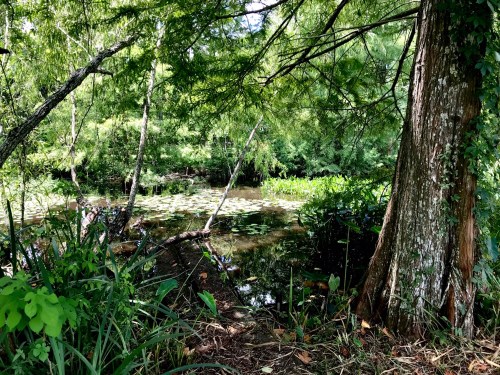
When I arrived back home, I watched hummingbirds at the feeder and other birds around the bayou and just chilled out.  My notebook was nearby, so I did write a poem.  I was comforted in knowing the muse hadn’t left.  I just needed to fill the well back up.

Quilt painting by T. Chase Nelson

One of the artists I talked with painted the painting I am featuring today for ekphrastic poetry, T. Chase Nelson. When I first saw the painting, I thought it was a quilt.  He explained to me that his inspiration was the quilts of Gee’s Bend.  I am familiar with these quilts through a fellow poet-blogger Irene Latham who wrote Leaving Gee’s Bend.  

For my poem, I took a line from Elisabeth Ellington’s Poem “Where do you Come From?” She wrote that each line of her poem was the translated name of a real place.  I responded that each line sounded like the title of a poem, so I took one to begin my poem and used it as a title first line.


Land Beside the Silvery River

where Nettie sews pieces
together like a life
of patchy soil, a garden with
a shady oak and a rope swing
for the grandchillen’ coming
for supper.

Across the river, life
rolls onto a highway.
But in Gee’s Bend,
an inlet of fertile soil,
life slows to the rhythm
of the silvery river.

–Margaret Simon (c) 2018


Read Full Post »

Star by Sarah Hazel

In a field of bluebonnets,
cockerpoo smiles for the Sky.
Royal Star of prairie grass.

Joy twinkles in his Star-eyes,
Inspiration for Sarah’s
hand to oil majestic poise.

–Margaret Simon, (c) 2018

This pet portrait looks just like my childhood dog, Lucky.  I was drawn in immediately, but the poem was elusive.  When I struggle with a poem, I often turn to form to guide me.  This one became a septercet, stanzas of three lines with seven syllables each.  Jane Yolen created the septercet.

Words are another hurdle, so I Googled bluebonnets and collected words.  The dog’s name is Star, but I decided to also capitalize Sky as if it is a character in the poem.  Sarah is the artist, and Joy is one of her daughters.  To see more of Sarah Hazel’s art, click here. 


Read Full Post »
National Poetry Month 2018


After Vespers by John Gibson


The mist calls them forth
from Vespers into evening.

Prayers echo like bells,
rising like incense before them.

Brother Anselm hums Hodie
holding tones with his breath.

Together they pray, again and again
invoking blessings, psalms, forgiveness

for a world in peril, a world outside the mist,
a world released from her sins.

Now, Lord, let your servant depart in peace.

Commentary:
This drawing is set at St. Joseph’s Abbey near Covington, LA. where my father’s best childhood friend, Billy, was a Benedictine monk.  Brother Anselm, as he was named in the Abbey, is the short one in the drawing. I remember fondly visiting him there.  He was a musician, organist and cantor, so I can imagine him humming after the service.  He also had a hilarious, ironic wit that I couldn’t capture in this poem.  Brother Anselm died a few years ago, but his spirit lives on in the music of St. Joseph’s Abbey.

Read Full Post »

National Poetry Month 2018

See more posts at Two Writing Teachers Slice of Life .


Afternoon Light by John Gibson

Sometimes it’s in the details of the day,
these spokes of wheel, pattern of brick, leaf fall.

Sometimes it’s the conversation you hear,
standing by, eavesdropping, that gossip-talk.

Sometimes it’s the way you walk to and fro,
wandering through tall grass and stepping into light.

–Margaret Simon, (c) 2018

“A poet needs to keep his wilderness alive inside him.” Stanley Kunitz

As I write a poem every day to my father’s incredible art, I feel unworthy, like a child waiting for a parent’s approval.  When I wrote the poem above and many of the ones I’ve done this month, I hear the echo of a first line in my head.  I go with it and follow it through the path to a poem.  Sometimes I don’t think it’s really me writing.  More like scribing.  The Stanley Kunitz quote above speaks to this wilderness inside me where poems live.  I’ve decided to trust this voice even when I don’t really understand her.


Read Full Post »
National Poetry Month 2018

Raven by John Gibson

Raven lights a fire
before dawning of sunrise,
forewarning of death,

calms darkness before released
hatred causes senseless grief.

Tanka: The Japanese tanka is a thirty-one-syllable poem, traditionally written in a single unbroken line. A form of waka, Japanese song or verse, tanka translates as “short song,” and is better known in its five-line, 5/7/5/7/7 syllable count form. From Poets.org

“The Irish goddess, Morrighan, had a number of different guises. In her aspect as bloodthirsty goddess of war, she was thought to be present on the battlefield in the form of a raven.” From Trees for Life, Mythology and Folklore.


Read Full Post »
National Poetry Month 2018


Afternoon by John Gibson

I come from an ocean of afternoons
where the sun hangs
onto the sky
splashing shadows long.

I pedal my bicycle
along the path
racing with the wind,
my hair flying like curly kite ribbons.

I come from this afternoon,
an open endless time
holding onto the handlebars,
then letting go…

Just to test my balance.

Margaret Simon (c) 2018

From PoemCrazy p.64: “Look for a place in a picture that feels like somewhere you’ve come from. Begin to write about where you feel you come from.”


Read Full Post »
National Poetry Month 2018

See more posts at Two Writing Teachers Slice of Life .

For National Poetry Month, I am writing poems to art, ekphrastic poetry.  My father has generously offered his art work for my project.  He works in pen and ink, using a method called pointillism in which tiny dots create the image.   The white spaces are defined by the dark.

Doves by John Gibson

Turtle doves are nesting
in
sanctified
altars,
hovering
in
holy
spaces.
Tranquility
in
nesting turtle doves.


Skinny Poetry Form: A Skinny is a short poem form that consists of eleven lines. The first and eleventh lines can be any length (although shorter lines are favored). The eleventh and last line must be repeated using the same words from the first and opening line (however, they can be rearranged). The second, sixth, and tenth lines must be identical. All the lines in this form, except for the first and last lines, must be comprised of ONLY one word. The Skinny was created by Truth Thomas in the Tony Medina Poetry Workshop at Howard University in 2005.


“Names are powerful. They influence our perception. The Chinese master Confucius believed all wisdom came from learning to call things by the right name.” PoemCrazy by Susan Goldsmith Wooldridge

The name turtle doves originates from the Hebrew word tor meaning twice, which became tur tur, transliterated into English as turtle dove. Thus turtle doves have nothing to do with turtles. They are referred to often in the Bible.


Read Full Post »

National Poetry Month 2018

Dark Clouds by John Gibson

I fade as light
brightens maple leaves
before they fall
to soft ground below.

Branches overshadow me
grip my confidence
and shun me.

I land without sound
without notice
without glee.

–Margaret Simon, (c) 2018

From Poem Crazy by Susan Goldsmith Wooldridge: “Writing poems using images can create an experience allowing others to feel what we feel. Perhaps more important, poems can put us in touch with our own often buried or unexpected feelings.”

Read Full Post »

Two Writing Teachers Slice of Life March Challenge

Find more celebration posts at Ruth’s blog.


Holy Week always brings up for me a mixture of feelings.  I feel a call to silent contemplation.  Years ago I offered a Good Friday meditation.  It originally came out of a prayer vigil from Maundy Thursday to Easter Sunday.  I had signed up for the 6 AM time slot and was moved by the rising of the sun as I sat alone in the quiet church.  We don’t have a vigil anymore, but the idea of sitting in quiet meditation early in the morning of Good Friday is still something I want to experience and share.

With four of us in the sanctuary, I read aloud Mary Oliver’s poem “I Happened to be Standing.”  Mary Oliver is a favorite poet of mine.  I love how simple and profound her poems are.  I searched for this one.  I remembered how it looked on the page, but I didn’t remember the title or which book it was published in.  I located five of her books around my home, none of them placed together.  Finally, A Thousand Mornings sang to me from the living room shelf, and there it was in all its humble glory.

I Happened to Be Standing

I don't know where prayers go,
     or what they do.
Do cats pray, while they sleep
     half-asleep in the sun?
Does the opossum pray as it
     crosses the street?
The sunflowers? The old black oak
     growing older every year?
I know I can walk through the world,
     along the shore or under the trees,
with my mind filled with things
     of little importance, in full
self-attendance. A condition I can't really
     call being alive
Is a prayer a gift, or a petition,
     or does it matter?
(Read and listen to the complete poem here.)


As I sat, I recalled Psalm 22 from the Maundy Thursday stripping of the altar. I wanted to respond to this psalm with my own psalm. I wrote:

Deus, Deus meus

My God, my God, why have you forgiven me?
The toll of the cardinal song
echoes You are my child.

Long ago, I carried a child in my own womb
felt her heart beat with mine,
felt the soft body roll inside.

Is this how you love me, God?

I held the hand of his father
as he passed into your light.
I let go of his quiet strength.

Is this how you love me, God?

When I think on these things,
I can know kindness.
I can hear stillness in the noise.
I can feel love in the bird’s song.

When you are near me, God,
My soul lives for you.

–Margaret Simon (c) 2018

Happy, Happy Easter! May you find joy in the quiet and love in the sounds of the birds!

Read Full Post »

« Newer Posts - Older Posts »