Feeds:
Posts
Comments

Archive for the ‘Writing’ Category

Please use this button on your site for DigiLit Sunday posts

Please use this button on your site for DigiLit Sunday posts


When I think of crafting in digital literacy, I think of those literary elements that make writing sing as well as design elements that give a project more meaning and audience appeal.  This week we worked on both aspects.

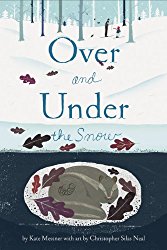
I read aloud two of Kate Messner’s picture books, Over and Under the Snow and Up in the Garden and Down in the Dirt.  Both of these books lead students on a journey of discovery about plants and animals.  We learned about the subnivean layer in the snow and which animals hibernate and which ones remain active in tunnels below.


over-and-under-the-snowupinthegarden_jacket_mech

Following the reading, we read the facts about the animals in the back of the book. We also looked back at Kate’s craft moves. On a few pages the words are spread out and down the page to show action in the words themselves. She also used alliteration and imagery and figurative language. The craft moves of a real author are ours to take and play with.

My students turned to old favorite PowerPoint, while a few tried out Emaze. Madison found an Emaze background with an ocean, the ecosystem she had chosen to write about. Jacob and Noah used the drawing tools in PowerPoint to illustrate their pages. I showed them how to group the pieces together and move them with animation. So cool to watch a fish that you made out of the shape tool actually move in the water.

Emaze has a variety of backgrounds for different ecosystems.

Emaze has a variety of backgrounds for different ecosystems.

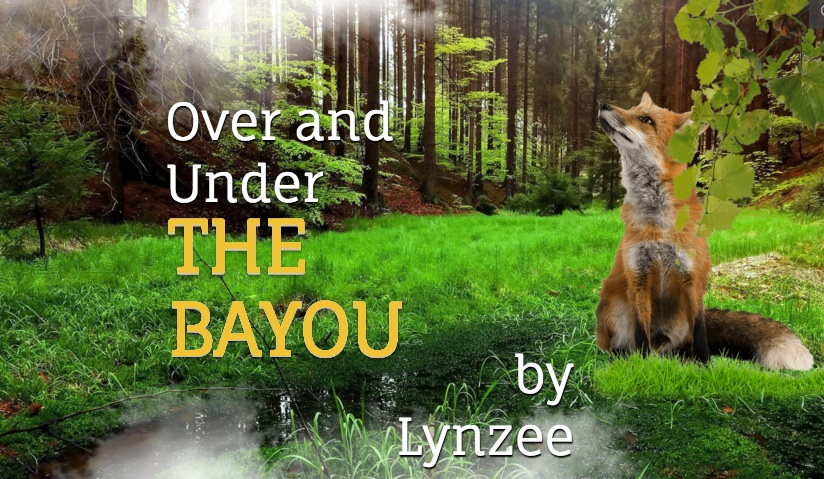
Lynzee chose the bayou for her ecosystem to study. She didn’t know about the nutria, so we talked about them and looked up information. When I turned back to see what she had written, I was pleased to see such clever craft moves.


Nutrias scrabble, skitter, scratch away the dirt as they search for the root of a forgotten summer plant to feast on when they are rare.

Andrew's slide features the wildebeests of the African savanna with a connection to the ancient boabab trees.

Andrew’s slide features the wildebeests of the African savanna with a connection to the ancient boabab trees.

Andrew decided to research the African savanna. As he was researching, he found out about the plight of elephants from poaching. He decided he wanted to do something about it. This week he will present his findings to his classmates and try to raise funds to adopt an orphaned elephant. I suggested we make a poster out of the baby elephant picture I took this summer in Africa. He loved the idea. He will sell the poster at a profit. (Much discussion about how profit works.)

baby-elephant-poster

As a teacher of language arts, I feel drawn to the craft moves authors make. They become mentor texts for my students, but then my students amaze me with their own use of craft. They become authors (and difference makers) themselves in this digital world.

Join in the conversation with your link below:

Read Full Post »

Haiku-a-day #7

The inspiration for today’s poem came in a blog post on Smack Dab in the Middle. 

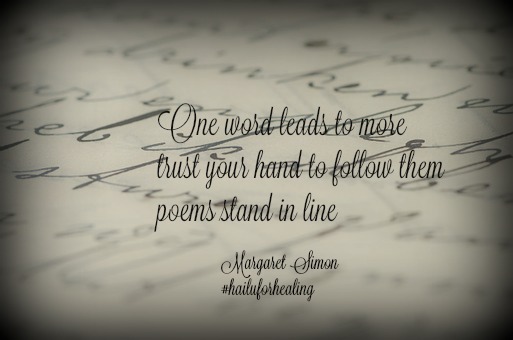
Writing advice that basically says Just.Do.It.  That is my mantra for this daily challenge.  I’m doing it.  But in the process, I am discovering a voice.  One that wants to be heard.  Poetry does that to me.  It’s like there is this other me hiding deep inside.  She’s not sure how to express herself until she writes one word, then another, then a few more.  That’s how it works.  Sounds simple.  Try it.


one-word-haiku

Read Full Post »

Join the Two Writing Teachers blog for the Slice of Life Challenge.

Join the Two Writing Teachers blog for the Slice of Life Challenge.

The news channels have been turned to the Hallmark channel. The living room smells of Douglas fir and burning wood. The front door welcomes visitors with poinsettias and a wreath.

It’s looking like Christmas. The days are short and darken early. This journey to winter solstice seems slow and cold. I want to make soup. I want to curl up with a warm blanket and drink hot tea. But this season also begs for things to get done. Shopping. Decorating. Writing Christmas cards. Wrapping… the list goes on…

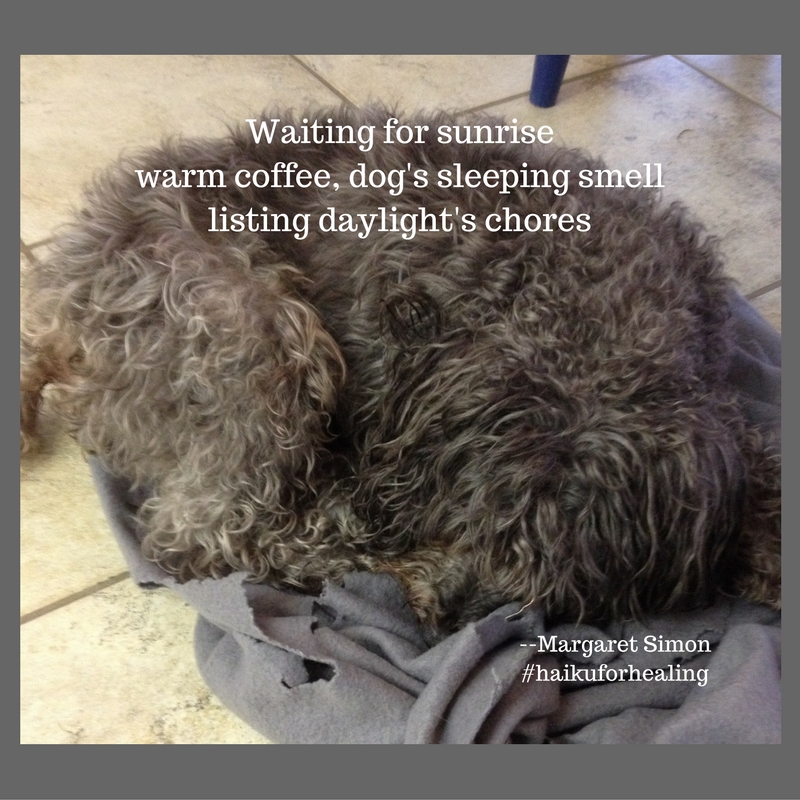
Once a day I slow down. I open my notebook and pen a haiku or two. Poetry makes me stop and pay attention. Haiku-a-day for December. #haikuforhealing

Join me in taking a small moment to stop and listen. Join me in making Advent what it’s truly meant to be…a time of waiting.

christmas-tree-waterlogue

The tree is waiting,
like me, in time we will know
secrets hidden here

–Margaret Simon

Read Full Post »

satsuma-candle


light the lanterns
darkness is trying to win
solstice seeks solace

–Margaret Simon

Mary Lee Hahn calls us poet/bloggers to write a haiku-a-day in December.  #haikuforhealing

For my first haiku, I stole Mary Lee’s last line.  Would someone like to steal my last line and make a new haiku?

Read Full Post »

Join the Two Writing Teachers blog for the Slice of Life Challenge.

Join the Two Writing Teachers blog for the Slice of Life Challenge.

The writer has to be like the firefighter, whose job, while everyone else is fleeing the flames, is to run straight into them. — Jonathan Franzen in The Best American Essays 2016

After reading Katherine Bomer’s book The Journey is Everything, meeting her virtually by hosting a Twitter chat, and meeting her face to face at NCTE16, I have a new understanding of the power of essay. Katherine’s passion for the resurgence of the real essay came through in the panel she hosted at NCTE with Corinne Arens, Allyson Smith, and Matthew Harper. These teachers experienced the transformative power of essay in a writing institute, and transferred that understanding to their classrooms.

Unpacking my notes, I rediscovered this way of thinking and writing. In real essay, we explore Hot Spots, Buried Truths, and Freedom. We write to think, leaving space for unknowing. Like a conversation with your best friend, real essay uses words like maybe and perhaps while circling around an idea, unwinding your thinking.

Essay is literature. Essay includes ideas, voice, and risk. It is the risk that stood out to me. Isn’t all writing risky? Yes, but adding the element of risk to essay has been funneled out by the Common Core testing. And when we remove risk, we remove what makes us human. Jonathan Franzen agrees as he writes in the introduction to the 2016 collection of The Best American Essays, “A true essay is ‘something hazarded, not definitive, not authoritative; something ventured on the basis of the author’s personal experience and subjectivity.'”

Writers are not born, they are made. In order to discover what we think, what we know, what we are passionate about, we need to be real in our essays, in our blog posts, with our students. When we trust this process of discovery, we allow our students an opportunity to express themselves beyond 5 paragraph essay structure.

The writer holds the paintbrush. Rather than painting an image with authority, paint with abandon to the rules. The image will be creative, expressive, and all yours.

student-essay-quote

Read Full Post »

digilit-gratitude

This image was the Twitter image I made for this week’s DigiLit link-up but never posted.  As many of you, I’ve been enjoying time with my family this holiday weekend.  I will extend this topic to next week, so think about joining the round up next week on Sunday, Dec. 4th.

I would like you to think about what DigiLit Sunday means to you.  I was asked to explain it last weekend at NCTE, and I realized the description has changed from my original intent.  I wanted a space to showcase my students’ digital work as well as a place to have conversations around digital literacy.  The purpose has turned to one that more deeply defines my teaching practice.

My posts and those of others who link up seem to gravitate to the theory around the topic and how that plays out in the classroom.  Is it time for a new name?  Any ideas?

I want to keep #DigiLitSunday going.  I am grateful for everyone who links up week after week.  How can we build a stronger future?  What need does this platform serve?

I am full of questions this week as the kitchen has quieted down, and I prepare for the ending of 2016.  Let me know in the comments or by email if you have any ideas you would like to share.  Thanks for being here.


Read Full Post »

Find more celebration posts at Ruth's blog.

Find more celebration posts at Ruth’s blog.

Gorgeous fall flowers for the table.

Gorgeous fall flowers for the table.


Time changes things.  For practically every Thanksgiving in my adult life, I’ve traveled home to Mississippi for Thanksgiving.  This year, with our growing family, I felt it was time to stay home.  I missed being with my family of origin but loved being with my daughters and their significant others (one husband, one fiancé, and one boyfriend).

This Thanksgiving became cooking by committee.  At one point I looked around my kitchen, and there were only guys cooking.  Each couple contributed something to the meal.  But also, these grown children worked together in every way.  Such a fun thing to watch and be a part of.  As the meal was almost ready to be served, I cried out, “Salad!”  There is always something we’ve forgotten.  Usually it’s cranberry sauce or bread, but this year it was the salad.  As I scrambled to get the salad ready, others stopped and chopped.  Our small community came together to make everything just right.

Friday, the committee started up again with the traditional turkey and sausage gumbo.  I know nothin’ ’bout cookin’ a gumbo, being a Mississippi girl and all.  But there is something so comforting about the scent of a dark roux.

As this holiday comes to a close, I celebrate change.  I celebrate a growing family. I celebrate the new generation.

My married daughter, Katherine, has two dogs, so we took daily walks in the neighborhood.

My married daughter, Katherine, has two dogs, so we took daily walks in the neighborhood.


A satsuma candle made by Paul using a satsuma peel and a touch of olive oil.

A satsuma candle made by Paul using a satsuma peel and a touch of olive oil.

Read Full Post »

Poetry Friday is with Carol at Carol's Corner.

Poetry Friday is with Carol at Carol’s Corner.

streetcar


In my Inbox, I found this prompt from Poets and Writers:

In his 1821 essay “A Defence of Poetry,” Percy Bysshe Shelley writes, “Poetry is…the perfect and consummate surface and bloom of all things; it is as the odor and the color of the rose to the texture of the elements which compose it….” Make a list of words and phrases that describe the surface textures, odors, and colors that surround you as this year draws to an end, choosing the details that are most evocative of the season. You may find yourself drawing inspiration from the contrasting primary colors of holiday cheer, bright puffy parkas or dark wool coats, the shiny prints and textures of patterned gift wrap, the stark tones of snow, or the scents of fragrant conifers and baked desserts. Write a trio of poems, each focusing on one type of sensory input. Select an element–setting, narrator’s voice, repeated words, or a specific object–that stays constant through all three, tying them together.

I was relaxing at my daughter’s house in New Orleans after a long, amazing, yet tiring weekend at NCTE.  The mowers came to mow the median.  And this poem emerged.


I.

Even in November
mowers hum,
chopping remains of green,
throwing dust to the wind.

My soul prepares
for the cold,
curled up in a blanket,
wearing wool socks.  

This cooling of air
this crisping of leaves, grass, my toes
gives space for new growth
prepares for seeds to flower.

II

When I hear
mower sounds,
wind playing its violin,

I turn my ear–
Listen.

III

I see black faces
of the mowers earnestly
getting the job done.
Do they take pride
in their mowing?

Do they take their families
for a ride later,
drive by the median
on Carrollton Avenue,
point to the grass,
and say, “I did that!” ?

Do any of us
see the lawn of our lives
as beauty
we have created?

–Margaret Simon

Read Full Post »

A breakfast conversation in the lobby of the Hilton in Atlanta for the NCTE 2016 conference, Collette turns to me and points her finger saying, “Words matter!”

We talked about this a lot.  Words and their importance was in the theme of every presentation I attended.  What we say, what we write, how we express ourselves and how we lead our students to express themselves matters.

The first gathering I attended on Thursday afternoon featured the work of Thomas Newkirk.  Friends and colleagues gathered to share how Tom’s words had influenced the ongoing work of writers like Penny Kittle, Jeff Wilhelm, and Ellin Keene. Jeff Wilhelm shared this Marge Percy poem, “To Be of Use.”   I wondered, “Am I of use?”

Our theories are disguised autobiographies often rooted in childhood.  –Tom Newkirk

Penny Kittle repeated this quote like a mantra, 3 times.  Long enough for me to write it down.  Long enough for me to contemplate what that means for me and for my students.  This idea leads us to empathy. How can we not be empathetic if we consider everyone’s theories come from their roots?  We must respect the roots to offer ourselves and our students wings.

This theme of empathy and the value of words continued on Friday morning at the Heinemann breakfast honoring the work of Don Graves.  Katherine Bomer reminded us that kids want to write.

Writing is the way children’s voices come into power, reminding us that we are all human.–Katherine Bomer

Following all of the amazing, articulate speakers, we were asked to create our own credo.  Here’s mine:

Student voices are precious, like a tiny fragile egg.  I must crack it open without destroying the life inside. –Margaret Simon

NCTE is a powerful, inspirational gathering of gentle, generous, kind and brave teachers and authors.  We know that words matter, but hearing the message in this atmosphere ingrains it into our hearts, and we are empowered to move forward.


Read Full Post »

Note: Header image art by my sister, Beth Gibson Saxena.

Join the Two Writing Teachers blog for the Slice of Life Challenge.

Join the Two Writing Teachers blog for the Slice of Life Challenge.

jane-yolen_

Jane Yolen

Poets love words. Poets play with words. Poets want you to love language as much as they do.

In my classroom, we read poems together, searching for sounds, images, and meaning. Jane Yolen is a master. I’ve admired her poetry for years. But only a year ago, maybe less, I signed up for her daily poem email. She believes in writing a poem a day. She practices what she preaches and sends out her daily drafts trusting that we receivers will honor and respect her words.

I shared one of these gems with my students, “Seven Ways of Kneeling on the Ground.” My first intent in sharing this poem was to show students how to use a pattern of 7 stanzas with 3 lines each, but in further examination, the poem offered so much more. We found imagery bouncing off the page. Her poem exemplified the magical sounds of words without using end rhyme: “Kneeling in the high bracken/ the brown crackle of it.”

There is JOY in reading a poem together, marking it up in colorful markers, and discovering how language (the sounds of words, double meanings, metaphor) leads us to a deeper understanding of our world.

jane-yolen-quote

Read Full Post »

« Newer Posts - Older Posts »