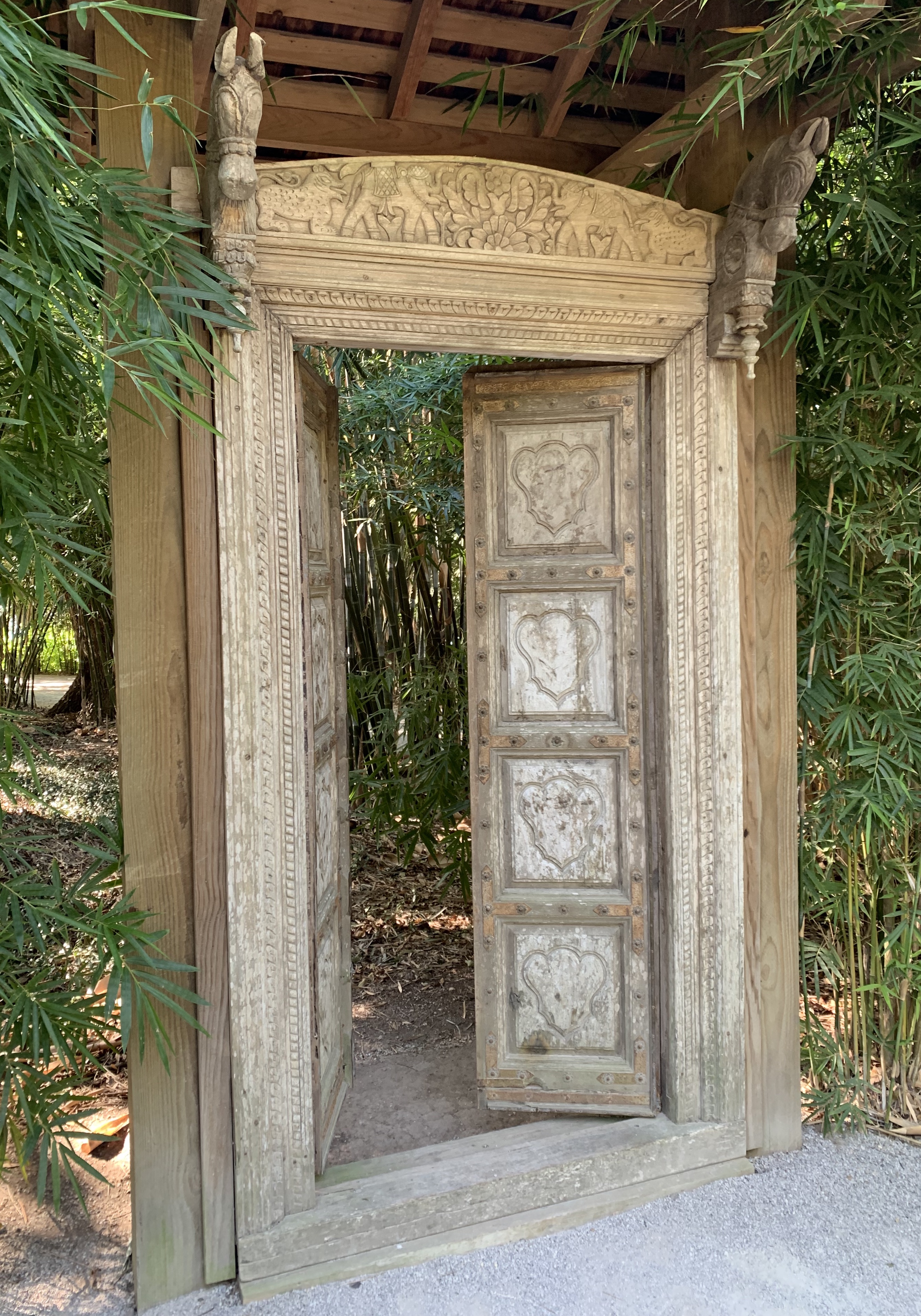
Last Saturday I attended a silent retreat at Jefferson Island. I wrote about the retreat here. This photo is an ancient doorway to nowhere. It is set in the gardens near an old wishing well. There is not much need for context today. Meander in your mind and find this doorway. Where does it lead you? Is it a place of rest? Is it a challenge to pass through? Is it guarded, or left open?
I recently came upon a new to me form called a luc bat.
The luc bat is a Vietnamese poetic form that means “six-eight.” In fact, the poem consists of alternating lines of six and eight syllables. This poem is interesting in its rhyme scheme that renews at the end of every eight-syllable line and rhymes on the sixth syllable of both lines. You can find a graphic on the Writer’s Digest. My own model draft took longer than usual to write. Rhymezone is my friend.
Retreat Door
Today I release need– Unmet purpose to feed my worth. This ancient door will birth new sight into our earth’s strong care. Inner eyes long to share wisdom carried from there to here. Look in my new seer, a vision that is clear and pure.
Linda Mitchell challenged the Inklings this month to write a prose piece and use it to create a poem. I thought of how much the Poetry Friday community nurtures me and keeps me writing, so my prose and poem are in praise of you, my Poetry Friday peeps.
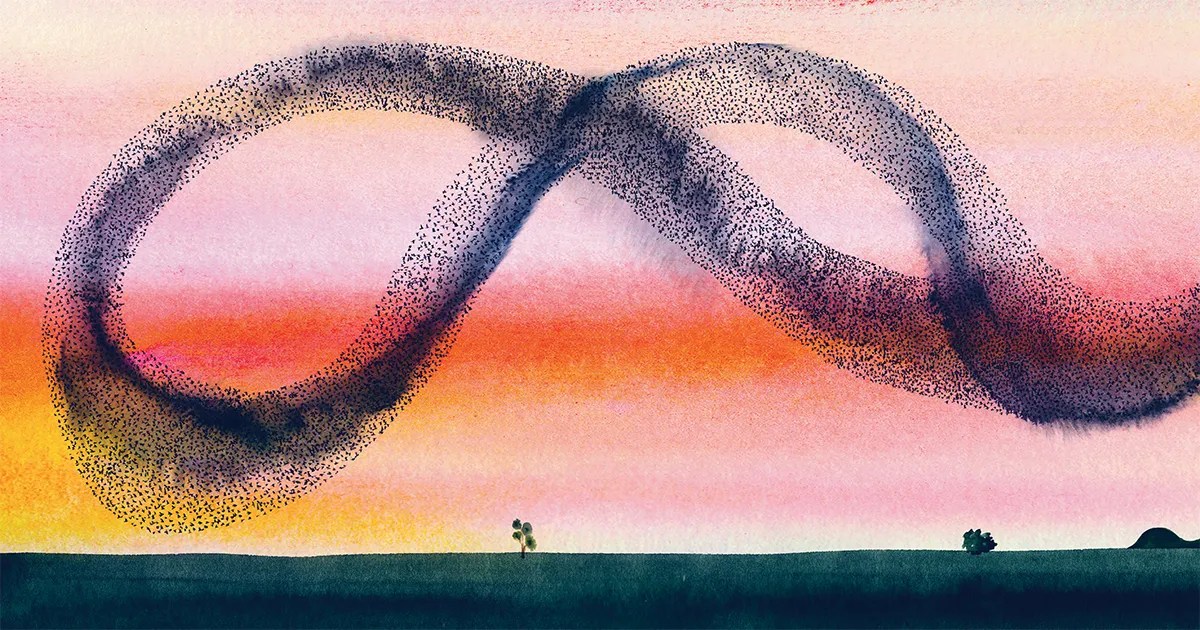
Because our kindred spirits meet each week, we read, internalize, explore words, thoughts and meanings from our virtual friends who write their hearts out, who transform small things into murmurations echoing through cyberspace.
In the sky of our world, words are offered up like kites in the wind, flipping to and fro, and sometimes taking flight, yet always tethered to its person– a human trying to make sense of the world, to take an ordinary day and make it shine like the sun or peek out from the clouds like the full moon.
I am honored by their presence inside my computer, by their comments that urge me onward or rest with me in grief. I cannot measure their worth with a single gesture. I can only take it all in as a gift, a surprise, or a nod that means everything will be fine. I am not alone. Hope is with me.
Kindred spirits meet Move like a murmuration Spreading cyber-hope.
Margaret Simon
To see how other Inklings approached this challenge, visit these sites:
What is bringing you joy? In her newsletter The Good Stuff, Maggie Smith wrote about finding beauty. She called it a “beauty emergency.” An abundance of beauty is available to us everyday if we choose to notice. Even on my sickest days this summer, I could look out my window to find the great white egret who daily feeds across the bayou. Even now I can see a flash of white as he flies by. Sometimes I watch him slowly wade through the water. Something about that presence of purity renews me.
Renewal happens even if we forget to ask for it. God knows how to renew all life.
“To find a new world, maybe you have to have lost one. Maybe you have to be lost. The dance of renewal, the dance that made world, was always danced here at the edge of things, on the brink, on the foggy coast.”
― Ursula K Le Guin
I am still in the process of renewal, walking a fine line between dark and light. I have to find the strength each day to see the light, to look for it, all the while knowing darkness is close by. Illness does that to a person. The fear of it all coming back again is real. I notice the fear, name it for what it truly is, then let it go. I must do this to bring joy to the forefront. And renewal comes as I find beauty in ordinary days.
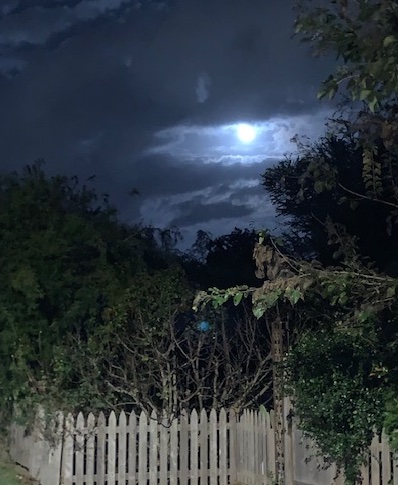
Full moon peeking out from the clouds
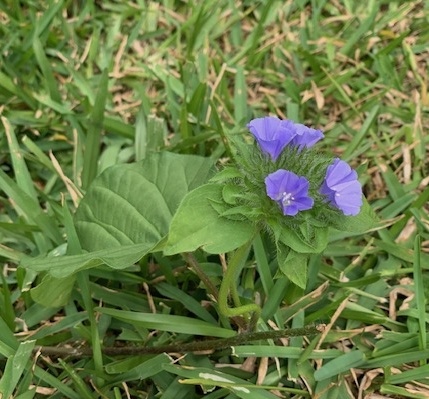
A colleague complained to me about an incessant vine that climbs her brick walls. “The guy has to come every 3 months to deal with it, even in this drought.” We can complain about the onslaught of weeds in the yard, or we can take pictures of them and find their beauty, their life, the way they insist on being here.
Weed in the grass insists on being noticed!
I believe that God gives us access to beauty all the time. We are meant to feel curious, to wonder about ordinary things, to be present and renewed, touched by beauty and joy.
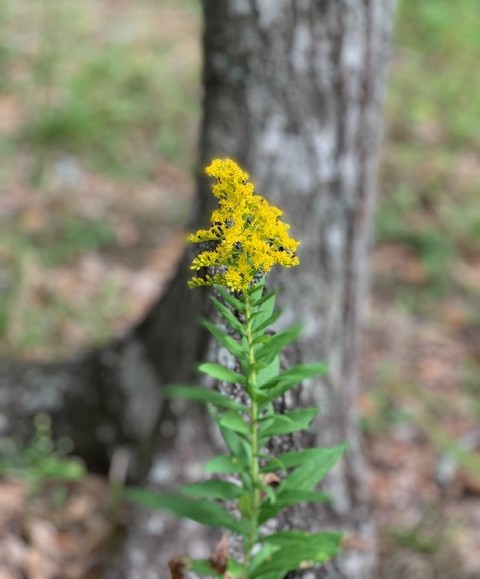
Goldenrod, photo by Margaret Simon
Solidago*
Meadow soul soother I turn toward your day light Don’t go. Don’t go.
Margaret Simon
*scientific name for goldenrod, solidus meaning “to make whole”
The National Writing Project’s Write Out ended last Friday with the National Day on Writing. All the wonderful content is still available, and my students aren’t ready to stop writing. Yesterday we perused the site and found information about Phillis Wheatley from the Boston National Historic Park. When I was researching to write poems for my forthcoming book Were You There: Biography of Emma Wakefield Piallet, I used a line of Phillis Wheatley to write a golden shovel. I shared the mentor text with my students.
They were fascinated to try writing golden shovels, so we found a poem written by Phillis Wheatley on Poetry Foundation. We read “A Hymn to the Evening.”
Soon as the sun forsook the eastern main The pealing thunder shook the heav’nly plain; Majestic grandeur! From the zephyr’s wing, Exhales the incense of the blooming spring. Soft purl the streams, the birds renew their notes, And through the air their mingled music floats. Through all the heav’ns what beauteous dies are spread! But the west glories in the deepest red:
Thursday was a special day in our small room. The butterfly whose chrysalis lay on the zipper finally emerged. We were excited because it meant we could finally open the enclosure to release them all. We had four that I had been feeding with mandarin oranges from the cafeteria.
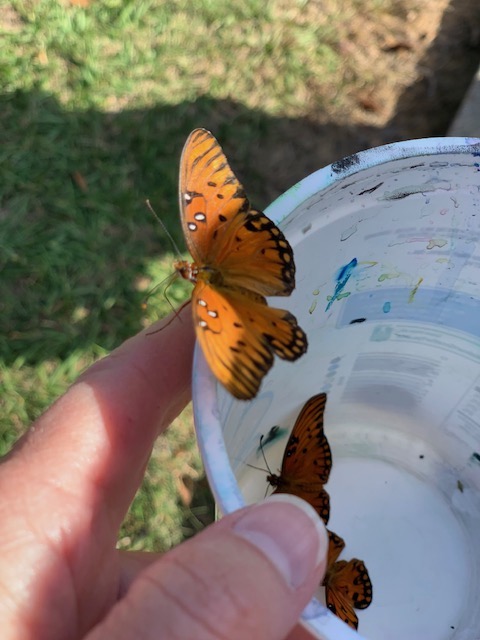
We had the privilege of watching their daily antics and marveling at their beauty. The butterflies were Gulf fritillaries. And flit they did. This breed was less tame than the monarchs we have raised before. They did not light easily on a finger. We had some exciting moments trying to catch them all. But we did and together released them into the butterfly garden. Luckily one of them hung around for a photo.
My mind and my golden shovel poem were both on this miracle of Mother Nature.
A Hymn for the Gulf Fritillary after Phillis Wheatley “A Hymn to the Evening”
Fritillary soft petals purl from enclosure to the spread of wings, flitting over streams, freedom like the birds who renew, survive and thrive singing their tender, sweet notes.
In her weekly newsletter, Maggie Smith asked the question, “What can a poem do?” Her conclusion is a poem can remind us of us, of who we are as humanity. We need poems now as much as ever. When times are hard, look to the sky and see poetry.
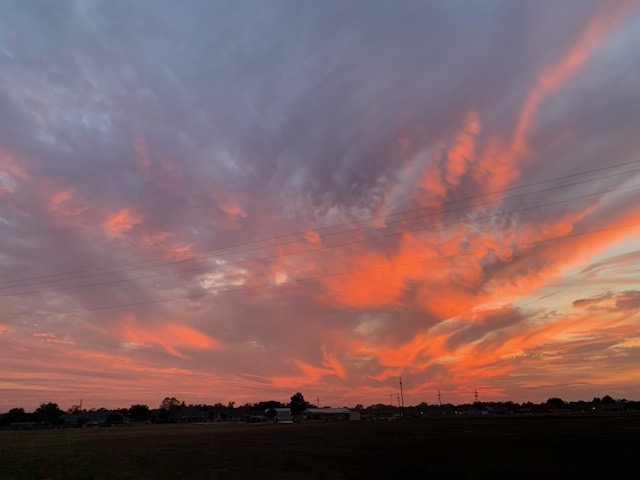
Last weekend while my husband was driving us home one evening, we saw the sky light up at sunset with this amazing cloud formation that disappeared into the night within minutes. I rolled down the window to take the picture. I saw an octopus. What do you see?
Octopus sky by Margaret Simon
Oh, octopus, octopus of the sky, what do you see as you pass by? A world of creatures down below Chasing time and on the go.
Oh octopus, octopus of the sky, what wisdom lies in your eyes? I stop to watch your tendril glow, breathe in deep, heart beats slow.
Margaret Simon, draft
Take a minute to breathe and see what you may see. Use your imagination to tell a story with a poem. Respond to others who are writing vulnerably today. Encourage with your comments.
Rich Novach in this video led us on a trail to writing found poetry. My students and I selected a National Park to research and “find” text that can be placed into a poem.
I visited Glacier National Park a few years ago, and the experience has stayed with me. I found my poem on the park’s website. I wrote it in the form of a nonet, 9 lines with each line using a syllable count of 9,8,7,6,5,4,3,2,1.
Ya-qawiswitxuki*
A place where there is a lot of ice of meltwater irrigation ice flowing under its weight alpine meadows showcase adventurous wild carved paradise history melting ice
Thank you to Two Writing Teachers for creating an amazing community of writers and a safe, welcoming space to write and share.
My students and I have been looking forward to the National Writing Project’s Write Out, a writing event that takes place in October. NWP partners with the National Parks to create videos and writing prompts designed to get kids outside to write. Last Friday, I handed each student a 5×7 blank book and told them it would be their Write-Out notebook. What is it about having a new clean colorful book that makes you want to write?
After watching a short video from Ranger Chris from the Delaware Water Gap National Recreation Area, we went outside to the playground to observe nature and write haiku poems. I wrote alongside them. I shared how I sketch in my notebook. Sketching is low-stakes art. Sketching helps to motivate and enhance writing while making their notebooks a safe place to explore.
Back inside, students were enthusiastic about sharing their poems. Because I teach multiple groups at two different schools, we use Fanschool for sharing our writing.
If you have a minute, it would be exciting to my students if you wrote comments on their first ever haiku poems:
Music is my mother’s memory. She was a pianist. When I was a teenager, she went back to school to get her masters in piano. She was always teaching and playing piano and singing in the choir at church on Sundays.
Last weekend my sister, my niece, and I drove up to Mississippi to visit her. She recognized us as people she loved dearly. Her conversations were choppy, a thought would begin but derail before she could finish the sentence. But music is still her love language.
Watching the LSU game together in the hotel lobby, we started “bom, bom, ba-bom, ba” the tune for the fight song and she joyfully joined in. At church she popped up from sitting to sing the service music in perfect tune. My sister played a song she knew Mom loved on the radio, so we could all sing along.
NPR did a report recently about a son who plays the guitar and sings for his mother with Alzheimer’s. (A four-minute listen at this link.) My brother is a musician. He plays keyboards with a band, with another artist, or alone. He makes sure Mom gets to as many gigs as she can, especially the ones he does in senior living facilities.
I was a little wary of my visit this time because my brother had reported that she is worse (She had a bout of Covid a month ago.), but her light is still there. It comes on when she hears familiar music. It shines when she sees my face. My sister and I are baffled by how one minute our mother seems far away, out of touch with the world. And the next she will say something completely logical and true. We are blessed that our mother is getting good care, and she is mostly happy. I admit to tearing up, though, when she was singing. It was then that I saw the person I long for, the one I miss.
I follow storytellersgallery on Instagram. He posts a photo and poem daily. This one spoke to me.
Already Gone.
i wish i could understand how you feel i wish i could feel what you’re missing here
i always feel like we’re doing okay that no matter what i know it could be worse
but i’m getting the idea that maybe you don’t agree i think you know i would give you anything and everything but i’m learning that maybe that’s not enough and maybe that’s why it feels like you’re already gone
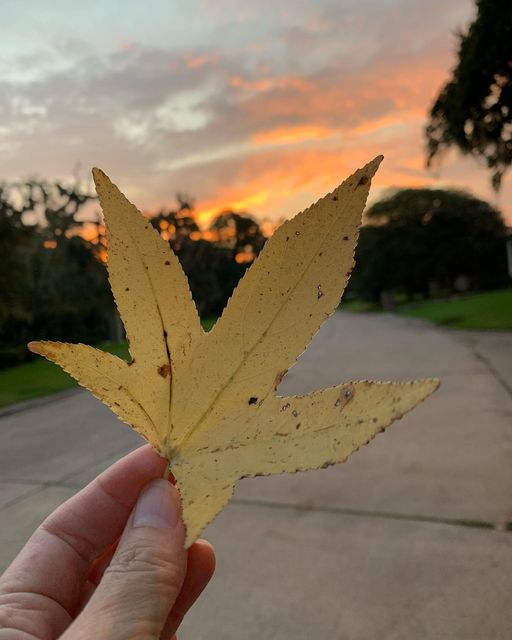
Fall here in South Louisiana doesn’t offer much color change of the trees. The oaks stay green. The cypress turn brown. Crepe myrtles are still blooming. I found this yellow beauty near a sweet-gum tree. I picked it up and pressed it into my notebook.
I invite you to think about fall with all your senses.
One of my favorite forms is the zeno created by J. Patrick Lewis. Based on a mathematical sequence, the syllable count is 8,4,2,1,4,2,1,4,2,1 with all the single syllable lines rhyming. I usually decide on the one syllable rhyming words and write the poem around them.
As sun’s glow fades through purple clouds, I walk alone seeking fall. A yellow leaf beneath sprawls, beckons to hear barred owl’s call.
Margaret Simon
Write your own musings in the comments and leave encouraging comments to others. With my students, today I plan to make Zeno Zines. Here’s a video of me sharing a Zine.
Thank you to Two Writing Teachers for creating an amazing community of writers and a safe, welcoming space to write and share.
Where did I read that we should be teaching living poets in our classrooms? I try to include poetry every day. This is a goal, but some days, as you well know, don’t go as planned. I’ve made a Google Slide Show for a Poem-a-Day, so I have a place to save poems I want to explore with my students. When I announced yesterday that we had time for poetry, my students were excited. I love this about elementary gifted kids!
First we read the poem through. Then I ask, “What do you notice?” I ask my students to notice 3 things about the poem. Using annotation on the smart board, I underline what they see and if they don’t, I name them.
I presented Danusha Lameris’s Small Kindness. I invited my students to write. They could borrow a line, make a list poem of small kindnesses, or write about their own topic using free verse.
I’ve long held the belief that I should write alongside my students. I also welcome their critique. Usually they just say, “I like it.” Then I know we need to work on how to offer critique with specifics such as “I like the way you used personification or metaphor or rhyme.” Naming the specific poetic elements.
Yesterday I was surprised when a student actually said, “I think it’s too clumped up.” As I questioned him further about what he meant, I realized that I read it like a paragraph, no line breaks. Danusha Lameris’s poem uses enjambment masterfully. She understands line breaks. It is definitely a skill I want to work on, and this student nailed it.
So I worked on it, revised, and will share today the current working draft.
Small Kindness
after Danusha Lameris
I’ve been thinking about the way when I open a car door, and a little kinder kid jumps out, how the driver says, “Thank you.”
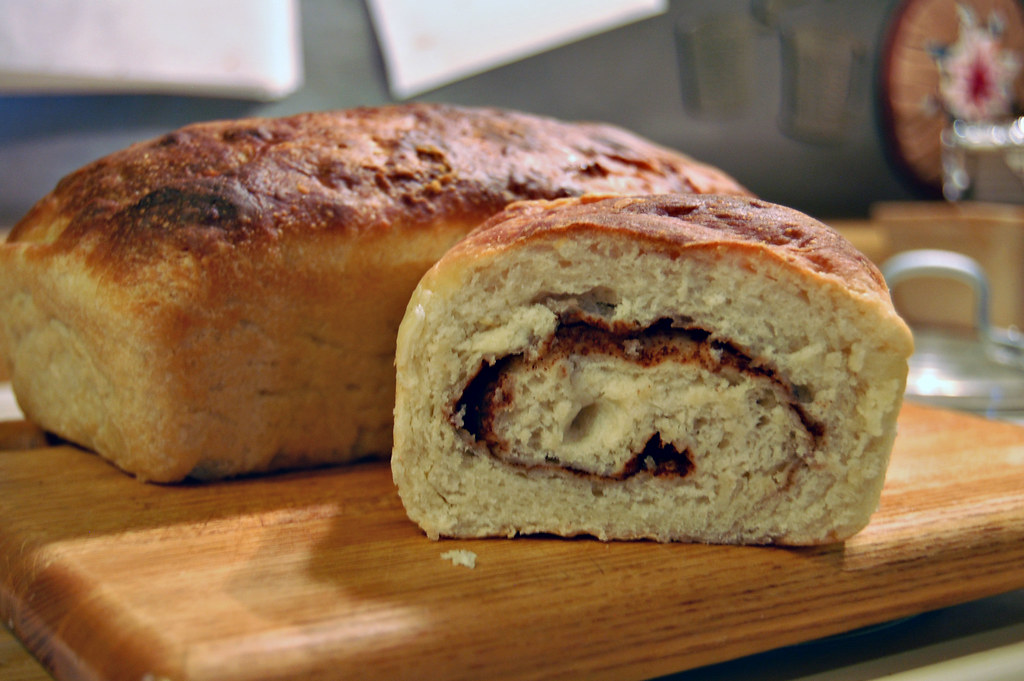
How on the way to school, a white suburban slowed to let me merge ahead. How cinnamon bread, a gift from my neighbor fills the kitchen with sweetness.
I want to believe everyone is kind and thoughtful. I want to find grace
in the corner of the parking lot waiting for me to notice her.
Margaret Simon lives on the Bayou Teche in New Iberia, Louisiana. She is a retired elementary gifted teacher who writes poetry and children's books. Welcome to a space of peace, poetry, and personal reflection. Walk in kindness.