Feeds:
Posts
Comments

Join the Two Writing Teachers blog for the Slice of Life Challenge.

southern hollows podcast

When I imagine a southern hollow, my mind takes me to a sunken clearing in the mountains or the woods… a good spot to build a bright campfire — and tell a story. But the more I explore the history of my part of the world, the more I come across a new kind of southern hollows: men and women missing that bit of conscience or soul or whatever you want to call it that lets us see, and feel, somebody else’s humanity. And though many of the stories are little known, they often have shaped history, and are definitely stories we ought to remember. –Stinson Liles

My cousin Stinson grew up in Jackson, MS later than me. After college he moved to Memphis, TN. He lives there now with his wife and two teenagers and runs his own advertising agency. I was taken by surprise about a month ago when I saw in a Facebook post that he was embarking on a podcasting adventure called Southern Hollows. You will read about how this came to be in my interview with Stinson, but until you listen, you will not know the deep, unique voice he inherited from my uncle, a strong tenor the memory of whose solo of Oh, Holy Night still gives me chills today.  Not only is Stinson’s voice appropriate for the telling of these stories, his writing is intriguing and inspiring.

When did you come up with the idea of starting Southern Hollows?

History and non-fiction are my favorite to read, and for a long time I’ve thought about a book project—writing one—and even had some outlines going. I’ve been listening to more and more podcasts as the number of them have grown – and have discovered some great history ones. As I listen, I constantly have found myself thinking of stories that would be great topics for these shows. Then, after the election, when I needed a hiatus from current events for a while, I set out to find more shows like these and realized there wasn’t anything out there that combined those two approaches – covering formative periods of American History in a more thoughtfully written way with some slightly higher production values. There are lots of people out there doing interviews and conversations — but not many who are wrapping historical moments up in an impactful tight little story package. So that’s when I got the idea, late last year, for Southern Hollows. 

And why?

So that’s an interesting one that I’ve even asked myself. I’m not sure why I’ve become increasingly interested in Reconstruction and Native American removal and all these times when we as a country weren’t our best selves. As I got going on the podcast, (my wife) Patty asked the same question. She said the listeners need to know what it is and why it is. So I went back and added the intro (found in the quote above).

To tell you the truth, I think we’re at a moment when we have a lot of trouble with history. Confederate monuments, voting protections… I’m not sure why we are so eager to intentionally misunderstand the past. We as Southerners, especially, have trouble knowing what to do with it. As humans, we all need ancestral lore. But when our ancestral lore is slavery and Jim Crow, we only have two choices – confront it or reject it. I think it’s hard to say segregation and the Civil War and the Night Riders were abominations because that means Grandpa was an abomination and – even harder – we lose our ancestral lore. We become unmoored from our own identities. We take on guilt not only for loving our family heritage, but for loving sausage gravy or linen suits or Great Aunt Gussie’s quilt. You’ve got to be very intentional to separate them, and I don’t know that a lot of people can or do.

And when we don’t allow ourselves to see and feel the horrors of our ancestors, we run the risk of repeating our worst history.

While Southern Hollows is a history hobby project for me, it’s also got some importance, I think. I hope we all can benefit from a white Southerner owning and sharing these stories of inhumanity.

How do you research the stories?

Since the goal is to do two a month, I can’t do the kind of primary research I’d like. So my general approach is to find a story that fits the bill, then read a well-researched book or two that aggregates a lot of the primary research. I try to give lots of credit to those authors, and even share links to their books.

How is writing a podcast different from other types of writing? Or how is it the same?

It’s funny you ask, because I didn’t think it would be that much different, but it turns out is very different. For obvious reasons, it’s a lot more like writing a script than an essay. I love to write in long complex sentences – those Winston Churchill type structures that a lot of times don’t resolve until the end. But while that kind of writing is useful in a history text, it’s both confusing and unnatural when spoken. So I’m writing them more and more with a storyteller’s ear, with fragments and interjections and lots of em dashes. I don’t want to lose the polish and intensity of the content that makes it different, but I don’t want the distraction of an overly academic or inauthentic voice.

Any advice for teachers for using podcasting in the classroom?

Part of the vision for Southern Hollows emerges from the evidence that people allow themselves to be desensitized to inhumanity – laying it out there naked is the work.

As long as students are old enough to be exposed to inhumanities like lynching (and the holocaust and other comparable historical human tragedy) I think mine would be appropriate.

As a marketing executive, incidentally, I read a lot about podcasting as an emerging advertising medium, and one of the key reasons is that millennials (and younger) have grown up consuming multiple media simultaneously. It’s why they get bored with documentaries and have huge trouble with books. Podcasts are a medium being embraced by younger people because they can listen as they do other stuff. It’s the preferred way to consume information-rich content. 

I highly recommend Stinson’s podcasts for many reasons.  The stories are interesting.  The content is forgotten or lost history.  And the style of Stinson’s writing and speaking are well-crafted.  You can subscribe to Southern Hollows on Stitcher and iTunes or directly from Southern Hollows website. 

Please use this button on your site for DigiLit Sunday posts

I know, it’s summer and who wants to think about problems during summer?  I didn’t expect to, but I do enjoy having more time to read.  I’ve been reading Dynamic Teaching for Dynamic Reading by Vicki Vinton.  This book was chosen for the CyberPD book for July. To follow the discussions around this book, tune in to #cyberpd and Michelle Nero’s blog Literacy Learning Zone. 

In Dynamic Teaching, Vicki sets us up to think more about the complexity of and the authentic purpose for reading. She leads us into the problem solving process for students when reading.


It’s one thing to read theory in a professional book, but quite another to see the theory play out in your own life.  I started reading Orphan Island by Laurel Snyder.  This book is intended for middle grade students, the students I teach. Immediately in the first chapter, I have to enter into the process of solving a problem.

Jinny heard the bell.  She threw down her book, rose from the stale comfort of the old brown sofa, and scrambled to the door.  When she burst from the cabin into the evening air, Jinny ran.

I can assume from the title of the book that Jinny is an orphan.  This first paragraph makes me think she is at camp.  A bell rings, and she runs from the cabin.  As I continue to read, though, I find clues that she is not at any camp I’ve ever known.

My purpose for reading is heightened.  I have to figure out why Jinny is at this camp.  Who else is there?  What happened to her parents?  Reading only this first chapter, I am full of questions.

It is time to honor this process of problem finding and problem solving with our students.  How could I set my students up to do this?

  • What do you think is happening?
  •  What are your questions?
  • Why do you want to keep reading?

My summer reading has taken on a different dimension.  I’m not only reading for understanding, but I am reading to find the problem.  Where can I apply this problem to my teaching?  How do my students find problems?  How do I present problems that will interest them enough to solve?

I have found a problem that interests me.  In fact, it came in the mail.  I think it’s from someone in the CLMOOC postcard exchange, but that in itself is a mystery. I received a postcard with a snippet of text glued to the back.  The instructions are to create a poem out of the text, black-out style.

As you may be able to see, I’ve started underlining words in pencil.  I haven’t committed to any of them yet.  The fact that I have to black-out and send the postcard back with some sort of meaningful text selected has heightened this problem from one of mere play to a serious thoughtful process.   How can I take this experience and apply it in my classroom?  I want my students to both play with language and see the serious potential of making meaning with words.  Wouldn’t it be interesting to send a postcard to each of my students with these same instructions?

Problem seeking leads to problem finding to problem solving.  This is the way of language in reading and in writing.  I invite you to contemplate problems in your own literacy learning and teaching and link up your blog post below.


Find more celebration posts at Ruth’s blog.

My view this morning. A cup of coffee. Dog Charlie at my feet.  Cats cuddling. And a chat with a friend.  Doesn’t get better than this.


Buzz snoozing in the sun.


Jen with Rio

On Wednesday I drove to Breaux Bridge to visit my friend Jen’s farm, Bonne Terre (which means good earth).  She has been working hard all year to get her property ready for renting.  She offered her place for a writing retreat, so I am working on plans.  Check out her new website here. 

Above Jen is flirting with her horse Rio.  I loved watching her interact with her animals.  She is a natural mother to them all.

Everywhere I turned there were writing prompts.  Sitting on the porch watching the birds, looking at all the artisan knick-knacks she has around, or reading the inspirational messages on her walls, I felt relaxed and inspired.

Today I celebrate friendship and the long relaxing days of summer.


Jen’s cow, Matilda, peeks at use over the fence to her pasture.


Poetry Friday is with Mary Lee at A Year of Reading.

 “Write a poem inspired by I Spy, the guessing game popular with kids during car rides and other long periods of downtime, in which the spy offers descriptive clues that hint at a visible object for other players to guess.”
Poets&Writers poetry prompt

I Spy

in the dome of the sky
a face
full and bright.

I spy
rising on the horizon
a sphere
of golden might

I spy
smiling through the trees
a force
moving the night.

–Margaret Simon


Join the Two Writing Teachers blog for the Slice of Life Challenge.

Every year I judge a state writing contest, LA Writes!  Teachers gather to choose finalists to send to author judges.  I never judge the elementary entries since that is the level I teach. Laurie was reading a stack of 5th grade poems when she came to me and said, “I have to share this with you.  It’s not a winning poem, but the first line is so hilarious that I was laughing so hard I had to take a puff of my inhaler!”

Then I noticed the title, “Lovely Owen Liles.”  My cousin Andrew has a daughter named Owen, and they live in New Orleans.  Wait!  I turned over to find the entry blank and sure enough, the poem was written by my cousin Amos who is in fifth grade.   Laurie was right, it wasn’t contest winning, but it certainly won my heart and made me laugh out loud!

Lovely Owen Liles
by Amos Liles
 
You make me laugh when you toot, and it smells like dead possum.
Have I told you that you make me laugh when you make that face
where you wrinkle your lips.
Have I told you that you are so cute even a princess
puppy is not cute.
Have I told you that you are so generous you get me a
lollipop everytime you go swimming.
Have I told you that you are so fun like when you make 
me laugh when I’m sad.
You are the best.

My cousin Andrew Liles with his daughter Owen, the lovely Owen Liles.

Please use this button on your site for DigiLit Sunday posts

Find more celebration posts at Ruth’s blog.

Some weeks call for combination posts. Today I am celebrating story in my DigiLitSunday post.

I am privileged to be in a family of writers. After her retirement as a district judge, my mother-in-law started writing crime novels. In each of her books, she fictionalizes actual cases that came across her bench in the courtroom. Sunday I am hosting a book signing for her third book, Blood of the Believers.


In this book, Detective Ted D’Aquin is struggling with the disappearance of his wife. But after a year and a half of leave from the St. Martinville Sheriff’s office, he returns to investigate two homicides. I know from my mother-in-law, Anne Simon, the parts of the cases that are real and which ones she made up. Sometimes real life can be crazier than fiction.

Reading her latest book, I could hear her voice. Even though she was writing as a male character, some of her ways of saying things came through. The average reader may not recognize these idiosyncrasies that our family lovingly calls “Minga-isms.” (Minga is her grandmother name.)

My father has published his first novel, Into the Silence. He’s been writing this book since 1975 when I was still a young teen. I encouraged him to get it published with my friends at Border Press. He will have a book signing in my home town of Jackson, MS at Lemuria Books on June 16th at 5:00.  Diane Moore wrote a glowing review on her blog, A Word’s Worth. 

When I was home last weekend, I got one of the hot-off-the-presses copies. I read furiously, couldn’t put it down. The protagonist is Todd Sutherland, a cardiologist, but to me, he is my father. Dad admits that he wanted to be a cardiologist. He was a radiologist by profession. Interspersed in the story of how Todd falls in love with one of his patients and is faced with her certain death are parts of my father’s life story, the death of his own father to Parkinson’s and his intense study of shamanism, Greek literature, and theology. The fictional story is intriguing, but I will hold on to the parts of my dad that live on in this story.

Why do we write? For both my mother-in-law Anne and my father John, they write to reveal the deepest parts of themselves while creating a strong compelling story. I am blessed to be among such mentors.

If you have stories about stories, please leave a link below. Click to read more DigiLitSunday posts.

Poetry Friday is with Buffy today.

I don’t think of myself as any kind of poetry expert, but I do love poetry in many ways. When my Voxer friend, Dani Burtsfield, asked for help with writing a poem for her mother, I was honored and humbled. Yesterday she went for a walk in the mountains of Montana where she lives and sent me a message about the lilacs and how their blooming means summer. “I think I feel a poem coming on.”

Thus began our late night discussion of her poem. This is what poetry should be, a walk in the woods that leads to talk that then becomes a poem. Jane Hirshfield writes in her poem, Mathematics, “Does a poem enlarge the world/ or only our idea of the world?” I believe that poetry and your own expression of it does enlarge the world. We experience the experience in a new and loving way. Please go to Dani’s blog and read her poem, her first brave contribution to Poetry Friday.

Our discussion of summer made me think about how summer reveals itself differently in different parts of the world. For Dani, it’s in the lilacs. Here in South Louisiana, the landscape is different. My poem attempts to capture my own summer landscape.

Summer

Summer waits
like the rope swing
hanging
from the old oak.

Summer welcomes
like sunflowers
opening
a morning

Summer vibrates
like cicadas
buzzing
at twilight.

Summer lingers
like the sun
hovering
the horizon.

–Margaret Simon, all rights reserved

Today, our Spiritual Journey blogging group is writing about Joy, Finding Joy.  I am gathering the posts in the Link button below this post.

I find joy on my morning walks.  Over the years I have joined different gyms.  I’d wake up in the dark, pull on some tights or other fashionable exercise wear, and go to a class or climb on the treadmill or rotate among the machines when Curves was around.  Last year I gave up all memberships and just started walking.  During the school year, I try to get out by 6 AM.  But now that it’s summer, and the days are getting warmer, and I don’t have to be anywhere, I’m out at 7 AM.  Charlie on the leash.  I carry my phone in a pouch that fits over my pants and stays in place with a magnetic grip.  Sometimes I talk to my Voxer pals.  Sometimes I listen to a podcast, and sometimes I run into a neighbor to chat with or who will join me.

These walks have become my Joy.

I find joy in the songs of birds.

I find joy in watching Charlie explore.

I find joy in waving to neighbors.

I find joy in the flowers, the trees, and the bayou beyond.

Another source of joy for me is poetry.  For this poem, I turned to one of my favorite collections, The Woman in this Poem.  Georgia Heard signed my copy with these words, “For the joy of poetry–and life!”


Happiness

by Jane Kenyon

There’s just no accounting for happiness,
or the way it turns up like a prodigal
who comes back to the dust at your feet
having squandered a fortune far away.

And how can you not forgive?
You make a feast in honor of what
was lost, and take from its place the finest
garment, which you saved for an occasion
you could not imagine, and you weep night and day
to know that you were not abandoned,
that happiness saved its most extreme form

for you alone.

No, happiness is the uncle you never
knew about, who flies a single-engine plane
onto the grassy landing strip, hitchhikes
into town, and inquires at every door
until he finds you asleep midafternoon
as you so often are during the unmerciful

hours of your despair.

It comes to the monk in his cell.
It comes to the woman sweeping the street
with a birch broom, to the child
whose mother has passed out from drink.
It comes to the lover, to the dog chewing
a sock, to the pusher, to the basketmaker,
and to the clerk stacking cans of carrots
in the night.
                     It even comes to the boulder
in the perpetual shade of pine barrens,
to rain falling on the open sea,

to the wineglass, weary of holding wine.

From The Woman in this Poem Selected and Introduced by Georgia Heard

Join the Two Writing Teachers blog for the Slice of Life Challenge.

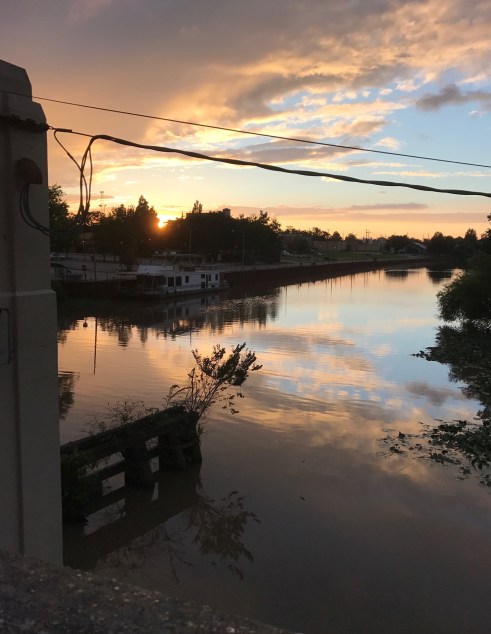
At the lake, the Canada geese lead the parade
while the great blue looks on.

There is always something
happening at the lake.

Woodpecker tap, tap, tapping
on a hollow tree.

Mallard daddy duck pacing,
waiting for the ducklings to hatch.

Three men fishing
passing the time
in friendship

There are always turtles
out for some sun.

There are always reflections
of sky on water.

There is always peace
watching from the deck.

Please use this button on your site for DigiLit Sunday posts

My email inbox is filled with ways for me to improve myself from reading recommendations to Enneathought (how to improve my personality and spirituality) to Choice Literacy.  It was this month’s Choice Literacy email that caught my eye and my idea for this week’s DigiLit topic.

This quote from Atul Gawande was the epigraph to Matt Renwick’s letter.   Quoting from the Gawande’s book Better: A Surgeon’s Notes on Performance, Matt outlines 3 ways for us to be better as teachers.

  1. Don’t complain
  2. Write something
  3. Change

These three directives immediately resonated with me.  This school year has ended, and I was having lunch with a colleague in our gifted department.  She said, “We have to do better next year.”

We then began a long discussion of how we could.  One way is we are going to meet together even if we don’t get paid.  As the years have gone by, the education budget has gotten smaller and smaller.  We were once able to meet weekly to plan for the next year and get a stipend.  Does the stipend matter?  Not when we are talking about doing our best for the kids.  We will meet anyway.

I am reading Dynamic Teaching for Deeper Reading by Vicki Vinton.  Vicki challenges our current thinking about the teaching of reading.  She calls for a change to embrace reading as the complex act that it is and teach the whole child-reader. I am convinced this book will not only improve my teaching, it will improve me.

The only way to make sense of change is to plunge into it, move with it, and join the dance. –Alan Watts

Summer break is a time to rejuvenate and renew what we believe about our own lives as well as our selves as teachers.  This year was my thirtieth year in education. Yet, I’m not best yet.  I continue to talk, write, and change to meet my own needs and those of my students.  Won’t you join me in doing the same?

Please add your links below.  Click to see more posts about Better.