Feeds:
Posts
Comments

NPM2016

My internal critic is turned on high voltage. I take my journal in my backpack to school to school (I teach at two), and I turn the page and write some words, then a student needs me. I come back to the page focused, thinking, and another student has to share.

Here I am at home with Charlie and there’s nothing worth much in my journal. This is day 13 of my personal challenge to write a poem a day, and my personal critic thinks I can’t possibly keep this up.

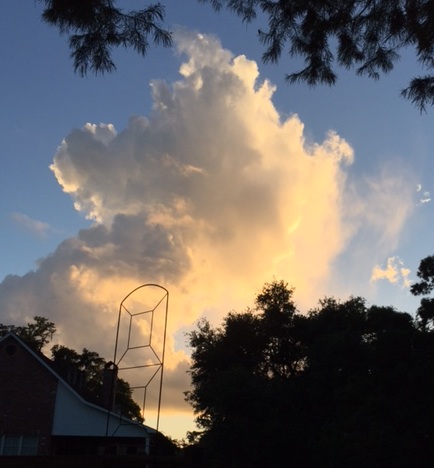
Step one: upload a picture. Here’s another sky picture taken from my car with my phone.

Sky Sea

Sky Sea

How to Stay a Poet (A synonym poem)

Attach a line to a thought
with a long string, maybe even wire

Fasten sprinkles of light,
a frosting of powdered sugar would taste good.

Unite clouds to sky to space,
an ethereal concept, I know.

Abide with your favorite poets,
savor their strength, their providence.

Linger over the page, make a statement,
scratch it out, start again.

Remain committed; don’t listen to the witch
in your head telling you to abandon all.

Keep on writing. Stay a poet.
Stay here.

–Margaret Simon

Process: After writing the title, I did a synonym search for “stay.” I used selected synonyms as the first word of each stanza. Creating rules for myself helped me get through writer’s block. This is not one of my finer poems, but it’s a poem. Let’s keep moving forward.

Follow the Progressive Poem to Teacher Dance

Follow the Progressive Poem to Teacher Dance

NPM2016

Join the Two Writing Teachers blog for March Slice of Life Challenge.

Join the Two Writing Teachers blog for March Slice of Life Challenge.

We brought out the paintbrushes and watercolor paints.  Each table had a stack of white paper.  I turned on the music.  Painting flowed in time with the beat.

This is dancing with a paintbrush.  When the music stops, we title the piece of art and list three words that come to mind.  This continues for three rounds.  The songs are all instrumental, one sounds oriental, another symphonic, and another Irish.

Following this painting activity, we write.

Freedom of expression, playing with words, making associations with music and poetry, the resulting poems went in all kinds of directions. (My students share their poems on Kidblog.)

In reading Tara Smith’s book review of Writing with Mentors, I pulled out this piece of advice: “Mentors Show Students How to Play: In order to grow as writers, students need safe places to play with writing – places that aren’t assessed or evaluated or given a grade.  They need places where their work can be messy, where thinking outside the box and being wild with ideas is encouraged.”

When I was struggling to write a poem with my painting, I turned to a favorite author, Mary Oliver.  From A Thousand Mornings, “Poem of the One World” begins “This morning/ the beautiful white heron/ was floating along above the water.”

Writing beside this master poet helped me to follow the rhythm that my own words wanted to take.

This longing
the beautiful white egret
wanders from known to unknown waters

And then
onto the shore of this
one stream we all swim in

where everyone
is part of the blue vein
where we can throw a stone in

which thought made me feel
for a small moment
welcomed home.

–Margaret Simon, after Mary Oliver

Dancing with a paintbrush

The abstract painting that led to my poem.


Follow the Progressive Poem to Today's Little Ditty

Follow the Progressive Poem to Today’s Little Ditty

NPM2016

Last week I led myself and my students into image poems.  We imagined a scene in nature (or on water) and wrote to this list of line prompts from the River of Words Teacher’s Guide. 

Prompts for the Teacher:

~ Think about this spot. Sketch it if you like.

~ Picture yourself in this location.Write a line or sentence that describes what you are doing and exactly where you are: “Sitting on a sandbar on the banks of the Calcasieu River in IndianVillage, Louisiana.”

~ In your imagination, look up.What do you see? Begin this line with “Above me” or “Over my head.”Try to use a simile in this line.

~ Now look into the distance, as far as you can see.Write what you see.

~ Describe a sound you might hear in this place.

~ What is on your right?

~ Hone in on a single detail in this scene.Try to describe it, using an unusual or vivid verb in the line.

~ Shift your perspective and your position—stand up, flop down, walk away—and notice another detail in the landscape: the quality of light, the time of day, a seasonal plant or animal,for example.

~ Finally, read over your images and see if you can conclude with a reflective line that somehow captures how you feel about being in this place.(You might caution students not to rush this line; it may occur to them later as they compose their poem).

rope swing

Swinging by the bayou on the grandmother oak,
legs curled around knotted rope,

Above me branches drape like outstretched arms
holding strong,

Sky opens up to a flash of egret flickering through the trees.

The echo of a far-off motor drums the quiet.

The holding tree is the oldest oak I know.
Hanging moss twirls in a wind-dance.

Jumping from the rope-grip,
my feet fall on fronds of greening fern.

My swinging is a brief sparkle in this grandmother’s eye.

–Margaret Simon

Here is Vannisa’s poem.  She pointed to a postcard from Marjorie Pierson’s collecting of wetlands photographs as her inspiration. Click here to view the image.

Standing in the shade,
on the edge of a swamp
where there are cypress trees
with snakes and alligators
lurking within the waters

Over my head,
thick branches and leaves
sway over me as a roof,
with moss dropping down
like the strings of balloons
that fly to the ceiling

In the distance
more trees and gators are
still creeping underneath

Insect buzzing
filling my ears,
the tweets of birds
travel from above

On my right,
a tree trunk
with bugs crawling in a line
making their way up and around

Mother duck and her ducklings
swim all over
yawing around places where
mother knows it’s unsafe

Moving away from the shade,
the water reflects
the afternoon sun into my eyes,
glistening in the light

This artistic landscape
won’t be able to stay forever,
you won’t notice it,
but the wetlands are quickly washing away.

–Vannisa, 6th grade

NPM2016

Also inspired by Amy, quick watercolor in the sketchbook.

Also inspired by Amy, quick watercolor in the sketchbook.

The kidlitoshpere is wildly growing with poems. Amy Ludwig VanDerwater is writing daily to wonders from Wonderopolis. I found a poem in her post, How Sweet is Honeysuckle?

The line “Words live on like echoes” came from Barry Lane’s song “Sammy Miller” from Force Field for Good.

I wrote two poems today,
one from an open window with honeysuckle
and rhyme, but this time the poem
felt not ready to be shared.

Words live on like echoes…

I need to let a poem sit
read  words over and over
Trust the feeling,
Move on.

Words live on like echoes…

Poems make me happy.
Poems make me sing.
I pretend to be a mother hummingbird.
I like the sounds of words.

Words live on like echoes…

Poems make me fall in love
with hummingbirds. I want to
plant a garden of milkweed,
trumpet honeysuckle,
& love poems
for you.

Words live on like echoes.

Please use this button on your site for DigiLit Sunday posts

Please use this button on your site for DigiLit Sunday posts


For National Poetry Month, I am not only writing a poem a day myself, but I am also asking my students to do the same.  Something I have noticed this week as they go from the written form to the typed form, my students are thinking about line breaks.  They are making their poems look like poems on the page.

Attention to form is made easier by digital media.  When they type into a blog post, they can press shift enter to make the lines fall directly below each other.  To create stanzas, they simply press enter.

They haven’t all caught on to this easy solution.  Kielan made a note in her post “Every stanza ends when the text color changes.”

We haven’t had explicit conversations about line breaks.  I talked with Erin about her poetry style.  She tells me she is using a list poem style.  “Today I am going to stick with my list poem style.  I like the way it looks on the page.”

Kaiden said he didn’t think his poem was a poem.  “It’s more like a story.”

I said, “That’s OK.  When you type it, think about line breaks.”  His line breaks made the difference.  He was proud of the result.

Every day I am providing some sort of prompt, but I am allowing freedom of form.  I think, for now, that is working well.  I like to see my students experimenting with form and sounds and styles in poetry.  Poetry is like that.  Freeing and fun!


Don't feed the boy

Madison’s poem response to Don’t Feed the Boy by Irene Latham.

Do not feed
me. I’m like
a zoo animal.

Yes. That is true.
And I moo at you
like a cow.

And snap at
you like a
snake.

I care
like a
cat.

I’m fat
like a
pig.

I cluck
like a
chicken.

I spread
my tail feathers
like a peacock.

I stick to
things like a
snail.

I am
strong like
an elephant.

Madison, 2nd grade

Enter your link below:


Discover. Play. Build.

Ruth Ayres invites us the celebrate each week. Click over to her site Discover. Play. Build. to read more celebrations.

It's my turn!

It’s my turn!

Today is Saturday, time to celebrate with Ruth Ayres and my fellow bloggers, but first I must stop and post a line to the Progressive Poem, the brainchild of author Irene Latham.  This year’s poem has taken on a pattern.  It rhymes, too, but I am grateful I don’t have to complete a rhyming line.  All I have to do is set up the next stanza.  The pattern of first lines began with Laura’s “A squall of hawk wings stirs the sky.”  Then Penny made the decision to repeat this pattern in “A cast of crabs engraves the sand.”  So all I have to do is fill in the blanks “A __da__ of __de___ __da-da____ ___di___ __doe___.”  Where do we want to go next?  From observing the sky to the ocean we have watched hawks and hummingbirds and crabs.

I have been working with images for my poem a day project.  My friend, Kimberley, in Maine sent me this picture of purple crocuses in her yard wilting in the recent cold snap.  I decided to keep us in the natural world but move into the plant world.

photo by Kimberley Moran

photo by Kimberley Moran

A squall of hawk wings stirs the sky
A hummingbird holds and then hies
If I could fly, I’d choose to be
Sailing through a forest of poet-trees
A cast of crabs engraves the sand
Delighting a child’s outstretched hand
If I could breathe under the sea
I’d dive, I’d dip, I’d dance with glee
A clump of crocuses crave the sun.
In the spirit of poetry and connecting through blogging, Kevin Hodgson left a comment on my abecedarian post yesterday that honored me as a writer, but also honored the entire blogging community.  Thanks, Kevin!
A
Blog has
Character beyond
Description:
Everywhere you write,
For yourself and readers,
Good words chewed like fine food, nourishing
Health and happiness and creative
Inspiration.
Just listen to the music of the dance,
Knowing you are invited to
Learn about the world through
Many voices, many stories, many
New ways of seeing the world, always
Open to
Possibilities.
Quell your qualms, for writing has
Real value beyond the shape and texture, and
Somewhere, someone will read your words
Though it might seem terribly silent at times,
Until that moment when they write a note that lets you know with
Veracity that your Truth resonates
With their Truth,
eXceeding the notion of one writer/one story;
You are writing the World together, dancing the
Zydeco Write!Kevin
— Cheated at X.
:0


NPM2016

Poetry Friday round-up with Laura Purdie Salas

Poetry Friday round-up with Laura Purdie Salas


Day 5 is with Janet at Live your Poem

Day 5 is with Janet at Live your Poem

National Poetry Month is in full swing.  My students are steeping in poetry.  They are writing and reading poems every day.

Amy Ludwig VanDerwater is a favorite in my classroom, so I shared her site The Poem Farm on Wonder Wednesday.   She is writing poems every day about the Wonder of the Day from Wonderopolis.  The thing that caught my students’ eyes was Amy’s abecedarian poem, To Make Compost.

Some of my students took the challenge to write an abecedarian poem.  Emily was inspired to write about animals in a zoo.  She imagined all the animals and searched for verbs and adjectives to describe them.

Koo-Koo Zoo

Any zoo has animals
But ours are special we have:
Caring Cats
Dancing Donkeys
Eager Elephants
Flying Ferrets
Giggling Giraffes
Howling Hummingbirds
Ignorant Iguanas
Jogging Jellyfish
Karaoke Kangaroos
Laughing Llamas
Magic Monkeys
Nerdy Newts
Offended Octopi
Parachuting Parrots
Quizzing Quails
Racing Rhinos
Sailing Snakes
Tap Dancing Tigers
Untidy Unicorns
Vanishing Vultures
Wrestling Walrusses
X-raying Eels
Yodeling Yachts
Zipping Zebras

–Emily, 5th grade

Vannisa worked for 2 days on her poem.  She used a dictionary to help her find the words she wanted to say.  She was looking for unique words to express her philosophy of kindness.

All of your actions are
Beyond what you think

Continuous caring
Decreases your selfishness
Exercises your soul

Follow
Good
Hearts
Into a
Jungle where
Kindness and
Love are
Major,
Never wasted

On a fast
Pace,
Quickly
Racing,
Spreading,
Tailoring
Under and over
Vines

Wildfire-spreading,
X-ing out negativity,
Yawing around the city,
Zigzagging everywhere, is love

–Vannisa, 6th grade

I am writing a poem a day to images.  This is a picture of flowers growing in our front flower bed taken through the arrowslits in the entryway to our house.  Our house is like a castle, complete with a turret with arrowslits.  When I Googled arrowslits, I the word embrasure came up as a synonym.   Here is a draft of my first ever abecedarian.

flowers in the window

A window
Beyond the
Downstairs
Embrasure

Flowers burst open
Give light to the view
Here, I stop
Invite spring in

Just to
Kiss blinking stars
Linger outside for this
Moment

Never would I’ve imagined
Open stars landing here
Popping  and
Quickening to life, they

Return to
Stand
Tall each year
Under this

Veranda of the castle
Wings waiting to fly
eXciting space with
Yearning and
Zest

–Margaret Simon


NPM16 #7 Merciful

NPM2016

Day 5 is with Liz today. Click here.

Day 5 is with Liz today. Click here.

Join the Spiritual Thursday round up at Reading, Teaching, Learning.

Join the Spiritual Thursday round up at Reading, Teaching, Learning.

For Spiritual Thursday, we are reflecting on the word “Merciful” today, Bobbie Ann Taylor’s One Little Word.

foggy sunrise

A Merciful Cinquain

Failure
clouds my vision
like fog in the morning
drapes the coming sunshine in
mercy

Every morning I drive to my school in the country while the sun rises.  I am often in awe of the way the light plays in the sky.  This image of fog covering the sun made me think about my feelings of failure.  These are natural, I suppose, as a teacher who cares deeply for her work with children and as a writer putting her words out to the world every day.

Liz Steinglass inspired me to use a cinquain form (2, 4, 6, 8, then 2 syllable lines.)

One tenet of faith that I have trouble grasping is mercy.  We are already forgiven even before we ask it.  When I fail, I tend to wallow in self-doubt.  I need to repeat the mantra I am worthy until I believe it.

“Surely goodness and mercy will follow all of my days.  I will dwell in the house of the Lord forever.” Psalm 23

NPM2016

Day 5 is with Carol at Beyond Literacy Link

Day 5 is with Carol at Beyond Literacy Link

Charles Simic in his poem “Stone” invites us to “go inside a stone.”  So I invited my students to explore rocks.  I found a collection in the closet.  Some child of mine collected them.  I thought I remembered them being there.

I tried to write with my kids.  I listed 5 steps for finding a poem: 1. describe it, 2. analyze it, 3. compare it, 4. associate it, 5. apply it.  Source for this activity is found here in the River of Words teacher’s guide. 

But I was stuck.  Oh, I wrote some lines like these:

The stepping stone
for my foot
grips and holds
me in wonder.

Another try:

On this smooth stone,
time stands still.

Some days I can start and stop like this all day, but eventually something emerges.  Today, nothing.  I was taking myself way too seriously.

Until Jacob said, “Inside a rock is a rock and a rock and another rock, a never ending chain of rocks.”

I wrote his words down in my notebook.  Took them straight out of the air and a poem started rolling out right there.

Jacob wasn’t as successful.  He was disappointed.  No, not disappointed exactly.  He was mad.  I took his words and made a poem with them.  This is my disclaimer.  With complete credit of the original lines to Jacob.

Jacob’s Rock

Inside a rock
is a rock
and a rock
and another rock.

A never ending chain of rocks.

Inside a shell
is a shell
and another shell
and a crab,
a crab?

A creepy, crawling crab in a never ending shell.

Inside my heart
is a beat
and a beat
and another beat

Beating hard as a rock for you.

–Margaret Simon (with help from Jacob.)

Free image from Pixabay

Free image from Pixabay

NPM2016

Join the Two Writing Teachers blog for March Slice of Life Challenge.

Join the Two Writing Teachers blog for March Slice of Life Challenge.

Day 5 is at Penny and Her Jots

Day 5 is at Penny and Her Jots

napo2016button2

Writing poems can be serious business. The first day back after spring break I asked my students to think hard about poetry. We read together a poem from the Teaching Guide for the River of Words Young Poets and Artists on the Nature of Things. (Handout 4:Writing from film) I highly recommend this guide for great poetry lessons written by my friends Harriet Maher and Connie McDonald.

The poem spoke in an ominous tone about the destruction of our earth. Students picked out these word, demented, shattered, purged, and monsters, as negative tone words. They noticed that the poem was a sad commentary on what we humans do to our earth home.

Then I played the first 8 minutes of the documentary of Ansel Adams.

While we watched the video, we collected words and phrases. We all wrote poems. Many of the students’ poems reflected the negative tone of the poem we read together. My favorite student poem is from Erin. She wrote how the silence was too loud. You can read her poem here.

Free image from Wikipedia.

Free image from Wikipedia.

Ansel Adams, 1902-1984

The artist transformed
moments into wild majesty
expressing in
exalted language of photography
how small we really are.

Among the tall trees
or the great mountains,
our humanness is separate–
a communion in the presence
of mystery.

Even in the absence of color,
in shades of black and white,
fragments are shattered
into a mosaic of truth.

We understand the fragile nature of things.

–Margaret Simon