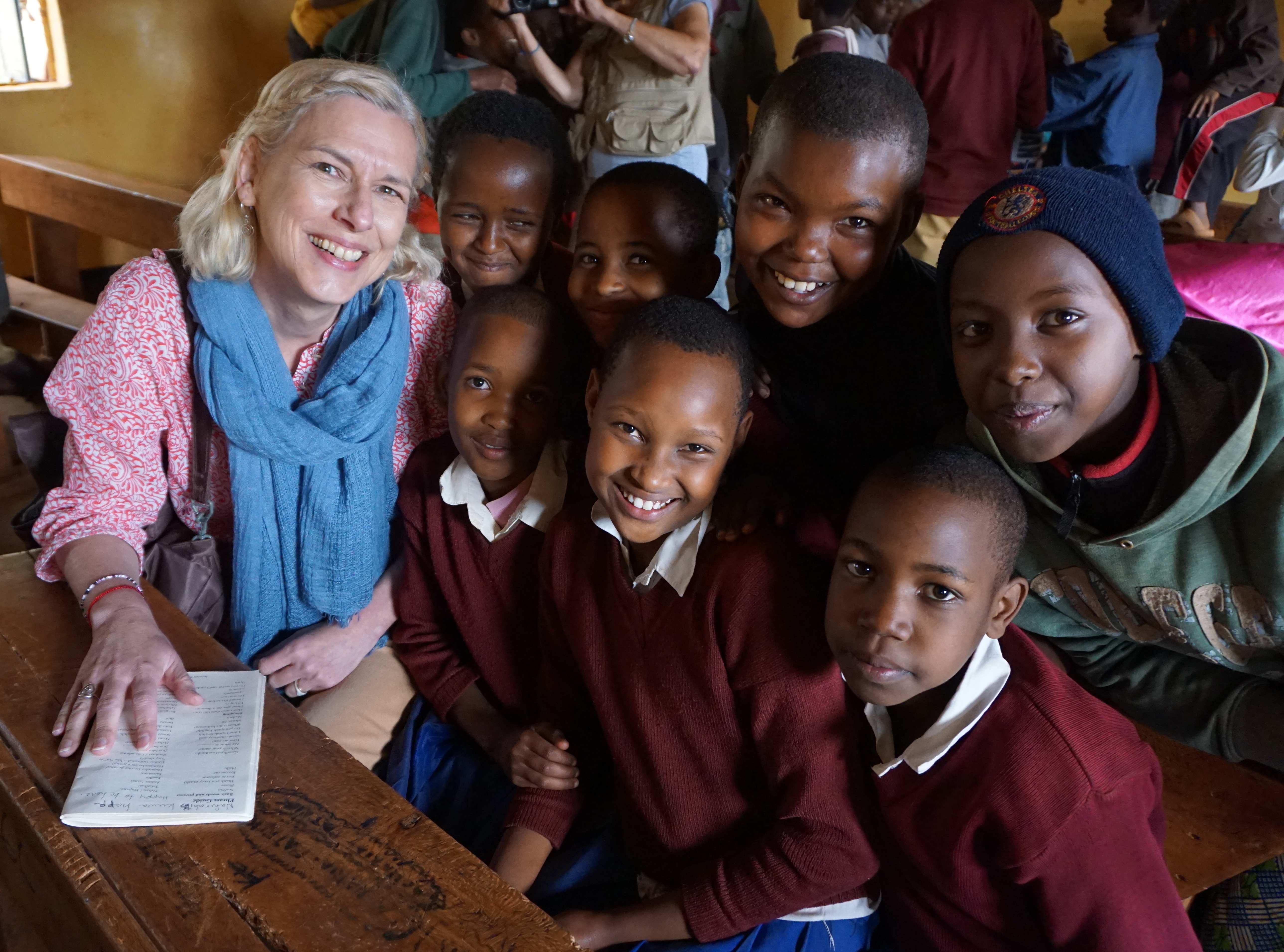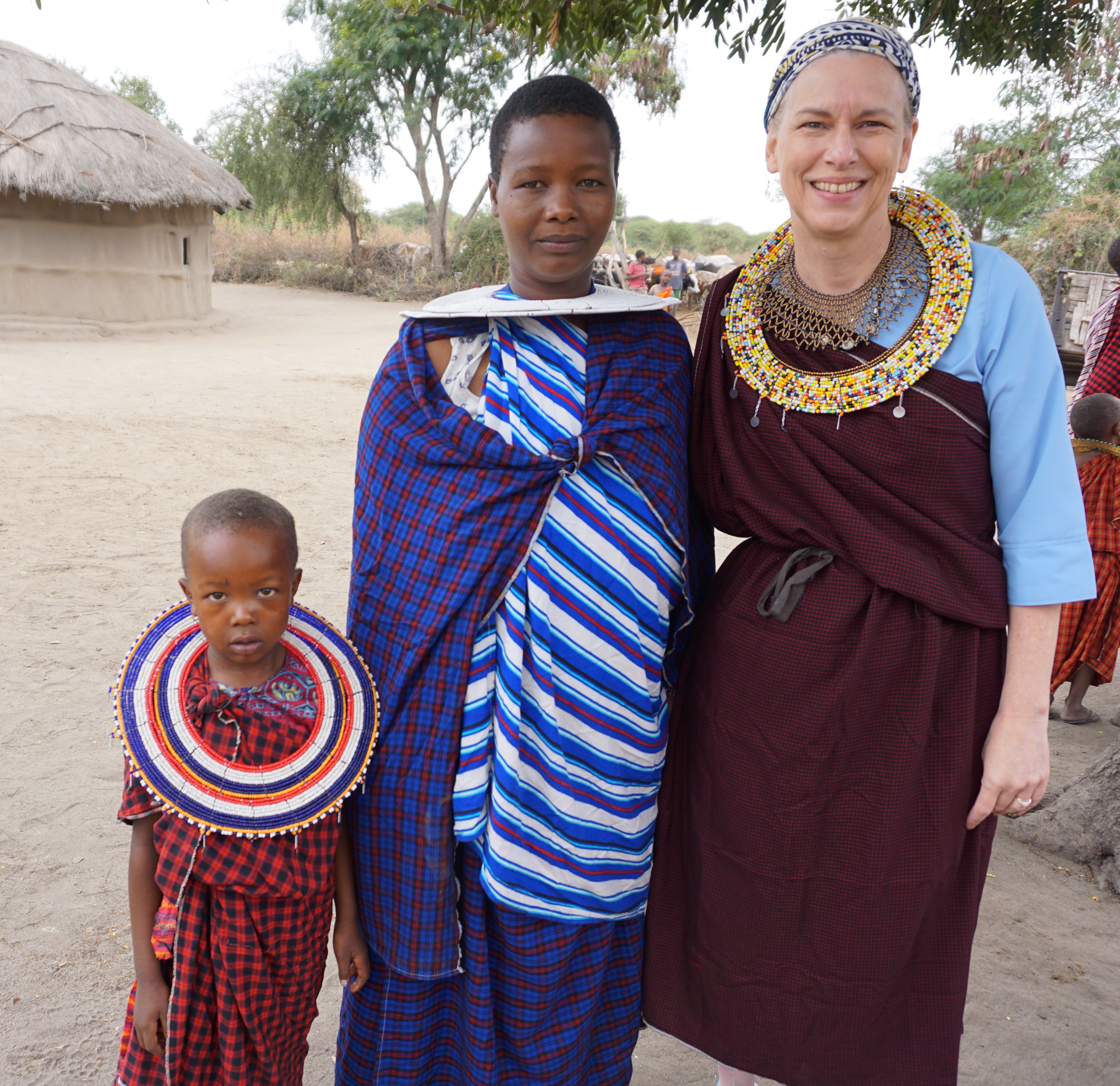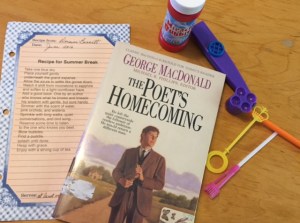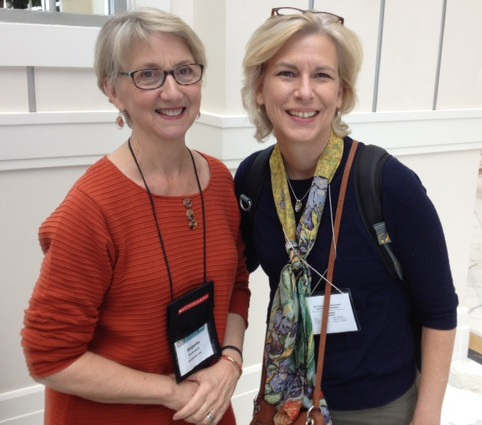
On the left is Augusta Scattergood. We met in person at NCTE ’14.
I met Augusta Scattergood face to face at NCTE in 2014, but I knew of her and her writing back in 2012 when a neighbor and friend of my parents came to a book signing for my book Blessen. He told me about growing up with her in Cleveland, MS. and how she had had a book signing for Glory Be just a few weeks before. I had to get the book and wanted to meet her from that moment on.
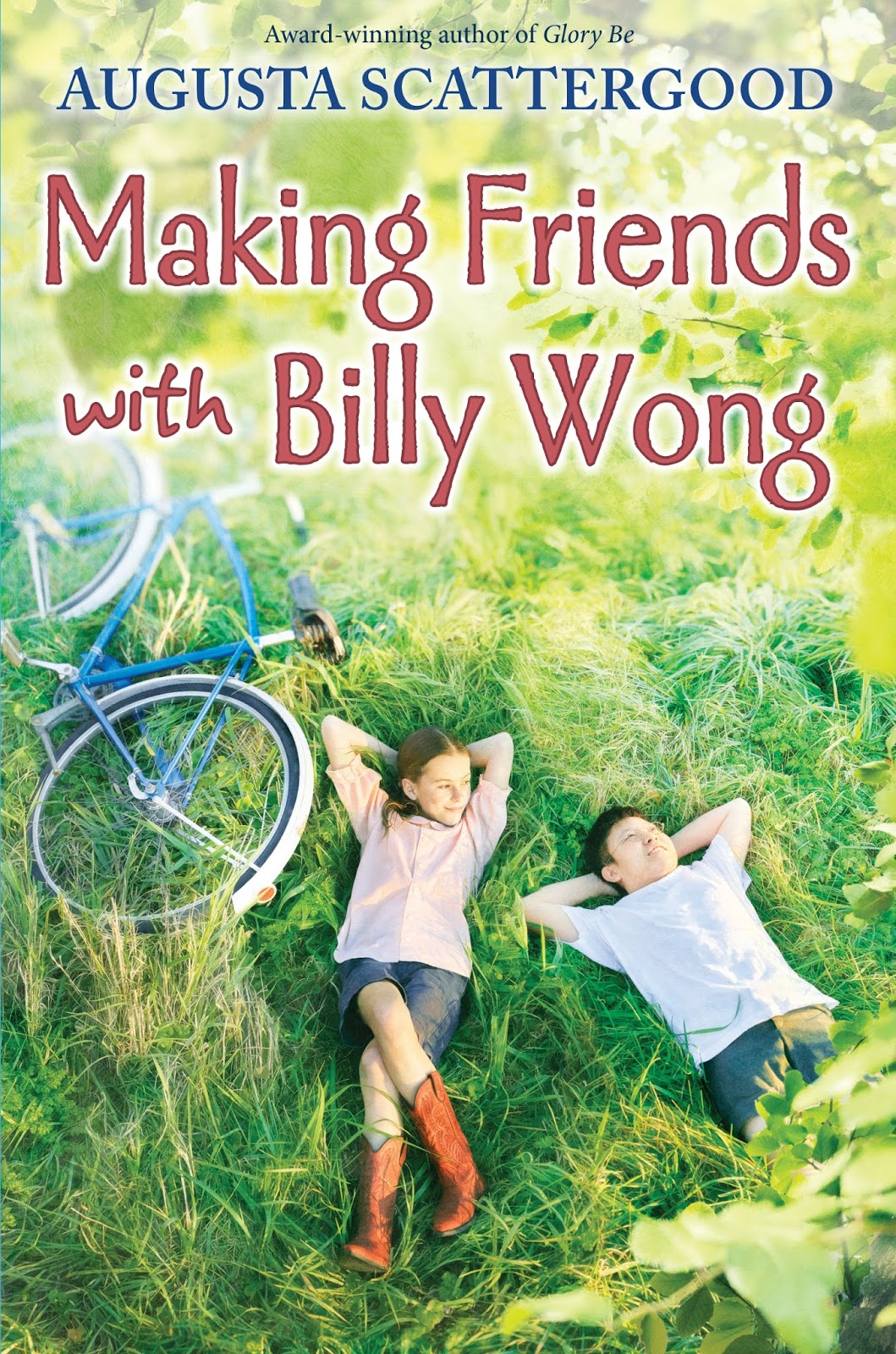
I sent her a message letting her know I would love an ARC of her latest book, Making Friends with Billy Long. Officially, the book will be out in August. You can pre-order a copy here.
My Goodreads and Amazon review:
Making friends sounds like it would be easy, but there is nothing easy for Azalea Morgan. Azalea starts her summer resenting the fact that she must leave her home and friends in Texas to help her grandmother who lives in Paris Junction, Arkansas. When Grandma Clark gathers a group of children to help in her garden, Azalea feels like an outsider. She is cautious of Willis DeLoach, a bully, and doesn’t warm up to Melinda Bowman, a girly girl. Yet Billy Wong is an outsider like her.
As Azalea adjusts to life in Paris Junction, she comes to understand her grandmother and enjoy spending time with Billy. Willis appears grumpy and mean, but Azalea knows his real problem is finding a safe place to live with his younger sister. While Azalea looks forward to going back home to Texas, her life is forever changed by her summer in Paris Junction.
This book will appeal to children ages 8-11 as they, too, navigate complicated relationships and learn how to accept others for who they are.
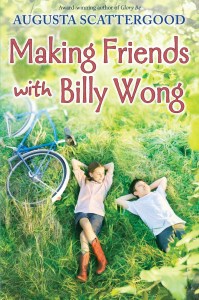
I am always curious about the decisions authors make in writing their books. I interviewed Augusta Scattergood about the writing of Making Friends with Billy Wong.
I am a collector of good opening lines for books, my favorite being E. B. White’s opening line for Charlotte’s Web, “Where’s Papa going with that ax?”
Your first line for Making Friends with Billy Wong is “All it took to send my summer on the road to ruin was a fancy note and a three-cent stamp.” Can you talk about your process of getting to that line and if you had any other contenders?
What a great question! I also love first lines and yes, there were many contenders. What helped me settle on that final first line was the three-cent stamp mention which hinted at the time period, and the worry Azalea felt about meeting her grandmother and spending time with her.
Until I read something from somebody about not starting with a “Hello, my name is” opening, this was one of my early favorites. (I’m terrible about reading writing advice and thinking I must follow it. I need to work on this.) Though I do still like this one of (many) early drafts, it was possibly too abrupt to announce this tidbit before we actually know much about the story or the characters:
My name is Azalea Ann Morgan, and I’ve already heard all the jokes. Yes, I was named for a pink-flowered bush blooming outside the Kings Daughters’ Hospital room when Mama first laid eyes on me.
Making Friends is written mainly from the point of view of Azalea, (great name, BTW); however, we hear from Billy Wong in small sections of verse. What made you decide to include his voice and why verse?
Originally, I tried to write in THREE points-of-view, and a character named Noble was the third. He was much too strong to take a back seat to anybody. He was taking over the story! I’m saving him for another day. My critique group often comments on how I give characters the ax. Or combine their traits with another’s. I do a lot of wandering around before I figure out my stories.
I started writing Billy’s voice as straight narrative. It was awful, a huge info dump. I gave up. Now I was down to Azalea telling the story, but I despaired of losing Billy. There were certain things, events, impressions that only he could tell us. Plus, such a nice kid!
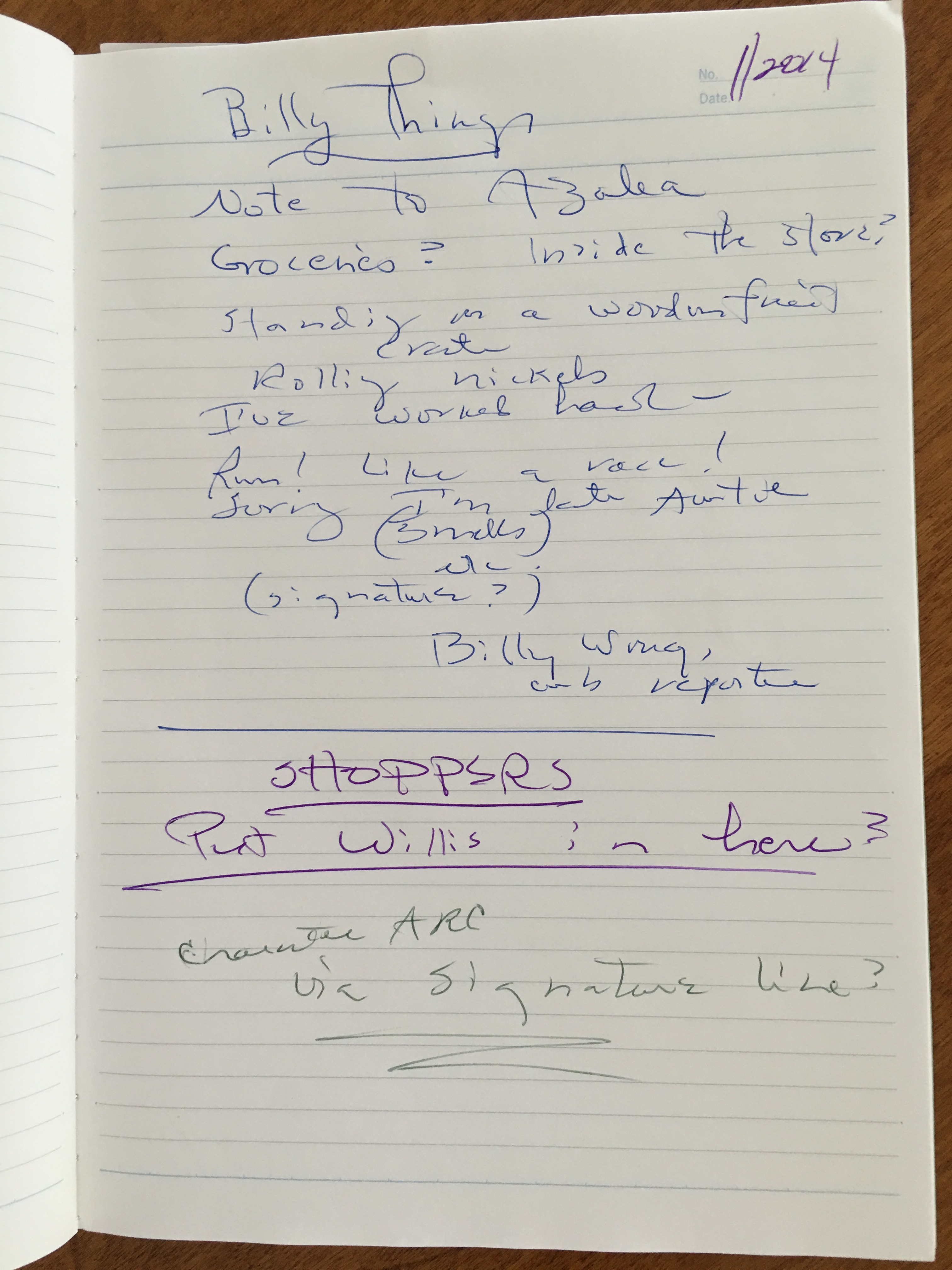
One day, I sat with a notebook doodling Billy Things (I even wrote that at the top of the page). What would Billy Wong be interested in? I doodled lists, newspaper notes, letters, Billy’s dreams, and I filled up a notebook with ideas. A true aha! moment.
I don’t think of them as verse exactly, but they spilled out with a certain poetic quality, and I liked that.
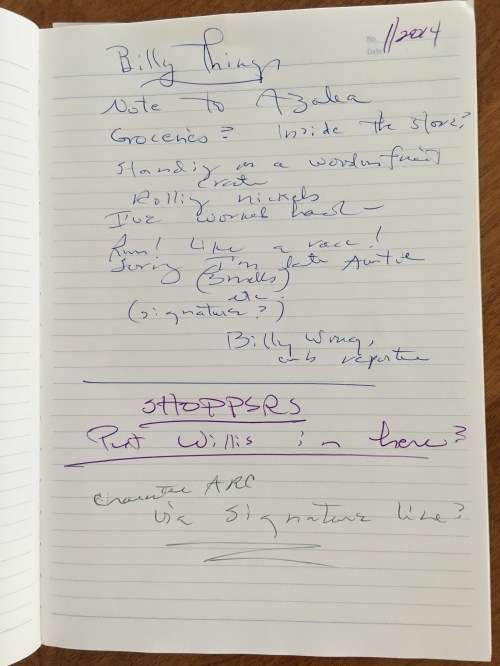
A peek into Augusta’s notebook as she thought about Billy.
You grew up in the segregated South. Billy Wong lives in Arkansas and Azalea is from Texas. Were you intentional about the setting? How does the setting influence the events in the story?
I love reading books where setting is a crucial part of the story. Right now, I’m reading THE HIRED GIRL, which takes place in Baltimore where I lived for a while. And that city is so wonderfully portrayed.
For me, setting is a huge part of my own writing. I don’t think I could set a book in the frozen north (though I did live in New Jersey for over 25 years, come to think of it), if I tried!
My childhood was bike rides, climbing trees to read a book, playing kick-the-can till it got dark. I can still feel the mosquito bites (and smell the DDT truck, sadly). Those are the details I know, and yes, they seem very southern.
But there were other things we didn’t see, or took for granted. There was a white side of my town and a black side. I learned from research that the Chinese often fit into both worlds. Even if I’m not describing some of these details, they slip subtly into my writing.
Perhaps I don’t write the kinds of books that could take place anywhere. But I think I write about family and friendship and feelings that are universal.
Willis DeLoach is an unlikable character, yet you build in some obvious reasons for his meanness. Willis does not change during the course of the novel. I was hoping he would somehow “see the light” and change his ways. Can you tell us about your impression of Willis and his character arc?
In my mind, Willis has small hints of seeing the light! But he’s a product of the times (1950s) and his environment. He worries that somebody’s going to take his place in his small world, replace him in school sports, usurp his tree hideaway. Unlikeable yes, yet he has a soft spot for his little sister. I think his eyes will open this year in school. Remember, before that time most people had never crossed paths with anybody who was different from them. Cross cultural and interracial friendships were not encouraged, and actually, there was little opportunity for someone like Willis DeLoach to truly know a boy like Billy Wong until the schools allowed Chinese American students to attend. I had to make his story true to the times.
Also, my book only spans a few weeks at the end of a summer. I decided it would be unrealistic to have Willis do a complete about-face and change his ways in that brief moment.
In the author’s note, you write about the research you did for historical context. Were there any surprises for you as you did this research?
As I mention in my note, I started writing after reading a very poignant essay written by a friend, Bobby Joe Moon, who also grew up in Cleveland, Mississippi. Children and even teenagers in the early 1960s in small southern towns could be oblivious to what was happening all around them. Bobby’s essay about the difficulties of growing up Chinese in the Deep South surprised me and made me think about sharing this story with young readers.
Many readers of my author’s note may be surprised to learn how many Chinese immigrants came to the south to open grocery stores. I’d shopped almost every day with my grandmother or my mother at those same stores and I knew they were there. But I was fascinated to discover why this happened. My research and my unrelenting questions posed to Chinese American friends uncovered so many fascinating details. I could not have told this story without asking a lot of questions.
All three of my novels have been historical fiction, requiring reading and digging deep, which I love. Uncovering surprises is really the best part of research, isn’t it?