Thank you to Two Writing Teachers for creating an amazing community of writers and a safe, welcoming space to write and share.
The “I am From” poem form has been a tried and true form to model with students. A few weeks ago, I pulled it out again in hopes to get my students to write for a hometown poetry contest. It didn’t really work out. But while I wrote with them, I ended up with a version that I liked.
I had to explain “pot liquor” to my students because the alarm bells went off when they heard the word liquor. Isn’t it funny how you can know something so well that you don’t even notice? Pot liquor is the distinctly southern delicacy of the broth from boiling greens. (AI says it is also “potlikker”.) My mother would mix it with corn bread and black-eyed peas and eat it with a spoon from a coffee mug. I never developed much of a taste for pot liquor, but what I wouldn’t give to smell it again.
I am From “The most important aspect of love is not in giving or the receiving: it’s in the being” Ram Dass
I am from a gold pearl ring on my right hand. I am from a grandmother with my name– (Margaret, meaning pearl)
I am from Dot, too, from her laughter at things funny, not funny, from her nimble fingers playing classical piano. From lazy afternoons with a Ding-Dong and a Coke.
I’m from photos by the azalea bushes full pink blossoms rising behind our blonde heads. From pot liquor with black-eyed peas and pecan pie fresh from the oven on Thanksgivings in Morton.
I open my mother’s jewelry box, a calm of pearls and golden beads slip on easily. Margaret Simon, 2025
Thank you to Two Writing Teachers for creating an amazing community of writers and a safe, welcoming space to write and share.
The time change is hitting me like a brick on these early mornings. I don’t wake up naturally to the new rhythm. Blindly I let out the dog, feed the cats, start the coffee, turn on the dryer (Its beating of my clothes like a metronome for morning music.).
In my afternoon gifted class for about half an hour, two sisters overlap, a 2nd grader and a 6th grader. They are early morning care kids, so they are coming to school in the dark. Rather than complain, Danielle talked about the moon.
“We saw the moon, and it was orange!” she exclaimed. “It’s called the blood worm moon.”
“Yeah,” chimed in sister Adelyn. “Thursday night there will be a lunar eclipse.” Here’s a link to Adelyn’s poem about their morning viewing.
Both girls wrote a Slice of Life post on our Fanschool site about it. I don’t think I’ll set an alarm for 2:30 AM, but maybe when my alarm goes off at 5:15, I’ll pop out of bed and go see what I can of the eclipse.
Thank you to Two Writing Teachers for creating an amazing community of writers and a safe, welcoming space to write and share.
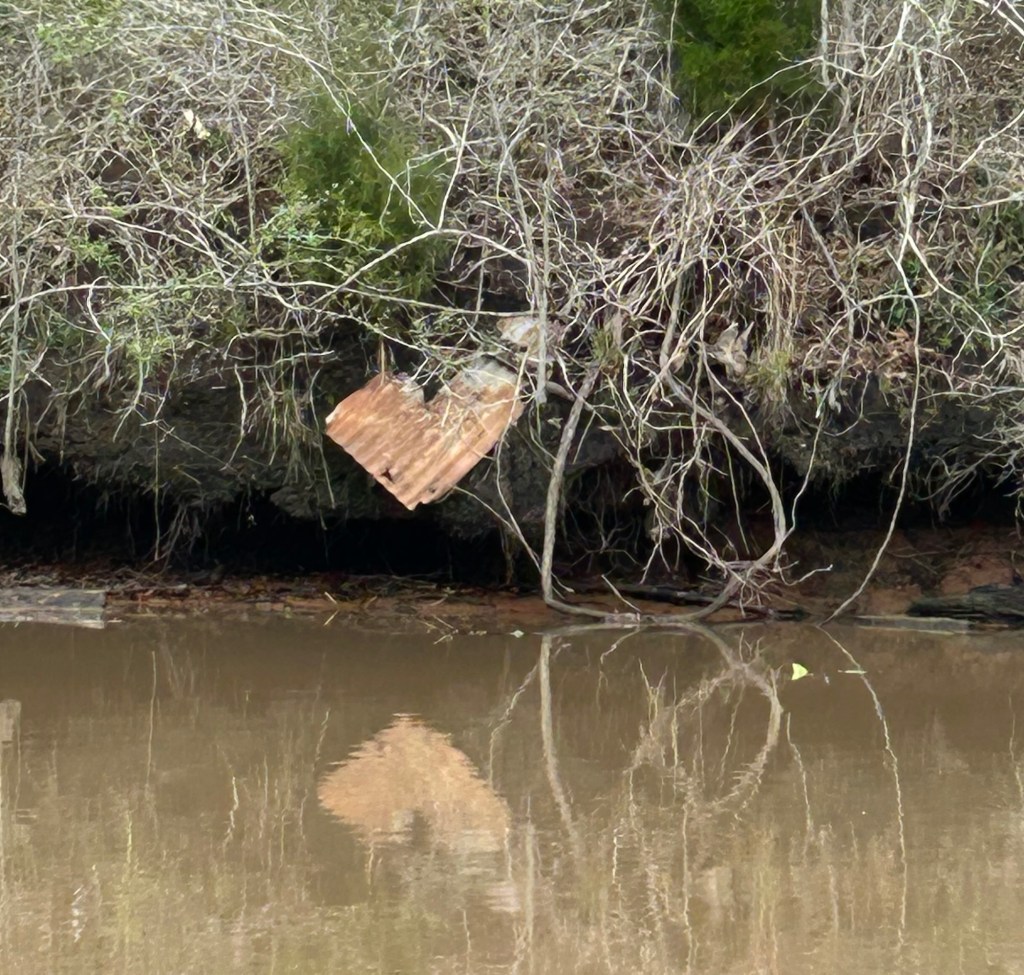
Scrap metal on the bank of Bayou Teche
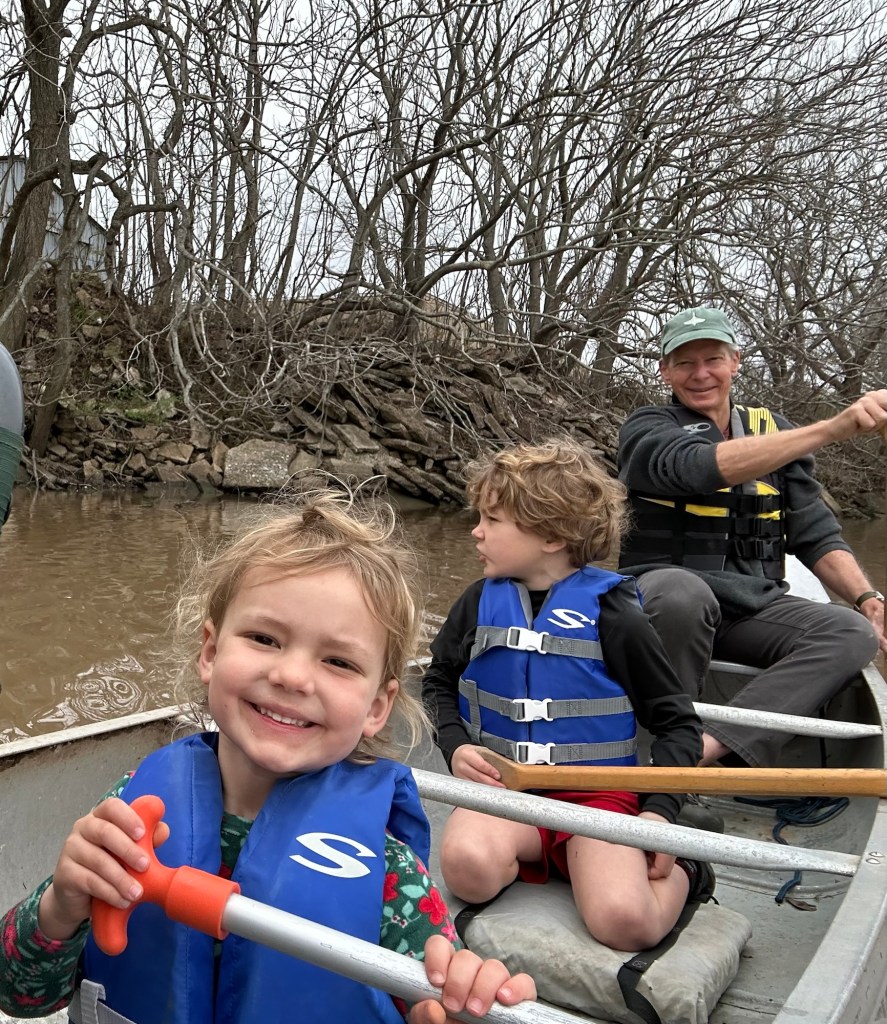
Is it trash or is it art? When my grandkids, my husband, and I were canoeing on Sunday, we passed this piece of metal.
“Look at that! It looks like a heart.”
“I want a photo of it.” Jeff knows what that means. He has often rerouted our canoe trips because of my directions to get a picture. I was extra pleased when, by the time we made it back to the “art”, there was a beautiful reflection of it in the bayou water.
I hope this photo inspires you to stop and see. Maybe write a small poem. If you write a poem, share it in the comments and encourage other writers with responses. Today, I wrote a 15 word poem.
If you find still water, place a piece of your heart near; reflect imperfect love. Margaret Simon, draft
If you would like to participate in the Kidlit Progressive Poem for National Poetry Month, sign up in the comments on this post.
Thank you to Two Writing Teachers for creating an amazing community of writers and a safe, welcoming space to write and share.
When I was having children, I never really considered the future and what it might mean for me to be a grandmother. I had three girls. Three daughters who grew into three amazing women. And now I am Mamére to four grands and another one on the way. My youngest daughter is pregnant with her 2nd child. She has a 2 year old, June, and this one is a boy due in July. We’ve had fun calling him “July.”
Pregnancy is not an easy time. There are so many changes happening in a woman’s body. After an earlier miscarriage, Martha was full of fear. I was confident, but I understood her fears. She invited me to the 20 week anatomy scan ultrasound. I sat in awe at the image on the screen…a perfect baby.
Here is my love letter to this new baby boy:
July
I already love all four chambers of your heart, steadily beating showing off for the camera. And those little toe nubs that I can’t wait to tickle. We could see the perfect stairs of your spine curled, floating up in the certain space of womb. I fell head over heals for your tiny nose, the deep eye sockets, the thing that tells us you are boy.
I can wait as you grow and grow, coming to us on a hot mid-July morning wailing for more time inside. It’s OK, my grandboy, I love you already. Margaret Simon, draft
On Sunday I read Maria Popover’s The Marginalian. She wrote about matrescence: “While mothering can take many forms and can be done by many different kinds of people, the process of one organism generating another from the raw materials of its own being — a process known as matrescence — is as invariable as breathing, as inevitable to life as death.”
In Matrescence: On Pregnancy, Childbirth, and Motherhood, Lucy Jones writes of her own experience giving birth to a girl. “Time started to bend. I was carrying the future inside me. I would learn that I was also carrying the eggs, already within my baby’s womb, that could go on to partly form my potential grandchildren. My future grandchildren were in some way inside me, just as part of me spent time in the womb of my grandmother.”
I am grateful to be a grandmother, the seed from which my grandchildren sprouted. Honored by my daughters to be beside them as they do their best to be strong women who mother with wisdom and care.
Thank you to Two Writing Teachers for creating an amazing community of writers and a safe, welcoming space to write and share.
I’ve crocheted for years, so this year I decided to try to make a garment. I’ve made baby blankets, shawls, and hats, but when I saw a pattern for a baby sweater using two hexagons, I thought this will be easy enough.
We were taking a driving trip with our family to Oklahoma right after Christmas, and I wanted a project to do on the drive and while relaxing at the house. I picked out three colors from my inherited boxes of yarn from my friend Marion who died in 2020. My daughter Maggie, the mother of Stella, said of the three colors, “Stella will wear that.”
I crocheted and crocheted until I realized that it was way too big. The first hexagon would almost fit me! I had not accounted for the gauge of the yarn. I was just following the pattern.
Rather than lose the project all together, I decided to rip out the extra rows to make it fit. Then I spent a while making the other side.
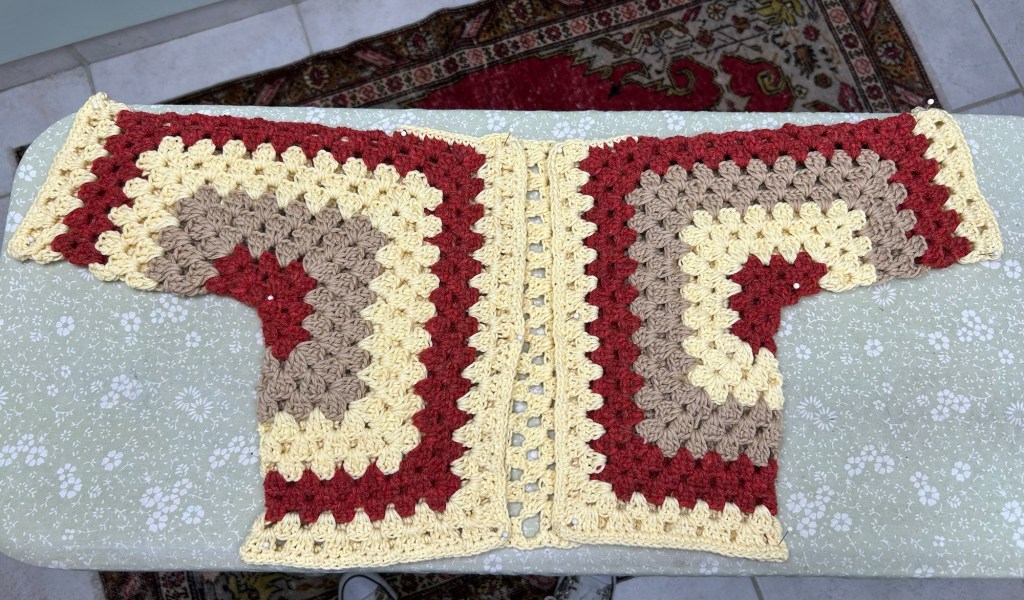
Finally it was ready to block.
Two hexagon crocheted sweater blocked on the ironing board ready for steaming.
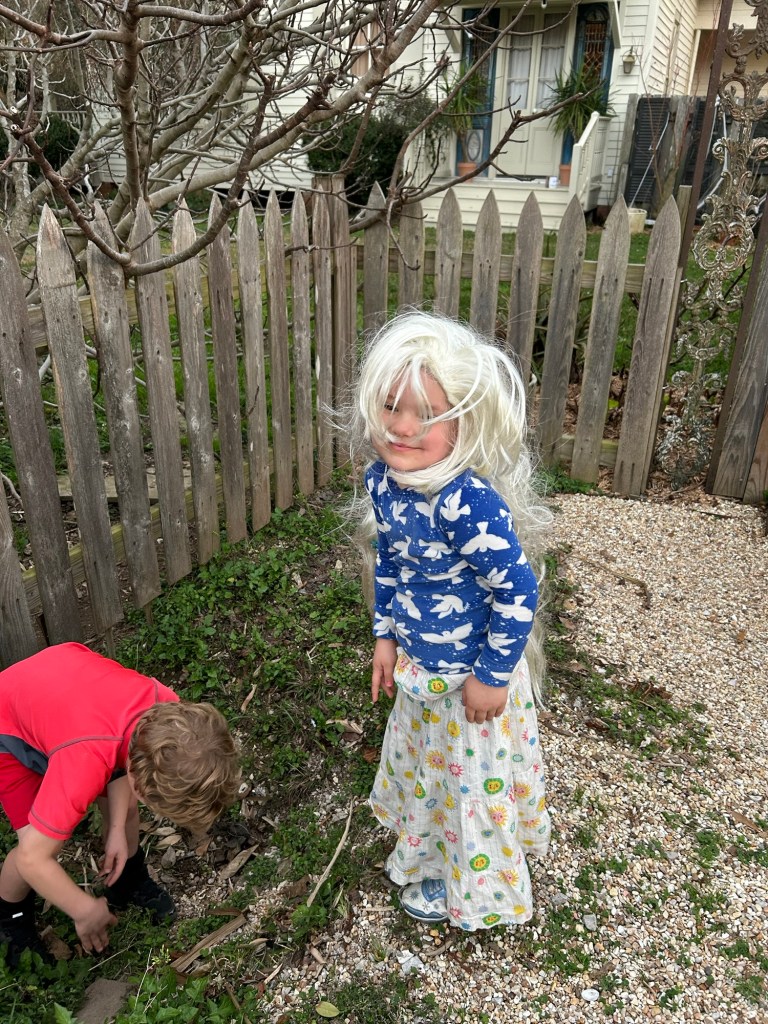
I brought it to Stella one afternoon when we were visiting. Stella has her own unique sense of fashion. Her preference is to wear leggings in one pattern and a top in another pattern. Sometimes she wears a dress as a skirt or a costume. Her favorites are skeleton, ninja mask, and Elsa nightgown.
Stella ready to go the art show (pj top, dress as skirt, and Elsa wig)
When Stella first saw the sweater, she said, “Nobody anywhere ever has worn a short sleeved sweater.”
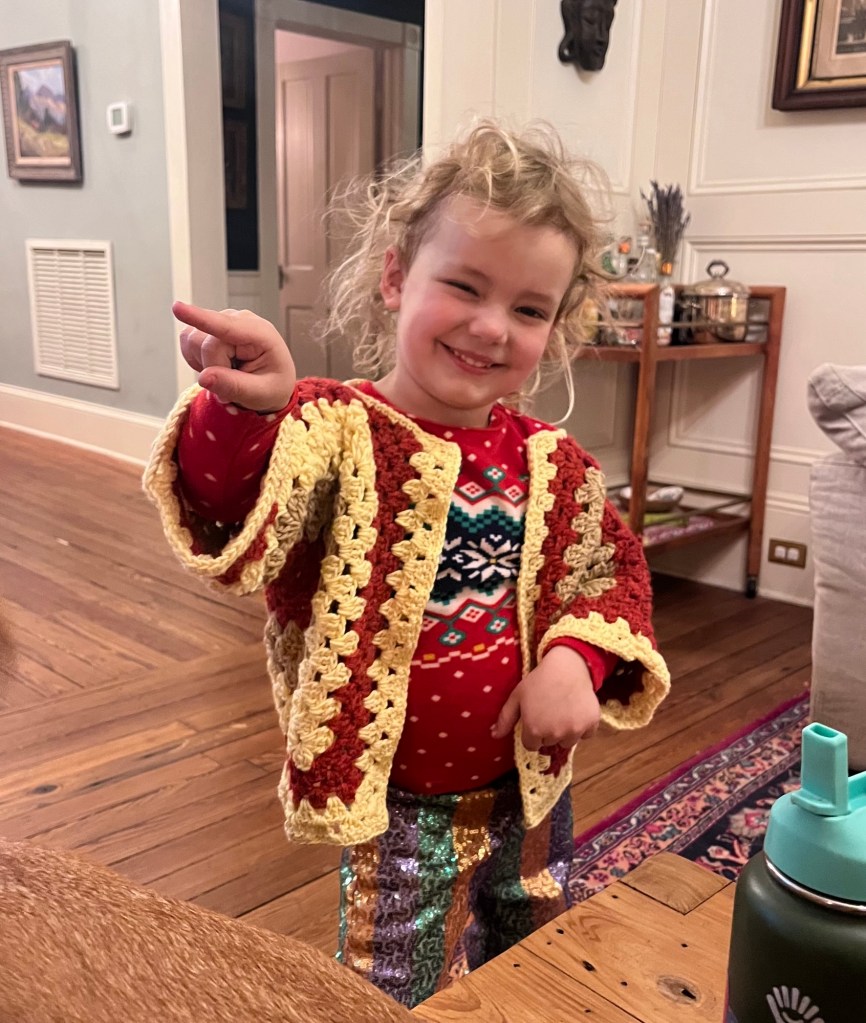
My daughter Maggie explained to her that I had made it specially for her. She eventually came around and posed for a picture in her new sweater. Her dad sent me this picture.
Stella fashion: Hexagon sweater over Christmas pj top and Mardi Gras pants
Currently I am looking at a pattern for a summer sundress. Do I dare?
Thank you to Two Writing Teachers for creating an amazing community of writers and a safe, welcoming space to write and share.
First off, before you start reading, you need a lesson in pronunciation. When we adopted a golden doodle puppy in June, I posted on Facebook that we were looking for a name for him. My friend Mary suggested Albert because she thought Jeff would like “You can call me Al.” I thought it was funny, too. Since the puppy was all black with poofy poodle fur, we decided to accent the -bert part like French, so he is not Albert, but Al-Bear!
During he car ride home from the breeder, our new puppy was calm and sweet. He was shy and couldn’t get far enough under my arms. He never cried, but he was what we thought was going to be a calm, shy dog. At his first check-up, the vet warned that he might need some extra socialization to help him come out of his shell. That proved to be an unnecessary warning. Albert is friendly to everyone!
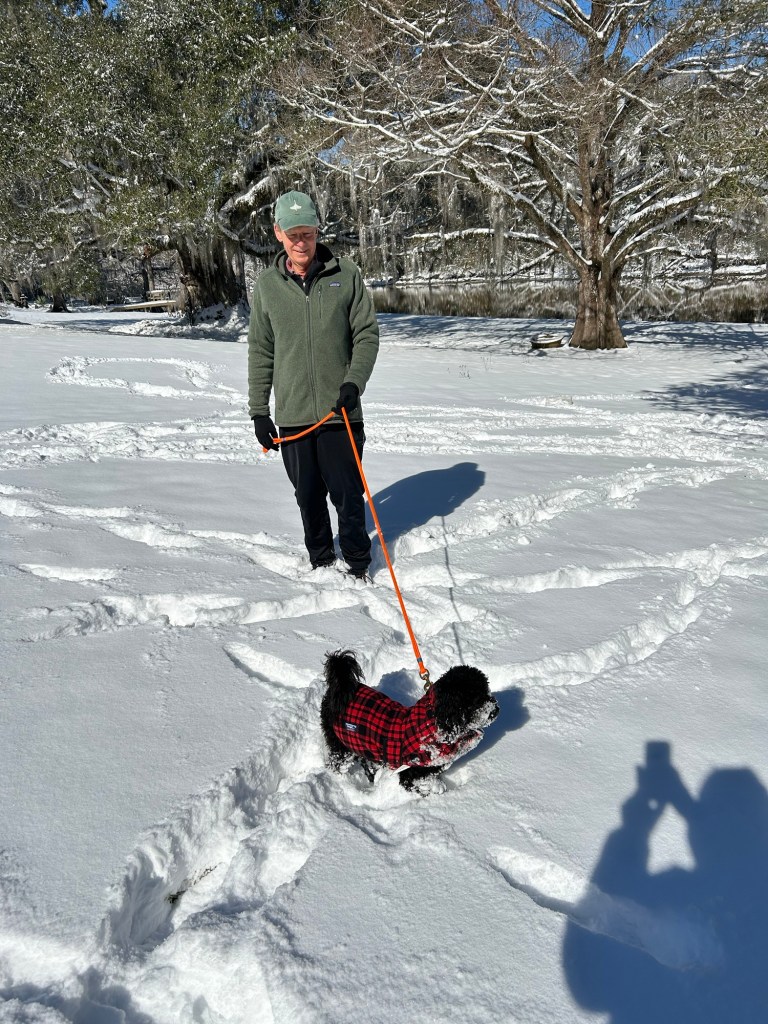
Albert was unsure of the rare snow we had in January.
We have outside cats, one of which is 16 years old (Buzz). Buzz was wary at first, but now he lets Albert attack him. We know Buzz could get away if he wanted to, but he seems to like it. He waits for Albert out on the deck by the side door to the “dog yard.”
I had conveniently forgotten about the puppy stage. I forgot about the training part. Albert turned a year on Feb. 22nd and is now fully house trained but after multiple starts and stops.
The best parts of having a golden doodle puppy are:
Albert loves everybody. And everybody thinks he’s adorable, so he introduces me to neighbors I wouldn’t normally stop to talk to. On walks, he will stop in front of Claire’s house. Claire is an older yellow lab who tolerates Albert’s antics like an older sister would.
Albert loves children. Good thing because we have 4 grandchildren. The problem here is he jumps on them and they are about his size, so they get aggravated. Sometimes he has to take a break in the laundry room.
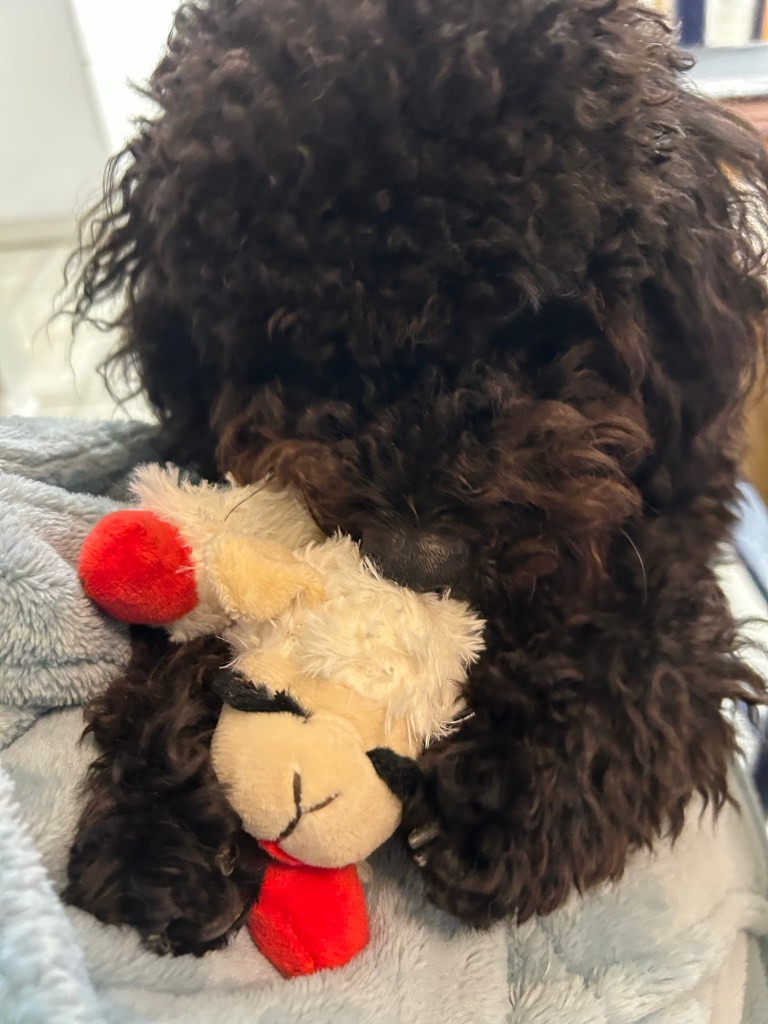
Albert loves his toys. He can entertain himself with his many toys, a ball which he is learning to fetch, a lamby, a Sasquatch ball we got in Oklahoma, and many more. The kitchen floor is littered with them, but since we put down a flannel sheet, he is very good about piling his toys all on his blanket. One of the funniest games he plays is hiding the toy and finding it. I love this because it’s independent play. It’s always nice when toddlers learn to play independently.
Walks are the best. Albert is leash trained, and he will prance next to me with royal airs. He loves to pick up trash on the road, so he helps reduce litter. Of course sometimes it’s yucky stuff I have to remove from his mouth, but often it’s a stick or pine cone or pile of moss. Trotting with his prizes, he looks like a prancing show horse.
Albert is small, miniature. He fits nicely on my lap on a chilly morning. And as long as he is not licking my face, or snapping at my writing fingers, he is welcome to curl up in my lap.
We think we’ll keep him. Every day we discuss his progress and decide we’ll give him more chances. Every day gets better. One day he will be an old dog, and I will completely forget the puppy stage.
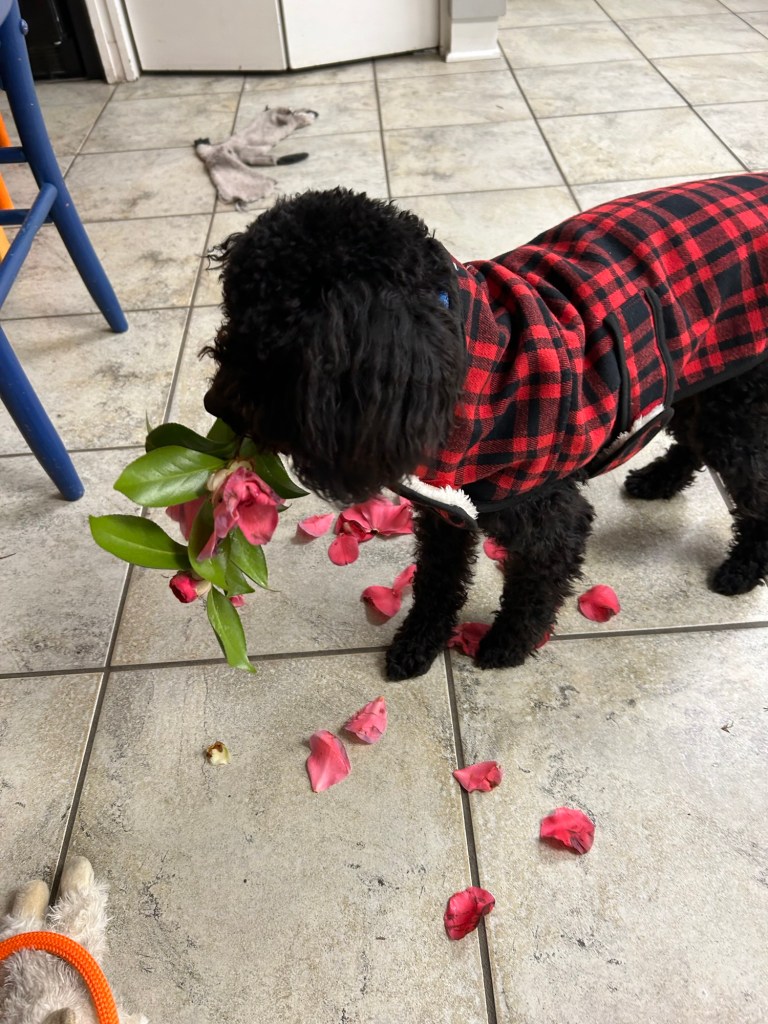
Albert with a camellia branch he picked up outside. He wanted to bring flowers to Papére.
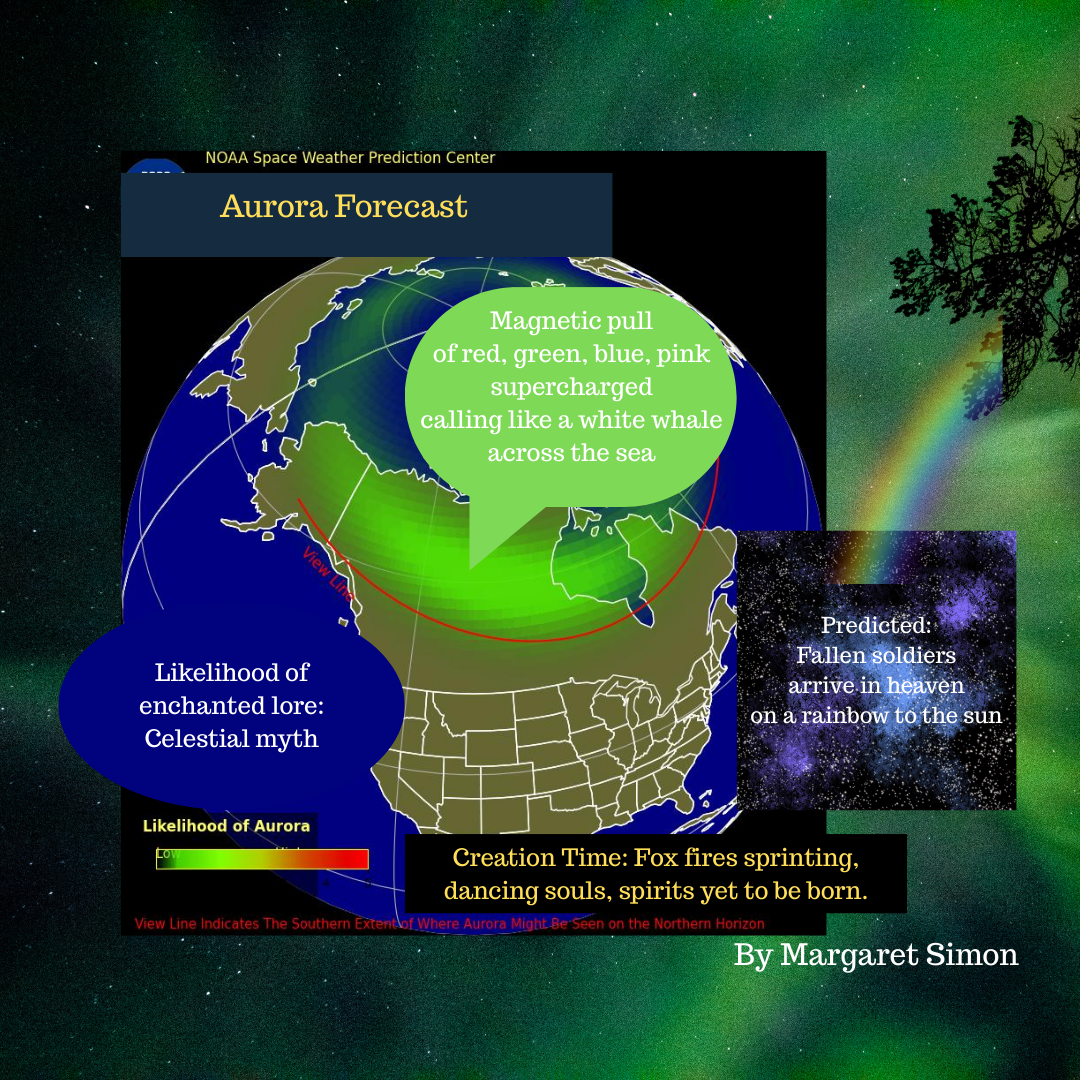
I put this one off, I admit. I knew I had a week of break to prepare, but still I created this last minute. I went back to the poems I wrote for Laura Shovan’s February project using the theme of Space. I had a different poem in mind when I found one I had written about the Aurora Borealis. I had just talked with a friend whose daughter had seen the Northern Lights on a trip to Norway. He shared fabulous photos from his phone. Definitely a bucket list item for me.
I realized I could transform my poem into a weather forecast. The creation part took some time using Canva and playing with placement of lines. I tried to adapt some of the words actually used in a forecast. Forget time; I was in Flow. The image is a bit busy for my taste, but I had to get this post done for the early Poetry Friday posters.
If you are interested in participating in the Kidlit Progressive Poem, click the link and leave a comment or email me your name, date chosen, blog name, and URL. Thanks!
Please sign up to add a line to the Kidlit Progressive Poem coming April, 2025. On your chosen day, you will copy and paste the previous lines of the poem to a blog post and add your own line. When you sign up, create a hyperlink to your home page. For example, Margaret at Reflections on the Teche. Thanks!
Denise Krebs is hosting first Thursday Spiritual Journey posts at Dare to Care
Each month a group of bloggers, who met through the Two Writing Teachers Slice of Life Challenge, gather to write posts about our spiritual journeys. This month Denise asked us to write on the topic of wholeness.
I think I may find wholeness by looking outward to someone else to make me complete, to their words of affirmation.
Wholeness is a river where my path moves in and out. I find balance one day, then a wind knocks me over the next.
I can watch the seedling grow, but cannot see the growth in myself.
Whole means all of me– Here now, in the present moment where I am welcomed, accepted, and loved.
Broken, cracked, grieving, or angry. All of me Whole.
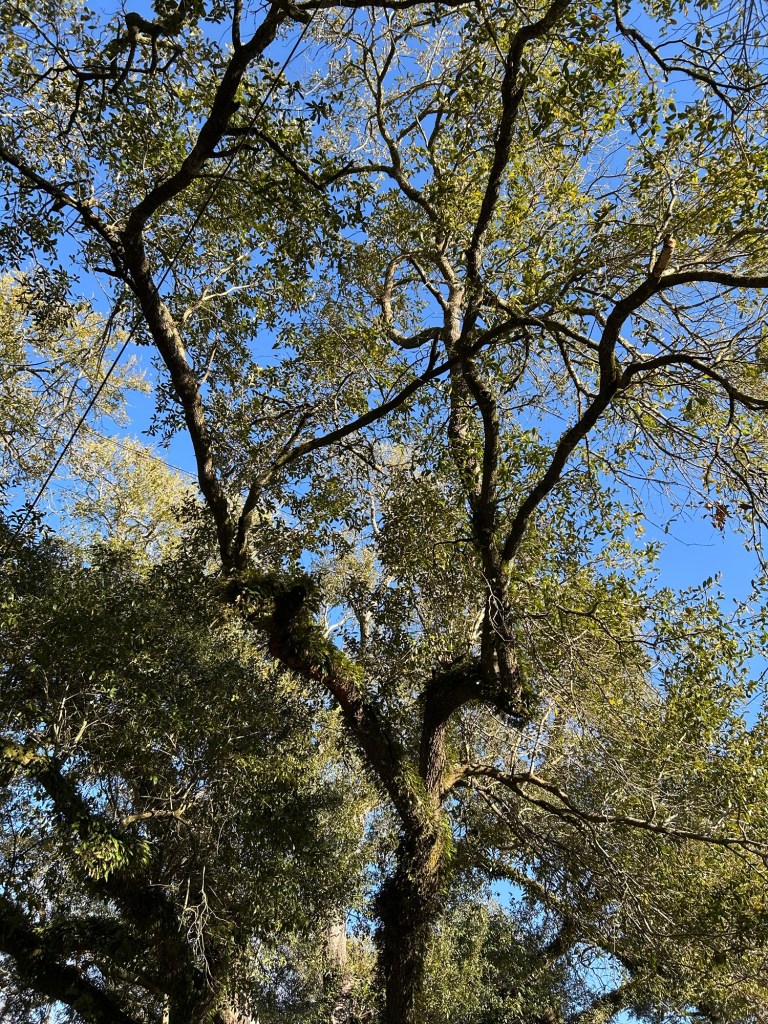
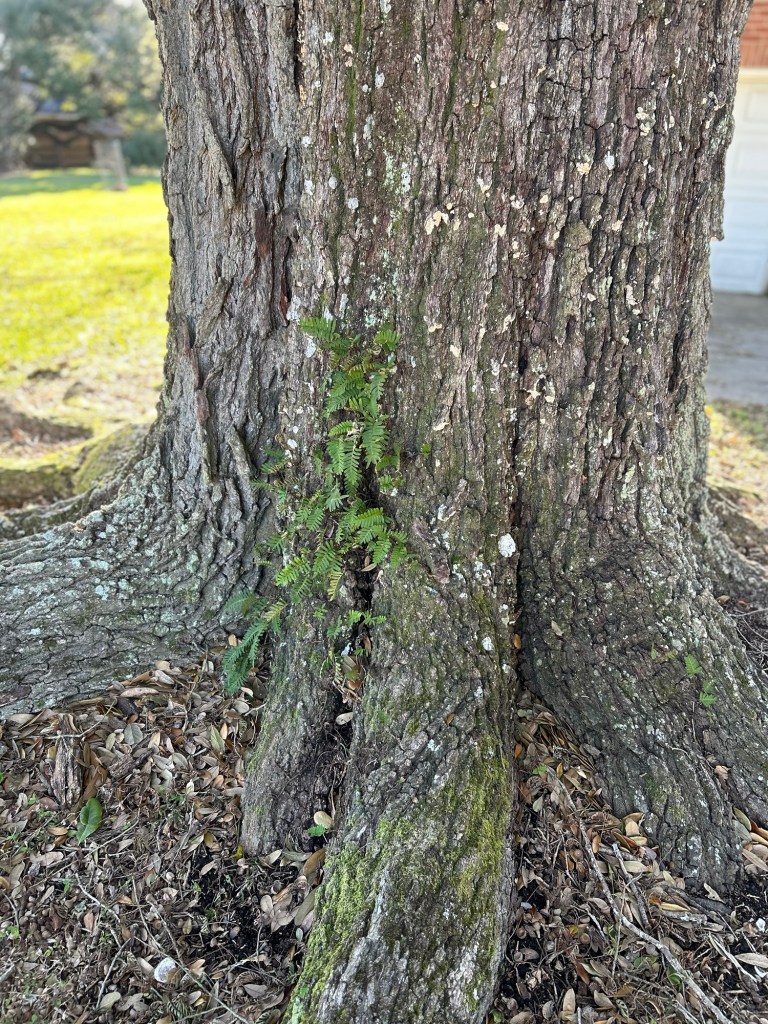
Resurrection fern on an old oak tree revived by rain.
Thank you to Two Writing Teachers for creating an amazing community of writers and a safe, welcoming space to write and share.
Margaret Simon lives on the Bayou Teche in New Iberia, Louisiana. She is a retired elementary gifted teacher who writes poetry and children's books. Welcome to a space of peace, poetry, and personal reflection. Walk in kindness.








 Reflections on the Teche