Feeds:
Posts
Comments

Summer Sunflower

summer sunflower

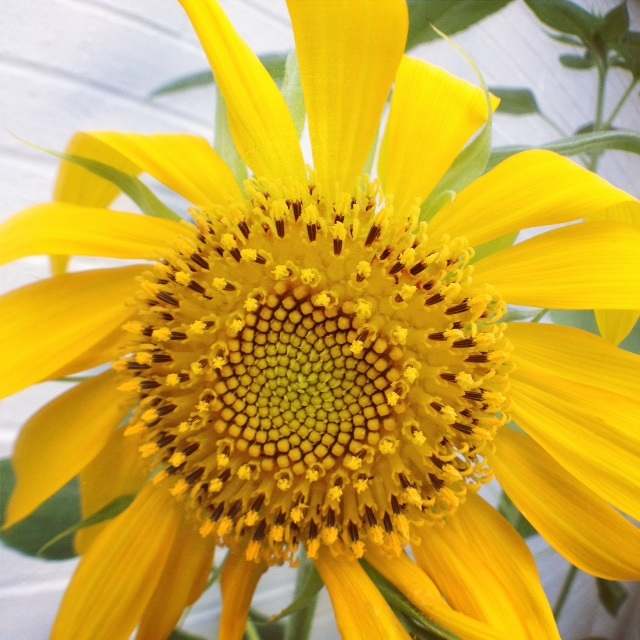
I bought a macro lenses for my iPhone. My sunflowers bloomed. So I took a close-up picture of this amazing gift of nature.

Using a poetry prompt from Poets and Writers, The Time is Now. “Choose an inch of space anywhere around you…Write about that inch. Take a step back. Focus the scope of your poetry. Writing about a single drop of rain can tell us the most about the sky above,” I set out to write a poem about this shining inch in my flower bed.

I also did some research on Wikipedia and found out that the design of the inflorescence (flower head) is a swirl. The swirl design can be mathematically described using the Fibonacci series. With my students last year, I wrote Fib poems using the syllable count of 1,1,2,3,5,8 then turned it around 8,5,3,2,1,1. So what is more appropriate than writing a Fib about the sunflower?

I’ve posted both versions of my poem here. The first is free verse while the second is a Fibonacci poem.

Summer Sunflower

Alive
in yellow exuberance,
inflorescent
spirals off a golden angle—
a mathematician’s playground
in patterned perfection.
I study your face
with squinty eyes,
let time elapse
loving our mother’s glory.
–Margaret Simon

(Fibonacci poem)
I
am
alive
in yellow
enthusiastic
spirals off a golden angle
patterned perfection
study of
mother’s
love.
— Margaret Simon

Poetry Friday is hosted today by Jone at Check it Out.

Poetry Friday is hosted today by Jone at Check it Out.

The Habit of Play

sans souci fountain

Join the Tuesday Slice of Life

Join the Tuesday Slice of Life

Children have an exquisite capacity to play, to imagine, to create stories, to connect with nature, art, and ritual. When children move into an imaginative space in their minds and spirits, a world of possibility and promise opens up for everyone. –Ed Bacon

This summer I have been responding to Ed Bacon’s book 8 Habits of Love. The 5th chapter is what I’ve been waiting for, the Habit of Play. What a boring world this would be without play!

This week I coordinated an art camp for kids. Each day we made something new. Rainsticks, cardboard self-portraits, and wood sculptures. We read The Dot by Peter Reynolds and made our unique dots. This was the 6th year for our art camp, and I finally had the brilliant idea to make a “Free Time Activity Box.” One little girl built a park scene using pink paper, pink tape, some wood scraps, sequins, etc. We put a sign next to it, “Do not touch.” It stayed up all week. Finally we transferred the scene to a scrap piece of foam board. I was fascinated to watch her play.

A sense of Play is essential to happiness and a feeling of safety in this world. Ed Bacon speaks of the difference between childlikeness and childishness. “Childlikeness makes room for everyone to play.”

Recently a friend of mine, a colleague and young mother, died in her sleep at 41 leaving three young children. As you can imagine, there were feelings of sadness,confusion,and helplessness. Following the service, I watched as my priest lifted up her 3-year-old son. He smiled and bounced the boy up and down. “I love you. We sure had fun today, didn’t we?” A sense of play in the midst of so much sorrow helped me see the hope that lives in love.

Love always wins. When we allow love to be in our nature, Play helps us relax and see the beauty in God’s gift of childlikeness to us all.

Instructions for Play

Leap in the green grass meadow.
Blow bubbles into the wind.
Twirl a girl in a swirling dress.
Open up the blossom of a flower.
Wave to everyone you see.
Smile, it’s always contagious.
Run through the sprinkler.
Climb a tree.
Make a bird out of an egg carton.
Create a space ship from a paper towel tube.
Laugh, giggle, belly guffaw.
Spend time with someone you love.
Praise the creator of Play.
–Margaret Simon, all rights reserved

When we invite Play in to all areas of our lives, we turn away from our fearful natures and invite the loving self to reengage with the world and with the parts of our brains that imagine and create. –Ed Bacon

2013 poetry swap with stamp included

Last week Tabatha sent me the name of my 3rd Poem Swap for this summer. I was so excited to see Linda Baie‘s name. Linda is a presence in the kidlitosphere. She won the prize (a copy of my book Blessen) for the biggest commenter on my blog during the March Slice of Life Challenge with the Two Writing Teachers. I have embraced Linda as a cyber-friend with hopes to one day meet her in person. She is so kind and supportive, I wanted to do something special for her.

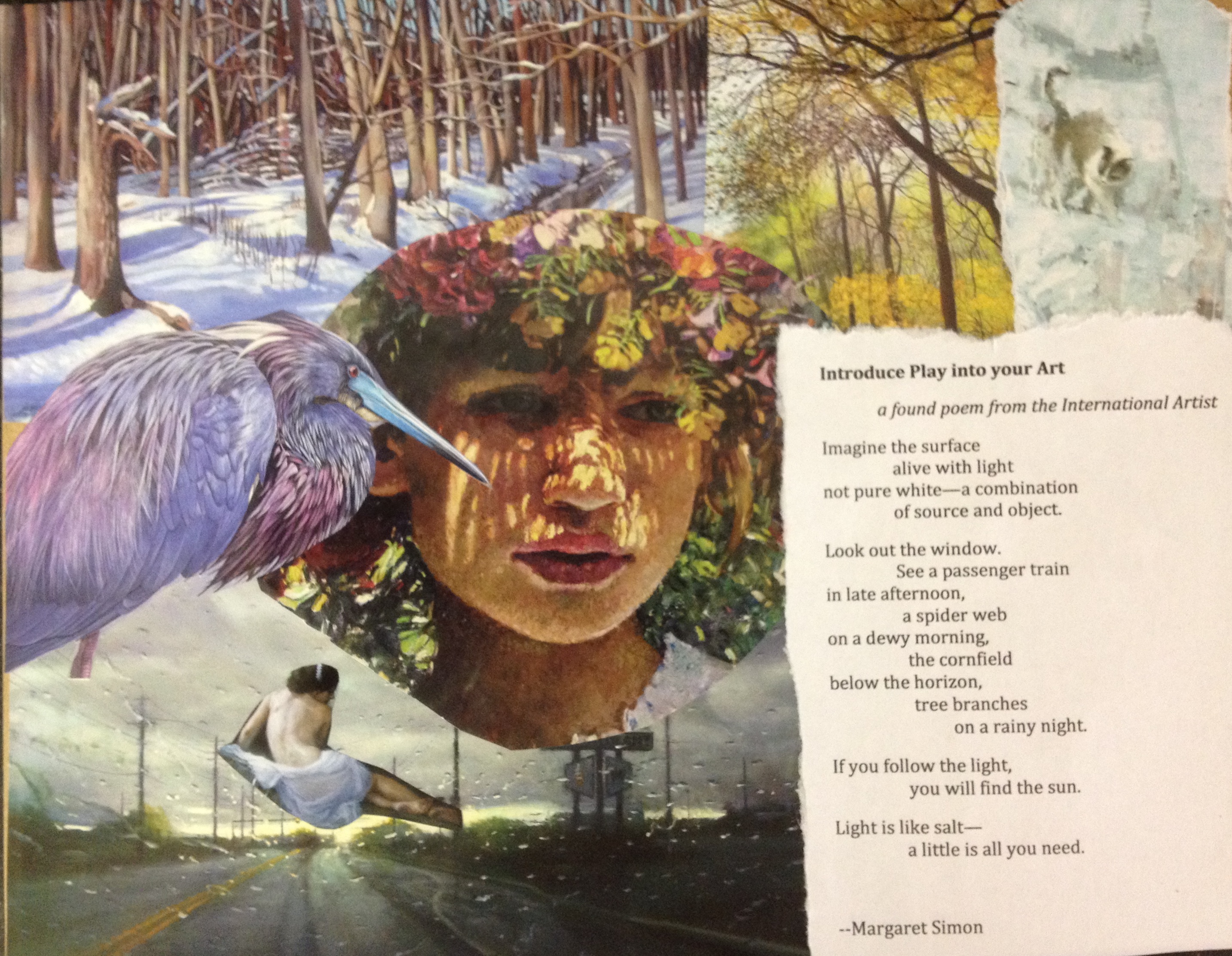
My father had given me back issues of art magazines to use in my classroom, so I pulled one out for inspiration. I found a poem in the words of the magazine. Then I decided to make a collage of pictures. That didn’t work out so well. While my result was something and may have been creative, it didn’t please me. It wasn’t good enough for Linda, so I made another one. This one pleased me. The found poem came from The International Artist. The images came from American Artist.

play in art collage and poem

Introduce Play into your Art
a found poem from the International Artist
Imagine the surface
alive with light
not pure white—a combination
of source and object.

Look out the window.
See a passenger train
in late afternoon,
a spider web
on a dewy morning,
the cornfield
below the horizon,
tree branches
on a rainy night.

If you follow the light,
you will find the sun.
Light is like salt—
a little is all you need.

–Margaret Simon

Poetry Friday is hosted today by Michelle at Today's Little Ditty.

Poetry Friday is hosted today by Michelle at Today’s Little Ditty.

Join the Tuesday Slice of Life

Join the Tuesday Slice of Life roundup over at Two Writing Teachers


Practice

Not the high mountain monastery

I had hoped for, the real

face of my spiritual practice

is this:

the sweat that pearls on my cheek

when I tell you the truth
–Kim Rosen

Candor (from Merriam-Webster)

  • whiteness, brilliance
    obsolete : unstained purity
    freedom from prejudice or malice : fairness
    kindliness
    unreserved, honest, or sincere expression : forthrightness

During the first few weeks of summer, I started writing about Ed Bacon’s 8 Habits of Love.  I wrote responses to the first three chapters, Generosity, Stillness, and Truth.  Then came Candor. I got squirmy, uncomfortable, and avoided responding to the chapter.  I am really not in a better place for responding to this today as I was, but a fellow blogger prodded me on in a comment last week.  From Deborah at Show, not Tell, “When will we see more of the 8 Habits of Love?”

I love that the first part of the definition of Candor is “whiteness, brilliance”  as if the habit of honesty may blind us with its brilliance.  Is this why Candor is so hard?  While I like to think of myself as someone who lives in love and not in fear, I get butterflies, the sweat on my brow, when faced with a situation that calls on me to be candid.  In fact, these times make me feel completely vulnerable.

Many potentially life-giving experiences of Candor are self-sabotaged by the fear that the person you are addressing will leave, …and you will be left alone in the world.

When we engage the Habit of Candor, our open, loving hearts help alleviate our fear and give us the courage to speak our minds.

–Ed Bacon, 8 Habits of Love

Candor requires us to have a sense of security and courage in our relationship, that it is strong enough to withstand the brilliance of honesty.  I am blessed to have a husband who will not let us sleep with anger or an unsettled matter.  We talk a lot.  Communication is key to our long lasting relationship. (30+ years!)  I believe this strongly.  Even as an introvert having to battle with my own insecurities, I have come to respect Candor as necessary, no matter how hard or painful.  Our honest conversations have helped me improve myself as a wife, mother, and teacher.

Candor is also instrumental in sustaining my relationships with my children.  My daughters are now in their twenties.  I can remember many candid conversations with them as teenagers.  I once said to my daughter, “Do we have a kid problem here or a teacher problem?”  Once we had the honest conversation about whose responsibility her grades were, we were able to move forward to address the issue.  The teen years are the hardest, in my opinion, and there were many times when I wanted to bury my head in the sand.  By being open to conversations, honest conversations, I feel my daughters are stronger and more goal oriented.  They have a support system backing them up at all times.

While I am an avid fan of honesty, sometimes it can cause painful resentment.  Ed Bacon talks about this.  “Even when the intention of Candor is positive, people often react to it with ferocious defensiveness.”  We want to protect ourselves from criticism.  I find in my most trusted relationships, I can ask for Candor and receive it much better than from someone I do not know well.

I have grown to love and care about my writing partners in my writing group.  While I still try to temper criticism with praise, I sometimes say things that I think a total stranger would take offense to; however, we have built a level of safety that allows us to be candid.  And we know that the spirit is a giving one; we support each other in all our writing endeavors.  Ed Bacon says that Candor is a compliment, an act of trusting the relationship. 

Candor takes courage.  Courage means opening your heart.  But if all is done in love, then Love will temper Candor with Kindness.  You may need to be patient and persistent.  The world may not be ready for what you have to say.

In what ways are you using Candor?  Have you found it difficult to be honest?  What is the risk?
2013 poetry swap with stamp included
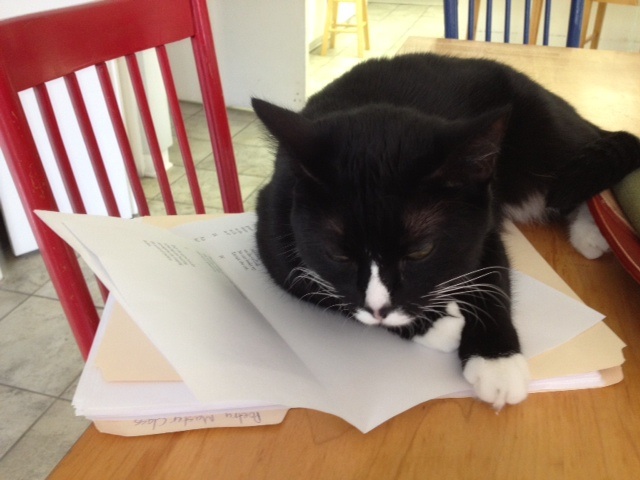
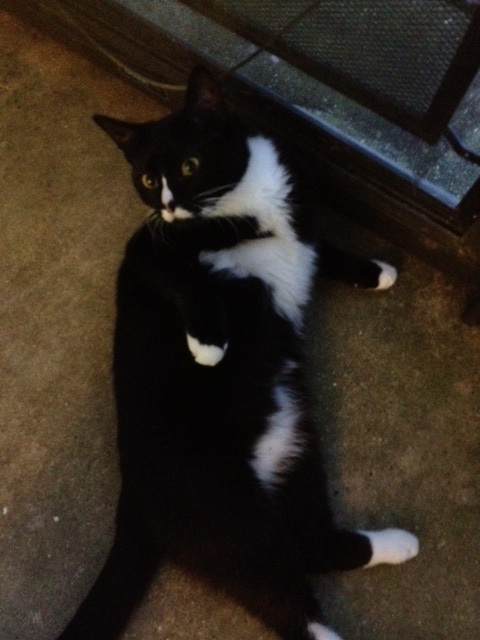
Tabatha Yeatts invented the Poetry Swap. I have been writing a poem each week to send out to my assigned Poetry Buddy. This week I received a poem from Tabatha herself. And she knows I have cats. The featured cat in my photos is our house cat, Mimi. These thirteen ways of looking at Emma could easily be about Mimi. She enjoyed hanging out on Tabatha’s poem while I wrote at the computer.

Mimi naps on a poem.

Mimi naps on a poem.

Thirteen Ways of Looking at Emma

By Tabatha Yeatts

with thanks to W.S.
for M.S. and E.

I
The tail moved
always —
before,
during,
and after.
There was never a time
the tail’s journey was over.

II
The cat’s nose
in the dog’s ear —
whispering love poems
with her whiskers.

III
Anything can be hidden
on the ceiling.
No one looks up.
Except the cat.

IV
The cat walks across the board game.
The whims of fate
cast furry shadows.

V
Only the spiral circles
of pacing and waiting
can express the longing
the scent of chicken
incites.

VI
The cat’s bones
ripple
like a pebble
dropped
in a water dish.

VII
Sleeping upright,
paws hidden,
tail delicately curving
around her side,
the memory of deity
remains.

VIII
The cat,
guardian, silent companion,
desires to be close to the rabbit,
as the tree guards the moss,
as the leaf guards the air,
as the earth guards the moon.

IX
A plane can take you far from the world,
but a cat can always bring you to it.

X
The cat discerns the approaching rain,
spins, and returns so adroitly
you might never imagine
that was not her original direction.

XI
Next to the cat,
the man sneezes.
The cat licks her side.

XII
One cat stalks a darting fly.
Her sister leaves her sleeping post
only to find another.

XIII
Shadows fall around the cat,
the icy gray fingers of age ruffle her fur;
the cat gets up
and moves.

When Mimi is happy, she flips.  We call her "Mrs. Flips."

When Mimi is happy, she flips. We call her “Mrs. Flips.”

Poetry Friday is hosted today by Keri at Keri Recommends.

Poetry Friday is hosted today by Keri at Keri Recommends.

Dear Art Man

Join the Tuesday Slice of Life

Join the Tuesday Slice of Life

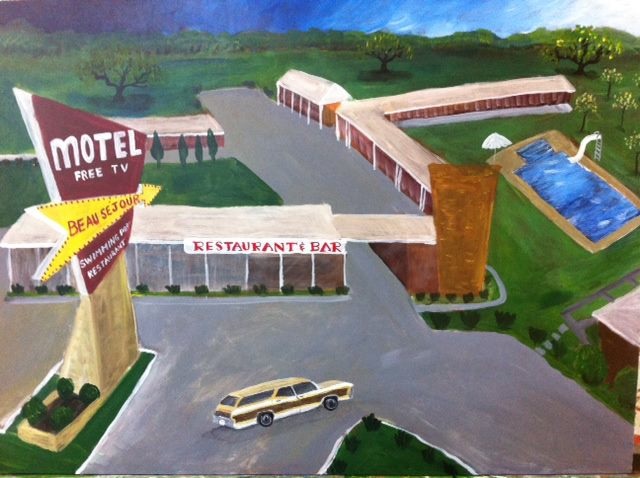
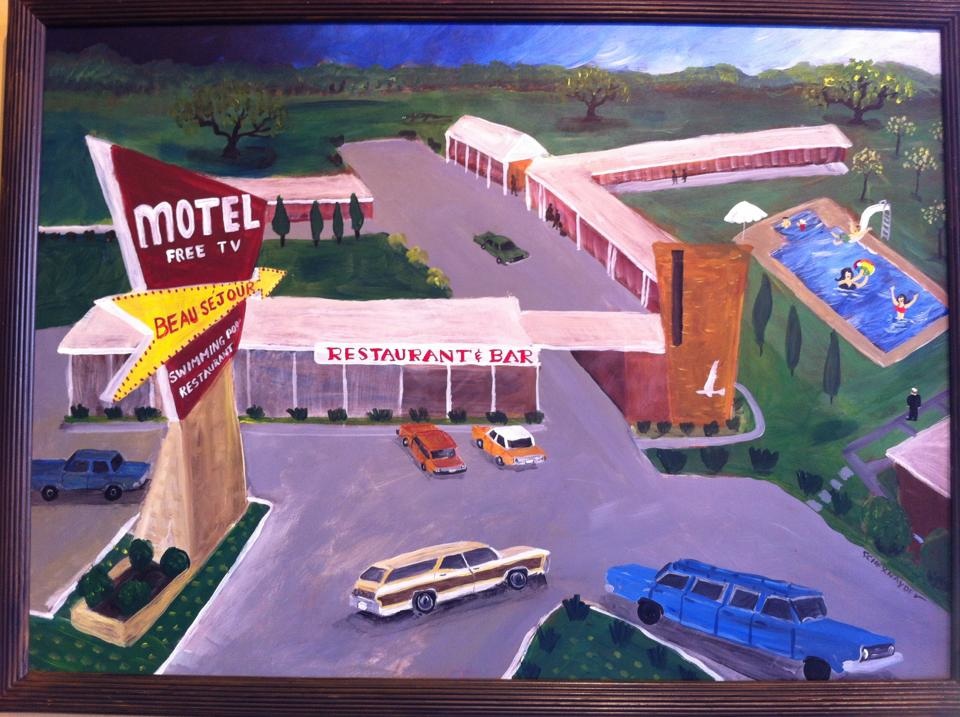
Motel Beau Sejour by Paul Schexnayder

Motel Beau Sejour by Paul Schexnayder

On Friday, I joined a group of teachers from the Acadiana Writing Project on a writing marathon. I took two other teachers with me to show them my friend and colleague Paul Schexnayder’s gallery. I sat next to the above painting and wrote him a letter. Paul was dubbed “Art Man” some years ago when he taught at the school my children attended. He has become the Art Man of New Iberia promoting local artists in an old historical building known as A&E Gallery after the original owner, August Erath.

Serendipitously, Paul posted his before and after paintings on Facebook and gave me permission to post them here. This painting is one of his Hometown Series. Residents remember this motel that stood at the western edge of town in the 1960’s and 70’s.

Click here to visit Paul’s website.

Dear Art Man,
I’m here in your gallery today. Like Goldilocks,
I sit in your chair. You know the one:
an old metal stool with the white vinyl seat
splattered with paint, just-right
for reaching the easel. Your apron is draped
over the back. I try it on, pretend
to be you.

Here is an aerial photograph of your subject.
Did you use it to lay out your design?
Are you finished yet? I’m not sure.
Are you?

The sky is a deep dark blue stretching to near white
in the far right hand corner. The sun, perhaps, is rising.
A line of trees defines the horizon. In the foreground,
a sign:

Motel,
Free TV,
Beau Sejour,
Swimming Pool, Restaurant

I recognize the Oldsmobile Vista Cruiser
I had as a child, fake wood on the side.
Does this one have a sunroof or an AM/FM radio
like ours?

I want to go jump into the motel pool
alluring me with a curvy white slide.
I see your foam plate palettes still full of paint.
Do I dare dip a brush in?
Make my mark on your developing masterpiece?
I can hop into the station wagon,
ride to Motel Beau Sejour—
uninvited.

–Margaret Simon, all rights reserved

Motel Beau Sejour finished by Paul Schexnayder.

Motel Beau Sejour finished by Paul Schexnayder.

Chalk-u

Join the Chalk-a-bration over at Teaching Young Writers

Join the Chalk-a-bration over at Teaching Young Writers

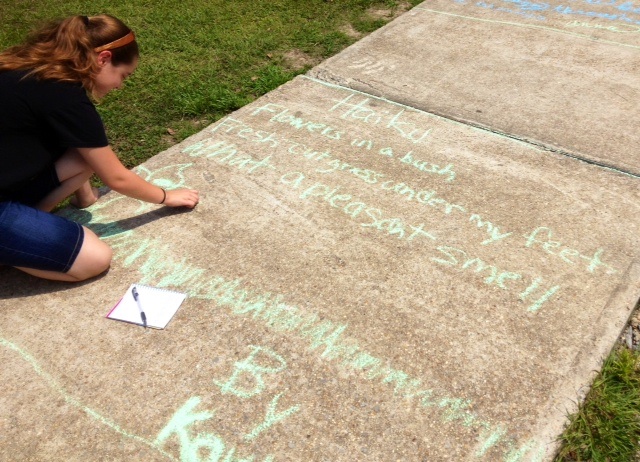
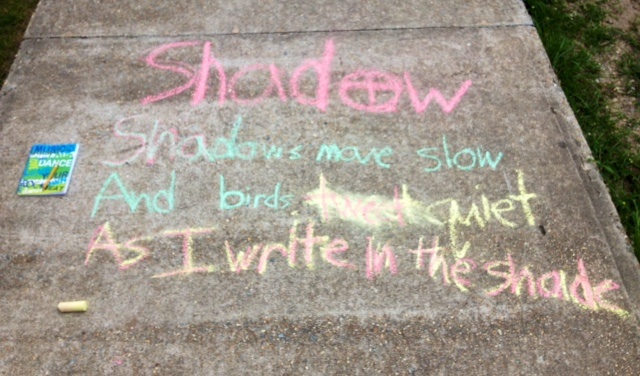
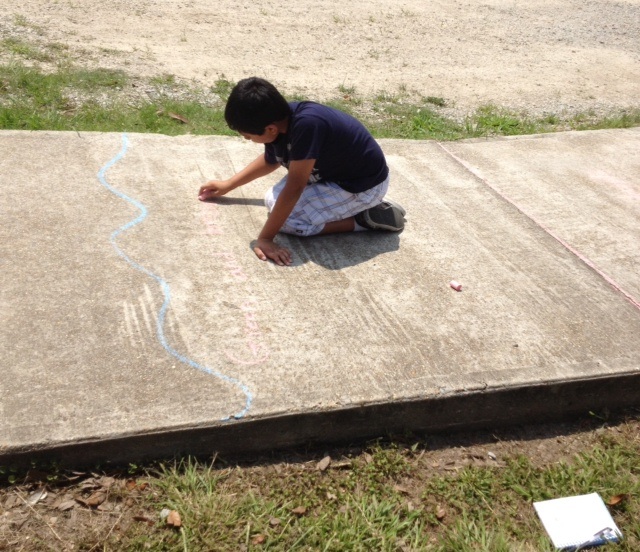
Betsy, a kindergarten teacher and fellow blogger, is hosting a round up of chalketry, poetry in chalk, at her monthly Chalkabration. On the last day of Write your Way youth writing camp a few weeks ago, we wrote haiku in chalk or chalku for the parents to read as they walked to the classroom for Author’s Chair. Here’s a sampling.

Flowers in a bush Fresh cut grass under my feet What a pleasant smell! by Kaylie

Flowers in a bush
Fresh cut grass under my feet
What a pleasant smell!
by Kaylie

Roses are in bloom
Bees buzz around the garden
All is peaceful
–Anna

Shadows dapple, splayed
beneath the crooked oak’s arms
Swaying though untouched
–Collin

Trees blow in the wind
Growing and growing until
They all pass away
–Jered

Shadows move slow and birds tweet quiet I write in the shade. Kylon

Shadows move slow
and birds tweet quiet
I write in the shade.
Kylon

A shady oak tree.
The perfect place on a hot day
A cool breeze blowing its leaves
By Lily

chalku rayn

Ocean Call

I am participating in the 2013 summer Poem Swap that Tabatha Yeatts is organizing. What fun it is to receive a poem in the real snail mail! This week Tabatha sent out a picture prompt suggesting an ekphrastic poem. Some poet will receive this poem this week.

The photo that prompted this poem is Noise of the Waves by Phillip Schumacher.

Ocean Call

If you feel small,
sit on the grass-lined dune
near the sea,

cross your legs,
cup your ear,
listen.

The wind will call to you
on wisps of white clouds,
over the roar of waves

drowning
your simple thoughts,
inviting you to be one
with the sculptor of things.

–Margaret Simon

For more Poetry Friday, go to Amy’s site Poem Farm.

Poetry Friday is hosted today by Amy at Poem Farm

Poetry Friday is hosted today by Amy at Poem Farm

Join the Tuesday Slice of Life

Join the Tuesday Slice of Life

Welcome

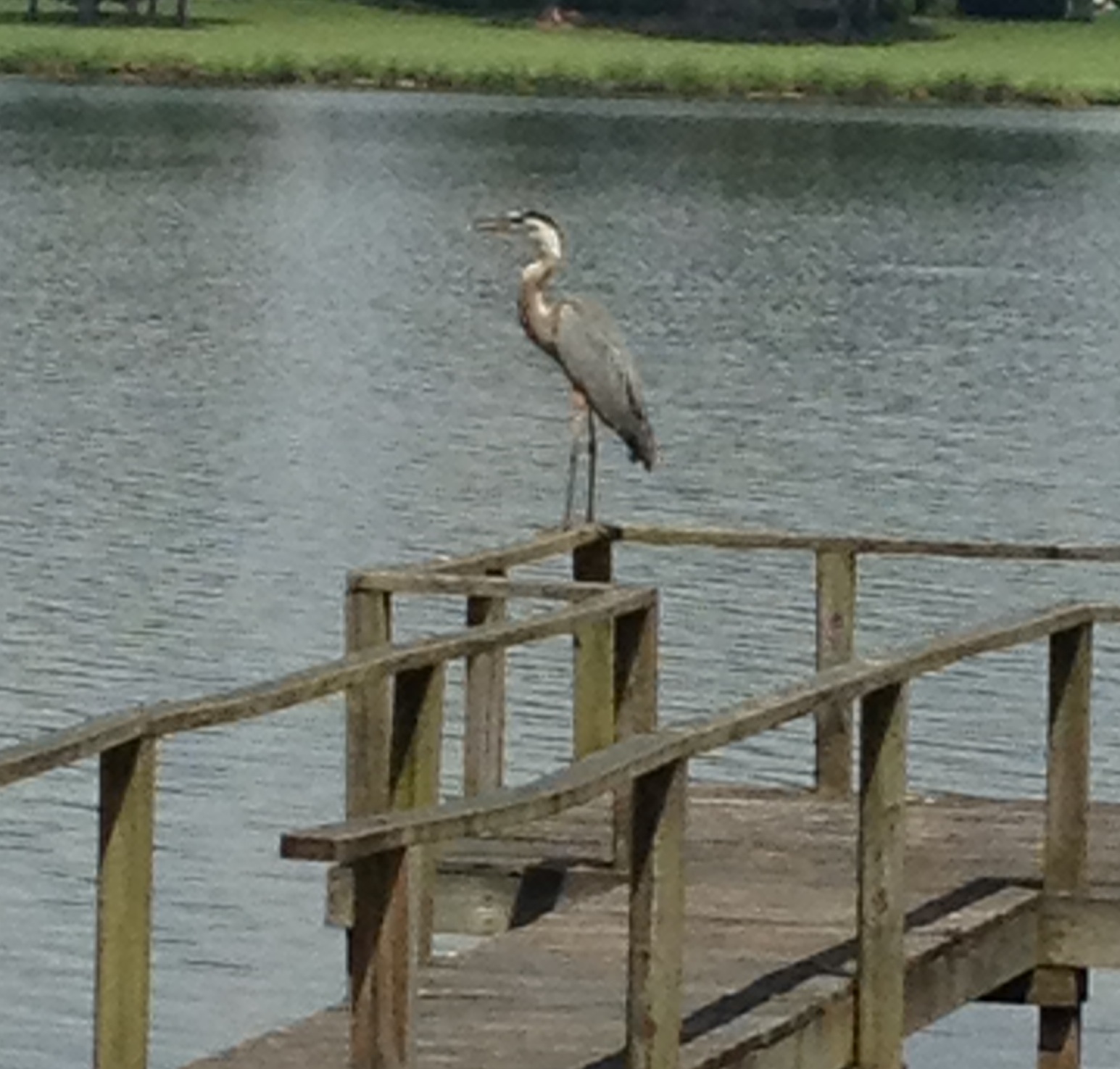
I have had a wonderful, peaceful week with my parents in Madison, MS. on New Castle Lake. They look out at the lake every day. There is something so calming about watching water. Each day, they are visited by a great blue heron, a gaggle of Canada geese, and a family of mallards. Each evening, the sun sets over the horizon making a new painting in the sky.

Sunset 1

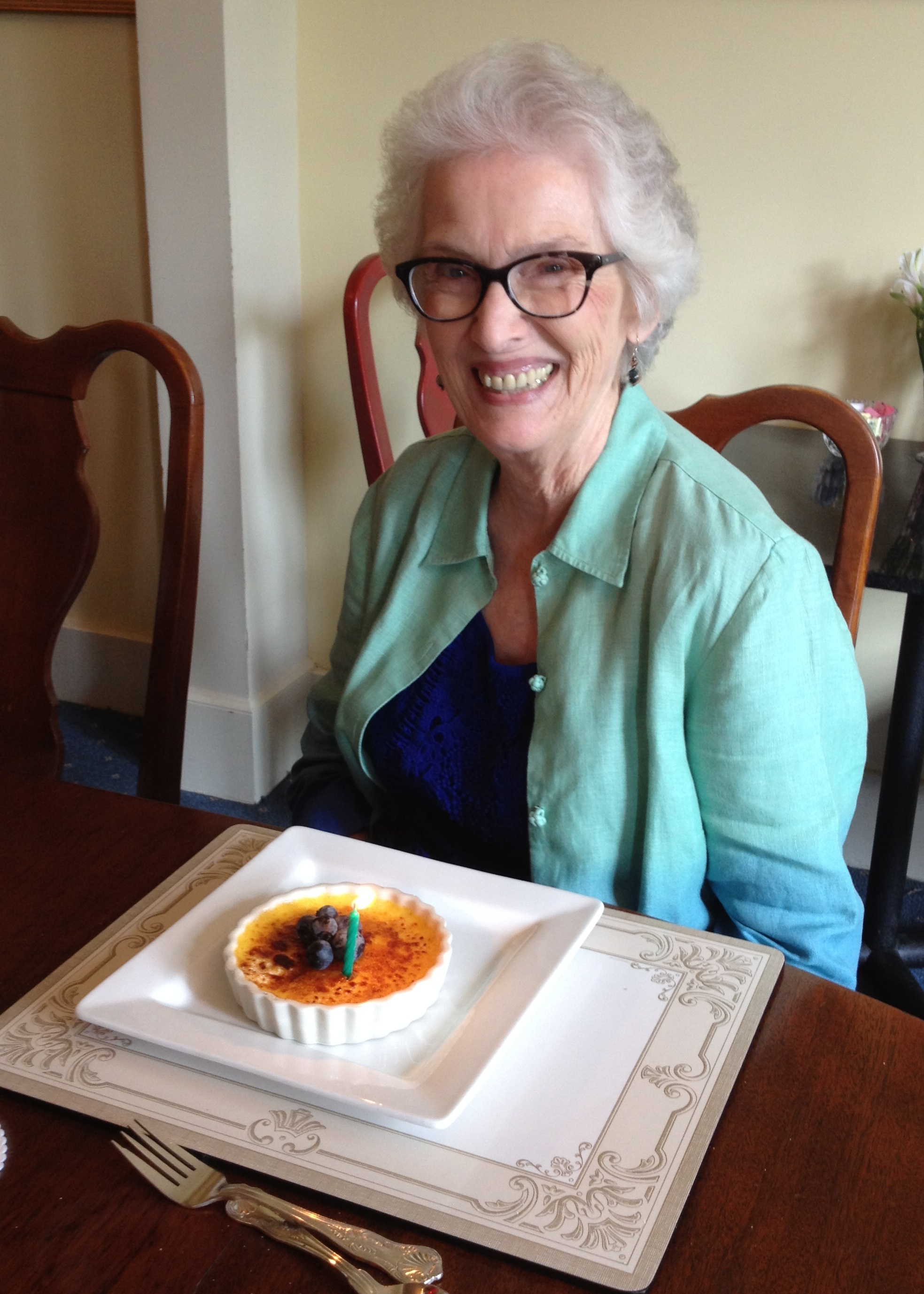
Each day we embarked on an outing. The first fell on my mother’s birthday. We attended her monthly book club meeting that took place in a Circa 1908 Revival mansion The Fairview Inn B&B and restaurant. I loved being surrounded by smart southern women discussing books and life! They put a candle in Mom’s crème brûlée.

Happy Birthday, Dot!

Happy Birthday, Dot!

The next day the three of us went to the Mississippi Museum of Art for lunch and a viewing of the Old Masters to Monet. We also enjoyed the permanent collection and the quilt competition.

On Thursday, we went to the Mississippi Craftsmen Center on the Natchez Trace. So many talented artists and craftsmen in Mississippi!

The rest of the week included hearing my brother play with two other musicians at a fine restaurant, a bookstore visit with my dad, and seeing my sister-in-law in Steel Magnolias. She played the mother, M’Lynn and had me sobbing by the end.

heron1

My favorite part was just being there, having time to read, write, and visit with my family. One evening we sat out on the screened-in porch. I read aloud poems by Natasha Trethewey (who is originally from Mississippi) while Mom tracked the stars on her iPad. I wrote the following poem:

Tonight,
instead of TV,
we stargaze;
chart the evening sky on the iPad app.

Mom announces Venus
above the horizon
glimmering like an orange diamond,

not unlike the firefly
with its lonely, silent flashes.

When we stop talking,
frogs moan, crying
like spoiled children resisting bedtime:

Let me stay a little longer,
to find more stars,
to catch more stories,
to be more awake!

Verse Novels

Poetry Friday is hosted today by Carol at Carol's Corner.

Poetry Friday is hosted today by Carol at Carol’s Corner.

Last week for Poetry Friday, Mary Lee had a feast of verse novels. These have attracted my interest lately. While I read Out of the Dust by Karen Hesse years ago and have shared Love that Dog, Love that Cat, and Heartbeat by Sharon Creech with my students, the genre feels new.

This week I read Inside Out and Back Again by Thanhha Lai. The book is based on her own life story of coming to America from Vietnam. The verse was simple, yet moving. In a verse novel, each chapter/verse/poem should stand alone yet hold the whole together. Lai does this. The novel made me think about 1975 when refugees were coming in to my own city. I don’t remember how I reacted. I hope I was kind. Not everyone in Lai’s book is kind. Our students can learn from Lai that not everyone looks the same or speaks the same, but everyone should be kind.

thanhha_lai_inside_out_and_back_again1

Wet and Crying

My biggest papaya
is light yellow,
still flecked with green.

Brother Vu wants
to cut it down,
saying it’s better than
letting the Communists have it.

Mother says yellow papaya
tastes lovely
dipped in chili salt.
You children should eat
fresh fruit
while you can.

Brother Vu chops;
the head falls;
a silver blade slices.

Black seeds spill
like clusters of eyes,
wet and crying.

–Thanhha Lai from Inside Out & Back Again

Last year during Teachers Write camp (which, by the way, begins Monday), Gae Polisner had Caroline Starr Rose, author of May B, as a guest on her Friday Feedback blog post. I was turned on to writing in verse. I have a WIP (Work in Progress) that hasn’t gone anywhere in years, and by turning to verse, I was able to revive it. I am attracted to this genre because it’s a way to combine my love of poetry and writing for children. Here’s a sample verse from my WIP Dear God:

.
Dear God,
Winter can be so boring,
short days, long nights.
But today, snow fell
for hours.
No school.
I watched the snow from the window,
picture perfect,
piling onto the bare tree branches,
sparkling, gleaming.
Benjie and I bundled up,
headed over to the hill by the park.
Neighborhood kids were there with sleds
and makeshift sleds of cardboard.
I helped Benjie climb onto the sled and pushed him off,
down the hill, twenty times at least.
When we finally headed home,
my nose and fingertips were frozen solid.
Mom made us hot chocolate and vegetable soup.
Simone could not play in the snow.
When we passed by, she waved at us from her window seat.
She wore a knit cap and a scarf around her neck,
looking like a snowman herself, pale and hairless.
She wasn’t sad, though.
Her smile was big and sparkled like the snow.