The world continues to spin out of control. We feel like we can’t hold on. If it’s not the rise of Covid cases, it’s the earthquake and storm in Haiti. If it’s not the political discord, it’s Afghanistan. There is little we can do, literally.
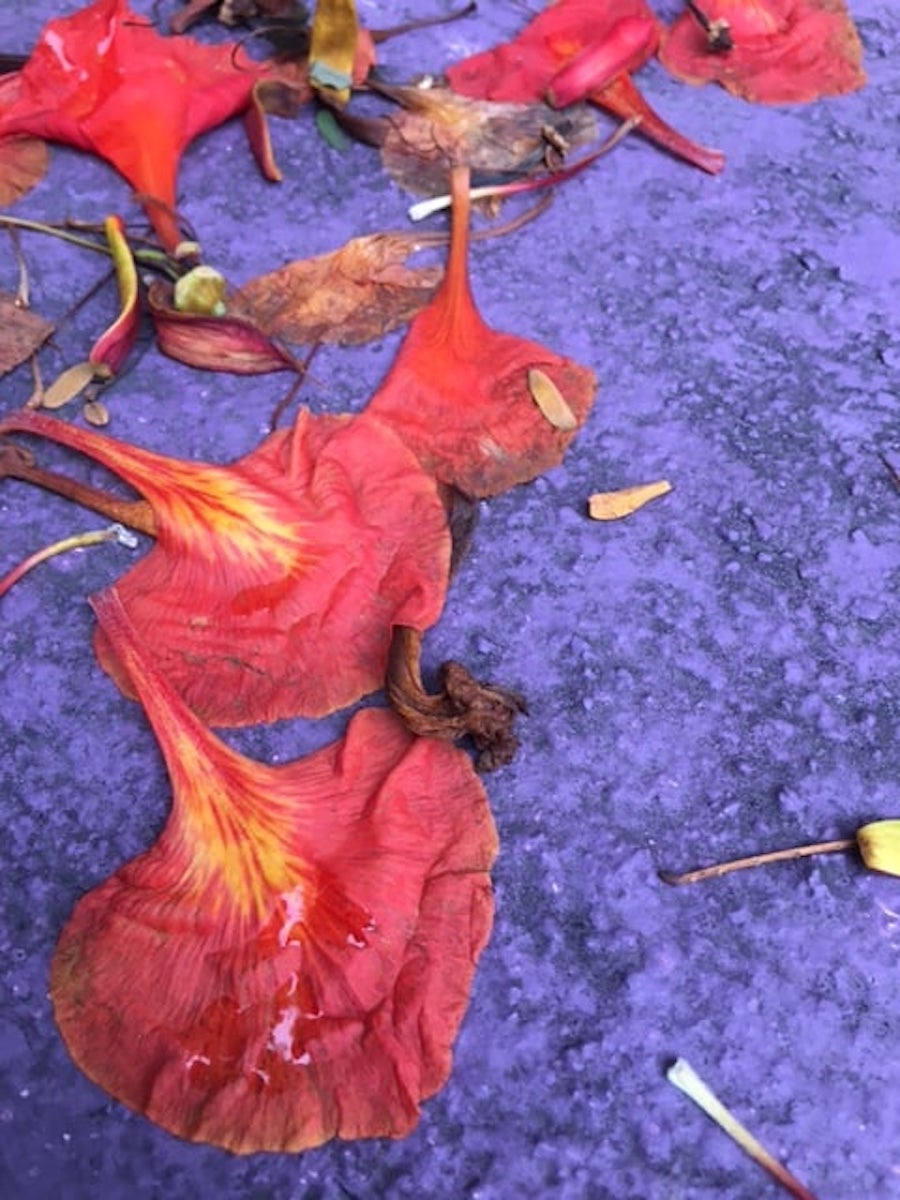
So let’s turn to this image from our friend-teacher-blogger Ruth Hersey’s. Ruth lives and teaches in Haiti. She made it home safely from a summer trip to the states only to be faced with political upheaval and an earthquake. Ruth is thankfully safe. Every day she posts a photo response to a daily prompt. She posted this beauty on Facebook. It’s an image that speaks of the beauty found in the tragedy. The petals are from the flamboyant tree (poinciana).
Ruth is also posting daily updates about Haiti and organizations that are on the ground doing good work. Check her FB page. For another way to donate to vetted organizations on the ground, click here for CNN’s Haiti Earthquake Relief.
Flamboyant tree by Ruth Hersey
Your flames still burn bright petals fall, confetti-tears after the party
Margaret Simon, draft
Write a small poem in the comments. Share encouraging words for other writers. Donate to Haiti, if you are able.
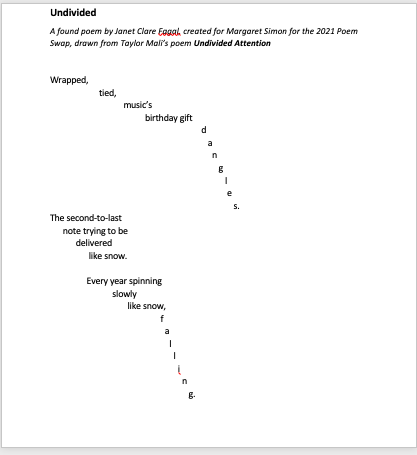
Just as my school year started, I received my final Poem Swap gift and poem from Janet Fagel. It was all about Taylor Mali, the inventor of Metaphor Dice. She’s friends with him. (Swoon!) She sent me his book Late Father, which I added to my Sealy Challenge stack, and a signed print of his poem Undivided Attention. Janet’s poem for me came as a found/black out poem from this poem. I don’t know if it was intentional or not, but the poem arrived just in time for my 60th birthday.
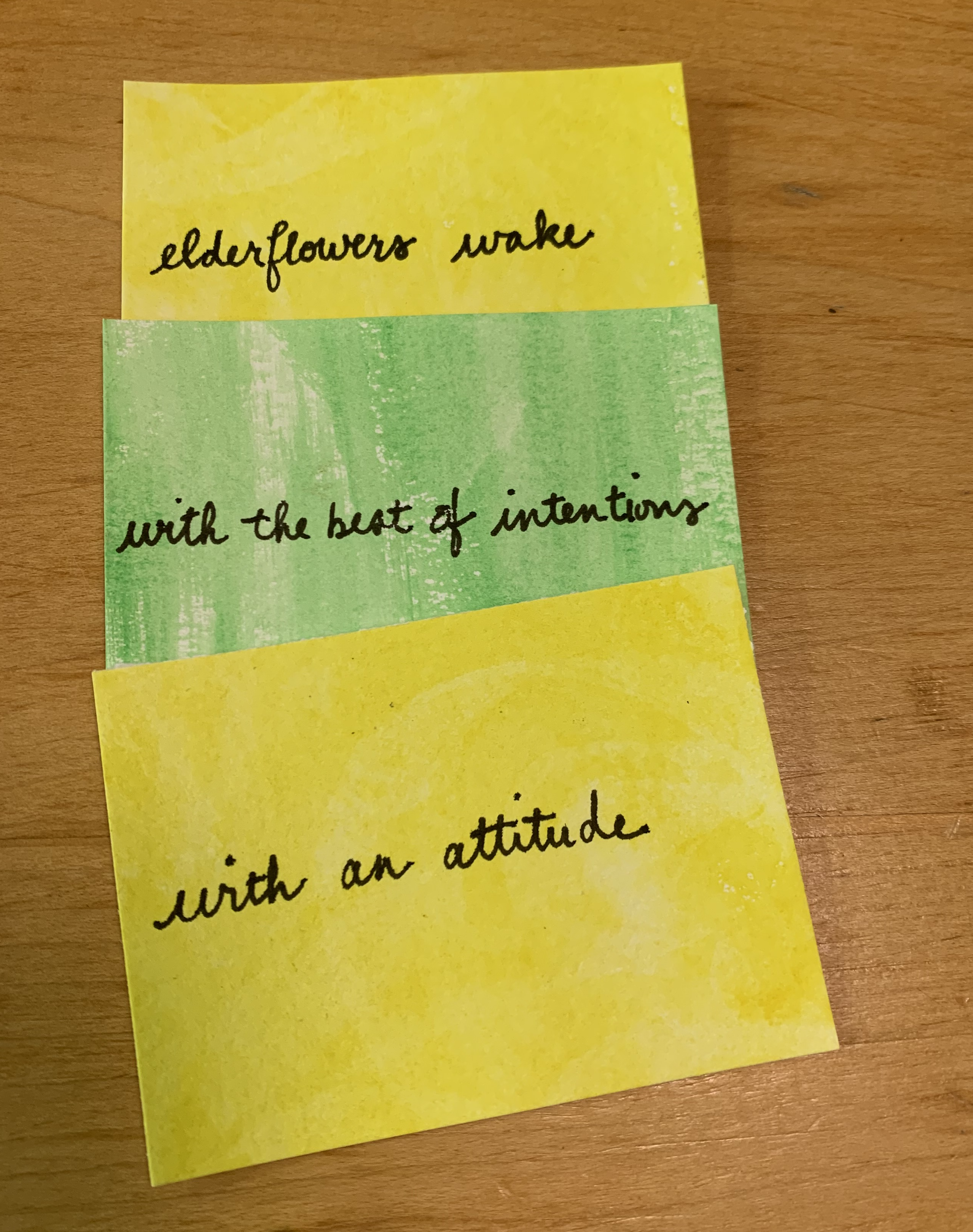
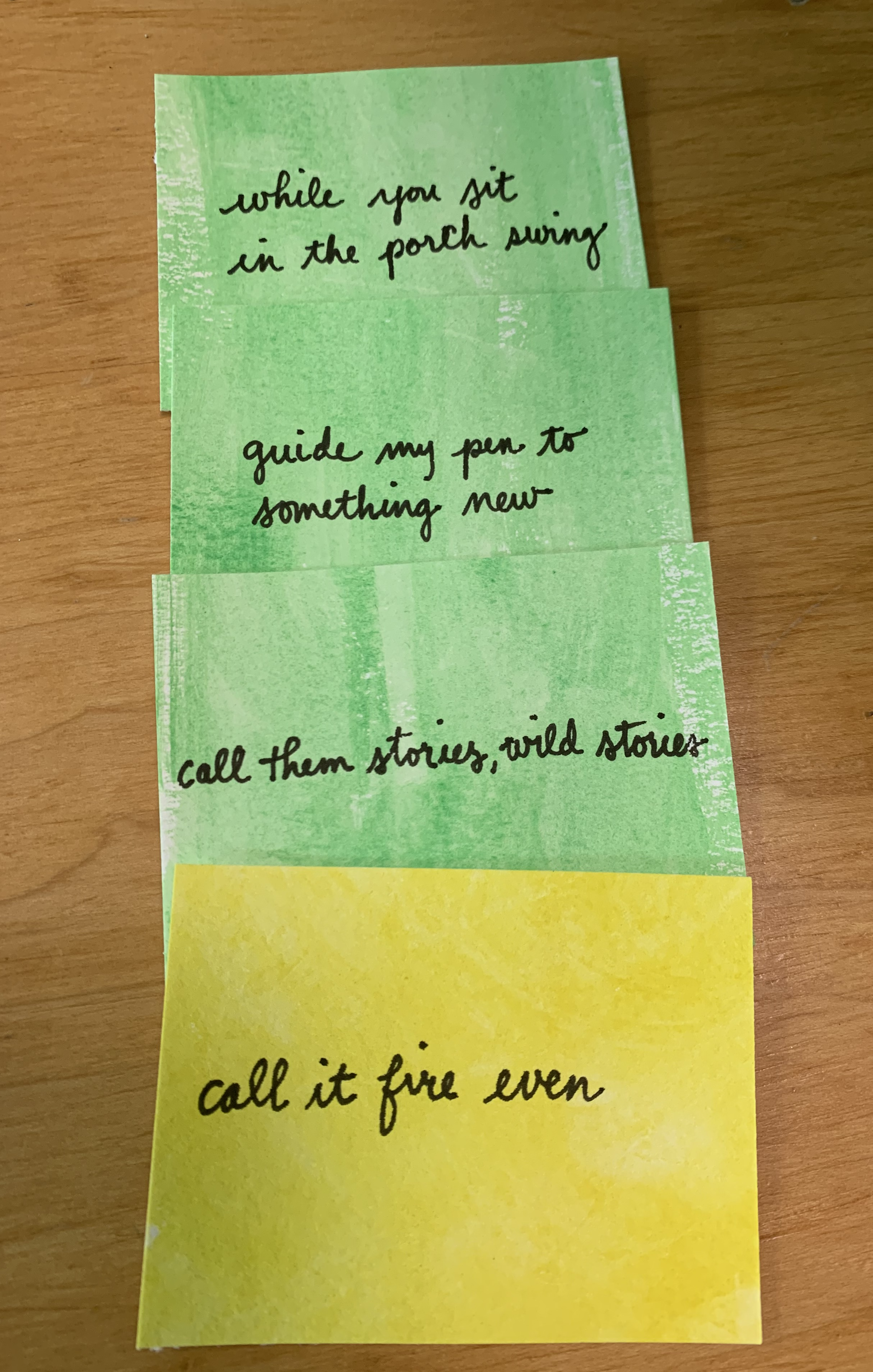
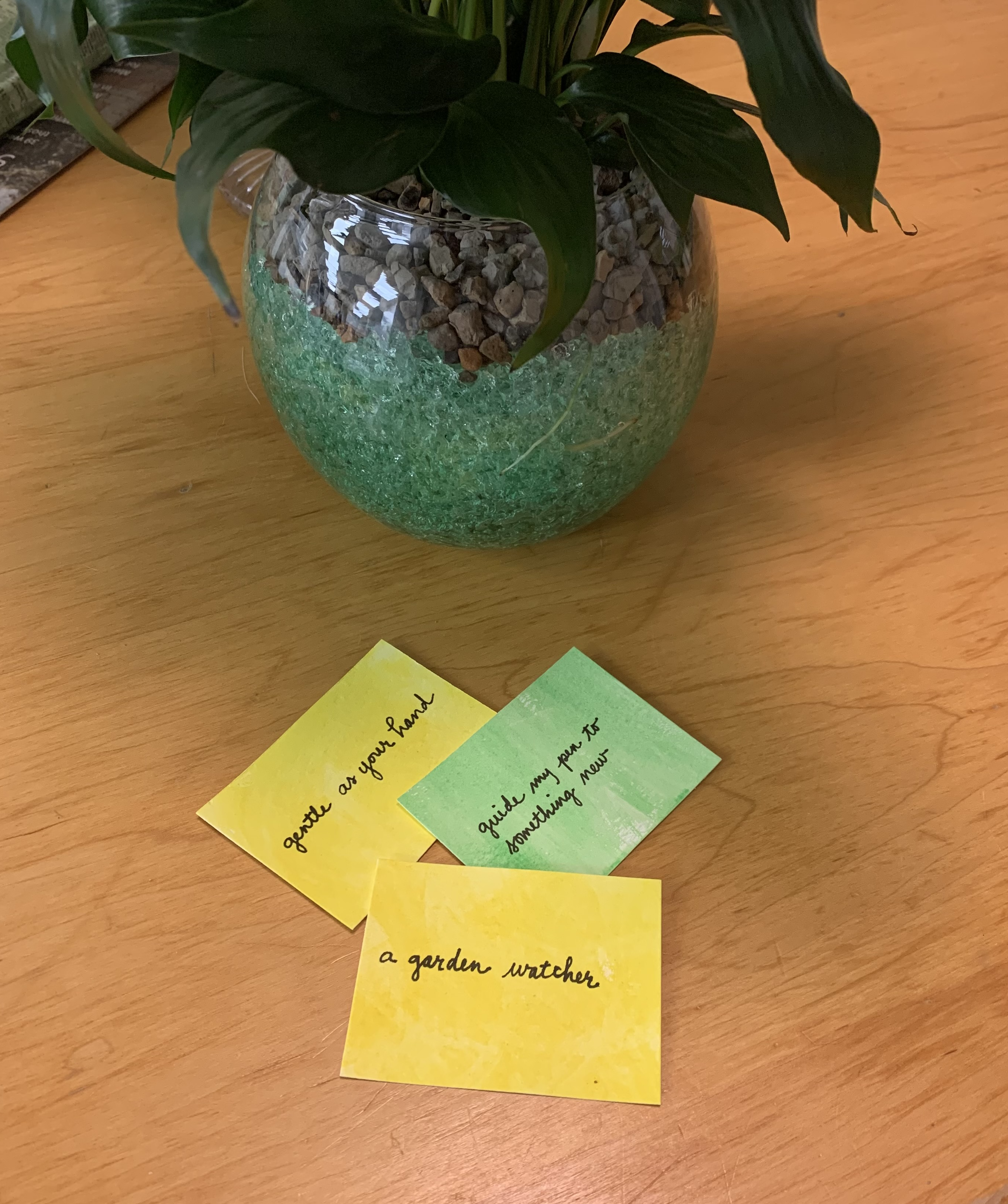
Earlier in the summer I received a poem swap from Mary Lee Hahn. She made an oracle deck from my own words, phrases she had found in my poems. She color-coded the cards to show which was 5 syllables and 7 syllables. Then she created two poems from my words, a haiku and a doditsu (7-7-7-5). She encouraged me to make these with my students this year. Tucking it away until April when we’ve written lots of poems together from which to choose lines.
Haiku by Mary Lee with phrases from Margaret Simon
Dodoitsu by Mary Lee Hahn with phrases from Margaret Simon
Creating my own haiku from the oracle deck.
Both of these gifts come straight from the heart. This is the whole embodiment of this Summer Poem Swap, organized and led by Tabatha Yeatts. Thanks Janet, Mary Lee, and Tabatha. My hear is full!
Today is my 60th birthday. I gasp when I see that. Sixty years is a long time! I share my birthday with two sisters I met right here, connecting through blogging, Linda Mitchell and Julieanne Harmatz. Happy Birthday to you, too!
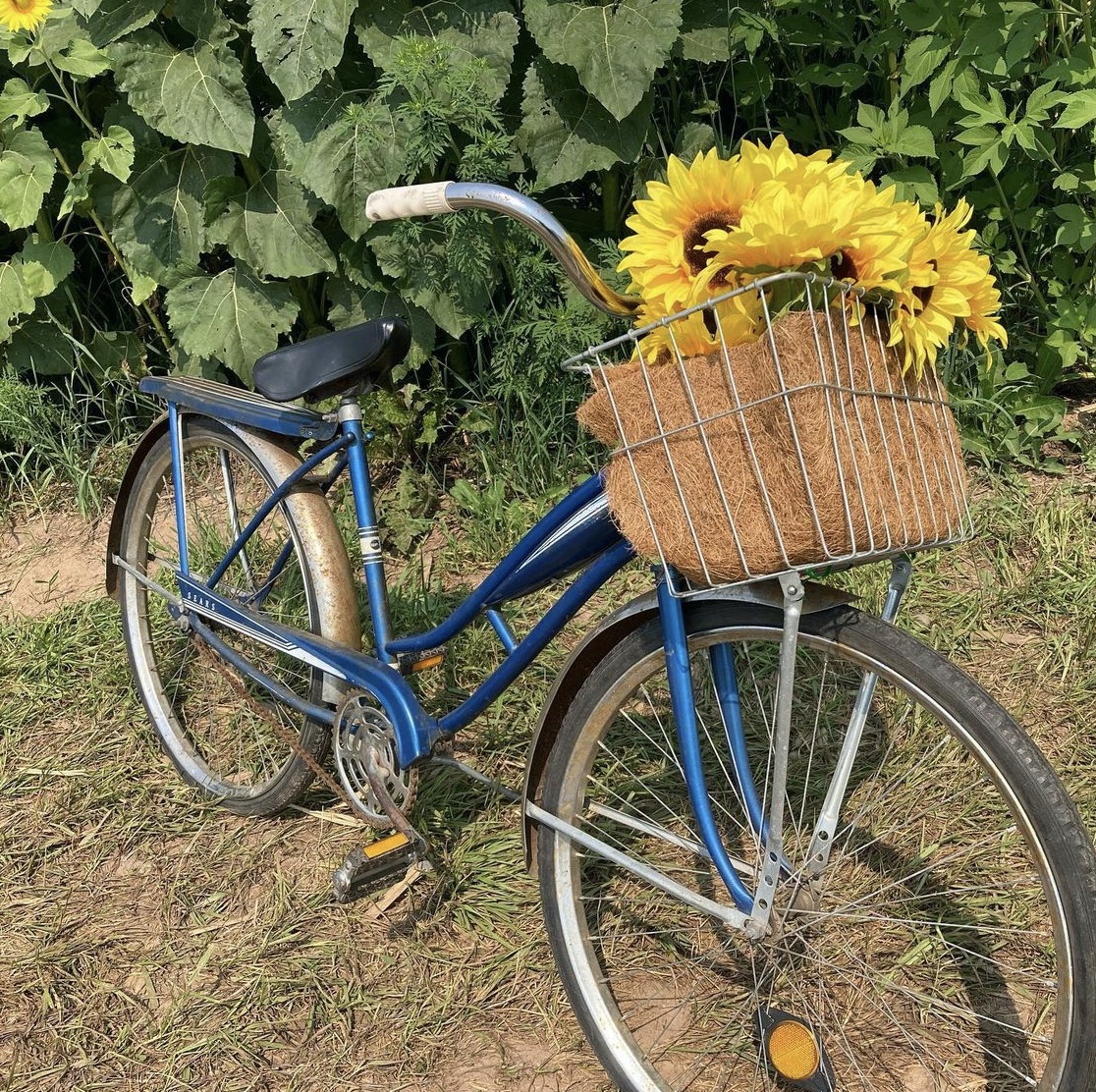
This week’s photo is a fun one. I found it on Instagram, posted by Trina Bartel, another fellow blogger. She tells me it was taken at Bergsbaken Farms in Wisconsin.
(The photo) is from a sunflower farm in a tiny town in Cecil, WI (NE WI). It’s a huge field of sunflowers that you can visit for a suggested donation of 2 dollars each. There are props (like the bike) that you can take photos with. The bike is on the edge of a huge sunflower field. It is at the entrance. This sunflower farm is about 3-4 years old. I believe it was created as a way to generate money for a struggling family farm.
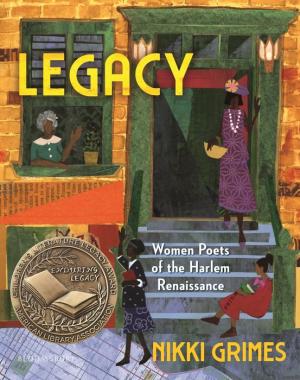
I was the lucky winner of a free copy of Legacy by Nikki Grimes. I would have, should have a copy of this book, but hadn’t bought it yet. I recently subscribed to Chris Barton’s newsletter, and low and behold, was the winner of this book on my first month. You can be lucky, too. Subscribe here. His newsletters are full of stuff, author interviews on “This Book is Dedicated to”, promotional materials, and links to more.
In Legacy, Nikki Grimes uses the golden shovel form to celebrate women poets of the Harlem Renaissance. Each Renaissance poem is accompanied by a golden shovel and an illustration by a Black woman artist. It’s beautifully pulled together into 3 sections: Heritage, Earth Mother, and Taking Notice.
The poems I am featuring today are about poetry, the writing of poems. The fancy term is ars poetica.
Notice the tactile in this poem, kneel, wriggling, and my favorite “water which satisfies, soothes, tickles–what wet word/ pours itself into the vessel that/you call thought?” Nikki Grimes calls us to notice it all and make poetry.
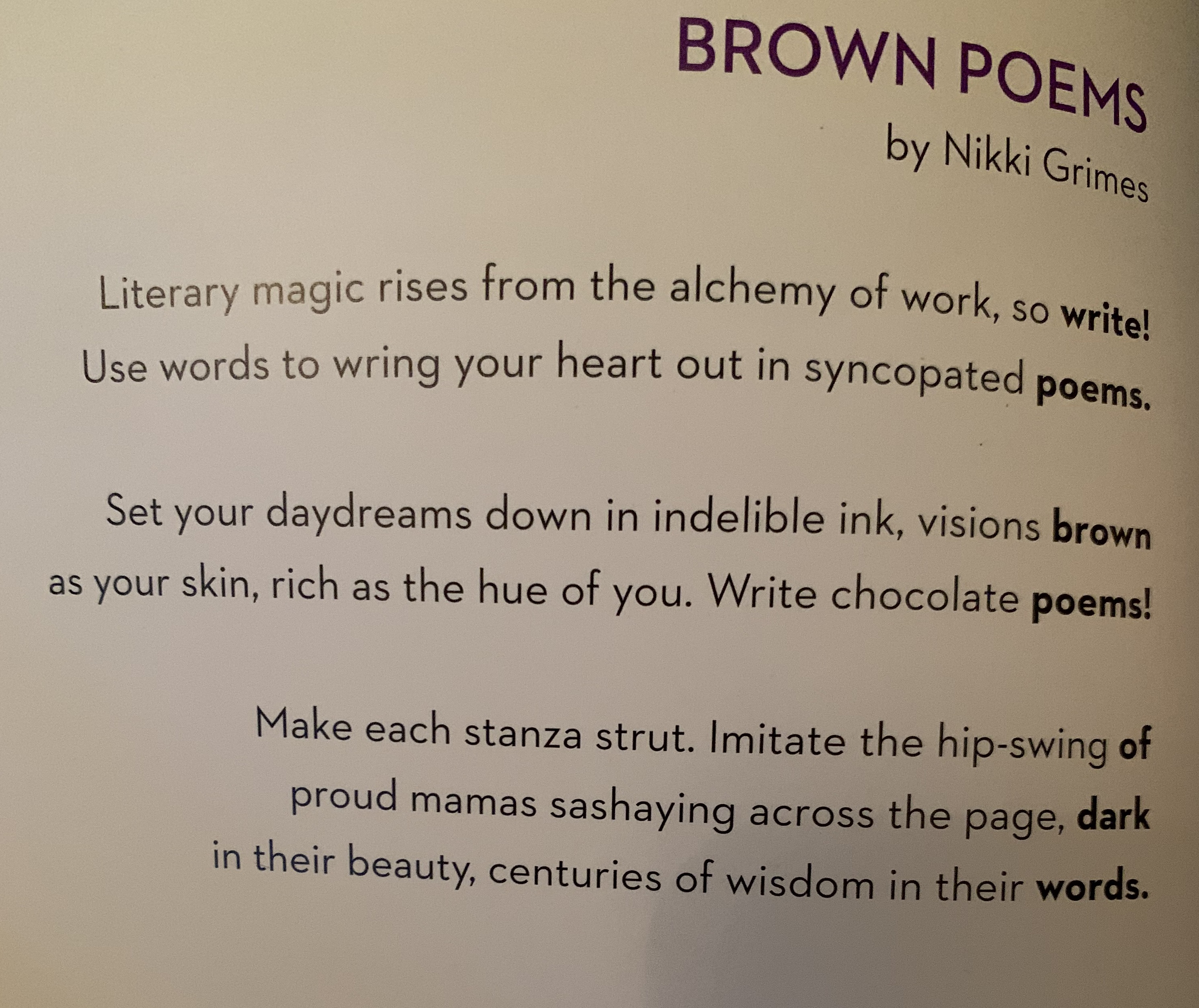
And this one I will print out for my brown girl writers this year.
I love the instruction to “Write chocolate poems!” Can’t you taste it? I’ll bring in Dove chocolates, the kind with a message on the wrapper and hand them this poem. Yes! I’m excited to start a new year of teaching with this book in my hands. Thanks, Chris Barton and Nikki Grimes!
Let’s get real; I took on the Sealy Challenge to get smarter, to read more poetry, to fill the well. The reality is I am challenged. Challenged not because I don’t have enough poetry books. Not because I can’t read a poetry book each day. I am challenged because poetry is not like fiction that carries you through with a narrative. Poetry requires a different kind of reading. You can’t skim poetry. You have to sit with a poem, and read it again and again to let it sink in. This takes time.
The latest books I’ve read are Irene Latham’s The Sky Between Us and Tracy K. Smith’s Life on Mars. Irene gave me her little chapbook years ago. Since then I’ve followed her blog, bought most of her books, and become friends with her. The Sky Between Us is a love song.
In the “Author’s Note”, Irene wrote “One of the great joys of my life continues to be the discovery of all the beauty this life offers, both in the natural world and in relationships.” In this way, The Sky Between Us slides in beside and between the pages of Life on Mars.
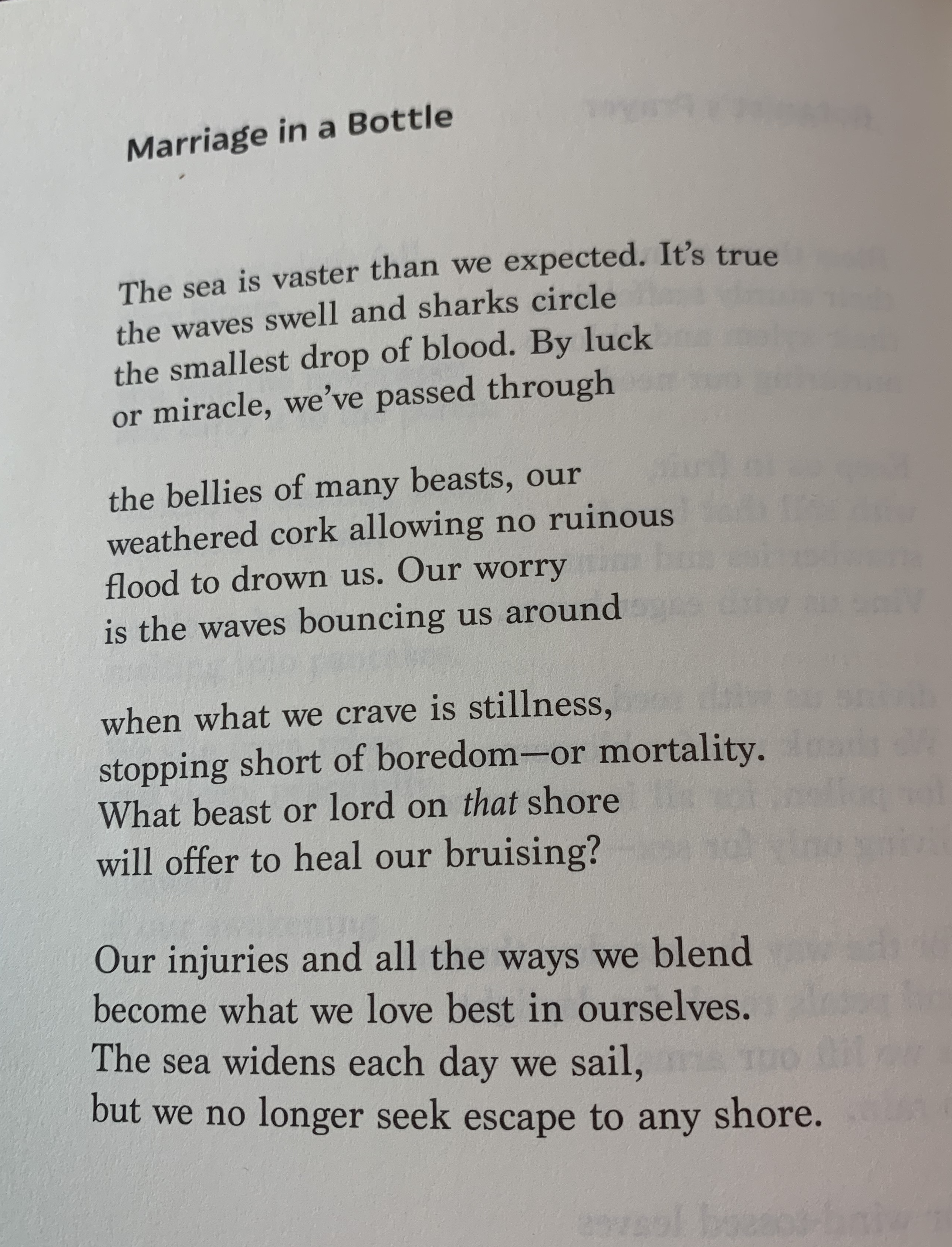
“Marriage in a Bottle” by Irene Latham
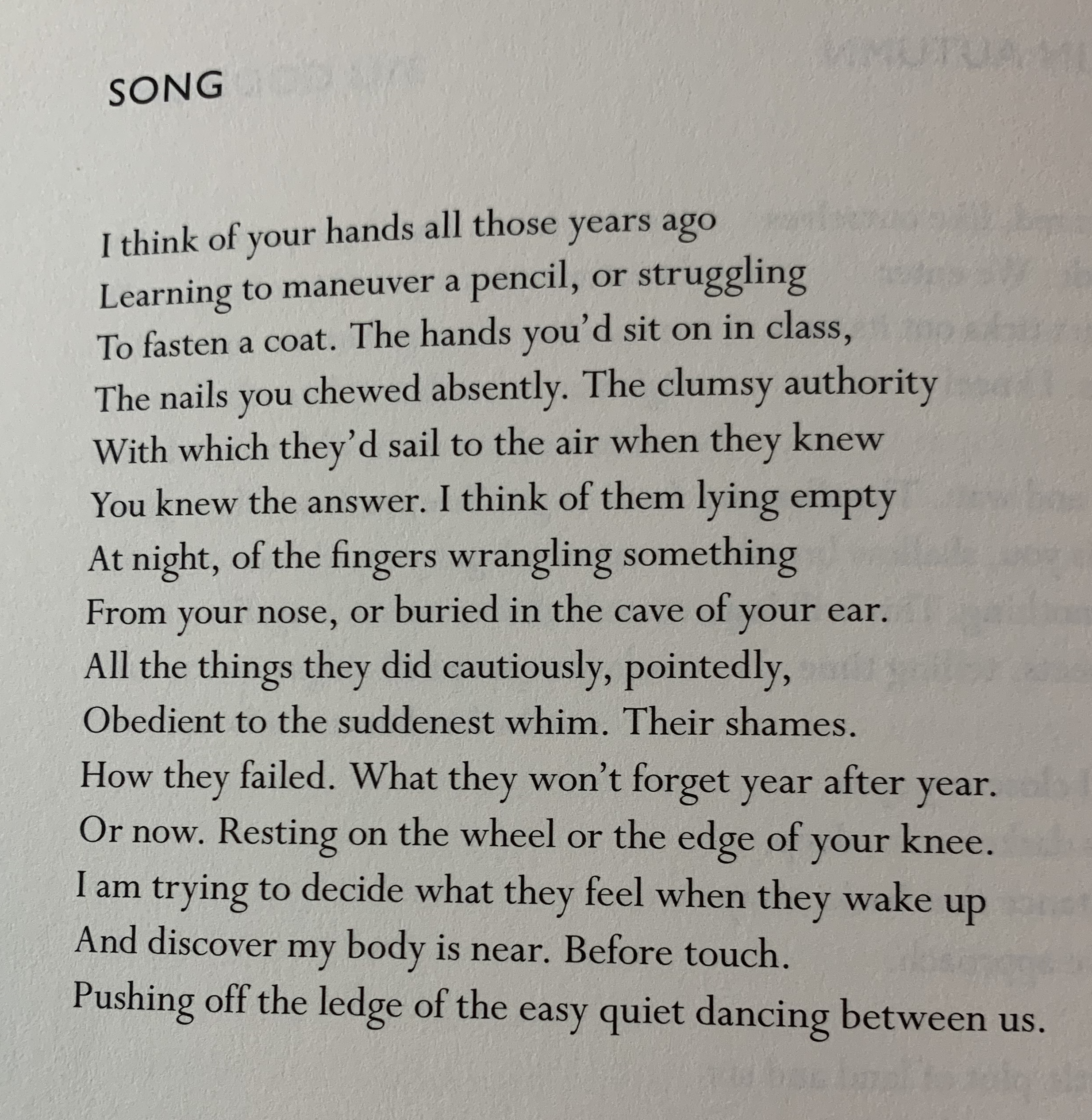
In 2017, Tracy K. Smith served as Poet Laureate of the United States. I loved her poetry podcast, The Slowdown. Her book Life on Mars (2011) won the Pulitzer Prize for Poetry. This book was written as an elegy to Smith’s father who was an astronomer who worked on the Hubble telescope. But, of course, it’s so much more. The poem I chose to share sits beside Marriage in a Bottle. I’ve tucked away the last line for stealing. Celebrating my 39th wedding anniversary this weekend has put me in the mood for marriage poems, poems that speak to the complexity and simplicity of loving another human for a lifetime.
My writing group is here this week with a new name and a new challenge. Formerly, the Sunday Swaggers, we are now the Inklings. Catherine Flynn challenged us this month to write an Ekphrastic Poem.
From the Poetry Foundation:
Ekphrasis
“Description” in Greek. An ekphrastic poem is a vivid description of a scene or, more commonly, a work of art. Through the imaginative act of narrating and reflecting on the “action” of a painting or sculpture, the poet may amplify and expand its meaning.
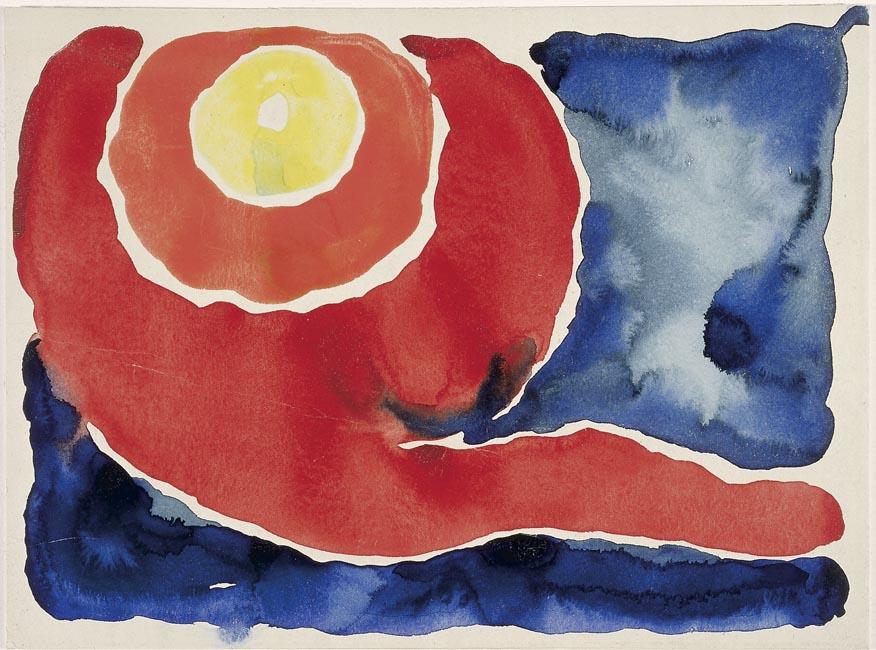
A few weeks ago I was participating in #WriteOut, a virtual writing marathon from the National Writing Project. On this visit, we were in San Antonio, Tx. One of the prompts was a work of art by Georgia O’Keefe that is housed at the McNay Art Museum.
Evening Star V by Georgia O’Keefe, from the McNay Art Museum
Evening Star
Texas sky blooms into star-gaze red glare haze across blue waves–
And there– a point of light opens a minor C– insignificant note like a dust-speck glistening then gone.
For #TheSealyChallenge, I have read 5 poetry books. This week I wrote blog posts about Before the Ever After, a verse novel by Jacqueline Woodson, and Ilya Kaminsky’s Deaf Republic, a totally different novel in verse. I also blogged about The Bridge Between Us, a collection of poems about teaching through the Covid-19 pandemic. I’ve read Robert Bly’s Morning Poems and Naomi Shihab Nye’s Cast Away, but haven’t blogged about them yet. I am enjoying this challenge. It’s making me pick up poetry books that I have had on my shelves and never read through. I only heard about this challenge this year, but it’s been around for a few years. Is anyone else doing it? How are you handling and processing?
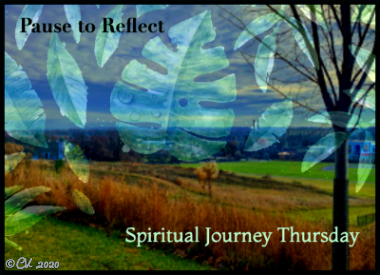
Spiritual Journey First Thursday is being gathered today by Linda Mitchell.
Linda Mitchell is gathering Spiritual Journey First Thursday posts. Her topic suggestion is Respect. I wasn’t going to write. In fact, I emailed Linda and apologized, “I’ve got nothing.” However, in the spirit of respect for this community of writers and because I’m awake on the last day of my summer break, I am writing.
Respect is born out of Love. The two are intertwined like the threads on the knitting needles. God calls us to Love.
And so we know and rely on the love God has for us. God is love. Whoever lives in love lives in God, and God in them.
1 John 4:16
This morning I read a beautiful poem by David Whyte, The True Love.
Step out of the boat and give your hand to God. Find true love with God. Trust the safety you feel. Hold your hand out to others in respectful response.
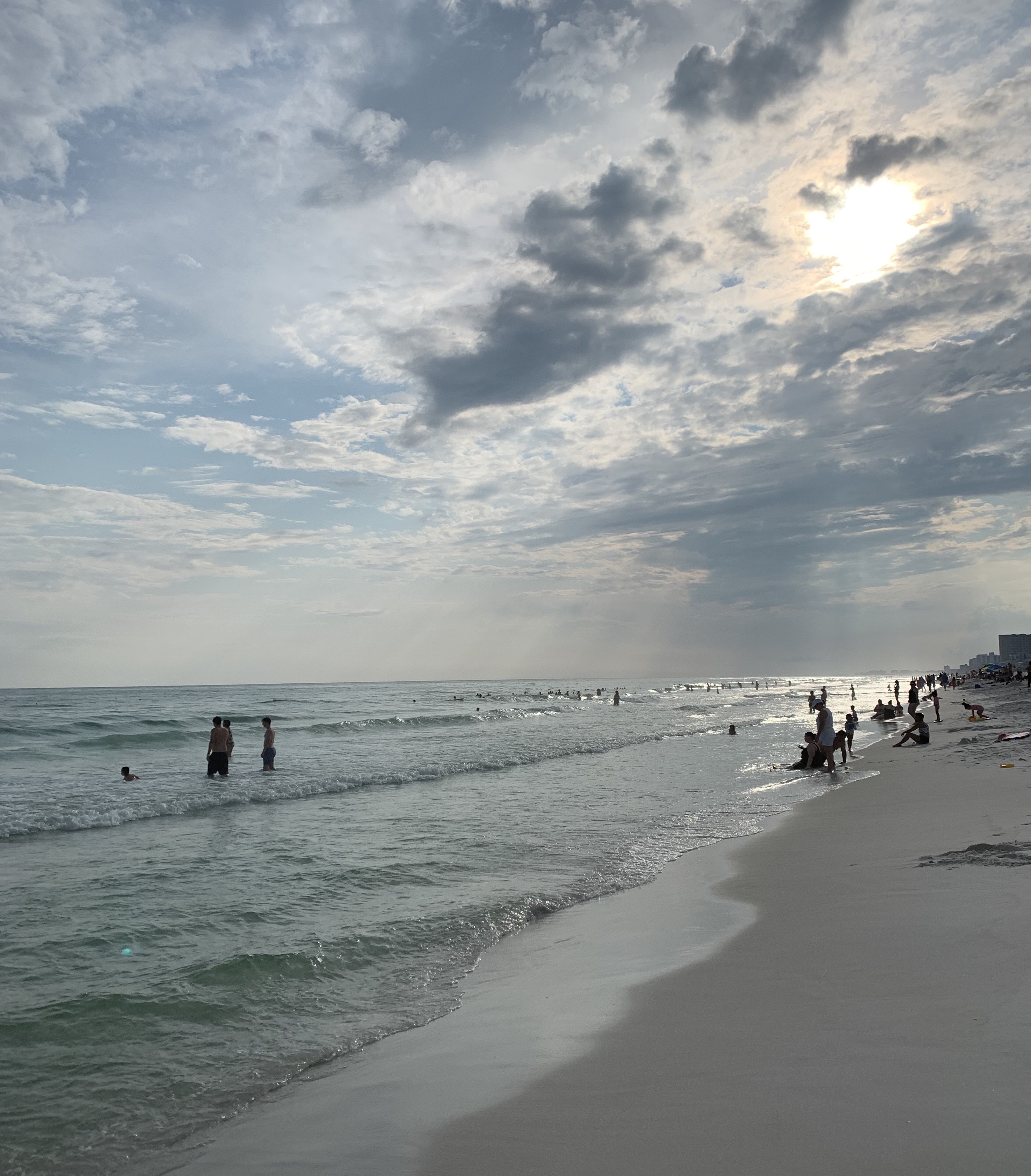
I am currently writing in a hotel room in SandDestin, Florida. We are being completely quiet to not wake up my sleeping grandson. My daughter has business here, so I came along to help with Thomas. (His daycare is on a summer break.) The beach views are wonderful, but I can’t take Thomas out on the beach because he hates the way the sand feels on his feet. We spent more time playing in the kiddie pool. He also enjoys running down the hotel hallways and hearing his voice echo. Oh, the joys of being a toddler!
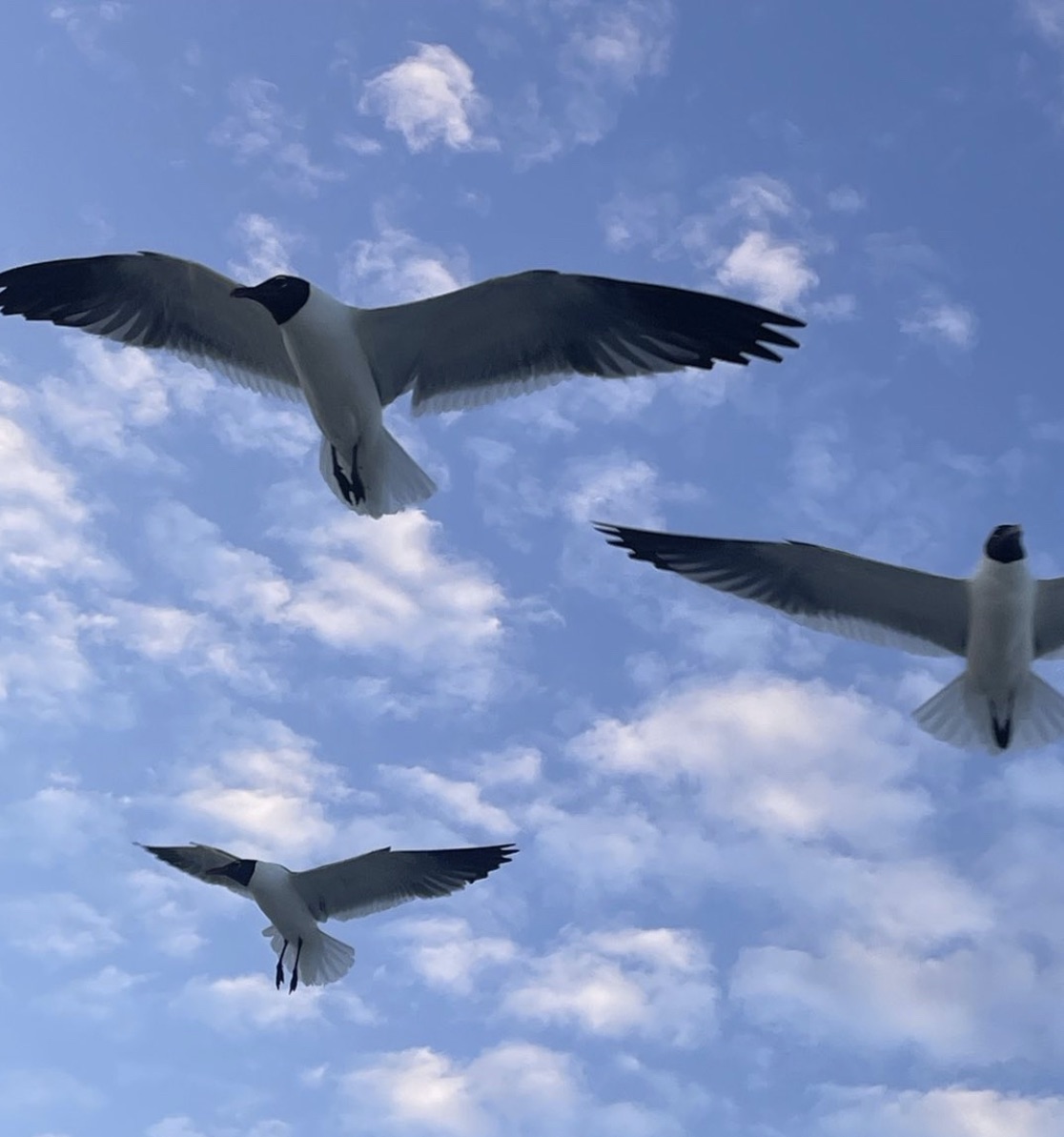
I took a few beach pictures on my phone, but I flipped back to Hope Dublin’s Instagram photos (@hopesview2021) and found this amazing one of flying seagulls. My summer days come to an end this Friday when teachers return to school.
Please join me today by writing a small poem in the comments. Support other writers with comment replies.
Photo by Hope Dublin
Sand tickles my toes while seagulls float on air sing an August song.
Margaret Simon, draft
Thomas finds the T on the keyboard. He can also find M for Mamére.
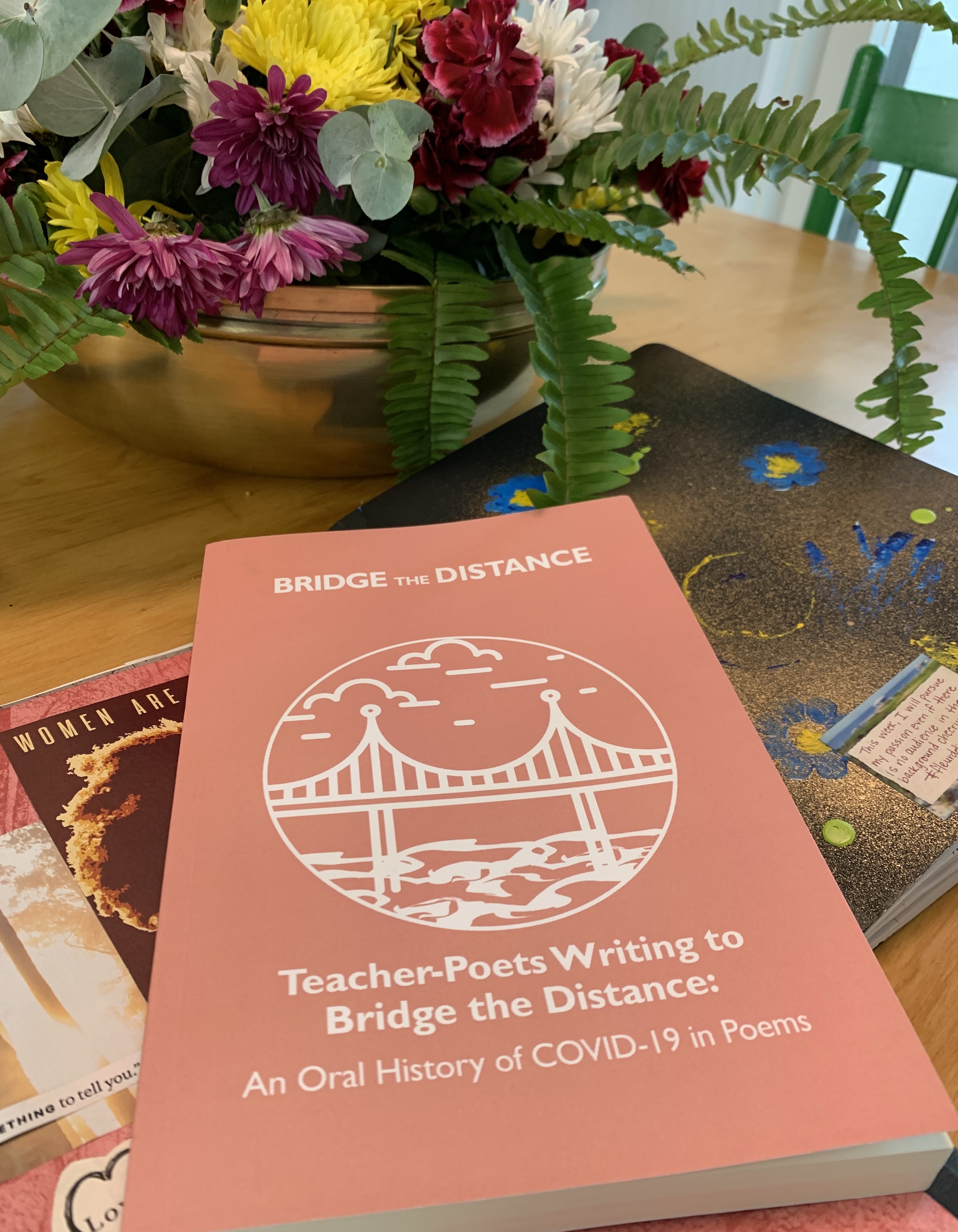
This month I am participating in The Sealy Challenge by reading a poetry book each day. Today’s book is An Oral History of Covid-19 in Poems gathered by Sarah Donovan of Ohio State University. Sarah curates Ethical ELA with an Open Write event each month. During the month of April, she posts a prompt each day. In the spring of 2020, the daily writing was a way for teachers isolated by the pandemic to connect through writing. We wrote poetry to process this unusual time. Sarah and her colleagues decided to preserve this work in an oral history project. Through that project, they conducted interviews by zoom and collected submitted poems into a collection. The book is free to read online or you can purchase a book copy for the cost of printing. (Link to Free Press Book.)
The thread that holds this collection together is the shared experience of teaching in 2020. Many of the poems are narrative while some follow forms.
I’ve chosen two poems to feature today.
Elms on Death Row
DENISE HILL
Three trees stand solemnly in a row just as planted nearly one hundred years ago
Each tendril root tapped deeply into place somnolently holding to earth
Craggy rough bark like aged hands so many life stories harbored there
Each now marked: a bright red dot some roughshod city worker sprayed just doing his job
Their days are numbered soon hewn to stumps then those ground flush
I place my hand on one breathe in breath out say “Thank you”
then the next: Thank you. then the next: Thank you.
Lest they go from this world unappreciated for all they have provided.
Thank you.
I relate to this poem as I have experience the chopping down of trees for development. Haven’t we all? I feel sad for the marked trees. Denise captures that feeling well. I love how she decides to deal with this sadness, not by ranting, but by gratitude. This poem also holds together as a metaphor poem for Covid. The illness strikes some with little or no symptoms while others are very ill and die. Senseless deaths. Like the Elms, they leave behind their stories.
Washing Hands
SCOTT MCCLOSKEY
They say that all poems are political; all poems are an expression of freedom against oppression are innately radical. Their mere “existence is resistance.”
But not this one.
This one is just about me washing my hands and how sometimes I lose count, so I need to start over to ensure that I’ve done it for the proper length of time.
Hands lathered up, I stare out the kitchen window at the neighbor’s house, at my neighbor who, although it’s the middle of December, and sure, it is unseasonably warm, looks to be planting fake flowers in the sills outside of her windows.
This is the same neighbor who was surprised when her racist lawn ornaments were stolen this past summer when yet more videos of atrocities and injustices were going viral,
which, of course, makes me scrub more vigorously, thinking of the UPS package that came, the actual reason that I’m standing here in the kitchen — Was that one thousand seventeen or eighteen? —
So, I apply more soap from the hands free dispenser, and watch, transfixed, as she carefully, artistically even, places various colors and kinds together, creating, to her mind at least, a pleasing arrangement, taking more care and effort to arrange these fake flowers than she has ever afforded her neighbors.
And I just wanted to wash my hands, wanted to not (potentially) infect my wife or myself, wanted to simply go about my business, maybe read a little, grade an essay or two,
but I keep thinking about the sad fact that cultivation does take time and effort and persistence, and, for some, it really is easier to arrange plastic flowers
than to plant and nurture live ones.
In Scott’s poem about washing hands, I appreciate how he sets up the poem as an ordinary moment, not a political poem “not this one” and yet, it becomes more and more filled with emotion, and in the end, imparts wisdom with an extended metaphor in “plastic flowers.”
I hope I can continue this daily blogging practice around a different poetry book each day, but realistically, “cultivation takes time and effort”, as Scott McCloskey says. I’ll take it day by day. Thanks for reading.
I first heard of Ilya Kaminsky in a Poetry Unbound podcast episode. Commentator Pádraig Ó Tuama said he read Deaf Republic three times on the airplane flying home to Dublin. Three times! I thought that would not be me. I don’t usually read books more than once, but when I bought it on Kindle, I had to read it at least twice to have any kind of understanding. In pulling together this post, I’ve read many of the poems a third time.
Deaf Republic is not a book of poems for kids or for the faint of heart, even. It was a difficult book. Violence and sex are not topics I choose to read, but I became intrigued by the characterization of deafness and sign language. The townspeople, after witnessing the shooting of a deaf boy, use an assumed deafness and create a sign language as opposition to the occupying forces.
I’ve learned that Ilya Kaminsky is deaf himself. It’s important to know this when listening to him read. I had a chance to see him present in the Poetry Teachers Institute from the Poetry Foundation last week.
The poem I’ve chosen to feature today is “Alfonso Stands Answerable”.
Alfonso Stands Answerable
My people, you were really something fucking fine on the morning of first arrests:
our men, once frightened, bound to their beds, now stand up like human masts— deafness passes through us like a police whistle.
Here then I testify:
each of us comes home, shouts at a wall, at a stove, at a refrigerator, at himself. Forgive me, I
was not honest with you, life—
to you I stand answerable. I run etcetera with my legs and my hands etcetera I run down Vasenka Street etcetera—
Whoever listens: thank you for the feather on my tongue,
thank you for our argument that ends, thank you for deafness, Lord, such fire
from a match you never lit.
Ilya Kaminsky, Deaf Republic
There is so much to notice in this poem. I notice the varying line lengths, first person narrative, and a strong simile is “deafness passes through us like a police whistle.”
A craft move that I would not consider in my own poetry because of the possibility of confusion is the direct address to different characters outside of the poem. “I was not honest with you, life–” and then “Whoever listens” To whom is the narrator testifying to? me, the reader? or the enemy?
I also wonder about the word “etcetera” repeated. I like the way it sounds when read aloud. But why, when the line means the same without the word?
This poem lands with power. As a poet, I rarely hit that mark.
I wonder about using this poem to teach poetry. For my students, I would remove the curse word and draw attention to repetition as a craft move and wonder about the word “answerable”. What does it mean? Why is the narrator answerable?
Honestly, the more I wonder about, the less I know. I probably need to read the book again.
Margaret Simon lives on the Bayou Teche in New Iberia, Louisiana. She is a retired elementary gifted teacher who writes poetry and children's books. Welcome to a space of peace, poetry, and personal reflection. Walk in kindness.








 Reflections on the Teche