Welcome to a weekly writing prompt. The steps are easy, if you choose to try them. Listen to your muse. Write a small poem in the comments. Leave encouraging responses to other writers. This is a safe and sacred place to write. Begin.
Butterweed by Margaret Simon. I took this photo on my iPhone using the app Camera+ 2.
Cypress knee with butterweed, photo by Margaret Simon
I took these photos in my backyard on Bayou Teche in Louisiana. These are wild flowers known as butterweed that grow before my yard man (husband) has a chance to mow. Sometimes he will mow around them because he knows I love them. They offer a bright spot in a winter yard of bare cypress trees and brown lawn. Here’s a bit of research I found.
Weary of its winter bed bursts of yellow whisper secrets of Eos.*
The word sacred can have many connotations. When I read today’s invitation to write about your sacred writing space, I began with thoughts about the word itself. Sacred. Yesterday I read Nikki Giovanni’s poem “In the Spirit of Martin” alongside a fifth grade student. She asked the question, “What does sacred mean?” responding to the poem’s first line, “This is a sacred poem…”
My initial response was “holy.” Sacred is a place that is quiet and contemplative, like a church.
Is my writing space sacred? Consecrated by different sizes, shapes, and surfaces of paper. Blessed with pens which become cat toys if I leave them out. Ordained by hard maple wood. My writing space is my kitchen. It’s where all the animals hang out. It’s close to the coffee pot. There’s a door that leads out to a winding bayou and cypress trees.
Our writing spaces become sacred when we make the space to sit in quiet stillness, to listen to the inner voice, and to be confident enough to put words on a page (or screen).
When the c trades places with the a,sacred becomes scared. Sacred can be scary. I’ve certainly had that mix of butterfly flutters in my belly when entering a sacristy.
Writing can be scary, too.
I’m learning to trust the process. To let my words be sacred. To open up myself to the vulnerable space. It’s still scary, but more often than not, it feels fulfilling and safe.
Thank you to Two Writing Teachers for creating an amazing community of writers and a safe, welcoming space to write and share.
We’ve learned that quiet isn’t always peace And the norms and notions of what just is Isn’t always just-ice
Amanda Gorman, The Hill We Climb Inaugural Poem
These words from Amanda Gorman hit a nerve. As a white woman raised in the south in the 60’s and 70’s, Just Is was a part of the thread that wove the fabric of racism in our time. Echoes of that’s just the way it is rang through the school hallways I walked, the places we shopped, the neighborhood streets we rode. The only dark faces I saw were our maids and their children.
Desegregation didn’t happen until I was in the 4th grade, 1971. I remember having no school for two weeks while the scramble to mix it up began. That was fun for us kids. When we returned to school, there were new faces, new teachers. My favorite was Miss Love. She was a large black woman with a great bosom for hugging you close. She gave us one of my favorite assignments, a state project. I chose Maine because the capital city is Augustus, my birthday month (of course!). I have never gone to Maine but have a special place for it in my heart because of Miss Love.
Change is easy for kids. Children don’t really know racism. I didn’t when I was ten. But now, in retrospect, I see more clearly how “just is” was not “justice.” I cannot change the past. None of us can. But we can do better when we know better, another famous quote from an African American hero– Maya Angelou.
Like the nation, I have fallen head over heals in love with Amanda Gorman, the youngest inaugural poet ever, and a heroine to many young girls just like the ones I teach. All girls, no matter their race, can now dream of being a Vice President someday. As much as I admire Kamala Harris and her accomplishments, the star of Inauguration Day was young Amanda Gorman. I couldn’t wait to present her to my students this week.
We started on Tuesday with her poem “In this Place (An American Lyric)” written for Tracy K. Smith’s inauguration as Poet Laureate in 2017. (This post from the Library of Congress contains the poem and a video from the reading.) As Kaia heard that poem, she was writing. And after class that day, she sent me two more poems. Amanda lit a fire in her, a flame for words.
There’s a poem in this place after Amanda Gorman
Not here nor there But there’s no need to look everywhere tug and pull on my hair Hoping that this poem, has time to spare
There’s a poem in this place While i’m in disgrace Of finding my lyric That belongs in this place
There’s a poem in this place Still not being found Is it in a dog hound? No, it weighs more than that one pound
There’s a poem in this place While the wind is hitting my face Being withdrawn due to lack of space Without leaving any sign of a trace
There’s a poem in this place Where could it be? Wait, I have found it! It’s in YOU and ME.
Kaia, 5th grade
On Thursday, we used Pernille Ripp’s generous gift of a slide show to visit and discuss “The Hill We Climb.” While the message of this poem was powerful, I was drawn to Amanda’s effective word choice, how they sound and how their meanings change with usage. Combinations like just is and justice, arms, harm, and harmony, and tired, tried, and tied. Chloe’s poem below is her good effort to play with word sounds like Amanda.
There’s a poem in sight Too bright To fight It takes flight To the world of an artist Who’s never artless Who just started to harness The sharpest words That bring out The creativity With a twist And a big Dream to Feel like They exist
I don’t live in a cold climate, and with our lows in the early 30’s last week, I was grateful for sweaters and scarves and hats. I don’t love cold, but I love photos of snow and ice. Amanda Potts lives in Ottawa, Canada. She walks every day (making me feel like a wimp when I don’t want to walk in the cold). She posts wonderful photos on Instagram. Most of her photos are close up. This one was so close that you can make out little ice sculptures in the branches. There’s a whole fairy tale world right there in the photo.
On the Merriam-Webster website, there is a quiz about words for snow and ice. I failed miserably. Perhaps if you want to challenge your knowledge, as well as gather words for your poem, take a chance: Words for Snow and Ice Quiz.
Join me in writing a small poem. Leave it in the comments. Be sure to support other writers with encouraging words.
Glimmer*
Ice birds peck at thorns finding the silver lining.
*ice newly formed in cracks, holes, or surface puddles of other ice
Thank you to Two Writing Teachers for creating an amazing community of writers and a safe, welcoming space to write and share.
As a teacher-poet, I am most fulfilled when I have inspired a young person to write a poem. My colleague and friend Beth was recently entertaining her two granddaughters, Annie and Eliza. Their mother, Beth’s daughter, would be coming home soon with their new baby sister. Beth read to them a poem from Bayou Song, I am a Beckoning Brown Bayou. Beth is a wonderful teacher, and possibly she talked to them about poetic elements, but I also know these girls have been read to as long as they have been alive, six years for Annie, and four years for Eliza. Lyrical language is a part of who they are!
Beth sent me a text with each of the girls’ poems. She gave permission for me to publish them. I sent an email response to the girls naming the things I noticed in their poems. Beth said they read my email over and over. Every writer, even ones as young as four and six, love to get feedback.
I am a flower dress I decorate a pretty pony tailed girl I twirl and spin around I move when she does I wiggle like a snake
I am a flower dress I am pretty pink and purple I have sparkles shining like a colorful rainbow I am beautiful like rose sapphire
by Eliza, age 4
I am a dinging doorbell I am squeezed in my belly button I am rung by a little girl with brown hair and a checkered dress I giggle when people press me to be funny
I am a dinging doorbell I am shy when visitors come I am happy when I am answered I ring when I am pressed. I get excited whenever I am used I am a dinging doorbell
Poetry Friday round-up is here today! Put your links with InLinkz at the bottom of this post.
Last week the Sunday Night Swaggers posted Nestling poems, like Irene Latham in This Poem is a Nest. I couldn’t stop there. I had to share the concept with my student writers. I had planned to teach the inaugural poem by Richard Blanco, One Today. I have the picture book, and it’s just an amazing poem all the way around. It’s especially full of nestlings for writers to find.
I filled two notebook pages with them. I copied a few into a Canva design. (My student helped with titles.)
Kaia and I wrote this one together, each choosing lines back and forth.
millions of faces
arrayed
all of us
we keep dreaming
many prayers
buon giorno
every language spoken
into one sky
by Kaia and Mrs. Simon
trains whistle
like a silent
drum tapping
on every rooftop
a birthday tune
by Chloe (She asks you to guess the title)
For the Winter Poem Swap, I received a gift poem all the way from Australia, along with the cutest little carrying bags with an original print of an echidna. Kat Apel and I muse about how similar and how different our landscape is. We often post similar pictures on Instagram of canoeing and walking about. Her poem is a delightful back and forth about our similar, yet different homes.
Pop over to Kat’s post to see how Robyn wrote in a similar style in her poem for Kat. It’s a small world after all.
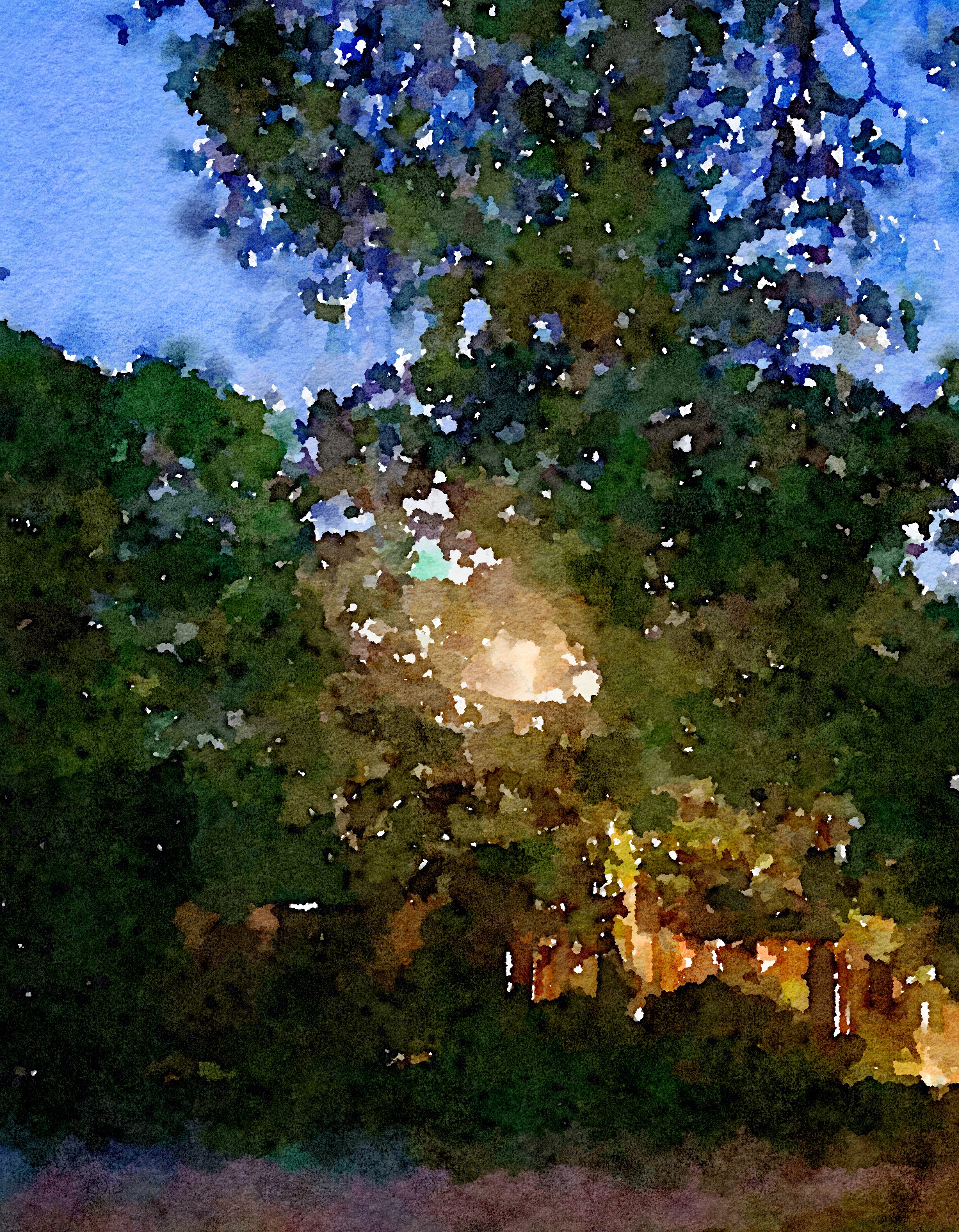
So much can happen in a week. I took a photo last Wednesday, January 6th in the early morning before the sunrise. Capturing the moon peeking between the arms of an old oak tree, I was in a good mood. The week was going well, back to school after the holidays, and my spirits were lifted to the sky. Since that morning, my country that felt safe became unsettled and moving in a violent direction, attacked by American citizens, our own people, our neighbors. I’m struggling with how to feel, how to move forward, how to teach.
But today, I was looking for a photo to post, a photo that wants to be a poem. Maybe you are, too. Please join me by writing a small soul-searching poem, only 15 words, maybe fewer. Leave your poem in the comments and respond to others. Thanks for giving me hope, the thing with feathers…
Moon and Live Oak, photo by Margaret Simon
An acorn buried long ago reaches out toward the moon hopeful to shelter another day.
Thank you to Two Writing Teachers for creating an amazing community of writers and a safe, welcoming space to write and share.
The world always seems brighter when you’ve just made something that wasn’t there before.
Neil Gaiman
Art wall selfie
I believe that art is for everyone. Even a 2 year old. I heard that the Acadiana Center for the Arts had free exhibits, so I packed up Leo (after a stop at CVS to get him a mask), and we made our first visit ever to an art museum. The first of many to come.
Leo, like many 2-year-olds, is learning about his world and naming things. He recently started saying, “What’s that?” In art, “that” can be open for interpretation, so I’d say, “What do you see?” He saw birds, crabs, and even dinosaurs. One large abstract painting made him say, “Scary!” I asked him what he saw that was scary. He named things in the painting that I didn’t see. Imagination beginning!
In one gallery, there was a table with an outline of a diamond shape, colored pencils, and scissors. We colored together and added our masterpiece to the art wall.
In another display there was a painted piano. He loved sitting on the stool and playing the “key horse.” I learned later that he was trying to say keyboard. I told him it was a piano, so he repeated, “pinano!”
I have joined Michelle Haseltine’s #100DaysofNotebooking. On our art date, Leo and I made a notebook page using washi tape, flair pens, colored paper, and poem seeds. Our poem captured Leo’s curiosity and wonder.
One Twinkling Star Looking
Making art in my notebook, Leo style.
Inspiration: Not everyone has the advantage of spending time with such an enthusiastic observer, but consider taking some time to go to an art museum or play in your notebook. You’ll be happy you did!
Poetry Friday round-up is with Sylvia at Poetry for Children. She highlights poetry books coming in 2021.
The Sunday Night Swaggers have entered this new year with a challenge from Heidi Mordhorst. We’ve all read and admired the new poetry collection from Irene Latham, This Poem is a Nest. I reviewed her book on this post.
Irene created the term nestling, which is similar to a found poem. She started with her own poem and found new poems within it. I decided to start with a poem I wrote for Heidi for the Winter Poem Swap.
Essence of Heidi
There you are rolling Play-doh balls, placing them onto a fake birthday cake, lighting each candle deep breath in, then screen-blow– a ritual of celebration, exclamation of You Matter!
There you are creating a caterpillar’s undoing, how it digests itself to become something miraculous, shouting the great wonder– a ritual of changing, shedding the old, in silence.
There you are writing words, passion-pulsed onto the page to inspire a child or grown-up– a ritual of reading aloud, praise for turn-the-page, frosted ice melting into a poem.
–Margaret Simon, 2020 Winter poem swap
Here are my nestlings…
Happy Birthday! Play-Doh cake in celebration of You!
Writing Teacher Words inspire-up praise.
Picture Book Lighting a miraculous child, then turn-the-page
Autumn Undoing– become shedding silence
Peek-a-Boo There, There, there you are.
Irene’s Nest Ritual of passion pulsed the page into poem
Margaret Simon lives on the Bayou Teche in New Iberia, Louisiana. She is a retired elementary gifted teacher who writes poetry and children's books. Welcome to a space of peace, poetry, and personal reflection. Walk in kindness.