Feeds:
Posts
Comments
Poetry Friday round-up is with Christie at Wondering and Wandering

On Tuesday evening I participated in a free webinar from Highlights with Lesléa Newman called “Poetry to Soothe the Soul”. During the presentation, I realized I had picked up one of her books at NCTE last fall, October Mourning. I went on a search for it and found it and have been reading. It’s a verse novel about the killing of Matthew Shephard. Her use of short form and repetition is affective in that book.

The Patrol Officer’s Report

two thin white tear tracks
one red swollen blood-caked face
this is someone’s child

Lesléa Newman, October Mourning

With us, she shared her own Pandemic Haiku. Her homework assignment was to write our own. I had written a haiku a few weeks ago and sent in a soundbite of me reading it to Alan Nakagawa’s sound collage commissioned by OCMA, Social Distance, Haiku, and You! This week I received a link to all the creative sound recordings. They had more than 500 entries. My haiku is included in Part B. Posted here if you choose to listen.

Heartbroken world mourns
Loss of who we were before
Waiting for new life
-Margaret Simon

On Wednesday, I collected moments throughout my day in haiku. Here is my collection:

Pandemic Haiku

In a viral time,
let us be grateful for this:
Breath. Green. Life.

Early morning sun
slant of light through cypress shades
welcoming hummers

Walks with Leo
are a wander, meander
See dat, dat, and dat? 

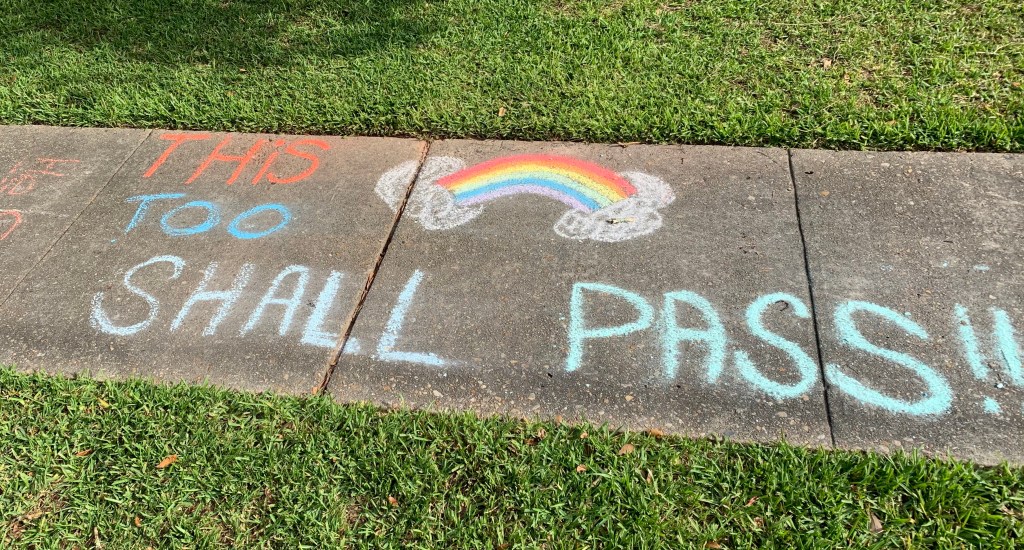
Chalk art on sidewalks
greet passersby with colors
“This too shall pass!”

A new duck tenant
three eggs today lay
in the wood duck house.

Seven green-gold charms
chrysalis-haven for wings
to magically form.

Watching my screen
I see Chloe, Rylee, you
in your own kitchen. 

Don’t know what will be
when the viral storm calms down
I hope for a hug. 

Margaret Simon, draft 4/22/20
Message in sidewalk chalk

Welcome back to This Photo…a low stakes writing prompt. Don’t think too long and hard about this. Whatever comes is good. Leave a small poem of 15 words or so in the comments. Read other poems and leave a supportive comment. That’s it. Poetry brain practice!

Clouds by Jone MacCulloch
Wispy clouds by Margaret Simon

I love to notice clouds. Cloud photos never quite come out as well as what you truly see. What can you imagine in the clouds? Look up. Just notice. Take a moment to be present.

Cloud goddess
flies her kite,
a ballet dance
on Spring’s serene
sky-stage.

Margaret Simon, draft

Check in on the Kidlit Progressive Poem that is going on an adventure today to Haiti with Ruth.

#NPM20: Earth Day

This poetry month I didn’t commit to write a certain type of poem every day like many other poets I am following. I decided I would write to the muse. Wherever she lead, I would follow.

Among my weekly teacher-poet emails, I get Teach this Poem from Poets.org. This week the poem to teach was “Earth. Your Dancing Place” by May Swenson. One line (“Take earth for your own large room”) jumped out at me and wanted to be a golden shovel. After messing with it in my journal, I created this draft.

Earth’s Heartbeat

If you take

a moment with earth,

touch her for

her soothing spirit, place your

hand on her beating heart, your own

heart will open a door to a large

living room

Margaret Simon, draft 2020

I was also inspired by Catherine Flynn’s post that included the NASA Earth Day poster. The artist, Jenny Motter, used the idea of listening to the pulse of a tree to create this amazing image. There is much more imagery used in the artwork that you can read about at the NASA site.

Thank you to Two Writing Teachers for creating an amazing community of writers and a safe, welcoming space to write and share.

#NPM20: Storm Song

I subscribe to Poets & Writers The Time is Now writing prompt email each week. This week, the poetry prompt here asked writers to watch a video of a dance in which their movements were stilted rather than flowing. The prompt was to write a poem of one syllable words. I want this to be a new form: single-syllable song.

My dog in many ways is the perfect dog, schnoodle (schnauzer/ poodle mix) so no shedding. He always wants to please. He’s incredibly patient with kittens and babies. However, he is afraid of storms.

Last night a storm rumbled around 11:30 PM. Charlie barked. His bark is more of a squeal. Like a baby’s cry of fear. I got up and held him in my lap for a while until he was calm enough to sleep. That’s where my mind went to write this poem. I like how placing each word on its own line helps bring out the tone of fear and release.

Storm Song
One
step
forth
leads
me
through
dark
halls
when
he
cries
he
pulls
my
heart
grabs
me
in
a
hug
we
fall
to
sleep
dream
of
a
new
way
to
feel.

(c) Margaret Simon, draft

Poetry Friday: Zeno

Poetry Friday round-up is with Molly at Nix the Comfort Zone

Have you heard of the Zeno form? It’s one of my favorites that I’d forgotten about until I made a “Poetry on the Bayou” episode on my YouTube channel. I’ve been recording myself sitting outside on the back deck overlooking the Bayou Teche. I’m reading poems from my book Bayou Song.

This week I read a Zeno about cypress knees, a strange phenomenon for the bald cypress trees which are prolific around the shores of the bayou. Some people cut the cypress knees and use them to carve decorations or paint on. There is no solid research on how or why the cypress trees make their knees. And my husband, aka the yard man, curses how they interrupt his mowing flow.

Listen to a Cypress Zeno and learn to write a Zeno poem.

A zeno follows a mathematical sequence for a syllable count of 8,4,2,1,4,2,1,4,2,1. J. Patrick Lewis originated the form and added that the 1 syllable lines should rhyme.

With students, I enjoyed adding the element of a “zine” to create a “Zeno-Zine.” You can see a previous posts about making Zeno-Zines for Dot Day and in Summer Poetry Swap.

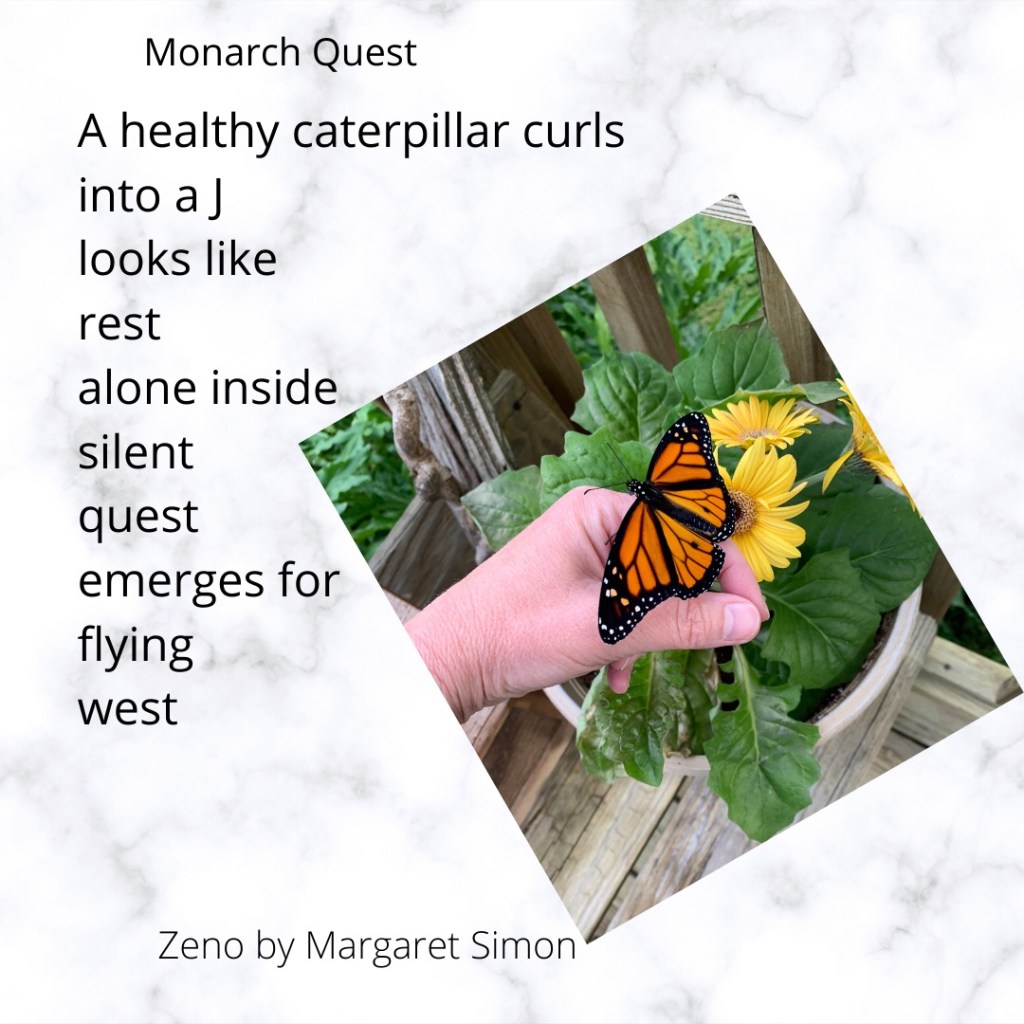
Today I released a monarch butterfly that I had sheltered in a habitat for two weeks. The caterpillar came as “lagniappe” on a milkweed plant I bought nearly three weeks ago. The caterpillar made its chrysalis on a leaf. I wanted to plant the milkweed in the garden, so I taped the leaf to the top of the butterfly net, only to have the tape release, and the chrysalis end up falling to the floor. I had luckily taken precaution and placed bubble wrap on the floor. Once it fell, I realized that the tape was sticking too well to the bubble wrap, so I just decided to leave it alone. I really wasn’t sure if it would develop. Call it the miracle of nature or the resilience of monarchs, but the butterfly emerged yesterday, full and complete. This calls for celebration in a Zeno poem.

Watching. Noticing. Listening. There’s more time for being more aware these days. More aware of the nuances of nature.

Welcome to another This Photo wants to be a Poem episode. Observe. Notice. Research, if you will. Then write about 15 words or so as a snippet of a poem. Leave comments on other poems.

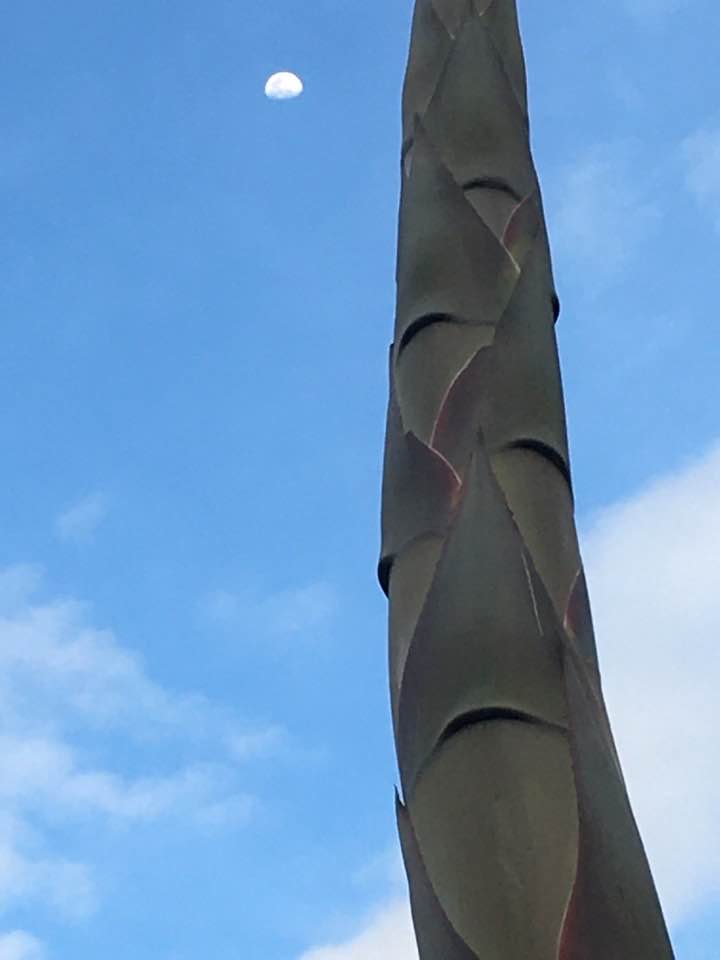
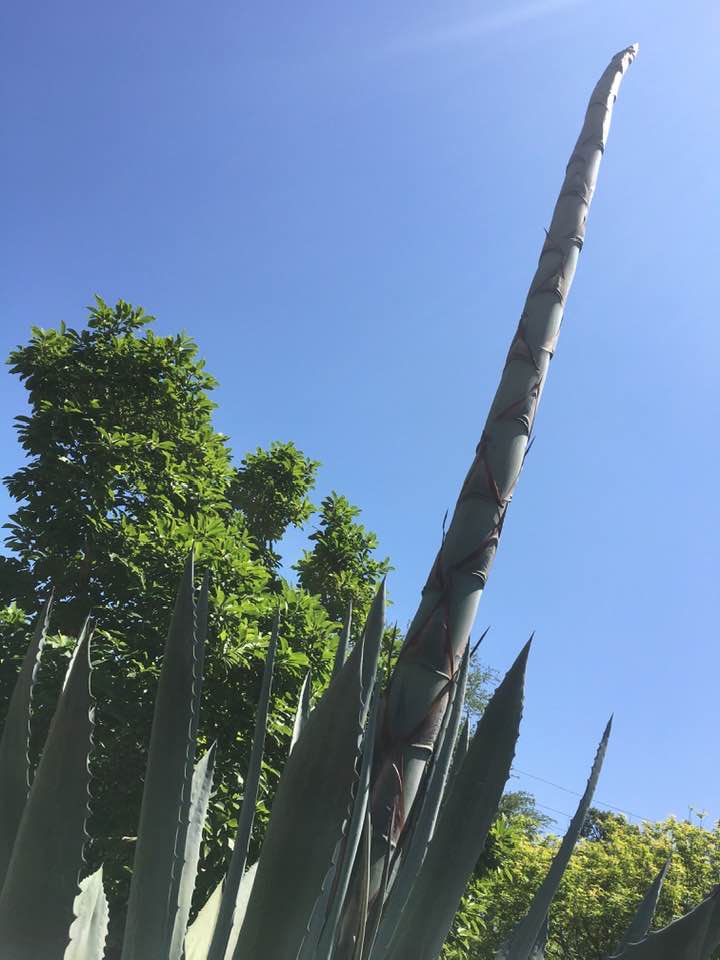
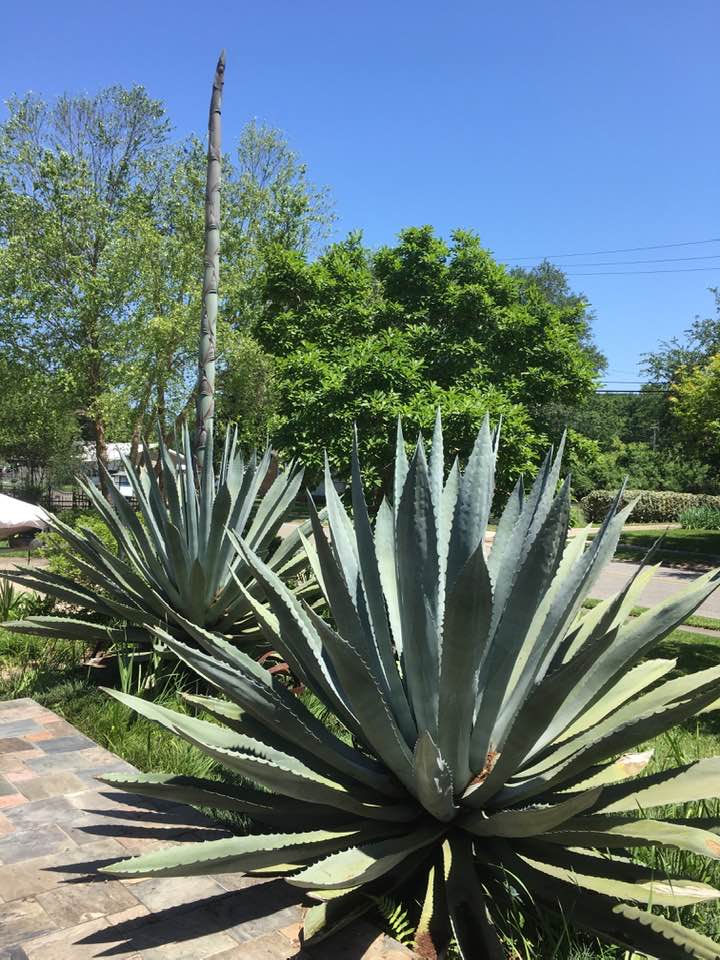
My neighbor has been posting pictures of her century plant almost daily for the last few weeks. I’d never heard of one before, but a century plant blooms once in its lifetime. And hers is about to bloom. Patience is keeping us waiting.

Century plant with moon, photo by Anne Darrah

I commented on one of her photos that this plant needed to be a poem. I can spend (waste) a lot of time down a research rabbit hole. Here are some quick bullets copied from Google about this plant.

  • Although it is called the century plant, Agave Americana typically lives only 10 to 30 years. It has a spread around 6–10 ft (1.8–3.0 m) with gray-green leaves of 3–5 ft (0.9–1.5 m) long, each with a prickly margin and a heavy spike at the tip that can pierce deeply.
  • Although century plants are quite long-lived — though not nearly as long as their name would suggest — they die right after flowering. As soon as flowers set seed and drop, the plant withers and dies.
  • The plant is called the “century plant” because of this “once a century” bloom (actually the plant lives an average of 25 years).
  • Agave plants are easy to grow, but they do have a few “needs” to thrive. They need at least 6 hours of direct sun and well-drained soils. Planting in well-drained soil is particularly important in preventing root rot, especially in North Florida where cooler winter temperatures may add stress to your plant.
  • The massive flower clusters (1-8 m long) are borne at the top of a very robust flowering stem.
Century plant taken 4/14/20 by Anne Darrah
Century plant full view, photo by Anne Darrah

Once in a Lifetime

Stairway to heaven,
one step at a time,
blossoms in the sky!

Margaret Simon, draft

Today is my prompt day at Ethical ELA. Please stop by and write an analogy acrostic.

On Sunday, Stefani Boutelier prompted on Ethical ELA a “Where I’m From” poem like the ever popular George Ella Lyon poem. I’ve done this exercise many times over the years and have never been happy with my results. The poem seems over-sentimental. I went ahead and tried again. This time, I’m happier with the poem and even shared it aloud with my sister, brother, and our parents on Easter morning over our FaceTime.

Photo by Steve Johnson from Pexels

Where I’m From

I am from piano keys and pot roast,
From Charles’ Chips in a can.
I am from the pine forests of Mississippi,
Beechcrest Drive and Purple Creek,
pink azaleas line the red brick house
while a concrete “waterfall” waits
at the edge of the woods.

I am from writing notes,
tucking them into your locker
between classes.
From shade of a sycamore–
broad-leafed Daddy’s pride.

I’m from singing carols around the grand,
a gallery of books climbing high as the ceiling.
From Liles and Gibson trees,
arms of Margaret and Eugene.

I’m from church on Sundays.
From hurricanes and a Pearl River flood.
From pot-liquor
with turnip greens, black-eyed peas, and cornbread.

I’m from war stories, Anglican prayers, and theology
over the dinner table set with woven mats,
pottery, and cotton napkins.

I’m from home movies, reel to reel,
stored in tins
that playback Love within.

(c) Margaret Simon


Traditions can be a comfort when life is not as it should be. The tradition of a Kidlit Progressive Poem started in 2012 by Irene Latham. Last year sometime she decided to pass it on. I said yes to coordinating this year, and so far, it’s been an easy job. The Progressive Poem is such a well-oiled machine that it just works. Each poet takes their turn. I haven’t had to remind anyone…yet.

This year Donna Smith started us off with a choose-your-own-adventure style by giving a choice of two lines. Subsequently, each poet has done the same. Choose a line. Compose two lines. Move on.

The first stanza wasn’t following a strict rhyme scheme. However, stanzas 2 and 3 unfolded in rhyming couplets.

Leave it to Kat Apel to stir things up a bit. From across the globe in Australia, she introduced some suspense. I’m good with that, but the two end words were snaps and glimpse. Try a search for rhymes, and you get impossible words like claps and wimps. When I left a comment for “katswhiskers”, she responded, “I confess, I wasn’t thinking ahead to any rhymes when I wrote my line. But now that you say that… I think a disruption of flow (and rhyme) is a good thing in a turning point. #permissiontobreakrules”

Sweet violets shimmy, daffodils sway
along the wiregrass path to the lake.
I carry a rucksack of tasty cakes
and a banjo passed down from my gram.

I follow the tracks of deer and raccoon
and echo the call of a wandering loon.
A whispering breeze joins in our song,
and night melts into a rose gold dawn.

Deep into nature’s embrace, I fold.
Promise of spring helps shake the cold.
Hints of sun lightly dapple the trees,
calling out the sleepy bees.

Leaf-litter crackles…I pause. Twig snaps.

As I pass this pleasant romp to the lake on to Leigh Anne, I decided to go the way of near rhyme. Will our hero fall? Or will they handle the pressure with mindfulness? You choose…

Option 1: I stumble, reach out… there’s nothing to grasp.

Option 2: I gasp! Shudder! Breathe out. Relax…

You can follow the Progressive Poem using the links on my sidebar. Thanks for stopping by.


I’ve been following Laura Shovan’s #WaterPoemProject. Margarita Engle, one of my favorite poets for children, prompted us to write an ode to a body of water. I write over and over about my bayou. Ha! I even call it my bayou. Living near water brings me joy and solace.

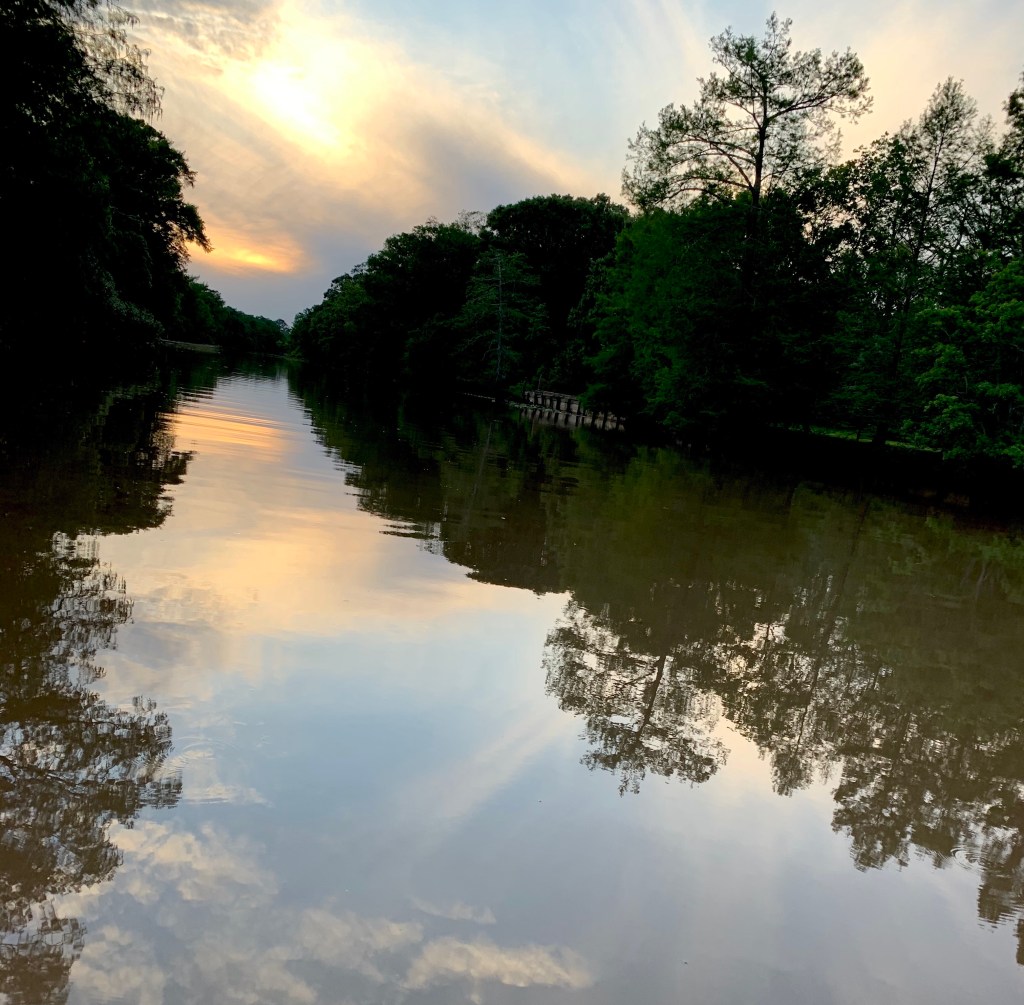
This ode comes directly from our experience of canoeing on the evening of Good Friday, without the annoying gnats.

Ode to the Bayou

Even as a water snake winds its way
around concrete rick-rack, haphazardly placed
for a bulkhead, I will wander

through your neighborhood of cypress trees
dodging knees, paddling a path of no destination.

Perhaps we’ll head toward the bridge,
stop to gather blackberries or chat
with neighbors about wood duck eggs
and such.

Even as you stretch out like a snake
for miles ahead, I will wander,
wishing for longer days,
photograph your evening haze,
and end my voyage with
this praise. 

© Margaret Simon, April 11, 2020

Bayou Teche sunset Good Friday, 2020

I am so happy to be here today! The Progressive Poem has always brought me joy, despite sometimes offering my line with a bit or more of trepidation. This year is no different. I am able to participate thanks to Margaret’s generous offer to host me here at Reflections on the Teche.  For most of the years of the Progressive Poem’s existence, Irene has taken blog-less me under her wing. I am grateful to both poets and friends. 

While my participation at Poetry Friday ebbs and flows, I am always captivated and inspired by the community I have come to feel so a part of. I look forward to your creative, enriching new works and words. I am intrigued by the newest project or offering. And your books. Oh how I love to read and share them with children. I love when I have the time to devote to joining in. And I am beyond thrilled to have met so many of you in person. You are my people and I feel at home here.  Thank you for your continued friendship and inspiration. It really means the world to me.

My friend Donna has started us in a lovely way. Besides swaying daffodils and violets, I am a proponent of choice for children (I taught for 41 years and still sub!) so I like this. Perhaps a little less pressure, I don’t know, but I feel our poem has thus far developed with flair and wonder.  And perhaps a metaphor for the times we are living in; our path may be lonely, but there is light and water, music and nature surrounding us. To me that is hope.

Thanks to my friend Matt at Radio, Rhythm and Rhyme I had two lovely lines to choose from. 

Sweet violets shimmy, daffodils sway
along the wiregrass path to the lake.
I carry a rucksack of tasty cakes
and a banjo passed down from my gram.

I follow the tracks of deer and raccoon
and echo the call of a wandering loon.
A whispering breeze joins in our song.
and night melts into a rose gold dawn.

Deep into nature’s embrace, I fold.
Promise of spring helps shake the cold

 Next I hand the poem to Linda Mitchell’s pen to see where we go:

Hints of sun lightly dapple the trees   (choice A)

I whistle, then whisper a snippet of poem  (choice B)

Janet Fagal aka Janet Clare F. or Janet F. (Long story how this came to be, but I am too low tech to really change now.) On Facebook I am Janet Clare and I love new friends. My favorite name is Grandma.

A bit about me:
Besides teaching and being Grandma to two sweeties ages 4 and 1, I consider myself to be a poetry advocate for children. I visit classrooms and fill the hours with poetry books piled on desks for children to read and share poems to learn by heart. I have always been met with warm enthusiasm from the children. It is the poetry not me! 

I have poems published in various places. My biggest thrill was being asked by my mentor and friend, Lee Bennett Hopkins, to write for the last anthology published in his lifetime, I AM SOMEONE ELSE: POEMS ABOUT PRETENDING which has my poem about wanting to be a mermaid. I have a poem in Pomelo Publishing’s Great Morning!, Best of Today’s Little Ditty 2014-2015, several in books, magazines, and online for the National League of American Pen Women (NLAPW.org), and most recently Clare Songbirds Press’s The Brave.

Here’s where you can find all the contributors to this year’s Progressive Poem. It’s a fine journey and I hope you will leave a comment or two along the way. It is always nice to hear from readers and other poets:

.
1 Donna Smith at Mainely Write

2 Irene Latham at Live Your Poem

3 Jone MacCulloch, at deo writer

4 Liz Steinglass at Elizabeth Steinglass

5 Buffy Silverman at Buffy Silverman Children’s Author

6 Kay McGriff at A Journey Through The Pages

7 Catherine Flynn at Reading to the Core

8 Tara Smith at Going to Walden

9 Carol Varsalona at Beyond Literacy Link

10 Matt Forrest Esenwine at Radio, Rhythm, and Rhyme

11 Janet Fagal hosted at Reflections on the Teche

12 Linda Mitchell at A Word Edgewise

13 Kat Apel at Kat Whiskers

14 Margaret at Reflections on the Teche

15 Leigh Anne Eck at A Day in the Life

16 Linda Baie at Teacher Dance

17 Heidi Mordhorst at My Juicy Little Universe

18 Mary Lee Hahn at A Year of Reading

19 Tabatha at Opposite of Indifference

20 Rose Cappelli at Imagine the Possibilities

21 Janice Scully at Salt City Verse

22 Julieanne Harmatz at To Read, To Write, To Be

23 Ruth, There is no such thing as a God-forsaken town

24 Christie Wyman at Wondering and Wandering

25 Amy at The Poem Farm

26 Dani Burtsfield at Doing the Work That Matters
27 Robyn Hood Black at Life on the Deckle Edge

28 Jessica Big at TBD
29 Fran Haley at lit bits and pieces
30 Michelle Kogan at Michelle Kogan

.