I dropped the ball yesterday with my Inklings writing group. I had given the monthly challenge and forgot about it. Today I am trying to make up for it by combining the Ethical ELA prompt from Bryan Ripley Crandall to write about scars with the form. Shadorma poems have a syllable count of 3, 5, 3, 3, 7, 5.
Virus
weary soul invisible scars tenderly heal in time slowly becoming new skin touched by cleansing light Margaret Simon, draft
On the first Friday of the month, Inklings (my trusty writing group) respond to a challenge. Mary Lee made it easy this month. She asked us to type a color into the public domain image archive and find a photo to write about. I chose lilac. I immediately got a photo I knew was telling a story. I imagined that Lilas and the bug are having a conversation.
“Unhappy the man who never had his eyes fill with tears at the sight of a particular flower. Such a one can have been neither a child nor a youth. He can have had neither mother, sister, nor affianced bride. He never loved.” This is the tone and tenor throughout Les Fleurs animées (The Flowers personified), a collection of floral — and sometimes florid — writing, featuring playful illustrations by J. J. Grandville (1803–1847), engraved and hand-colored by Charles Michel Geoffroy.
How Lilas Learns of Love (a cherita)
With draping lilacs for long locks,
Lilas questions Sir Ladybug, “Where will my love grow?”
Love grows from a starter seed planted small in your heart until with wisdom, grace, and tender care…Blooms!
Spiritual Journey first Thursday is gathered by Bob Hamera.
Bob suggested we ponder the idea that doors may close while another one opens, how focusing on the closed door may lead us to miss the open one. My father spoke about this in his firm belief that there is always a resurrection. Jesus showed us in a very real sense that when someone dies, it is not the end. I’ve always prided myself on a belief in the resurrection; however, when faced with an actual closed door, a death of something in my life that I put my trust in, whether it be a job, a friendship, a manuscript, I get lost and lonely and question. That is the rough part of the death/resurrection story arc.
I am following a path to a new journey to retirement. This is a door I’ve chosen, but even so, I have mixed feelings. So many of my days with my students are good, happy, and fulfilling. I will miss teaching, I know. I also know I’m a teacher through and through. I chose this career when I was 15 years old. I will find ways to still be a teacher. I keep telling myself this truth, but it’s not easy. When I tell people I’m retiring, I hear “Congratulations!” I wish I could feel excited. Is it the closed door I fear? Or the open one I’m unsure about?
Resurrection fern is grey when the sun is out, but turns to bright green after the rain. May God bless us with the knowledge and grit to survive the grey and thrive again after the rain.
I am posting on my phone because I’m having trouble connecting in a hotel room. I’m visiting my mother who is in the end stages of Alzheimer’s. This time is filled with hard and love, tears and joy.
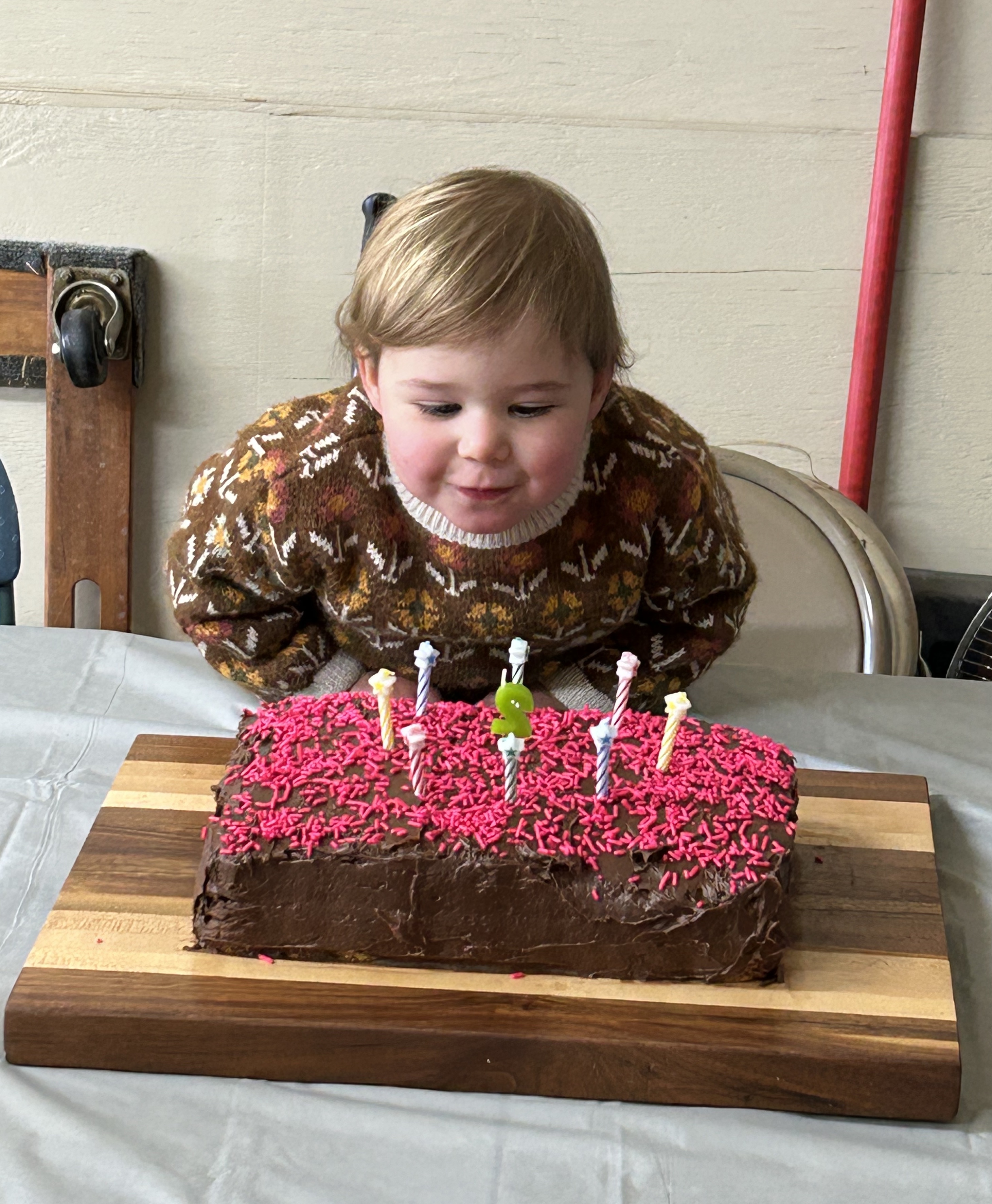
Heidi challenged the Inklings this first Friday to choose a prompt from her Yule calendar. Since I spent last week in the company of my grandchildren, I was drawn to the prompt “Capture the sound of laughter in rhyme.”
I am taking delight in watching my grandchildren laugh. This poem is dedicated to my granddaughter, June, who was two on Dec. 21st.
De-Light
I taste a note of nutmeg on my tongue, a slight burn while I yearn for sweetness, and your song
“Happy Day Day”
your two-ness of delight candles to blow ribbons flow
twisting into this gift of a child shifting,
becoming laughter.
Margaret Simon, draft
June is Two!
To see how other Inklings wrote to this challenge:
Happy November! This is the first day and first Friday, so it’s time for a new challenge from the Inklings. This month Linda, who is also hosting Spiritual Thursday, selected a poem by Joy Harjo Fall Song. She asked us to respond in some way to the poem. I collected words that pleased me for their sounds: blue, you, divine, mind, behind. I was thinking of my mother’s blue eyes.
Her Eyes Blue like the Sky
(after Joy Harjo “Fall Song”)
All you leave behind is blue– blue lace wings–
tinted with night sky. Your divine sign forever will be a blue bird.
I cry for more– more of your soft touch,
the gleam of love lighting
from your crystal blue eyes. Margaret Simon, draft
Linda's One Little Word for 2024 is "World". She has been writing poems all year on a padlet using her word. I admire her dedication to this daily writing. Since she sent out the prompt for Spiritual Journey, I have been noticing that poets often use the word "world".
I recently read Evie Shockley’s poem “job prescription ” and striked a line for a golden shovel: “poetry may not change the world, but might change you.” I believe in poetry. I want to believe that it could change the world, but I’m satisfied knowing that it has changed me. I am a better person, a better teacher, a better child of God because I breathe in poems every day.
What is poetry? An acorn that may or may not become an oak, change leaves for the next season of the world. We read & write, but are never sure which words might sprout to change and inspire the deepest you. Margaret Simon, draft
The Pythagorean poem is another modern poetic invention using a mathematical pattern. Shari Green shared the form with Laura Shovan who shared the form with me and other PF folks. I challenged the Inklings to write one for our monthly challenge before trying one myself. It’s not as easy as it looks.
Like the Pythagorean theorem of geometry, the word count is based on a right triangle. Shari’s instructions:
Here’s the math background: Pythagoras’ theorem is a2 + b2 = c2. One possible “triple” is 3, 4, 5.
3×3 + 4×4 = 5×5
9 + 16 = 25
Using the triple, the poetic form works like this:
1st stanza: 3 lines of 3 words each
2nd stanza: 4 lines of 4 words each
3rd stanza: 5 lines of 5 words each*
* The third stanza must be composed of all the words found in stanzas one and two (in any order; variations okay). The third stanza should be a progression of sorts, a product of the first two in thought or theme or meaning.
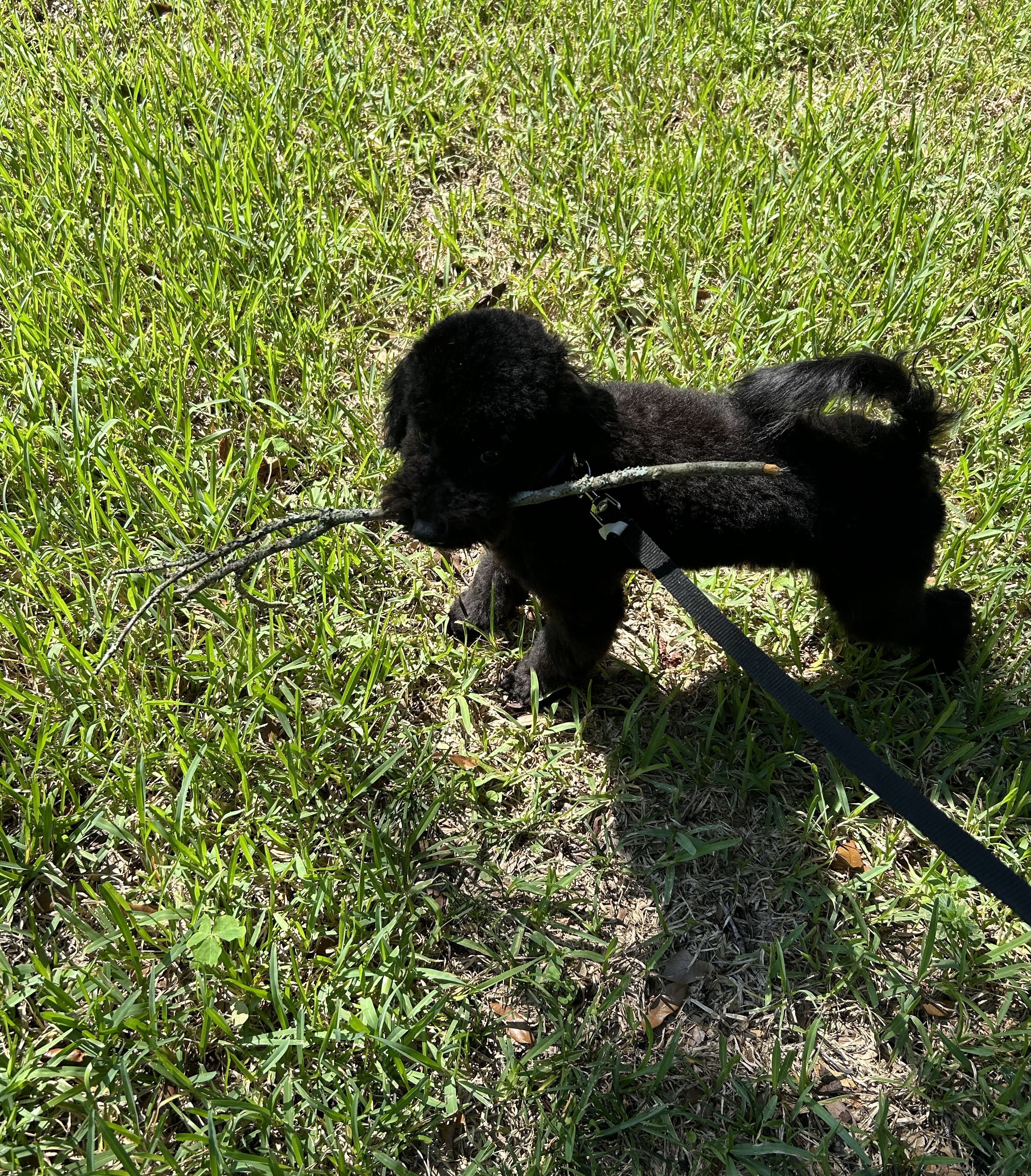
The trickery comes when writing the third stanza. I wrote one about butterflies here. As I tried to write another one, I thought I should have saved that first one for this post. I chose another topic close to my heart, my puppy golden doodle “Albert (Albear)” Albert has been with us for almost 4 months, and he’s really doing well about most things, but he has an annoying habit of barking at us when we eat dinner. As we take our daily walks, he loves to pick up a stick and prance like the prince he is. My poem takes words from Mark Doty’s Golden Retrievals.
I hope you will try the form and tag Shari Green and me. Honestly, I haven’t tried it with my students yet. They are getting their feet wet with cinquains and fib poems.
This month Mary Lee Hahn challenged the Inklings to write after Joyce Sutphen‘s poem Next Time. Sutphen’s poem has a dreamy quality to it, that if-only-I-could-do-it-again thought process. I was drawn to her lines “Next time I won’t waste my time on anger…Next time, I’ll rush up to people I love, look into their eyes, and kiss them, quick.”
I write about grief a lot. Why is that? Grief settles after a while but is always there waiting to be released again and again. It can be set off by a song, the familiar sound of a bird, or my grandson saying “I want to Facetime Pop.” We have to remind him (at age 5) that Pop died. When I sent this poem to fellow inkling Heidi Mordhorst, she said, “You write again and again about grief because you are still learning exactly this.”
Abby Wambach said recently in “We Can Do Hard Things” that she has made friends with her grief. “grief has become a friend to me, in that I am developing a real true relationship with it, because it’s the access point to all of the most intense feelings that I feel, the most intense sadness, the most intense anger.” So, here I am again and again, writing a grief poem.
I’ll avoid the cut grass where the snake eggs lie. I’ll check the mailbox for menacing wasps. Next time I’ll be wary when the cat calls to me in mournful mews.
Next time I won’t stray from the well-worn path. I’ll acknowledge wisdom of ancestors who learned, felt a spiritual guide. Who denies their purpose?
Next time I’ll read the book start to finish, underline passages in pencil, notes in the margin. Next time I’ll know death comes. It will not surprise me. Gut me.
Next time I’ll answer the call on the first ring. I’ll be there by your side, holding your hand in mine. I’ll let love keep its promise, be my purpose.
Poetry Friday is gathered today by Laura Purdie Salas who has a new picture book Line Leads the Way. Visit her site for all the poetry goodness.
The first Friday of each month is reserved for the Inklings challenge. This month Catherine tuned us in to Ada Limon’s project You are Here. Her question is What would you write in response to the landscape around you?
Last month I participated in Ethical ELA’s Open Write. Mo Daley prompted us to write a type of found poem called “X Marks the Spot.” The idea was to take any text and draw an x across the page, then use the words to make a new poem.
I look forward to trying this prompt with my students soon. Having a bank of words to use in a poem can be just the push you need. “You are here” is often marked by an X. I used a poem found in the American Scholar magazine titled “The Bougainvillea Line” by Ange Mlinko.
This summer our landscape has been saturated by rain. This is better than drought, to be sure, and my garden has loved it. This poetry exercise stretched me to find a new place to land. The found words are in italics.
Summer Soaked in Rain
Driving the back roads which pass by train tracks which carve ditches of untended weeds, we breathe the familiar lime-lit gravel there swarming with wild volunteers.
Illuminatedporches bark with fervor, tomatoes once sweet, pock-marked by bird beaks.
I think of my own garden full and overgrown, untrained vine of bougainvillea stretching underfoot with poor allegiance to the government of gardens dissolving in rained-on glory.
Margaret Simon, draft
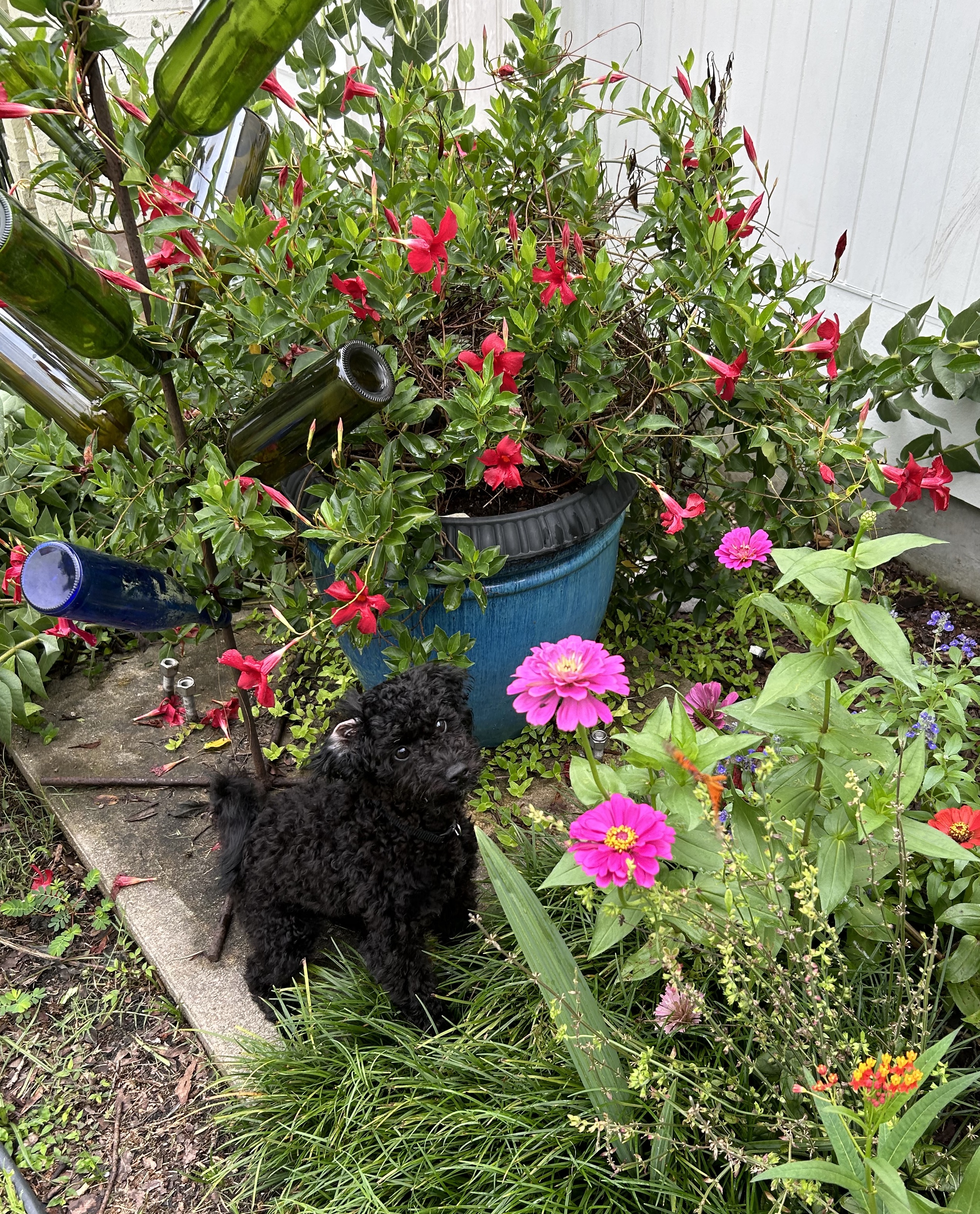
In my butterfly garden, Albert chases a Gulf fritillary. Photo by Margaret Simon
To see how other Inklings responded to this prompt, go to these links:
Poetry Friday is hosted today by Tracey Kiff-Judson at Tangles & Tails.
Here we are again with a monthly Inkling challenge. This month Molly challenged us with a prompt from Pádraig Ó Tuama who said “A poem is a word-event going in many directions at once. Sometimes the “you” of a poem is a specific person, at other times it’s the poet, or a general audience, and at times there’s no you at all so the poem addresses itself to the world.”
Molly asked us to write a narrative poem that includes observations about the world and explores the craft of address, the you of a poem. On a recent morning walk, I spoke two observations into my notes app. I felt invaded upon when a truck high up on oversized wheels revved its engine at me as it passed. The other observation was not connected at all. I saw oak tree arms leaning on electric wires. We’ve had a number of sudden storms this summer, and each one is frightening. That’s all to say that poetry is a place where I can vent; I can let steam rise and fall. I address this poem to the you of a random monster truck.
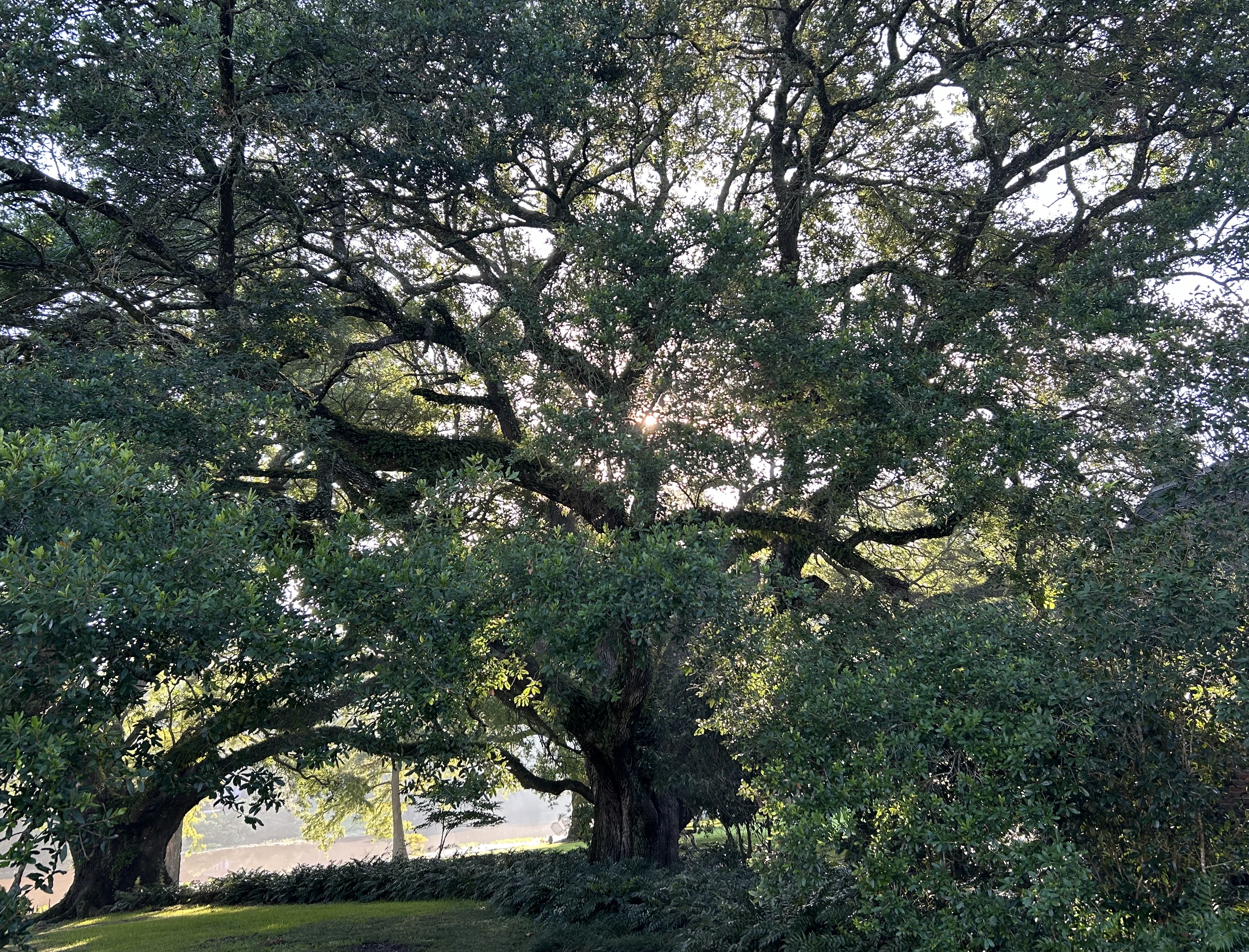
Grandmother Oak Sunrise June 6, 2024
You disturb my peace.
You! with your hot wheels rumbling down the road, motor revving, disrupt this peace of mind I’m in writing a poem in my head about birds singing.
Birds sing as you pass, your rolled-up windows beat-boxing, shaking a rhythm
of my walking, heart pumping brow sweating. I’m in this groove you move your hard edge against.
My poem wants to be kind, but I cannot wash away your harsh sound that erases the wind heaving a heavy sigh
like the old oak arms leaning on electric wires holding heavy vibration– a lightning bolt I cry
to be saved from.
Margaret Simon, draft
Take a look at how my Inkling friends approached this challenge:
Happy May! In many ways, I’m sad that it’s May. I looked over the school calendars, and I have fewer than 10 days left with my students. May’s calendars are worse than December. They are full of “Fun Days”, field trips, and “Awards Day”… Where are the time-with-my-students days?
Of course, there are some wonderful days on the same calendar: Teacher Appreciation Week, Mother’s Day, Memorial Day, Sleep-in-it’s-summer days.
Today is Inklings Challenge of the Month Day. Linda Mitchell hit us with an interesting challenge to exchange poems and “Fiddle with, play with, tinker, tear-apart, be inspired or stumped by” the poem you were given. I chose to find a nestling ( à la Irene Latham). On this Canva design, you can see the poem Linda sent and my nestling.
Full poem “Star Says” by Linda Mitchell Nestling “Star” by Margaret Simon
Links to other Inklings. Molly had my poem to fiddle with. I can’t wait to see what she did with it.
If you followed the Progressive Poem, you can find the poem as a whole at this link: 2024 Kidlit Progressive Poem: Border Crossing This year felt different, a higher stakes dramatic story evolved. Thanks to everyone who participated.
I will be participating in a poetry reading event on Saturday night. It’s been a while since I have read for an audience. Wish me luck.
Here we are on the first Friday of the month and Inklings are spilling secrets. Catherine Flynn prompted us “Write a poem about secrets——family, community/societal, governmental, personal, etc. This could be a narrative (how the secret(s) started, where it or they led, the along-the-way and final (if any) consequences. For inspiration or starting blocks for your poem, here’s this poem, “Family Secret” by Nancy Kuhl: https://poets.org/poem/family-secret“
I found a way to write about my mother. It really isn’t a secret that she is living with Alzheimer’s. I’ve written about her before. But I hesitated to write about her. Is it disrespectful to the mother she used to be? I have discovered by revealing this secret, people are more open about their own struggles with the disease. I hope by telling my story with specificity, this poem/secret reaches out to the universal.
Dressing my Mother at the Memory Care Home
In my dreams, she’s at the kitchen table, sipping black coffee. She’s reading, ready for the day to come.
My sister and I remove her oversized jacket– daughters on either side coaxing her arms free from brown suede. “Is this Dad’s old coat?” my sister asks, pulling
on the heavy cloth. We are caught in a maze of arms and fabric, confusion, undoing a mistake of memory we can no longer hide from. Mom stays silent.
How does thinking work when words are gone?
Her eyes laugh at this silly game we’ve urged her to play. She giggles looks to the dolls on the bed– “How are you doing today?”
Margaret Simon
Visit other Inklings’ sites to hear their secrets, or not.
Margaret Simon lives on the Bayou Teche in New Iberia, Louisiana. She is a retired elementary gifted teacher who writes poetry and children's books. Welcome to a space of peace, poetry, and personal reflection. Walk in kindness.