Feeds:
Posts
Comments

Posts Tagged ‘Joyce Sidman’

Crocheted tree wrap on the streets of Denver

I am happily home and cozy after being in Denver for a week of busy (NCTE) and, after Jeff came, walking. We clocked over 20,000 steps on Monday.

Today I am taking a day off before my family comes for Friday Thanksgiving. I wanted to take this opportunity to thank the poetry community, so wonderfully kind and generous. Some of you I hugged and talked to at NCTE. Others of you stop by this blog and give support through comments. Reflections on the Teche (pronounced Tesh) is my happy place because of you, my readers.

Today’s photo is a crochet-wrapped tree. I’m using a free verse form today following a prompt from Joyce Sidman after her book Dear Acorn, Love, Oak: a compliment, a question, and a wish.

A Tree that Grows in Denver
Single crochet,
double crochet,
cluster-hills & valleys,
green, pink, purple
blooming round
a tree that juts from concrete.
Your colors give warmth
when times are tough.
Will you twirl with me?
I hope your dancing colors
fill the gloom with bright
like a vine that’s lost control
and only seeks the light.
(Margaret Simon, draft)

Poetry Friday will be gathered at Buffy Silverman’s blog.

If you are feeling the muse of this photo, leave a poem draft in the comments. Support other writers with your responses.

Read Full Post »

Thank you to Two Writing Teachers for creating an amazing community of writers and a safe, welcoming space to write and share.

Dear Readers,

I am writing this post from a historical B&B in downtown Denver. I’m still here after a whirlwind weekend at NCTE. Have you ever gone to a conference in a new-to-you city and never had the chance to see the city?

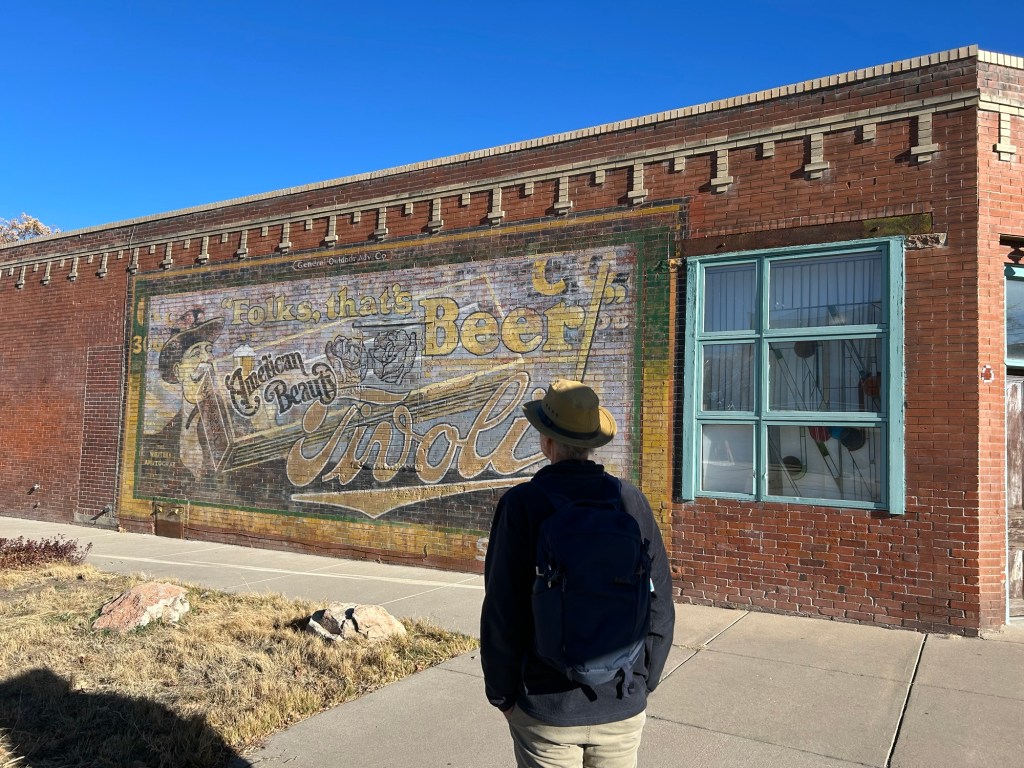
On Sunday Jeff flew in, and I switched from conference mode to vacation mode. Yesterday we walked over 20,000 steps in Denver, an exploration that included murals, food, coffee shops, a bookstore, and a Japanese knife store. The weather was perfect for walking.

While I was attending NCTE “Dream Boldly”, I was worried that I wouldn’t find sessions that spoke to me as a retired teacher; however, I look back in my notebook and realize that I am still a Writer.

In a session with wonderful poets Georgia Heard, Joyce Sidman, and Rebecca Kai Dotlich, we were given prompts and time to write.

Joyce Sidman has an amazing new book, “Dear Acorn, Love Oak”, and she used a simple formula from her book to lead us into writing our own letter poem: Write to an inanimate object, Dear ____, including a compliment, a question, and a wish.

I loved how this prompt could work with any age group, and the participants shared some wonderful responses. Here’s mine:

Dear Black Bic Pen,
Your ink is flowing nicely today, with only a few blotches here and there. Do you like writing poems, being my muse? I wonder if you’d rather be pink and scented like a rose. I wish I could write poems with you. Can you whisper a line or two?
Love, Writer’s Block

Not only did NCTE fill my writer’s cup, it also filled my soul. My husband calls it “hobnobbing with my fellow wizards”. I was in the company of many wizards who, after 20 years of attending this conference, are now friends. Lots of hugs, conversations, and laughs.

Read Full Post »

Poetry Friday round-up is with Elisabeth at Unexpected Intersections

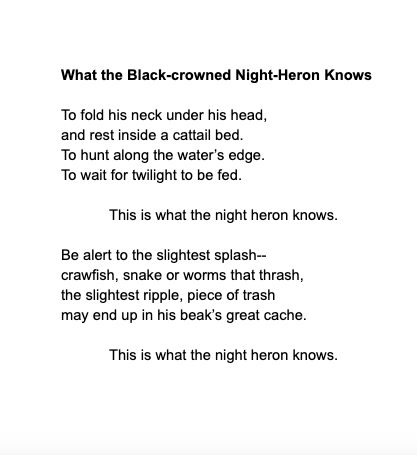
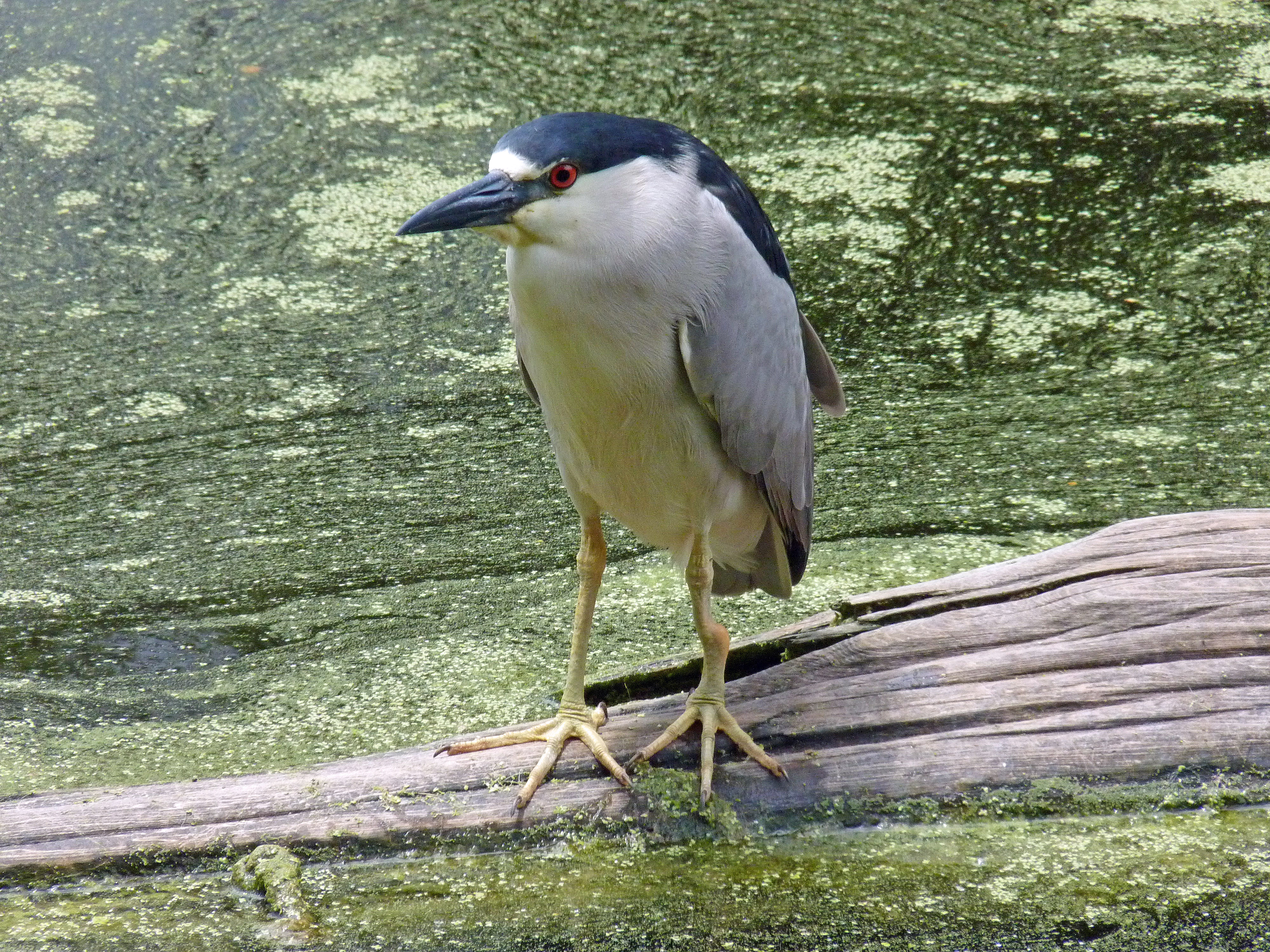
For the end of the month Poetry Sisters challenge, Mary Lee posted this call to write deeper wisdom poems in the form of Jane Yolen’s What the Bear Knows. I recall a similar challenge from Michelle Barnes’ interview with Joyce Sidman on Today’s Little Ditty. I used this form in my book Bayou Song to write about the black-crowned night-heron.

(c) Margaret Simon, Bayou Song

photo by Henry Cancienne

To order a copy of Bayou Song: Creative Explorations of the South Louisiana Landscape, go to UL Press website.

On this anniversary of Hurricane Laura that devastated Lake Charles, Louisiana last year, we are once again bracing for a storm, Tropical Storm Ida that is predicted to come in around New Orleans as a Category 3 hurricane. We are preparing and watching news closely. Please keep us in your prayers. We know how to do this. I’ll post updates as I am able on Instagram/ Facebook. Thanks!

Read Full Post »

Poetry Friday round-up is with Cheriee at Library Matters.

An Invitation: With Laura Purdie Salas’s blessing, I’ve started a weekly writing prompt for Thursdays in the spirit of 15 words or less. Pop over to read the poems this week about a pretty pink thistle: This Photo Wants to be a Poem.

This week my students and I read Joyce Sidman’s poem in the December issue of Scope magazine: Song of Bravery. There were a few things to notice in her poem, allusion and irony. When one normally thinks of a song, it’s something positive and praising. Joyce Sidman’s poem stated the opposite.


This one’s not a sure thing.
I’m not bound to win.
I don’t think I’ll ace it this time.
I won’t break a leg,
make my own luck,
or reach the stars.

Joyce Sidman, Song of Bravery from What the Heart Knows
read the whole poem here.

After Joyce, I wrote Song of the Sacred.

I am not a barefoot Buddha.
I cannot think and become.
I’m not singing rhyming psalms
in the present moment.

When I fall on my knees, they hurt.
I have no burnt offerings
or holy incense to light.

Maybe I pray with open hands
or maybe someone prays for me.
I’ll never know.

But here I am
stretched in savasana
humming an Om
with my eyes closed tight

Breathing to clear my mind
from the shadows of a cloudy day
to see the holy sun.

Margaret Simon, draft
Photo by David Bartus from Pexels

Read Full Post »

Poetry Friday round-up is with Carol at Beyond Literacy Link.

One of my favorite books in my rather large collection of poetry books is What the Heart Knows by Joyce Sidman. This week I shared the poem Happiness, a chant invoking happiness.  We talked about writing from the perspective of direct address to an emotion.  I directed my students to choose an emotion and to try using imagery to make the emotion personified.  I played along with my kiddos and took out the magnetic poetry cookie sheets.  Finding the word poems mused me to write a direct address to poems.  Karson and I both used the imagery of a monarch butterfly drawing on our experience of hatching and releasing monarchs this week.

Poems,

You hide in shadows
of oak trees.
You whisper words
in the breeze.
You shudder my heart.

Poems,
When we meet eye to eye,
I am amazed
by your strength,
unexpected yet welcome.

Poems,
Your delicate wings
unfold before our eyes
surprising us
with your ease of flight.

–Margaret Simon, draft, 2019


Free image from Pixabay.


Excitement,

too much thrill can bring confusion
and confusion leads to mystery.
You are like the breeze on the top of a mountain.
When I see the brightness of the moon, I feel you.
You are the feeling when a monarch flies into the distance.

Karson, 4th grade


Curiosity,

You are full of forest mazes
that my mind gets stuck in.
My eyes show the way.
You bring me thoughts,
you make me think,
Curiosity

Jaden, 3rd grade


Read Full Post »

Find more Poetry Friday with Irene at Live your Poem.

Find more Poetry Friday with Irene at Live your Poem.

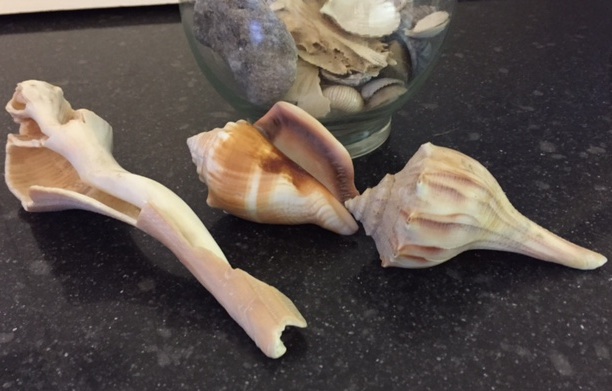
shells

The shells went to school this week. Children are fascinated by shells. They loved picking out their own special shell to write about.

In her book Awakening the Heart, Georgia Heard writes about spinning metaphors, “Spinning metaphors and similes has the effect of spinning a kaleidoscope around to see the beautiful and multifaceted color variations.” On a clean notebook page, let’s see how many metaphors we can think of for our shells. Then we started spinning.

Wonderopolis has a number of seashell-oriented Wonders. We explored two of them: How Much is a Sand Dollar Worth? and How are Sea Shells Formed?

After enjoying the Wonders, shells, and discussion, we had a “sacred writing time.” During this time, I gave them the option to write a Deeper Wisdom poem introduced by Joyce Sidman at Today’s Little Ditty, Michelle H. Barnes.

The steps are:
1. Choose a subject. It can be anything: an ant, the Empire State Building, your father. Your poem will be called “What Does [your subject] Know?
2. Think about the greater Truths that this particular object knows, whether it is alive or not.
3. State these truths—six of them—in two stanzas, repeating your question before each stanza.
4. If you want, rhyme each final word—but this is not necessary. (Joyce Sidman)

My student Matthew met this challenge with an amazing result.

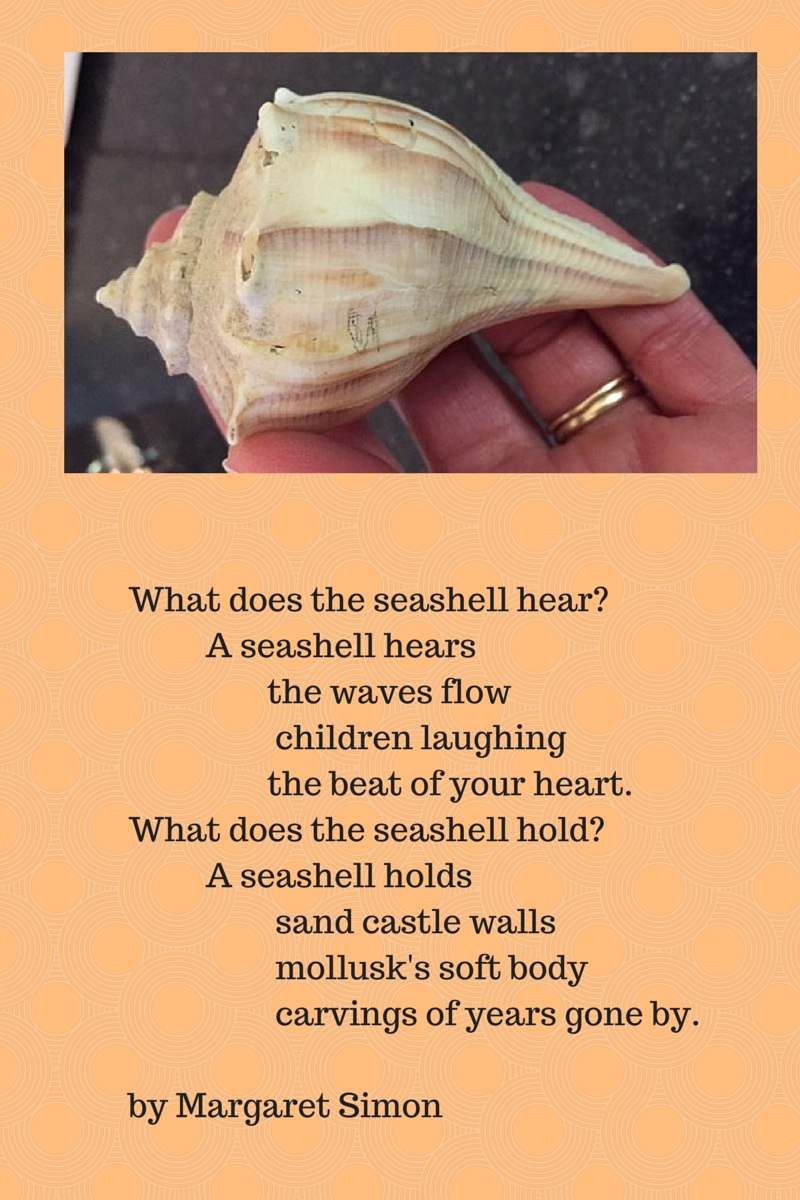
What does a seashell know?
It doesn’t know the Pythagorean Theorem
Or how to count by fives,
But it knows the ocean’s feelings.
It’s felt the sea god’s cries.
It knows it has an owner.
It knows that it’s a shield.
It has one life purpose—
to make the sea assassins yield.

By Matthew, 5th grade

I struggled with this form. Rhyme stumps me up every time. After quite a few tries, I tweaked the form a bit to write the poem I wanted to write.

Sea Shell Wisdom

Read Full Post »

Poetry Friday Round-up is with Jama at Jama's Alphabet Soup

Poetry Friday Round-up is with Jama at Jama’s Alphabet Soup

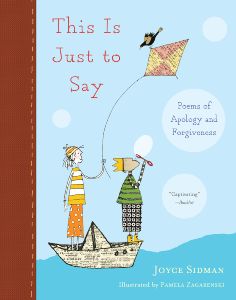
Amidst the season of post tests and field trips, I am still trying to squeeze poetry in to the school day. For the letter G, I decided to teach poems of apology using This is Just to Say: Poems of Apology and Forgiveness by Joyce Sidman. This is a delightful book of poems written by Mrs. Merz’s sixth grade class. Joyce begins this book with the classic apology poem by William Carlos Williams. Can you recite it?

thisisjusttosay

This is Just to Say
I have eaten
the plums
that were in
the icebox

Find the full poem here.

The first character, Thomas, uses this form to write the poem “This is Just to Say/ I have stolen/ the jelly doughnuts/ that were in/ the teacher’s lounge…” to Mrs. Garcia in the office. Mrs. Garcia responds with her own poem ending with “Of course I forgive you./ But I still have to call your mother.”

When my students and I were writing poems of apology, some used the WCW title as first line. I love how this small poem from Kendall expresses a common problem among 6th graders, hurt feelings.

This is just to say
I am sorry for this day
that I have treated you this way
you don’t have to accept my apology but hey
I didn’t mean to offend,
it sort of just slipped out along with shame
I hope you did not take it the wrong way
–Kendall

I gave my poem to my principal to apologize for being late. She said I set the bar for apology notes. The funny thing is many of these things listed actually do happen and do make me late.

Mrs. Heumann , Mrs. Heumann,
I just want to say
I’m sorry for being late today.

The alarm didn’t shout;
the dog got out;

My coffee over-flowed,
while I watched oatmeal explode.

There was a 50 car-train,
a truck hauling sugarcane.

The bridge was open, cars were slowed.
A trash can blew into the road.

The sun in my eyes, oh the glare.
Then a cow, would he dare?

Enough, you say. OK?
Just sorry,
I was late today.
–Margaret Simon, all rights reserved

And Kaylie stopped by the kidblog and saw all the Apolo-G poetry and added her own to her pencil.

I’m sorry, pencil, for dulling your head
Your sharp-tipped graphite point
I’m sorry for gnawing on your side,
My teeth-prints etched in your cedar

I’m sorry, pencil, for tapping your eraser on the desk,
For rubbing on the soft pink curls of your hair
And sweeping them away

I’m sorry for losing you and dropping you and trading you.
I’m sorry for putting your end in the pencil sharpener,
For tossing you away when you got too small.

Pencil, I’m sorry for hurting you all these years.
Will you ever be able to forgive me?

In writing this post, I found Joyce Sidman’s website and a great resource guide for using This is Just to Say in the classroom.

Read Full Post »