Today’s #verselove prompt is from Padma Venkatraman who wrote Bridge to Home and most recently Safe Harbor. Her books never fail to take me to a new place where I can find a relatable character and beautiful language. What a honor to have her writing a prompt for us based on her latest book. She invited us to write about a safe place.
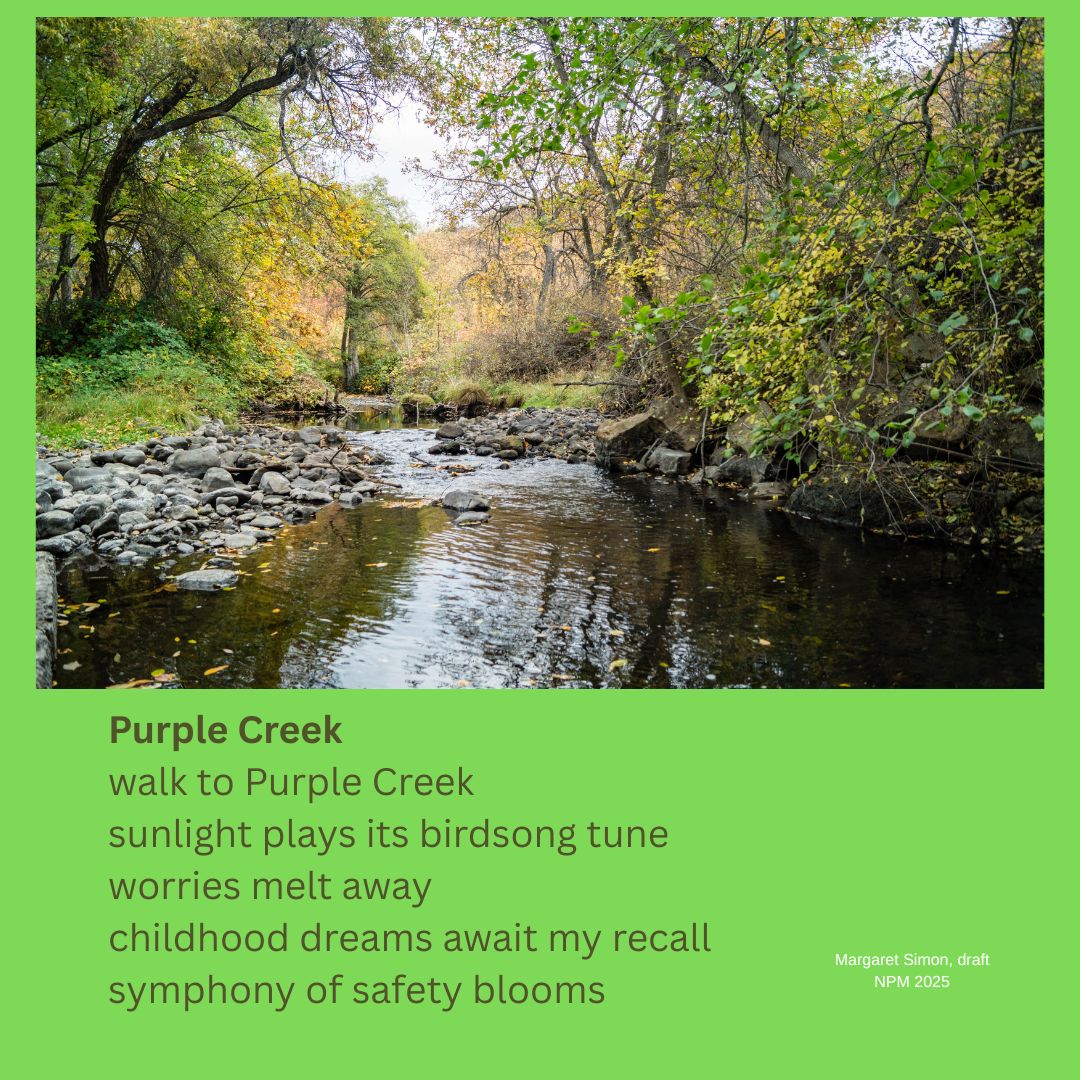
I am visiting Ridgeland, MS, a few miles from the place I grew up. While my visits here bring forth many emotions, this morning I wanted to find solace in a walk in nature. Even though my hotel is near an outdoor shopping mall, there is a creek nearby with a walking path. The creek is the very same creek that ran behind my childhood home, Purple Creek. I used the poetry form of tanka (haiku with a chorus) which has a syllable count of 5, 7, 5, 7, 7.
The Kidlit Progressive Poem is with Janet today at Donna’s blog, Mainely Write.
Irene Latham is gathering Poetry Friday today at Live Your Poem
I didn’t want to write about my father today, but I woke up and looked at the clock at 4:44 AM, so there he was. He would tell us that he always woke up at 4:44. He had a thing for double numbers. His birthday was 11/11/33. On this day 4/11/22, he had a stroke and died 11 days later on 4/22/22.
When I opened #Verselove, I saw a prompt that Kim Johnson shared in our poetry session on Wednesday at the Fay B Kaigler Children’s Book Festival. Unfortunately, Kim had a family emergency, so she had to leave on Thursday. She is supposed to be sitting with me as I write this morning. The loneliness has gotten the best of me, so I had to write about my father. As Kim and I said to our session participants, poetry can be healing. It’s a place of vulnerability. Kim’s prompt can be found on Ethical ELA.
Remember
I remember the phone call in the middle of class. I answered it. I remember thinking something bad had happened.
I remember I packed a bag for 3 nights max (I stayed 2 weeks).
I remember the gruff hospitalist rattling the bed with her pronouncement of no hope. You stared after her with anger and fear.
I remember the long days as you fought, grabbing tubes, glaring helplessly, speech stolen by the stroke.
I remember tears and singing, prayers whispering, silently longing to bring you back to us.
I remember someone said the deepest grief comes from the deepest love. I wasn’t ready to remember.
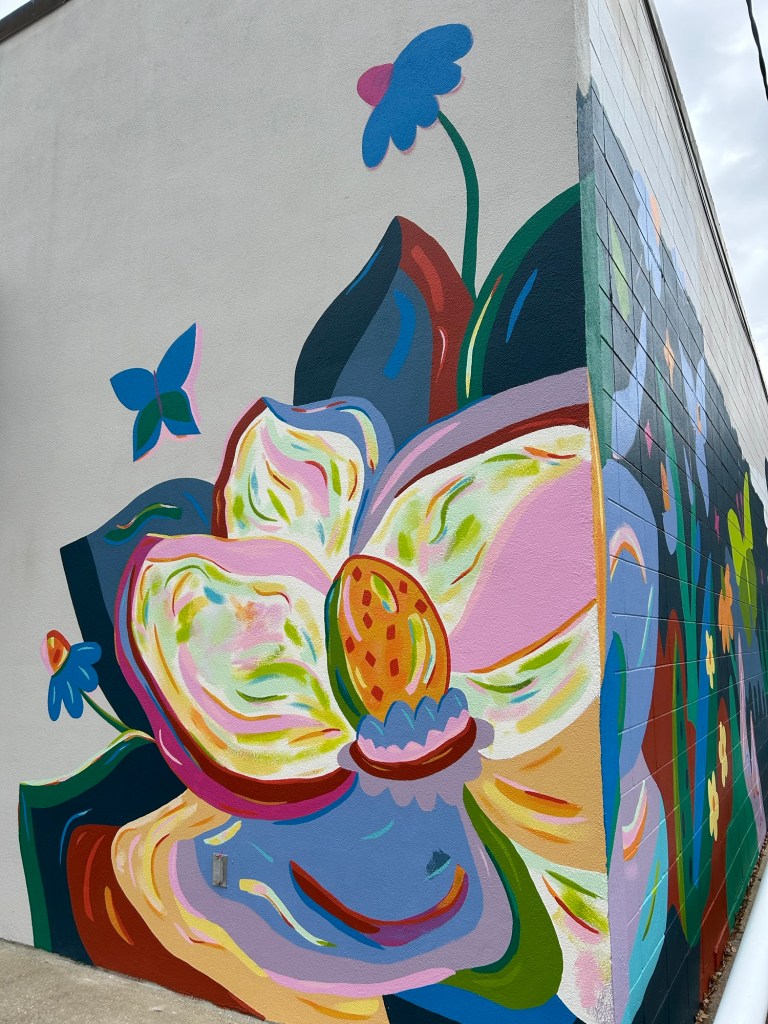
Mural in process at The Southern Linen Company, New Iberia, Louisiana
I was running late for a lunch date with friends, but I had to stop. The artists, Hannah Gumbo and Terez Molitor, were hard at work painting this bright and cheerful mural. A little while later, they stopped for lunch at the same cafe. I was able to get their names and thank them for their tireless work on the mural. They both lit up. Creating this art brought them joy. And now it will bring joy to passers-by. Public art is for everyone!
Can you write a small poem inspired by this photo? Join us in the comments. After you write, be sure to stop back by to leave some comment love on other writers’ poems. Together we are creating art with words.
At Ethical ELA Verselove, Leilya inspires us to write a tricube poem. This form is 3 stanzas of 3 lines with 3 syllables each.
Mural Art
In spring, red dances with yellow light.
Buds become butterfly, bee feeders.
Painted walls fill my heart with delight. Margaret Simon, draft
Thank you to Two Writing Teachers for creating an amazing community of writers and a safe, welcoming space to write and share.
Today is the last day of March which means I have finished my 12th year of writing a slice of life for 31 days. It’s easy to think this is some great accomplishment. But who matters more to me are the bloggers I do this with. Through the Two Writing Teachers blog, we have connected over time and space and supported each other. I always end with the wish that I had read more and commented more. What a wonderful community of teacher-writers! Thank you!
I also want to express my pride over my students who stuck with the daily slicing challenge. Julian wrote “This is the final day for writing and I cannot believe I actually did it. Before I ever did this challenge I was having trouble with writing 1 SOL a week. I never would have thought I would be able to write one continuously for a month straight. But I did and I’m very proud of myself.” You can view their posts at Fanschool/ GT Allstars
Tomorrow begins another writing adventure: National Poetry Month. Many of my poet blogger friends are doing projects. I will be writing with Ethical ELA VerseLove as I have done since 2020. At Ethical ELA, there is another great community of teacher writers who support each other.
I coordinate a gathering of children’s poets to write the 2025 Kidlit Progressive Poem. Linda Mitchell has bravely agreed to start us off. You will find her post at A Word Edgewise. We have three slots left at the end of the month if you want to play along. Kidlit Progressive Poem 2025 Sign Up.
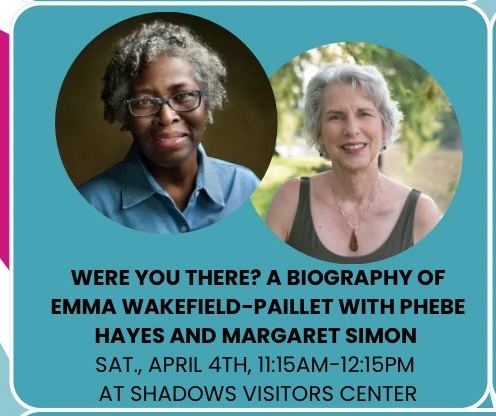
Tomorrow is a big day for me. Release day for Were You There? A Biography of Emma Wakefield Paillet that I co-authored with Phebe Hayes. I will be presenting this weekend at the Books Along the Teche Literary Festival at the Shadows on the Teche Visitors Center at 11:15 AM on Saturday. My co-author Phebe Hayes and I are excited to launch this important book about the history of New Iberia, LA. If you are local, please join us for this long awaited release.
Thank you to Two Writing Teachers for creating an amazing community of writers and a safe, welcoming space to write and share.
If you are a blogger and would like to add a line during National Poetry Month to our Kidlit Progressive Poem, please make a comment or send me an email with a date choice and a link to your blog. Everyone is welcome to play!
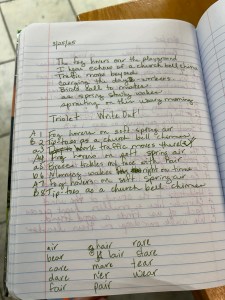
The early morning school playground was covered in a sheet of fog. Avalyn and I went outside to write. This is something she often requests. There is an old oak with a picnic table in a just right spot for writing in our notebooks. I wrote about my surroundings, observations of the morning.
The fog hovers over the playground. I hear echoes of a church bell chime. Traffic moves beyond carrying the day-workers. Birds call to mates as spring slowly wakes sprouting on this weary morning.
Form can give us a container for our words. I looked up the triolet form. I labeled my paper with the number of lines and the rhyme scheme. The poem changed shape while still holding the mood.
Fog hovers on soft spring air, tip-toes as a church bell chimes. Work day traffic moves on everywhere. Fog hovers on soft spring air. Breeze tickles my face with hair. Morning wakes right on time. Fog hovers on soft spring air, tip-toes as a church bell chimes.
(Margaret Simon, draft)
I used these two drafts to discuss revision with my students at the next school in the afternoon. I suggested they go back to a poem and revise it.
Max who is a humble poet will rarely share his poems out loud, so I asked his permission to share his revision here. He wrote it on Fanschool, and you can leave comments specifically for him there.
“Insects buzzing all around,
Bugs are feeding on the ground,
For there is no need for them to hurry,
So why should they need to worry?”
March 25th, 2025: I absolutely despise the quality of this poem. REVISE!
Insects hover in the air,
Gracefully, glide without care.
Spot a flower, beautifully white.
Harvesting energy, basking in the sunlight.
Insects, bugs, air and the ground.
Moving, flying, all around.
To hurry is not a worry, for them.
Unless by something, they’re found.
Then Scurry!
I would add something else, but this is just about it. (Max, 6th grade)
How do you approach revision? Is it hard for you? I think students don’t usually like to revise. They like to write and move on to the next thing. Honestly until I read Max’s post, I thought the class didn’t think much of my little revision lesson. Modeling our own writing process with our students makes us vulnerable, but in the long run, shares how we all are in this together, writing side by side.
Thank you to Two Writing Teachers for creating an amazing community of writers and a safe, welcoming space to write and share.
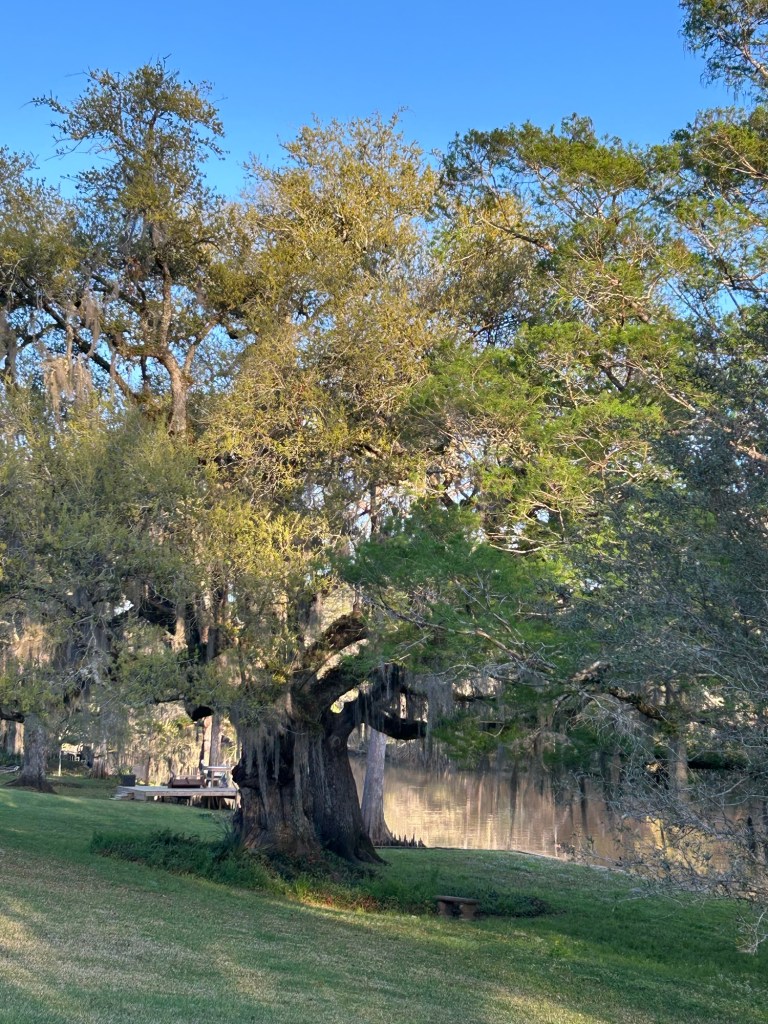
Sun dappled live oak on Bayou Teche
EnneaThought® for the Day
Type Four EnneaThought®
“Are you still yearning for your ideal life? Appreciate the small daily pleasures, kind words, and heartfelt exchanges that are already present. You’re already more appreciated than you may think.”
I am a type four on the Enneagram. I’m the one who cries, who ponders over the past, and who turns to romanticism. Daily the message for me is to be present. Be still and know…
Recently I have felt rushed and busy. I try to take some time or myself in walks and in writing time. What space can I give to just being in the moment? How can I slow down to breathe and be present?
In poetry, I find a place to be present. When I write with specificity and imagery, I feel present. I also like the comfort of anaphora, a phrase that leads to a new thought. This poem I wrote in response to a prompt on Ethical ELA here from Sarah Donovan. She used the mentor poem “A Place to Breathe” by Christine Hartman Derr from a free Ethical ELA anthology Just YA.
There’s a Way to Breathe Today
It’s the way the sun dapples the oak tree with a halo of light.
It’s the way the cypress needles pop out like green leprechauns.
It’s the way a bayou runs through and around a town of ancestry.
It’s the way I sit at my table with coffee and a pen. Margaret Simon, draft
I hope you find a little corner to breathe in today. Find stillness. Find peace. Write about it.
Thank you to Two Writing Teachers for creating an amazing community of writers and a safe, welcoming space to write and share.
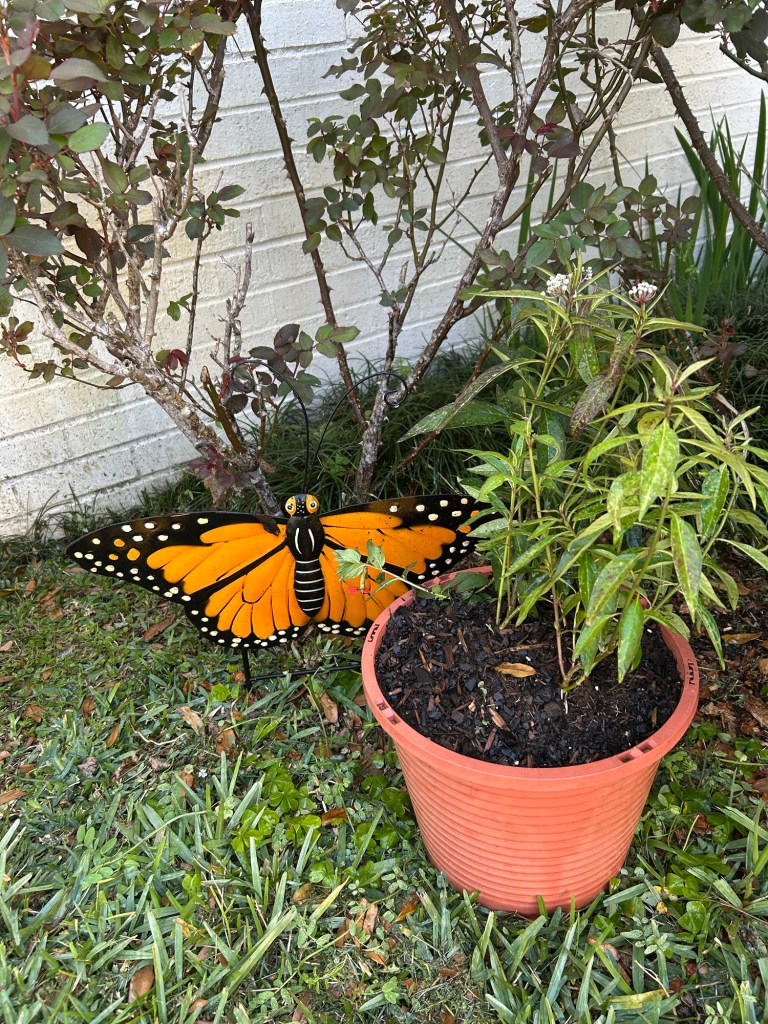
Each week I find a photo to write about. This form of poetry is called ekphrastic poetry, verse written in response to art. I invite my students to write alongside me on Fanschool. I ask my blog visitors, too. No pressure. If you feel inspired, write a small poem in the comments. Encourage other writers by visiting Fanschool or responding to writers here.
Butterfly Garden: Swamp Milkweed
The spring means time to ready the butterfly gardens. This year I have to put my butterfly plants in pots due to a puppy that likes to discover things by nosing, peeing, and chewing. Last night he was chewing and chewing. When I finally scraped his mouth, I found an electric wire. Yikes! That could have caused all kinds of damage.
If you could name a just right plant for feeding pollinators this spring, If milkweed, fennel, or parsley are on your garden list, swallowtails and monarchs, too, may stop by this place for a day or two, drop off an egg upon a leaf to start a new life.
If you could name just one small plant, and save it for the spring, you’d plant a lifetime once again where butterflies can come back home.
Thank you to Two Writing Teachers for creating an amazing community of writers and a safe, welcoming space to write and share.
The “I am From” poem form has been a tried and true form to model with students. A few weeks ago, I pulled it out again in hopes to get my students to write for a hometown poetry contest. It didn’t really work out. But while I wrote with them, I ended up with a version that I liked.
I had to explain “pot liquor” to my students because the alarm bells went off when they heard the word liquor. Isn’t it funny how you can know something so well that you don’t even notice? Pot liquor is the distinctly southern delicacy of the broth from boiling greens. (AI says it is also “potlikker”.) My mother would mix it with corn bread and black-eyed peas and eat it with a spoon from a coffee mug. I never developed much of a taste for pot liquor, but what I wouldn’t give to smell it again.
I am From “The most important aspect of love is not in giving or the receiving: it’s in the being” Ram Dass
I am from a gold pearl ring on my right hand. I am from a grandmother with my name– (Margaret, meaning pearl)
I am from Dot, too, from her laughter at things funny, not funny, from her nimble fingers playing classical piano. From lazy afternoons with a Ding-Dong and a Coke.
I’m from photos by the azalea bushes full pink blossoms rising behind our blonde heads. From pot liquor with black-eyed peas and pecan pie fresh from the oven on Thanksgivings in Morton.
I open my mother’s jewelry box, a calm of pearls and golden beads slip on easily. Margaret Simon, 2025
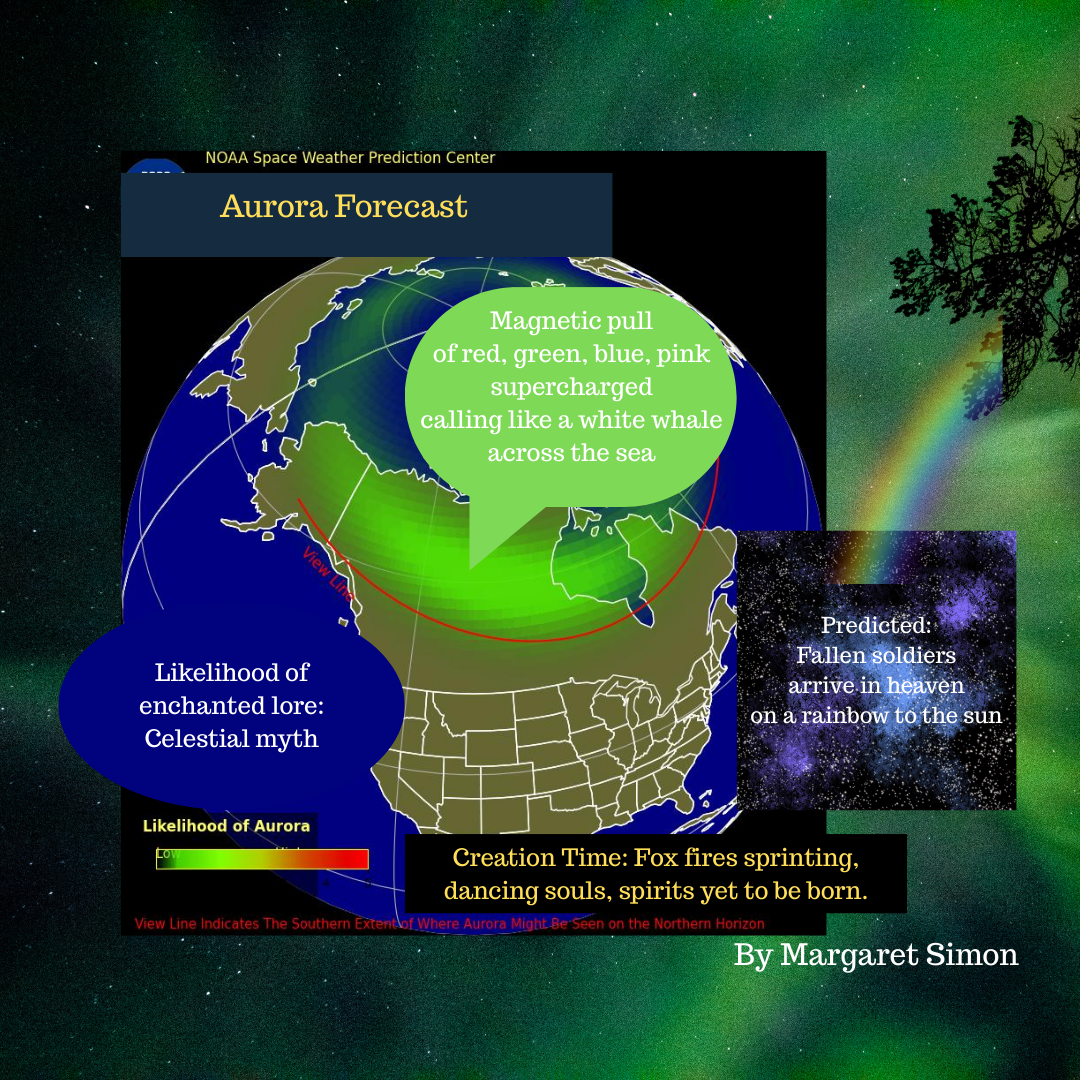
I put this one off, I admit. I knew I had a week of break to prepare, but still I created this last minute. I went back to the poems I wrote for Laura Shovan’s February project using the theme of Space. I had a different poem in mind when I found one I had written about the Aurora Borealis. I had just talked with a friend whose daughter had seen the Northern Lights on a trip to Norway. He shared fabulous photos from his phone. Definitely a bucket list item for me.
I realized I could transform my poem into a weather forecast. The creation part took some time using Canva and playing with placement of lines. I tried to adapt some of the words actually used in a forecast. Forget time; I was in Flow. The image is a bit busy for my taste, but I had to get this post done for the early Poetry Friday posters.
If you are interested in participating in the Kidlit Progressive Poem, click the link and leave a comment or email me your name, date chosen, blog name, and URL. Thanks!
Please sign up to add a line to the Kidlit Progressive Poem coming April, 2025. On your chosen day, you will copy and paste the previous lines of the poem to a blog post and add your own line. When you sign up, create a hyperlink to your home page. For example, Margaret at Reflections on the Teche. Thanks!
Margaret Simon lives on the Bayou Teche in New Iberia, Louisiana. She is a retired elementary gifted teacher who writes poetry and children's books. Welcome to a space of peace, poetry, and personal reflection. Walk in kindness.