Today is my husband’s birthday. I wrote him a poem. The poem came from a prompt from Georgia Heard during her Write Bites workshop with Ralph Fletcher. She shared Imperfection by Elizabeth Carlson. Elizabeth’s poem begins with the line “I am falling in love with my imperfections.” It’s a wonderful poem about accepting your faults. I turned my attention to the imperfections of our house. If you own your own home, you’ll understand. This week we had a water heater go out. Oh my, how we take hot water for granted until it’s gone.
I’m learning to love the smell of dust gathering in soft corners how mold creeps in the crevices of window sills.
I’m finding joy in the left behind sliver of soap, stash of tea-stained cups, single smelly sock.
Our house has become a home of imperfections. That door never stays shut. That switch doesn’t turn any light on.
We are ignoring the leak streaking the living room wall. I’d rather sit next to you on the sofa, make space for the dog between us, talk about the day behind, the future ahead.
Let the house be. Let the rain come.
Margaret Simon, 2025
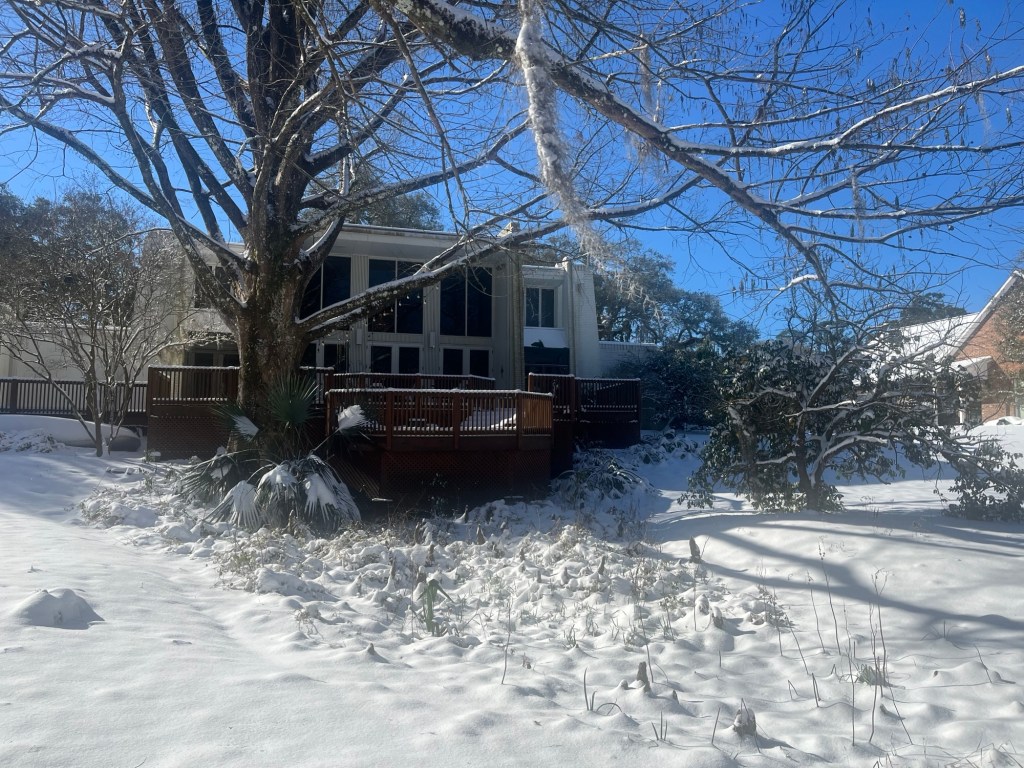
The Big White Castle in the snow of January, 2025. (We call our house a castle because it has a turret, a unique mid-century modern architecture feature of the early 70’s.)
Last Friday and into the beginning of this week, my students worked on heart maps inspired by Georgia Heard. To see their “maps” and poems, see this post.
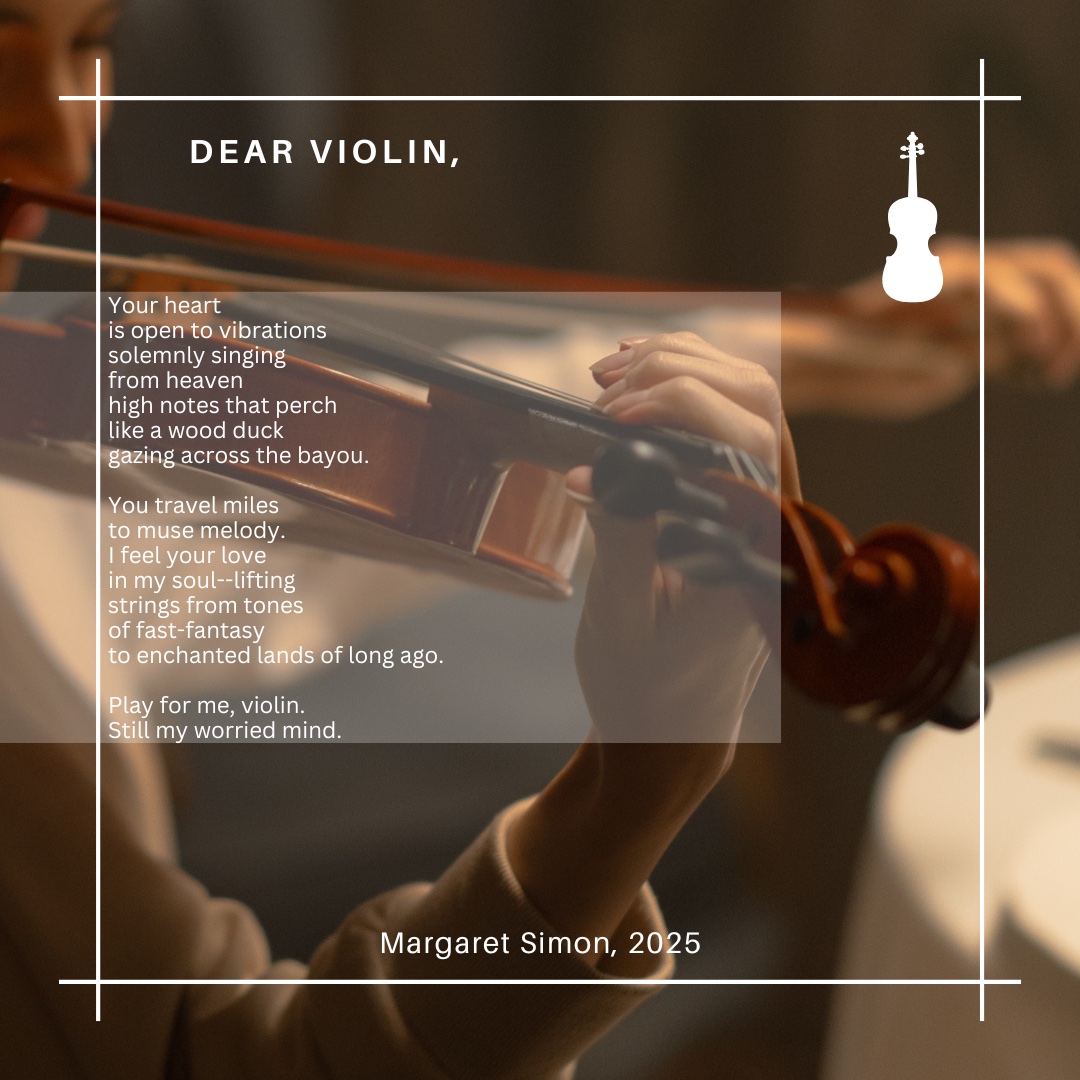
I wrote an epistolary poem to the violin. Inspiration flowed when playing Vivaldi’s Four Seasons. The violin is my favorite instrument. My grandmother was a violinist, though I never heard her play. When Jeff and I hear Cajun music, my favorites are the waltzes with dual fiddles. The instrument is universal to all kinds of music. In the poem, I used my One Little Word Still.
I have left a card on the kitchen counter for my husband. We’re in our 43rd year of marriage. I am blessed with long love. Here is the note (poem) I wrote for him.
Acknowledgement
“Acknowledge the many ways in which your life and relationships are good.” Enneathought of the Day 1/17/25
Life is good. I don’t have to sit on the floor for hours talking so you will understand, but I would and so would you.
Even in the silence of making the bed, we hold each other.
We can laugh at a photo and bring it up later with only a word; giggles rumble like rainbow bubbles between us.
We are not One. We are Two dancing a waltz of life-is-good together.
Margaret Simon, draft
Happy Valentine’s Day! I hope your heart is full. Take a peek at Carol Varsalona’s padlet. A few of my students are featured there.
On the first Friday of the month, Inklings (my trusty writing group) respond to a challenge. Mary Lee made it easy this month. She asked us to type a color into the public domain image archive and find a photo to write about. I chose lilac. I immediately got a photo I knew was telling a story. I imagined that Lilas and the bug are having a conversation.
“Unhappy the man who never had his eyes fill with tears at the sight of a particular flower. Such a one can have been neither a child nor a youth. He can have had neither mother, sister, nor affianced bride. He never loved.” This is the tone and tenor throughout Les Fleurs animées (The Flowers personified), a collection of floral — and sometimes florid — writing, featuring playful illustrations by J. J. Grandville (1803–1847), engraved and hand-colored by Charles Michel Geoffroy.
How Lilas Learns of Love (a cherita)
With draping lilacs for long locks,
Lilas questions Sir Ladybug, “Where will my love grow?”
Love grows from a starter seed planted small in your heart until with wisdom, grace, and tender care…Blooms!
Spiritual Journey first Thursday is gathered by Bob Hamera.
Bob suggested we ponder the idea that doors may close while another one opens, how focusing on the closed door may lead us to miss the open one. My father spoke about this in his firm belief that there is always a resurrection. Jesus showed us in a very real sense that when someone dies, it is not the end. I’ve always prided myself on a belief in the resurrection; however, when faced with an actual closed door, a death of something in my life that I put my trust in, whether it be a job, a friendship, a manuscript, I get lost and lonely and question. That is the rough part of the death/resurrection story arc.
I am following a path to a new journey to retirement. This is a door I’ve chosen, but even so, I have mixed feelings. So many of my days with my students are good, happy, and fulfilling. I will miss teaching, I know. I also know I’m a teacher through and through. I chose this career when I was 15 years old. I will find ways to still be a teacher. I keep telling myself this truth, but it’s not easy. When I tell people I’m retiring, I hear “Congratulations!” I wish I could feel excited. Is it the closed door I fear? Or the open one I’m unsure about?
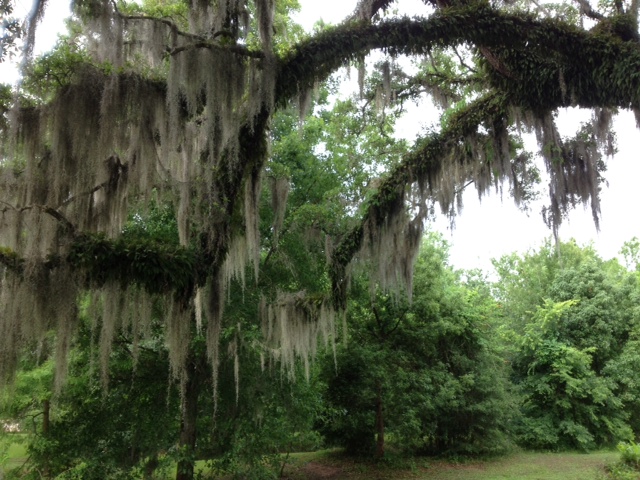
Resurrection fern is grey when the sun is out, but turns to bright green after the rain. May God bless us with the knowledge and grit to survive the grey and thrive again after the rain.
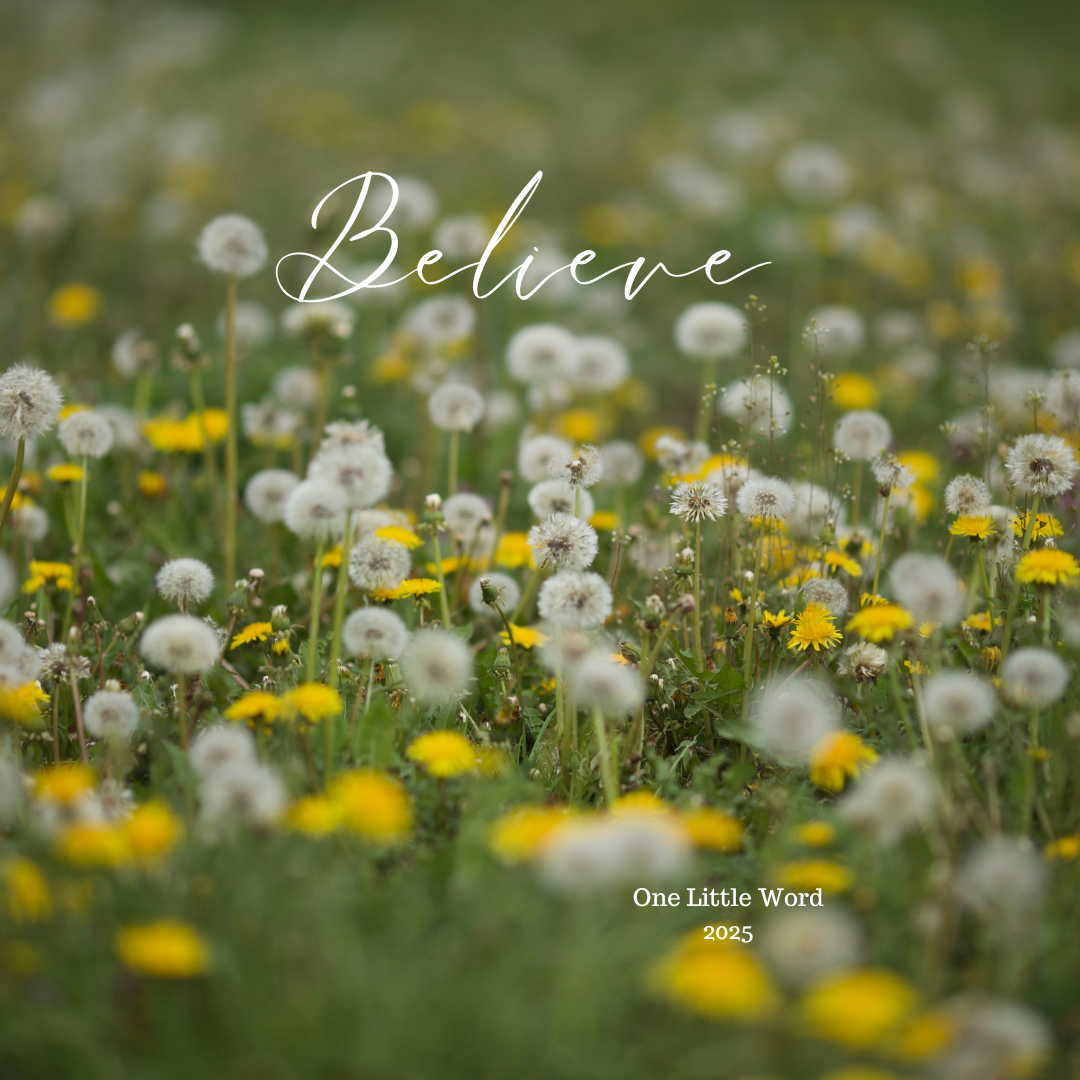
I don’t often join the Poetry Sisters challenge, but I felt this month’s was within my reach: a tanku which is a tanka in conversation with a haiku. I recently attended a workshop, Write Bites with Georgia Heard and Ralph Fletcher. Georgia’s writing prompt was to write about a word. One suggestion she had was to have a conversation with the word. That draft led me to create a tanku around one of my two words for this year.
Believe
What do I believe? Remove my rear view finder Need a reminder– blinders to understanding, “I don’t believe you heard me.”
I say to the wind; It says, “I believe in you. That’s true, you will see.”
This week has been weird. Weirdly wonderful. Here on the Gulf coast, we had a snowstorm that broke records all the way back to 1899. The snow fell all day on Tuesday and shut down the whole area for two days. Businesses opened up on Thursday, but we haven’t gone back to school. Our water systems are not built to handle this kind of weather and single digit temperatures, so water pipes have burst and water pressure is down. In Coteau, where one of my schools is located, they cut off water for 12 hours. But my students and my grandchildren have had a blast!
I can’t stop writing about it. On Tuesday, the Ethical ELA Open Write prompt was introduced by Erica Johnson. You can read the full prompt and lots of great poems here.
Enzo Blizzard 2025
It wasn’t until I walked in the snow that I discovered snow is wet. In the movies, actors never seem bedraggled.
And now as a historic blizzard pours down snow, I remember my rain boots in the dusty box, dig out the snap-on hood for the coat, and place a towel by the back door.
And yet, snow is silent surprising me with a steady fluttering rhythm of soft white flakes.
I know this phenomenon is unreal, ethereal, a moment I want to keep in a photograph to cherish and hold.
Margaret Simon, draft
The back of our house in the snow. photo by Maggie Simon LeBlanc.
Last week I read Rose Cappelli’s post. She decided to write a poem each month using her One Little Word. I have actually picked two words: Still and Believe. I’ve been determined to train my puppy Albert “Al-Bear”. He is an 11 month old miniature golden doodle with a lot of energy. He’s been developing some bad habits. One of them is barking at us when he wants to play. I bought a collar with a vibrator on it, so I can give him a little buzz (remote control) every time he barks at us. It’s working…slowly.
I receive a prompt each week from Kelly Bennet called News from the Fishbowl. Last week she introduced me to a form I hadn’t heard of, Shadorma. It’s from Spain. There are 6 lines with a syllable count of 3, 5, 3, 3, 7, 5. The topic can be anything, but usually the poem is all one sentence.
Puppy Training
I believe this puppy can learn to be still to cuddle warming my cold morning lap– blending our perfume.
Poetry Friday is hosted today by Kat Apel. with a fun poem about cats and dogs.
My students have gotten off with a rocking (and sometimes rocky) start to 2025. I have become re-committed to giving them notebooking time and prompts to consider. When they get to “poem-ish” on their notebook page, they often turn to the good-ole acrostic. In fact, I asked them yesterday to tell me why they like that form so much. “It’s a curse,” one student piped up. “Everybody’s got it.”
This response made me laugh. The curse of the acrostic. Perhaps it’s also a crutch, a form they can depend on. When I looked closer at some of the poems they had written, though, I found some thoughtfulness as well as expression of emotion. It may be a curse, but sometimes it works.
Avalyn chose a quote that used the word Glow and wrote the following poem in her notebook.
Get up and Love your freedom, or love someone. Wisely understand that you are a free bird. Ignite that flame of love. Never let your wings be pierced, Gone, broken, or enslaved. Avalyn, 5th grade
Just started on a New Year An arctic blast is happening Nature makes trees bare Under the weather limit All of us have jackets Runny noses You are frozen. Everybody is frigid. by Carson, 3rd grade
I presented Mary Lee’s poem from last week and wrote my own notebook page about the prompt “What wisdom do you yearn for?”
Where is wisdom hiding? Illusive Search for Definitive understanding Overcoming the overwhelming Melancholy Margaret Simon, draft
When you are looking for a way to enter your daily writing, try an acrostic. You may surprise yourself.
I am posting on my phone because I’m having trouble connecting in a hotel room. I’m visiting my mother who is in the end stages of Alzheimer’s. This time is filled with hard and love, tears and joy.
Heidi challenged the Inklings this first Friday to choose a prompt from her Yule calendar. Since I spent last week in the company of my grandchildren, I was drawn to the prompt “Capture the sound of laughter in rhyme.”
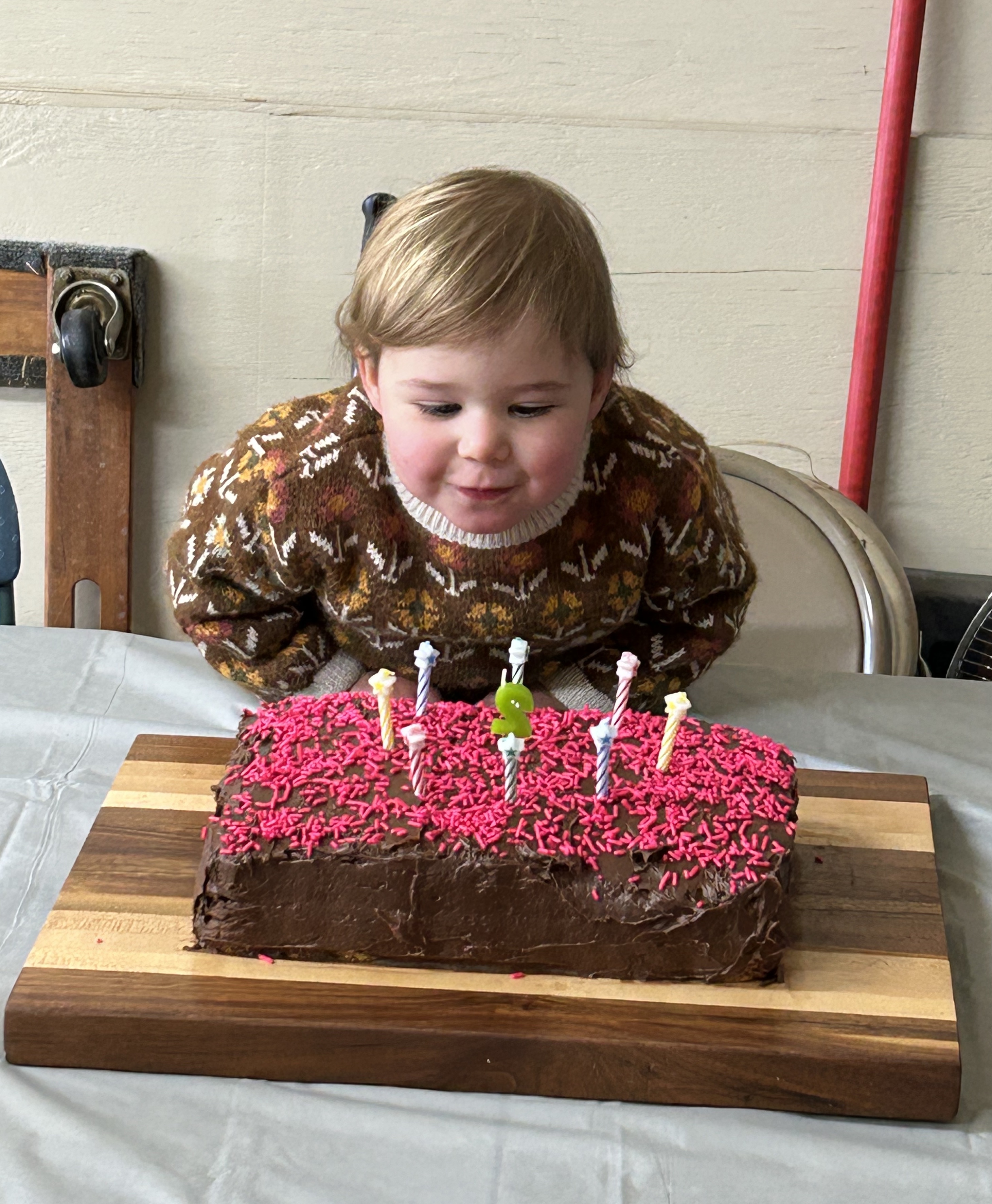
I am taking delight in watching my grandchildren laugh. This poem is dedicated to my granddaughter, June, who was two on Dec. 21st.
De-Light
I taste a note of nutmeg on my tongue, a slight burn while I yearn for sweetness, and your song
“Happy Day Day”
your two-ness of delight candles to blow ribbons flow
twisting into this gift of a child shifting,
becoming laughter.
Margaret Simon, draft
June is Two!
To see how other Inklings wrote to this challenge:
I have subscribed to The Isolation Journals for years and often read the prompts but don’t do them, usually because I read them at a time when I don’t have time to stop and write. They usually speak to me, but perhaps there is a little intimidation happening with me as well. I don’t know. I try to keep my doubt under control, but it’s not always that easy.
I tucked away a prompt from Amber Tamblyn. She used anaphora in a poem titled “This Living”. Her prompt suggested we use this same phrase, “It’s going to be”. As I was driving to school on a particularly foggy day, a phrase came to me, “I could fall in love with”. I played around with it in my Notes app. Autocorrect created the title.
On Love
I could fall in love with someone playing acoustic guitar singing breathy tones.
I could fall in love with a fog bow reaching for a waning moon.
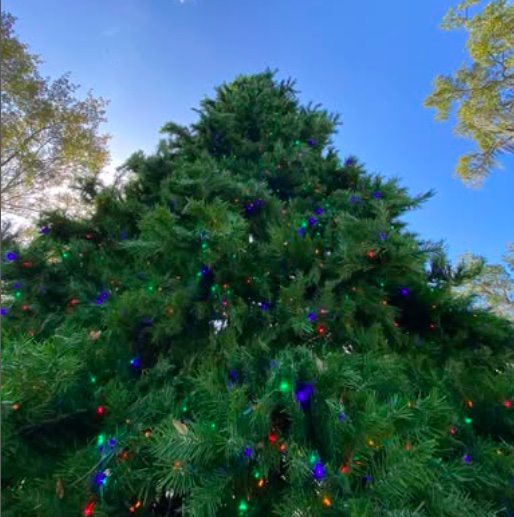
I could fall in love with twinkling lights blue, red, golden on the tall Main Street Christmas tree.
I could fall in love with my own alto voice rising in this small car joining a choir cantata.
I could fall in love with darkness coming so soon– a winter solstice Peace.
by Margaret Simon, draft
Peace has been my One Little Word for 2024. I’m grateful for the way “peace” showed up for me and for this poem. Have a wonderful holiday season!
Linda is hosting today with a mashup of songs and poems. This reminded me that we did a similar activity in my class. I asked the class what song about friendship do they like. Kailyn said, “Count on Me” by Bruno Mars.
I stole the line “I’ll sail the world to find you.” to create a golden shovel.
My friend, I’ll tell you again that I will sail through a turbulent storm, the end of the world as we know it to rescue you, comfort you, to find safety in this place with you. Margaret Simon, draft
Margaret Simon lives on the Bayou Teche in New Iberia, Louisiana. She is a retired elementary gifted teacher who writes poetry and children's books. Welcome to a space of peace, poetry, and personal reflection. Walk in kindness.