Thank you to Two Writing Teachers for creating an amazing community of writers and a safe, welcoming space to write and share.
My mind has been on hearts and monarchs. For Valentine’s Day, I gave each of my students a small canvas to create a heart-inspired art piece. We looked at Pinterest images and got inspired. They enjoyed spending time focused on design and playing with paint.
Heart art by Jaden
In my email inbox, the Poetry Foundation Poem-of-the-Day was a concrete poem in the shape of half of a heart. I used the idea to create a poem for Laura Shovan’s poetry challenge. It was a challenge. I managed to make the shape, but I’m not sure if I managed a cohesive poem.
Margaret Simon, draft 2022
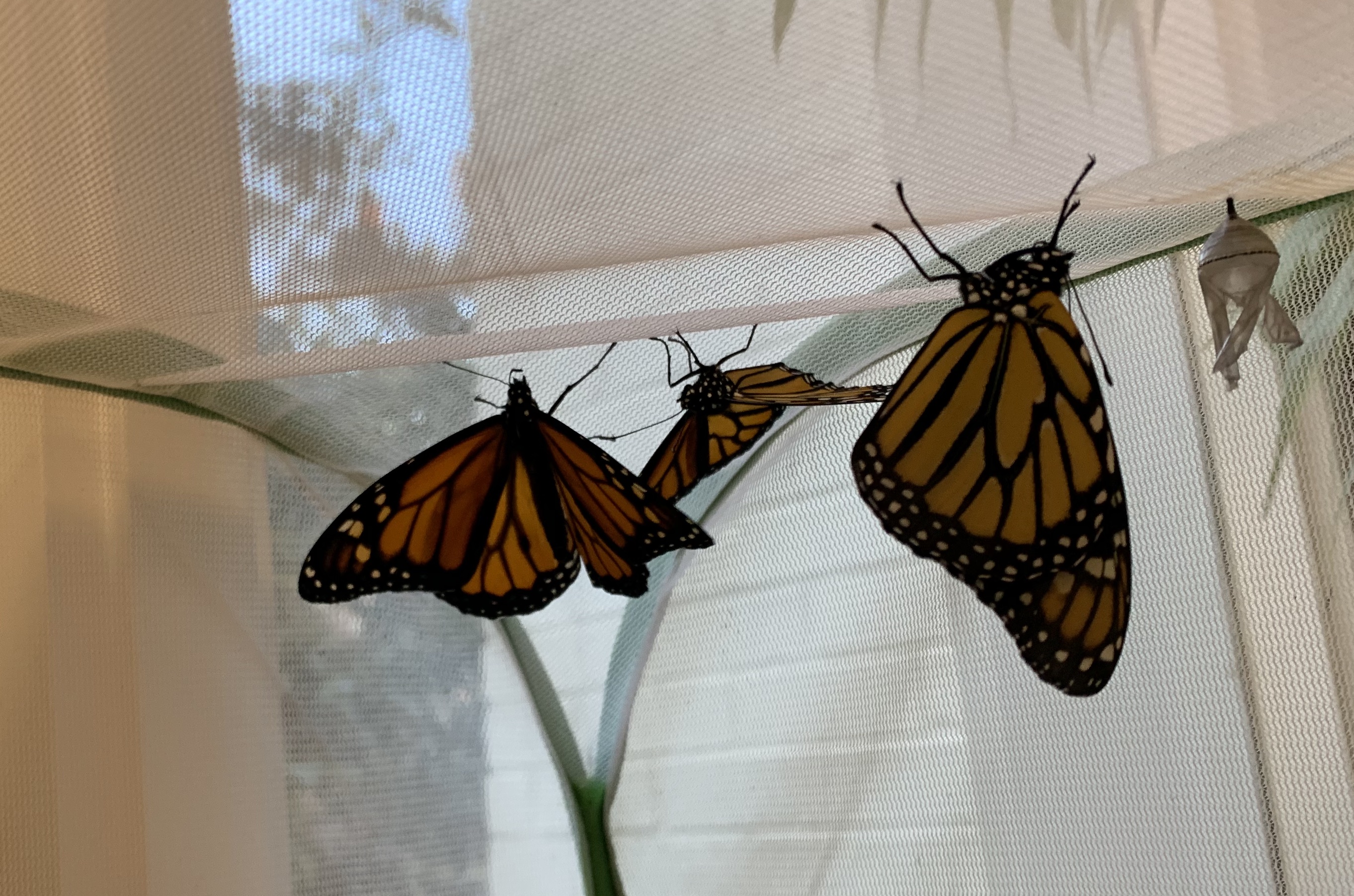
I came home to find four monarchs hanging out in my butterfly enclosure. Such beautiful creatures. I am worried, though, because we are still having cold temperatures. I released two of them in the afternoon 60 degrees. Today the temps will climb to 70, so I’ll release the other two.
Thank you to Two Writing Teachers for creating an amazing community of writers and a safe, welcoming space to write and share.
When we returned from winter break, I started a new daily writing activity in my classroom: 100 Days of Notebooking. In truth we don’t have 100 days of school left, but no matter. The point is to write and draw and be creative every day in some way or another. My students have embraced this idea.
We start each entry with the date and a quote. I have a copy of 360 Days of Wonder which is full of quotes. I also allow students to look up quotes by famous people they admire. One student is choosing a sports quote each day.
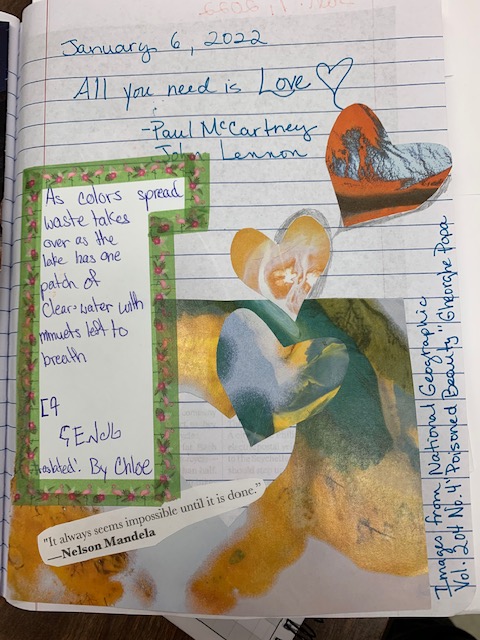
Notebook page, January 6, 2022
The papers I used for the collage above were images in a National Geographic magazine of a polluted lake in Romania. I told Chloe about it and she wrote a poem about it. I asked her if I could have a copy for my notebook page.
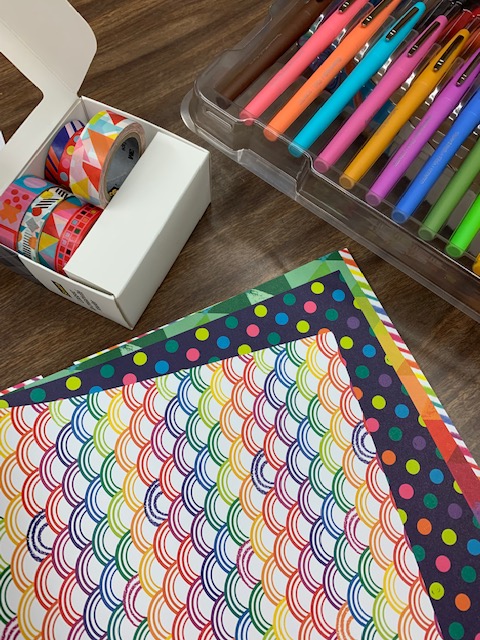
For Christmas, one of my students gave me a gift card to Target, so I used it to get more notebooking supplies, washi tape, felt-tip pens, and decorative paper.
new notebook supplies
Michelle Haseltine started a Facebook group and an Instagram hashtag. It’s fun to be a part of a larger group. Everyone has their own unique style of notebooking. I enjoy drawing inspiration from others.
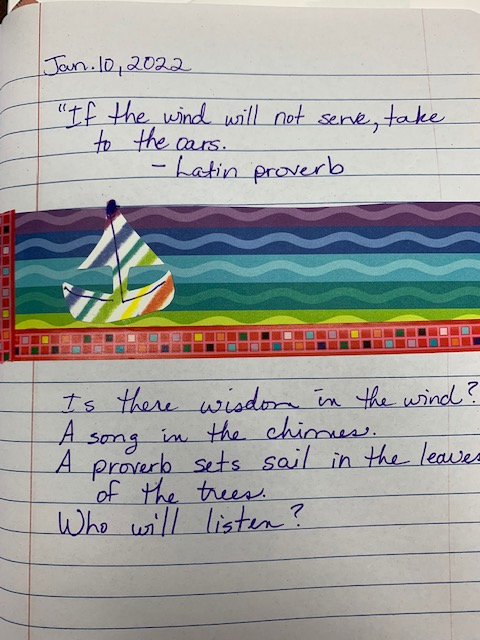
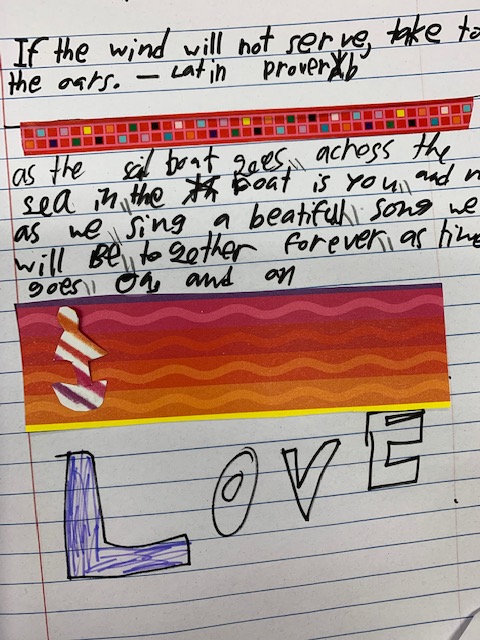
Notebook page, January 10, 2022
Avalyn picked out the quote above, and we discussed the figurative meaning of it. On her notebook page, she wrote a loving poem. You can see how she worked on the line breaks. She posted it on our Fanschool page. You can leave a comment for her here.
Avalyn, 2nd grade
Do you have a notebook? What creativity can you bring to the blank page?
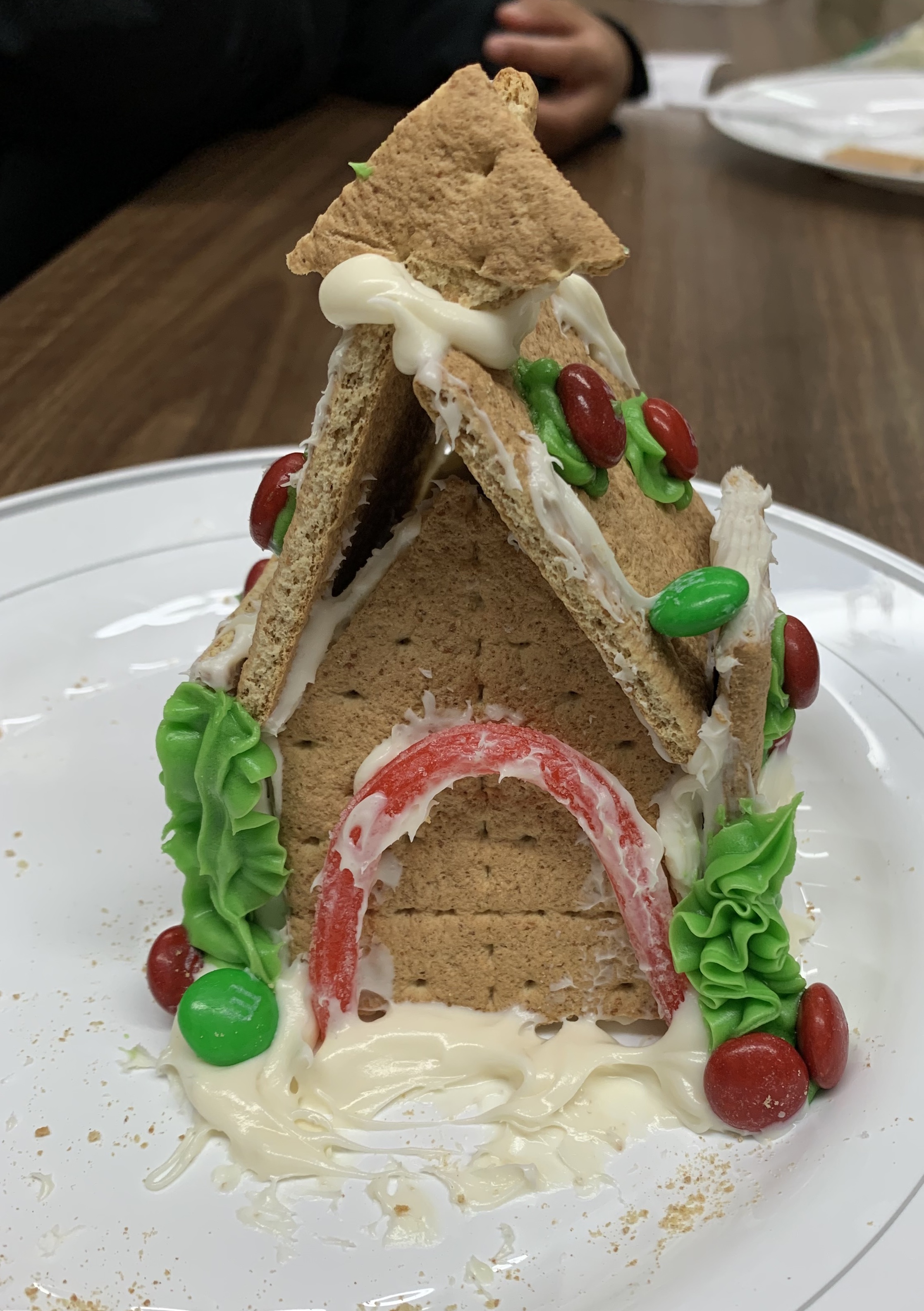
The whole room smells of graham crackers and icing, sweet-scented as Christmas should be, marked by twinkle lights and fingers dipped in icing or glitter glue.
Santa’s in the hallway listening to every child’s wish. Teachers are tired, overwhelmed by lists and sugary treats. Too much time spent on planning, cooking, decorating.
But there’s the child with bright eyes who opens her arms and says “I love you”.
You must open your little gingerbread house to all of it.
Margaret Simon, draft
I started my day listening to Ada Limón and The Slowdown. She talked about her grandmother’s kitchen and read the poem little tree by ee cummings. I played this episode for my students, and we wrote together. My poem above is true. I took the plunge and did gingerbread houses made out of graham crackers for the first (and most likely last) time. The success on Avalyn’s face and her insistence on telling me she loved me comforted my weary soul. She wrote a sweet story about her little gingerbread house on Fanschool here. (Spoiler alert: it includes a true story about a lizard rescue.)
Chloe wrote a poem side-by-side to ee cummings.
(after ee cummings little tree)
bright star bright little North Star you are so bright you are more like a light
who found you behind Mars and were you sad to lose hide and seek? see I will comfort you because you light up my Christmas tree.
i will hug your prickly sides and swing you gently as your mother would so don’t run away
and my father and i will lift you up and look at your shining stem we’ll skip and sing “Behold that Star”
Chloe Willis, 6th grade
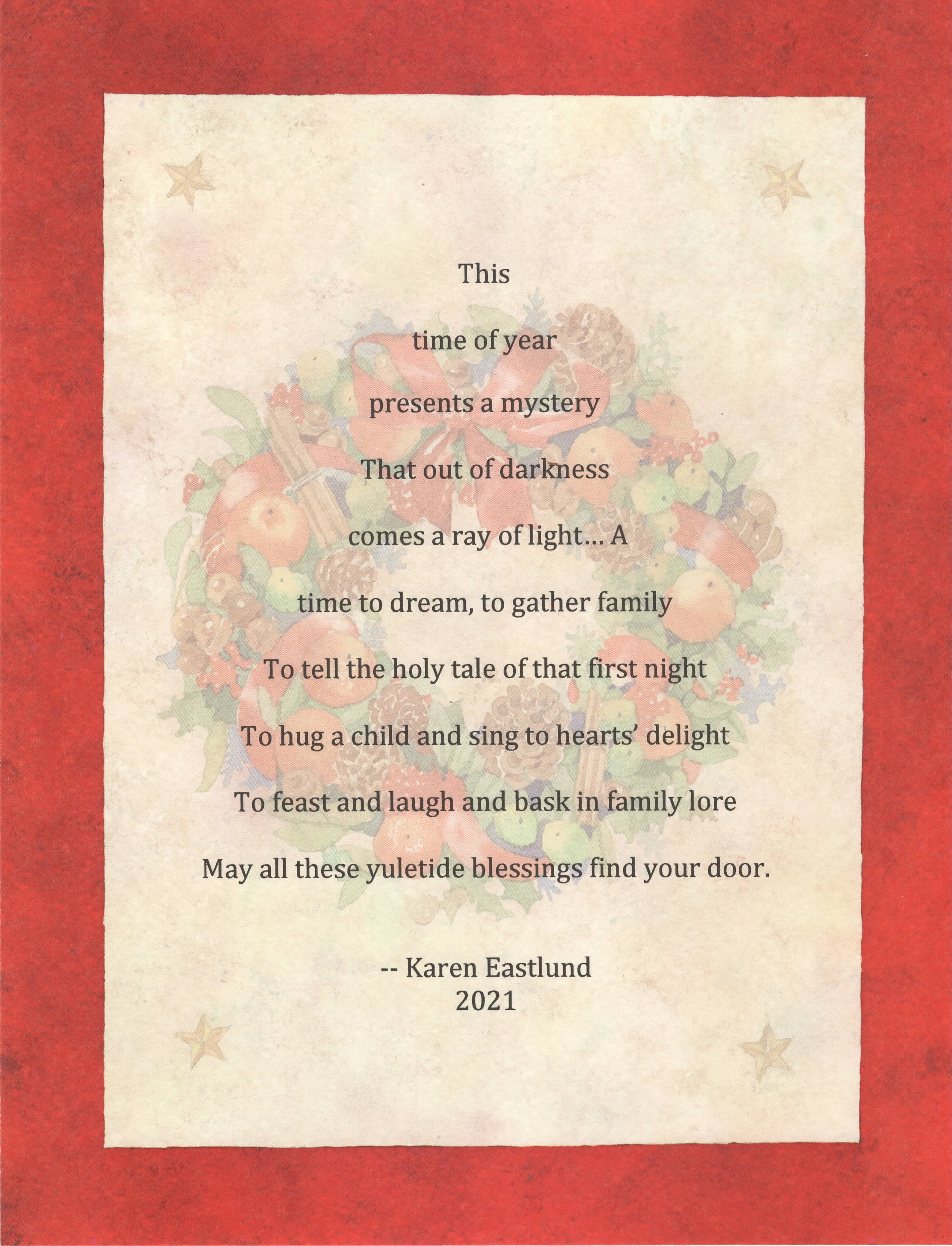
This is the time of year for the Winter Poetry Swap. I exchanged with Karen Eastlund. She sent me the following poem (how cool that it’s in the shape of a Christmas tree) along with some delicious goodies and a hand sewn mini bin. Thanks, Karen.
Thank you to Two Writing Teachers for creating an amazing community of writers and a safe, welcoming space to write and share.
Through blogging communities like this one (Slice of Life) and Poetry Friday, I’ve met many mentors for writing. Amy Ludwig VanDerwater is one of those special teacher-poets who generously gives of herself. During the pandemic shut down, she recorded videos in Betsy, her writing camper, every day. These can be found on her YouTube channel. Last year she went back to teaching, so she didn’t blog as much. Boy, did we miss her voice in cyberspace!
But she’s back and each week on Friday, she posts a mentor poem on The Poem Farm with student-friendly (and adult-friendly) instructions for writing your own poem. This past Friday, her poem came up on my Instagram and was just right for our writing time.
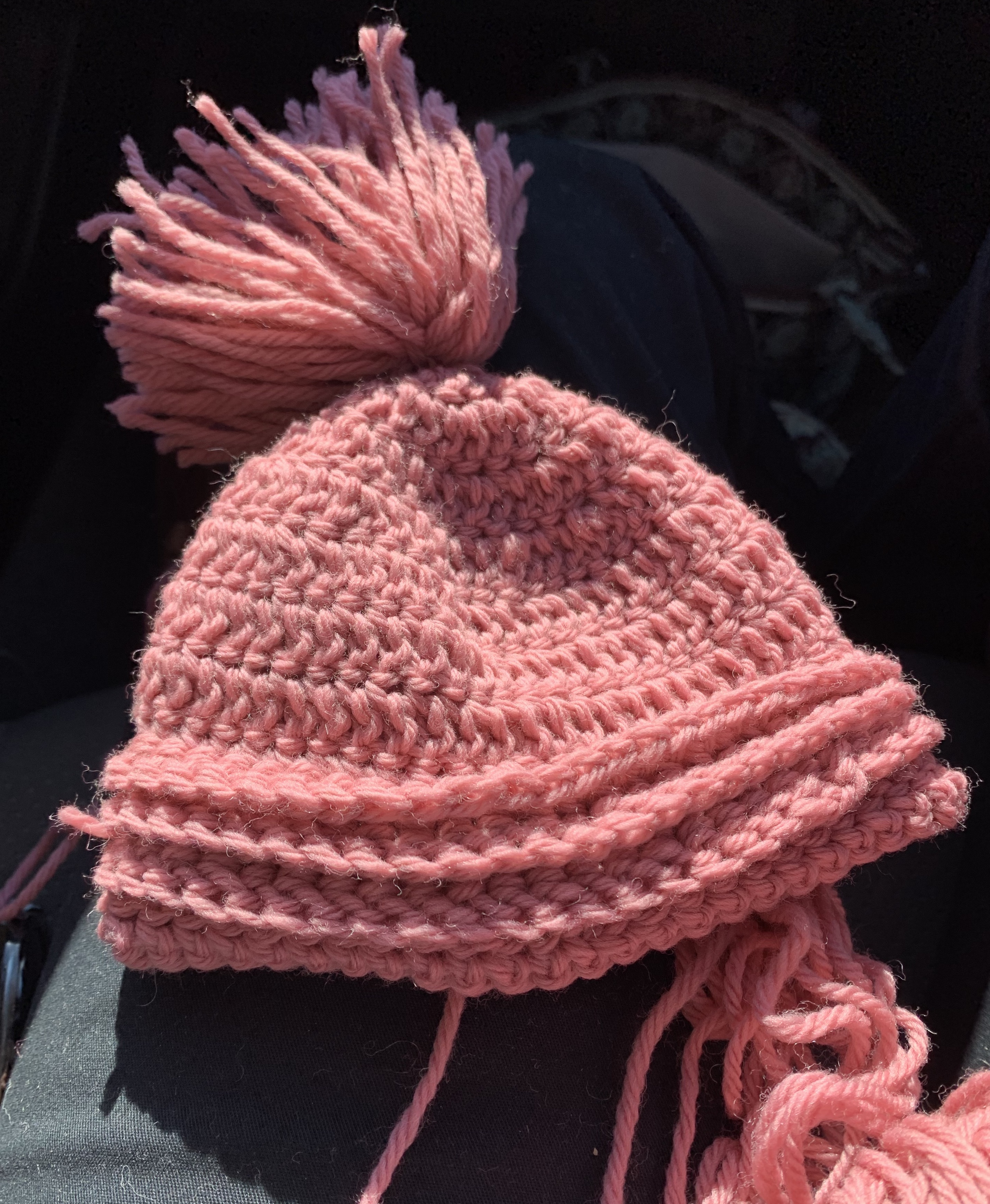
Crocheted wool hat by Margaret Simon
One of our kindergarten teachers is having a baby, so I crocheted a little hat for her new child. This was on my mind when I wrote alongside my students. I gifted the poem to Miss Heidi along with the hat.
When sheep’s wool becomes yarn becomes crochet becomes hat, a newborn baby’s head holds a sheep, yarn, hands, needle, warmth, and I wonder how prayers offered for a stranger growing inside a friend becomes a child wearing a hat passed on from sheep to hand to heart to warmth to love.
Margaret Simon
Jaden, 6th grade, has started a new trend when he writes his gratitude poem. If he makes a mistake, he turns it into a picture. I noticed his little designs and complimented him. He said, “Oh, I made those dots and stars because I messed up.” That sounds like a poem to me. And so he turned his mistakes into stars into a poem.
Recycle Poem
Old mistakes become rainbows and new designs old mistakes become new inspirations when I look at the designs will I remember the old mistakes? will I think of new ideas? shapes like stars and squares? or something new? what will the new mistakes become?
Jaden, 6th grade
One of the fourth grade teachers is raising monarchs. Katie was inspired by this and wrote her circle poem about the life cycle of a butterfly.
Life Cycle Poem
Out of a small egg comes a small, slimy, bean. A bean that squirms and grows and grows. Grows into a small chrysalis where it stays for a while until it’s ready to fly. Fly into the real world with beautiful, colored, wings and to reproduce another small egg.
Thank you to Two Writing Teachers for creating an amazing community of writers and a safe, welcoming space to write and share.
On Saturday as part of the Festival of Words, I had the privilege to attend a small workshop with Aimee Nezhukumatathil. She led us through a number of writing exercises and ended with a discussion of the haibun.
From Poets.org: “Haibun combines a prose poem with a haiku. The haiku usually ends the poem as a sort of whispery and insightful postscript to the prose of the beginning of the poem. Another way of looking at the form is thinking of haibun as highly focused testimony or recollection of a journey composed of a prose poem and ending with a meaningful murmur of sorts: a haiku.”
Aimee added to this definition with two concepts: Aware, a Japanese concept similar to natsukashisa, a type of nostalgia with a fondness for what is gone but also slight optimism for what’s ahead and a sense of calm because this is the natural course of things. She also Nezhukumatathiled the form with the addition of scent. She spoke about scent as a way to activate the reader’s mind to a memory.
On Monday, I went to a former school to screen a student for gifted. They put me in my old room to do the testing and while the child took her test, I wrote this poem.
I enter the spacious classroom, and you are not here. So many hard days in masks and social distance defined our relationship then. Your desk is gone. The smell of pencil shavings is sharp mixed with musty-mold of an old school. Today I am testing a girl like you, bright and edgy with a little swagger to her walk. But she isn’t you. No one can be you but you. This chair, the small blue square that lost its cushion years ago, holds me again. I trip over its wobbly wheels wishing you were here to laugh at me. Where are you now? In another classroom, another school, same masked face, same suspicious eyes. I want to know if you are OK. I only ever wanted you to be OK.
Students come in Twist my heart into a knot And leave it longing
Thank you to Two Writing Teachers for creating an amazing community of writers and a safe, welcoming space to write and share.
The last two weeks have offered a wealth of writing inspiration as we participated in #write0ut, a National Writing Project and National Park Service collaboration. Teaching gifted kids challenges me to find quality writing activities that will inspire, motivate, and engage my young students. #Writeout 2021 did not disappoint. And the resources will remain available on the website here.
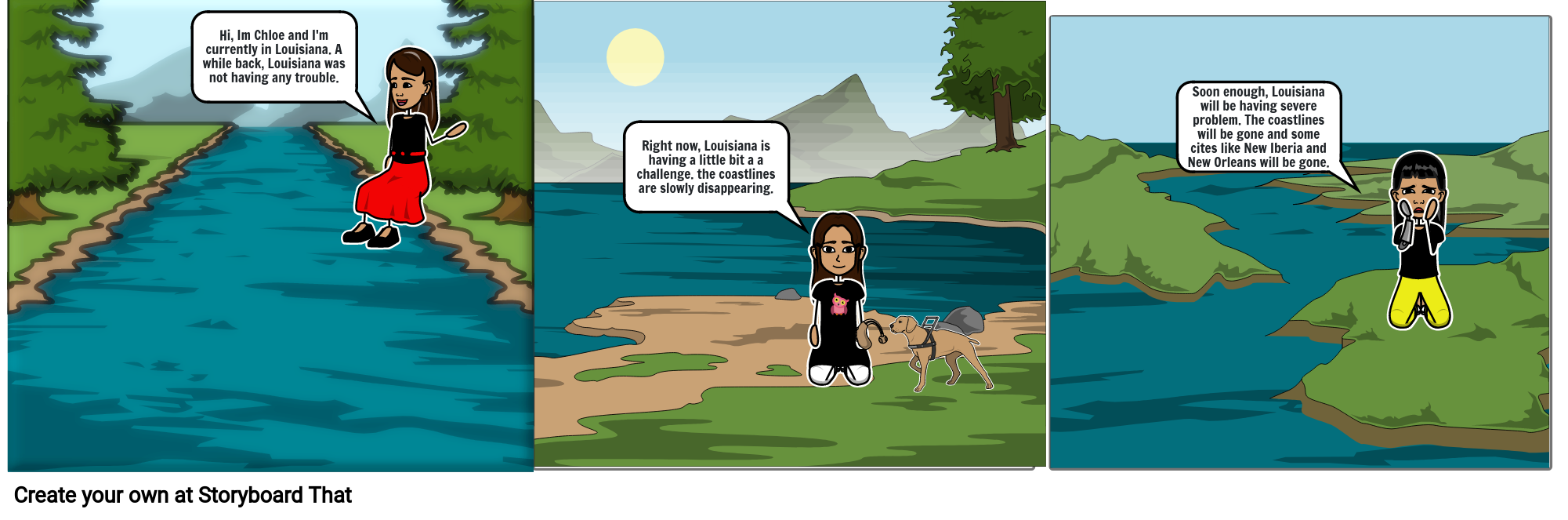
My students have created storyboards with Storyboard That about geological changes over time.
Chloe’s storyboard about Louisiana’s loss of wetlands.
They wrote poetry. Things to do if you’re a puppy by Avalyn:
Pound on a window when you want to go on a walk, purr when you want pets. Go outside and dig when you’re bored. Lastly only bark when you’re in danger.
Avalyn, 2nd grade
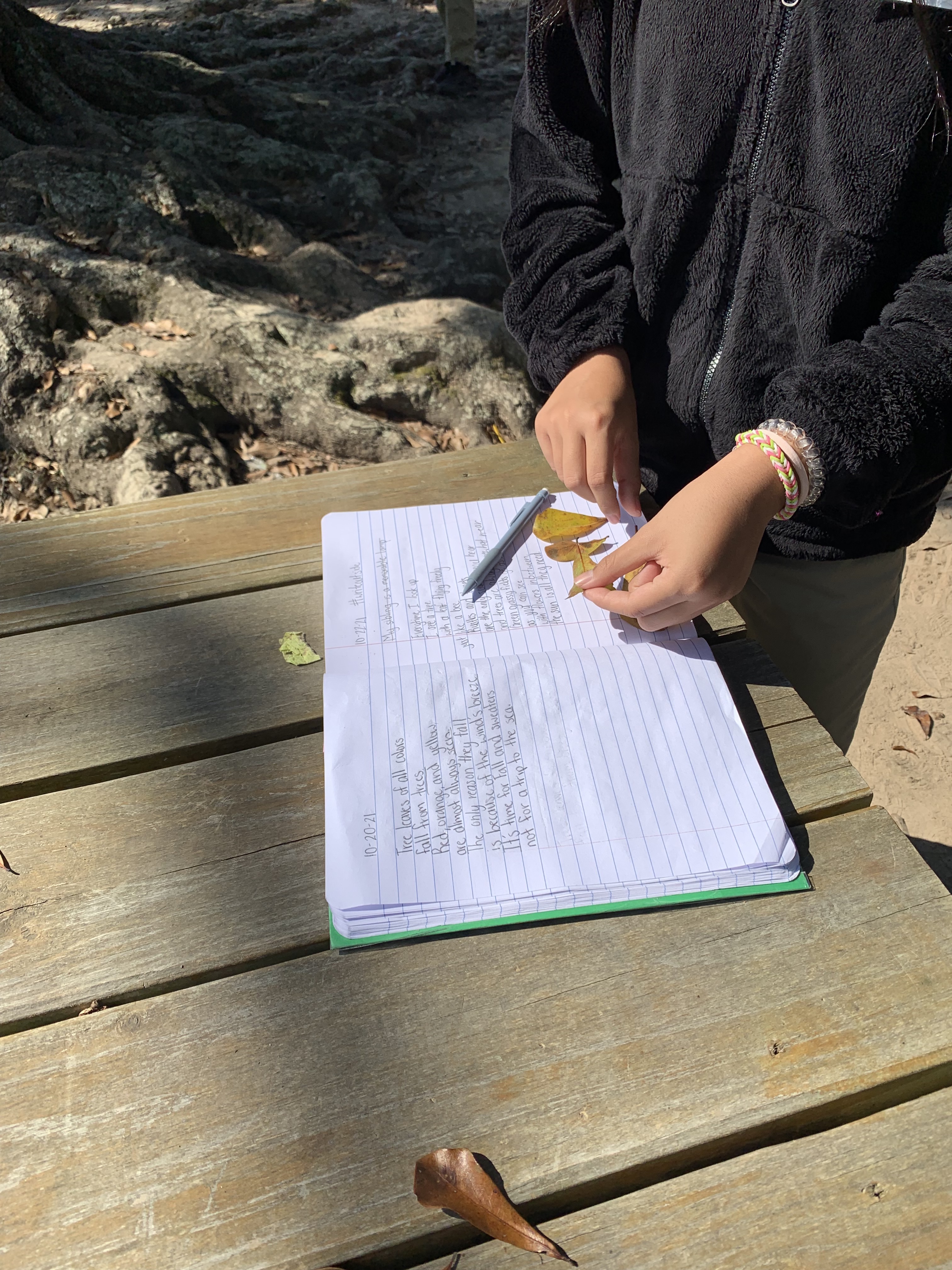
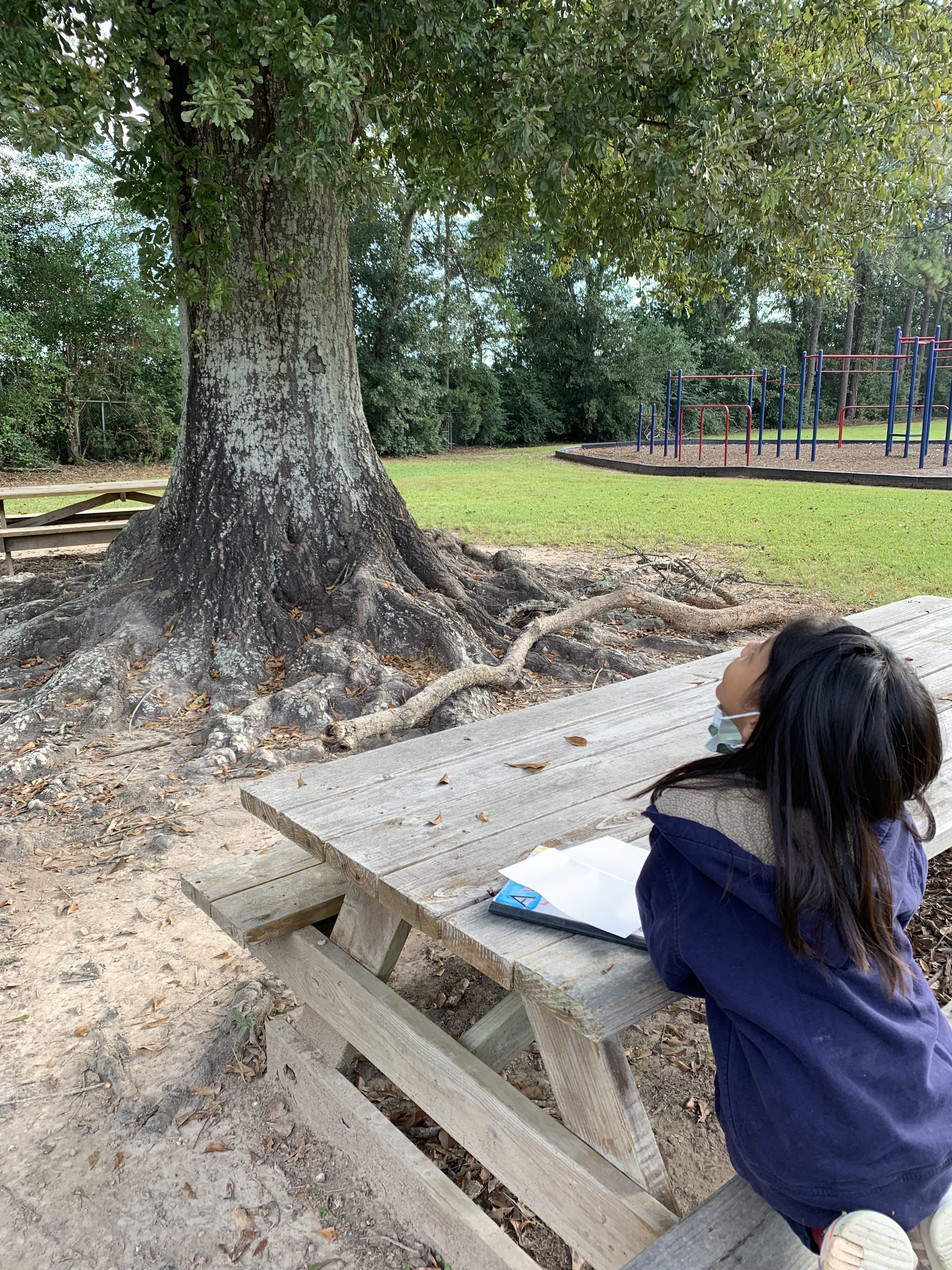
On Friday, we ventured outside to the playground. At one school, there is a large live oak. My students sat underneath the tree for writing inspiration and gathered natural materials to create an art piece.
Katie gathers leaves for her notebook.
Avalyn observes a live oak tree.
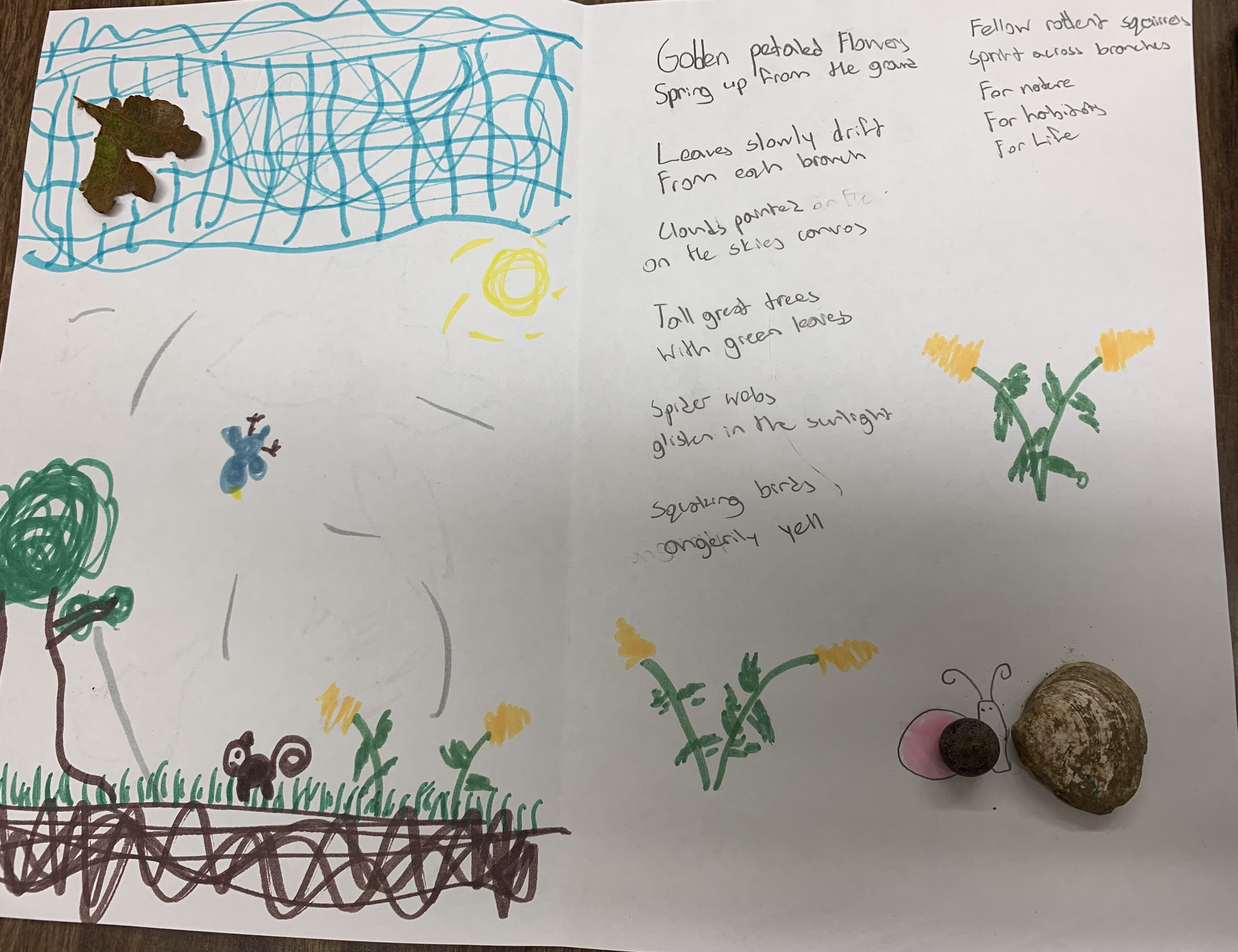
Jaden’s are collage and poem
Golden petaled flowers spring up from the ground
Leaves slowly drift from each branch
Clouds painted on the sky’s canvas
Tall great trees with green leaves
Spider webs glisten in the sunlight
Squawking birds angrily yell
Fellow rodent squirrels sprint across branches
For nature For habitats For life
Jaden, 6th grade (form inspired by Irene Latham)
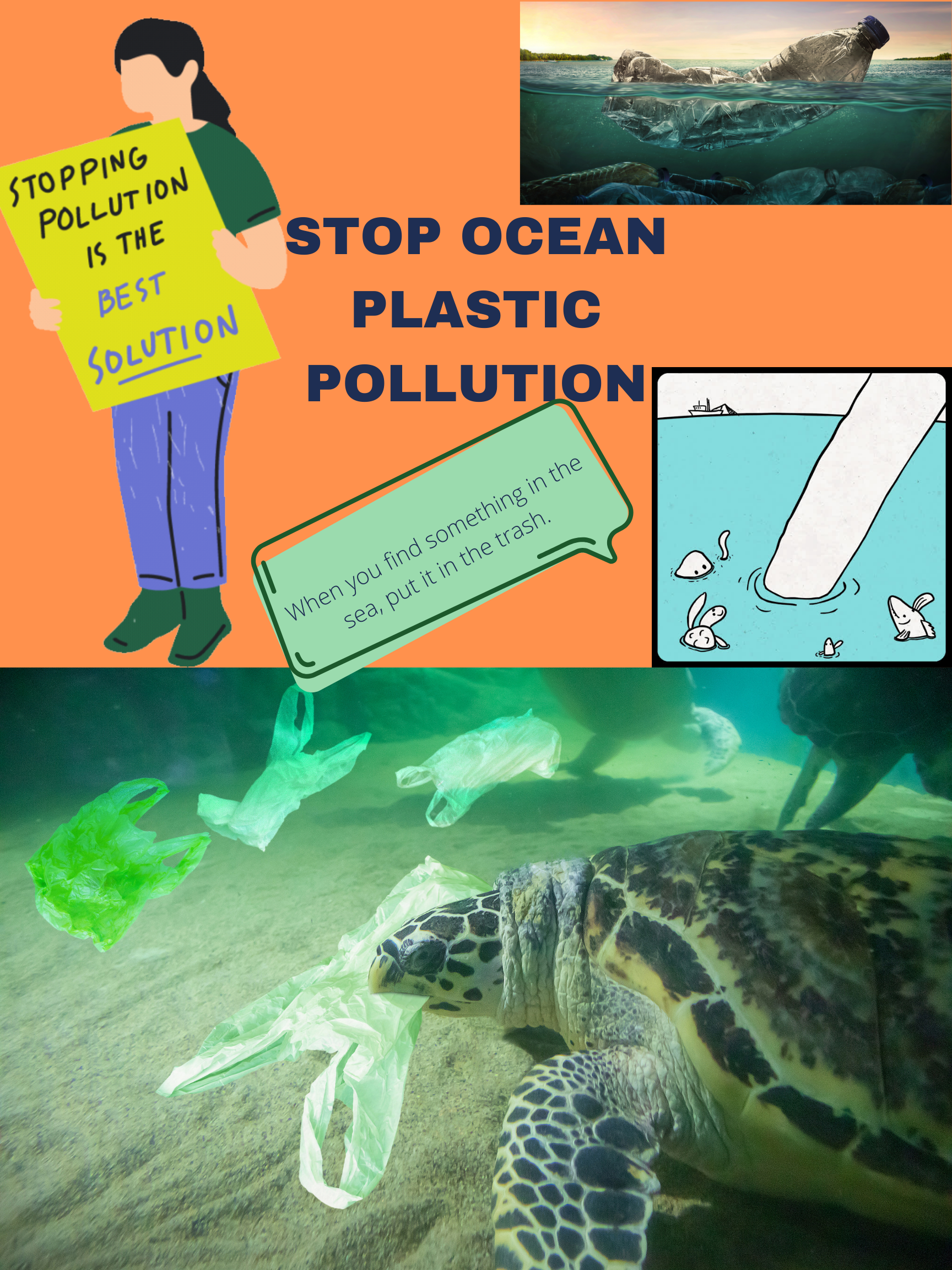
Another #writeout prompt asked students to make a poster. We used Canva and Adalyn create this one. On Canva it’s animated. You can view the animated version here.
Reading has begun for Cybils Round One. I am judging once again in the poetry category. This is such a treat, to read new poetry books and select my favorites. Stay tuned…
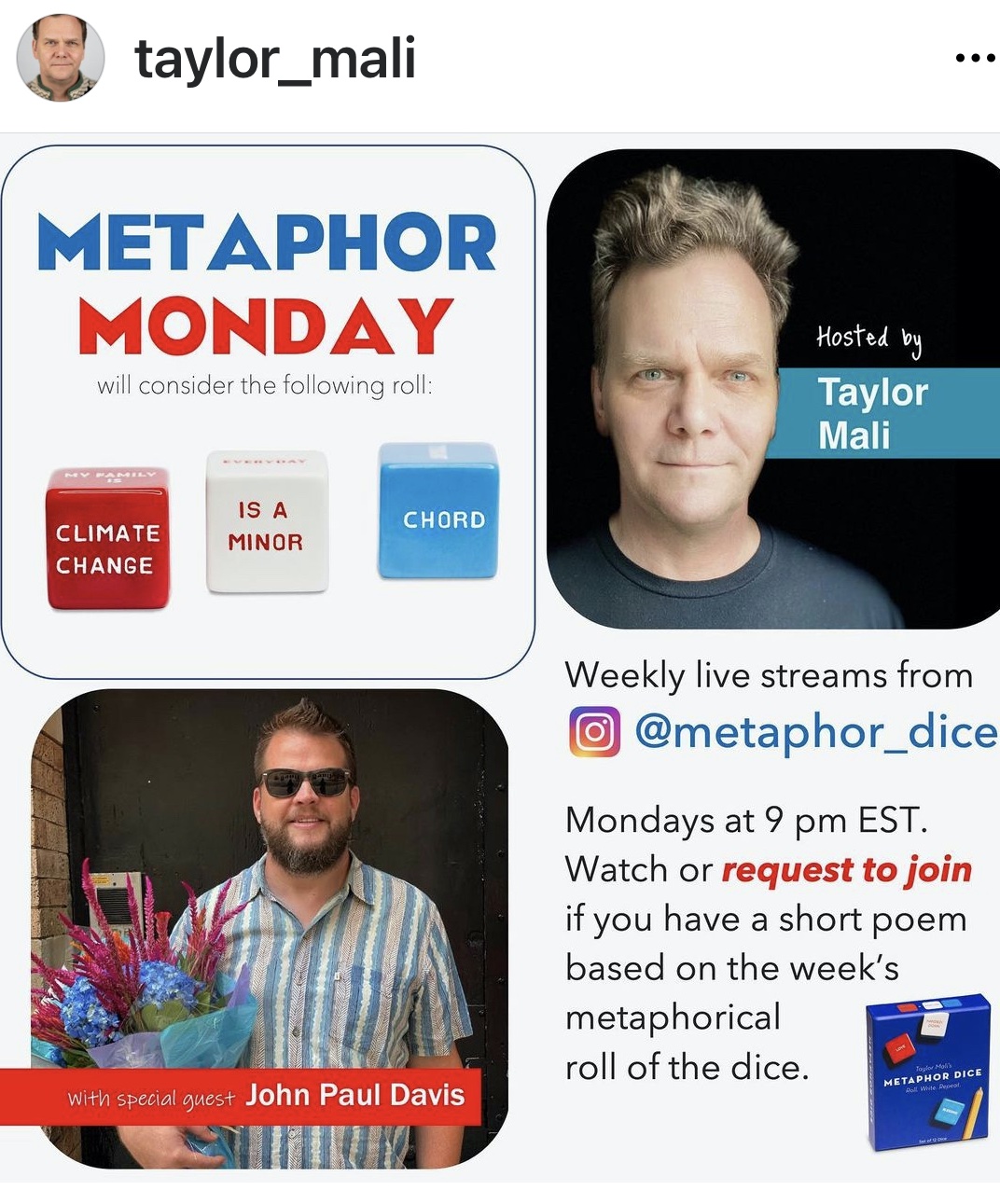
This week we had a special visitor in my 6th grade gifted classroom. One of those serendipitous things about blogging and connecting with authors is exposing my students to real authors doing the work. Taylor Mali joined us on Tuesday. Prior to the visit, he sent a package of create-your-own metaphor dice. Here’s a link to order some. We struggled with deciding which words to put on our own set of dice. We made lists in our notebooks of concepts, adjectives, and objects. I’m glad we had a little struggle because we could ask questions of the master.
Jaden asked, “What is the difference between a concept and an object? Isn’t “father” an object?” Taylor was quick with the answer. He explained that many people like to write about their fathers and mothers in a metaphorical way, more like a concept than an object. He went on to tell the story of a student of his who wrote about their father as shattered glass. “I can still see myself in the shattered pieces.”
We shared our own metaphor poems and he offered feedback. One of the things he noticed in my students’ poems was the absence of their own lives. He talked about how poetry should be beautiful language, yes, but also should be the truth. He suggested ways that they could put more of their own life experience into the poems they wrote.
I tried this idea myself with a roll of my own homemade metaphor dice. The roll I got was “The past is a soft wind.” I was pleased that Taylor’s advice to my kids resonated with me, and I tapped into a true story from my childhood.
The Past is a Soft Wind
blowing wind chimes in the old cypress tree, ringing like a distant train that left the station years ago.
The year we drove to Morton, Mississippi for Thanksgiving and gathered pecans with great grandfather. We thought he was 100 years old. He knew things–
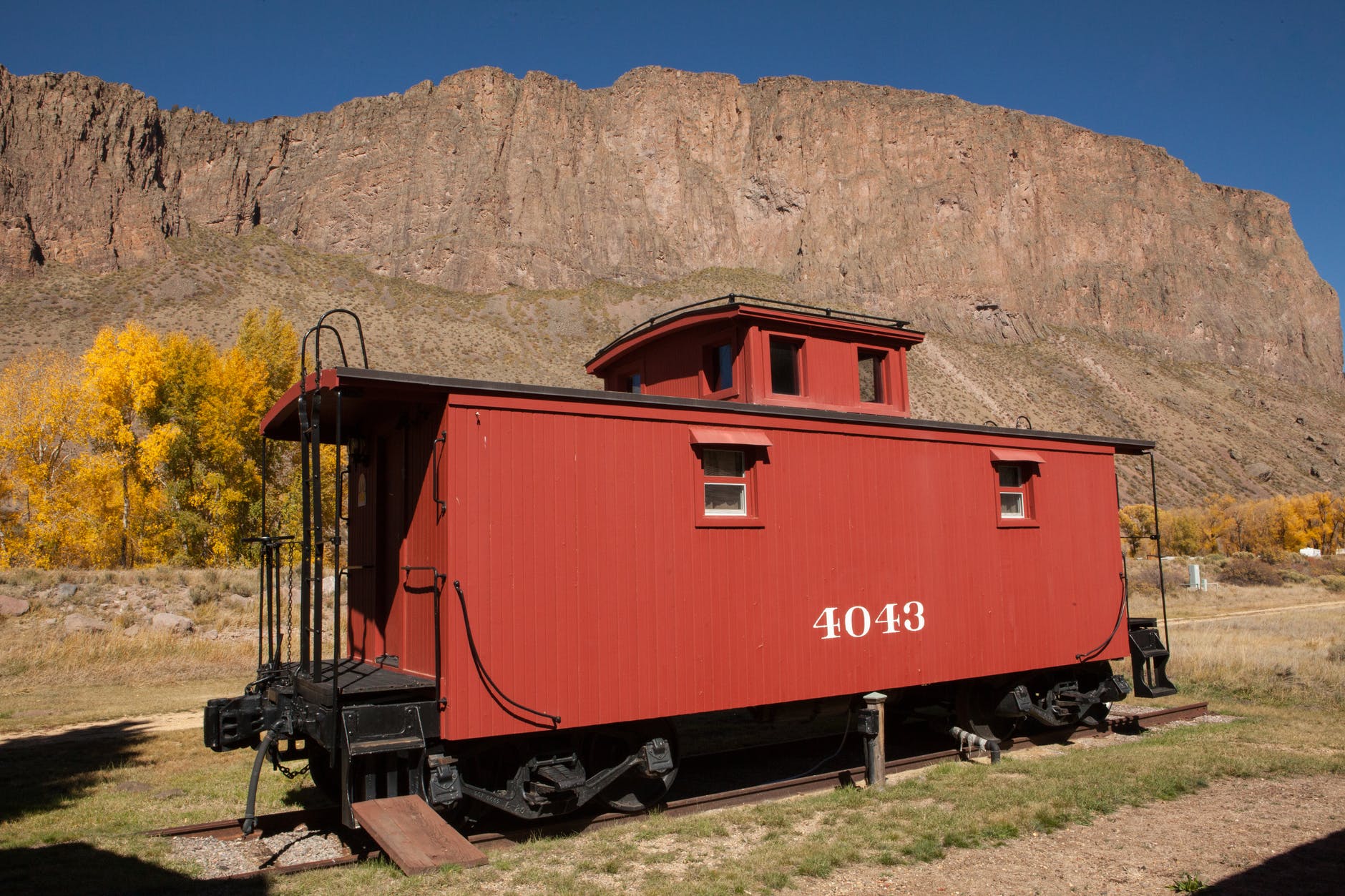
How to crack pecans in the palm of his hand and how many minutes from the engine to the caboose. We stood together watching, counting, waving to the conductor who, as that red house rounded the curve, always waved back.
Bridget Magee, our Poetry Friday hostess, just released an anthology around the number 10. I ordered it from Amazon and received it yesterday. I jumped right in and read poems from many of my Poetry Friday friends. Here is what Bridget wrote about her motivation for curating and publishing this anthology:
As the TENTH child born into a family of TEN children in the TENTH month, I am fascinated by the number ten. Add TENACITY to that fascination and the idea to create this anthology was conceived.
Every week I post a photo that begs to be a poem here on Reflections on the Teche as well as on my classroom Fanschool space. This week I was particularly struck by how the photo of a close-up of dragonfly wings inspired metaphors. Stained glass, mosaic art, prehistoric maps are a few that appeared in the small poems in the comments.
I was able to grab the student’s own writing to teach and reinforce the concept. Children can use figurative language long before they have a name for it.
dragonfly wings by Amanda Potts
Avalyn wrote “like a chandelier” in her notebook, and I took the opportunity to teach her about what she had just done. She had created a “simile.” I told her she could use the colored markers to underline it in her notebook and write the word simile in the margins. Her next line was “a clear shower curtain and the outline of your window.” I directed her to choose another color to mark the metaphor. Then I read her my poem and allowed her to mark my poem with the same colors. I was almost giddy with delight to be able to notice and note a gem in my second grade student’s writing.
This experience makes me wonder about photography and writing. Did the writing change if I told the children the photo was dragonfly wings? I told Jaden what the image was before he wrote, so he decided to google “dragonflies” and included a science fact in his poem.
Wings like glass designs shedding light zipping through the sky 30 wing beats every second bzz-bzz the dragon fly slips by.
by Jaden, 6th grade
I’ve been thinking a lot lately about retirement. I envy my poet-teacher-friend Mary Lee Hahn who has a poem about retirement today. But moments like these in my classroom writing alongside such gifted and talented writers inspires me and makes me a better person. I think I’ll stick with it a little longer.
Thank you to Two Writing Teachers for creating an amazing community of writers and a safe, welcoming space to write and share.
#WriteOut sponsored by the National Writing Project in partnership with the National Parks began yesterday with a wonderful video and prompt from Golden Gate National Recreation Area. My students and I had a productive day of writing in response.
As a teacher of writing, I am interested in prompts that lead to creative and imaginative writing. This first prompt did the job. Because there was a way into the story (a character enters a portal), students created a variety of different responses. Each one carried their character through the portal in interesting ways. Avalyn, second grade, chose herself as the character who finds the portal on the monkey bars and travels to the desert, then the rainforest, and back home where she lives happily ever after. Her story is here.
Katie and Jaden, 6th graders, chose to be animals in their stories. I think their chosen animals say a little about who they are. You can read their stories on Fanschool here and here.
Chloe’s story reminds me of a book I read this summer on Netgalley, Once Upon a Camel by Kathi Appelt. It’s a book to grab up if you teach middle grades. It’s a lovely story of a camel who saves tiny twin kestrels from a dust storm. I loved all the characters in this book and love that it weaves in a history of camels in Texas. Chloe hasn’t read this book yet, but the creative magic wand waved over her with these words:
Once in a desert, a camel walked into a purple glowing light. He knew it was a portal. He shifted and swayed until he stopped, opened his eyes and saw a horse running around a castle that had the words “Mississippi Land” on it.
I wrote alongside my students and may work on my story for a regional Louisiana picture book idea. There, I put it in writing. I know it needs a lot of work, but what do you think about a mosquito and banana spider that take a ride through the swamp on a brown pelican?
The Write Out prompts and resources will be remain available on NWP’s website, so even if you don’t have time to work them into your lessons now, tuck them into a back pocket. They are gems!
This month, Inkling Mary Lee Hahn challenged the group to write a poem to define or exemplify a poetic device or form. She was inspired by two books, The Craft of Poetry by Lucy Newlyn and Inside Out by Marjorie Maddox. I remembered a set of poems I wrote using the definito form to define a poetic device.
Another Inkling partner Heidi Mordhorst created the definito form which is a poem written for children in 8-12 lines that defines a word. The word appears as the last word of the poem. Today’s poems define alliteration, imagery, personification, and meter.
Letters, linked and lively, Lindy-hopping- Notice how some sounds repeat Tongue twister Word sister…alliteration.
Make a movie in your mind Imagine all that tastes, feels, sounds– hands gripping, feet slipping, Writers show me how to see with imagery.
If the wind waves If flowers wink If hummingbirds tell a tale. A thing you know A thing you love becomes a person real and alive walking across the page personification.
Can you tap out a beat? ta da, ta dum, ta dee! Count the upbeats? one, two, three A poem may rhyme but the rhythm is clear Iambic, dactylic, pentameter words for the beat Tap, tap…meter.
Write Out 2021 (#writeout) is getting ready to launch this October 10th and will run through the 24th. This year’s theme—Palettes, Storyboards, and Cadences—is meant to support you as you explore the natural world and public spaces around you, while engaging as writers and creators who share in a connected virtual community.
This summer I worked with the National Writing Project on creating prompts for writing with Write Out. This two-week event encourages you to get outdoors and write. A number of National Parks have created videos for students to inspire writing. You can sign up at the NWP website to receive updates.
Margaret Simon lives on the Bayou Teche in New Iberia, Louisiana. She is a retired elementary gifted teacher who writes poetry and children's books. Welcome to a space of peace, poetry, and personal reflection. Walk in kindness.










 Reflections on the Teche