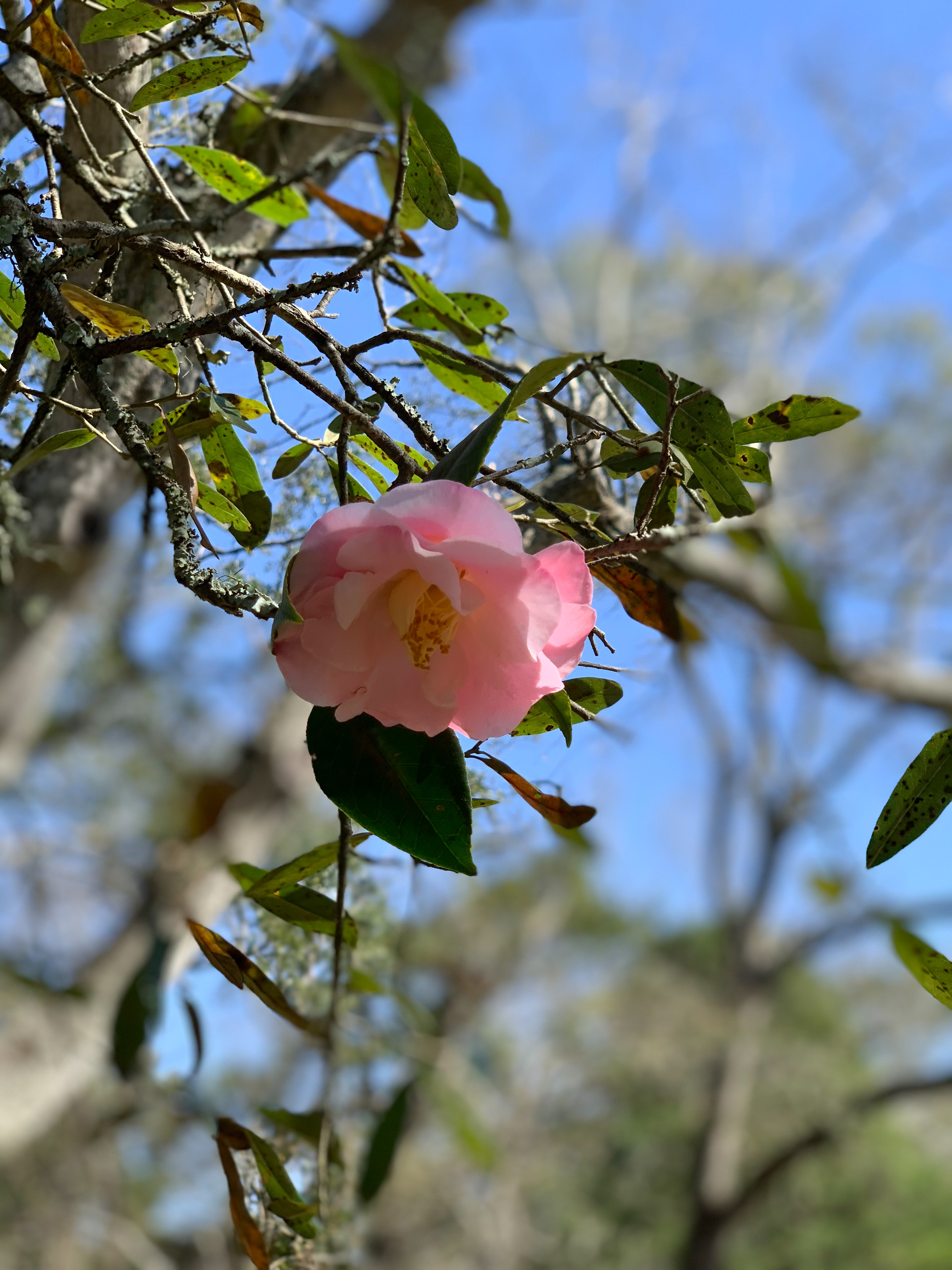
If you are a reader of my blog, you know that I love spending time with my grandchildren. A few weeks ago I took Leo to visit his great grandmother. We wandered around her backyard. Minga picked a camellia, a common winter flower here in the South. She handed the beautiful pink blossom to Leo. He held it out to me and pointed up, “Tree!” So, of course, I placed the flower into the tree. Off went Leo, satisfied and ready to romp across the yard.
Camellia blossom in an oak tree. Photo by Margaret Simon
With a line borrowed from Ellen Bass, I offer this small poem. Leave your own poem in the comments. Please encourage other writers with response to their poem-gifts.
The thing is to love life, to hold a flower in your hands, and then give it away.
Thank you to Two Writing Teachers for creating an amazing community of writers and a safe, welcoming space to write and share.
Amanda Gorman is an icon these days. She’s everywhere. Even at the Super Bowl. While I didn’t care much for the game, I do care about poetry and am enthralled by Amanda Gorman.
For writing time Monday morning, I showed this video of her performance. At first we just watched and listened. Then my students and I collected word groups. Amanda not only writes with rhyme and rhythm, she also plays with the inner sounds of words. Here are a few of the groups we collected:
captain action impact
need lead exceeding succeed
expectation limitation uplifting
wound warfare warrior share
nonstop hot spots laptops workshops
acting courage compassion
charge champions carry call captain
neighbors leaders educators healers
schools tools
Chloe said “Her tongue’s a trampoline.” I grabbed that line as a first line to this poem.
Amanda
Her tongue’s a trampoline! Words bouncing, beginning a charge for compassion, acting, not reacting with a force for choice. Nonstop flips and jumps, swinging above expectations with a landing, a bow, and branding a voice for now, an example of how, Amanda amps the vow– Wow!
The Writer’s Almanac comes daily in my email inbox. Some days I barely have time to read it, but others I find a kernel of inspiration, a poem, an author, a rabbit hole. On this day, I remembered Catherine’s prompt and tucked the poem into a document to work with later.
The process was fun. I used the suggesting tool in Google docs editor. That way I kept the original underneath the new text I added. In Greg Watson’s poem, the main character is a yellow lab waiting for its owner outside a coffee shop. We don’t have a yellow lab, but my little schnoodle Charlie goes bonkers when our resident raccoon visits to steal our outdoor cat’s food.
When I’m up early, I feed the cat before dawn. When the raccoon comes, I let Charlie out to the side yard when he goes crazy. One morning, I actually saw the raccoon. It did not run away as I expected, but just stood still like a stone creature from The Lion, the Witch, and the Wardrobe. Watson’s poem gave me the perfect structure to capture this surprising moment.
Raccoon Outside the Back Door
The raccoon outside the back door today does not move; but instead,
still with ever-expectant energy, like a heron perched for the catch,
forepaws poised in the air above the leaf-littered sidewalk,
he stops without making a sound, knowing that any moment
the cat food will disappear, slipped back into the human house,
and night will suddenly fall into day: every sound, sight, and aroma
disturbed, the door swinging open and shut, with a backward glance
awkward silhouette, following, as if it had somewhere to go.
Spiritual Journey First Thursday is being gathered today by Fran Haley.
Take Heart is Fran’s choice for our Spiritual Thursday posts. In my Mississippi childhood, Dear Heart was a common feminine expression, similar to cher in the Cajun culture I now live in. Dear heart is an expression of endearment that could have a connotation of condescension.
But Take Heart is not at all condescending. In a sense, its meaning is quite the opposite. To Take Heart is a way to overcome the troubles of the world.
“I have said these things to you, that in me you may have peace. In the world you will have tribulation. But take heart; I have overcome the world.” — John 16:33
Take Heart means to live a life that understands there is trouble, there is hardship, there is pain, but there is a greater spirit that overcomes and offers hope. As I read Out of the Dust with a student this week, he identified the theme, “There is always hope.” A pandemic is a kind of Dust Bowl for our time. We have little control over who the virus will target next. Our handkerchiefs are our masks. We stay distanced to avoid the dust. Yet, there is hope. There is always hope.
I started thinking about ways I overcome and find peace in my own life and wrote a “Things to do” poem.
Things to Do to Take Heart
Notice the singing of morning birds. Begin each day in prayerful meditation. Read poetry. Write poetry. Write a letter to a girl in prison. Fold an origami heart. Sing a lullaby to a new baby. Take a child to the park. Swing with him on your lap. Kiss the screen on Facetime. Laugh with your partner. Go to sleep to the owl’s call.
Margaret Simon, 2021
My students and I are making origami heart messages for V-Day.
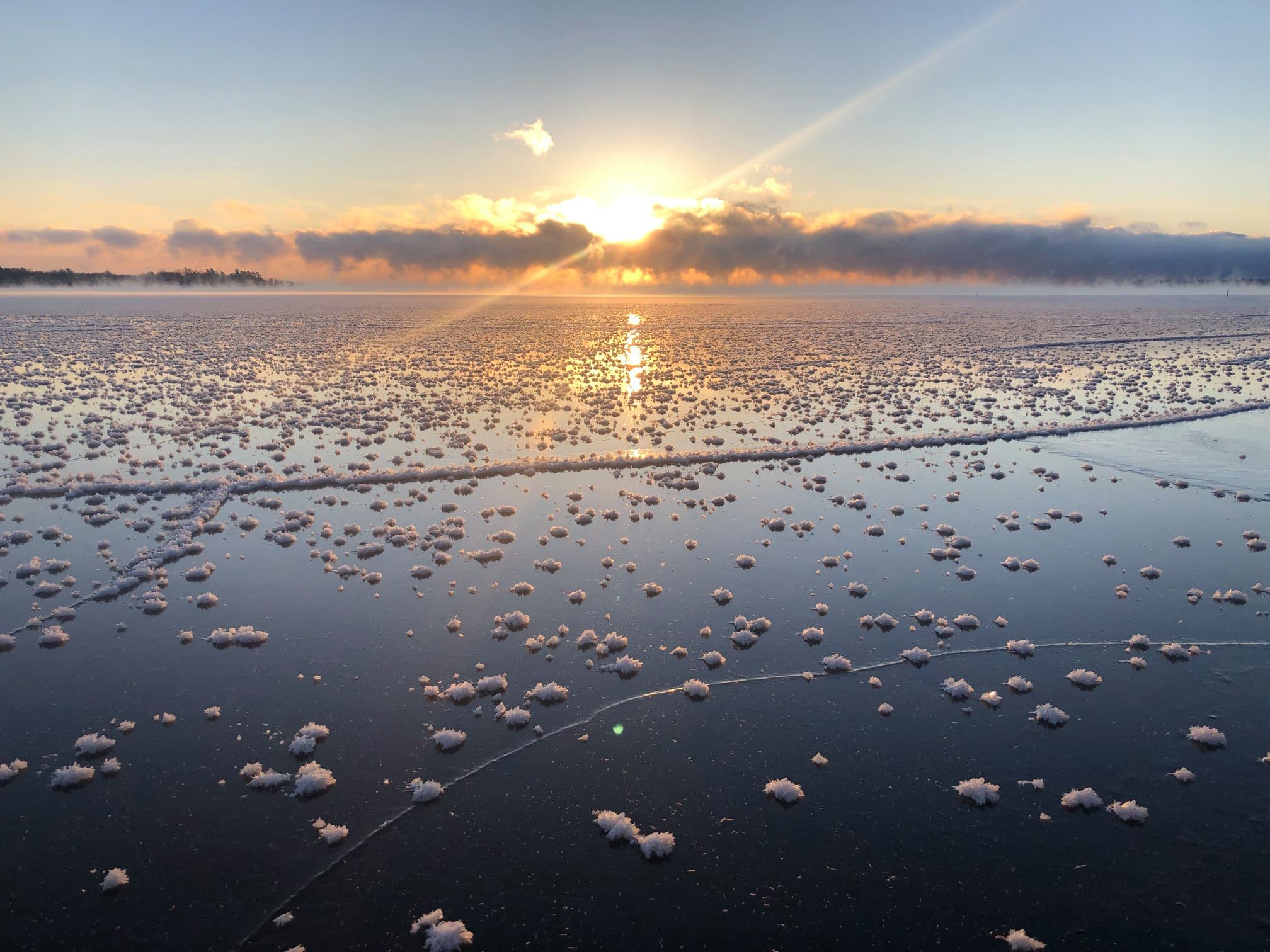
I have followed Kate Messner for years and have many of her wonderful books for middle grade readers. Kate is a real person, as well as an author-hero, who lives on Lake Champlain. Too cold for my southern blood, but she posted photos on her Instagram recently of ice flowers. Kate wrote a blog post about this phenomenon on her website here.
Natural beauty that comes with scientific facts fascinates and inspires me. I tend to dive into googling and wonder. Here is an interesting article from American Scientist. There seems to be controversy or conversation, rather, about what to call this amazing phenomenon. Frost flowers, frost weed, or frost plant, these winter blooms are sure to inspire some small poems.
Lake Champlain Sunrise, Photo by Kate MessnerIce flowers by Kate Messner
(I tried a zeno poem today with the syllable pattern of 8,4,2,1,4,2,1,4,2,1 with all one syllables rhyming.)
Displayed on a black lake blanket diamond blossoms gemstones nice beauty hidden stinging ice golden morning winter spice
Margaret Simon, draft
Leave a small poem in the comments. Be sure to connect with other writers by leaving comments on their poems.
Kate celebrated World Read Aloud Day today with a video of amazing authors reading from their books. Click here to find the video on her website.
Last Friday I posted poems from my two fifth grade girls who responded to Amanda Gorman’s powerful words with their own poems. Their poetry prowess has not stopped. On Thursday, Kaia announced that she had written another poem. She explained to me that she saw Beldam, the Other Mother in Coraline. She googled it and found a poem by John Keats, La Belle Dame sans Merci. As she’s telling me this, she is writing and googling and writing and asking me about the Queen and how tall she is. Where is she going with this? In the end, it all led to an original ballad-esque poem.
I told her, “You are doing the work of a poet.”
Her face (her eyes, for she was wearing a mask) lit up. “Really, why?”
I explained that as a writer, we seek inspiration and research it and then write from it. Amanda Gorman explained in an interview with Anderson Cooper that she read other inaugural poets and researched inspirational speeches to write her poem, The Hill We Climb. “You are doing this kind of work. You are not just writing from my prompts anymore. You are actually a poet.”
Those words inspired her to write another poem. I will post a stanza here. She said, “I love how in poetry, you can write about anything. I can write about your desk, that pen, the Kleenex box.”
“Yes, you can.” I thought to myself, a dream come true. Or my One Little Word, Inspire, at work.
I’d like to find a place to send some of her work. If you have any ideas, please leave a comment.
The Work of a Poet
As you pick up the pen, you wonder what to write Thinking this way and that way, until you see a light A shining and glistening rhythm it sets off And helps you to the end of the paper, as fast as a cough
Welcome to a weekly writing prompt. The steps are easy, if you choose to try them. Listen to your muse. Write a small poem in the comments. Leave encouraging responses to other writers. This is a safe and sacred place to write. Begin.
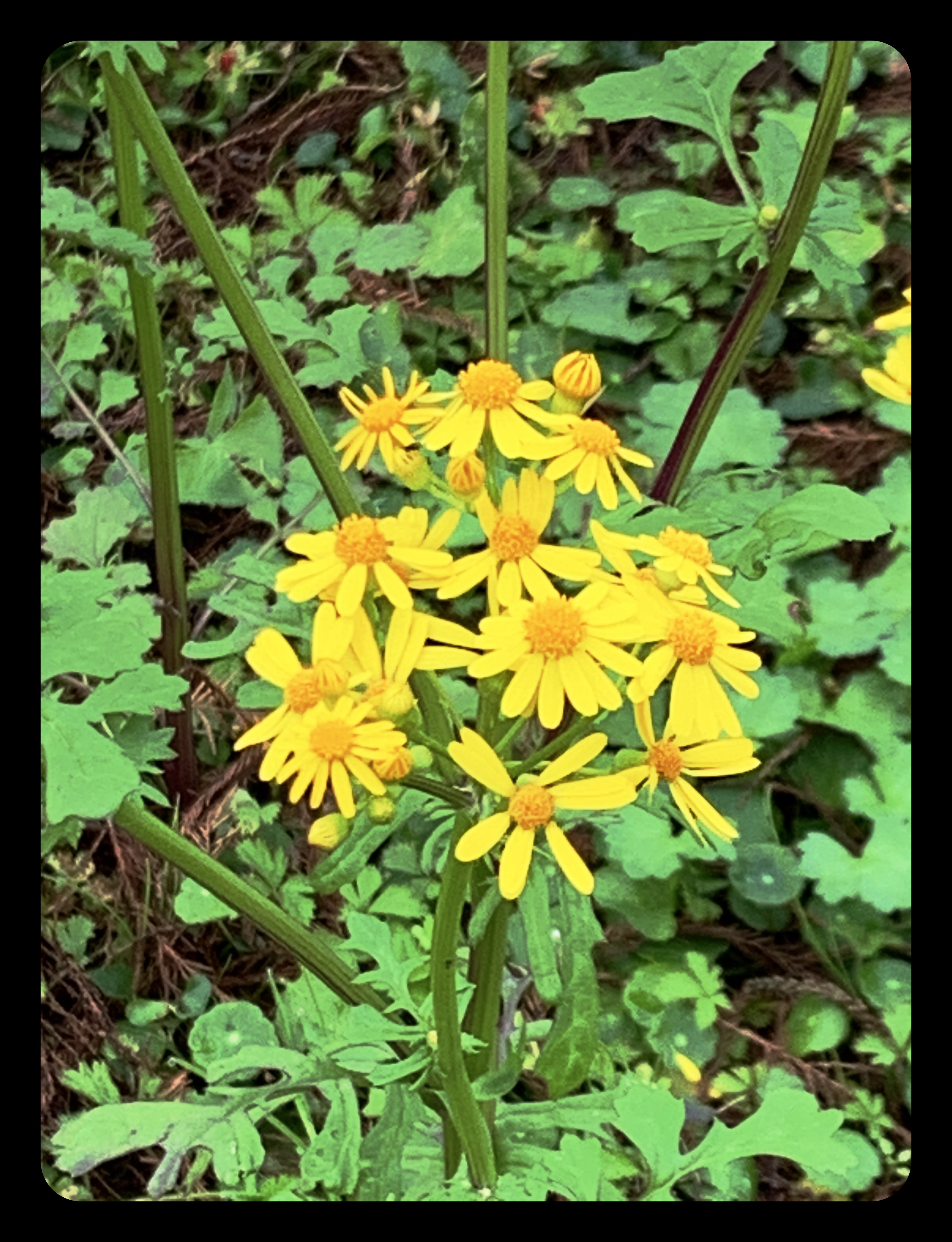
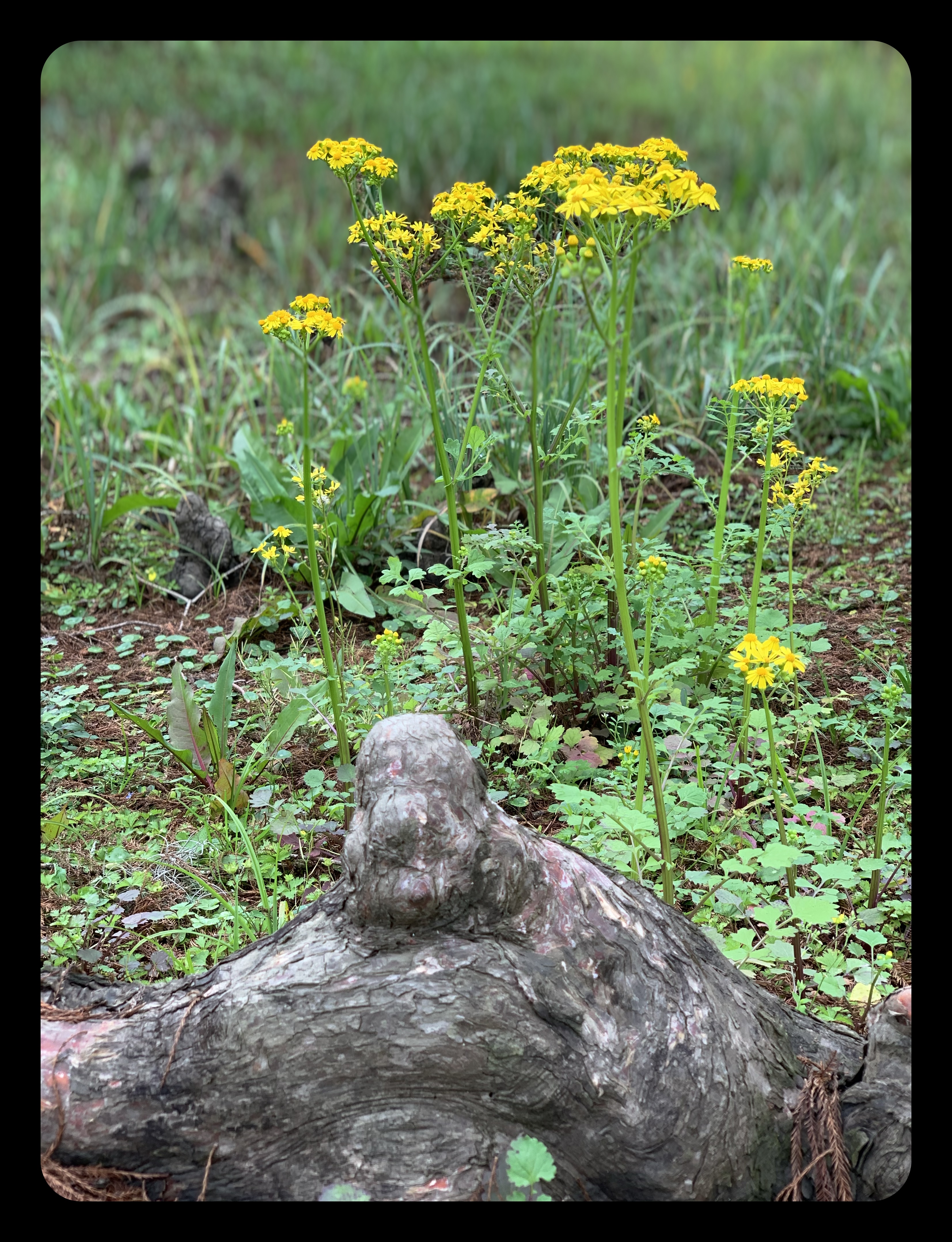
Butterweed by Margaret Simon. I took this photo on my iPhone using the app Camera+ 2.
Cypress knee with butterweed, photo by Margaret Simon
I took these photos in my backyard on Bayou Teche in Louisiana. These are wild flowers known as butterweed that grow before my yard man (husband) has a chance to mow. Sometimes he will mow around them because he knows I love them. They offer a bright spot in a winter yard of bare cypress trees and brown lawn. Here’s a bit of research I found.
Weary of its winter bed bursts of yellow whisper secrets of Eos.*
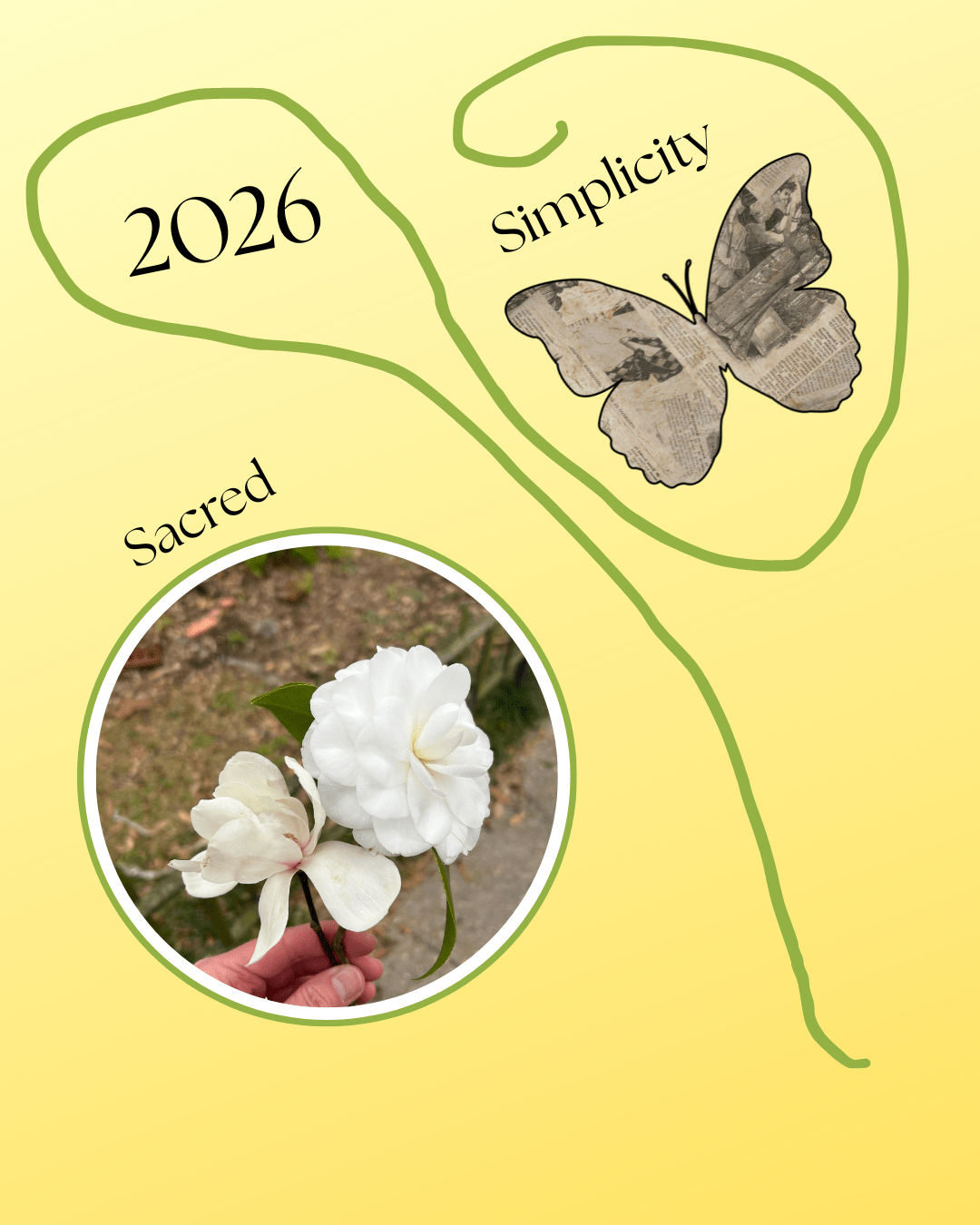
The word sacred can have many connotations. When I read today’s invitation to write about your sacred writing space, I began with thoughts about the word itself. Sacred. Yesterday I read Nikki Giovanni’s poem “In the Spirit of Martin” alongside a fifth grade student. She asked the question, “What does sacred mean?” responding to the poem’s first line, “This is a sacred poem…”
My initial response was “holy.” Sacred is a place that is quiet and contemplative, like a church.
Is my writing space sacred? Consecrated by different sizes, shapes, and surfaces of paper. Blessed with pens which become cat toys if I leave them out. Ordained by hard maple wood. My writing space is my kitchen. It’s where all the animals hang out. It’s close to the coffee pot. There’s a door that leads out to a winding bayou and cypress trees.
Our writing spaces become sacred when we make the space to sit in quiet stillness, to listen to the inner voice, and to be confident enough to put words on a page (or screen).
When the c trades places with the a,sacred becomes scared. Sacred can be scary. I’ve certainly had that mix of butterfly flutters in my belly when entering a sacristy.
Writing can be scary, too.
I’m learning to trust the process. To let my words be sacred. To open up myself to the vulnerable space. It’s still scary, but more often than not, it feels fulfilling and safe.
Thank you to Two Writing Teachers for creating an amazing community of writers and a safe, welcoming space to write and share.
We’ve learned that quiet isn’t always peace And the norms and notions of what just is Isn’t always just-ice
Amanda Gorman, The Hill We Climb Inaugural Poem
These words from Amanda Gorman hit a nerve. As a white woman raised in the south in the 60’s and 70’s, Just Is was a part of the thread that wove the fabric of racism in our time. Echoes of that’s just the way it is rang through the school hallways I walked, the places we shopped, the neighborhood streets we rode. The only dark faces I saw were our maids and their children.
Desegregation didn’t happen until I was in the 4th grade, 1971. I remember having no school for two weeks while the scramble to mix it up began. That was fun for us kids. When we returned to school, there were new faces, new teachers. My favorite was Miss Love. She was a large black woman with a great bosom for hugging you close. She gave us one of my favorite assignments, a state project. I chose Maine because the capital city is Augustus, my birthday month (of course!). I have never gone to Maine but have a special place for it in my heart because of Miss Love.
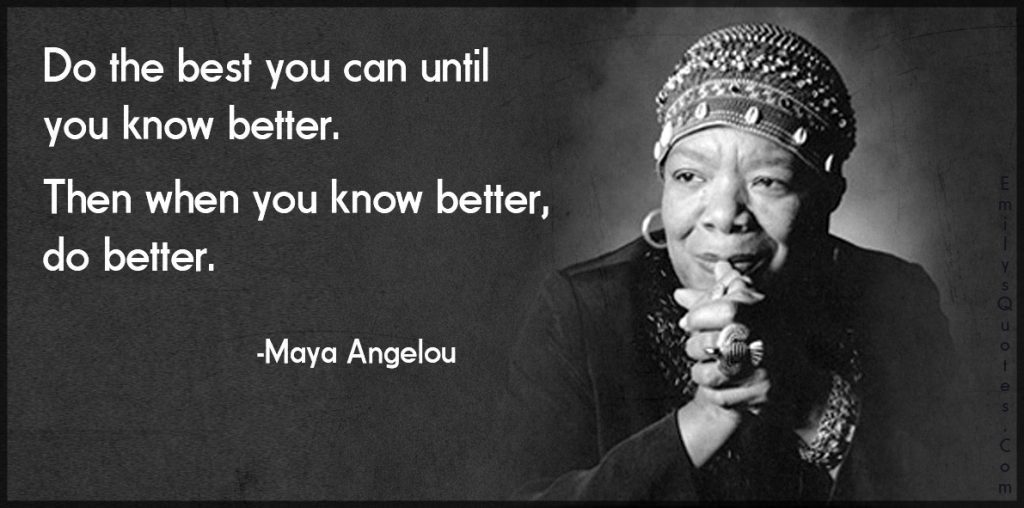
Change is easy for kids. Children don’t really know racism. I didn’t when I was ten. But now, in retrospect, I see more clearly how “just is” was not “justice.” I cannot change the past. None of us can. But we can do better when we know better, another famous quote from an African American hero– Maya Angelou.
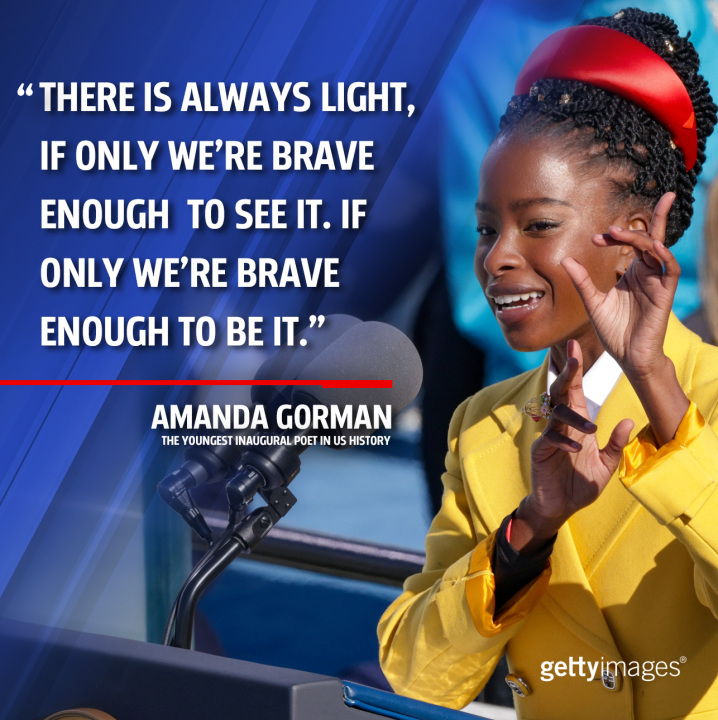
Like the nation, I have fallen head over heals in love with Amanda Gorman, the youngest inaugural poet ever, and a heroine to many young girls just like the ones I teach. All girls, no matter their race, can now dream of being a Vice President someday. As much as I admire Kamala Harris and her accomplishments, the star of Inauguration Day was young Amanda Gorman. I couldn’t wait to present her to my students this week.
We started on Tuesday with her poem “In this Place (An American Lyric)” written for Tracy K. Smith’s inauguration as Poet Laureate in 2017. (This post from the Library of Congress contains the poem and a video from the reading.) As Kaia heard that poem, she was writing. And after class that day, she sent me two more poems. Amanda lit a fire in her, a flame for words.
There’s a poem in this place after Amanda Gorman
Not here nor there But there’s no need to look everywhere tug and pull on my hair Hoping that this poem, has time to spare
There’s a poem in this place While i’m in disgrace Of finding my lyric That belongs in this place
There’s a poem in this place Still not being found Is it in a dog hound? No, it weighs more than that one pound
There’s a poem in this place While the wind is hitting my face Being withdrawn due to lack of space Without leaving any sign of a trace
There’s a poem in this place Where could it be? Wait, I have found it! It’s in YOU and ME.
Kaia, 5th grade
On Thursday, we used Pernille Ripp’s generous gift of a slide show to visit and discuss “The Hill We Climb.” While the message of this poem was powerful, I was drawn to Amanda’s effective word choice, how they sound and how their meanings change with usage. Combinations like just is and justice, arms, harm, and harmony, and tired, tried, and tied. Chloe’s poem below is her good effort to play with word sounds like Amanda.
There’s a poem in sight Too bright To fight It takes flight To the world of an artist Who’s never artless Who just started to harness The sharpest words That bring out The creativity With a twist And a big Dream to Feel like They exist
Margaret Simon lives on the Bayou Teche in New Iberia, Louisiana. She is a retired elementary gifted teacher who writes poetry and children's books. Welcome to a space of peace, poetry, and personal reflection. Walk in kindness.