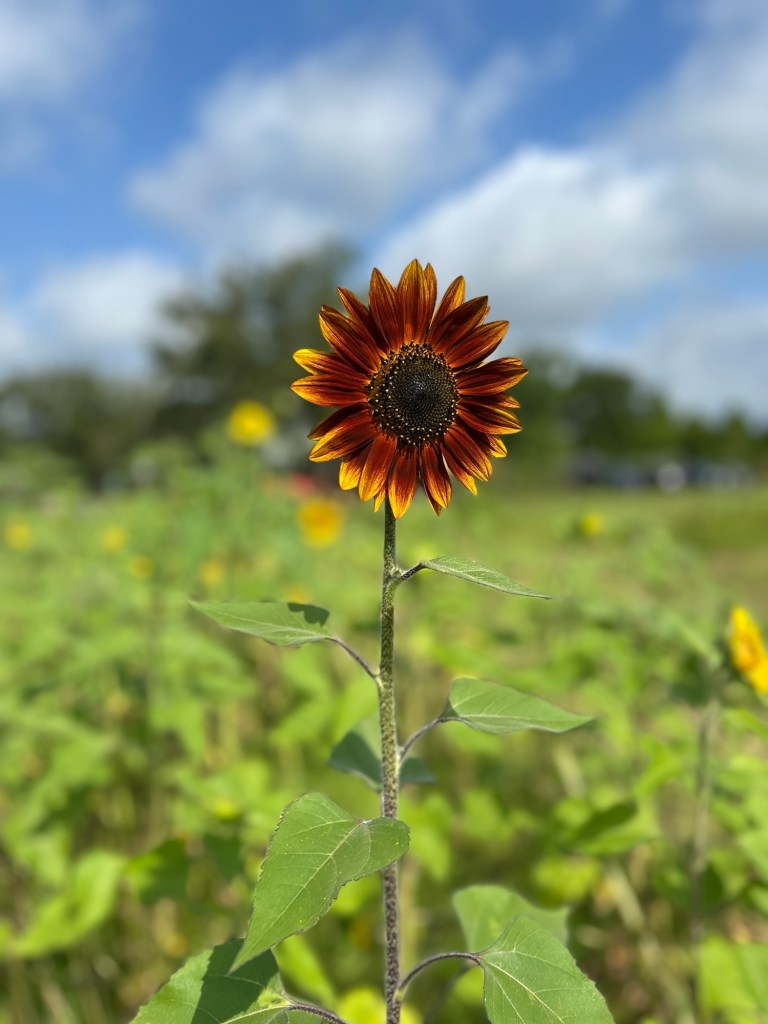
This weekend was You-Pick Day at the Petite Anse Sunflower Farm. My daughter Martha was visiting with her little family, so we headed out Saturday morning to fill a vase for my book signing. The bright May sun was shining, and, with Martha’s help, we filled a vase of beautiful sunflowers. I love this annual event. Jennifer and Andy welcome visitors with buckets, clippers, bug spray, and conversation.
Sunflowers are living examples of the Fibonacci series, so I feel a fib poem is an appropriate small form. The syllable count is 1, 2, 3, 5, 8. Today on Georgia Heard’s inspiring calendar the prompt is “a letter to a place.”
Let’s celebrate May and warmth and flowers today. Please leave a small poem in the comments and support other writers with encouraging comments. Thanks for being here.
Dear fire red sunflower, Thank you for your face flaming from a stalk of grace.
Thank you to Two Writing Teachers for creating an amazing community of writers and a safe, welcoming space to write and share.
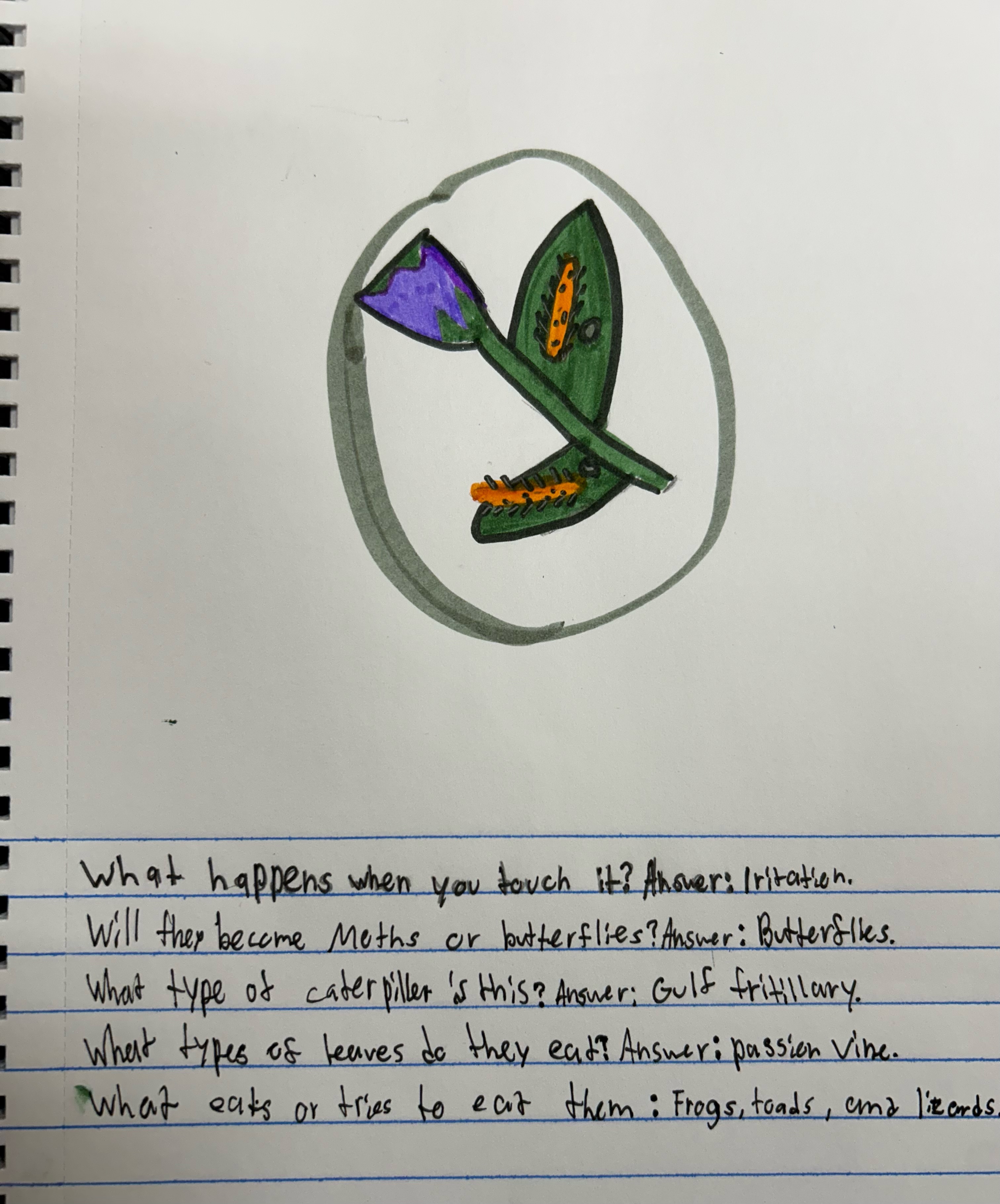
I teach gifted elementary students. I think of my classroom door as a revolving one because students from grades 2-6 come in and go out all day long. Two weeks ago I brought in some Gulf fritillary caterpillars in a butterfly net. I placed them on the table and invited my students to ask questions.
This is Marifaye’s sketchbook neatly written with her 5 questions and the answers. (Not all notebooks looked this neat.)
Students gathered around the table and drew what they saw, asking question after question. They became enthusiastic yet frustrated that I would not give them a straight answer. They practiced using Google to research and answer their questions.
This week the caterpillars eclosed (hatched) and once again we observed and drew pictures then released the butterfly.
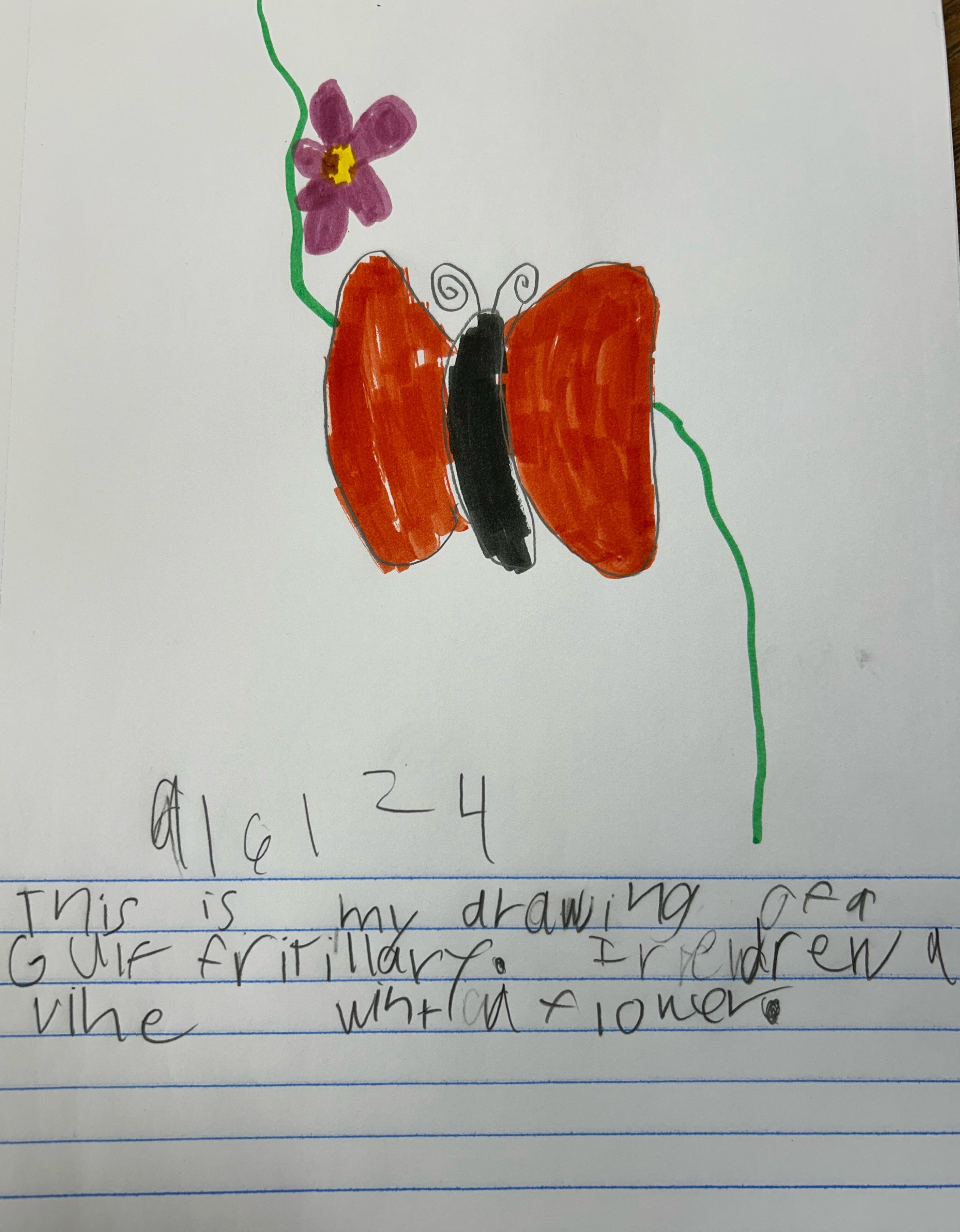
Danielle, 2nd grade, wrote a sentence. “This is my drawing of a Gulf fritillary. I drew a vine with a flower.”
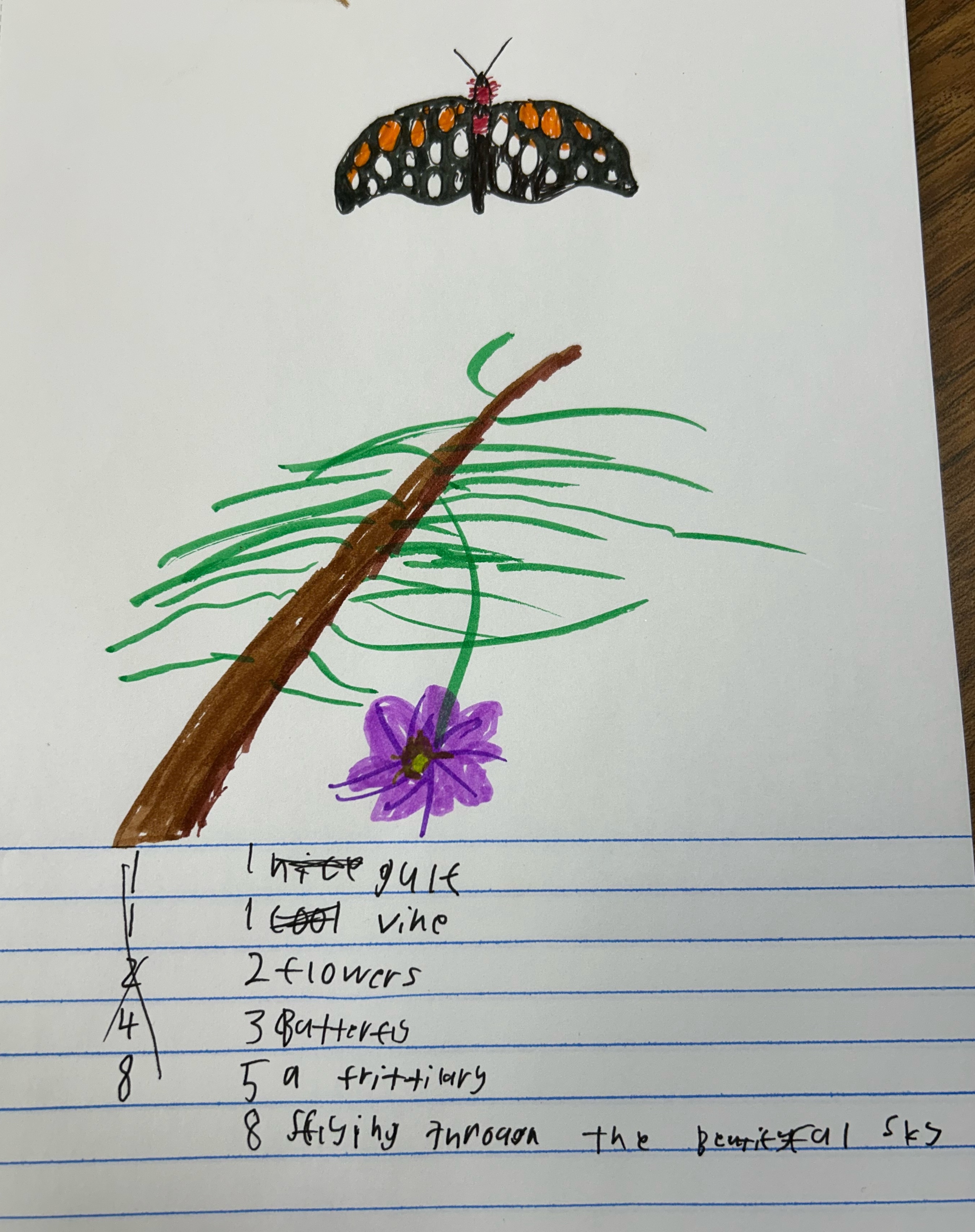
James wrote a fib poem about the butterfly. (We talked about using more specific vocabulary than words like nice and cool.) Gulf vine flowers butterfly a fritillary flying through the beautiful sky
I don’t always have nature at my fingertips to lead inquiry with my classes. This was a wonderful way to introduce the idea that asking questions and wondering are all part of the process of learning. And releasing was just pure Joy!
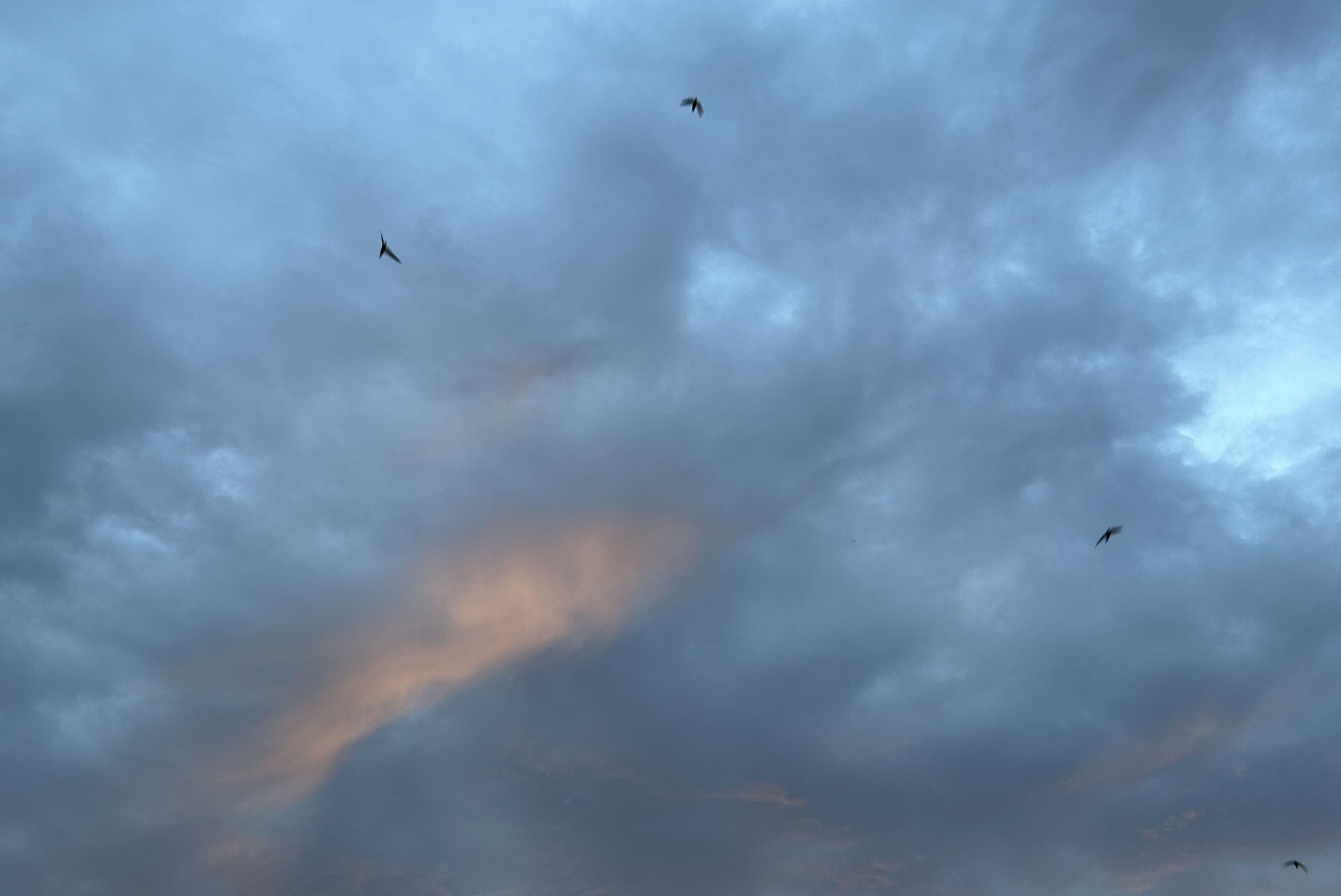
Every evening after dinner, my husband and I take the puppy out for a walk. Last night my gaze was up at the sky watching small birds circle and swoop above us. I opened my Merlin bird identification app and found they were chimney swifts.
The sun was setting and coloring the clouds a deep purple and pink. After a few attempts, I captured some of these “swift” birds against the canvas of the sky.
Write a small poem today inspired by this photo. Please share it with us in the comments and respond to other writers. Thanks for being here.
A Swift Fib
Small swifts circle purple sky speckling the evening with dazzling twittering delight @Margaret Simon, draft
A fib poem has a syllable count that follows the Fibonacci series (1,1,2,3,5,8…)
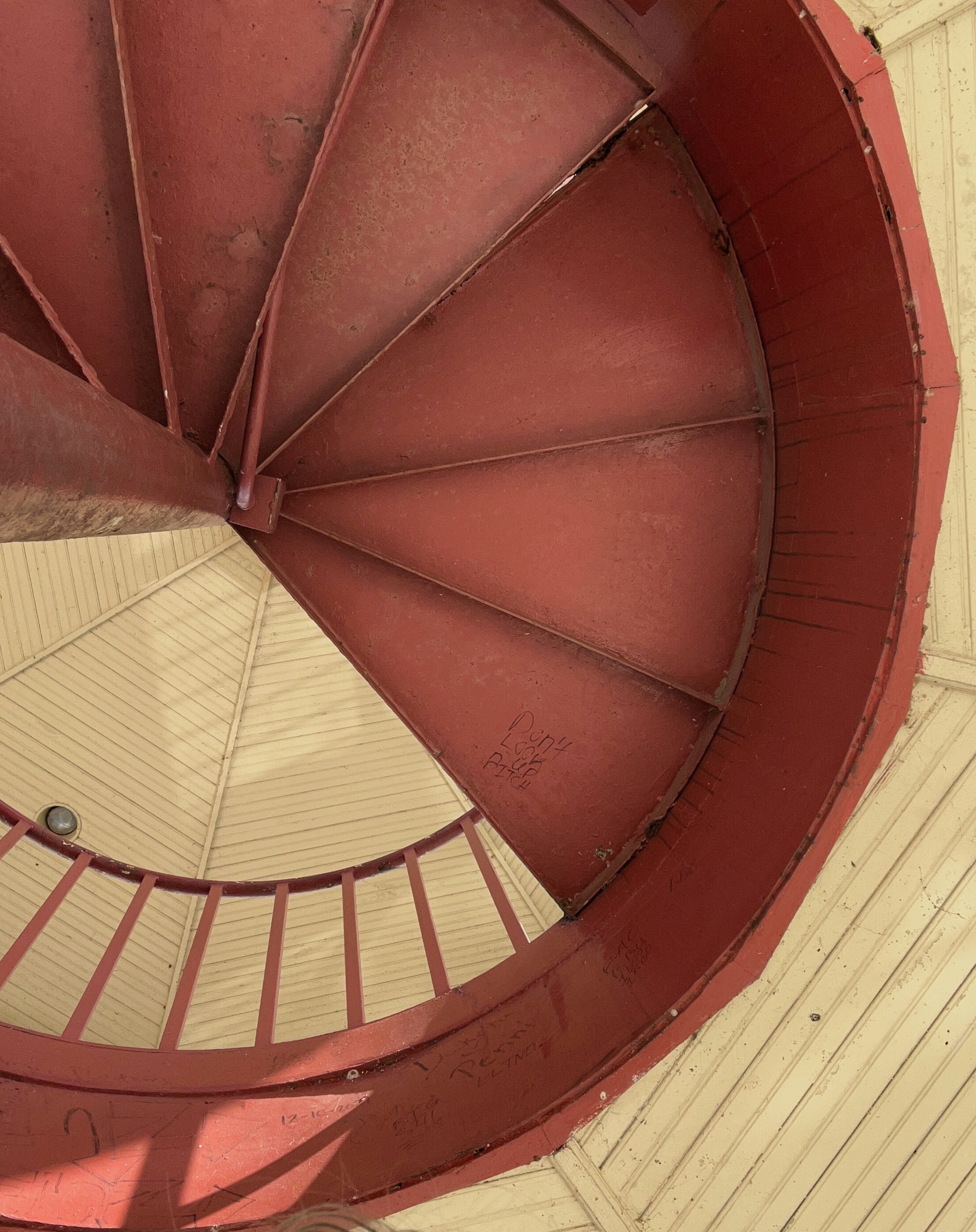
My grandson Thomas “Tuffy” (age 4.5) is visiting. I took him to get ice cream at a shopping center near the bayou. There is a gazebo that has a bayou lookout up a small metal spiral staircase. I was worried about going up and coming down, but Tuffy and I did it. Tuffy did it over and over, coming carefully down by sitting on each stair.
Photo by Thomas
I had my phone out to take pictures. When I gave it to him, he knew exactly what to do. Some of the shots were selfies of his face in different expressions. But one of them missed his head altogether and became an intriguing photo of the spiral stair. This made me think of the Fibonacci sequence (1, 1, 2, 3, 5, 8, 13…) that mathematically makes a spiral. Today I am echoing Langston Hughes’ line “Life is no crystal stair.”
Life can be a spiral stair anchored gracefully to solid ground–imagining a future full of open sky, pathway to purpose. Margaret Simon, draft
Please respond with your own small poem. You can use the Fib form if you choose. Leave encouraging comments to other writers.
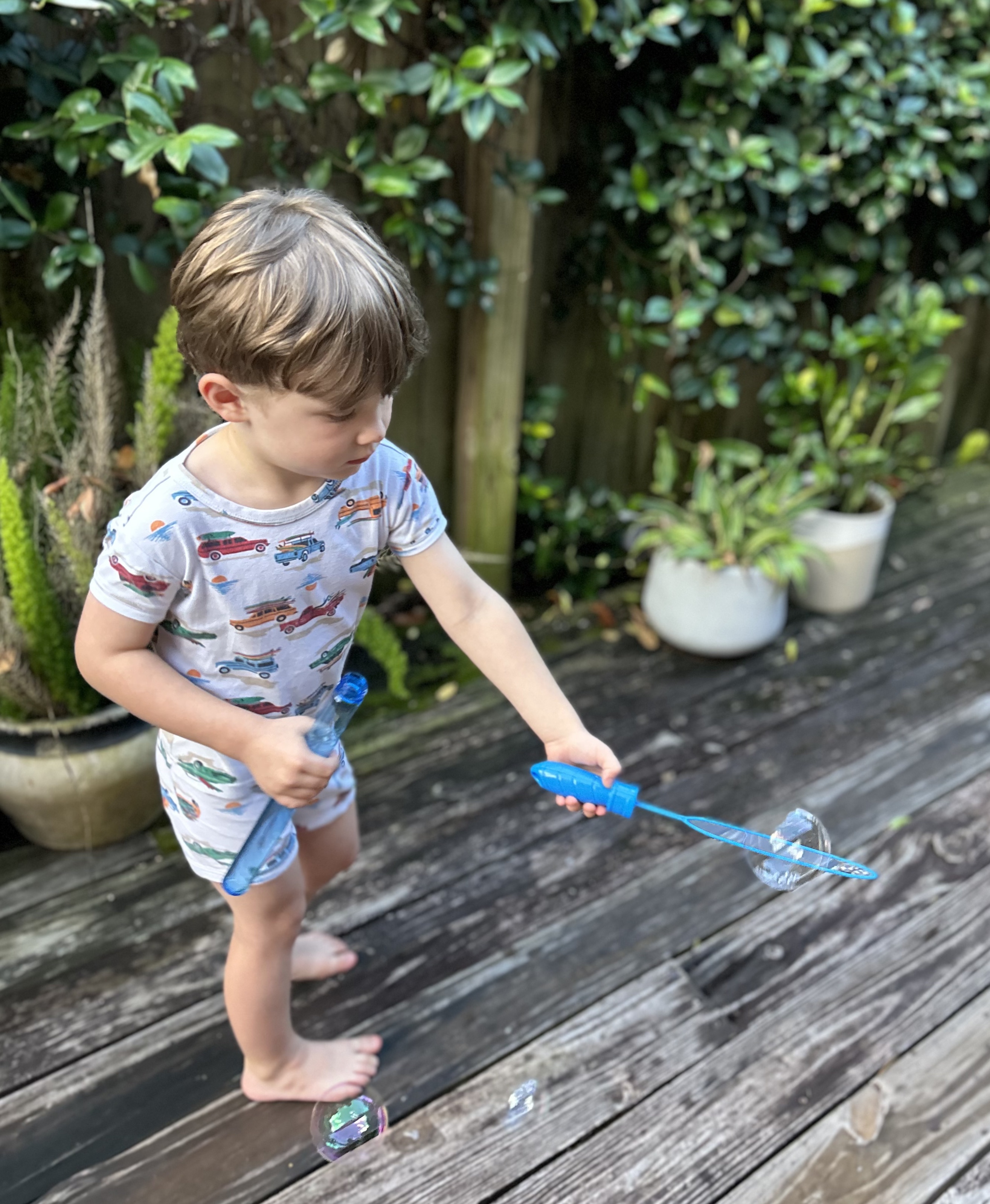
This morning I am waking up with Thomas. His mother is on a work trip, so I am being Mamére. Thomas is fascinated by bubbles. He has a bubble blower and a collection of bubble wands. Early in the morning, this is his outside play time in between bites of cereal.
I wrote 3 poems for Two Truths and a Fib, an anthology by Bridget Magee. In that book, I have a bubble metaphor poem, acrostic, and Fibonacci poem. Since another fascination of Thomas’s is numbers, I decided to write another Fib poem. The syllable count follows the sequence, 1, 1, 2, 3, 5, 8 (and so on, if you choose).
Bubbles
Trapped Air circles in the wind caught in a rainbow– A fascinating wonderland.
Margaret Simon, draft
I invite you to write a small poem today. Please respond to other writers with kind encouragement. Thanks for stopping by.
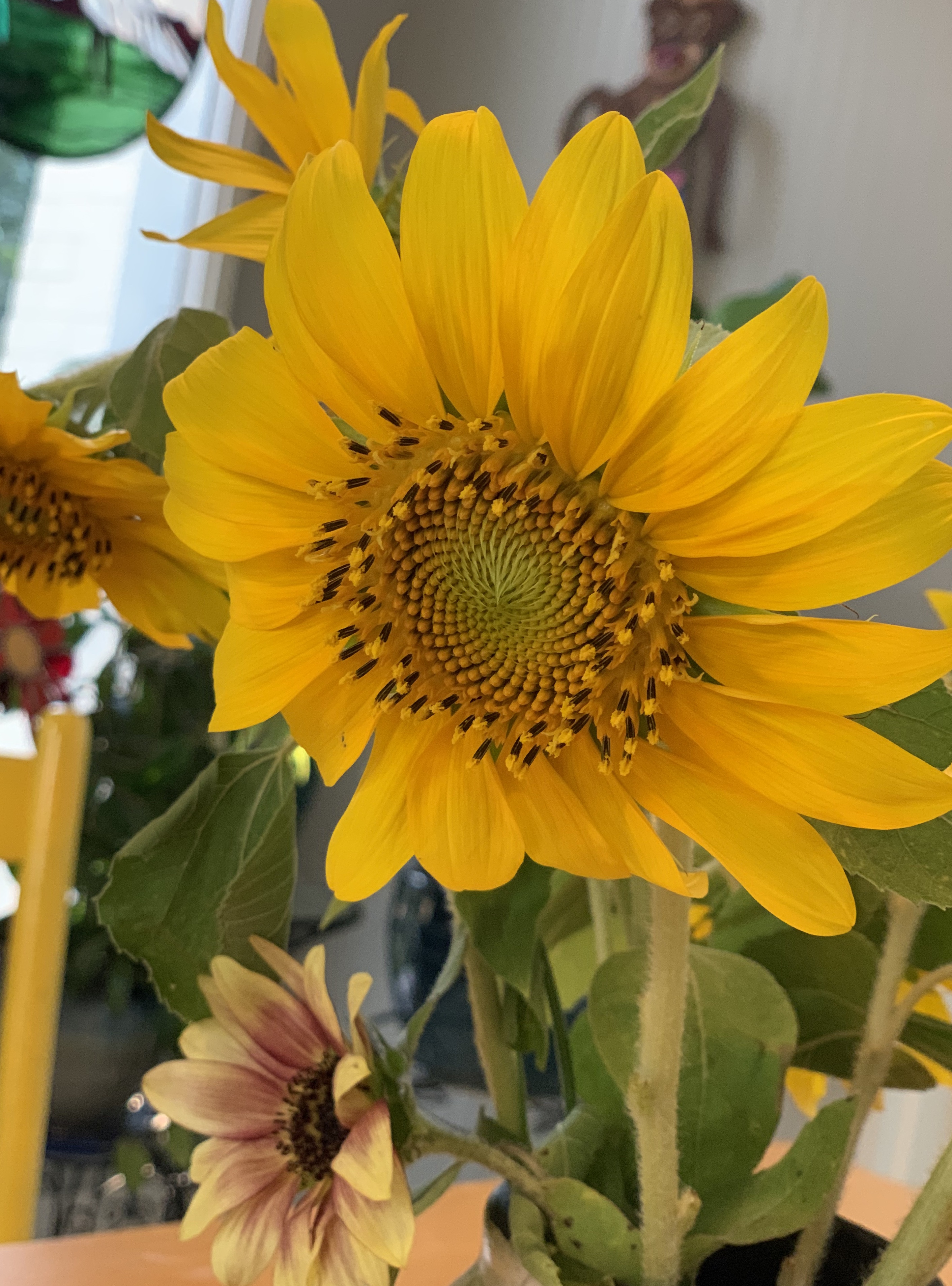
On Memorial Day, I visited a sunflower farm out in the country with my family. I brought a bucket load home and made 5 vases full. It was fun to give them away to neighbors. I kept this large one for myself. It made its happy face known in my kitchen. Since the sunflower seed head is a fibonacci sequence, I decided to write a fib poem. A fib poem is 20 syllables as each line follows the sequence, 1, 1, 2, 3, 5, 8.
Face it! I glow yellowbright on tables, in fields– Happiness grows if you let it.
Margaret Simon, draft
Please leave your own poem in the comments and encourage other writers with responses. Happy Summer!
Today I am juggling many hats. First, I am hosting the blog roundup for Poetry Friday. If you participate, the link up will be at the end of this post. 2. I have the next line for the annual Kidlit Progressive Poem (gentle hand-off from Donna who is wearing many hats of her own lately). 3. It’s the first Friday of the month which means a challenge from an Inkling (our writing group’s cute nickname).
The Kidlit Progressive Poem is the dream-child of Irene Latham. I am carrying the torch these days which means I round up all the volunteer writers and send them a reminder if they forget. Not a terrible job, really. So far, it all seems to come together in an amazing poem by the end of the month. You can follow the progression by clicking on the links on the side bar. Six days of April means six lines. I feel like I’m cheating because the line came to me immediately. Repetition is good in a poem and so are similes. Here is the poem with my line added in italics.
Suddenly everything fell into place like raindrops hitting soil and sinking in.
When morning first poked me, I’d wished it away my mind in the mist, muddled, confused.
Was this a dream, or reality, rousing my response? The sun surged, urging me to join in its rising,
Rising like a crystal ball reflecting on morning dew.
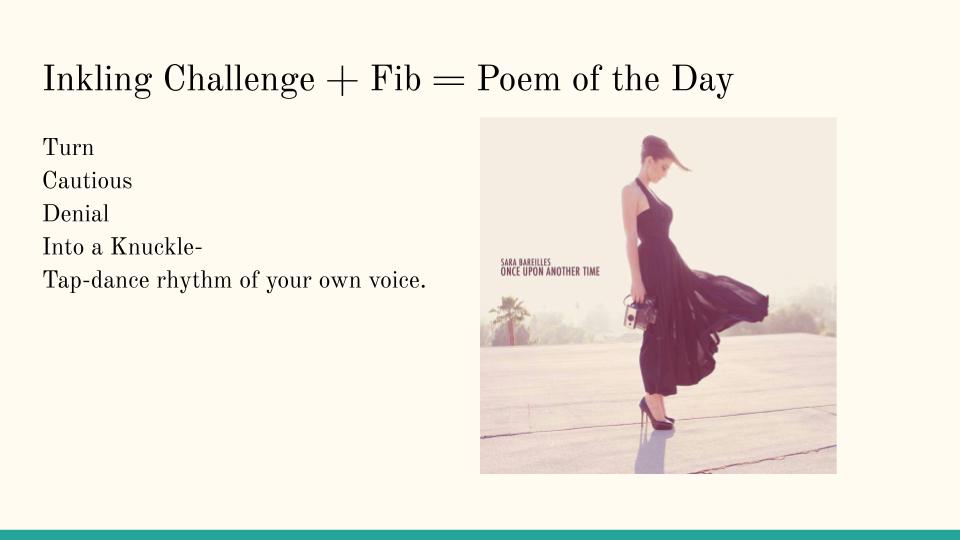
The Inkling challenge this month comes from Mary Lee Hahn. She decided to choose random words as a prompt for a poem. The words were knuckle, denial, turn, cautious.
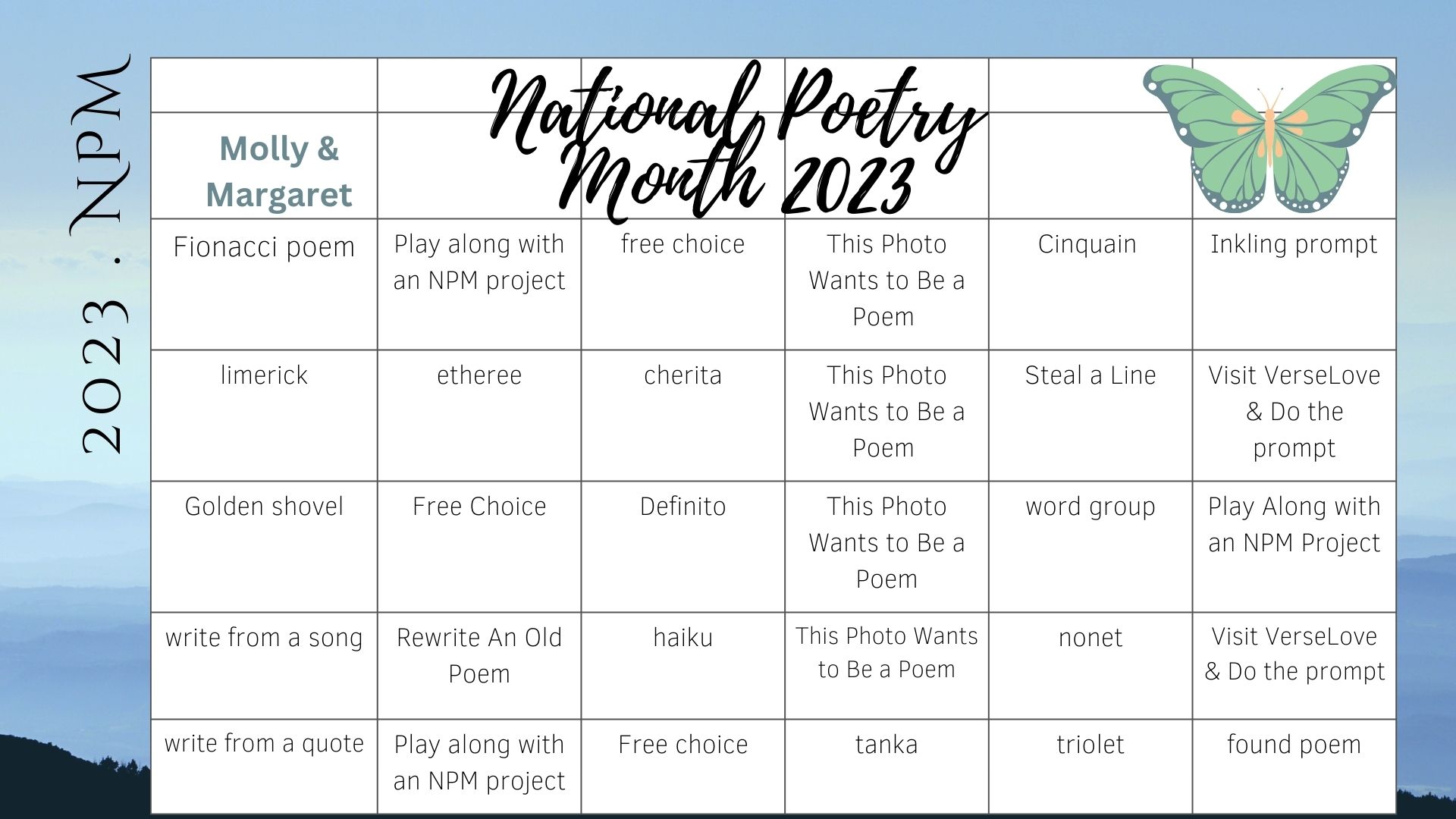
Molly Hogan, fellow Inkling, and I are using a calendar grid for National Poetry Month. Here’s a copy of our calendar which you are welcome to use if you need ideas. I chose to write a Fib poem, a form that uses the Fibonacci Series for syllable counts: 1, 1, 2, 3, 5, 8. (I just realized I didn’t repeat the one syllable line. Fudge it. Too late to revise now.)
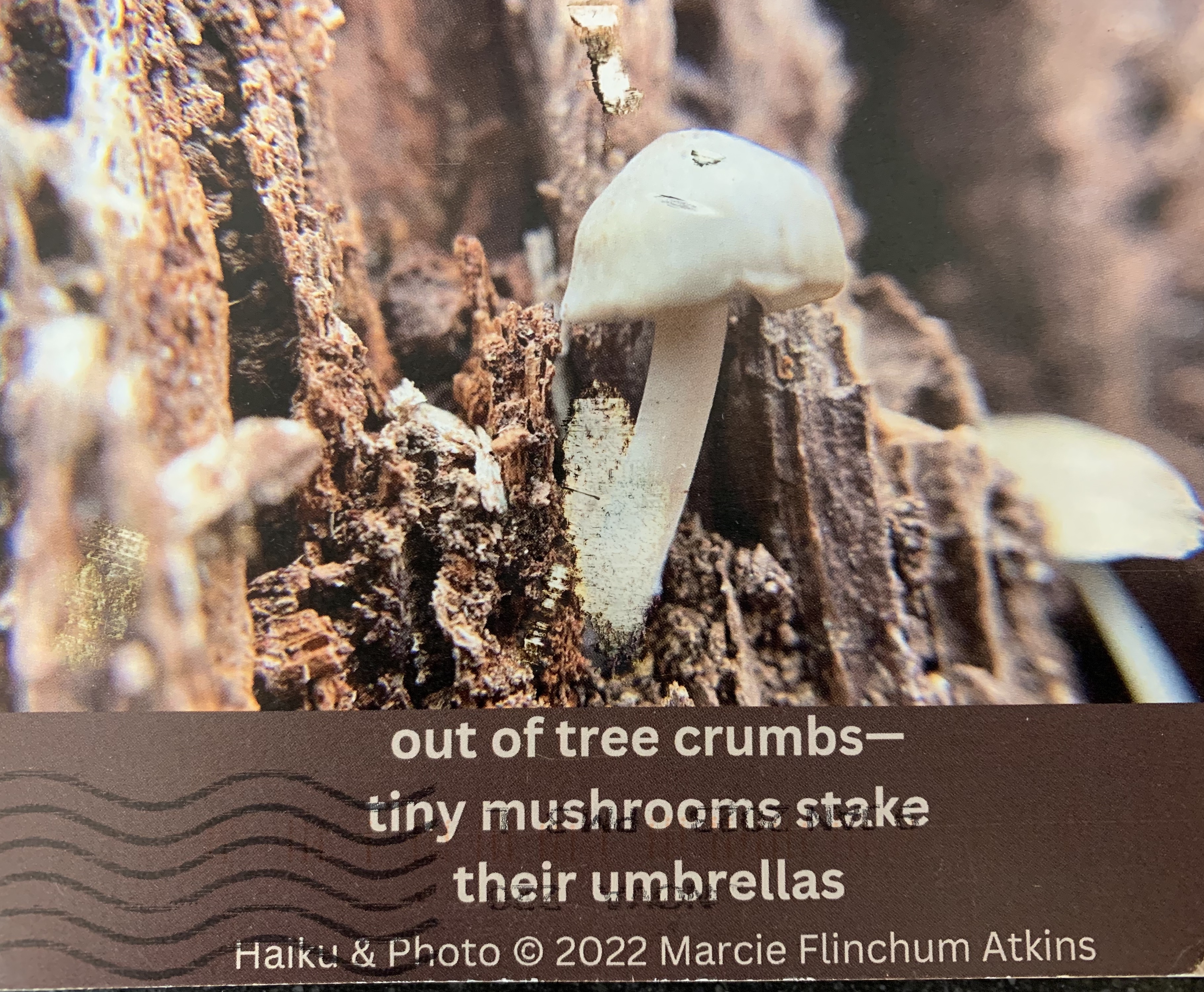
Poetry Friday is hosted today by my new poet-friend, Marcie. She is a master at haiku and sends me a beautiful photo with haiku card each month. Here is the latest one:
out of tree crumbs– tiny mushrooms stake their umbrellas haiku and photo by Marcie Flinchum Atkins
I was inspired to write about Bubbles because my grandkids love to play with bubbles. Aren’t they fascinating? Kim Douillard granted permission for this photo to be included in the book. She takes photos on the beaches of San Diego, California. There is a bubble person who creates amazing bubbles on the beach. I love how she captures the wonder of a huge bubble in her photos.
Photo by Kim Douillard
I want to share my Fib poem. The Fib poem form was created by Greg Pincus using the Fibonacci series for syllable count: 1. 1, 2, 3, 5, 8,…
Blow Big Sturdy Flexible Shape-shifting whispers Large enough for you to ride on.
(c) Margaret Simon, 2023
Consider ordering a copy of this book full of fun poem forms and fibs: Click here.
Poetry Friday round-up is with Carol at Beyond Literacy Link.
I’ve challenged my students to write a list poem this week. Before Friday was even here, Madison had taken the bait and wrote a list about the famous Fibonacci series. Madison has an unique style of writing poetry. She capitalizes all the words. I once asked her why she did that, and she told me because they are all important. Who can argue with that!?
Fib-List Poetry
Never-ending
Always Twirling
Since the Very Beginning
It has been Swirling
Green Points
A Real Place to Pinpoint
It will Not Disappoint
At the Right Viewpoint
A Fibonacci
Unlike the Nazi
Madison, 5th grade
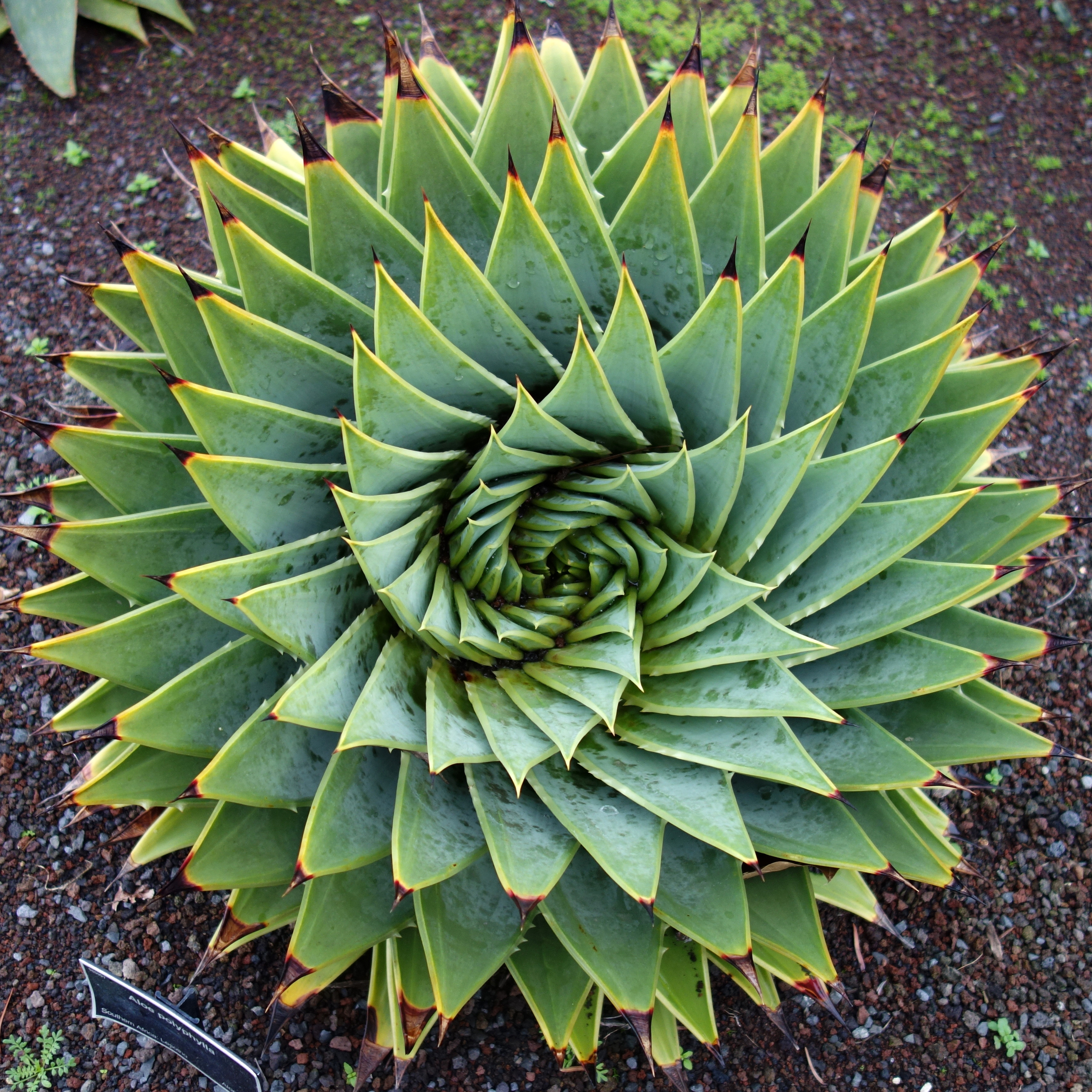
Phyllotaxis plant spiral, goodfreephotos.com
My friend Kay continues to use Bayou Song to inspire poetry with her gifted 4th and 5th graders. Last week they wrote I am poems. This week they wrote tercets. I love Karter’s use of B words to express the beauty of birdsong.
Birdsongs by Karter
Birds are like singing angels Busting through sadness Belting out melodies.
Pop on over to Linda Mitchell’s post full of poetry love from the National Book Festival last weekend. Her post helps me remember with joy and celebration!
Poetry Friday round-up is with Rebecca at Sloth Reads.
As school winds down, I keep teaching. I haven’t pulled out a movie yet. I haven’t started packing (not significantly, anyway). I want to savor every moment with my kiddos and want them to enjoy every moment left with me.
On Wednesday, we held our annual Gifted by Nature Day when all the gifted kids in the parish elementary schools gather in City Park for a day of nature, learning, and play. This year our theme focused on fractals. Do you know what a fractal is? Here’s a collage of fractals in nature:
Fractals in Nature
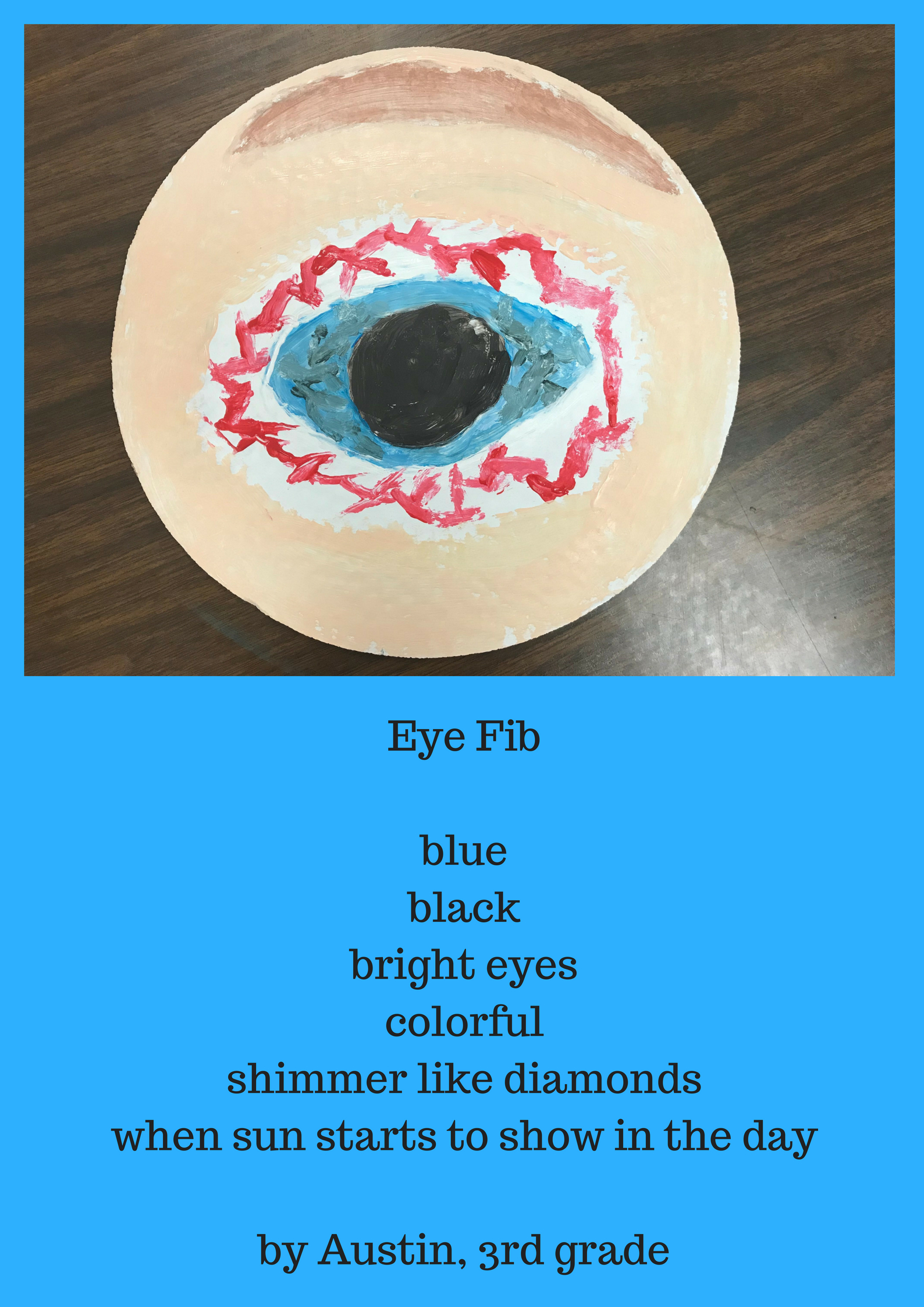
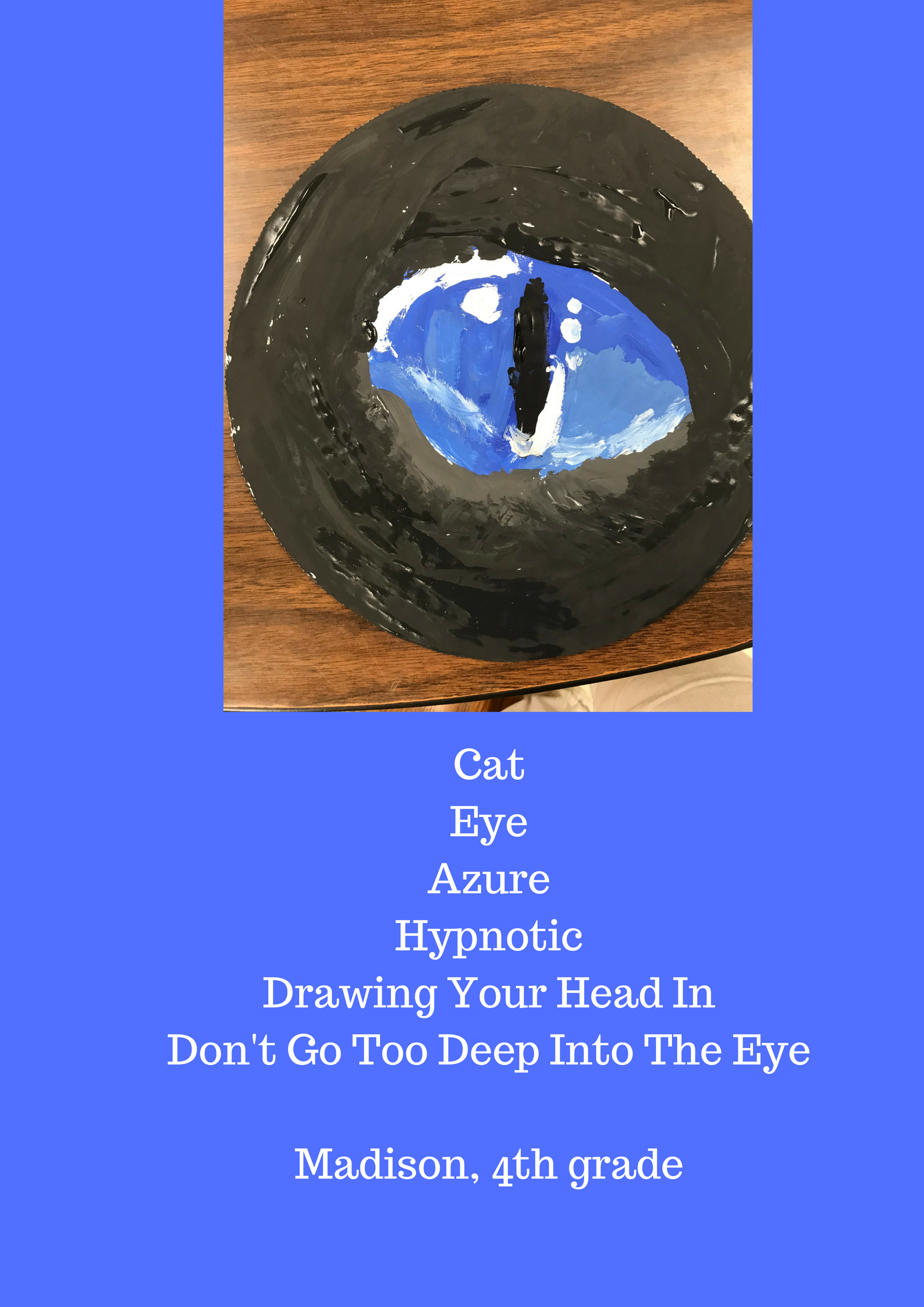
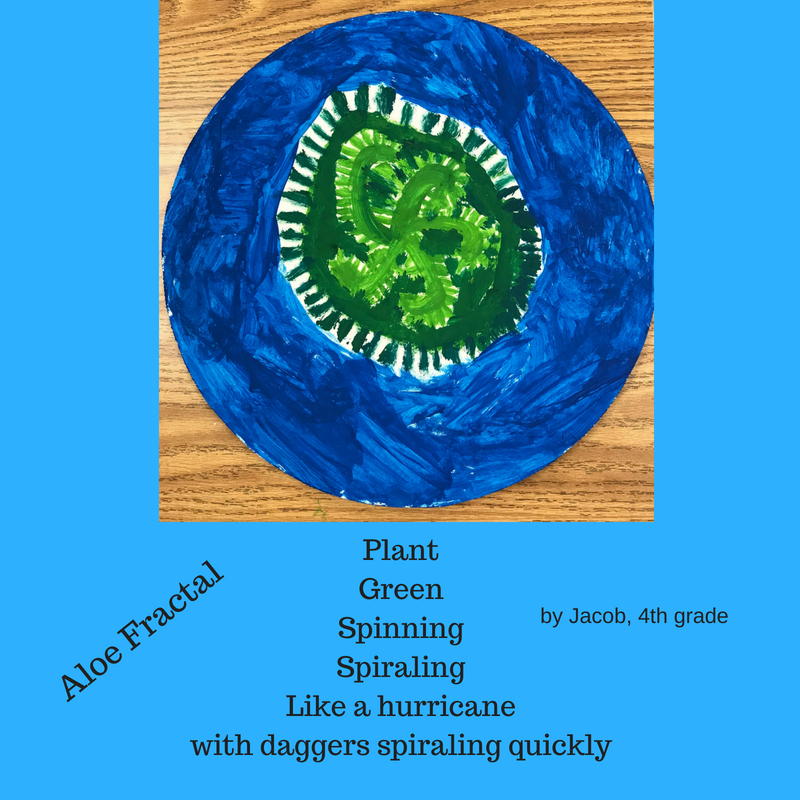
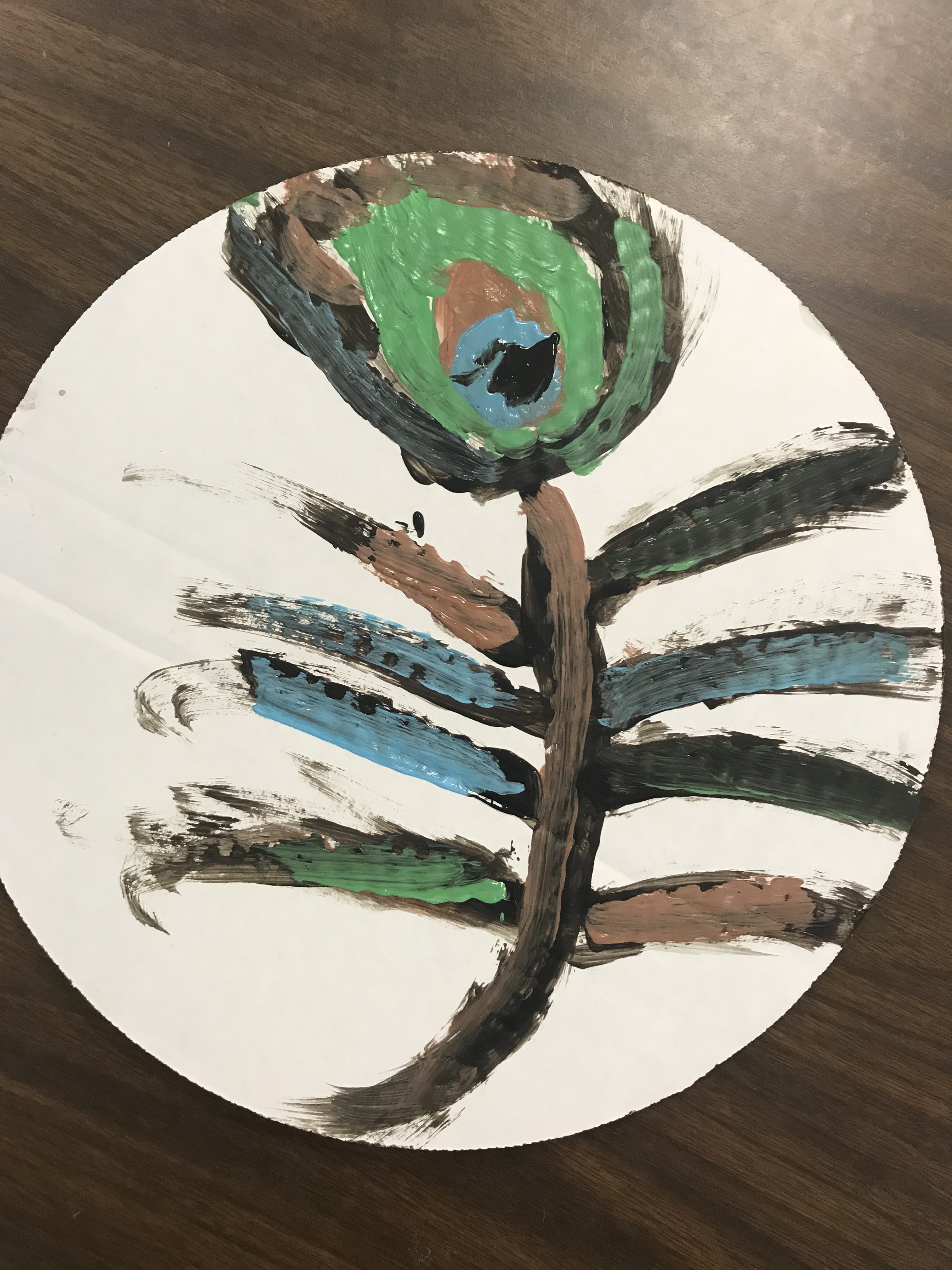
To follow up on the learning from our day in the park, I reviewed fractals and provided art supplies for students to paint a chosen fractal from nature. Did you know that the Fibonacci series is a fractal? Of course, we had to write fib poems. I used this post by Catherine Flynn as a model text. I wrote a model fib poem based on a fractal in nature. Then sent them out to create. Here’s a gallery of art and poems.
Lightning
by Jasmine, 6th grade
Boom Clap The sound Lightning makes Spreading through the sky Sharing its color with the world Fascinating us with its beauty, but deadliness
Peacock Feather by Lynzee
Fib Bird Feather Natural Beautifully swirls Fractal stares from a peacock’s wing
Margaret Simon lives on the Bayou Teche in New Iberia, Louisiana. She is a retired elementary gifted teacher who writes poetry and children's books. Welcome to a space of peace, poetry, and personal reflection. Walk in kindness.





 Reflections on the Teche